
In this article
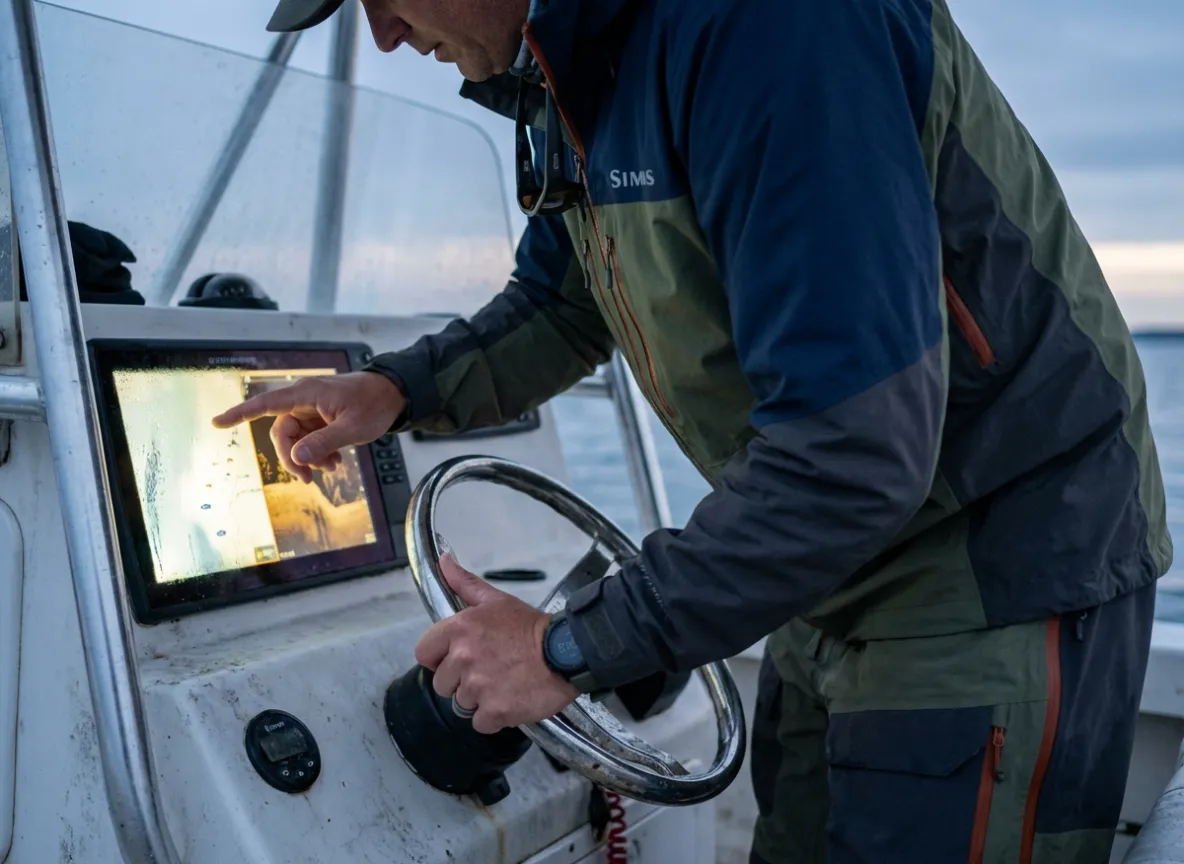
You drop the trolling motor and the marine electronics light up, painting a scrolling mess of yellow blobs, blue fuzz, and jagged lines. Most anglers stare at this expensive fish finder screen and see only green noise, hoping a distinct fish icon appears to tell them where to cast. But relying on Fish-ID software is a mistake.
True competence begins when you stop looking for cartoons and start interpreting the raw physics of sound. You need to transform that abstract digital scroll into a precise mental map of the structurescan beneath your hull. This is the core of visual interpretation.
This isn’t about buying a better GPS combo unit; it’s about understanding the sport fishing technology you have. We are going to break down the physics of the sonar cone, translate color palettes into density, and decode the biological signatures that separate a trophy Bass from a school of Shad. By the end, you won’t just see pixels; you’ll see the water.
How Does Sonar Actually See Underwater?
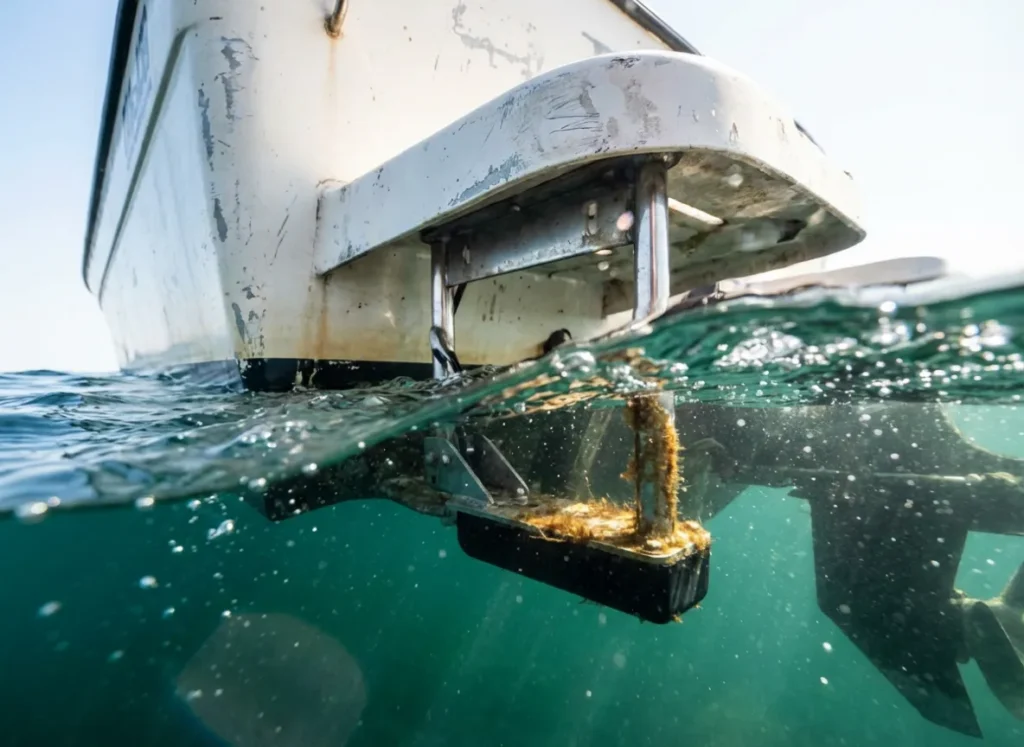
This section demystifies the fundamental mechanics of the device, shifting your perspective from “viewing a camera” to “analyzing a data graph.”
Why Does the Scroll Move from Right to Left?
The screen is not a live video feed; it is a historical timeline of acoustic returns. The far-right edge of the screen represents “Now”—what is currently directly under your transducer. Everything to the left of that leading edge is history view, representing water you have already passed over or fish that have already swum through the beam.
To read the sonar screen effectively, you must constantly correlate the boat speed with the scroll speed. A stationary boat produces a flat, continuous line because the history creates a streak of the same object being detected over and over.
Interpreting the “Time Delay” is crucial for precise positioning. If a fish arch appears in the middle of the screen, it is already 10 to 20 seconds behind you. The ping speed determines the refresh rate of this history. Higher ping speeds in shallow water create a more detailed history, while lower speeds are necessary in deep water to allow the signal to return.
Recognizing that the vertical axis is distance (depth) while the horizontal axis is strictly time—known as right-to-left scrolling—is the first step to mastering essential fishing terms and jargon.
Pro-Tip: If you are vertically jigging and see a flat line appearing across the screen, that is your lure. If the line moves up and down in real-time as you lift your rod, you have verified your sonar is reading “Now.”
For a detailed analysis of the physics of acoustic returns, refer to the principles of multibeam sonar operation by the University of Connecticut.
What is the Sonar Cone and Why Does Depth Matter?
The transducer emits sound in a cone shape, expanding as it travels deeper, similar to a flashlight beam in a dark room. In shallow water, such as 10 feet, a standard 20-degree transducer beam covers a circle on the bottom only about 3.5 feet wide.
This “Straw Effect” means you are viewing a tiny fraction of the water column. A fish could be five feet from your lure and remain invisible on the screen. Conversely, in deep water (e.g., 50 feet), the sonar cone expands significantly (approx. 17 feet wide). This covers more area but reduces signal concentration.

This geometry is a critical factor when choosing the right kayak fish finder, as kayak anglers often frequent shallower waters where cone width is limited.
Different frequencies alter this view. High frequencies like 200kHz or 455kHz provide a narrow, detailed cone, while lower frequencies like 83kHz offer a wider search area but less target separation.
Calculating the “Dead Zone” is critical on sloped drop-offs. Where the cone hits the high side of a slope, it draws the bottom line. This effectively hides any fish positioned deeper in the cone on the low side of the slope. You must mentally visualize this 3D volume to understand why you might catch fish that never appeared on the display. Academic research on acoustic target strength analysis further explains how beam geometry interacts with biological targets.
Why Do Fish Appear as Arches Instead of Fish Shapes?
The fish arch is a hyperbolic representation of distance changing over time as a moving target passes through the cone. As a fish enters the edge of the cone, it is farther away from the transducer, creating the downward-sloping “tail” on the left of the arch.
As the fish passes through the center of the cone (the shortest distance to the transducer), the return is drawn at its shallowest point, creating the peak. As the fish exits the cone, the distance increases again, drawing the second downward slope.
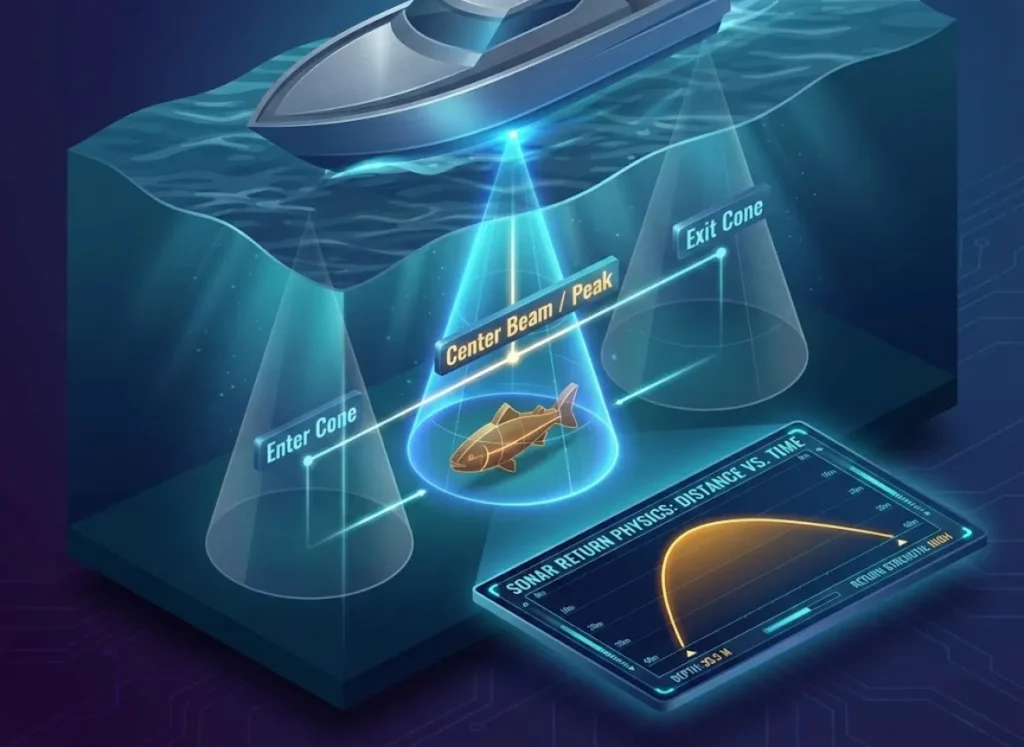
A perfect arch indicates the fish passed directly through the center of the beam. A “half-arch” or “streak” indicates the fish merely grazed the outer edge. The arch thickness indicates the return strength—often the size of the swim bladder—not necessarily the length of the fish.
Disabling Fish-ID (cartoon icons) is essential. Algorithms often misinterpret air bubbles, prop wash, or surface clutter as fish. Learning the arch ensures you are seeing raw data, which is vital when employing a complete summer fishing system where fish often suspend deep and appear as distinct fish arches. For technical details on how 2D sonar resolves these shapes, refer to this guide on fisheries acoustics and target separation.
How Do Color Palettes Indicate Bottom Hardness and Density?
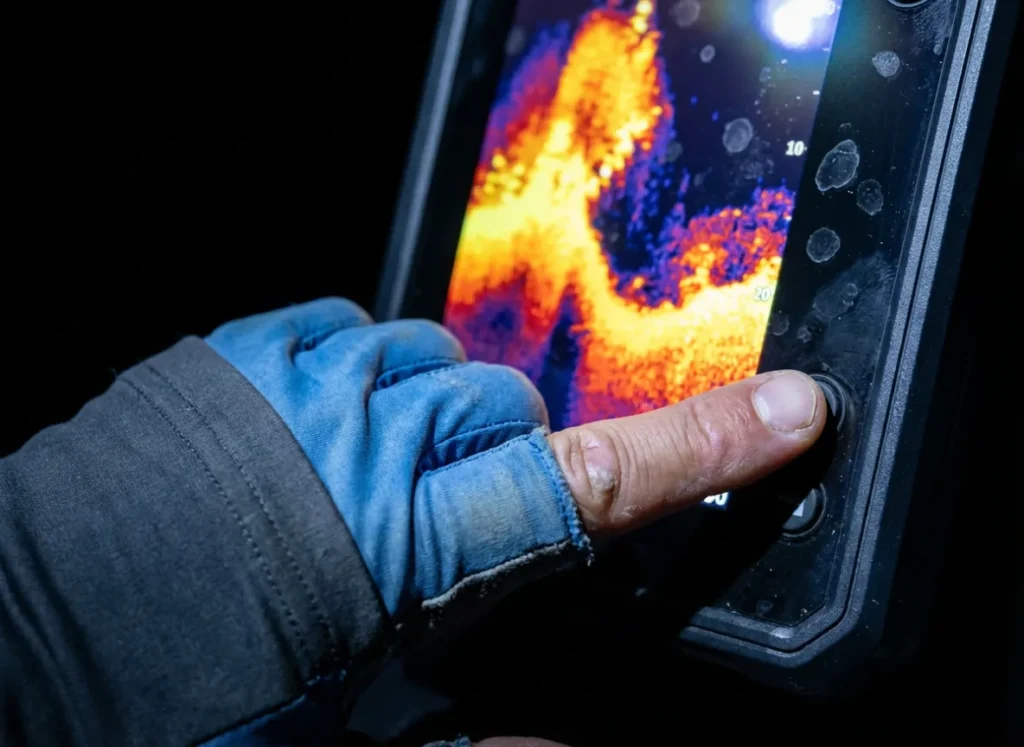
This section teaches you to interpret the “heat map” of the sonar return, translating color intensity into geological composition.
What Do the Different Colors Represent on a 2D Sonar?
Color palettes represent the density of the object and the strength of the acoustic return. In standard settings (like Yellow/Red/Blue), a red return or yellow return represents the strongest signal (dense objects). This indicates hard bottom, rock, or the center of a large fish.
A blue return or green return represents weak signals (low density), indicating soft mud, aquatic vegetation, or the outer edges of the sonar cone. A “White Line” or clear separation often separates the bottom from the water column, aiding in instant depth reading and visual interpretation.
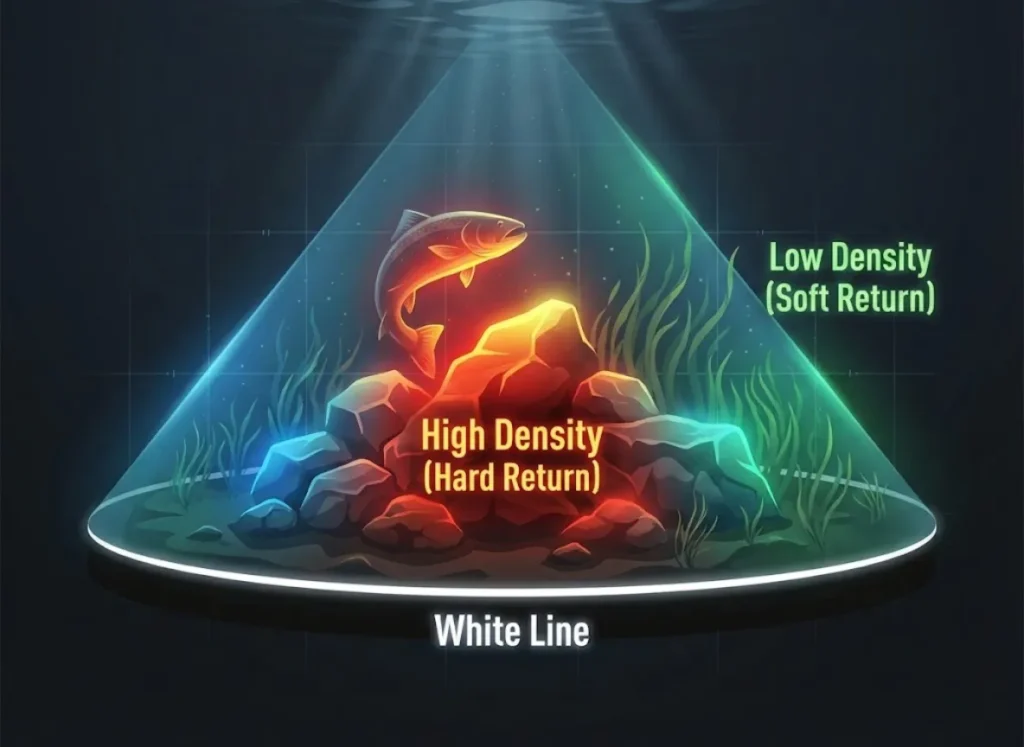
Choosing the right palette is a strategic decision. Some palettes contrast brown bottoms with red fish to prevent targets from blending in. High-contrast palettes reduce eye fatigue and make “weak” returns like baitfish clouds more visible against the dark background. You can see how professionals categorize these bottom composition types in Wisconsin DNR lake mapping data.
Understanding the “gain” or “sensitivity” setting allows you to adjust how much of the hard return is displayed. This prevents the screen from becoming a solid block of color. This capability is essential when you are trying to score the perfect fishing spot by identifying specific bottom hardness.
How Can You Distinguish a Hard Bottom from a Muddy Bottom?
A hard bottom (rock, gravel, compacted sand) reflects the signal strongly. This creates a thick line, a bold band of high-intensity color, such as bright yellow with a thick red tail.
A soft bottom (silt, mud, muck) absorbs the acoustic energy. This results in a thin line that may appear blue or green with very little red. Transition zones where the line changes from thin/blue to thick/yellow are “Goldilocks zones” for fish, as they often patrol these geological edges.
The second echo or double bottom phenomenon occurs when the signal bounces off a hard bottom, hits the surface, bounces back to the bottom, and returns again. This creates a “ghost” bottom at twice the depth. The presence of a double bottom is the most reliable indicator of hard substrate; mud rarely reflects enough energy to create a second return.
This skill is foundational for walleye fishing 101, as Walleye strongly favor these hard substrates. For a biological perspective on substrate types, review this Vermont DEC aquatic habitat assessment.
How Do You Distinguish Between Baitfish, Predators, and Vegetation?
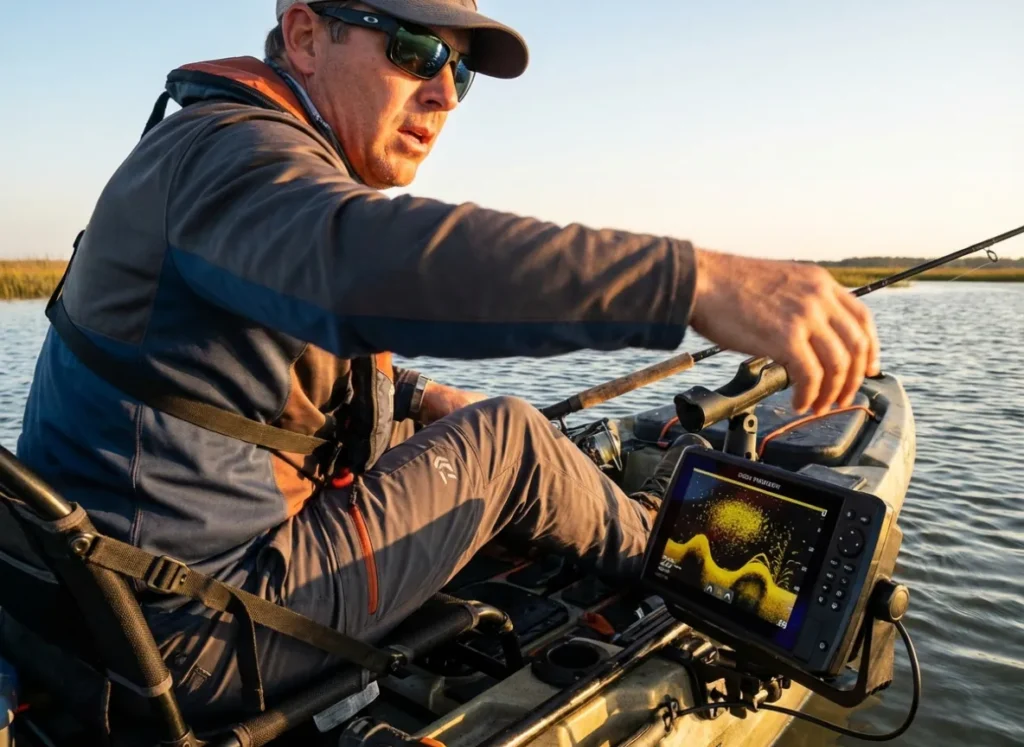
This section acts as your “Field Guide,” teaching you to identify biological signatures based on formation and behavior patterns.
What Do Bait Balls and Schooling Fish Look Like?
Baitfish rarely appear as individual arches. Instead, they form “cloud return,” “blobs,” or “amorphous shapes” suspended in the water column. A bait ball appears as a dense, tightly packed sphere or oval of high-intensity color surrounded by a softer halo.
“Grains of Rice” or “static” returns indicate scattered bait or plankton that are not currently under threat. The position of the bait ball is a key indicator. Balls pushed tight against the surface or the bottom often signal active predation by game fish. This visual identification is a core component of the shad spawn playbook.
The shape of the cloud tells the story of the hunt. A “splintered” or “streaked” bait ball suggests a predator is slashing through it. It is also vital to differentiate a thermocline from a bait layer. A thermocline appears as a continuous horizontal band of haze stretching across the entire screen, whereas fish schools are distinct, isolated masses. You can see practical examples of this in identifying fish species via sonar by Michigan Out-of-Doors.
How Do Predator Species Like Bass and Walleye Appear?
Bass typically appear as thick, robust fish arches that relate strongly to cover like submerged timber or weed lines. They are often suspended slightly off the bottom or hovering near a drop-off.
Walleye often relate “belly-to-bottom.” They appear as bumps or flattened humps that merge with the bottom contour line, looking like “stationary objects” that move.
Crappie display a distinct vertical “stacking” behavior. They resemble a Christmas tree formation or “grapes on a vine” suspended over brush piles. This formation is the primary signal used when mastering how to catch crappie.
Catfish create massive, thick, snake-like returns with high-intensity cores due to their large heads and swim bladder size, often cruising slowly along the mud.
Pro-Tip: Look for separation. If you see a sliver of blue water between the arch and the bottom line, the fish is active and likely catchable. A fish merged with the bottom is often lethargic.
For more on the habitat structures these species prefer, check out this article on crappie management and habitat structures.
How Do Down Imaging and Side Imaging Change the Perspective?
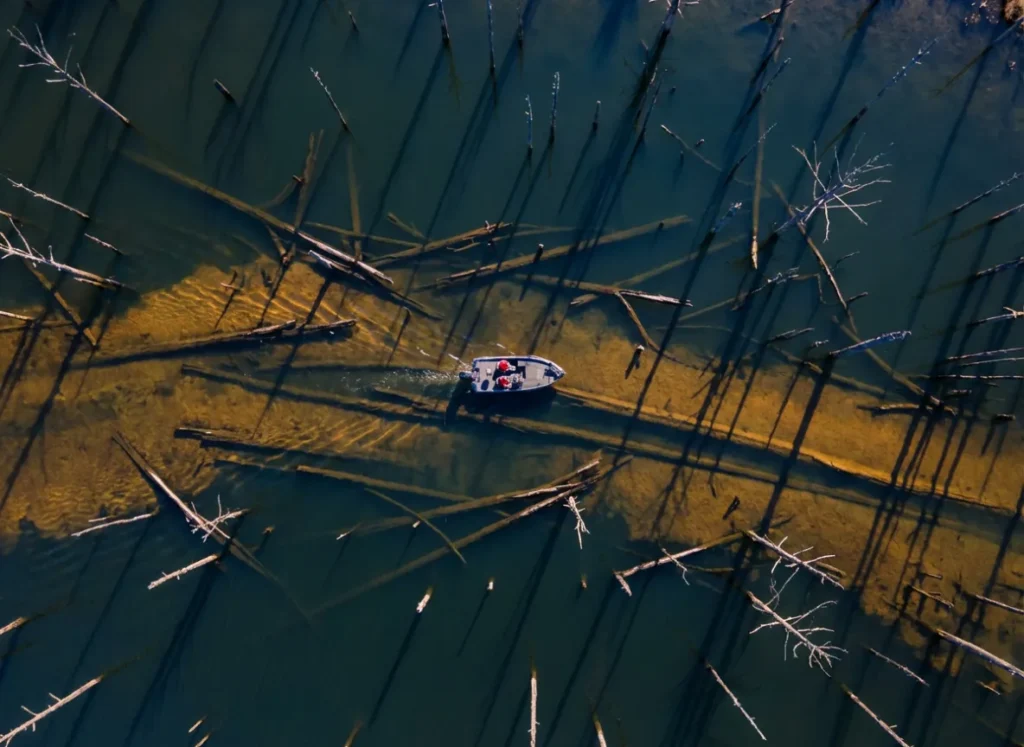
This section explains how high-frequency imaging solves the “blob” problem by providing structural context and acoustic shadows.
What is the Key to Reading Side Imaging Shadows?
Side Imaging (or Side Scan) works by casting a transducer beam sideways. Interpret the image as an aerial photograph or a flashlight shining across a dark floor.
The Shadow Tells the Story. Objects reflect sound (bright white), but they block sound from hitting the bottom behind them. This creates a dark sonar shadow. The length of the shadow directly correlates to the height of the object. A long shadow indicates a tall tree or piling, while a short shadow indicates a low rock.
If a bright dot (fish) has a shadow detached from it, the fish is suspended. The distance between the dot and the shadow reveals how high off the bottom the fish is.
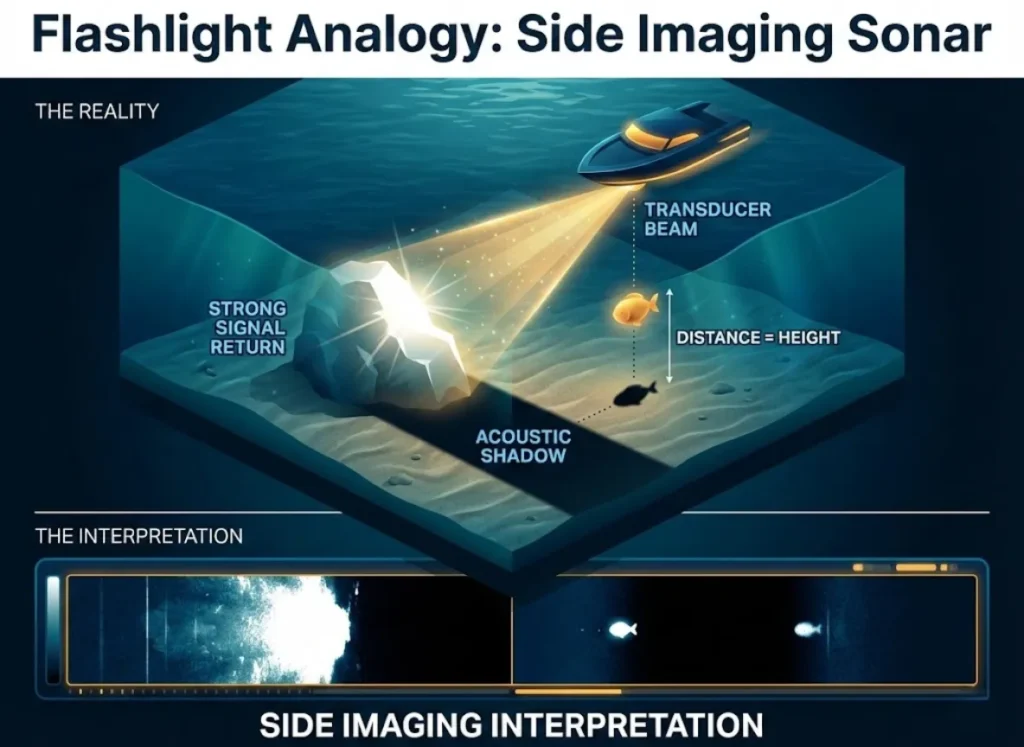
The “water column” is the dark strip down the center of the screen. Beginners often ignore this, but it shows what is directly under the boat in the side-scan view. This technology is indispensable for fishing heavy cover, as it allows you to visualize weed lines and timber that 2D sonar would display as a confused lump. For clear examples of shadow interpretation, refer to interpreting side scan sonar imagery.
While Side Imaging finds the neighborhood, newer tech like Forward Facing Sonar (e.g., LiveScope) puts you in the room with the fish, offering real-time tracking that old down scan units couldn’t dream of.
Final Thoughts
Reading a fish finder effectively requires a shift in mindset. Remember the core principles:
- History is Left: The screen is a timeline; objects on the left are in the past.
- Color is Density: Red/Yellow indicates hard bottom or dense biological mass; Blue is soft or weak.
- Geometry is Depth: The sonar cone determines your field of view; shallow water means a narrow view.
- Shadows are Height: In Side Imaging, the sonar shadow reveals the true shape and position of the target.
Next time you launch, spend the first 20 minutes leaving your rods in the locker. Cruise the contours, adjust your gain, check your depth reading, and practice predicting the bottom composition before you cast.
FAQ – Frequently Asked Questions
How do you tell if it is a fish or structure on a fish finder?
Look for separation and movement. Stationary objects (structure) are usually connected to the bottom and remain static, while fish arches often show a small gap (separation) between their arch and the bottom line, or change position on subsequent passes.
What color is hard bottom on a fish finder?
On standard color palettes, a hard bottom appears as a thick, bright yellow or red return. It often produces a second echo (a second bottom line at twice the depth) due to the strength of the signal reflection.
Why do fish look like arches?
Fish look like arches because the distance between the fish and the transducer changes as the fish passes through the sonar cone. The arch shape is the visual graph of the fish entering (farther), centering (closer), and exiting (farther) the sonar beam.
What is the best frequency for shallow water fishing?
High frequencies (200kHz, 455kHz, or higher) are best for shallow water. They provide a narrower cone with higher detail and target separation, which is crucial when fishing in depths under 20 feet.
Risk Disclaimer: Fishing, boating, and all related outdoor activities involve inherent risks that
can lead to injury. The information provided on Master Fishing Mag is for educational and informational purposes
only. While we strive for accuracy, the information, techniques, and advice on gear and safety are not a substitute
for your own best judgment, local knowledge, and adherence to official regulations. Fishing regulations, including
seasons, size limits, and species restrictions, change frequently and vary by location. Always consult the latest
official regulations from your local fish and wildlife agency before heading out. Proper handling of hooks, knives,
and other sharp equipment is essential for safety. Furthermore, be aware of local fish consumption advisories. By
using this website, you agree that you are solely responsible for your own safety and for complying with all
applicable laws. Any reliance you place on our content is strictly at your own risk. Master Fishing Mag and its
authors will not be held liable for any injury, damage, or loss sustained in connection with the use of the
information herein.
Affiliate Disclosure: We are a participant in the Amazon Services LLC Associates Program, an
affiliate advertising program designed to provide a means for us to earn advertising fees by advertising and linking
to Amazon.com. As an Amazon Associate, we earn from qualifying purchases. We also participate in other affiliate
programs and may receive a commission on products purchased through our links, at no extra cost to you. Additional
terms are found in the terms of service.