In this article
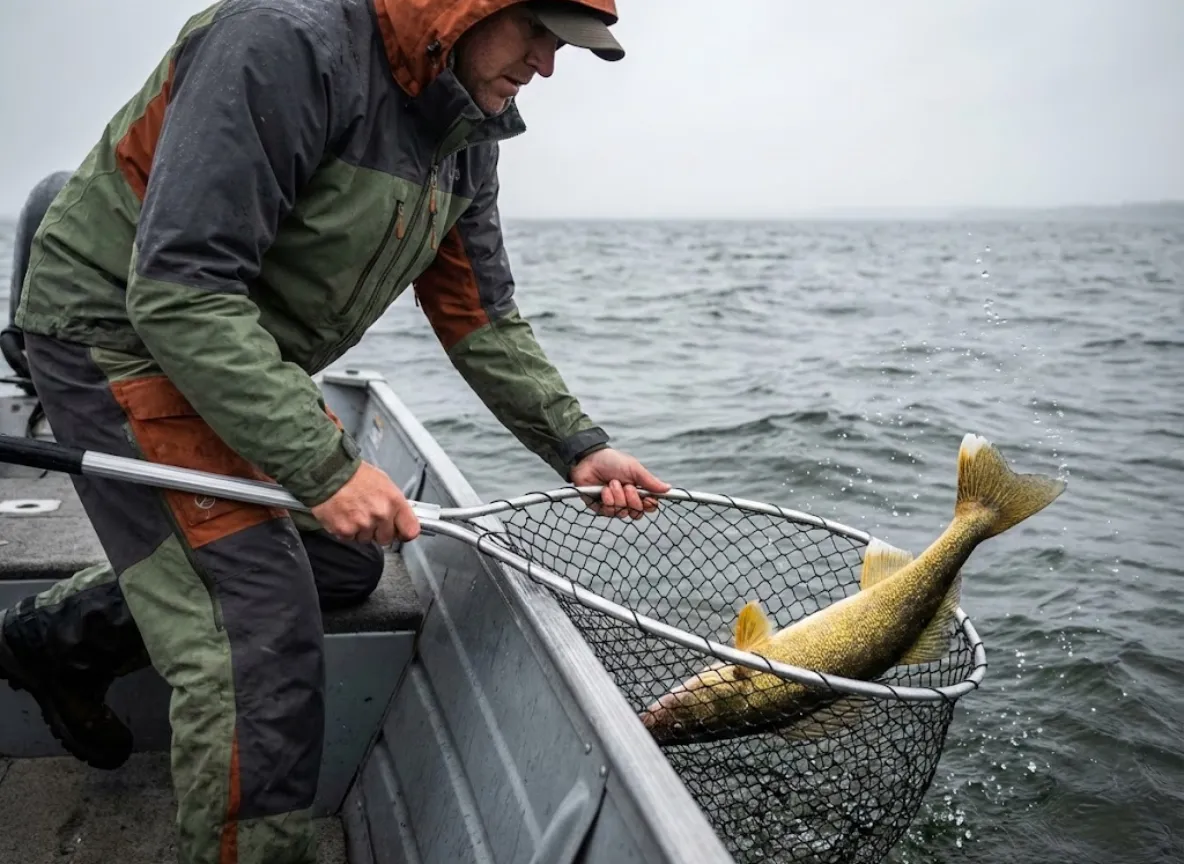
The wind cuts across the bow, turning the lake into a sheet of grey steel. While other boats race back to the comfort of the marina, you are reaching for the net. You stay because you know Sander vitreus—the largest member of the Percidae family—is effectively blind in the high sun but transforms into an apex predator the moment the light fails.
Fishing for walleye isn’t about luck or secret waypoints; it’s about applied physics. Understanding the mechanics of the “glass eye,” the constraints of the air bladder, and the hydrodynamics of the lateral line turns this elusive North American game fish into a predictable target. In my years on the water, from the Missouri River to the Walleye Capital of Lake Erie, I’ve learned that true competence comes from turning theoretical freshwater ichthyology into confident action.
Why Do Walleye Bite Best in Low Light?

Walleyes dominate low-light conditions because their eyes are engineered to recycle photons. This gives them a massive advantage over prey species like yellow perch or gizzard shad when the sun goes down.
How does the Tapetum Lucidum work?
The tapetum lucidum is a layer of reflective pigment sitting immediately behind the retina. This biological mirror creates a “double exposure” effect. Light passes through the retina once, hits the tapetum, and bounces back through the retina a second time. This mechanism functions remarkably like night vision technology, maximizing photon capture in dark environments.
This adaptation gives the fish its signature opaque, cloudy eyes (or wall-like eye appearance) in daylight. However, this advantage comes with a cost. Walleye suffer from photophobia—extreme light sensitivity that causes physical distress in bright, direct sunlight.
This forces adult walleyes to bury themselves in weeds or retreat to deep water during high noon to protect their eyes. This sensitivity is confirmed by research on vertebrate retinal adaptations, which provides the data on why scotopic (low-light) vision dictates their behavior.
This is also why the “Walleye Chop” is so effective. Wind-driven surface turbulence refracts sunlight, creating a “false twilight” underwater that triggers midday feeding binges. While learning how fish see underwater covers the general rules of optics, the yellow walleye has specific adaptations that make it unique.
What colors can walleye actually see?
Walleye possess dichromatic vision, meaning they have cones sensitive to Red/Orange and Green, but they lack Blue-sensitive cones. To a walleye, the blue and violet spectrum likely appears as a dark grey or black silhouette. This biological reality explains why Chartreuse and Orange are historically the most productive colors; they align perfectly with the retina’s peak sensitivity.
Visible color is only part of the equation, however. The walleye lens allows Ultraviolet light to pass through to the retina, a trait humans do not share. According to visual sensitivity studies on walleye, this capability allows them to spot prey in deep water where red light has already been absorbed.
Pro-Tip: In water deeper than 30 feet, standard colors turn grey. Switch to lures with UV-reflective finishes. These finishes create high-contrast visibility for the fish long after visible color has faded.
This sensitivity to light and UV spectrums is closely tied to understanding the science of fishing by the moon, as lunar cycles directly impact the amount of available ambient light at night.
How Do Walleye Find Prey in Dirty Water?
When the water turns to chocolate milk, vision takes a backseat. Whether in the St. Lawrence River or a stained Canadian shield lake, the walleye shifts to its secondary radar system, the lateral line, to track prey through vibration.
What frequencies trigger the Lateral Line system?
The lateral line is a horizontal canal of fluid-filled sensory organs called neuromasts running along the fish’s flank. These hair cells do not hear sound in the traditional sense; they detect particle displacement and pressure gradients. This gives the fish “distant touch,” allowing it to construct a 3D map of its surroundings without visual input.
Walleye are tuned to a specific frequency range, roughly 1 Hz to 200 Hz. This is not a coincidence. This range creates a “Kill Zone” overlap that matches the hydrodynamic tail beat of distressed minnows, ciscoes, or shiners. This is why North Central Regional Aquaculture Center biology reports emphasize the sensory development of these predators.
If you are applying these walleye fishing 101 basics to your next trip, remember that lure engineering matters. In turbid water, “thumping” lures like paddletails or large Colorado blades (which produce low-frequency vibration) will consistently outperform high-pitch rattles (high frequency).
Why is Catch-and-Release from Deep Water Dangerous?
Mastering the strike is useless if the fish doesn’t survive the release. Understanding the internal pressure systems of the walleye is a critical skill for the ethical angler, especially given the popularity of catch-and-release in stocking programs and trophy lakes.
What is a Physoclistous Swim Bladder?
Walleye possess a physoclistous swim bladder. This means it is a “closed” system lacking a pneumatic duct to the esophagus, unlike Trout or Pike which can “burp” air. Gas exchange happens slowly through the blood via a capillary network called the rete mirabile.
When you pull a walleye up from depth quickly, Boyle’s Law takes over. The gas in the air bladder expands as the external pressure decreases. In the “Danger Zone”—depths greater than 30 feet—this expansion becomes critical. It can cause the stomach to evert (protrude from the mouth) and bruise internal organs, a condition known as barotrauma.
Understanding barotrauma in fish helps you recognize the symptoms: bloating, inability to submerge, and equilibrium loss. According to Minnesota DNR barotrauma guidelines, simply releasing a fish suffering from these symptoms often leads to delayed mortality, even if it manages to swim away initially.
Why are Descending Devices better than “Fizzing”?
For decades, anglers used “fizzing”—puncturing the fish with a hypodermic needle to vent gas. While well-intentioned, this method carries high risks of infection and accidental puncture of vital organs.
The modern, ethical standard is the descending device (such as a weighted clamp). These tools use weight to return the fish to depth, where the water pressure naturally recompresses the gas in the bladder. A scientific assessment of descending devices confirms significantly higher survival rates with this method compared to fizzing.
Pro-Tip: If you are ice fishing in deep water, barotrauma is compounded by corneal freezing. Keep the fish in the water as much as possible and use a descending device immediately to get it back to warmer, pressurized water.
Protecting the resource is part of mastering proper catch and release techniques, ensuring the fishery remains viable for the next walleye year-class.
How Can You Tell a Walleye from a Sauger?
Misidentification can lead to hefty fines, as bag limits often differ between species. You need to know exactly what is in your net, specifically distinguishing between the Yellow Pike (a regional nickname for Walleye), the Sauger, and their hybrid, the Saugeye.
What is the “3-Point Check” for identification?
To be absolutely certain, execute this check every time:
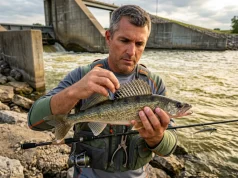
- Point 1: The Tail. Walleye have a distinct white tip on the lower tail fin. Sauger do not.
- Point 2: The Dorsal Fin. Sauger have distinct rows of polka-dots on their spiny dorsal fin. Walleye have dusky darker striations and a single black blotch at the base.
- Point 3: The Cheek. Do the “Rub Test.” Walleye cheeks are smooth and scaleless. Sauger cheeks are rough, covered in cheek scales. Note that the operculum (gill cover) can be sharp on both.
Things get complicated with the Saugeye, a hybrid often stocked in reservoirs. These fish display intermediate traits, often having broken dorsal spots or a faint white tip on the tail. The Ohio Department of Natural Resources identification guide is the gold standard for distinguishing these hybrids.
Always double-check before throwing a fish in the livewell. This habit creates a natural segue into verifying your state fishing regulations to ensure you are compliant with local laws in Ohio, Minnesota, or Ontario.
The Angler’s Takeaway
Success with walleye isn’t about magic; it’s about biology.
- Light is the Lock: High sun means deep or weed-buried fish; low light opens the feeding window.
- Vibration is the Key: In stained water, neglect color and prioritize lures that thump (10-50 Hz range).
- Depth is the Danger: Never target catch-and-release fish deeper than 30 feet without a descending device ready.
- The White Tip Rules: If it has a white tip on the lower tail fin, it’s a Walleye; if it’s rough on the cheek, it’s likely a Sauger.
Next time you hit the water, don’t just cast blindly. Read the light, check the wind, and fish the biology. Share your own low-light success stories in the comments below.
FAQ – Frequently Asked Questions about Walleye
What is the world record walleye weight?
The recognized world record walleye is 25 lbs, caught by Mabry Harper in Tennessee (1960). However, a 22 lb 11 oz catch by Al Nelson in Arkansas (1982) is considered by many anglers to be the modern undisputed benchmark. While trophy fish of this size are rare, female walleye in Southern reservoirs often achieve massive sizes due to longer growing seasons.
How big do they usually get?
While giants exist, the walleye averages 1 to 2 pounds in most waters. Adult walleyes in healthy systems typically measure between 15 and 20 inches. A trophy walleye is generally considered anything over 28 inches or about 8 pounds.
Are walleye cheeks and wings edible?
Yes, absolutely. The cheeks (opercular muscle) are considered a culinary delicacy similar to scallops. The wings (pectoral girdle meat) are also increasingly prized for their unique texture. The flaky mild meat of the walleye makes it perhaps the most prized table fare in the Upper Midwest.
What is the best water temperature for walleye spawning?
Walleye spawn when water temperatures reach 42°F to 50°F, usually shortly after ice-out. They typically deposit eggs on gravel shoals or rock substrate in moving water. This creates a predictable spring spawn migration into rivers or onto wind-blown rocky reefs.
How have Zebra Mussels changed walleye fishing?
Zebra mussels filter particulates, making water clearer. This forces light-sensitive walleye to move deeper or become more nocturnal to escape the sun. Anglers in infested lakes, like those in the Great Lakes region or Bay de Noc, must often use lighter line (fluorocarbon) and fish later in the day to adapt.
What is the origin of the name?
The name Walleye comes from their opaque, wall-like eyes. However, the Ojibway tribe called them Ogaa. In parts of Canada, they are still colloquially referred to as pickerel, though they are not related to the pike family.
Risk Disclaimer: Fishing, boating, and all related outdoor activities involve inherent risks that
can lead to injury. The information provided on Master Fishing Mag is for educational and informational purposes
only. While we strive for accuracy, the information, techniques, and advice on gear and safety are not a substitute
for your own best judgment, local knowledge, and adherence to official regulations. Fishing regulations, including
seasons, size limits, and species restrictions, change frequently and vary by location. Always consult the latest
official regulations from your local fish and wildlife agency before heading out. Proper handling of hooks, knives,
and other sharp equipment is essential for safety. Furthermore, be aware of local fish consumption advisories. By
using this website, you agree that you are solely responsible for your own safety and for complying with all
applicable laws. Any reliance you place on our content is strictly at your own risk. Master Fishing Mag and its
authors will not be held liable for any injury, damage, or loss sustained in connection with the use of the
information herein.
Affiliate Disclosure: We are a participant in the Amazon Services LLC Associates Program, an
affiliate advertising program designed to provide a means for us to earn advertising fees by advertising and linking
to Amazon.com. As an Amazon Associate, we earn from qualifying purchases. We also participate in other affiliate
programs and may receive a commission on products purchased through our links, at no extra cost to you. Additional
terms are found in the terms of service.