
In this article
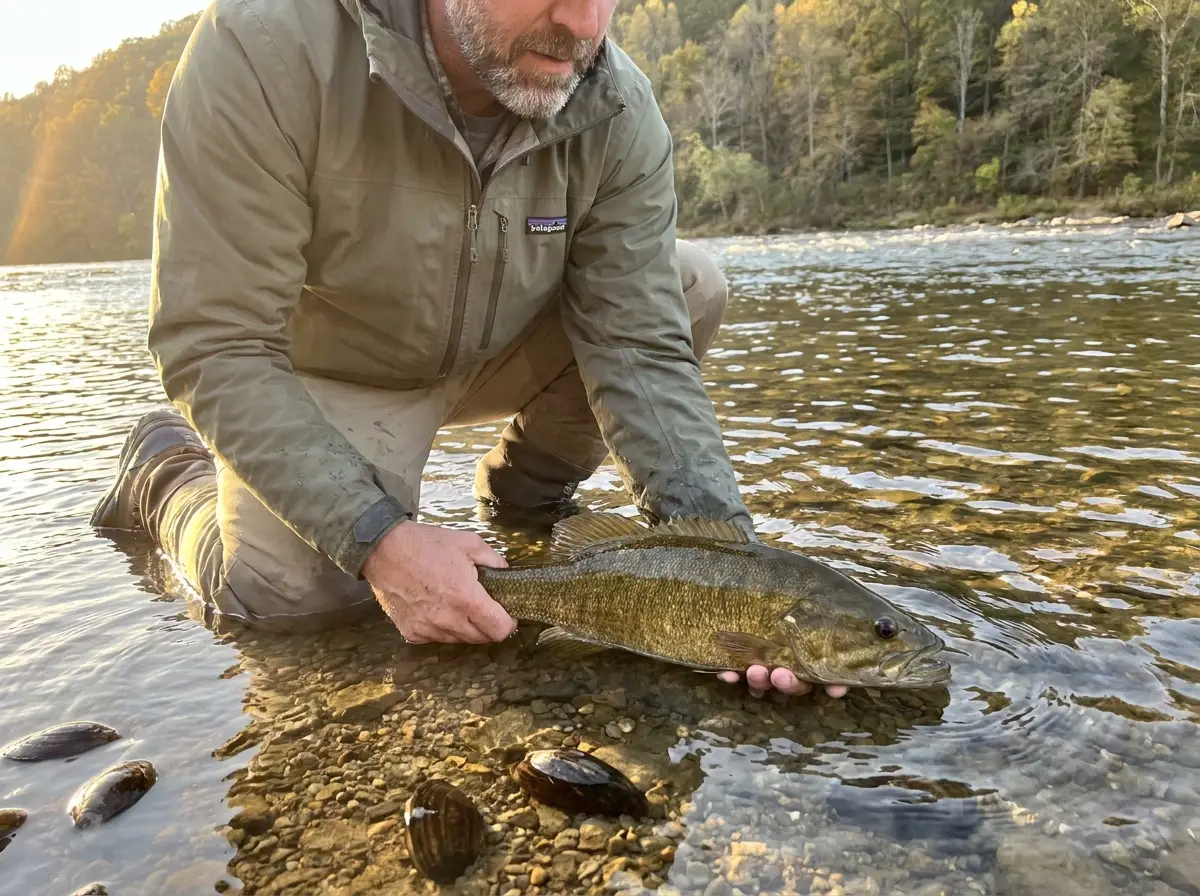
The bass you released last Saturday might have been carrying mussel larvae in its gills at that exact moment. Completely harmless to the fish — absolutely critical for the river. I noticed this connection after years of fishing rivers where the best smallmouth stretches always seemed to share the same clean gravel bottom and the same odd clusters of shells. Turns out the shells and the fish are running the same ecosystem. Here’s what every angler should know about freshwater mussels, and why the work you already do — releasing fish, cleaning your gear — matters more than you realize.
Quick Answer: Freshwater mussels filter up to 20 gallons of water daily, build invertebrate habitat that feeds your target species, and depend on bass, bluegill, and sunfish as hosts for their larvae. With 71.7% of North American mussel species at risk, their decline directly threatens the rivers you fish — and most anglers never see it coming.
Reason 1: Freshwater Mussels Are the Water Filter Your Fish Depend On
How Mussels Clean River Water
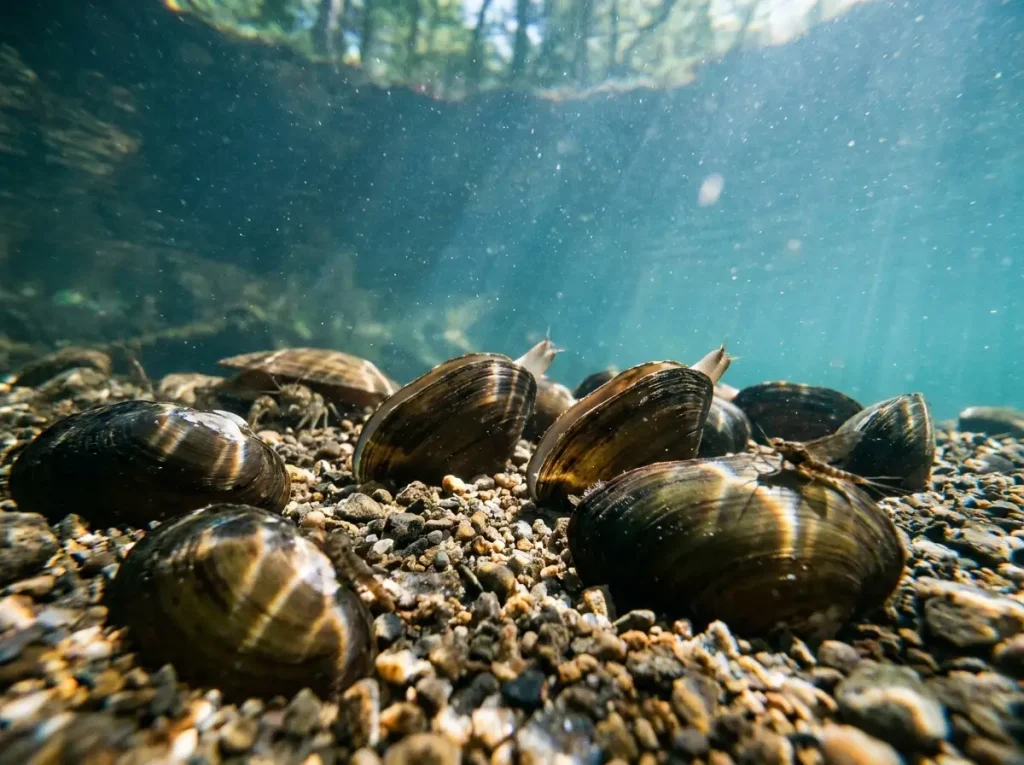
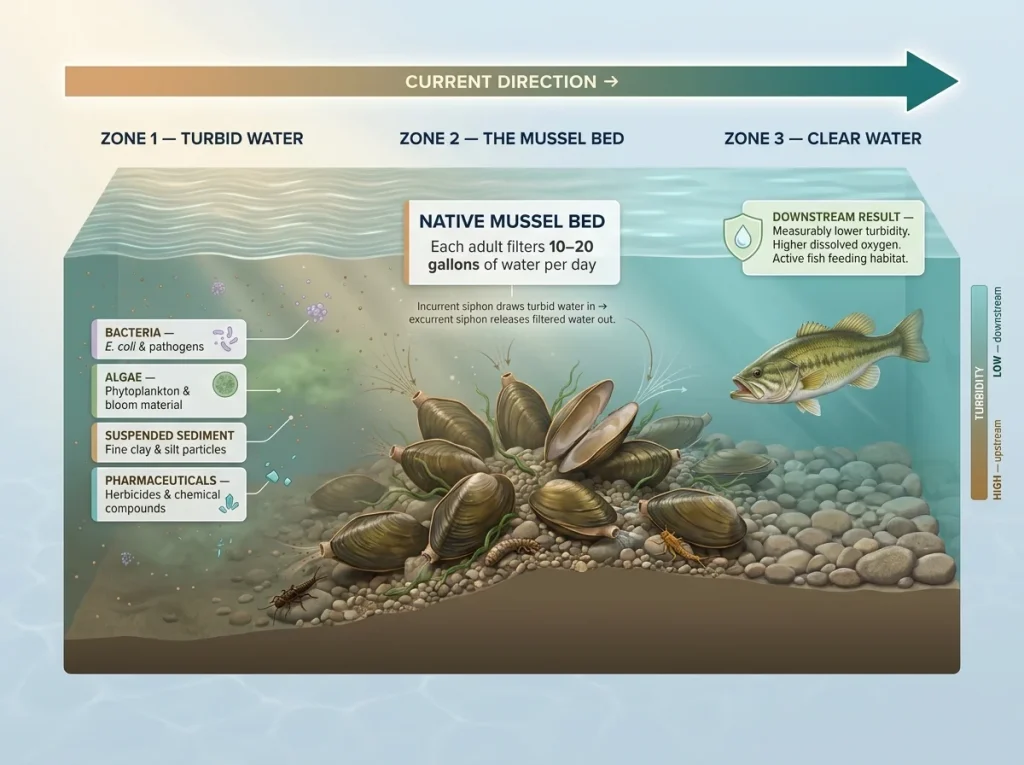
Filter feeders working around the clock, native freshwater mussels pump between 10 and 20 gallons of water per day per adult animal, according to the U.S. Fish & Wildlife Service. That sounds abstract until you picture a mussel bed with a few hundred animals — a natural filtration system handling thousands of gallons every day, right on the stretch of river you fish.
What they pull out matters. Zooplankton, phytoplankton, bacteria, pharmaceuticals, herbicides, and E. coli get filtered from the water column continuously. They’re removing the suspended particles that cloud water and deplete dissolved oxygen — two factors that directly control how and where fish hold. Turbidity levels in rivers with healthy mussel populations are measurably lower than in comparable stretches without them, and lower turbidity means fish can hunt by sight, which means more aggressive feeding and better fishing.
Pro tip: If you’re scouting a new river and the water clarity stays poor even in low-flow conditions, look at the substrate. No mussels where there should be mussels often means chronic turbidity — and fish populations frequently reflect it.
What Happens When Mussels Disappear
When native mussel populations collapse, the filtration capacity of the river collapses with them. Phytoplankton blooms go unchecked. Suspended sediment stays suspended. Dissolved oxygen drops in warm stretches. Fish that can tolerate murky water — catfish, carp — outcompete fish that can’t — bass, trout. It doesn’t happen overnight, but the trajectory is predictable.
The same kind of degraded water quality compounds with other stressors; thermal pollution drives fish off their patterns in precisely the stretches where mussel loss has already weakened the system’s resilience. A river that was excellent bass water ten years ago sometimes isn’t anymore, and the chain of causation often starts with the mussels.
The “Liver of the River” Connection to Fishing Quality
The ecologists’ nickname for mussels — “the liver of the river” — is accurate in a way that’s useful for anglers. Your liver filters toxins so the whole system can function. Mussels filter contaminants so fish can hold, feed, and reproduce in viable habitat. Remove the filter and the system accumulates what it can no longer process, affecting every species in the water column.
Reason 2: Mussel Beds Build the Habitat Your Target Species Rely On
The Underwater Apartment Complex You Didn’t Know Existed
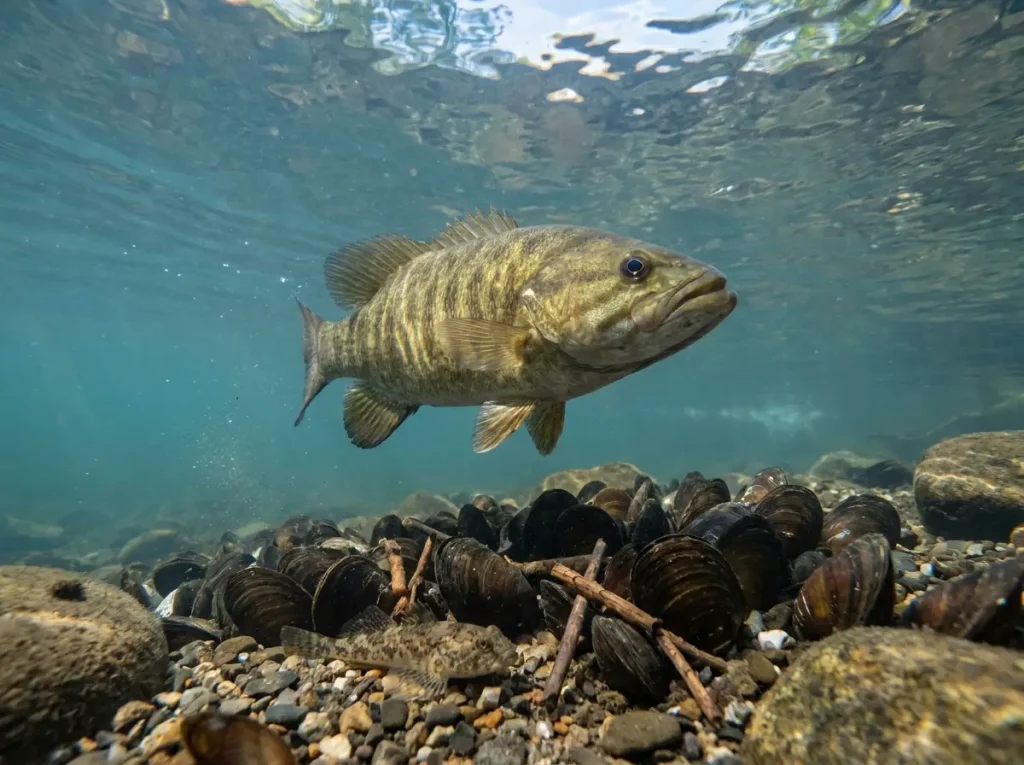
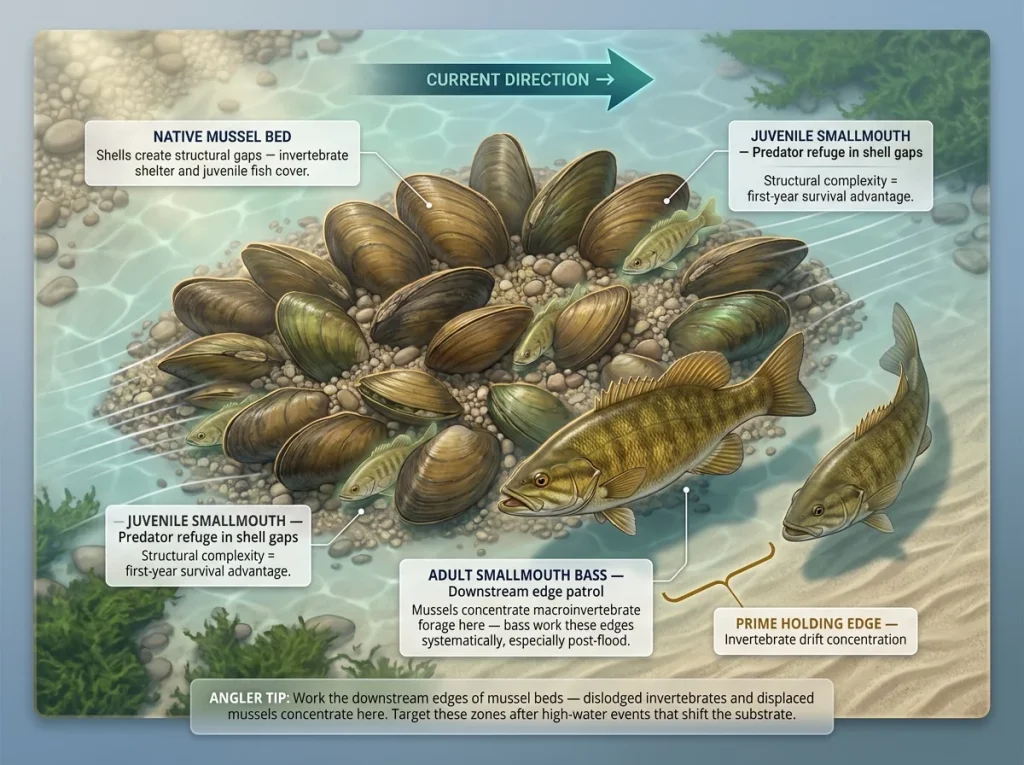
A mussel bed is more than a population of filter feeders — it’s three-dimensional structure on the riverbed. Live mussels cluster together, creating gaps, crevices, and small open pockets between shells. Those gaps are where aquatic macroinvertebrates — caddisflies, stoneflies, mayfly nymphs, aquatic worms, amphipods — live, shelter, and reproduce. That invertebrate community is the foundation of the food web that everything you’re targeting is built on.
Mussels also stabilize substrate. The shells hold sediment in place and prevent fine silt from blanketing the gravel that fish use for spawning. Clean gravel and a high invertebrate density in the same location — that’s what anglers call “good holding water,” even when they’ve never connected it to the mussels that made it that way.
Mussel Beds as Fish Nursery Infrastructure
Understanding why wade fishing pressure on stream beds matters becomes more specific when you know what’s living in those beds. Juvenile fish use the structural complexity of mussel beds as predator-avoidance cover during their most vulnerable growth stages. Larger fish patrol mussel beds because that’s where the food is concentrated. The bed is a nexus: filter, food factory, nursery, and feeding station in one location.
The Xerces Society documented that fish surviving drought stress last longer in pools with active native mussels. When summer low flows shrink a river to isolated pools, the ones with mussel beds retain more invertebrate biomass and maintain better water quality — giving fish better survival odds until flow returns. That effect directly protects the populations you fish the following season.
Why the Best Smallmouth Water Always Has Mussels
This isn’t coincidence. Smallmouth bass favor the same cold, clear, well-oxygenated river segments with clean gravel substrate that mussels require. Healthy mussel beds and excellent smallmouth fishing co-occur because both species need the same water quality inputs. When you find one, you typically find the other — and when the mussels decline, the bass numbers follow within a few years.
Pro tip: In rivers where you know there’s a healthy mussel population, work the downstream edges of those beds. Dislodged mussels and the invertebrates they shelter often concentrate there, and bass work those edges systematically, especially after high-water events that shift the substrate.
Reason 3: Your Sport Fish Are Mussel Nurseries (and That’s a Good Thing)
What Glochidia Are and Why They Need Your Bass
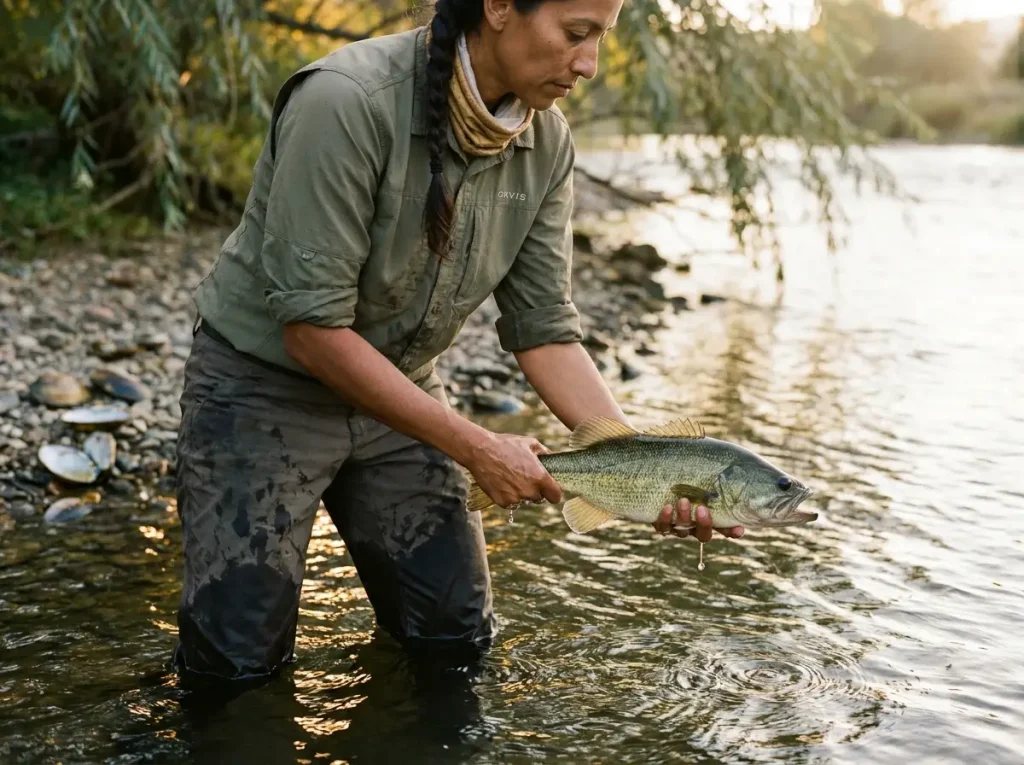
Glochidia are the microscopic larvae of freshwater mussels, and they have one of the more remarkable life strategies in North American freshwater ecology. When a female mussel releases glochidia, the larvae must attach to a host fish — specifically the gills, fins, or skin of a compatible fish species — and remain there for several weeks while they develop into juvenile mussels. Then they detach and fall to the substrate.
The relationship doesn’t meaningfully harm the fish. The glochidia aren’t feeding from tissue; they’re primarily using the host for temperature regulation and water flow during metamorphosis. But most mussel species are specific in their requirements. According to the USDA Forest Service research on fish host specificity, many Unionid mussels require one or a few particular fish species and will die if those hosts aren’t present.
Common hosts include largemouth bass, smallmouth bass, bluegill, redear sunfish — the panfish species known for its relationship with shellfish — channel catfish, and several darter species.
The Mussels That Fish for Their Own Young
Here’s where it gets genuinely strange. Some mussels in the Lampsilini tribe have evolved mantle tissue that mimics fish prey — a flap of tissue that looks and moves exactly like a minnow or crayfish. The mussel waves this lure in the current to attract the specific host fish it needs. When a bass or sunfish strikes at what looks like distressed prey, the mussel releases its glochidia directly onto the fish’s gills. It’s nature running the same deception you use with artificial lures — just with different stakes.
That means catch-and-release fishing for bass, bluegill, and sunfish is directly supporting mussel reproduction. Every fish you release carries the potential to transport mussel larvae to new reaches of the river, extending mussel populations into areas that didn’t have them before. Your catch-and-release ethic is doing conservation work you probably didn’t sign up for, and that’s a good thing.
How Dams Cut Off Mussel Reproduction
A dam doesn’t just block fish migration — it cuts off mussel reproduction in every stretch above the barrier. Migratory and resident fish can’t reach upstream habitat. The glochidia released above the dam have no viable hosts, and within a generation, those mussel beds become what biologists call “functionally extinct” — living adults still present, but no successful recruitment happening below the replacement rate.
Understanding how dam removal restores both fish migration and mussel reproduction is central to the biggest conservation wins of the past decade. Recovery can happen within five to ten years in favorable conditions once fish passage is restored. The fish come back, the glochidia have hosts again, and mussel recruitment resumes in reaches that had been silent for decades.
Reason 4: Zebra Mussels Are the Enemy — Native Mussels Are Not
How to Tell the Difference at the Boat Ramp
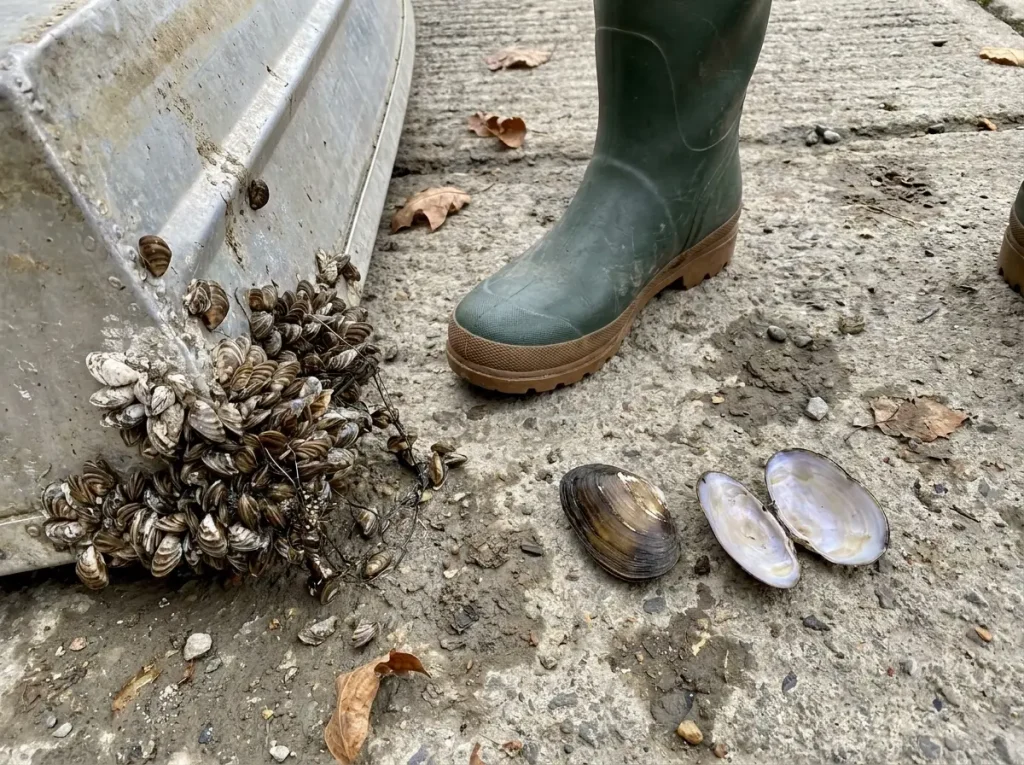
Most anglers who’ve been on Midwestern or Great Lakes water have seen zebra mussels — the small, striped bivalves fouling boat hulls, dock pilings, and water intakes. It’s tempting to put all mussels in the same mental category: invasive pest, navigation hazard, something you scrape off. That’s a mistake with consequences.
Native freshwater mussels (family Unionidae) have been in North American rivers for millions of years. They have smooth, brown or black shells and live buried in sediment — you won’t see them attached to hard surfaces. Zebra mussels (Dreissena polymorpha) are from the Caspian and Black Sea region, arrived via ship ballast water in the late 1980s, and have a distinctive brown-and-white striped shell. They attach to hard surfaces — rocks, dock pilings, boat hulls, and the shells of native mussels — using adhesive threads. The visual difference at the boat ramp is immediate once you know what to look for.
Why Zebra Mussels Are Destroying Fishing Water
Zebra mussels are exceptional filter feeders. Too exceptional. As documented by the U.S. Geological Survey on invasive species, they outcompete both native mussels and small fish for the phytoplankton in the water column. In Lake Erie after zebra mussels established in the 1990s, plankton availability collapsed. The food web rearranged. Some species benefited from the clearer water; many more struggled as their forage base dropped out.
The direct impact on native Unionid mussels is severe. Zebra mussels physically attach to native mussel shells in layers, eventually preventing the native animals from opening their valves to feed or breathe. Rivers and lakes with established zebra mussel populations have seen significant losses of native mussel communities within years of initial infestation. The two don’t coexist — one replaces the other.
The Anglers Accidentally Spreading Zebra Mussels
Anglers and boaters are the primary spread vector for zebra mussels outside the Great Lakes basin, as tracked by the Xerces Society for Invertebrate Conservation. Zebra mussel veligers — free-floating larvae, microscopic and invisible to the naked eye — survive in livewells, bilge water, and wet gear. Equipment moved between water bodies before drying is an active transport mechanism.
The connection to wading gear is why felt soles are banned in several states for invasive species reasons. Felt retains moisture and biological material far longer than rubber, making it an effective transport medium for veligers and other aquatic invasive species. The bans have nothing to do with traction performance — they’re entirely about preventing disease and invasive species transmission between drainages.
Pro tip: If you fish multiple water bodies in the same week, drain your livewell completely at the access point where you launched — before you leave the ramp, not when you get home. The 60-second difference matters, and it’s required by law in many states.
Reason 5: What You Do at the Boat Ramp Directly Affects Mussel Survival
The Clean-Drain-Dry Protocol (What It Actually Means)
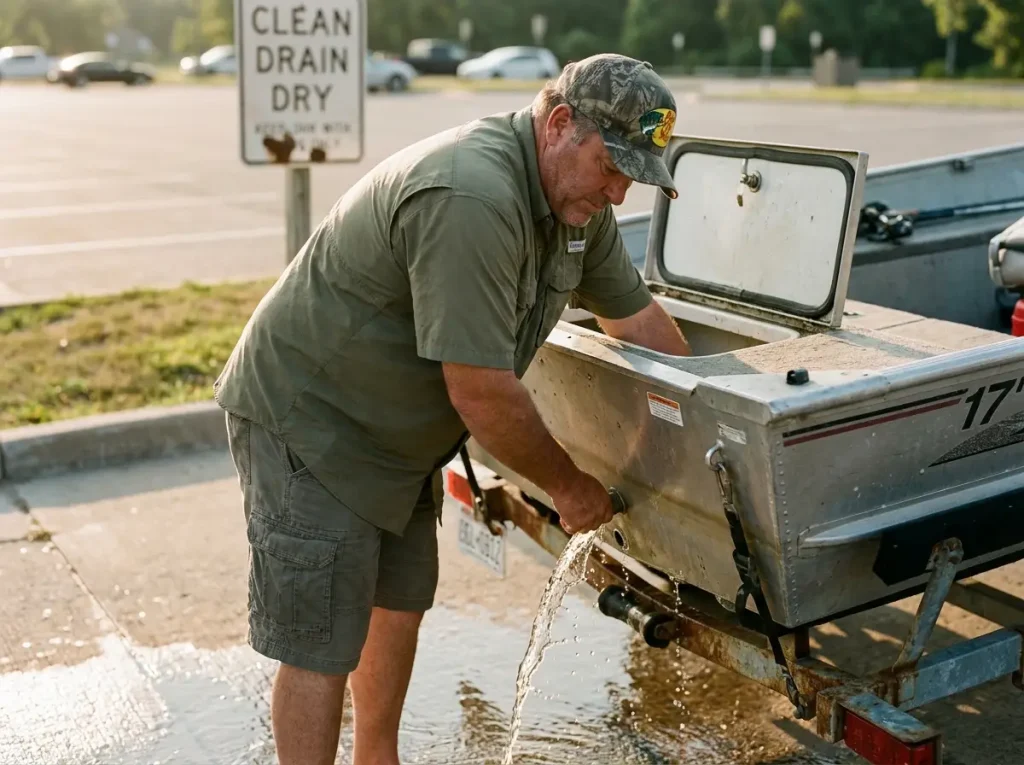
Clean-Drain-Dry is three distinct steps, not one phrase. Clean means physically inspecting and removing any visible aquatic plants, organisms, or mud from your hull, trailer, and gear before leaving the access point. Drain means emptying the motor, bilge, livewell, and any water-holding container at the launch. Dry means leaving all equipment to air for five or more days before use in a different water body — or using a towel plus hot water above 140°F to achieve the same result faster.
Most anglers do the “clean” step and skip the dry timeline. A boat that looks clean can still carry veligers in trace water in hull crevices and equipment fittings. Five days of dry time eliminates them. Hot water above 140°F eliminates them on contact. Both methods work; using them together is most reliable.
Catch-and-Release as Mussel Conservation
Releasing sport fish species that serve as mussel hosts does measurable conservation work, especially during the window when conservation timing matters as much as technique. Bass and sunfish are the most common hosts for the most threatened mussel species. A strong catch-and-release practice for these species doesn’t just protect fish populations — it sustains mussel recruitment directly.
This also means fish passage is a mussel conservation issue. Advocating for culvert replacements, low-head dam removals, and ladder improvements isn’t just about trout and salmon. It’s about every mussel bed upstream of every barrier on every river you care about fishing in ten years.
Supporting Dam Removal and Restoration Efforts
The work organizations like American Rivers, Trout Unlimited, and state fish and wildlife agencies do on dam removal is the single largest lever available for mussel population recovery. When fish passage is restored, host fish recolonize above the barrier and mussel recruitment resumes. Recovery can happen within a generation in favorable conditions.
Anglers can support these efforts directly: report mussel sightings — especially unusual die-offs — to your state agency (many have smartphone-based reporting programs). Volunteer for mussel monitoring surveys when your local conservation district runs them. And understand the broader impact of fishing gear on aquatic systems that goes beyond what most regulations address — how you handle your gear at every ramp is part of a larger conservation record.
Conclusion
Three things worth holding onto: healthy mussel beds produce better water clarity, more invertebrate forage, and more productive fish habitat — directly. The bass and bluegill you catch-and-release are doing mussel conservation work every time they carry glochidia to a new stretch of river. And the single most actionable thing you can do costs ten minutes at the boat ramp: Clean-Drain-Dry, every time, between every water body, no exceptions.
You can’t fish healthy rivers forever in water that’s losing its filters. Native mussels have been running that filtration system for millions of years, long before anyone got out there with a spinning rod. The least anglers can do is not be the reason that stops.
Q1 Are freshwater mussels endangered?
Yes — 71.7% of North America’s 297 native freshwater mussel species are classified as endangered, threatened, or of special concern, making them the most at-risk group of animals on the continent. The U.S. Fish & Wildlife Service currently lists 69 species as Endangered and 20 as Threatened under the Endangered Species Act, with new listings added regularly.
Q2 How do freshwater mussels reproduce using fish?
Female mussels release microscopic larvae called glochidia that must attach to the gills or fins of specific host fish to develop into juvenile mussels. The process is harmless to the fish and takes several weeks. Without those host species present, the larvae die and mussel recruitment fails — which is exactly why healthy fish populations directly support mussel survival.
Q3 What is the difference between zebra mussels and native mussels?
Zebra mussels are an invasive species from Eastern Europe with brown-and-white striped shells; they attach to hard surfaces and are harming native mussel populations across North America. Native freshwater mussels have smooth brown or black shells, live buried in sediment, have been in North American rivers for millions of years, and are critical to river health and fishing quality.
Q4 How can I tell if a river has healthy native mussels?
Walk rocky riverbeds in knee-deep water and look for smooth, oval-shaped brown or black shells partially buried in the substrate. Live mussels are slightly open when undisturbed. Empty shells on gravel bars often indicate a nearby active bed. Good water-quality indicators accompany healthy mussel populations: clear water, abundant aquatic insects, and strong bass or panfish productivity.
Q5 What should anglers do to protect freshwater mussels?
Practice Clean-Drain-Dry every time you move boats or gear between water bodies — drain at the access point, not at home. Release bass, bluegill, sunfish, and catfish when legal; these are primary mussel host fish. Avoid wading directly across visible mussel beds. Report die-offs or notable mussel sightings to your state fish and wildlife agency.
Risk Disclaimer: Fishing, boating, and all related outdoor activities involve inherent risks that
can lead to injury. The information provided on Master Fishing Mag is for educational and informational purposes
only. While we strive for accuracy, the information, techniques, and advice on gear and safety are not a substitute
for your own best judgment, local knowledge, and adherence to official regulations. Fishing regulations, including
seasons, size limits, and species restrictions, change frequently and vary by location. Always consult the latest
official regulations from your local fish and wildlife agency before heading out. Proper handling of hooks, knives,
and other sharp equipment is essential for safety. Furthermore, be aware of local fish consumption advisories. By
using this website, you agree that you are solely responsible for your own safety and for complying with all
applicable laws. Any reliance you place on our content is strictly at your own risk. Master Fishing Mag and its
authors will not be held liable for any injury, damage, or loss sustained in connection with the use of the
information herein.
Affiliate Disclosure: We are a participant in the Amazon Services LLC Associates Program, an
affiliate advertising program designed to provide a means for us to earn advertising fees by advertising and linking
to Amazon.com. As an Amazon Associate, we earn from qualifying purchases. We also participate in other affiliate
programs and may receive a commission on products purchased through our links, at no extra cost to you. Additional
terms are found in the terms of service.