In this article
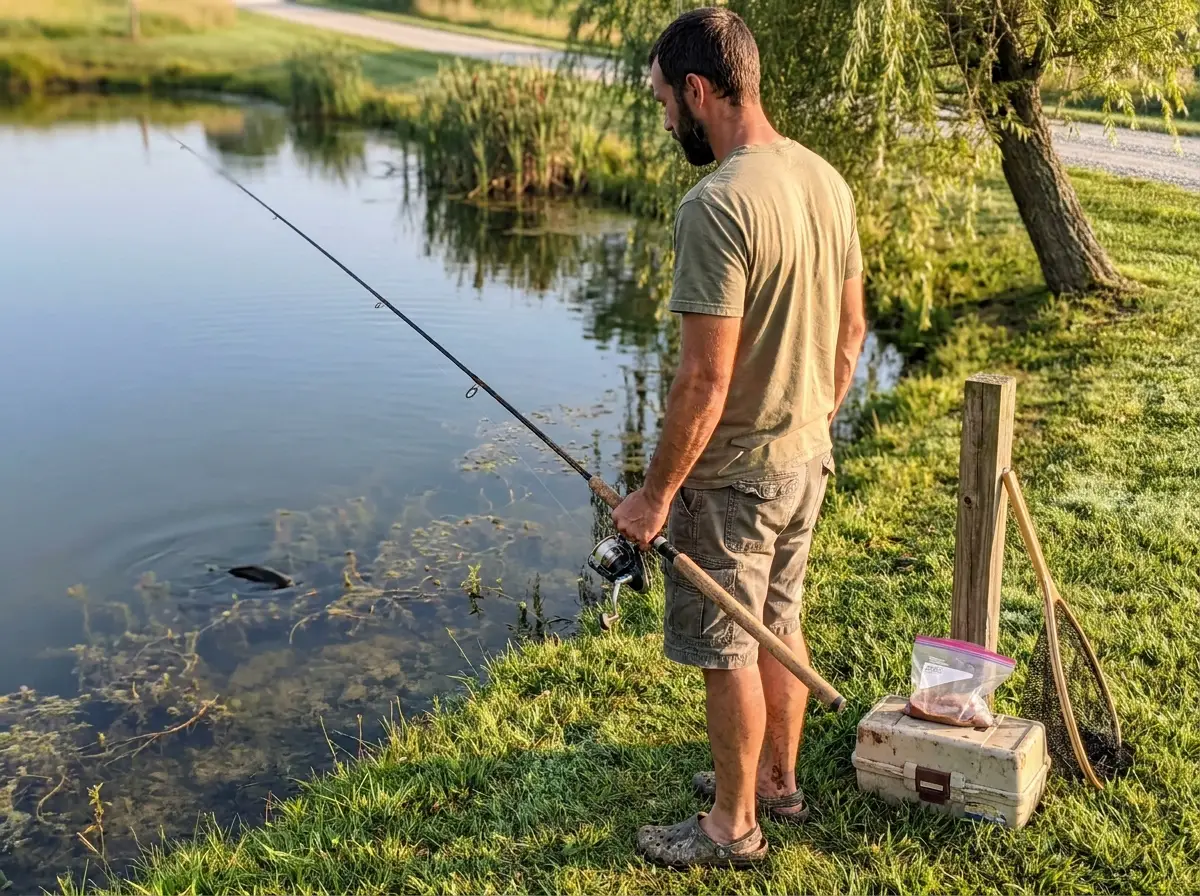
You watch the rod tips pointed at deep water and wonder why nothing is happening. Meanwhile, thirty feet behind you, a 20-pound common pushes a wake through shin-deep water along the bank. That disconnect between where anglers fish and where carp actually feed in summer is the single biggest reason people blank in July and August. After seasons spent chasing carp across Midwest farm ponds, Great Lakes flats, and urban park lakes, the pattern holds — summer carp want the shallows, and everything from dissolved oxygen to forage density explains why.
This guide breaks down the science behind that shallow migration, the specific US water types where it plays out, and the rigs, baits, and approach tactics that put summer carp on the bank.
Quick Answer: Summer carp move shallow because warm-water weedbeds produce more dissolved oxygen than deep zones. To catch them:
- Fish the margins at dawn and dusk when carp patrol bank edges
- Target weedbeds during midday when photosynthesis peaks oxygen levels
- Use sweet corn or pack bait on a hair rig for quiet, effective presentations
- Read the water for mudding, tailing, and bubble trails before casting
- Stay back from the bank and minimize casting — stealth decides everything in two feet of water
Why Carp Move Shallow When the Water Heats Up
How Dissolved Oxygen Drives the Shallow Migration
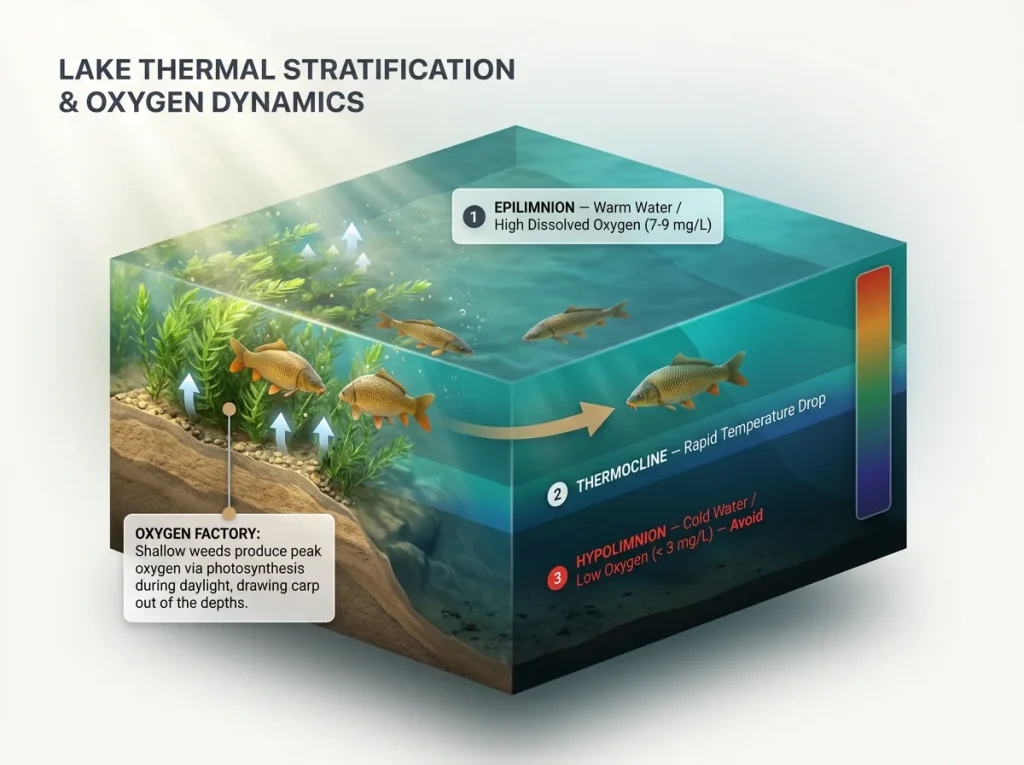
Every freshwater species follows oxygen, and carp are no different. In summer, lakes develop thermal stratification — a warm upper layer (epilimnion), a narrow transition zone (thermocline), and a cold bottom layer (hypolimnion) where dissolved oxygen drops to levels that discourage feeding. Carp thrive at 5-7 mg/L of dissolved oxygen, and in a stratified lake, those numbers exist in the upper few feet of the water column, not the depths.
Shallow weedbeds make the effect stronger. Submerged plants like coontail, pondweed, and milfoil photosynthesize during daylight hours, pumping oxygen directly into the surrounding water. A healthy weedbed in three feet of water can produce more oxygen per square foot than any spot in the lake. Carp know this, and they congregate where the food and the comfort zone overlap. If you want to understand how dissolved oxygen and how fish use it to choose feeding depth works at a deeper level, that mechanism drives more species behavior than most anglers realize.
The connection between how thermoclines form and what they mean for your fishing depth and where carp position themselves is direct. When thermal layers lock in by mid-June, carp that spent spring roaming the full water column compress into the oxygenated shallows. That compression is why summer shallow fishing can be so productive — the fish have fewer comfortable places to be.
Reading Water Temperature Without Electronics
You don’t need a sonar unit to find the warm, oxygenated shallows. Touch the water at different depths along the bank. If the surface feels noticeably warmer than water at knee depth, stratification is in play and the shallows are holding the oxygen advantage. Dark-bottomed bays and south-facing banks heat faster than open shoreline, and those temperature pockets attract carp earlier in the morning.
When Shallow Gets Too Shallow — Heat Stress Thresholds
Carp feed most actively between 72-81°F (22-27°C). That range explains why shallow water is prime territory in early morning and late afternoon. But when water temperature climbs above 84°F (29°C) in the peak of a heatwave, even shallows become uncomfortable. Carp shift to undercut banks, spring seeps, feeder creek mouths, or deeper weedbed edges where cooler water mixes in. Knowing both ends of the comfort range — the sweet spot and the stress threshold — keeps you on fish when conditions shift through the day.
Pro tip: Carry a cheap aquarium thermometer in your tackle bag. Dip it at your swim and again at the weedbed edge. A 3-4 degree difference between those two spots tells you exactly where the comfort zone sits.
Where Summer Carp Stack Up in US Waters
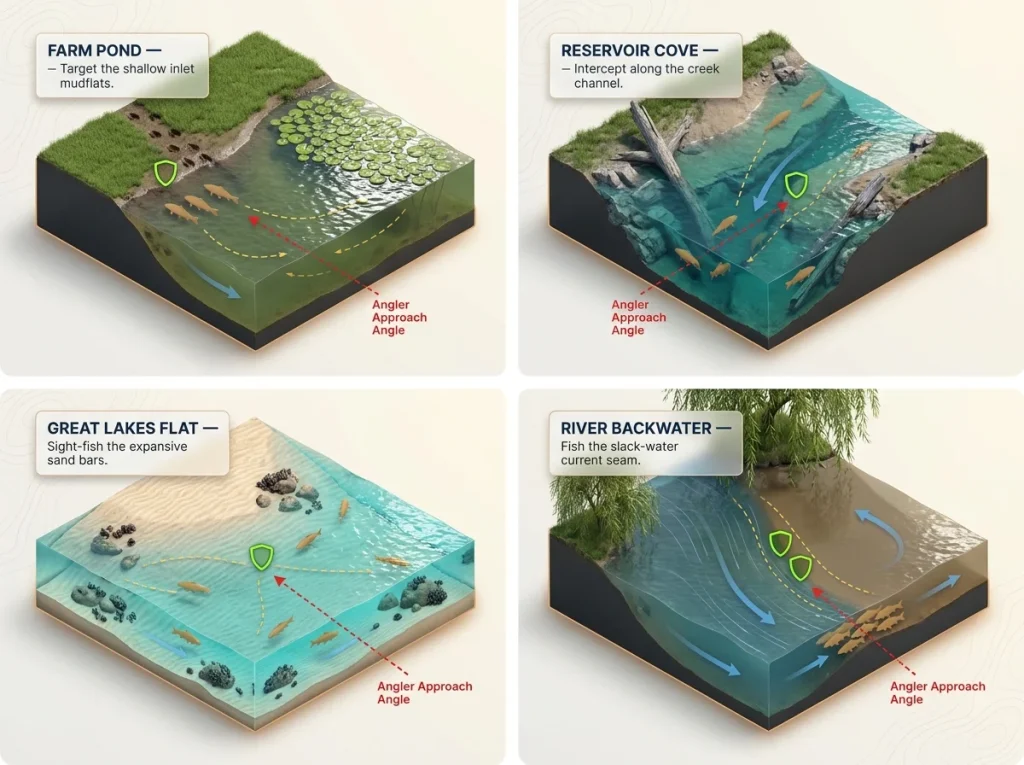
Farm Ponds and Small Impoundments
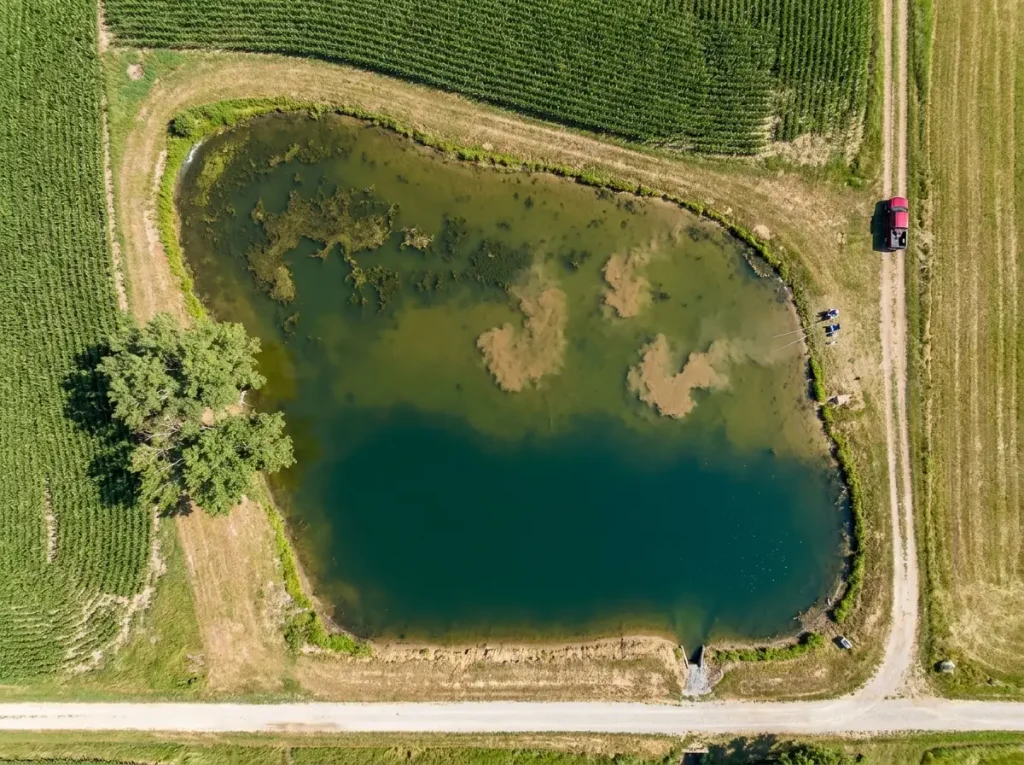
The classic two-acre Midwest farm pond is arguably the best summer carp water in America. These ponds are shallow by design — most max out around eight feet — which means the entire pond can function as a carp feeding flat when conditions align. Carp cruise the margins feeding on earthworms, insect larvae, crawfish, and decomposing vegetation, often in water barely deep enough to cover their backs.
The approach on farm ponds is simple. Find the shallow weedy end — usually the inlet side where sediment builds up — and watch for mudding or tailing fish. Most farm ponds get zero fishing pressure for carp, which means the fish are less wary than their lake or river counterparts. Our guide to reading small pond structure for feeding zones covers the details of finding productive water in these small systems.
Lakes, Reservoirs, and Great Lakes Flats
Reservoirs with shallow coves and creek arms create natural funnels for summer carp. Pre-bait a cove at dawn with scattered corn and pack bait, then return at midday when carp push into the shallows. The creek arm channels act as highways — carp follow them from the main lake into feeding zones on the flats.
Great Lakes tributaries and harbors have become the epicenter of a growing sight-fishing culture. Anglers in Chicago, Cleveland, Buffalo, and Toronto stalk carp on sand and gravel flats in two to four feet of water, often with fly rods. The community calls them golden bonefish, and the comparison fits — the same stealth, the same visual presentation, the same adrenaline when a tailing fish eats.
Rivers, Backwaters, and Urban Waterways
Mississippi River backwaters and oxbow lakes hold enormous carp populations that concentrate in shallow slack water during summer. Current seams where moving water meets still water create natural feeding stations. Urban park lakes are wildly underrated — low angling pressure, consistent fish, and easy access make them ideal for learning summer carp patterns.
The tactics that work in these distinctly American waters differ from the UK stillwater approach that dominates the search results. If you haven’t explored the carp techniques most North American anglers overlook, the differences between US and European carp fishing run deeper than just geography.
Timing the Shallow Bite — Dawn, Dusk, and the Midday Window
The Dawn and Dusk Windows You Already Know
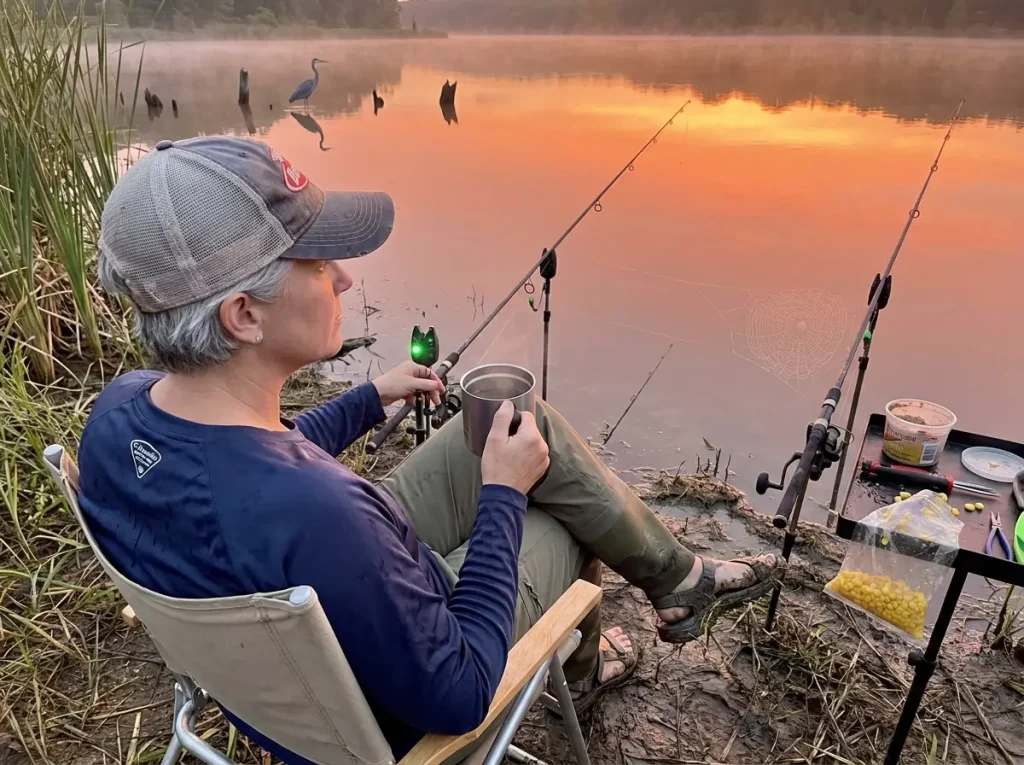
The first two hours after sunrise and the last two before sunset are the classic carp windows, and summer doesn’t change that. At dawn, carp are finishing their overnight margin patrol and still feeding actively. The water is at its coolest, dissolved oxygen is recovering from the nighttime dip, and bankside noise is minimal. At dusk, falling light triggers another push into the shallows as water temperature drops from the afternoon peak.
These windows produce reliably, and most carp anglers already fish them. The mistake is treating them as the only windows.
The Midday Weedbed Window Most Anglers Miss
Here’s where the dissolved oxygen science pays off. Between roughly 10 AM and 2 PM on sunny days, photosynthesis in shallow weedbeds hits peak production. Oxygen levels in and around the weeds spike, and carp that may have retreated from the bare shallows during mid-morning often push back into the weed cover to feed. This is the window nobody fishes because everyone assumes midday heat shuts carp down.
It doesn’t shut them down — it relocates them. Instead of bare sand or mud flats, they’re tucked into the weedbeds where oxygen and food converge. Position a bait at the edge of a weedbed during this window and you’ll catch fish that other anglers never see. Our piece on beating the summer slump when fish seem to shut down covers the broader tactics for midday fishing across species.
How Weather Fronts Reset the Feeding Clock
A low-pressure front with wind and rain can flip summer carp behavior in hours. Fish that were cruising the surface or sitting inactive in weed cover suddenly drop down and feed hard. The barometric drop triggers feeding instincts, and the wind pushes warmer surface water toward the downwind bank, concentrating both food and carp. Fish the windward bank after a front pushes through — the bait, the oxygen, and the carp all stack up there.
Understanding how water temperature drives fish feeding metabolism puts these weather-driven shifts into context. Temperature and oxygen fluctuations from weather events create windows that the angler who stays mobile can exploit.
Pro tip: Check your weather app for barometric pressure trends, not just rain forecasts. A steady drop in pressure over 6-8 hours usually triggers a feeding burst even if rain never arrives.
Reading Shallow Water for Feeding Carp
The Four Visual Cues That Give Carp Away
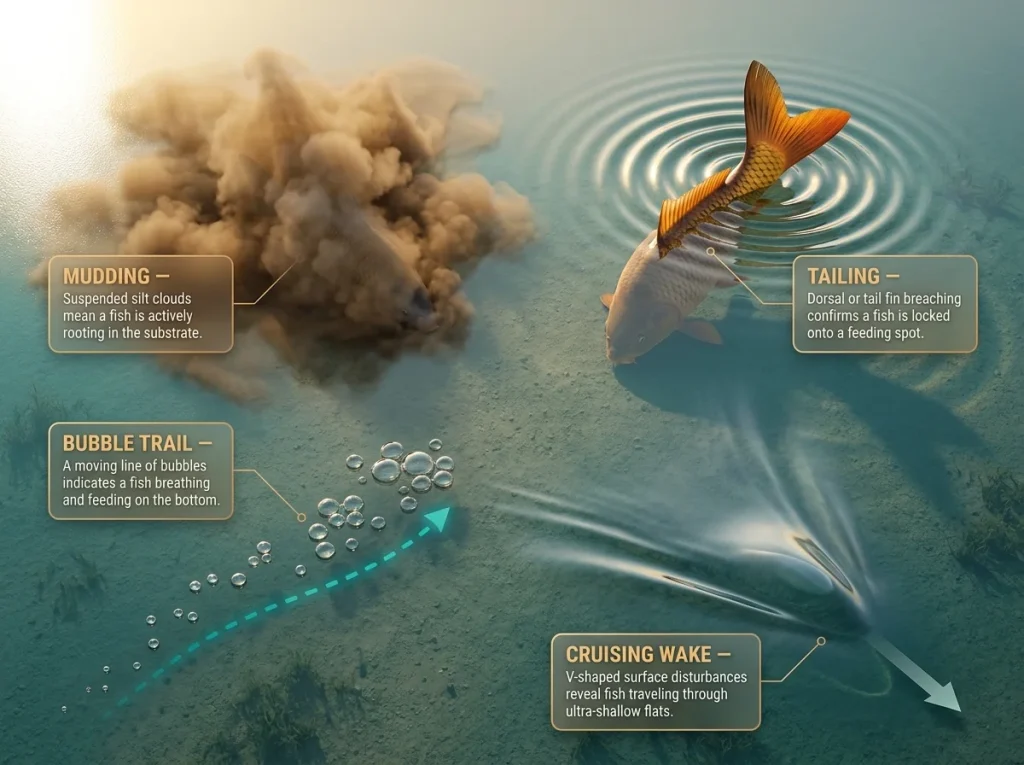
Before you cast into shallow water, read it. Blind casting in two feet of water spooks more fish than it catches. Four visual signs tell you carp are present and feeding:
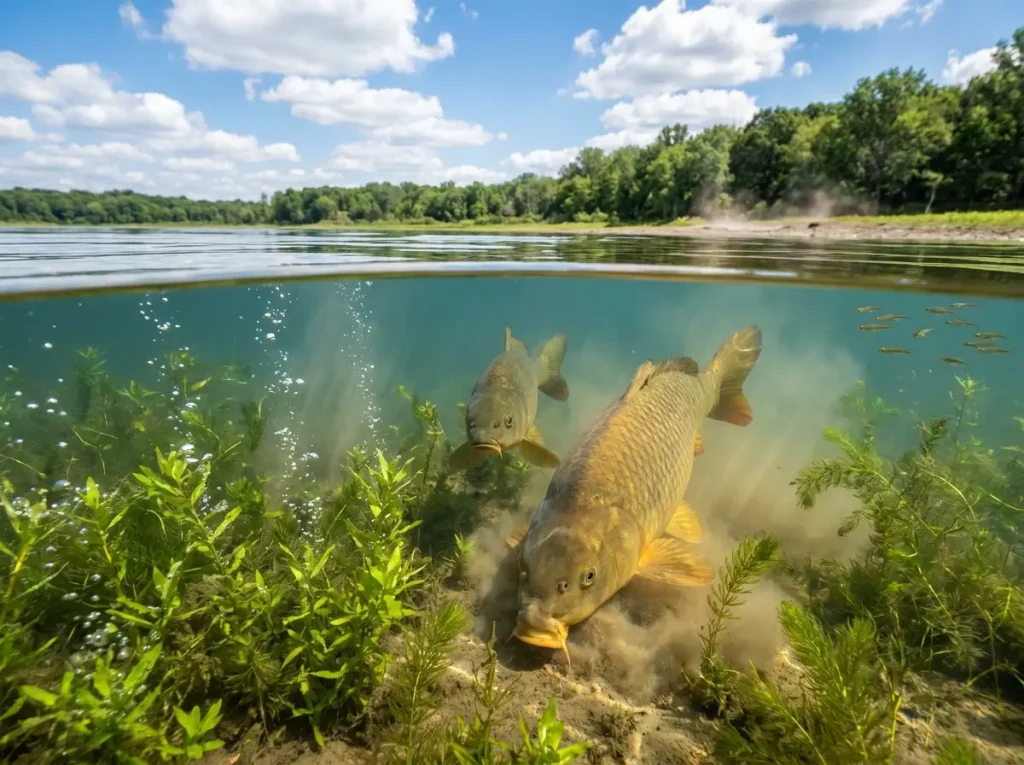
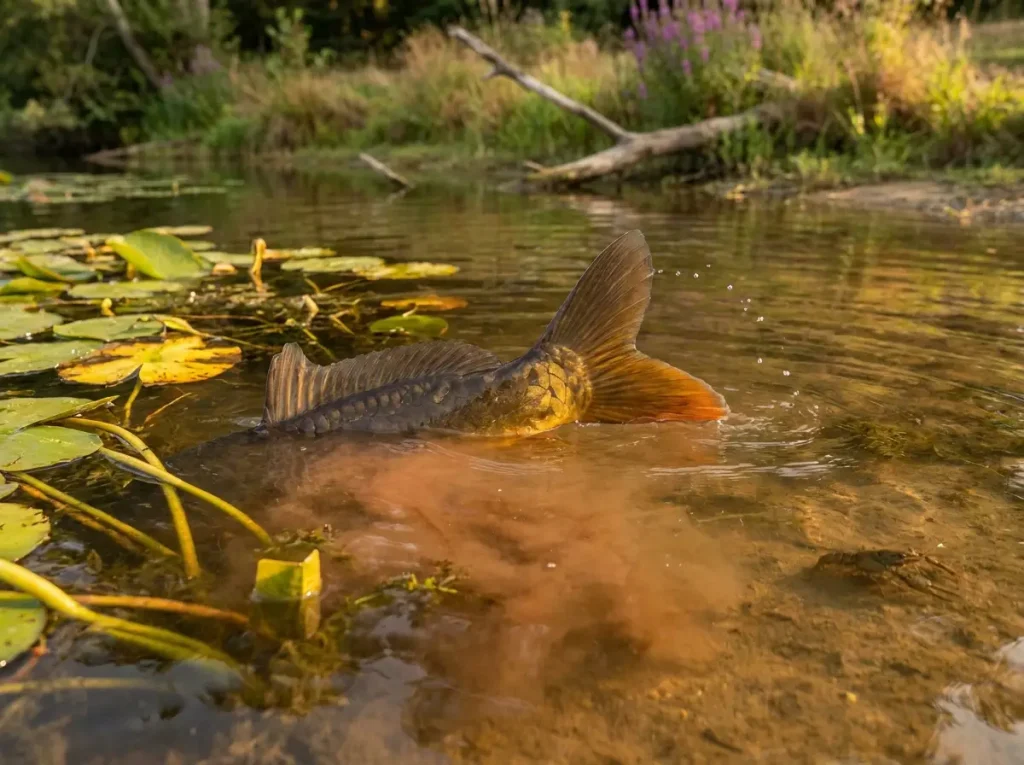
Mudding is the clearest indicator — a cloud of disturbed silt spreading through clear water, caused by carp rooting through the substrate with their barbels. The cloud can be subtle in sandy bottoms or dramatic in silty ones, but either way it means a fish is head-down and eating.
Tailing is the electric one. A dorsal fin or broad golden tail breaks the surface in shallow water, waving slowly as the fish feeds head-down. This means the water is shallow enough that the carp physically can’t stay submerged while feeding. When you see a tail, the fish is committed to that spot.
Bubbling — strings of small bubbles rising to the surface in a moving line — indicates carp working through the substrate. The bubbles release from disturbed sediment and from the fish’s gill plates during bottom feeding. A steady bubble trail that moves is almost always a carp. Stationary bubbles are usually decomposition gas.
Wakes — V-shaped surface disturbances moving slowly through calm shallows — reveal cruising fish. These carp may or may not be feeding, but they’re in the area and can be intercepted by placing bait ahead of their travel path.
Why Polarized Sunglasses Are Your Most Important Gear
This isn’t a style choice. Polarized sunglasses eliminate surface glare and let you see into the water column. In shallow carp fishing, they’re the difference between casting at fish and casting blind. Amber or copper lenses work best for the green and tea-stained water typical of most US carp habitat. Without them, you’ll miss every visual cue except the most obvious wakes.
Reading Wind, Current, and Structure in the Shallows
Wind pushes warm surface water and floating food toward the downwind bank. On windy summer days, start your search on the bank the wind blows into — carp follow the food. Current in rivers and creeks creates seams where slack water meets flow. Carp sit on the slack side and pick off food items tumbling through the seam. Structure — fallen trees, rock piles, lily pad beds, dock pilings — provides both cover and a food-holding edge that carp patrol.
Baits That Trigger Summer Carp in the Shallows
Grocery-Store Baits That Outfish Expensive Imports
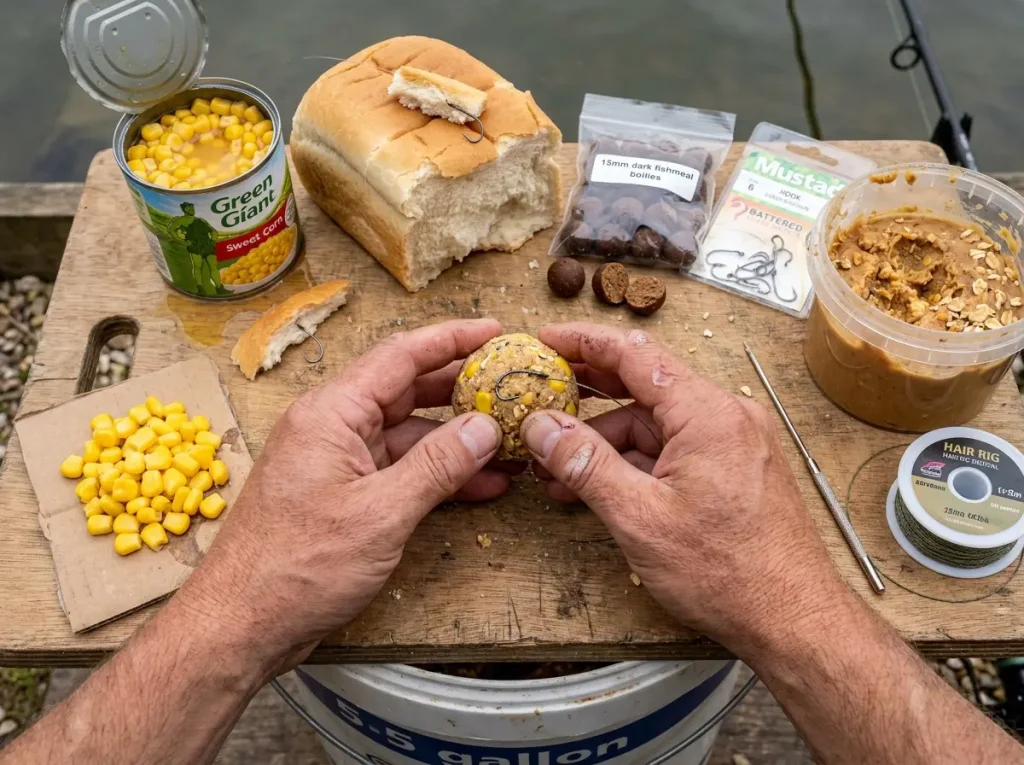
Sweet corn is the entry point for US carp fishing, and it works year-round. Canned corn combines salty and sweet flavors that carp respond to aggressively, it stays on the hook well, and it costs a dollar a can. Thread two or three kernels on a hair rig below a size 6-8 hook, scatter a handful of loose kernels around your hookbait, and you have a presentation that catches carp from farm ponds to the Great Lakes.
Bread crust is the go-to surface bait. Tear a piece of crust roughly the size of a quarter, thread it on a hook or hair, and fish it under a small controller float. When carp are cruising the surface on hot days — backs out of the water, mouths gulping — bread dropped 10 feet ahead of their path is often all it takes.
Pack Bait and the Method Approach
Pack bait is the distinctly American carp method. Mix cheap oats, cornmeal, a can of creamed corn, and enough water to form a dense ball that holds together on the cast but breaks down in 10-15 minutes on the bottom. Mold a fist-sized ball around your hook and hair-rigged corn, cast it to the feeding zone, and the dissolving pack bait creates a scent trail and feeding patch that draws carp in.
The method feeder is the European version of the same concept — a small flat frame loaded with sticky groundbait that sits on the bottom near the hookbait. Both systems work by creating a concentrated food source around the hook.
Pro tip: Mix your pack bait the night before and let it sit in the fridge. The cold mass stays firm during casting and gives you about five more minutes of hold time on the bottom before it breaks apart — enough to let the swim settle after the splash.
When to Escalate to Boilies and Particles
Boilies — dense dough balls made from eggs, flour, and concentrated attractants, then boiled to harden the shell — are the standard in European carp fishing but less common in US bait shops. If you can source them online or at a specialty tackle store, 15mm fishmeal boilies are excellent summer baits because warm water breaks down the attractant shell faster, releasing scent within minutes.
Particle baits like hemp, tiger nuts, and maize outperform boilies in post-spawn periods when carp want volume over individual food items. A bed of scattered particles with a hair-rigged tiger nut on top is a proven summer approach.
Rigs and Presentation for Shallow Water
The Hair Rig — Why It Works and How to Tie One
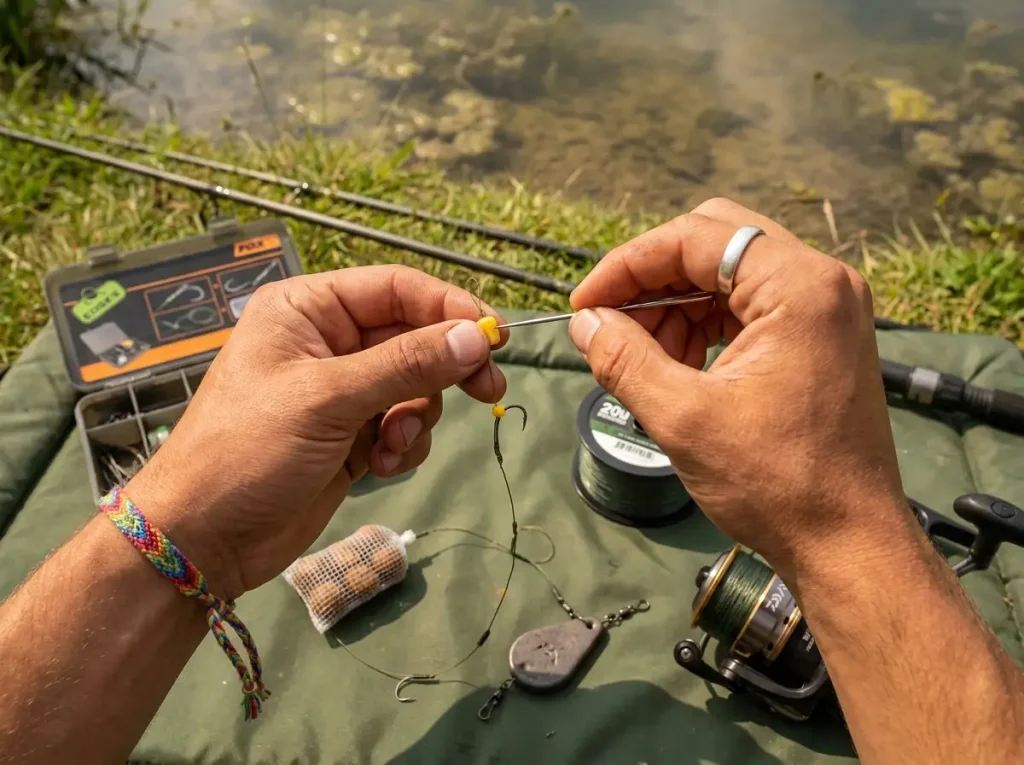
The hair rig is the foundation of modern carp fishing because it defeats the carp’s primary defense mechanism. Carp feed by sucking food items into their mouth and then ejecting anything suspicious. On a traditional hook-in-bait setup, the carp ejects the bait and the hook together. A hair rig separates the bait from the hook by mounting it on a short length of line below the hook bend. When the carp sucks in the bait and tries to eject it, the bare hook catches in the lip.
To tie one: thread your hooklink material through the eye of a wide-gape hook, leaving a 1-inch tail below the bend. Tie a small loop at the tail end. Slide your bait (corn, boilie, or artificial) onto a baiting needle, hook the loop, pull the bait onto the hair, and insert a tiny bait stop to hold it. The bait hangs freely below the hook, and the hook rides point-up for clean lip-hooking.
For a deeper look at selecting a carp rod with the right sensitivity for shallow presentations, rod choice matters more in shallow water where you need to feel subtle bites and absorb sudden lunges without snapping light hooklinks.
Method Feeder, Zig Rig, and Surface Setups
The method feeder rig pairs a flat cage feeder with a short 4-6 inch hooklink. Press your groundbait around the feeder with the hookbait buried in the pack. It lands quietly and presents the bait in a concentrated food pile — perfect for shallow, clear water where a heavy lead-and-long-cast approach would scatter every fish.
The zig rig suspends the hookbait at an adjustable height in the water column using a buoyant foam or pop-up bait. In summer, carp often feed mid-water or just below the surface rather than on the bottom. A zig set to sit two feet below the surface in four feet of water puts your bait at eye level for cruising fish.
Surface rigs are the simplest — a controller float for casting weight, a 3-4 foot leader, and a floating bait (bread, dog biscuit, or artificial) on a size 8 hook. Cast beyond cruising fish and slowly draw the bait into their path.
Shallow Water Adjustments That Stop Spooking Fish
Standard carp rigs use 2-3 ounce leads for casting distance. In shallow water, that weight smashing through two feet of water sounds like a brick hitting a bathtub. Drop to 1 ounce maximum. Shorten your hooklink to 4-6 inches — long hooklinks tangle more in shallow weed. Use a fluorocarbon leader for near-invisibility in clear water. And cast past your target and slowly reel back into position rather than landing the rig directly on top of feeding fish.
Pro tip: In ultra-shallow swims under 18 inches, ditch the lead entirely. Use a PVA mesh bag filled with crushed pellet or crumbled boilie as your weight — it provides enough mass for a short underarm flick and dissolves within minutes, leaving zero hard hardware on the bottom to spook wary fish.
Stealth, Approach, and Carp Care in the Shallows
Bankside Discipline That Puts Fish on the Mat
In two feet of clear water, carp can feel footsteps, see your silhouette, and hear a bail arm click from surprising distances. Stay at least six feet back from the water’s edge. Wear neutral colors — olive, brown, gray — that blend with the bank. Move slowly. Keep your rod tips low. And resist the urge to walk right up to the water to look — you’ll push out every fish within 30 feet before you see a single one.
The community calls this stalking, and it’s the highest-skill, highest-reward approach in summer carp fishing. Stalking carp in the shallows borrows more from sight-fishing for bonefish on saltwater flats than from traditional bait-and-wait freshwater fishing. The principles of patience, observation, and reading fish behavior transfer directly.
Pre-Baiting Strategy for Shallow Swims
The single most effective shallow tactic is a split-session approach. At dawn, walk your target margins and scatter small amounts of bait — a handful of corn, a few crumbled pack bait balls, a scatter of pellets — into three or four promising spots. Then leave. Come back at midday or early afternoon when the sun pushes carp into the weedbed zones. The pre-baited spots have had hours to settle, and any carp that found the free offerings will be confident and feeding.
This approach contradicts the instinct to start fishing immediately. But in shallow water, every cast, every footstep, and every shadow you put over the swim costs you fish. Letting the swim settle while you bait other spots multiplies your chances across the session.
Handling Carp Safely — Gear and Technique
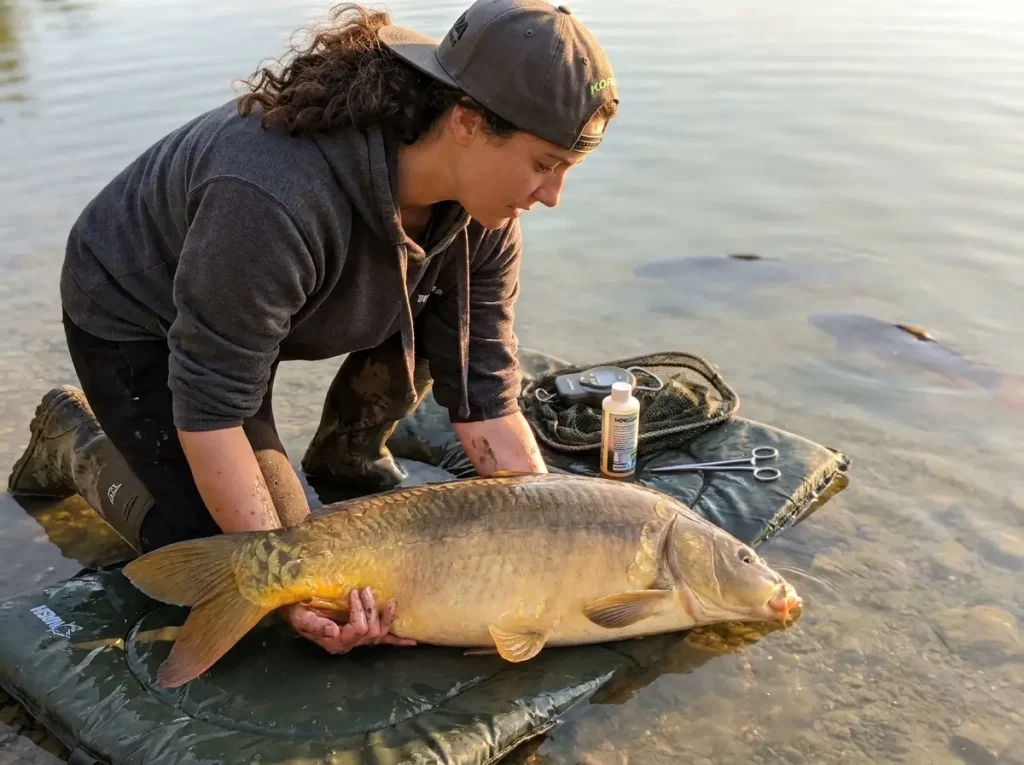
Carp are powerful fish with a protective slime coat that’s essential for disease resistance. Handling them on dry ground or with dry hands strips that slime and leaves them vulnerable. Always carry an unhooking mat — a padded, wetted surface where you lay the fish during hook removal and photos. Wet your hands before touching the fish. Support the belly with one hand and grip the tail wrist with the other. Keep the fish low to the ground in case it thrashes. Quick photos, then a controlled release in calm water — hold the fish upright and let it kick away under its own power.
In the US, common carp regulations vary wildly by state. Many states classify them as unregulated and encourage harvest — no daily limit, no size limit. Others require a standard freshwater fishing license. Check your state fish and wildlife agency before your trip, and review the USFWS invasive carp management guidelines for the broader context on carp management across the country. Our article on proper warm-water fish handling to prevent post-release harm covers the physiology behind why summer catch-and-release demands extra care.
Conclusion
Summer carp fishing in shallow water works because the fish have biological reasons to be there — dissolved oxygen, forage concentration, and thermal comfort all peak in the shallows during the warm months. The anglers who blank in July are the ones casting deep and waiting. The ones who catch fish are reading the water at their feet.
Start with what you have. A can of corn, a simple hair rig, and a pair of polarized sunglasses will catch carp from any farm pond, park lake, or reservoir cove in the country. Read the shallows before you cast, stay quiet on the bank, and let the fish tell you where they want to eat.
The summer carp bite is there. You just have to stop looking past it.
Q1 What is the best bait for carp in summer?
Sweet corn is the most effective and accessible summer carp bait across US waters. It combines a scent profile carp respond to with easy availability at any grocery store. Pack bait and bread crust are strong alternatives, with boilies and particle baits reserved for more experienced setups.
Q2 How deep do carp feed in hot weather?
In summer, carp typically feed in 1-4 feet of water during dawn, dusk, and midday weedbed windows. Dissolved oxygen levels drop in deeper water due to thermal stratification, pushing carp into the shallow, oxygenated zones where weedbeds concentrate food and comfort.
Q3 What time of day is best for summer carp fishing?
The first two hours after sunrise and last two before sunset produce the most consistent shallow bites. The overlooked midday window — roughly 10 AM to 2 PM — catches fish in weedbeds where photosynthesis peaks dissolved oxygen production.
Q4 Do carp feed in shallow water during summer?
Carp actively feed in shallow water throughout summer, driven by higher dissolved oxygen levels and concentrated food sources in the littoral zone. Look for mudding, tailing, and bubble trails as confirmation that fish are present and feeding in the shallows.
Q5 What rigs work best for carp in shallow water?
The hair rig with a 1-ounce or lighter lead is the foundation for shallow water carp fishing. Method feeders, zig rigs, and surface rigs each cover different feeding scenarios. The key adjustment for shallow water is reducing lead weight and shortening hooklinks to minimize disturbance.
Risk Disclaimer: Fishing, boating, and all related outdoor activities involve inherent risks that
can lead to injury. The information provided on Master Fishing Mag is for educational and informational purposes
only. While we strive for accuracy, the information, techniques, and advice on gear and safety are not a substitute
for your own best judgment, local knowledge, and adherence to official regulations. Fishing regulations, including
seasons, size limits, and species restrictions, change frequently and vary by location. Always consult the latest
official regulations from your local fish and wildlife agency before heading out. Proper handling of hooks, knives,
and other sharp equipment is essential for safety. Furthermore, be aware of local fish consumption advisories. By
using this website, you agree that you are solely responsible for your own safety and for complying with all
applicable laws. Any reliance you place on our content is strictly at your own risk. Master Fishing Mag and its
authors will not be held liable for any injury, damage, or loss sustained in connection with the use of the
information herein.
Affiliate Disclosure: We are a participant in the Amazon Services LLC Associates Program, an
affiliate advertising program designed to provide a means for us to earn advertising fees by advertising and linking
to Amazon.com. As an Amazon Associate, we earn from qualifying purchases. We also participate in other affiliate
programs and may receive a commission on products purchased through our links, at no extra cost to you. Additional
terms are found in the terms of service.