
In this article
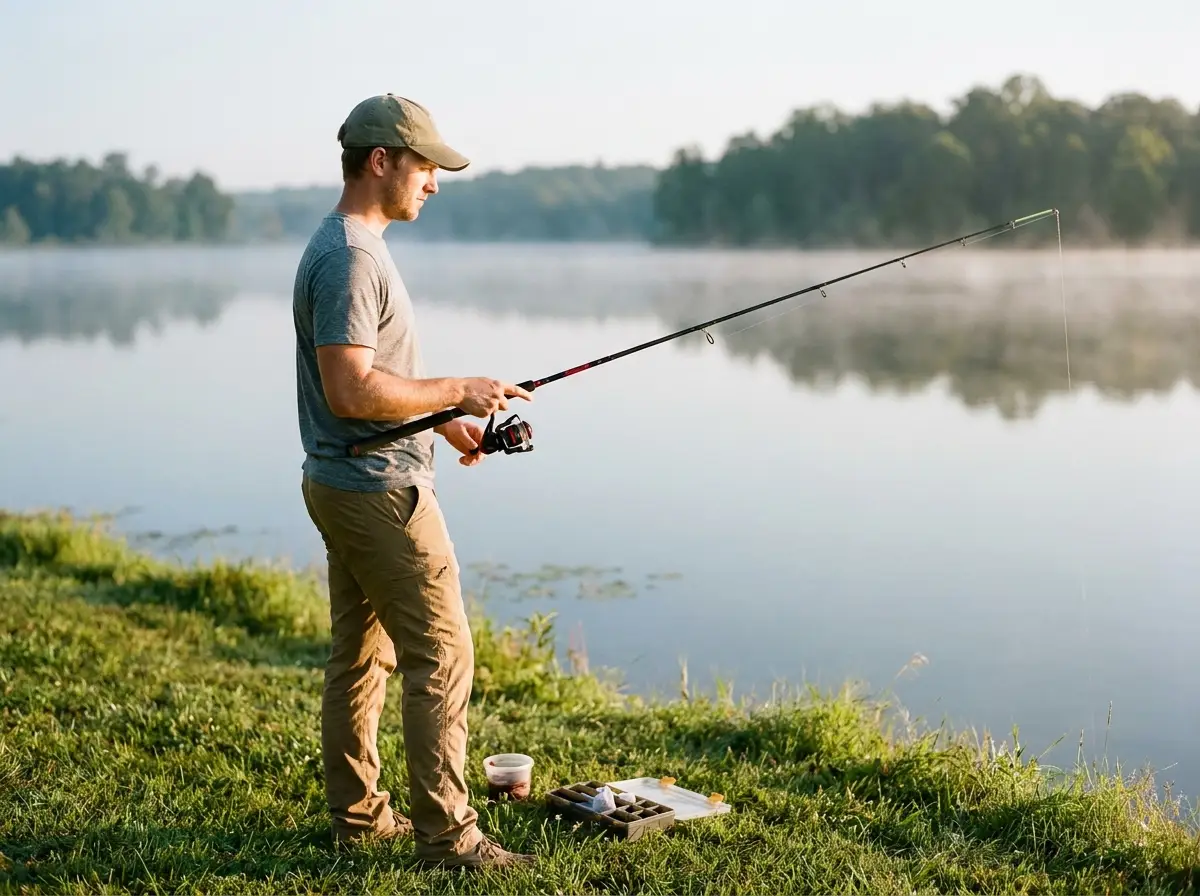
Picture yourself standing in the middle of a tackle shop, forty feet of fishing rods on one wall, a glass case of reels on the other, and a teenage employee who clearly wants to be anywhere else. The easy move is to grab the priciest baitcaster on the rack because it looks like what the pros use, drop two hundred dollars, and walk out feeling official. That is also how most people end up with a setup that fights them instead of catching fish. The truth is simpler and cheaper: one balanced spinning combo, the right monofilament, and a drag set correctly will out-fish that fancy rig nine times out of ten. Here is the exact ready-to-fish kit for under a hundred dollars, why each piece earns its spot, and the first rig to tie when you reach the water.
Why One Spinning Combo Beats Buying Parts
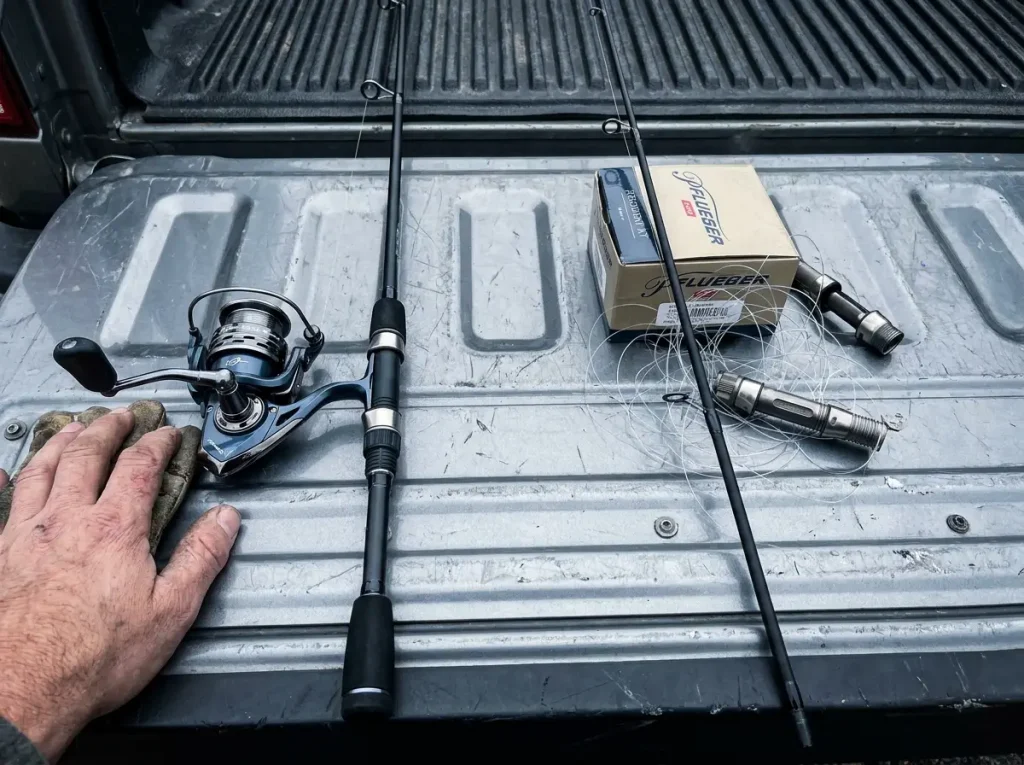
A rod and reel combo is sold matched together as a single purchase, and that pairing is doing more work than it looks like. The reel seat fits the reel that comes with it. The line guides are sized and spaced for the line that reel is built to throw. The whole thing balances in your hand instead of feeling tip-heavy or butt-heavy. Buy a bare rod and a separate reel as a first-timer, and the odds are good you end up with a setup that casts worse than the combo you skipped.
A Combo Is a Feature, Not a Compromise
There is a quiet assumption among beginners that buying pieces separately is the “real” way to do it, like assembling your own bike. For somebody who already knows what action they want and which reel size matches it, sure. For your first setup, pairing your own parts usually nets you a worse-fishing rod, not a better one. The combo makers already solved the matching problem for you, and they did it at a price you cannot beat buying retail piece by piece. If you want the full reasoning, here is the case for building your first fishing setup around one balanced combo.
Why Spinning, Not Baitcasting
A spinning reel hangs under the rod and the line peels off a fixed spool, which means it does not backlash. A baitcaster sits on top and the spool spins as the line leaves it, which is exactly why beginners spend their first afternoon picking out tangled bird’s nests instead of fishing. The baitcaster looks pro on the shelf and feels like punishment at the water. Start with spinning, get your reps in, and step up later if you ever actually need to. There is a longer breakdown of why a spinning reel is almost always the right first reel if you want to see how the other types stack up.
One Setup, Most of the Fish
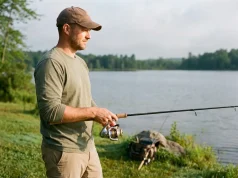
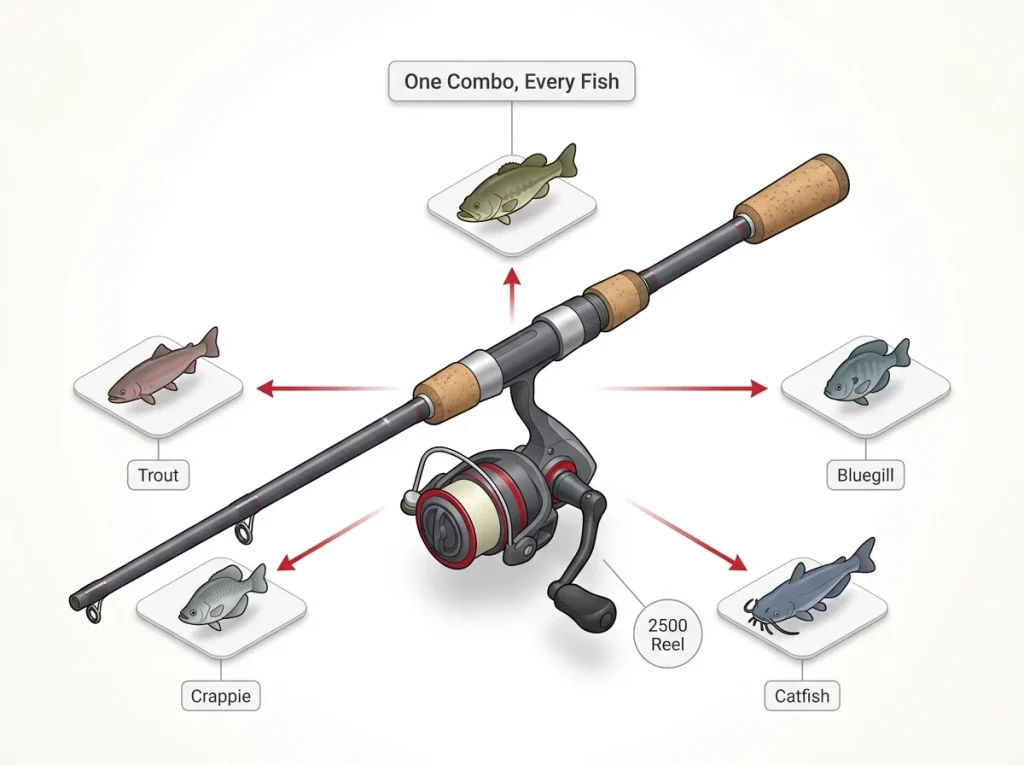
The setup in this guide covers largemouth bass, trout, crappie, bluegill, and a dozen other species you are likely to meet on a pond or lake. You do not need a bass rod and a trout rod and a panfish rod to start. A 6-foot-6 medium spinning combo with 8 pound mono will handle all of it from a bank or a small boat. Specialization comes later, after you have figured out what you actually like to catch.
The Rod and Reel That Cover Almost Everything
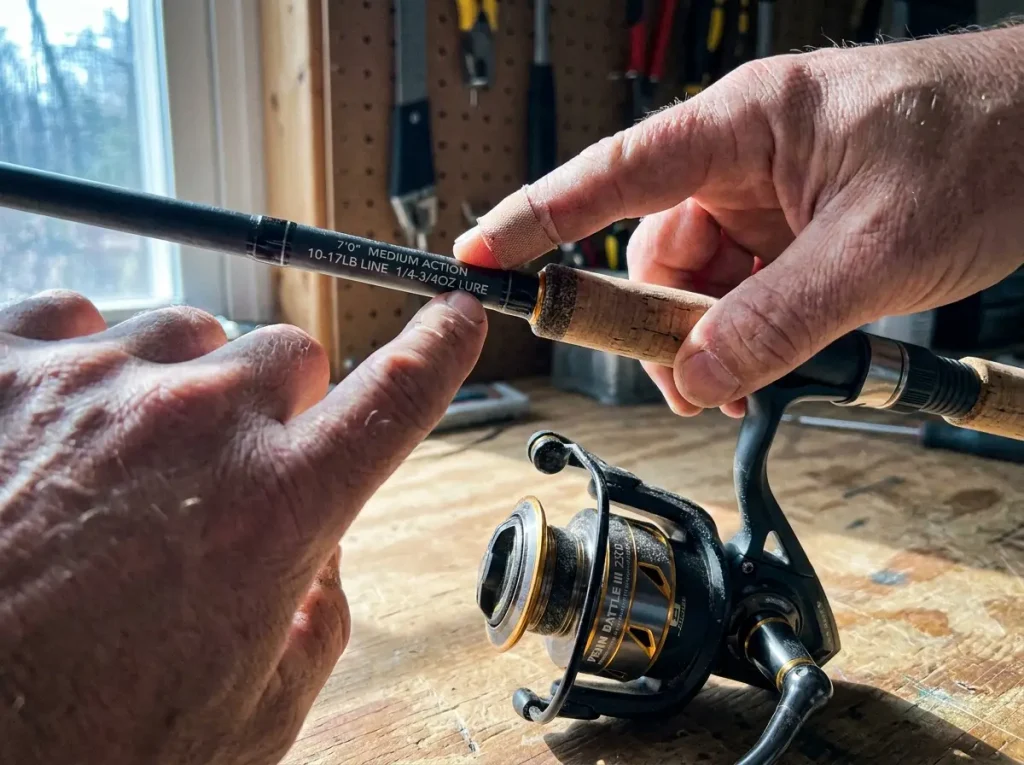
Walk up to the rod rack knowing two numbers and a couple of words, and the wall of choices shrinks to a handful. You want a 6-foot-6 to 7-foot spinning rod, medium power, fast action, matched to a size 2500 reel. That combination is the closest thing fishing has to a default setting, and it exists because it works for almost everyone, almost everywhere.
What the Rod Numbers Mean
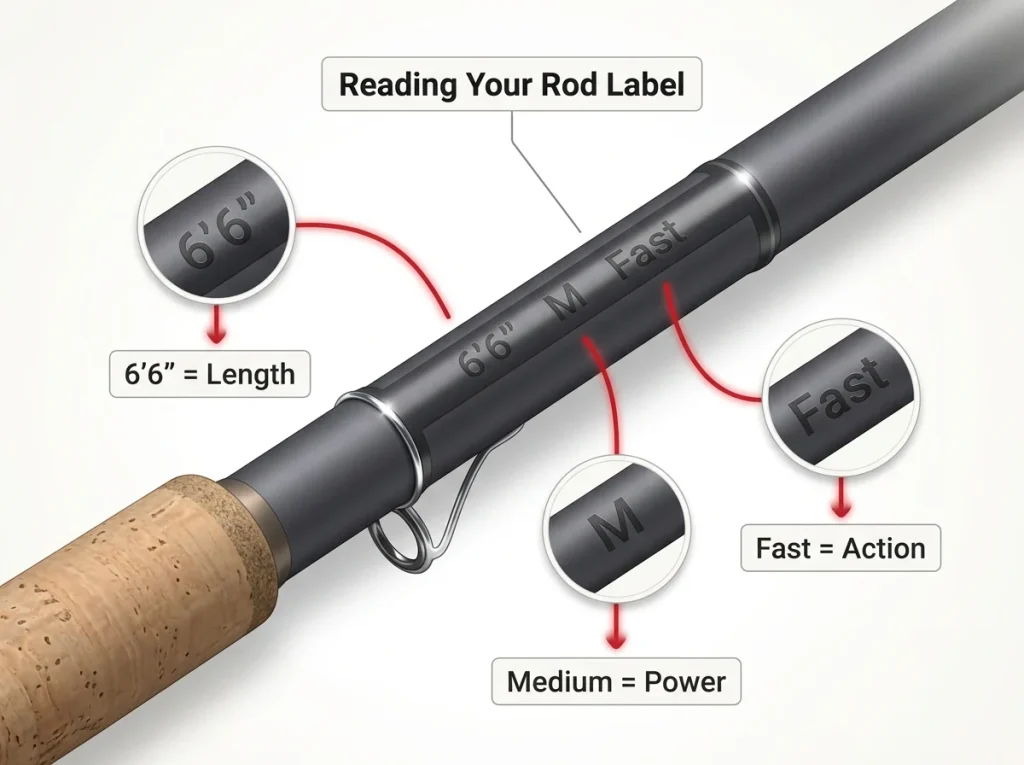
Every rod has its specs printed on the blank just above the grip. Length is straightforward: 6-foot-6 gives you control and accuracy, 7-foot gives you a little more casting distance. Power describes how much force it takes to bend the rod, and medium is the sweet spot for a beginner, with enough backbone for a solid bass and enough give for a panfish. Action describes where the rod bends, and fast action means it flexes near the tip, which gives you a quicker hookset and better feel. If the alphabet soup on the label still looks like a foreign language, this guide to what each part of the rod label is telling you walks through it slowly.
Why a 2500 Reel Is the Sweet Spot
A size 2500 reel, sometimes written 25 or 250 depending on the brand, is the universal beginner spinning size. Its line capacity is roughly 120 to 140 yards of 8 pound mono, which is more than enough that no panfish or average bass will ever strip you down to the spool. It is light enough to cast all day without your wrist complaining, and it balances perfectly on a 6-foot-6 medium rod. Ask any guide what reel to put in a beginner’s hand and you will hear “a 2500” before you finish the question.
Matching Rod to Reel
This is the part the combo solves for you. A 2500 reel on a 6-foot-6 medium rod balances right at the reel foot, so the setup feels weightless and points where you aim it. Bolt a heavy surf reel onto a light rod and the thing pivots in your hand like a seesaw. Buy the matched combo and you never think about this. Buy separately and you have one more way to get it wrong.
Spooling the Right Line Without the Tangles
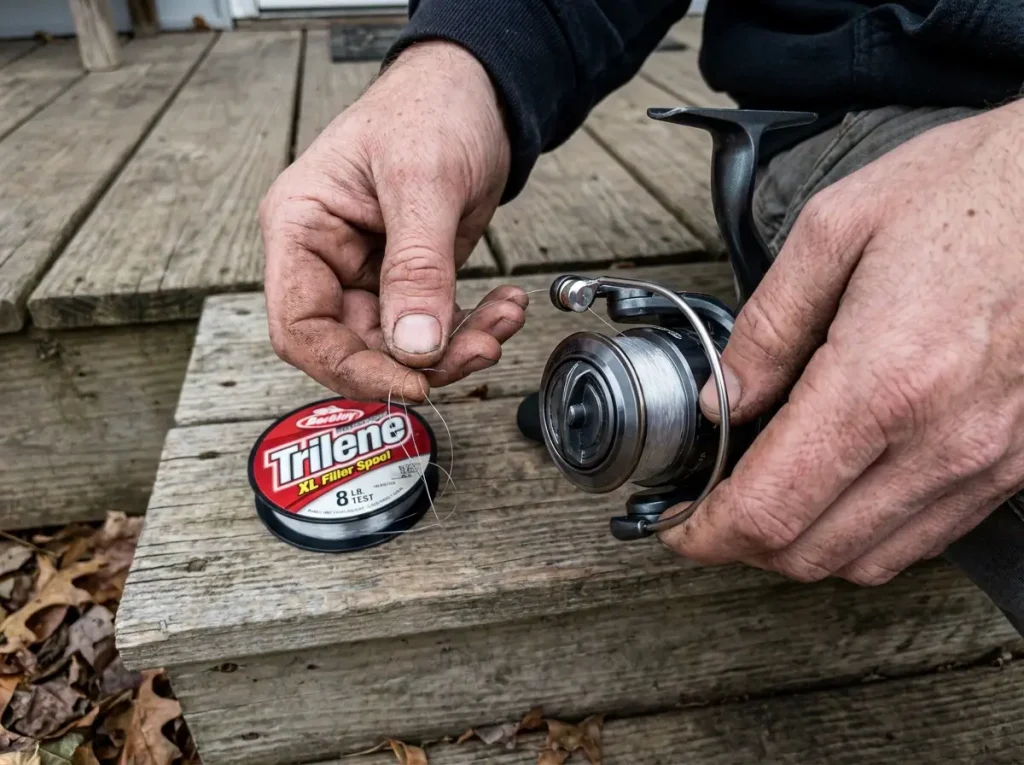
Here is something nobody tells beginners until after they have already cursed at a tangled reel: most “my reel is junk” problems are actually a line problem, and specifically a spooling problem. The line you choose and the way you wind it on decide whether your first trip is fishing or untangling.
Why Mono Is the Beginner’s Line
Monofilament line is a single strand of nylon, and it stretches 20 to 30 percent before it breaks. That stretch is your friend. It forgives a hard hookset when you yank too soon, it cushions a clumsy fight when you are still learning to play a fish, and it ties easy knots that actually hold. Braid has no stretch and punishes mistakes; fluorocarbon is stiff and pricey and earns its keep as a leader, not a main line for a beginner. Spool up with 8 to 10 pound mono and you have the most forgiving line on the market. A good pick is the Berkley Trilene XL in 8 pound, clear (check it on Amazon), a low-memory mono that lays smooth and ties clean, with a 330-yard spool that fills a 2500 reel twice over. If you want the full comparison, here is why monofilament beats braid and fluoro for a beginner.
Spool It So It Doesn’t Twist
Mono winds onto a spinning spool in a specific direction, and getting it backward is the number one cause of the loops and wind knots beginners blame on the reel. Lay the filler spool flat on the ground, label facing up, and let the line come off it the same way the reel’s bail turns. Fill the reel spool to about an eighth of an inch below the rim, no more, because an overfilled spool throws loops off on every cast. Close the bail by hand instead of cranking it shut, and watch the line for twist as it goes on. Do those few things and you stop ninety percent of wind knots before they start.
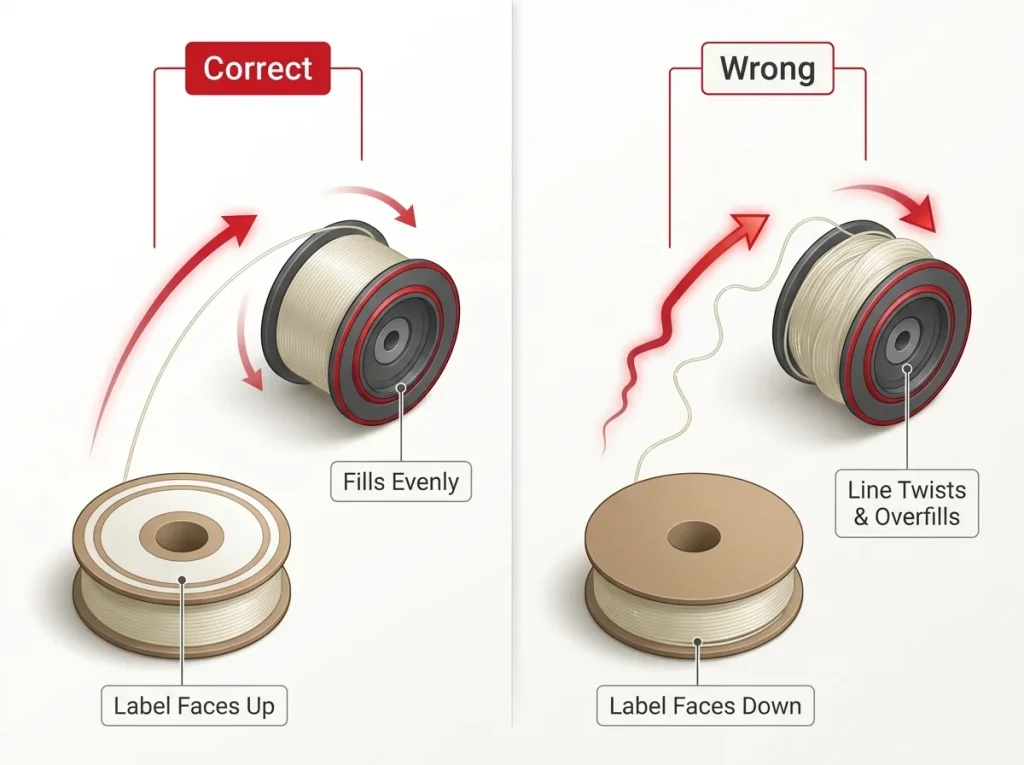
Lay the new line spool on the floor, label up, and pull a few feet off before you start winding. If the line coils into loops in the air, flip the spool over. That thirty-second check is the difference between a smooth day and a morning spent picking knots.
How Much Line a 2500 Needs
A 2500 reel takes about 120 to 140 yards of 8 pound mono to fill correctly, and a 330-yard spool gives you enough to fill it twice with backing to spare. You will not use all of it in a fight, but a properly filled spool casts farther and tangles less than a half-empty one. When the line starts to coil and misbehave after a season of sun, strip it and respool. The exact six-step way to spool any reel without twist covers the whole process if you want to watch it done.
Setting the Drag the Right Way
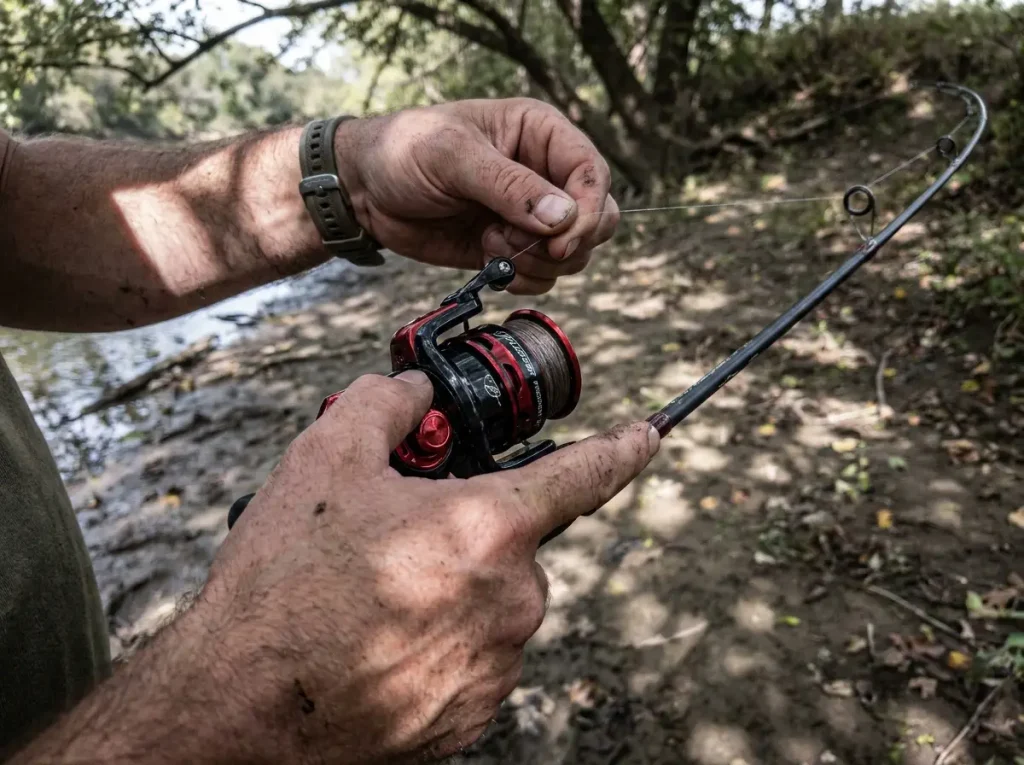
If there is one skill that separates the people who land their first fish from the people who tell a sad story about the one that snapped off, it is this. The drag, not the rod, is what fights the fish. And almost every beginner sets it wrong in the same direction.
Why Drag Loses More Fish Than the Rod
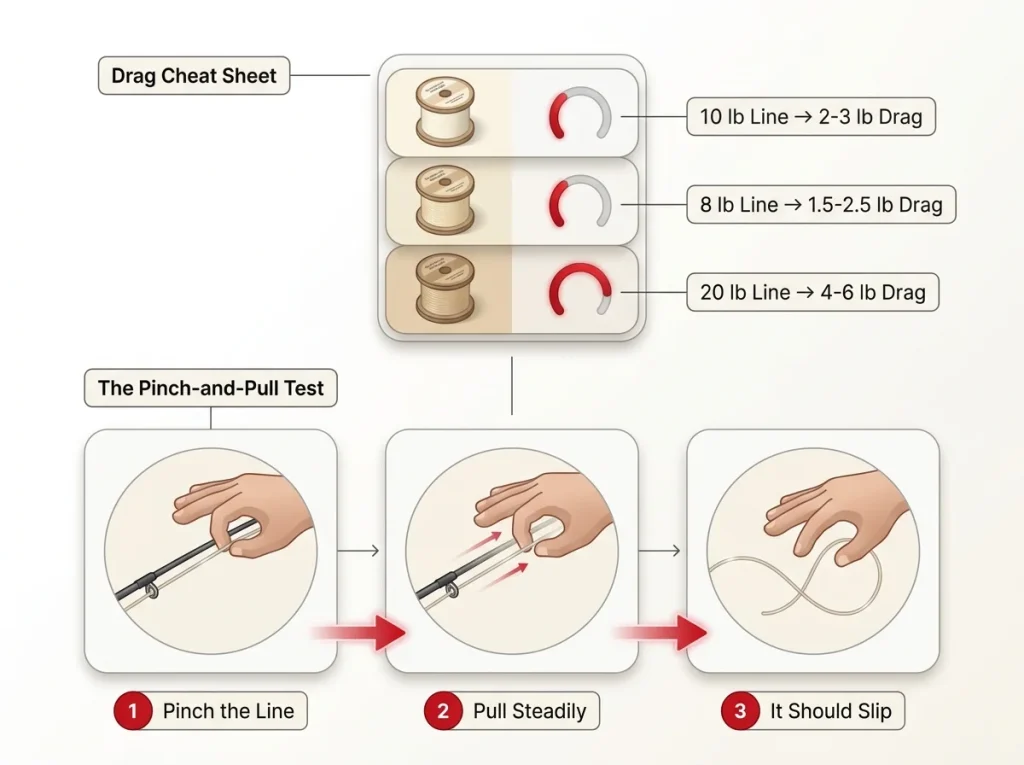
The drag is the slipping clutch inside your reel that lets line pay out under pressure so a fish cannot simply snap it. Set it to roughly 20 to 30 percent of your line’s pound test, which is about 2 to 3 pounds of pull on 10 pound line. Cranked too tight, a hard run hits a wall and the line pings, or the hook tears straight out of a crappie’s paper-thin mouth. Set too loose, you cannot drive the hook home on the set and a decent fish strips you down to the spool. The beginner instinct is to bolt the drag down tight “so the fish can’t pull,” which is exactly the setting that loses the fish. A reel with a genuinely smooth drag makes this easier to get right, and the Pflueger President XT combo (see it on Amazon) is the common step-up there, with a front drag that pays out in a smooth slip instead of a jerky stutter. The gear-and-drag mistakes that quietly cost beginners fish go deeper into where this goes wrong.
The Pinch-and-Pull Test
You do not need a scale to set drag. Tie your line to something solid, or just pinch it over one finger above the first guide, and pull. The line should slip out against the drag well before you feel like you are about to break it. If you have to yank hard to make it give, it is too tight. If it slides out under almost no pressure, it is too loose. Set it at home, dry, on the couch the night before, so you are not fumbling with it while a fish is already pulling. This short demo shows the pinch-and-pull test in motion, which is worth more than any paragraph.
For a second opinion straight from the people who teach this for a living, here is how to set your drag the right way before the first cast.
Set your drag before you ever tie on a hook, not after a fish is already running. In the heat of a fight, every beginner cranks it the wrong way. Get it right on the couch the night before, and leave it alone.
Let the Drag Do the Fighting
Once a fish takes line, stop reeling. Cranking the handle against a slipping drag does nothing but twist your line into loops and knots. Keep the rod tip up, let the drag wear the fish down, and reel only when you can actually gain line. When the fish surges, let it run. When it pauses, take back what you can. That rhythm is the whole game, and the correctly set drag is what makes it possible.
The Complete Ready-to-Fish Shopping List
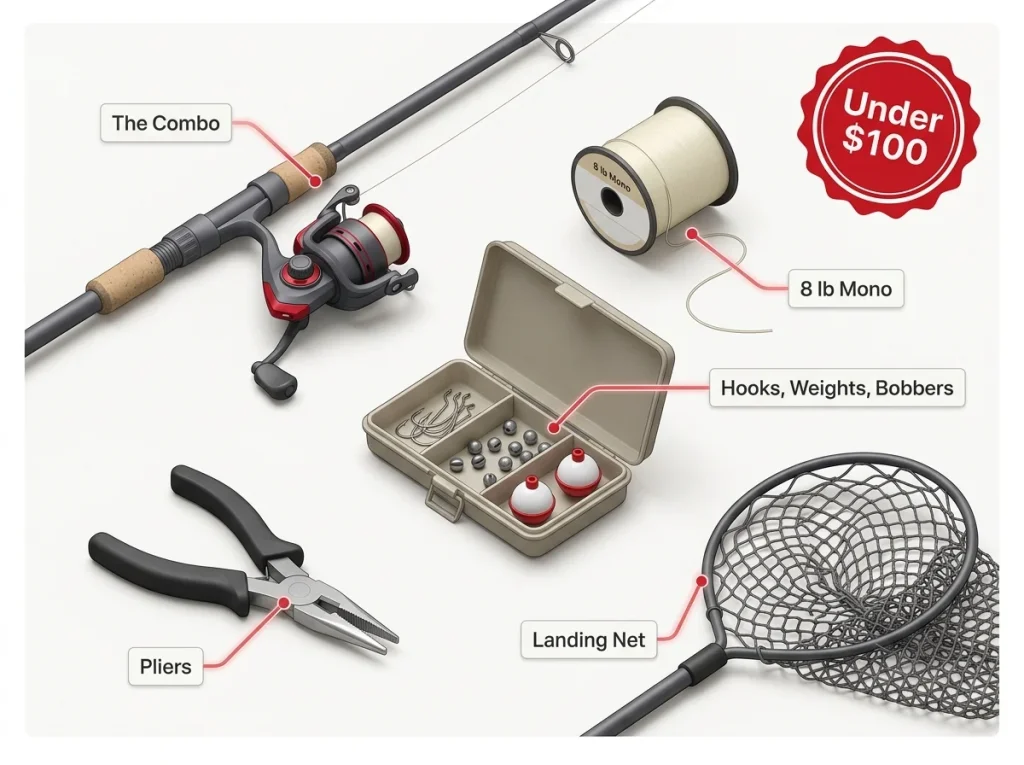
This is the part nobody else hands you. Most “best setup” articles tell you to buy a combo and “get some tackle,” then leave you to figure out the rest. Here is the entire kit, laid out, every piece you need to walk to the water and catch a fish, for somewhere around eighty to a hundred dollars total.
The Budget Combo That Just Works
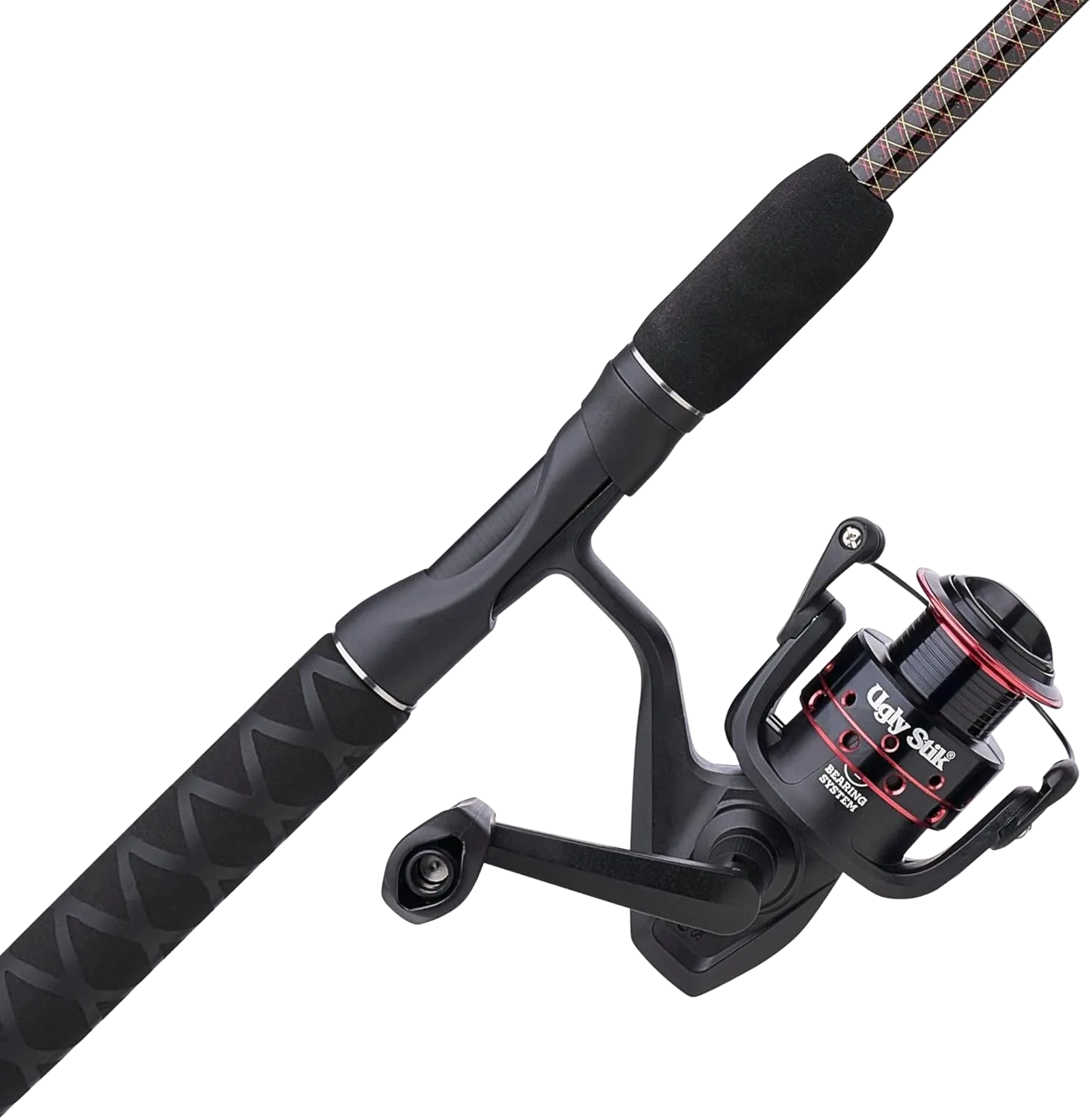
The Ugly Stik GX2 is the combo that has been putting fish in beginner hands for decades, and the reason is dead simple: it is almost impossible to break and it just fishes. The blank has a clear fiberglass tip that telegraphs a bite without being so stiff it rips hooks loose. The matched reel is smooth enough to be honest. It is the budget pick on this page and the one I would hand a complete first-timer without a second thought.
The Step-Up Combo Worth the Extra
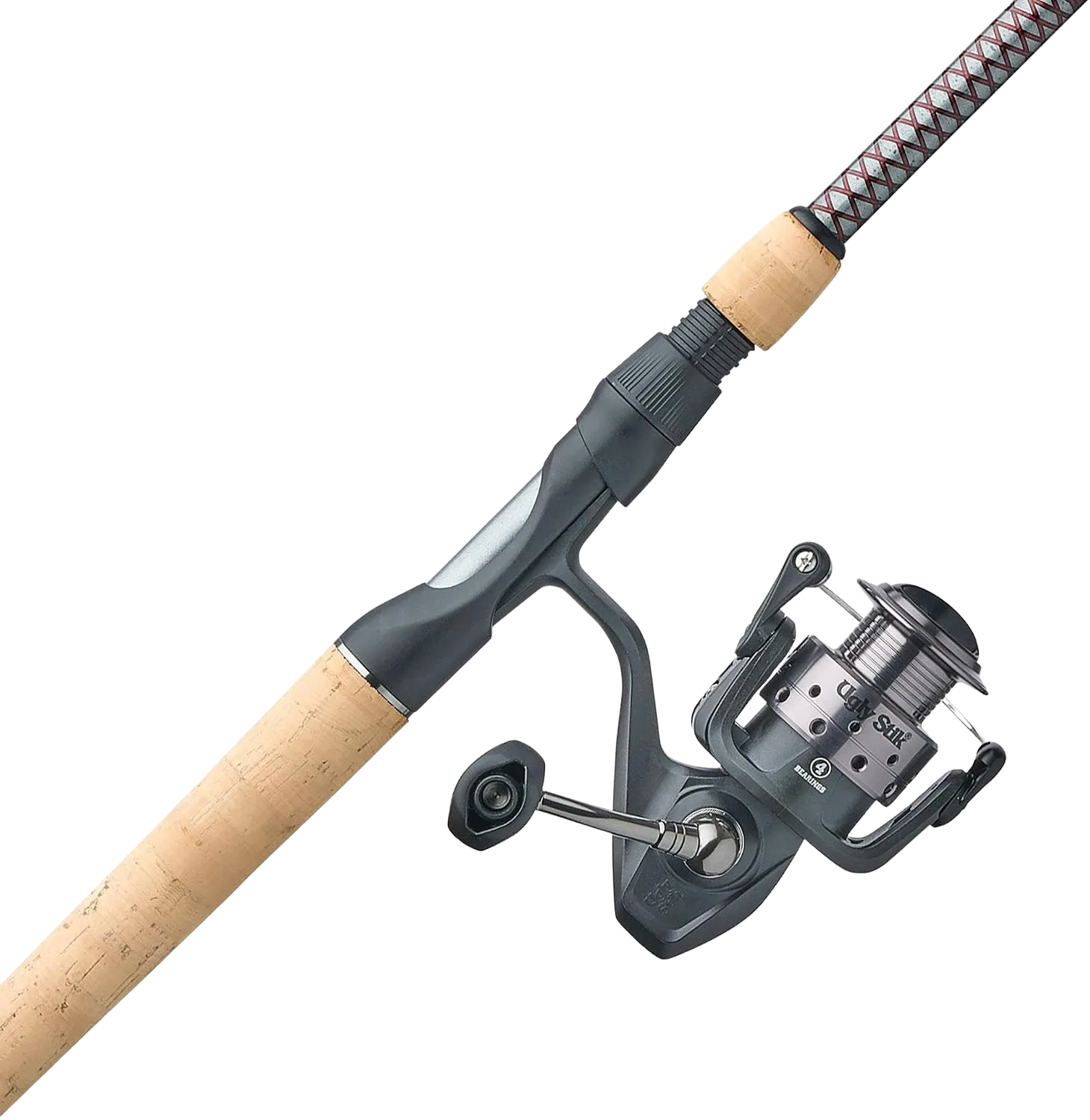
The Ugly Stik Elite is what you buy if you already suspect fishing is going to stick. It keeps the bombproof reputation but swaps in a graphite-and-fiberglass composite blank that you can actually feel a light bite through, plus a cork grip that beats the foam on the cheaper model. It costs more than the GX2 and earns it for the angler who wants one rod to grow into instead of a starter to replace.
The $10 Terminal-Tackle List
Terminal tackle is the stuff at the business end of your line, and the entire beginner list is tiny. You need size 6 to 8 Aberdeen hooks, a small assortment of split shot weights, and two or three bobbers. That is genuinely it for catching ninety percent of the freshwater fish a beginner will target. Aberdeen hooks have thin wire and a long shank, which means they bend out of a snag instead of costing you the whole rig, and they back out of a fish easily when you are still learning to handle one. The whole kit costs about ten dollars.
Buy thin-wire Aberdeen hooks on purpose. When you hang up on a log, you can usually pull the hook straight rather than break off and re-tie. Thick “tough” hooks just cost you rigs and patience while you learn where the snags are.
The Tools That Finish the Kit
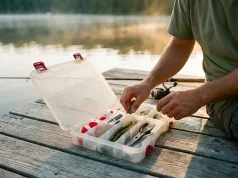
Three small things turn a pile of gear into a setup. First, somewhere to keep it: a Plano 3600 ProLatch tackle box (on Amazon) holds the whole minimum kit and clicks shut so your hooks do not end up loose in the trunk. Resist the giant tackle chest; you do not have enough gear to fill it and you never will at this stage. Second, a pair of fishing pliers: the KastKing Cutthroat 7-inch pliers (on Amazon) back a hook out of a fish, or out of your thumb, and snip line clean. This is the one tool beginners skip and then regret the first time a bluegill swallows the hook. Third, a net: the SF rubber-mesh landing net (on Amazon) lifts a fish without scraping off its protective slime coat, which matters if you plan to release anything. That rounds out the kit. A beginner genuinely needs about seven pieces, not seventy, and the one place cheap gear quietly costs you fish is the drag, so spend there before anywhere else.
Tying Your First Rig and Catching Day One
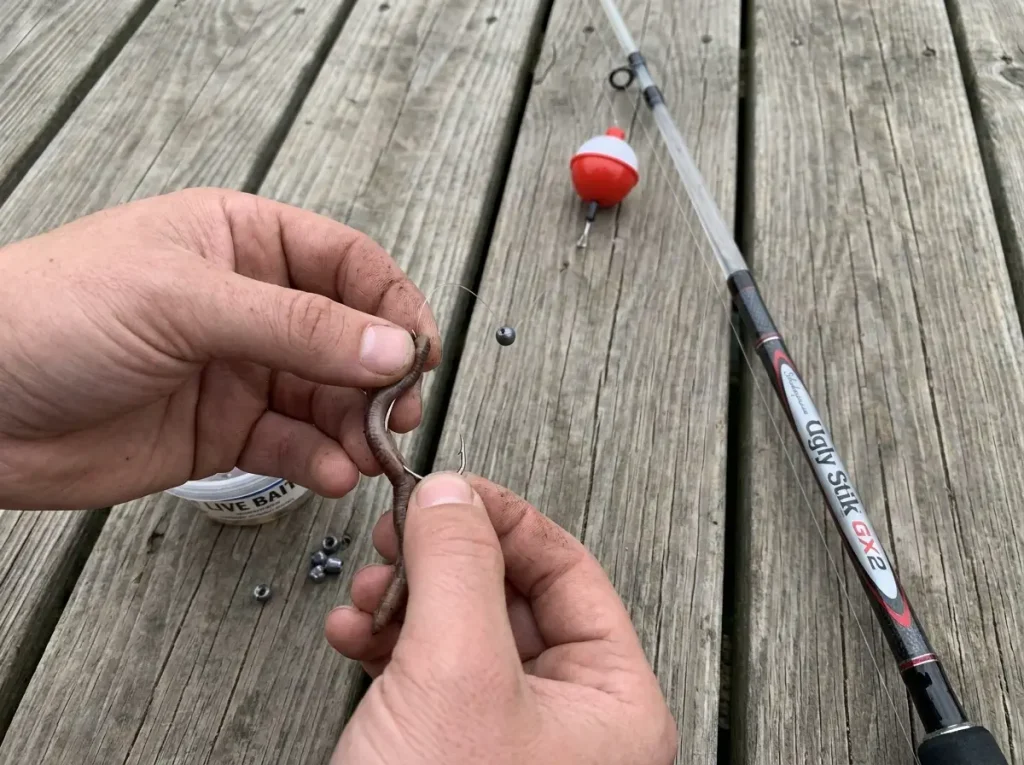
You have the gear. Now here is the part that actually puts a fish on the bank, the thing the buy-this-combo articles never get around to telling you. You need one simple rig and a worm, and you need to be legal to fish where you are standing.
The Split-Shot Bobber Rig
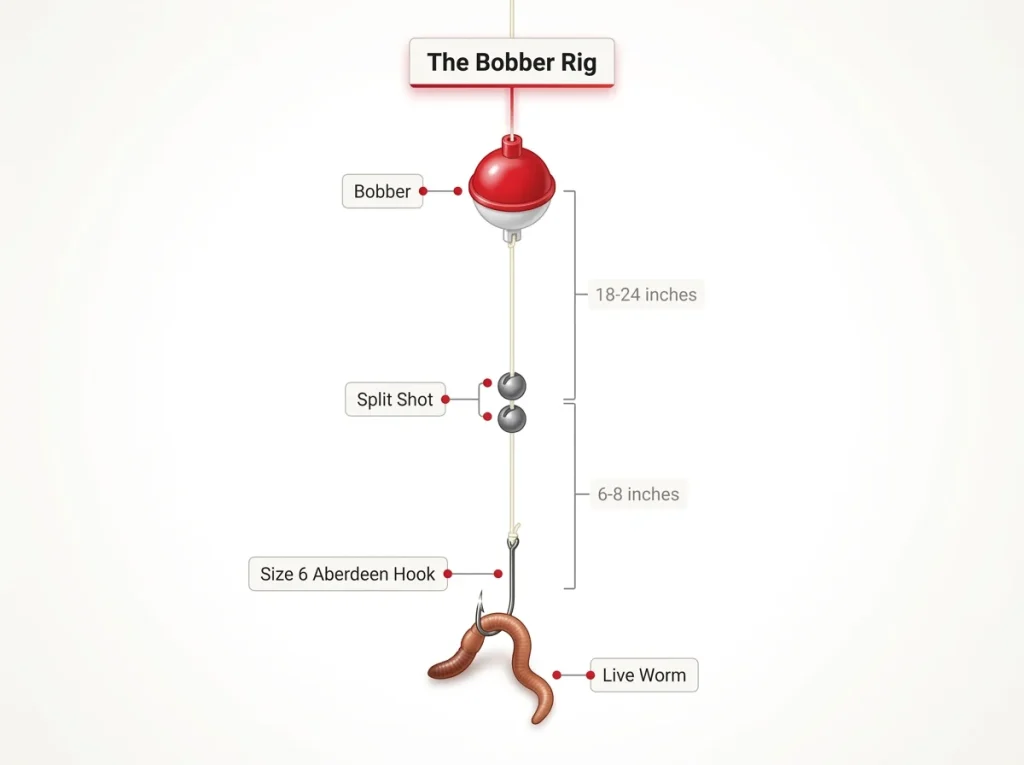
This is the rig that has hooked more first fish than every fancy lure combined. Clip a bobber onto your line 18 to 24 inches above the hook. Pinch one or two split shot weights onto the line 6 to 8 inches above the hook to get the bait down and keep the bobber upright. Tie a size 6 Aberdeen hook to the end, thread on a live worm so a little of it wiggles free, and cast it out near some cover. When the bobber dips and slides under, that is your bite. For dialing in exactly how deep to set the bobber so your bait sits right in the strike zone, here is the full rundown on fishing a simple bobber rig. This quick video shows the whole rig coming together from bare line to baited hook.
Why a Worm Beats a Lure on Day One
There is a reason the worm is a cliché. A live worm under a bobber out-fishes a tackle box of expensive lures for a first-timer almost every time, because it does the hard part for you. A lure only catches fish if you work it correctly, with the right cadence and retrieve, and that is a skill you do not have yet. A worm just sits there smelling like food. Start with bait, learn what a bite feels like and how to set the hook and fight a fish, and graduate to lures once the basics are muscle memory.
Do not set the hook the instant the bobber twitches. Wait for it to actually go under and start moving away, then lift the rod tip firmly. Beginners pull the bait out of the fish’s mouth early far more often than they miss a real take.
Get Your License First
Before your first cast, get legal. Most states require a fishing license for adults, though youth, seniors, anglers with disabilities, and some veterans are often exempt. The fee is small, usually less than a tank of gas, and it is not a tax grab. License dollars fund the federal Sport Fish Restoration program that turns license dollars into stocked water, hatcheries, and boat ramps, a system that has poured billions back into the fisheries you are about to enjoy. Check what a license costs and who is exempt in your state before you head out, because that first ticket costs far more than the license would have. Buy it online in five minutes and keep it on your phone.
What You Don’t Need Yet
The fastest way to spot a nervous beginner is the mountain of gear they think they need. Half of being good at this early on is knowing what to skip, and the anti-sell here is the honest version of the advice you will not get from someone trying to move inventory.
Gear You Can Skip for Now
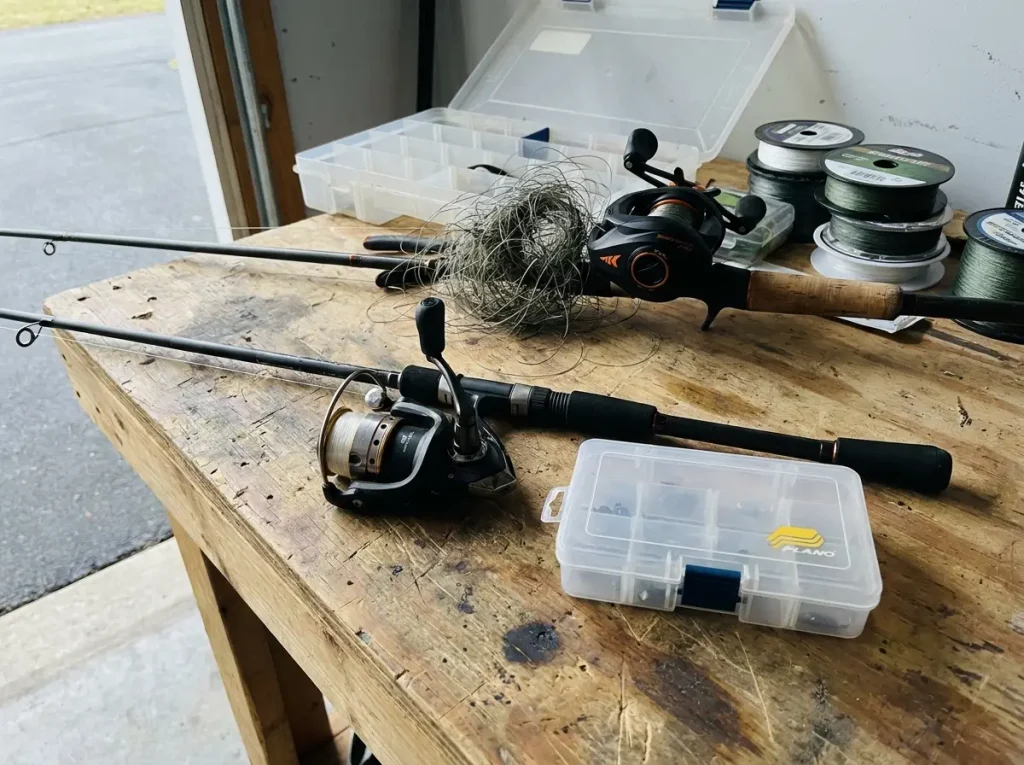
Skip the baitcaster until you have a season under your belt and a specific reason to want one; on day one it is a backlash machine. Skip the second rod, because you can only fish one at a time and you do not yet know what specialty you would even be buying for. Skip the giant tackle chest, the premium braided line, the fluorocarbon leader spools, the electronic bite alarms, and every gadget that promises to find fish for you. None of it catches more first fish than a worm under a bobber on a balanced combo. Add gear when a real, specific need shows up on the water, not before. The over-buyer freezes in the tackle aisle; the under-buyer is already fishing.
When You’d Step Up to Saltwater Gear
Everything above assumes freshwater, a pond, lake, or river. If you are heading to the salt, the setup forks: step the 2500 reel up to a sealed-drag 4000-class reel, switch to braided line with a fluorocarbon leader, and rinse every piece of gear with fresh water after each trip or the salt eats it alive. That is a different article, and you do not need to think about it until your first inshore trip is actually on the calendar. Here is why the reel, not the rod, is the part that fails first in saltwater if that is where you are headed.
Conclusion
Three things matter more than anything else when you are starting out. Buy one balanced spinning combo instead of a pile of mismatched parts, because the matching is half the battle and the combo makers already won it for you. Set your drag to a fifth or a third of your line’s pound test and let it, not the rod, fight the fish. And remember the whole ready-to-fish kit, combo, line, hooks, weights, bobbers, and the few tools that finish it, comes in under a hundred dollars.
Buy the combo, spool it with 8 pound mono tonight, set the drag on the couch before you sleep, and tie up a bobber rig. Then go put a panfish on the bank this weekend. That first fish is closer and cheaper than the tackle aisle wants you to believe.
Frequently Asked Questions
01What is the best fishing setup for a complete beginner?
One balanced spinning combo: a 6-foot-6 medium, fast-action rod with a size 2500 reel, spooled with 8 to 10 pound monofilament. Add hooks, split shot, and bobbers and you are ready to fish for under $100.
02What size reel should a beginner use?
A size 2500 spinning reel is the universal beginner choice. It holds enough 8 pound mono for any pond or lake fish, balances on a 6-foot-6 rod, and is light enough to cast all day without tiring your wrist.
03How much should you spend on a beginner fishing setup?
Plan on $80 to $100 for the complete kit. A solid combo runs $50 to $90, line is about $10, and the terminal tackle is another $10. Spending more does not catch more fish at the beginner stage.
04What pound test line should a beginner use?
Go with 8 to 10 pound monofilament. It has enough stretch to forgive hard hooksets, ties easy knots, and handles everything from panfish to bass. Save braid and fluorocarbon for after you have the basics down.
05Is spinning or baitcasting better for beginners?
Spinning, without question. A spinning reel does not backlash, so you spend your first trip fishing instead of untangling. Baitcasters offer more control for experienced anglers but punish beginners with bird’s nests.
Risk Disclaimer: Fishing, boating, and all related outdoor activities involve inherent risks that
can lead to injury. The information provided on Master Fishing Mag is for educational and informational purposes
only. While we strive for accuracy, the information, techniques, and advice on gear and safety are not a substitute
for your own best judgment, local knowledge, and adherence to official regulations. Fishing regulations, including
seasons, size limits, and species restrictions, change frequently and vary by location. Always consult the latest
official regulations from your local fish and wildlife agency before heading out. Proper handling of hooks, knives,
and other sharp equipment is essential for safety. Furthermore, be aware of local fish consumption advisories. By
using this website, you agree that you are solely responsible for your own safety and for complying with all
applicable laws. Any reliance you place on our content is strictly at your own risk. Master Fishing Mag and its
authors will not be held liable for any injury, damage, or loss sustained in connection with the use of the
information herein.
Affiliate Disclosure: We are a participant in the Amazon Services LLC Associates Program, an
affiliate advertising program designed to provide a means for us to earn advertising fees by advertising and linking
to Amazon.com. As an Amazon Associate, we earn from qualifying purchases. We also participate in other affiliate
programs and may receive a commission on products purchased through our links, at no extra cost to you. Additional
terms are found in the terms of service.