
In this article
Half the sunglasses sold to anglers with POLARIZED stamped on the tag never get tested, and the test that settles it takes ten seconds in front of a laptop screen. That gap is where most of the money in this category quietly disappears, because a dark lens and a polarized lens do completely different jobs and only one of them shows you fish. The honest version of this guide covers what polarization actually removes, what glass buys you over polycarbonate at three times the price, which tint belongs on which water, and ten pairs sorted by how you actually fish. Here are the picks that answer the most common cases before we get into why.
| Category | Pick | Lens | Best For |
|---|---|---|---|
| Best Overall | Costa Del Mar King Tide 8 | 580G glass | One pair for offshore, inshore and boat days |
| Best Budget | Torege Pure Cratos | Polycarbonate | Entry point before you commit real money |
| Best Inshore and Sight Fishing | Bajío Cocho | Mineral glass | Reading bottom contrast in skinny water |
| Best Premium Glass | Maui Jim Southern Cross | PolarizedPlus2 glass | Offshore anglers who want top-end clarity |
| Best for Readers | Fishoholic Polarized Bi-Focal | Polycarbonate with magnification | Tying knots without swapping glasses |
What Polarized Lenses Actually Do on the Water
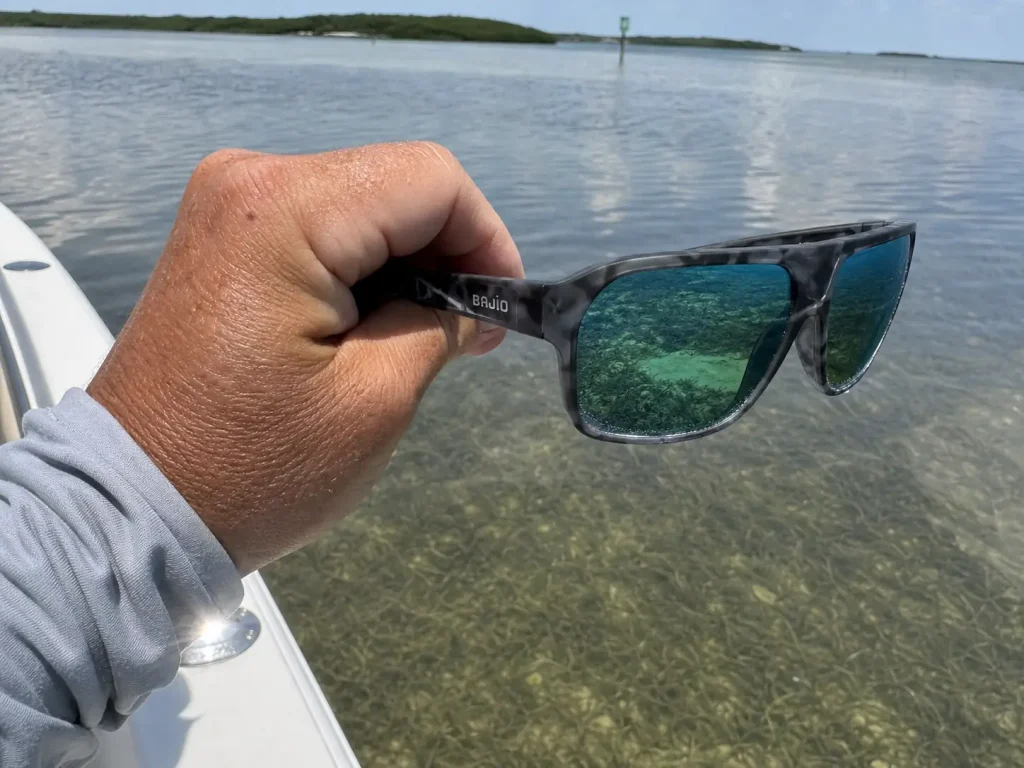
Every angler who has swapped a gas station pair for a real polarized pair remembers the moment the water stopped being a mirror. The drop-off appears. The grass edge sharpens. The dark shape you had been looking through for twenty minutes turns out to be a fish. That flip is not about darkness, and understanding why is the difference between buying well and buying twice.
Why Glare Comes Off Water Horizontally
When sunlight hits a flat water surface at a shallow angle, the light that bounces back gets organized. Instead of vibrating in every direction, most of it ends up oscillating horizontally, which is why surface glare on a lake reads as one flat sheet of white rather than scattered brightness. A polarized filter is a grid of molecules aligned to block exactly that horizontal component while letting the rest through.
The result is selective. The glare disappears, and the light coming up from under the surface, the light carrying the grass, the sand hole and the fish, passes straight through to your eye. If you want the deeper version of this, including how the lens axis has to be oriented to work at all, we broke down the physics of how the polarization axis lines up against water glare separately.
Polarized vs. Just Dark: What Each One Removes
A tinted lens is a dimmer switch. It reduces every wavelength coming at your eye by roughly the same amount, which means the glare gets darker and so does the fish. Your pupils open to compensate, and you end up with the same ratio of glare to detail that you started with, just in a lower key.
A polarized lens changes the ratio itself. It removes the glare disproportionately, so the underwater detail that was always there becomes visible for the first time. This is also why VLT (visible light transmission) and polarization are separate specs: a lens can be very dark and not polarized, or fairly light and strongly polarized.
What You Gain to See Once the Glare Is Gone
The practical payoff is reading water. Grass lines, sand pockets, submerged timber, the color change where a flat drops into a channel, and the moving shadow that turns into a redfish before it turns into a wake. Anglers call it “blowing out” when the surface gets bad enough that none of that is readable anymore, and a good polarized lens pushes that moment back by hours.
How far down you can see still depends on water clarity, and no lens invents detail that is not there. What polarization does is let you use whatever visibility the water is offering, so you are spotting structure in the water column instead of blind fishing a spot you have to guess at.
Worth being clear on one thing: polarization, UV protection and tint color are three different jobs riding on the same lens. A pair can nail one and fail another, which is why the tag alone tells you almost nothing.
The Eye Damage Anglers Do Not See Coming

There is a guy at every ramp who has fished five days a week for thirty years and now has a fleshy white wedge creeping across the inside corner of his eye. Nobody warned him at twenty-five, because the entire category talks about sunglasses as a performance item. The health case is the stronger argument, and no roundup makes it.
Pterygium and Why Anglers Get It
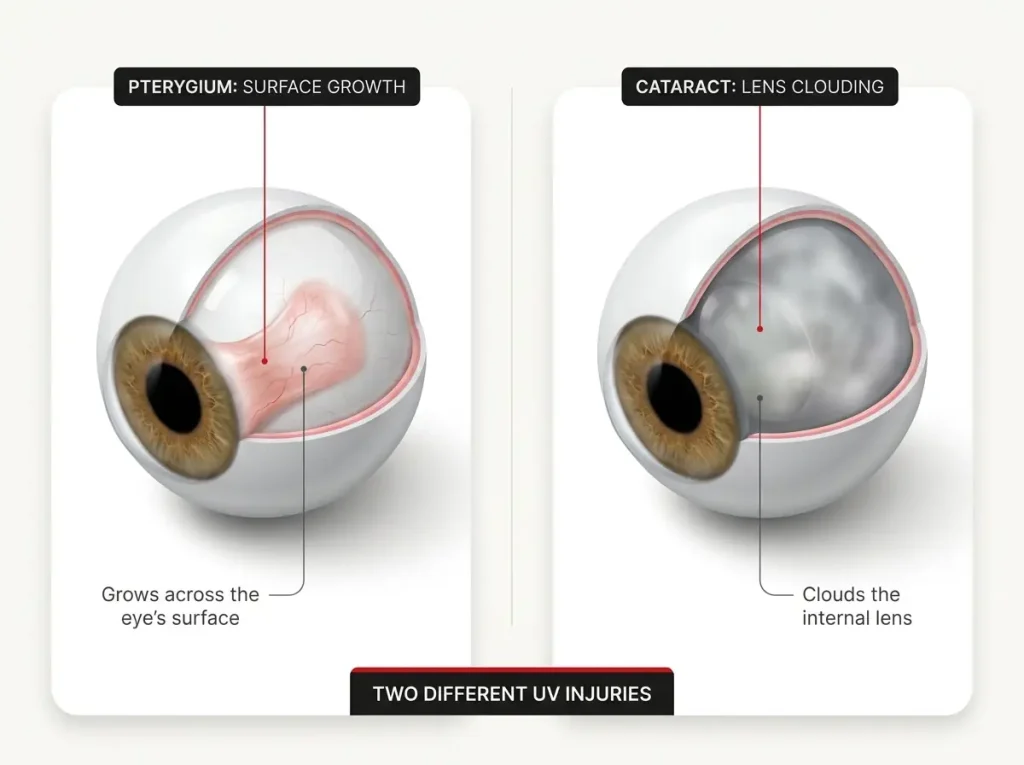
That white wedge has a name. It is what eye doctors call pterygium, or “surfer’s eye”, a permanent growth anglers and surfers develop after years without real UV protection, and it shows up disproportionately in the three groups who spend their working lives outdoors under reflected light: surfers, farmers and fishermen.
It is a tissue growth on the surface of the eye, not inside it. Small ones are cosmetic and irritating. Larger ones distort vision and get removed surgically, and they come back often enough that removal is not a clean fix. The cause is straightforward accumulated UVA UVB exposure to unprotected eyes.
Cataract Risk and Cumulative Exposure
Cataracts are a separate injury with a separate mechanism, clouding the internal lens of the eye rather than growing across the surface. And as the American Academy of Ophthalmology notes, cumulative UV exposure, not just a single bright afternoon, is what drives long-term eye damage. One frequently cited study population showed a 57% higher cataract rate among people who did not wear sunglasses regularly.
The word doing the work there is cumulative. No single day on the water hurts you in a way you can feel, which is exactly why the habit never forms. It is fifteen seasons of afternoons, and the bill arrives long after the trips stop being memorable individually.
Why Water Doubles the Dose
Standing on a boat deck, you take UV from the sky and again off the surface, which is a meaningful multiplier compared with the same hours spent in a yard. OSHA flags 10 a.m. to 4 p.m. as the peak intensity window for outdoor workers, and that window is the exact stretch most anglers are sitting on open water with nothing overhead.
A hat brim handles the top. It does nothing about the reflected dose coming up off the water into the underside of your eye, which is the part anglers underestimate. Sunglasses are one component of a full-day system, and the rest of it, shirts, gaiters and brim geometry, is covered in our guide to the rest of a real sun protection setup for a full day on the water.
The Blackout Test That Outs a Fake Polarized Lens
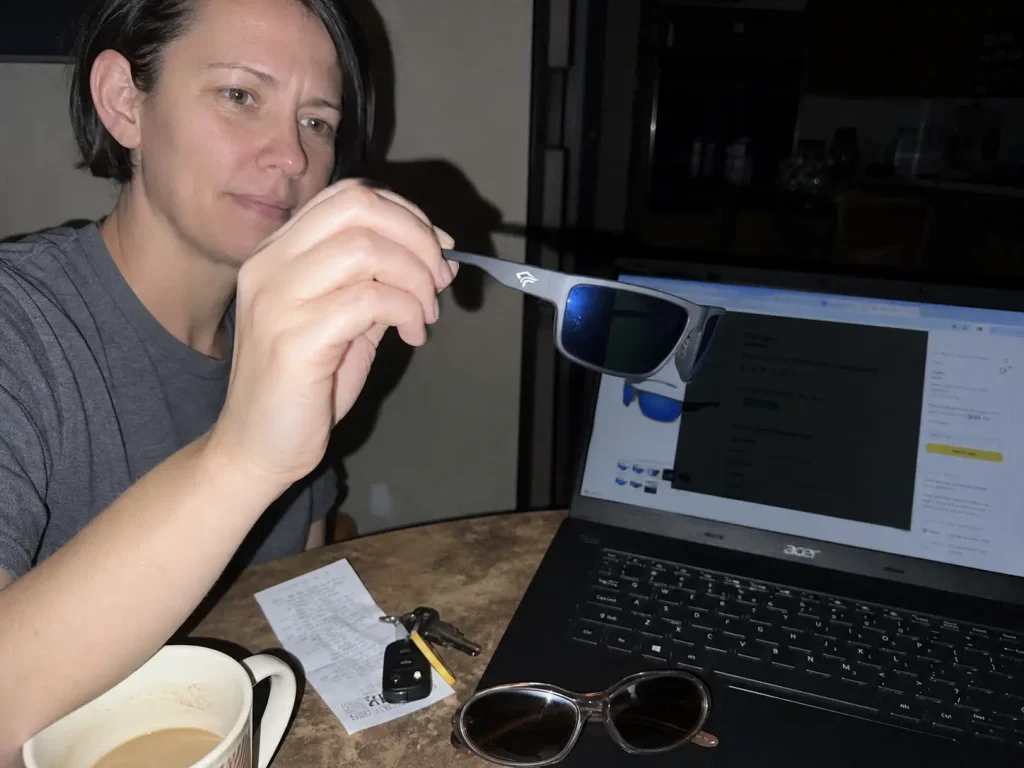
Standing in an aisle with a cheap pair that says POLARIZED on a sticker, there is exactly one way to know before your money moves. It costs nothing, takes half a minute, and almost nobody does it.
How to Run the Test in Thirty Seconds
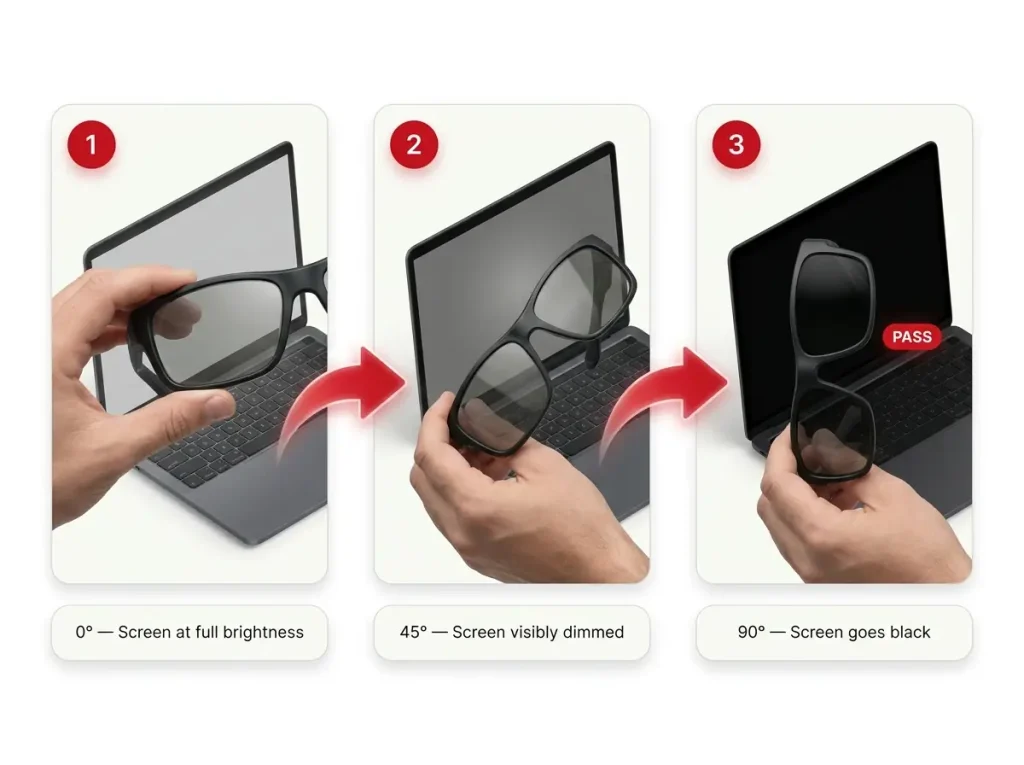
Hold the sunglasses up in front of an LCD monitor at arm’s length, look through one lens at the screen, and slowly rotate the frame about ninety degrees. A genuinely polarized lens will go to near-total black at a specific angle, because the screen’s own light is already polarized and your lens is now crossed against it. A dark tint that is only pretending will dim a little and never black out.
Any laptop, desktop monitor or store display screen works. If you have no screen at all, use two pairs: hold one lens in front of another and rotate. Two real polarized lenses will black each other out at ninety degrees. This is what anglers mean when they say blackout test, and it is a pass or fail with no middle ground.
Why Your Phone Screen Gives a False Reading
Do not run this on your phone. Most modern phone screens are OLED, and their light behaves differently from an LCD panel, so you can get a weak or misleading result on a lens that is genuinely fine. Use a laptop or a desktop monitor and the answer is unambiguous.
The same behavior is worth knowing about because it works against you on the boat too. Marine electronics use polarized displays, and the same polarization behavior is why your fish finder screen can go black behind your sunglasses at certain head angles, which catches out plenty of anglers who assume the unit has failed.
What a Real Pass Looks Like vs. a Fail
A pass is dramatic. The screen goes essentially black, and rotating back brings it right back. There is no ambiguity, no squinting to decide.
A fail looks like a slight dimming through the whole rotation, the same amount at every angle. That is a sunglass, not a polarized lens. The common mistake here is trusting the tag on the arm, and the second most common is assuming that darker means more polarized, which is not how any of this works.
Run the blackout test on the pair already sitting in your truck before you buy anything. Plenty of anglers find out the “polarized” pair they have been fishing for two seasons was never polarized at all, which explains a lot about why the water always looked like a mirror.
Glass or Polycarbonate: What Each Lens Material Buys You
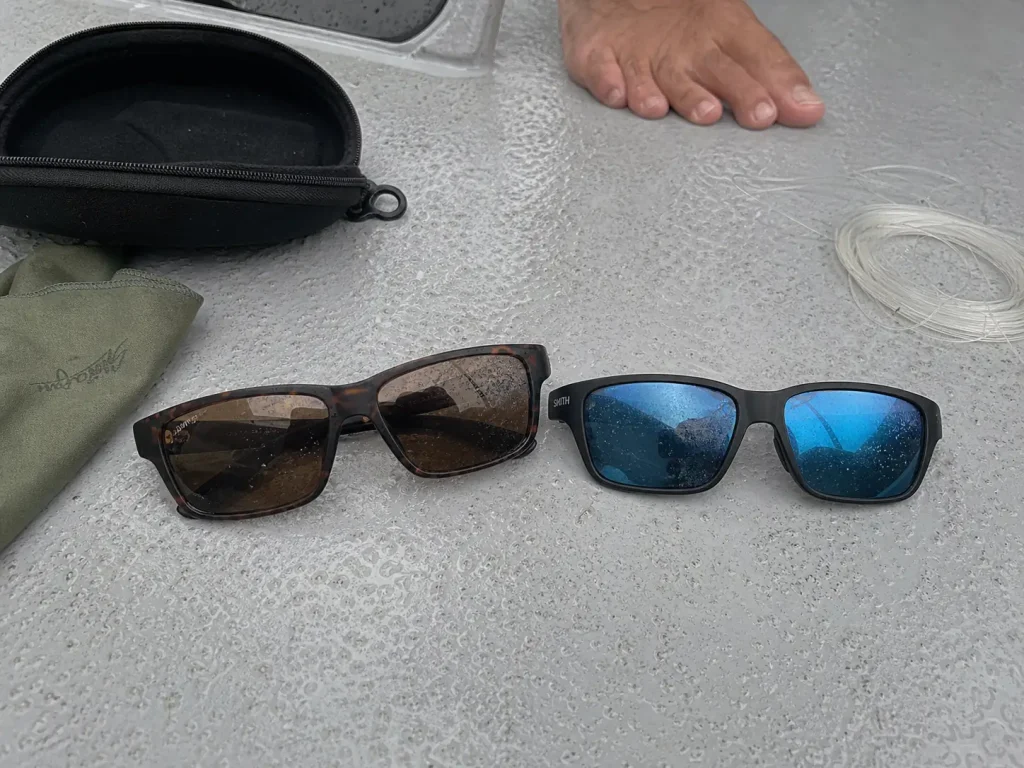
Put two anglers in the same boat, one in glass and one in polycarbonate, and by hour six only one of them is still pushing his sunglasses back up a sweaty nose. That is the tradeoff in one sentence, but it deserves the full version because the marketing gets it backwards.
Optical Clarity and Scratch Resistance (Glass)
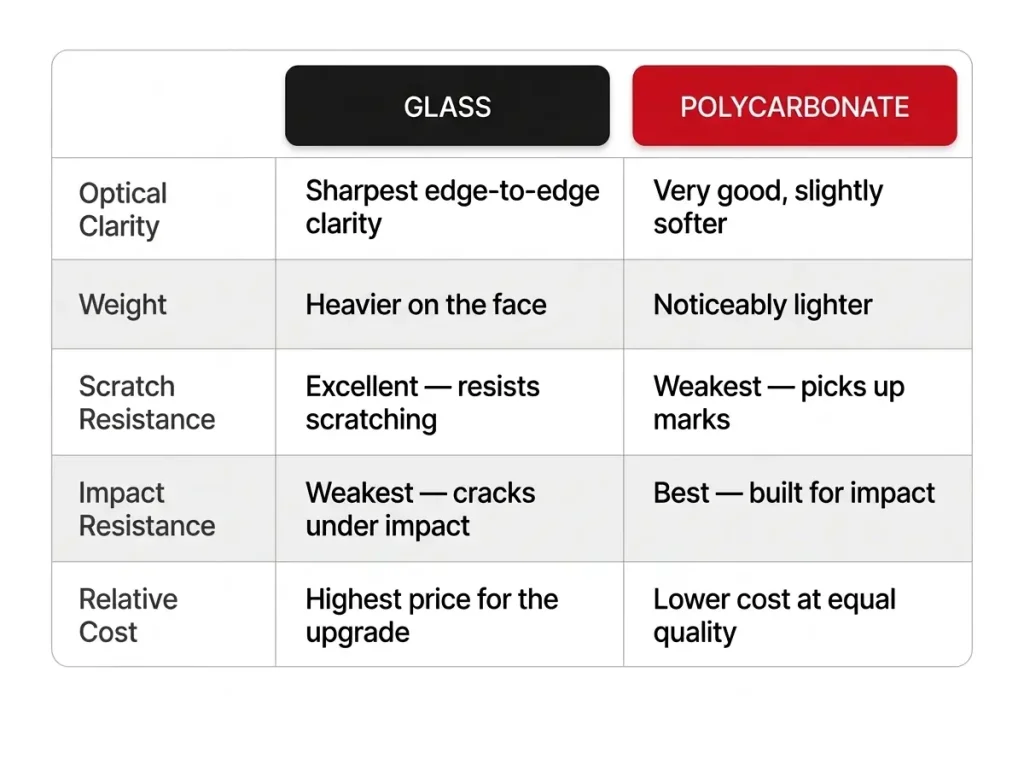
Glass lens designs win on raw optics. Edge-to-edge sharpness is better, distortion at the periphery is lower, and the Abbe value (a measure of how much a lens splits light into color fringes) is higher, so high-contrast edges stay clean. Glass also resists scratching in a way polycarbonate simply cannot, which matters over a lens’s whole life more than most buyers expect.
Costa’s own lineup makes the comparison concrete. Their 580G glass runs thinner and more scratch-resistant than their 580P polycarbonate, with marginally sharper clarity. The company markets 580G as roughly 20% thinner and 22% lighter than other polarized glass, and that qualifier matters: lighter than competing glass, not lighter than poly.
Weight, Impact Resistance, and Cost (Polycarbonate)
Polycarbonate is lighter, cheaper by a meaningful margin at equivalent quality, and considerably tougher against impact. For an angler throwing weighted jigs or casting a heavy fly into a headwind, that last point is not academic. Frames rated to ANSI Z87.1, the ballistic impact standard, are almost always polycarbonate for exactly this reason.
The honest knock is scratches. Poly picks up hairline marks that glass would shrug off, and a coating slows that down without stopping it. What you get in exchange is a lens that survives being dropped on a boat deck, and one that does not slide down your face at hour eight.
Baked-In Polarization vs. Laminated Film
At the cheap end of the market, the material matters less than how the polarization got there. Baked-in polarization means the polarizing layer is fused inside the lens during manufacture. Polarized film means a thin sheet laminated to the surface, and that film is what delaminates, bubbles or peels after a couple of seasons of heat and salt.
This is the single biggest quality line in the category, and it is more predictive of how a pair ages than glass versus poly is. A mid-priced polycarbonate lens with baked-in polarization will outlive a cheap film-laminated one by years.
Is a $300 Glass Pair Worth It Over a $50 Poly Pair
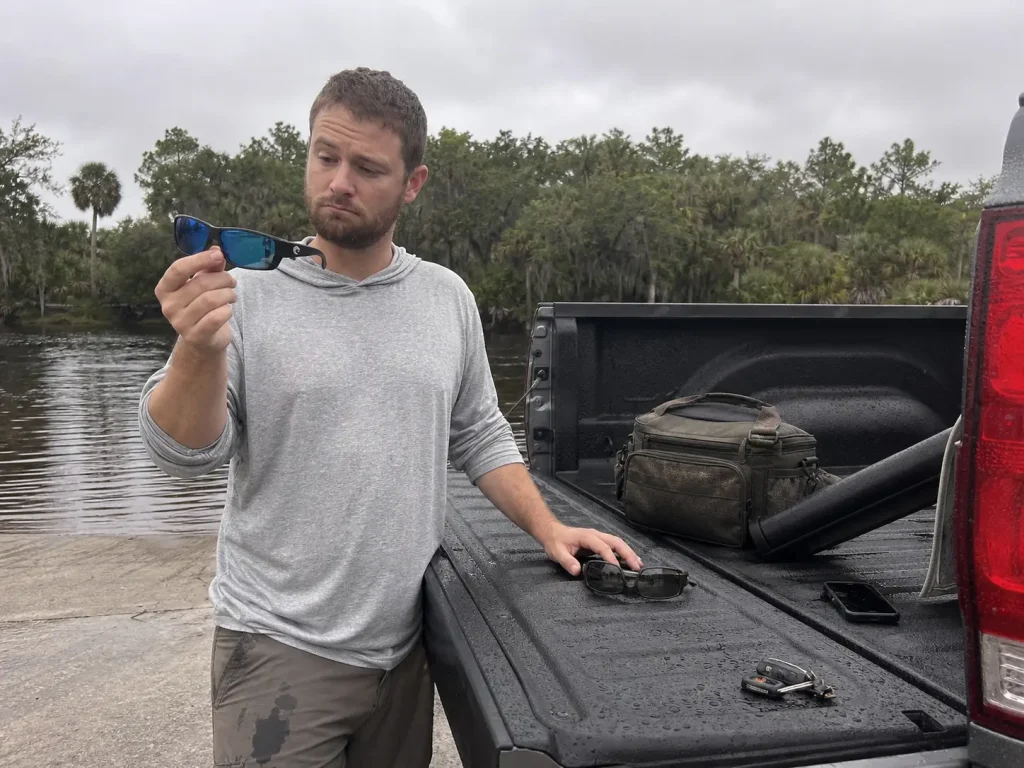
This is the question a friend actually asks in the parking lot, and he deserves a real answer instead of a spec sheet. Here it is, in three parts.
What the Extra Money Genuinely Buys
Sharper edge-to-edge clarity, real scratch resistance, consistent polarization quality that does not drift between units, and frames built from materials like Grilamid TR-90 or bio-based nylon that survive salt, UV and being sat on. It also buys service. Premium brands sell replacement nose pads, temple arms and lenses, so a pair stays in rotation for a decade instead of going in a drawer when one part fails.
The clarity difference is genuine and it compounds. If you are sight fishing, scanning a flat for six hours looking for shapes rather than fish, marginal optical quality translates directly into fish spotted. That is the case where the money is doing real work.
What It Does Not Buy
Comfort. Anglers who fish dawn to dark commonly prefer polycarbonate even when budget is not the constraint, because glass slides down a sweaty nose and you notice its weight by the afternoon. Nobody in the marketing copy mentions this, and it is the most consistent thing you hear from people who fish a lot.
It also does not buy immunity from loss. The more you fish from a moving boat, a kayak or while wading, the worse the expected-value math looks on an expensive pair, and no amount of premium glass changes what happens when the frame goes over the side.
The Verdict by How Much You Actually Fish
If you fish a handful of times a year, or you are still finding out whether this sticks, buy polycarbonate and spend the difference on a license and gas. You will lose approximately nothing in fish spotted.
If you are on the water fifty-plus days a year, and especially if you sight fish, the clarity upgrade is real enough to justify itself. And there is a middle answer most people miss: the jump from entry to mid-range, roughly the $100 to $180 band, captures most of the available optical gain. Going from there to the top of the market is the steepest diminishing return in the category.
Lens Tint Matched to Water and Light
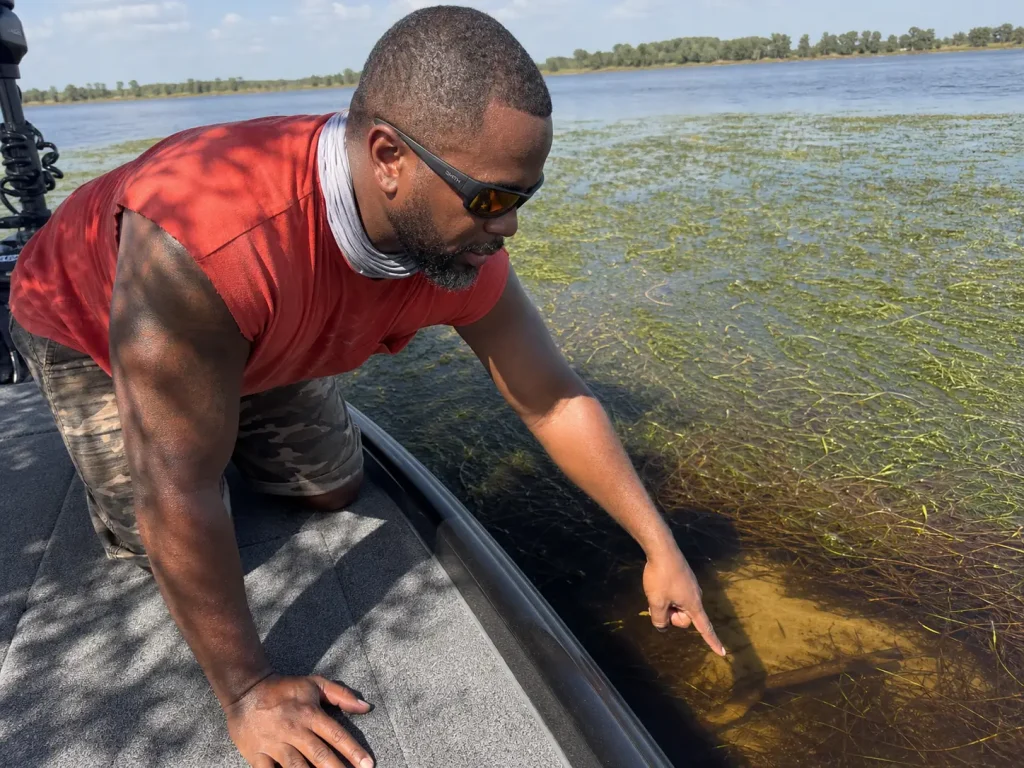
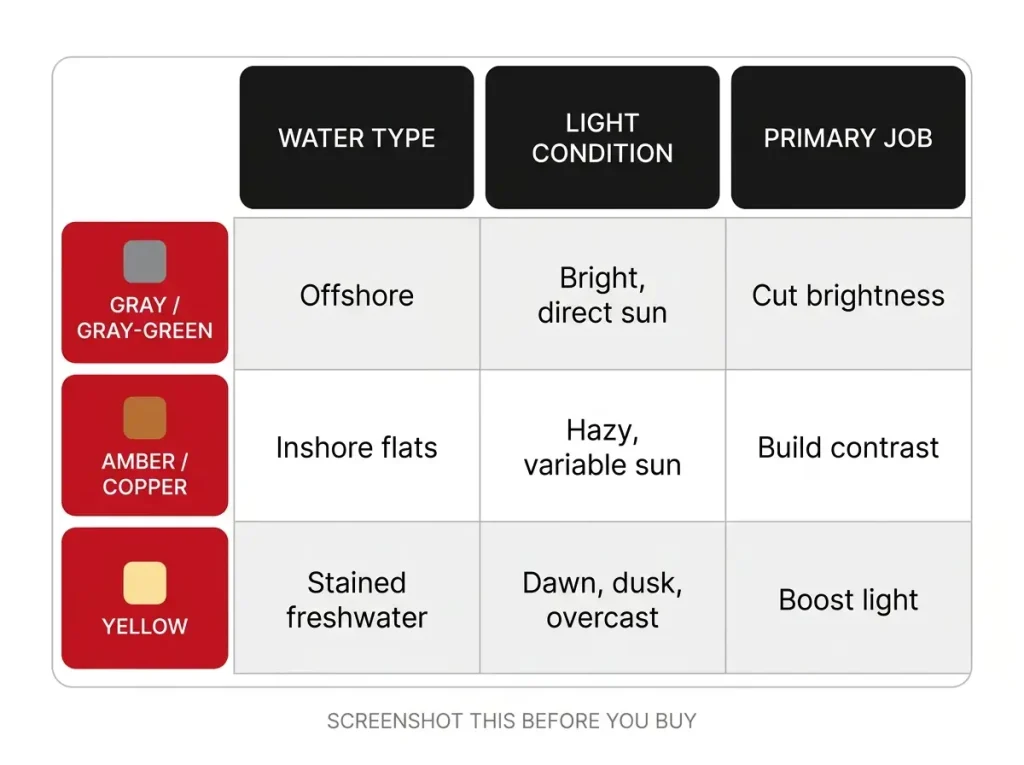
Tint is where anglers buy by looks and regret it quietly for a season. The dark gray lens looks serious in the store and underperforms badly on a shallow grass flat. Match the tint to the water and light you actually fish, and if you want the wavelength reasoning underneath the chart, we covered the science behind why each lens color reads water differently in its own guide.
Gray and Gray-Green for Offshore Brightness
Gray lens and gray-green tints are neutral. They cut overall brightness without shifting color relationships, so what you see is a dimmer version of reality rather than a re-graded one. That is what you want offshore, where the job is surviving raw intensity over deep blue water and the contrast you need is already there.
They are the wrong tool in shallow, stained or low-light water, because neutral means they add nothing back. On a grass flat under a hazy sky, a gray lens hands you a dim, flat scene.
Amber and Copper for Skinny Water Contrast
Amber lens and copper tints work by filtering blue light, which lifts contrast between browns, greens and tans. In skinny water, where you are separating a fish’s shadow from mottled bottom, that contrast boost is the whole game. It also improves depth perception, which is why sight fishing guides live in copper.
The color shift is real and takes an hour to get used to. Everything reads slightly warmer. In exchange you see the edge of the grass, the sand hole and the fish sitting on it.
Yellow for Dawn, Dusk, and Overcast
Yellow lens and other low-light lens tints have very high visible light transmission. They are not there to cut brightness, they are there to boost apparent contrast when there is barely any light to work with: pre-dawn, last light, heavy overcast, tannin-dark water.
They are genuinely uncomfortable in full sun, which is why they are a second pair rather than a main pair for most anglers.
What Mirror Coatings Change (and What They Don’t)
A blue mirror lens or a green mirror is not a tint. It is a reflective coating layered on top of a base tint that bounces some additional light away before it reaches the lens, effectively lowering transmission by a few percent. Blue mirror over gray is the standard offshore build, green mirror over copper the standard inshore one.
The base tint underneath is what determines how you see color. The mirror is an intensity adjustment, plus a cosmetic one, and it is not a reason to choose one pair over another. An anti-reflective coating on the inside surface of the lens matters more day to day, because it kills the bounce-back of light coming from behind you into the back of the lens.
Switching Tints From Pre-Dawn to Golden Hour
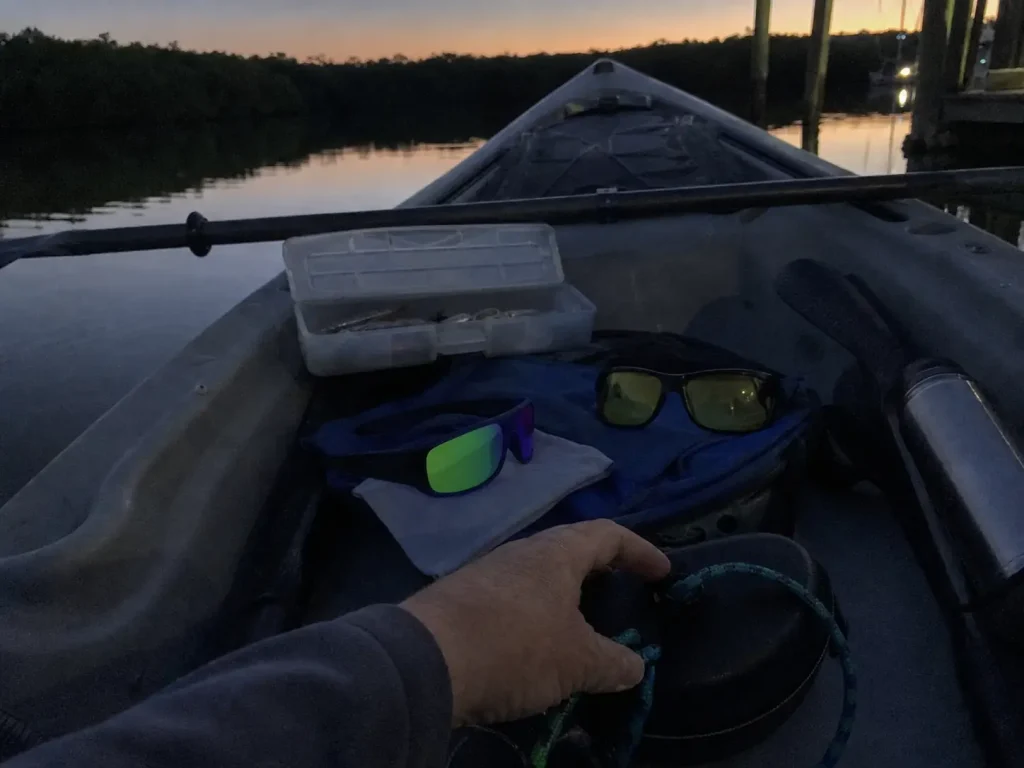
Every tint chart ever published assumes the light holds still. It does not. You launch in the dark, you are squinting into flat white by ten, and by six the sun is low and firing straight down the water into your face. Same trip, three genuinely different lens problems, and this is the part every competitor skips.
The Three Light Phases of a Full Day
Pre-dawn and first light is a transmission problem. There is not enough light, and a dark lens actively costs you fish because you cannot see structure at all. Plenty of anglers run bare-eyed until sunrise, which solves visibility and does nothing for the wind.
Midday is a pure intensity problem. Overhead sun means the glare comes off the surface at its most punishing, and this is when polarization earns its whole price. Golden hour is the sneaky one: the sun drops to a low angle and fires glare directly along your sight line, which is precisely the geometry polarized lenses handle best and hat brims handle worst. If you are working fish visually through all three, the technique side of that is covered in our guide to spotting fish before they spot you across changing light.
Two Pairs vs. Interchangeable Lenses
Two pairs is what most guides quietly do, and the cheapest version is a budget low-light pair riding alongside a good bright-light pair rather than two premium pairs. It is foolproof, it costs little, and the only failure mode is leaving one in the truck.
Interchangeable lens systems put one frame and two or three lenses in a case, which is tidier. The catch is real: swapping a lens on a rocking deck with wet, salty hands is how lenses get scratched and dropped, and you will always need to do it at the worst possible moment.
The One-Pair Compromise That Works
If you are buying one pair and you want it to be right most of the time, buy copper or amber. It holds up across a wider slice of a variable day than gray does, it is workable in low light in a way gray is not, and it is only mildly overmatched in true offshore glare.
That is not a perfect answer for any single condition. It is the best single answer across a real day, which is a different and more useful thing.
Keep the cheap backup pair in the boat, not in the truck. A spare that lives permanently in a dry hatch has saved more days than any premium lens ever has, and it doubles as the pair you hand the friend who showed up with nothing.
Frame Fit, Wrap Coverage, and the Fogging Problem
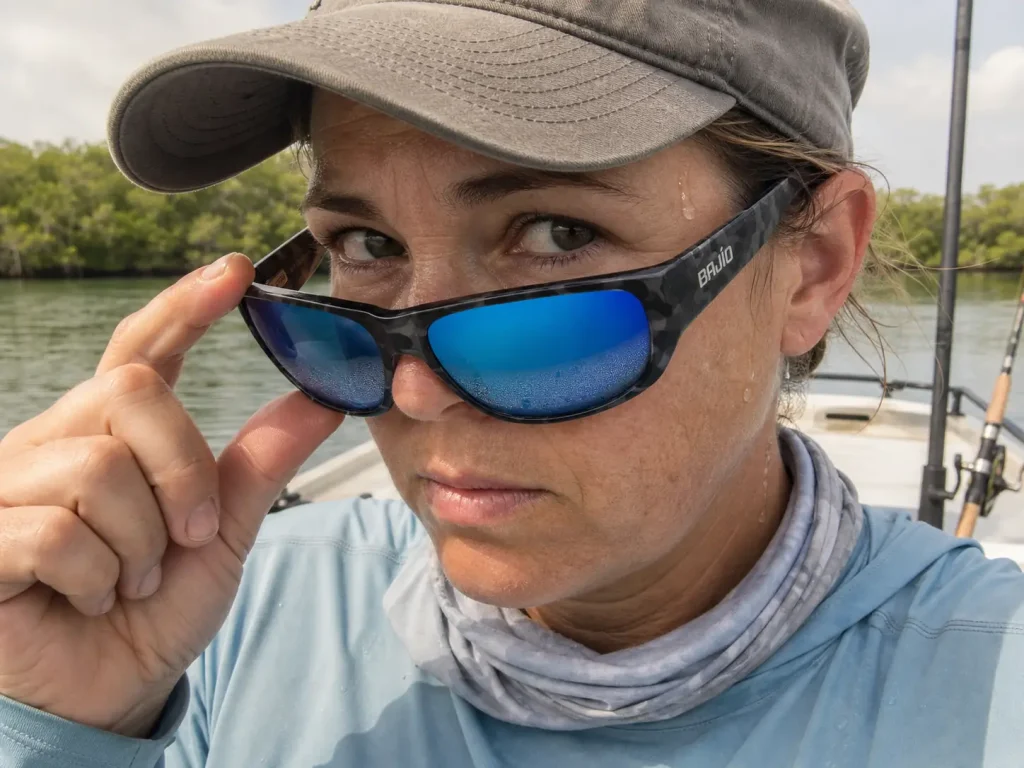
Anglers blame lenses for problems the frame caused. The classic is a humid morning on a flats trip with a wrap frame fogged solid by nine, and the guy in the bow deciding the tint is wrong when the actual problem was zero airflow. Frame geometry does more work here than most buyers realize.
Wrap Coverage and Removable Side Shields
A flat lens shields the front of your eye and leaves the sides wide open, which is where peripheral glare and reflected UV get in. Wrap-around geometry closes that gap by curving the lens around the orbital bone, and it is not a styling choice. This lines up with the CDC’s guidance for outdoor workers, which specifically calls for wrap-around sunglasses that block UVA and UVB from the sides rather than front-only lenses.
Side shields are the next step up, small panels that clip on to seal the remaining gap at the temples. Flats and offshore anglers use them for maximum light blocking, and the removable kind come off the moment you want airflow back. Coverage works with your hat rather than against it, and the brim side of that equation is covered in our breakdown of the brim features that work with a wrap frame instead of against it.
Venting and Why Frames Fog
Fog is warm humid air from your face meeting a cooler lens with nowhere to go. Sealed wrap frames trap it. Vented frames, brow gaps and standoff nose pads that hold the lens a few millimeters off your skin let air move, and that airflow is the entire fix.
Anti-fog venting is worth prioritizing above almost every other frame feature if you fish humid coastal mornings. The alternative is a lens you take off every ten minutes, which defeats the purpose of buying good ones.
Sizing to Your Head, Not to the Photo
A frame that is too wide slides forward on your nose all day and gaps at the temples. A frame that is too narrow presses on the sides of your head, gives you a headache by noon, and pushes the lens close enough to your face to guarantee fogging. Neither problem is solvable with a strap.
Measure the frame width against a pair you already own that fits, or use the brand’s listed frame width in millimeters. Larger faces need offshore-sized frames, and a smaller face in a big wrap gets light coming in over the top of the lens where the frame stands off the brow.
Temple grip is the other half of fit. Rubberized temple tips that hold against a sweaty head are the difference between a pair that stays put when you lean over the gunwale and one that does not, and they matter more than any amount of frame styling.
Coatings That Shed Salt Spray
Hydrophobic coating and oleophobic coating decide how fast water beads off and how easily fingerprints wipe clean. Practically, this is the difference between a pair that is usable right after a wet run and a pair you have to stop and clean before you can see anything.
Salt is the real enemy. It dries into a haze that grinds against the lens if you wipe it dry, so rinse first, then use a proper lens cloth rather than a shirttail. A good coating means less wiping, which means fewer scratches over the life of the lens.
Storage is the other half of that. A hard case in the boat costs almost nothing and prevents the scratch that a soft pouch in a tackle bag guarantees, and it is the single cheapest way to make a good lens last.
What You Actually Get at Each Price Tier
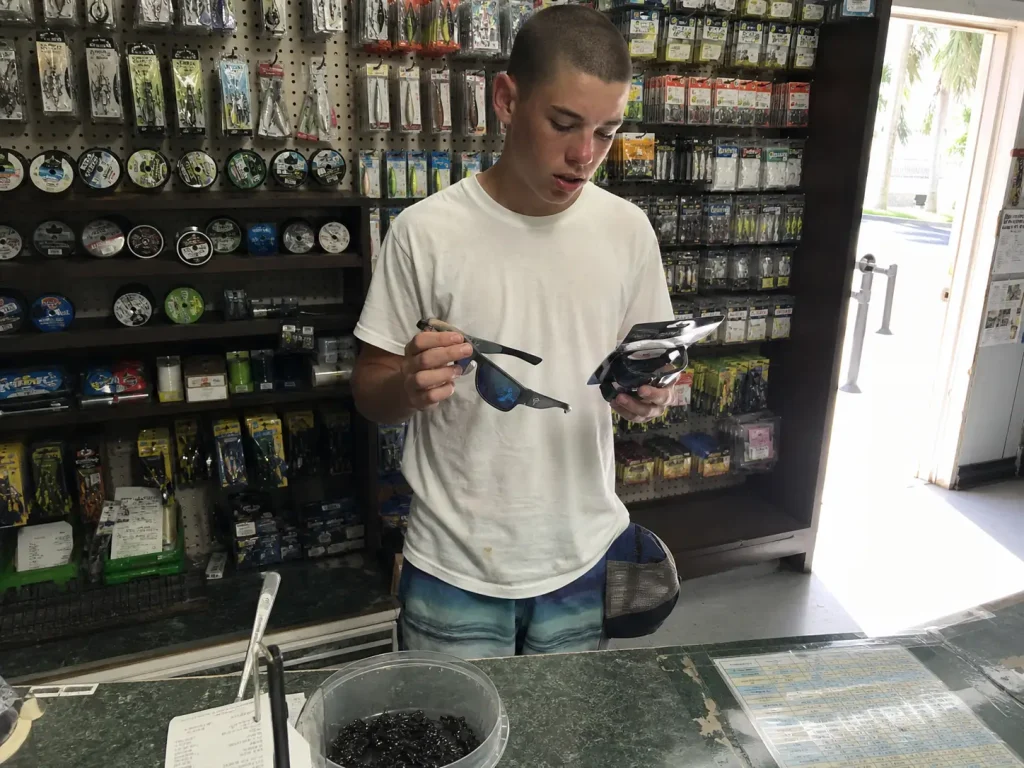
Pick a tier before you pick a pair. The honest way to choose one is by how often you fish and how likely you are to lose them, not by which brand you have heard of.
Entry Tier: What to Verify Before You Trust It
At the bottom of the market, real polarization is achievable, but it is usually film-based, the frame hardware is the first thing to fail, and coatings are minimal or absent. Hinges loosen, arms snap at the joint, and the polarizing film starts separating after a couple of hot seasons.
This is the tier where the blackout test is not optional. Run it on the exact pair you are buying, not on a display model, because quality control at this level is inconsistent enough that two units of the same product can differ.
Mid Tier: Where the Jump per Dollar Is Biggest
Mid-range is where baked-in polarization becomes standard, frame materials move to Grilamid TR-90 or bio-based nylon, coatings actually work, and warranty support exists. That band buys most of the optical performance available in the category.
For the large majority of anglers, this is the correct answer. You get a lens that reads water properly, a frame that survives a season of salt, and a pair you are not sick about losing.
Premium Tier: Service, Parts, and Longevity
At the top you get glass options, the best available clarity, and the thing nobody shops for: parts and service. Replaceable nose pads, temple arms and lens replacement programs mean a premium pair stays in rotation for years rather than getting retired by one broken component.
That longevity is a real part of the value, and it partly answers the price objection. It only pays off if you keep them, which brings us to the section most anglers need more than any of the above.
Our Top Overall and Budget Picks
These two answer the majority of “just tell me what to buy” cases. One is the pair you buy once and fish for a decade. The other is the pair you buy to find out whether you are going to become the kind of angler who buys the first one.
Best Overall: Costa Del Mar King Tide 8
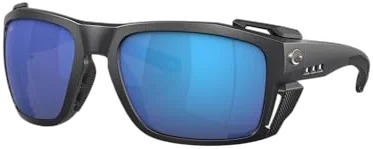
The Costa Del Mar King Tide 8 is the pair most competitors lead with, and for once the consensus is right. The 580G glass gives you the clarity ceiling of the category, and the wrap plus removable side shields covers the peripheral gap that flat frames leave open. It is a big frame, which is worth knowing before you order.
The float feature is the part worth paying attention to. On a category where the most common way to lose a premium pair is a gust of wind and a bare deck, a frame with positive buoyancy meaningfully changes the risk. It also runs warm in dead-still humidity, which is what the removable shields are for.
Best Budget: Torege Pure Cratos
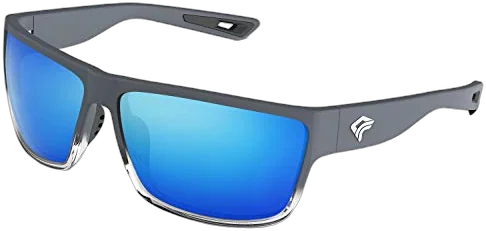
The Torege Pure Cratos is the budget pick competitors themselves point at, and it earns the slot honestly. Polycarbonate, light, and polarized enough to pass the blackout test, which is the only bar that matters at this price.
Set expectations correctly and it is a good buy. Edge clarity is softer than glass, coatings are basic, and it will pick up scratches. It is also the pair to keep permanently in the boat as a spare, which is arguably the highest-value job any pair of sunglasses does.
Best Picks for Where You Fish
The frame that is right on a poling platform is wrong in a bass boat, and the pair you would happily fish offshore is the last one you want going over the side of a kayak. Match the pair to your water.
Best for Inshore and Sight Fishing: Bajío Cocho
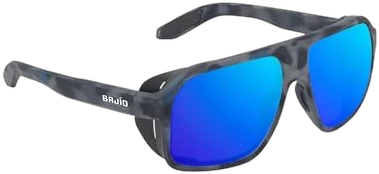
The Bajío Cocho is a specialist, and that is the point. If your fishing is bonefish, redfish, seatrout or anything else you have to see before you cast to, contrast in shallow water beats every other spec on the sheet.
The tradeoff is that a flats-tuned lens is more lens than you need for open blue water. If your days are split evenly between the flats and offshore, the King Tide is the more sensible single purchase.
Best Premium Glass for Offshore: Maui Jim Southern Cross
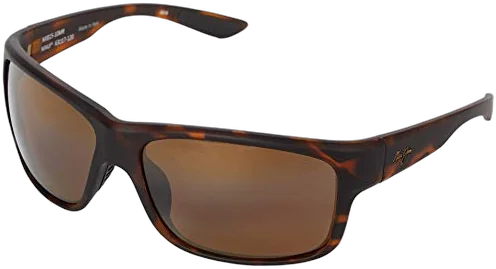
The Maui Jim Southern Cross is the pair that anchors the whole premium argument. The glass is excellent, the frame is built for a face looking out over open water, and the brand’s service program means a broken arm is a repair rather than a replacement.
Here is the blunt part. If you fish ten days a year, this pair will not put more fish in the boat than a solid mid-range polycarbonate will. It will look and feel better every one of those ten days, which is a legitimate reason to buy something, just not a performance one.
Best for Freshwater and Bass: Smith Optics Hookset
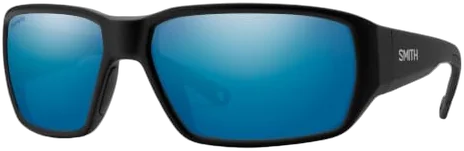
The Smith Optics Hookset solves a problem offshore-oriented brands mostly ignore, which is that a big saltwater wrap looks and feels ridiculous on a smaller face working a bank in a bass boat. The frame is proportioned for that, and polycarbonate keeps it light enough to forget about.
Stained freshwater is where the contrast tuning pays. On a tannin-dark lake, a neutral lens gives you a dimmer version of nothing, while a contrast-enhancing tint pulls the grass edge and the timber out of the murk.
Best for Fly Fishing: Costa Del Mar Tuna Alley
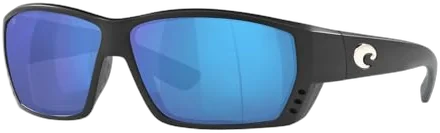
Fly anglers gravitate to the Costa Del Mar Tuna Alley for a practical reason: when a weighted fly is coming past your head on a backcast, you want to see it. The aviator shape gives more usable peripheral view than a tight wrap does, and the vented frame handles the heat of standing on a flat in July.
If you go this route, think hard about the lens material choice. Glass gives you the clarity for spotting, polycarbonate gives you impact resistance for a hook coming past your eye at speed, and the second consideration is not a small one for fly casters.
Best for Kayak and Boat: Hobie Hull Float
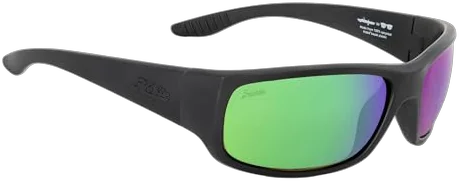
The Hobie Hull Float exists because paddle anglers lose sunglasses at a rate boat anglers find hard to believe. A frame with positive buoyancy turns a total loss into a two-minute paddle back upwind, which changes what you can reasonably justify wearing on the water.
Kayak fishing has its own list of things that go wrong before you have the routine dialed, and losing your eyewear is only one of them. We covered the rest of what goes wrong on a kayak before you’ve figured out the routine separately, and it is worth reading before your first serious trip.
Best Picks for Fit, Kids, and Readers
Three anglers in the same boat get handed the same unisex wrap. One has it sliding off her face, one is nine years old and wearing it like a windshield, and one has to take his glasses off every time he ties on. All three are solvable.
Best Women’s Fit: Bajío Coulee
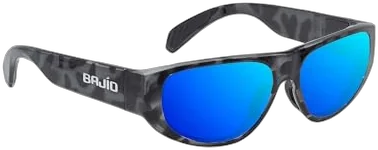
Genuinely women’s-specific fishing frames are rare, and the Bajío Coulee is one of the few worth naming. The geometry change is real: narrower temple spacing, a different bridge and a shallower lens, which together stop the frame from sliding forward and leaving a light gap at the top.
That gap is not a comfort issue, it is a coverage issue. A frame that stands off the brow lets light and reflected UV straight in over the top of the lens, which undoes the reason you bought a wrap in the first place.
Best for Kids and Youth: Costa Del Mar Schoolie
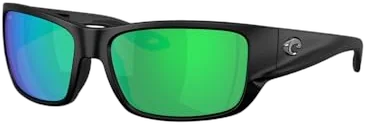
Kids get the worst of this category. They are handed a loose adult frame that gaps at every edge, and they accumulate more lifetime UV exposure than anyone else on the boat because they start at five. The Costa Del Mar Schoolie is built at 56mm for an actual young face.
Polycarbonate is the correct material for a kid without any argument. It is lighter, it survives being sat on, and it will not shatter when the inevitable happens.
Best for Readers and Bifocal Needs: Fishoholic Polarized Bi-Focal
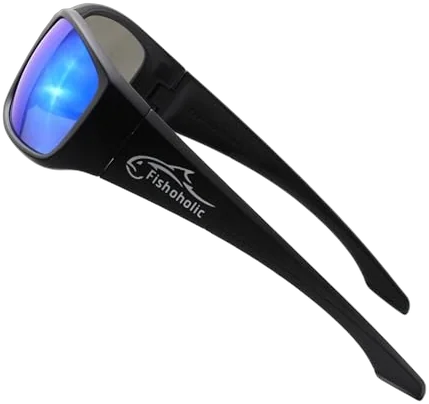
If you are taking your sunglasses off to tie on a hook, you are losing minutes every trip and doing it in the worst possible light. The Fishoholic Polarized Bi-Focal puts reader lenses magnification in the lower portion of the lens so the fix is automatic.
Pick your magnification the same way you would pick drugstore readers, and go slightly weaker than you think if you are between strengths. Full corrective lenses are a different route entirely, available through prescription sunglasses, prescription inserts or clip-on lenses over your everyday frames, and all three escalate cost quickly. Most anglers only need the close-up help.
Buy a kid’s pair with a strap already attached and make wearing it the rule from the first trip. Anglers who grew up with sunglasses on the boat keep the habit, and the ones who did not are the guys at the ramp explaining what pterygium is.
How to Not Lose a Good Pair Overboard
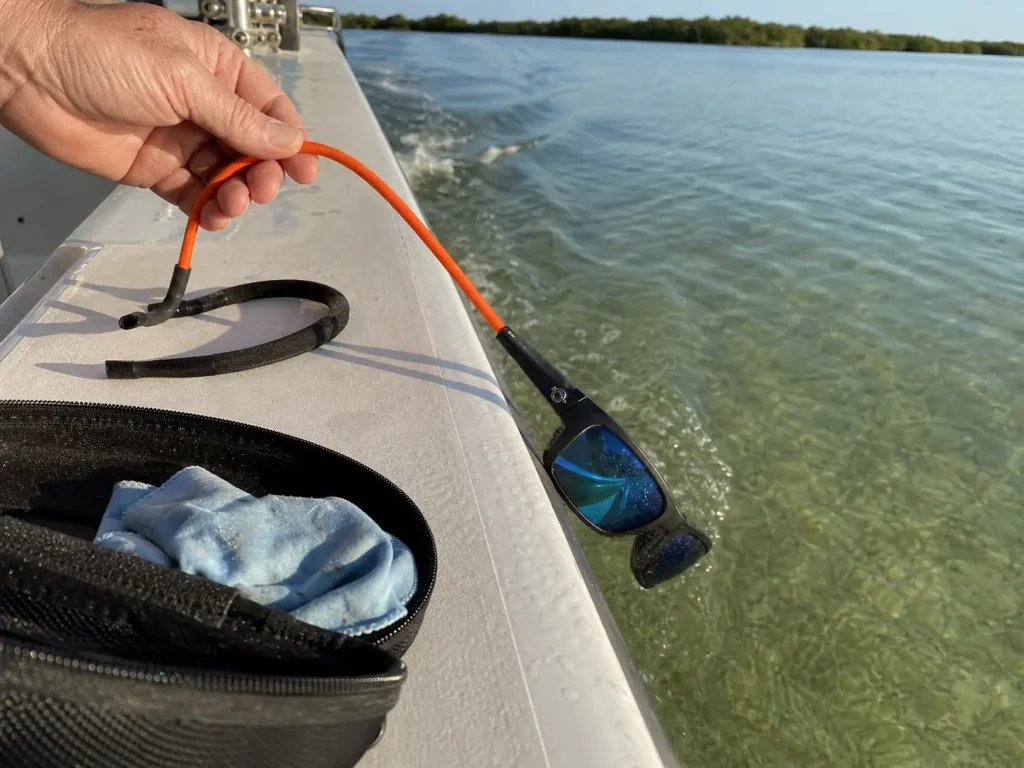
An angler’s wife lost a pair of prescription Costas over the side in Quake Lake, Montana, and they are almost certainly still down there. Everybody at every ramp tells a version of that story about someone. Retention is the section nobody writes and everybody needs.
Floating vs. Sinking Retainers
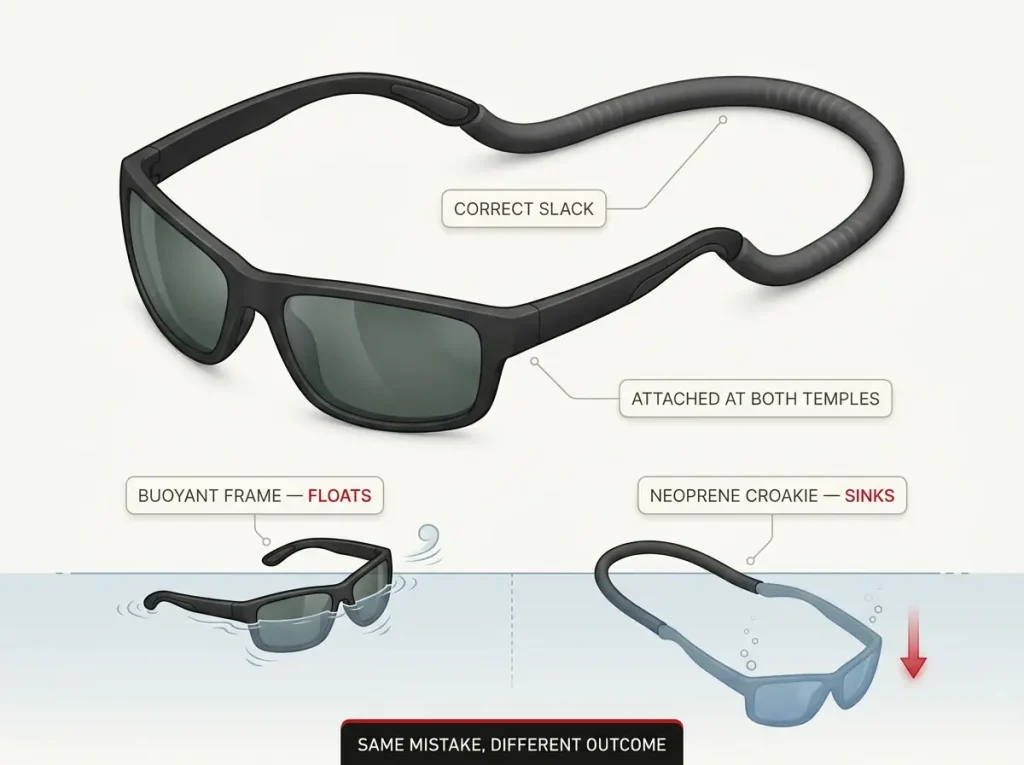
Here is the trap. The neoprene croakie is the comfortable one, the easy-on easy-off one, the one most anglers buy without thinking. It also sinks. Attaching your sunglasses to something that sinks means that when they come off your face over deep water, the strap comes along for the ride.
Buy a retainer that is explicitly rated to float, the Chums-style buoyant straps rather than a plain tube of neoprene. Attached and recoverable are two different things, and only one of them gets your glasses back. A float-rated retainer strap runs on the same tether logic that keeps nippers and forceps from disappearing while wading, where a retractor that works and one that fails differ by exactly this kind of detail.
Buoyant Frames and What They Change
A frame with positive buoyancy solves the problem at the source. It also changes your math about what you can afford to risk: a floating pair on a kayak is a recoverable mistake, while a sinking pair is a total loss in eight feet of water.
The tradeoff is that buoyant frames are usually polycarbonate, because glass is heavy. That is a fair price for the feature if you are fishing from anything that sits low or moves fast.
The First Ten Seconds After You Go In
If they go in, mark the spot before you do anything else, ideally against two fixed points on shore rather than a single one. Cut the motor or stop paddling immediately, because your own wake is what pushes them out of reach.
Then look down-current, not straight down. Floating pairs drift, and they drift faster than people expect in even a light wind. Sinking pairs are gone the moment you stop watching the exact patch of water they entered, which is why the marking step comes first.
The habits that prevent all of this are boring and they work. Retainer on before you leave the ramp, glasses either on your face or in the case rather than perched on your head when you lean over the gunwale, and a cheap spare pair living permanently in a dry hatch.
Final Thoughts
Three things carry more weight than everything else in this guide. Polarization is not optional and it is not the same thing as a dark tint, so verify it with the blackout test instead of trusting a sticker. Glass is a genuine upgrade for anglers who fish enough to perceive it, and polycarbonate is the right answer more often than the premium tier will ever admit. And the pair you keep beats the pair you buy, which makes a floating retainer the highest-return purchase in this whole category.
You can act on two of those today without spending a cent. Take the pair already sitting in your truck, hold it up to a laptop screen, and rotate it. Then put a float-rated strap on whatever survives the test.
After that, buy the tier that matches how much you actually fish rather than how much you wish you fished. Someone on the water fifty days a year and someone out four times a summer are answering different questions, and only one of them needs glass.
Frequently Asked Questions
01What is the best polarized tint for fishing?
Copper or amber is the best single tint for most anglers because it boosts contrast in shallow water and still works as light changes. Choose gray for bright offshore glare and yellow for dawn, dusk or heavy overcast.
02What color polarized sunglasses for fishing?
Match the base lens color to your water: amber or copper for inshore flats and stained lakes, gray or gray-green for deep offshore water. Mirror coatings sit on top of that base tint and only adjust intensity.
03Which brand has the best polarized sunglasses?
No single brand wins outright. Costa and Maui Jim lead on glass optics, Bajío on flats-specific tuning, and Smith on lighter freshwater frames. Lens technology and fit vary more within a brand’s lineup than between brands.
04Are polarized sunglasses worth it for fishing?
Yes. Polarized lenses cut surface glare so you can read structure and spot fish that are invisible through a plain tint. They also block the cumulative UV exposure linked to cataracts and pterygium in lifelong anglers.
Risk Disclaimer: Fishing, boating, and all related outdoor activities involve inherent risks that
can lead to injury. The information provided on Master Fishing Mag is for educational and informational purposes
only. While we strive for accuracy, the information, techniques, and advice on gear and safety are not a substitute
for your own best judgment, local knowledge, and adherence to official regulations. Fishing regulations, including
seasons, size limits, and species restrictions, change frequently and vary by location. Always consult the latest
official regulations from your local fish and wildlife agency before heading out. Proper handling of hooks, knives,
and other sharp equipment is essential for safety. Furthermore, be aware of local fish consumption advisories. By
using this website, you agree that you are solely responsible for your own safety and for complying with all
applicable laws. Any reliance you place on our content is strictly at your own risk. Master Fishing Mag and its
authors will not be held liable for any injury, damage, or loss sustained in connection with the use of the
information herein.
Affiliate Disclosure: We are a participant in the Amazon Services LLC Associates Program, an
affiliate advertising program designed to provide a means for us to earn advertising fees by advertising and linking
to Amazon.com. As an Amazon Associate, we earn from qualifying purchases. We also participate in other affiliate
programs and may receive a commission on products purchased through our links, at no extra cost to you. Additional
terms are found in the terms of service.