
In this article
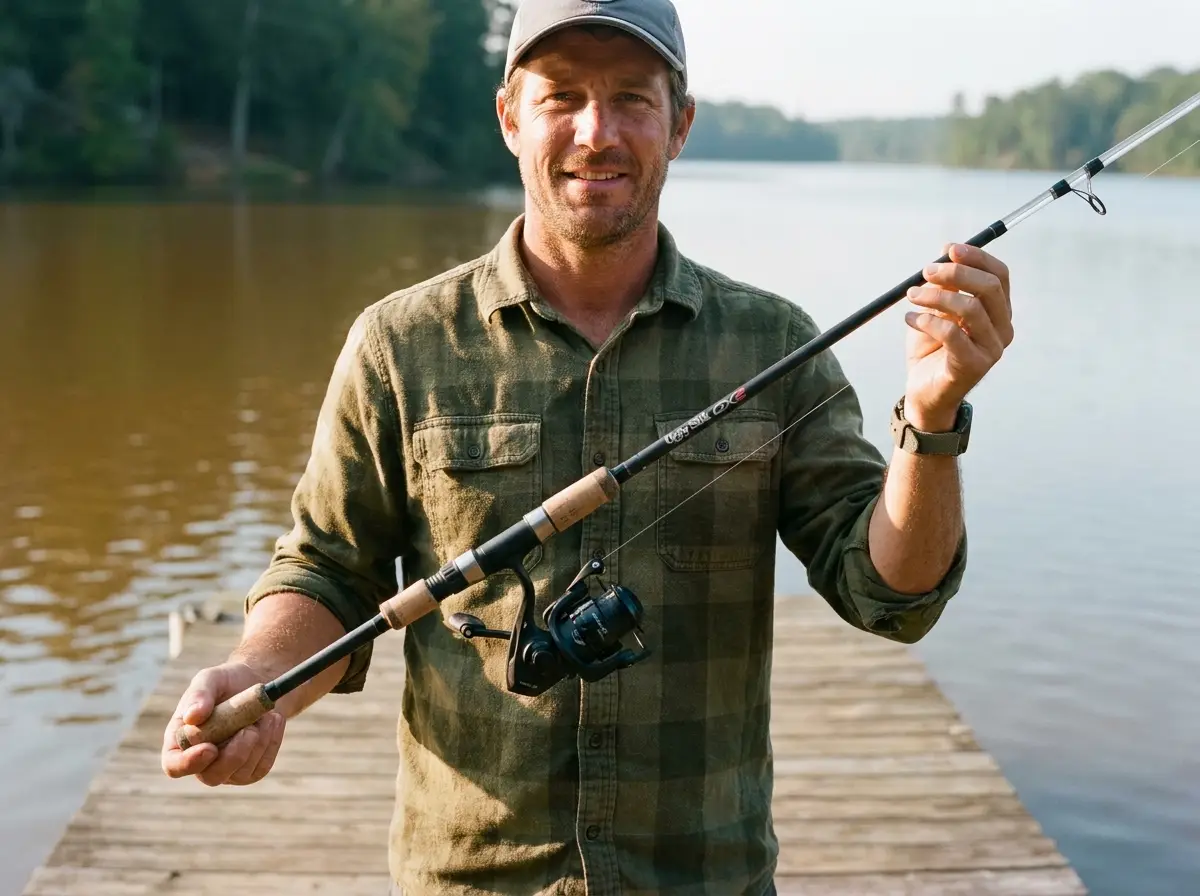
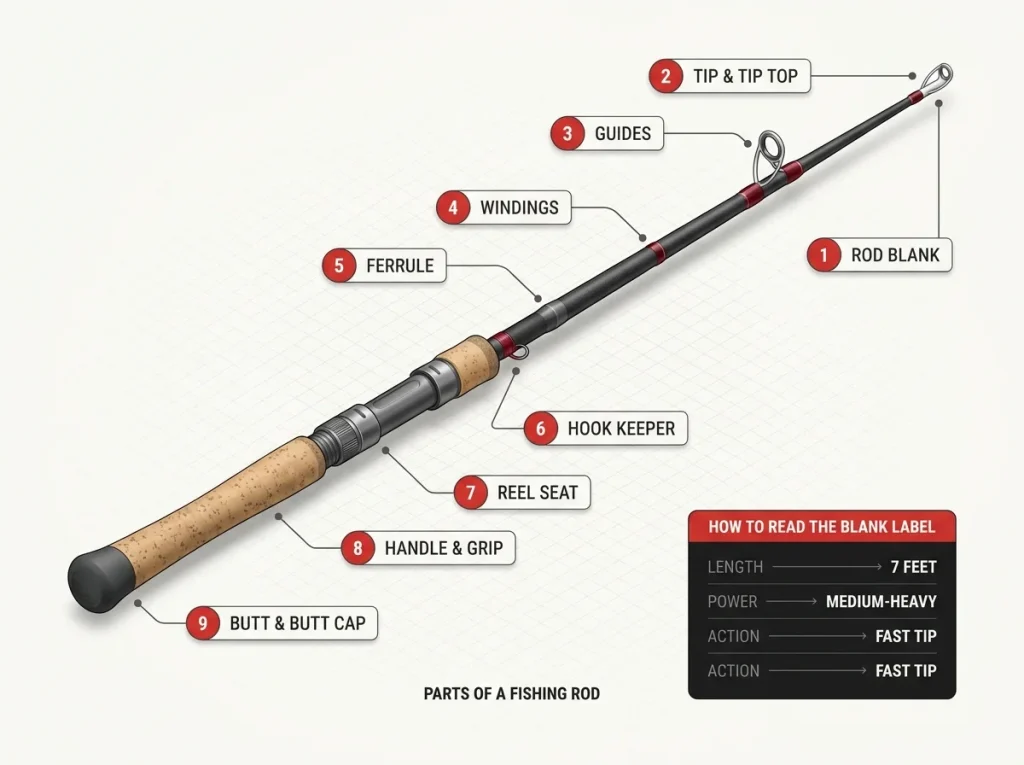
You’re standing in the tackle aisle holding a rod that says 7′ MH Fast on the blank, and it might as well be written in another language. Nobody is born knowing this stuff. The good news is that rod anatomy is simpler than it looks: a fishing rod really only has about nine real parts, and once somebody walks you down the rod the way a buddy would at the boat ramp, the whole thing stops being a mystery. We’ll go tip to butt, name every part of a fishing rod, and for each one answer the question the spec sheets always skip: why it actually matters when a fish is on the line.
The Rod Blank, the Backbone Everything Bolts Onto
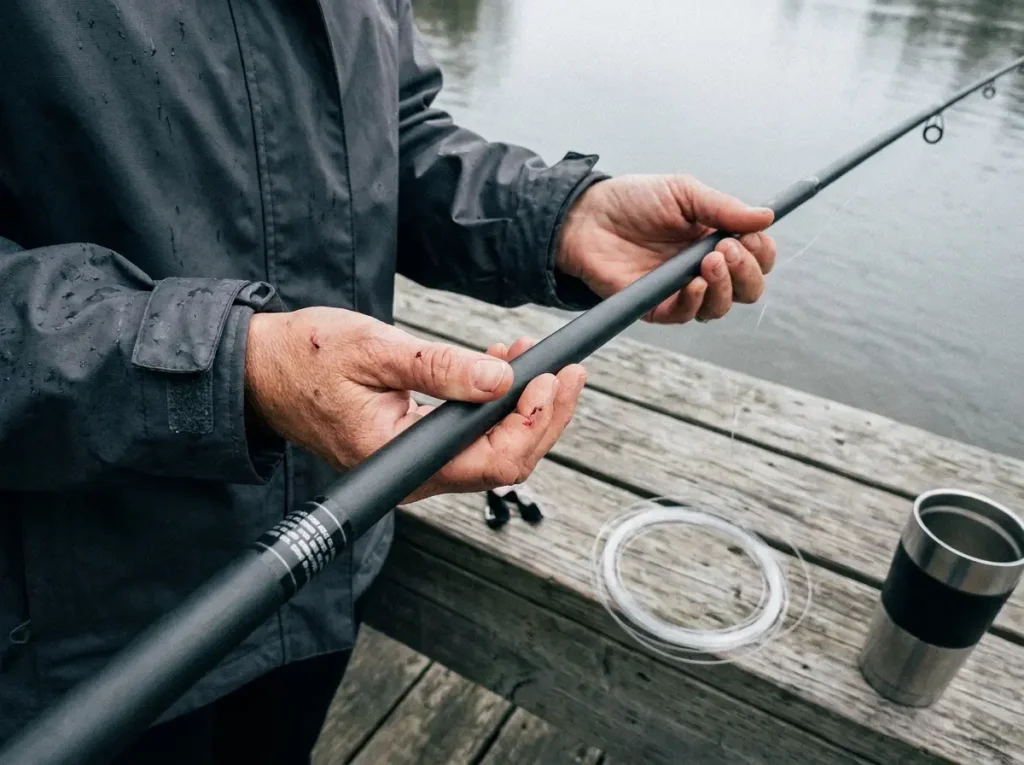
The rod blank is the rod. Every other part gets glued, wrapped, or bolted onto this one tapered tube, so if you only ever learn one part, learn this one. It is also the part that decides how the whole rod casts, bends, and feels in your hand.
What the Blank Actually Is
The blank, sometimes called the rod shaft, is a single tapered tube, thick down near the handle and thinning out toward the tip. That taper is not just for looks. It is the reason the tip bends first while the butt does the heavy lifting when a fish digs for the bottom. The whole personality of a rod lives in how that tube is built.
Graphite vs Fiberglass vs Composite
Three materials show up on almost every blank, whether you fish a spinning rod or a baitcasting rod. Graphite, often labeled carbon fiber, is light and sensitive, so more of what happens at the lure travels up to your hand, but it is more brittle. Fiberglass is heavier and feels a touch numb by comparison, yet it is close to indestructible and very forgiving, which is why so many kids’ rods and trolling rods are glass. A composite blank blends the two. For a first rod that is going to get dropped, stepped on, and shut in a truck door, a little glass in the mix is a feature, not a downgrade.
Power and Action, and How to Read “7′ MH Fast”
This is where most beginners lock up, and it is the easiest thing on the whole rod to fix. The label printed right above the handle decodes cleanly once you know the order. The number is length, so 7 feet. The letters are rod power, meaning how much force it takes to bend the rod, running from Ultralight up to Extra-Heavy, with Medium-Heavy shortened to MH. The last word is rod action, which is where along the blank it bends. Action runs from slow action through moderate up to fast and extra-fast. Fast action puts the bend up near the tip for a quicker hookset and more feel, while slow and moderate actions bend deeper into the rod. That fast tip is literally how you feel the bite, because the sensitive far end telegraphs the tap straight up to your hand. If you want every letter on the blank decoded, a full breakdown of every spec printed on the rod goes further than we can here, and Temple Fork Outfitters publishes a rod maker’s own breakdown of power versus action if you want it straight from the people who build them. A 6’6″ to 7′ Medium or Medium-Heavy is the consensus do-everything first rod, and that one choice is most of what putting your whole first setup together comes down to.
Read the print on the blank before you ask a soul. Power tells you how hard the rod is to bend, action tells you where it bends. Stand in the aisle, find a 7′ Medium with a fast tip, and you have picked a rod that handles most of freshwater without anyone’s help.
The Tip & Tip Top, the Sensitive End That Feels the Bite
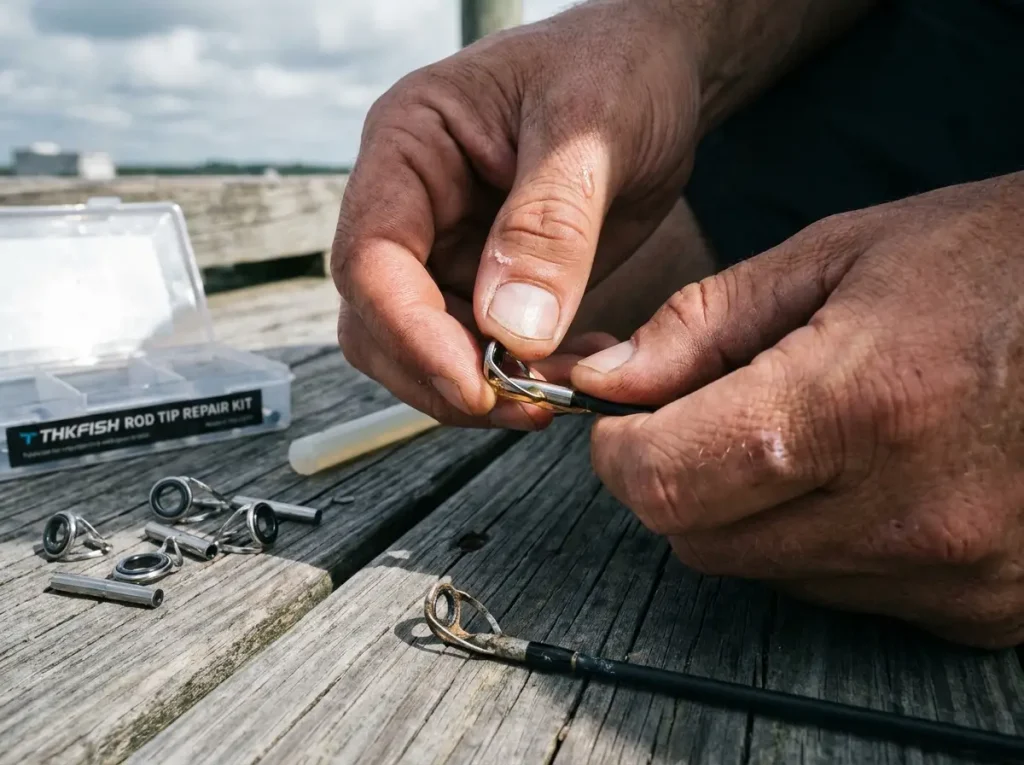
The top six inches of your rod do the most work and take the most abuse. This end is what tells your hand a fish just touched the bait, and it is also the first thing to crack in the garage or the back of the truck.
The Tip vs the Tip Top
People mix these two up constantly. The rod tip is the flexible far end of the blank itself. The tip top is the small metal guide fitted onto that end, the last ring your line touches before it hits the water. Same neighborhood, two different parts, and the metal one is the part that fails.
Why a Sensitive Tip Lets You Feel the Bite
A light, fast tip is your bite alarm. When a fish taps the bait, that flick travels up the thin end of the blank and into your hand before you ever see your line move. A stiff, dead tip swallows those little taps, which is how beginners sit there with a fish mouthing the bait and never know it. Sensitivity is not a luxury here, it is how you catch the careful ones.
When the Tip Top Cracks
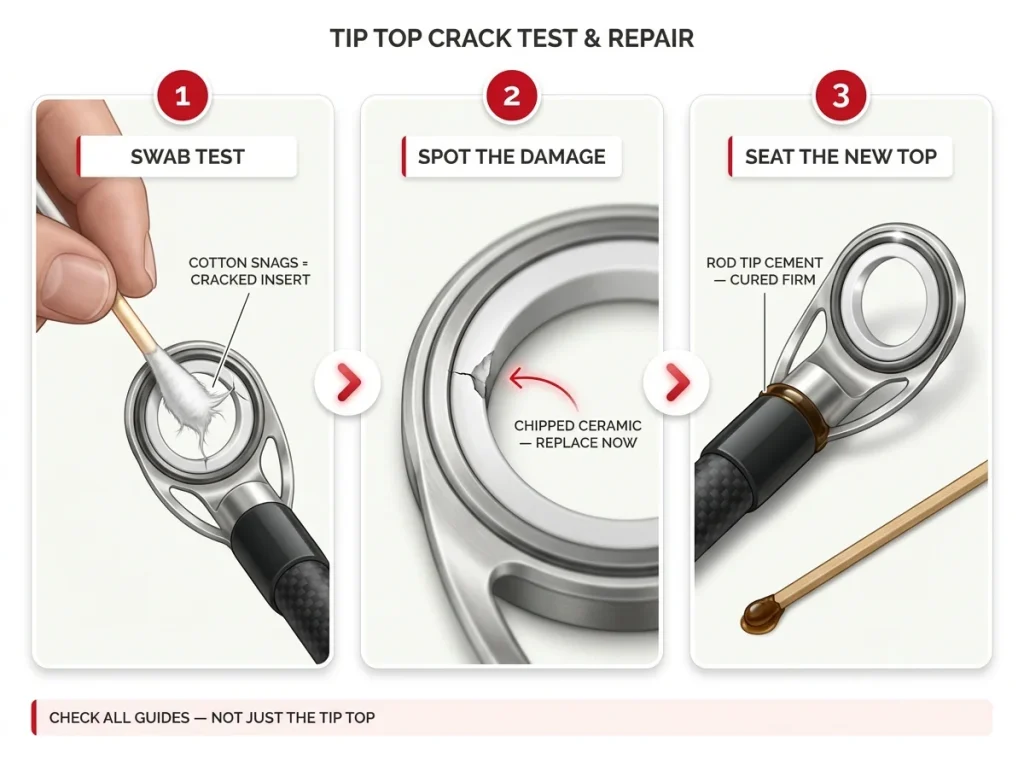
The tip top is the smallest, most-abused guide on the rod, and a cracked one is sneaky. The ceramic insert chips, and instead of a clean ring, your braided line now runs over a tiny serrated edge that quietly saws through it cast after cast until the line lets go mid-fight. Catch it early with the swab test below. When one does crack, a few-dollar rod tip repair kit with assorted stainless tops and a stick of melt glue lets you swap it in your driveway instead of trashing the rod, and there is a two-minute fix for a snapped or cracked tip if you want to see it done step by step.
Run a cotton swab or a piece of pantyhose through every guide, tip top first. If it snags and pulls cotton, the insert is cracked and it is shredding your line whether you have noticed yet or not. Thirty seconds at the truck saves a lost fish later.
Guides & Windings, How Your Line Actually Travels
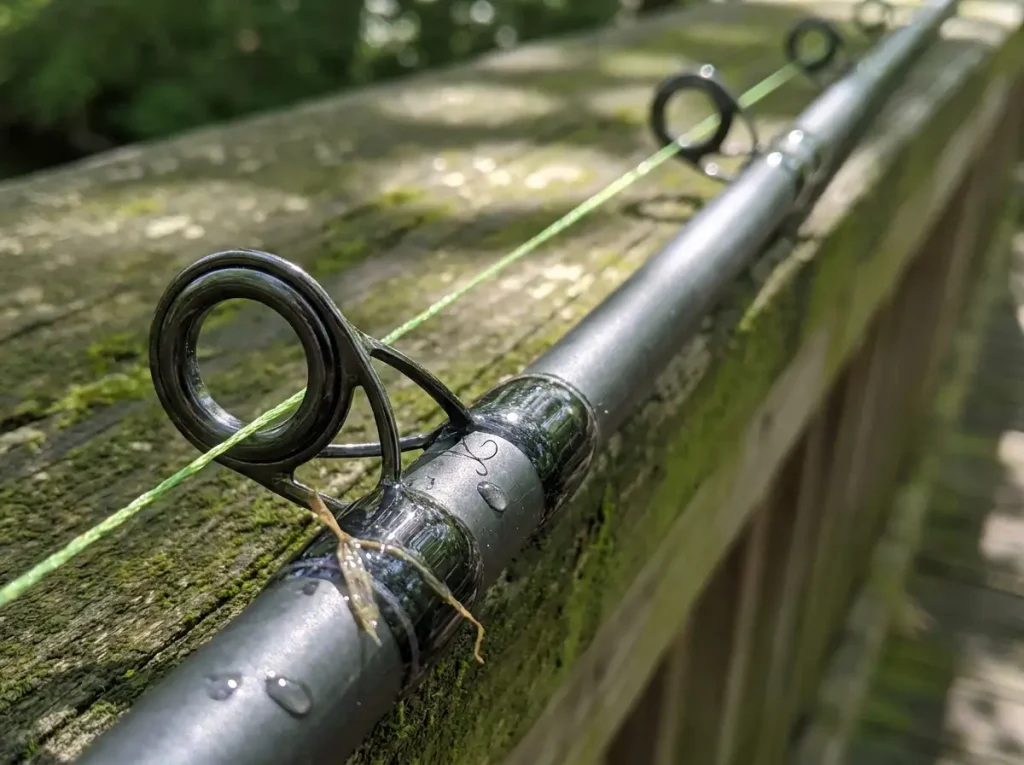
Run your eye down the rod and you’ll see a line of rings marching toward the tip. Those are the guides, and the thread that holds them on is the windings. Together they control every inch of line that leaves your reel, and this is also where the honest money talk lives.
Guides, Stripper Guide, and What They Do
Guides, also called line guides or just eyes, keep your line tracking straight up the blank instead of slapping against it, whether you run monofilament, fluorocarbon, or braid. The big one closest to the reel is the stripper guide, and it is the busiest ring on the rod. It catches the line coming off the spool and funnels it into the smaller guides up top. When your line slaps the blank or whistles on a cast, the size or placement of that stripper guide is usually the reason. The frames holding those rings are usually stainless steel, with a lighter titanium frame showing up on pricier rods from brands like Shimano, Penn, and Daiwa.
Windings and Wraps
The windings, also called wraps, are the bands of thread sealed under epoxy that lash each guide foot to the blank. They are easy to ignore until one starts to lift. If you see thread fraying or a guide that wiggles, the winding is failing and the guide is on its way off the rod. A fresh wrap and a drop of finish fixes it before you lose the guide on a cast.
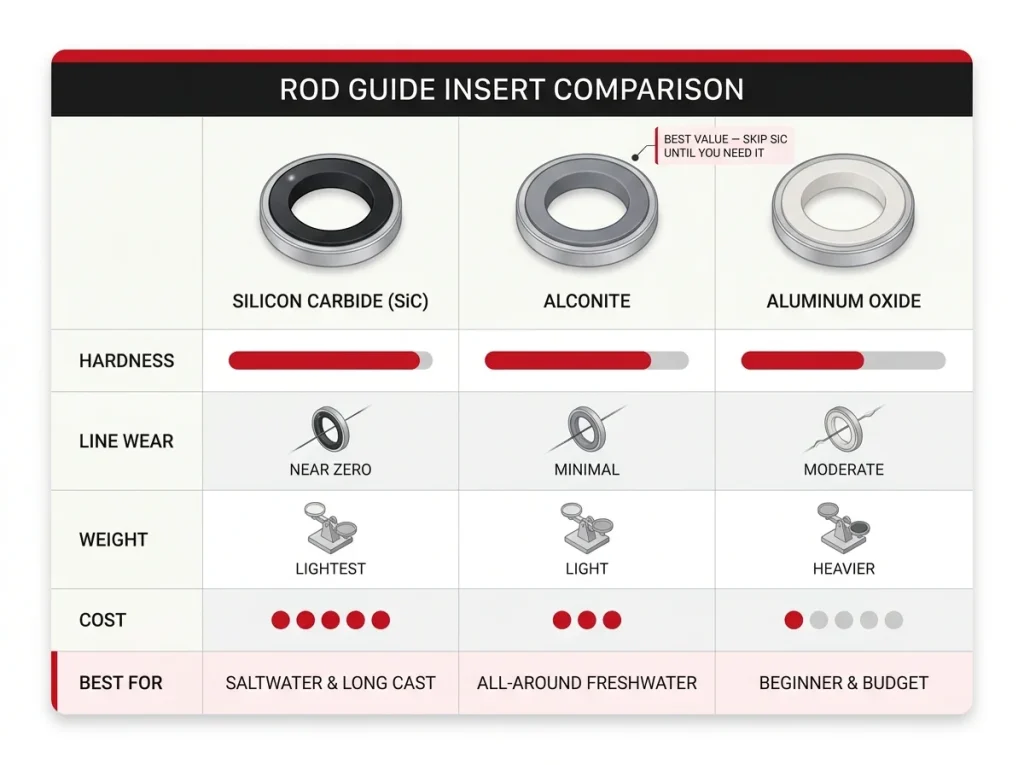
SiC vs Alconite vs Aluminum Oxide
Here is the part the tackle shop won’t lead with. The ring inside each guide is the insert, and the material it is made of is where rod prices climb. Silicon carbide, or SiC, is second only to diamond in hardness, so even braided line barely marks it, and that glass-smooth surface is what your money buys on a pricier rod. Alconite is the smart middle tier, roughly 80% stronger and 20% lighter than plain aluminum oxide and cheaper than SiC, and for casual freshwater the gap to SiC is basically invisible. The honest truth most roundups skip: a beginner does not need SiC. For casual freshwater fishing the difference is not significant, and it only really pays off on long-distance and saltwater rods, so put that money somewhere it counts. If you want the full teardown, here is how the guide-insert materials really stack up, and the same logic drives where your gear money actually matters across the rest of a beginner kit.
Ferrules & the Hook Keeper, the Joint and the Handy Little Loop
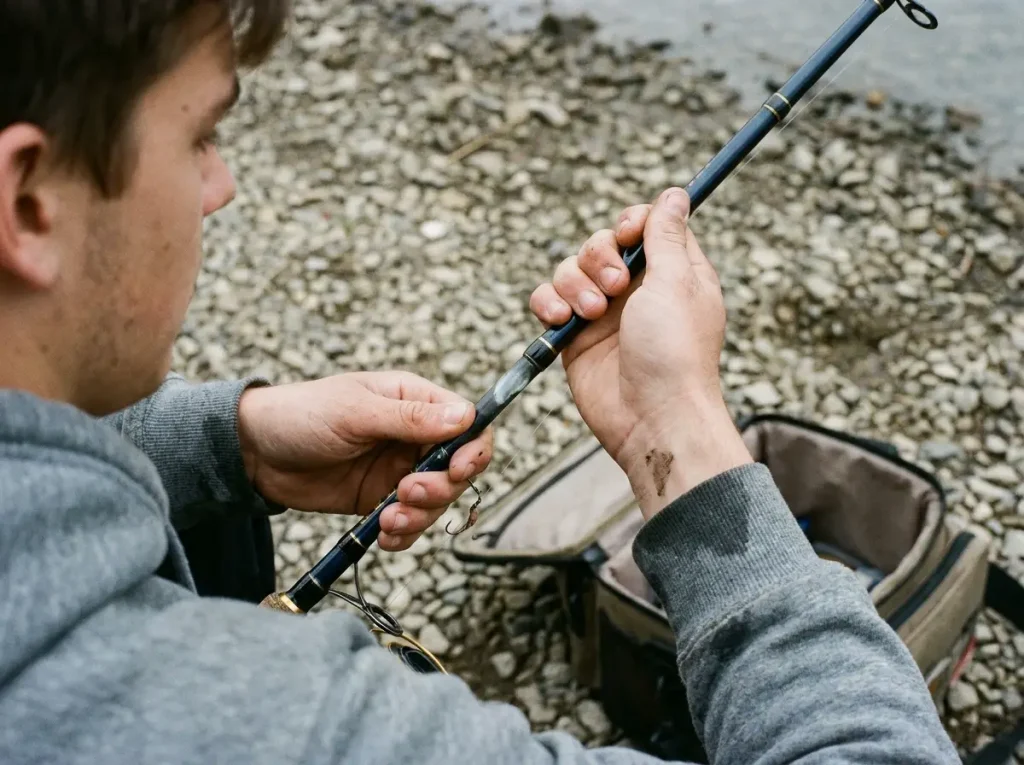
Two small parts live in the middle of the rod, and one of them snaps more rods than big fish ever will. The ferrule is where a multi-piece rod joins together, and the hook keeper is the tiny loop most people never even notice.
Ferrules
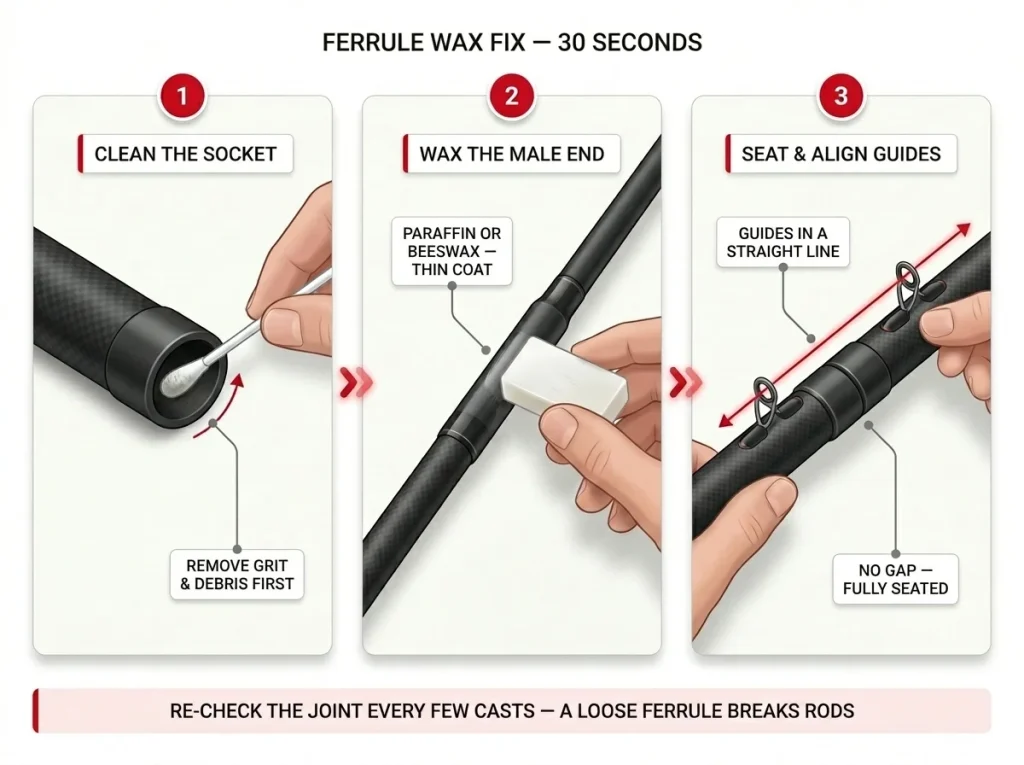
A ferrule is the joint where the sections of a two-piece or travel rod connect, usually a thinner male end that slides into a hollow female socket. Most beginner rods are two-piece, so this is the seam that lets the rod break down to fit in a car. Lining the guides up straight when you join the halves is half the battle, and it pays to know the trade-offs between one-piece and two-piece rods before your next rod purchase.
The Loose-Ferrule “Blow Out”
This is the one to take seriously. The male ferrule works a little looser with every cast, and once there is a gap, a hard cast can crack the blank wall right at the joint and blow the rod apart. It is one of the leading rod breaks that has nothing to do with the fish, and it is completely preventable. Picture the cast where the top half of the rod sails out into the lake with your lure still attached, because that is exactly how it happens. Push the sections fully together, give them a small twist to seat them, and re-check them through the day.
Wipe a light coat of paraffin or beeswax on the male ferrule, and clean the female socket with a dry cotton swab first. It silences the squeak and, more to the point, keeps the joint from working loose and blowing out mid-cast. Thirty seconds in the garage, one less snapped rod.
The Hook Keeper
The hook keeper is the small metal loop just above the handle, and its only job is to give your hook a home when you are walking between spots. Park your lure there instead of on a guide, and you stop the hook point from chipping a guide insert or snagging every bush you pass. It is a tiny part most beginners never use, right up until the day a loose treble catches their sleeve on the walk back to the truck.
The Reel Seat, Where the Reel Locks In
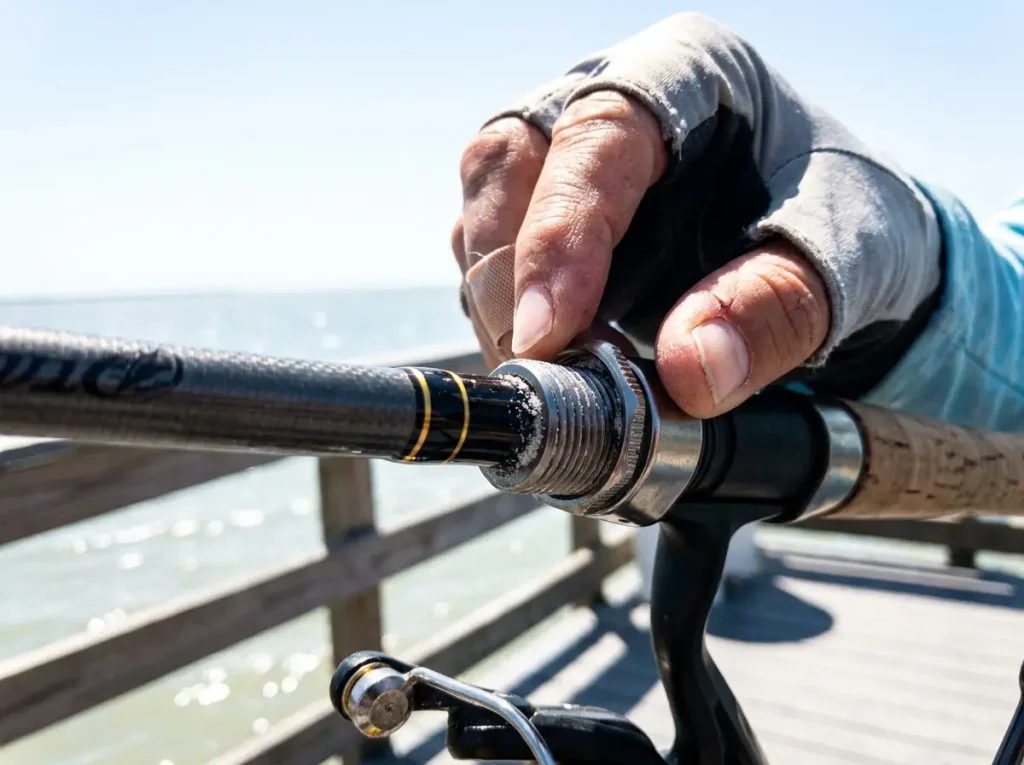
The reel seat is the hardware that clamps your reel to the rod, and it is the first place a cheap rod shows its price. When a reel wobbles loose halfway through the day, the seat is almost always why.
How the Reel Seat Holds the Reel
The reel seat works with a pair of hoods and a threaded locking nut. The reel foot slides under the hoods, you spin the nut down to clamp it tight, and that is what keeps the reel from rocking while you fight a fish. Snug it by hand before every trip, because a quarter-turn loose is the difference between a locked reel and one that rattles in your palm all morning.
Plastic vs Metal Seats
A reel that goes wobbly mid-cast is usually riding on a cheap plastic seat or a nut that backed off under load. This is one of the few spots where spending up genuinely pays, because a metal reel seat with a solid locking nut just stays put. If you are deciding where a beginner’s money should go, a metal seat beats fancy guide inserts every time.
Salt and Grit
Fine grit and salt corrosion do the quiet damage here, which is why a little rod maintenance matters most around the reel seat. They work into the threads of the locking nut and either seize it solid or corrode it until it won’t turn. A quick freshwater rinse after every saltwater trip keeps the nut spinning freely, which matters far more on the salt than it ever does in freshwater. The seat also pairs directly with your reel, so it is worth a minute on picking the reel that locks into that seat.
The Handle & Grip, Where You Actually Hold It
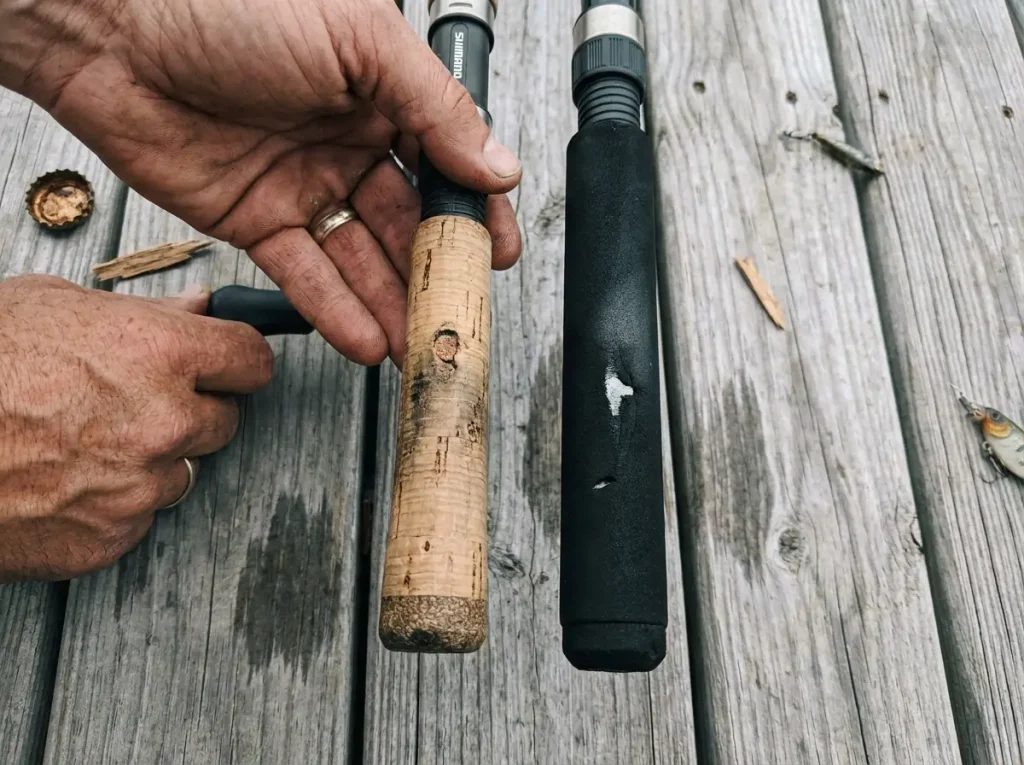
The handle is the one part you are touching for the entire trip, and the material matters more than beginners expect. Cork or foam is not just a looks thing, it changes what you feel and how your hand holds up over a long day.
Cork vs EVA Foam
Cork is lighter, warmer in cold hands, and passes along a little more feel from the blank. EVA foam is tougher, cheaper, and shrugs off dings, grime, and the odd hook point. Cork eventually crumbles and foam eventually tears, but both are repairable, and neither is a reason to junk a rod you otherwise like. If you are torn between them, here is the full cork-versus-EVA breakdown.
Split Grip vs Full Grip
A split grip leaves a gap of bare blank between two shorter pieces of grip, which trims weight and cost. A full grip runs unbroken down the handle and gives you more to brace against on a long cast or a hard fight. Neither is wrong. Lighter lure work leans split, heavier rods lean full, and a lot of it comes down to what feels right in your hand.
What the Grip Tells Your Hand
Here is the part nobody mentions: a good grip transmits the same bite a sensitive tip feels. Cheap, mushy foam deadens that signal before it reaches you, so a rod can have a fine tip and still feel dull because the handle is muting the feedback. Wrap your hand around a rod in the shop and you can feel the difference between a grip that talks to you and one that just fills your palm.
The Butt & Butt Cap, Lifting Power and Rod Protection
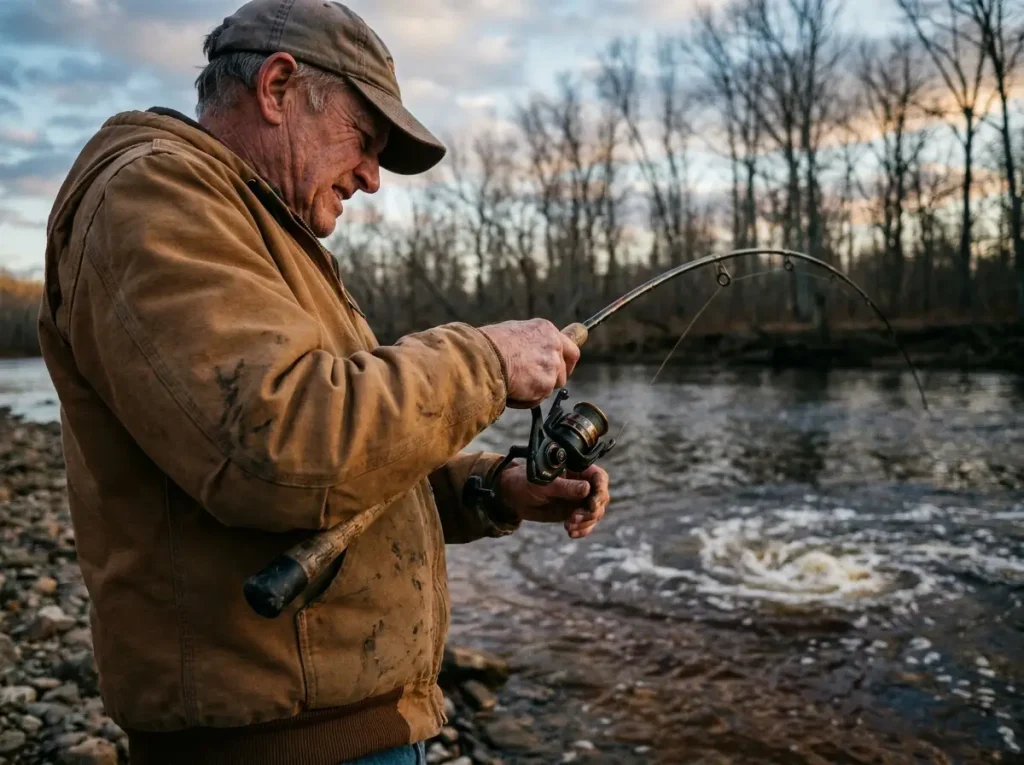
Down at the bottom sit the rod butt and the butt cap, the parts you stop noticing right up until they matter. One gives you leverage in a fight, the other keeps the end of the rod from splitting in the garage.
The Butt
The rod butt is the thick, strong base below the reel. It is your lifting power, the part you brace against your forearm or hip when a good fish is trying to reach the bottom. The taper that makes the tip sensitive is the same taper that makes the butt stout, so the rod has a soft end for feel and a strong end for muscle.
The Butt Cap and Gimbal
The butt cap is the rubber or cork piece that protects the very end of the blank, taking the abuse every time you stand the rod on its end. Some saltwater rods swap it for a gimbal, a notched end that seats into a rod holder or a fighting belt so the rod can’t spin under heavy load. A cracked butt cap is a cheap fix and worth doing, because a bare blank end chips fast.
High-Sticking
Now that you can name every part, here is the move that breaks the most of them. High-sticking means pointing the rod straight up under load, which jams all the strain into the thin tip that was never built to lift. Keep the rod at an angle and let the butt do the work instead. It is also one of the fastest ways to void a warranty, because manufacturers can spot a high-stick break on sight.
Conclusion
Walk away with three things. You can now read a label like 7′ MH Fast and know exactly what rod you are holding. You can name all nine parts of a fishing rod, from blank to butt cap, and say what each one does on the water. And you know the two failures that actually break rods, a loose ferrule and a cracked tip top, plus the thirty-second habits that stop both.
If you want a first rod that forgives the mistakes you are going to make while this sinks in, the Ugly Stik GX2 is the honest pick, close to indestructible and cheap enough that you won’t baby it. Pair it with a reel, some line, and a small box of tackle and you are set. Next time you are in the tackle aisle, walk the rod tip to butt and read it like a buddy just taught you. You’ll pick a better one without asking anybody.
Frequently Asked Questions
01What are the parts of a fishing rod called?
A fishing rod has nine main parts: the blank, the tip and tip top, the guides, the windings, the ferrule, the hook keeper, the reel seat, the handle or grip, and the butt with its butt cap. Learn those names and any spec sheet stops being confusing.
02What is the tip top on a fishing rod?
The tip top is the metal guide at the very end of the rod, the last ring your line passes through before the water. It is the smallest, most-abused part and the one most likely to crack. A chipped tip top quietly saws through braided line, so check it often.
03What is the difference between a fishing rod and a fishing pole?
Traditionally a pole has no reel and no guides, just line tied to the end, while a rod has guides, a reel seat, and a reel. In everyday use most anglers treat the two words as the same thing, so do not overthink it.
04What are the metal parts of a fishing rod?
The metal parts are the guide frames and their inserts, the tip top, the reel seat hardware and locking nut, the hook keeper, and any gimbal or butt cap. These are the parts that corrode, so a freshwater rinse after saltwater trips keeps them working.
05Why do fishing rods bend, and what makes one break?
Rods bend because the blank is tapered and built to load up under weight, flexing most where the action is set. They break mostly from high-sticking, a loose ferrule blowing out the blank, or a nicked blank giving way, rarely from a big fish alone.
Risk Disclaimer: Fishing, boating, and all related outdoor activities involve inherent risks that
can lead to injury. The information provided on Master Fishing Mag is for educational and informational purposes
only. While we strive for accuracy, the information, techniques, and advice on gear and safety are not a substitute
for your own best judgment, local knowledge, and adherence to official regulations. Fishing regulations, including
seasons, size limits, and species restrictions, change frequently and vary by location. Always consult the latest
official regulations from your local fish and wildlife agency before heading out. Proper handling of hooks, knives,
and other sharp equipment is essential for safety. Furthermore, be aware of local fish consumption advisories. By
using this website, you agree that you are solely responsible for your own safety and for complying with all
applicable laws. Any reliance you place on our content is strictly at your own risk. Master Fishing Mag and its
authors will not be held liable for any injury, damage, or loss sustained in connection with the use of the
information herein.
Affiliate Disclosure: We are a participant in the Amazon Services LLC Associates Program, an
affiliate advertising program designed to provide a means for us to earn advertising fees by advertising and linking
to Amazon.com. As an Amazon Associate, we earn from qualifying purchases. We also participate in other affiliate
programs and may receive a commission on products purchased through our links, at no extra cost to you. Additional
terms are found in the terms of service.