
In this article
The humidity hits you the moment the sun breaches the tree line, turning the air into a heavy, suffocating blanket. While casual anglers retreat to the AC by noon, blaming the dog days for their empty livewells, the aquatic ecosystem is actually operating at peak efficiency—just not where most people think it is.
In my years on the water, both as a competitor and a conservationist, I’ve learned that successful summer fishing isn’t about enduring the heat. It is about aligning your tactics with the rigid laws of thermodynamics, fluid dynamics, and biological oxygen demand that enslave every fish in the lake.
If you understand the invisible barriers of water temperature and the physics of light, you can stop casting at empty water. This guide breaks down the limnological diagnostics needed to find the thermocline, the bio-sensory hacks to trigger lethargic fish, and the technical adjustments required to pull largemouth bass from the depths.
Where Are the Fish Hidden During the Summer Heat?
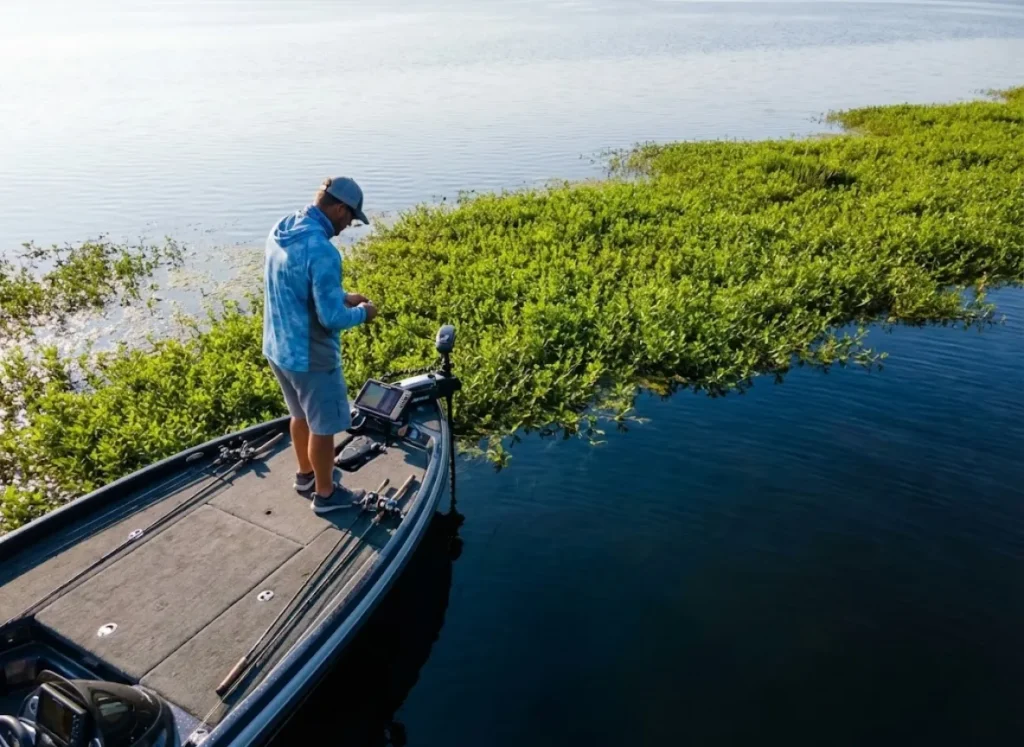
Before you make a cast, you must visualize the physical and chemical structure of the lake. Temperature and oxygen create invisible walls that dictate vertical migration and fish location more strictly than any physical cover like docks or bridges.
Why Is the Thermocline the Most Critical Boundary in the Lake?
The “Sweet Spot” is the Metalimnion, or Thermocline. Solar radiation heats the surface water (epilimnion), causing it to expand and become less dense than the cooler water below. This density difference acts like oil on water, creating a physical barrier that prevents wind from mixing the water column.
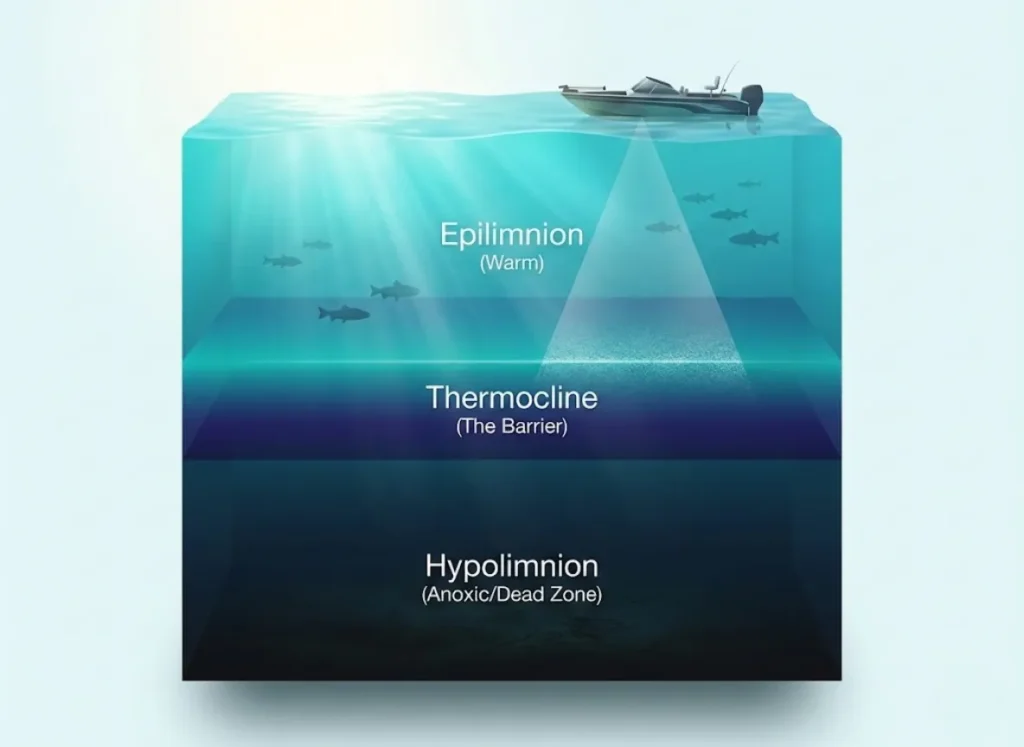
This phenomenon, known as summer stratification, results in three distinct layers. The thermocline is defined as the layer where temperature drops at least 1°C per meter of depth. Identifying this layer—often visible as a distinct clutter line in the 10-20ft depth range—is the first step in eliminating unproductive water. If you aren’t comfortable interpreting traditional 2D sonar to visualize this layer, you are fishing blind.
Pro-Tip: If your sonar is cluttered, turn up the sensitivity until the screen is almost full of noise, then dial it back slowly. The thermocline will often appear as a faint, continuous horizontal band that spans open water.
Below this line lies the Hypolimnion. While cool, it is often a trap. The Illinois Environmental Protection Agency details the mechanics of how density-dependent stratification isolates this deep water. In fertile lakes, organic decomposition on the bottom consumes available oxygen, rendering deep water anoxic (dead). If you fish below the thermocline, you are dragging lures through water where fish physically cannot respire.
How Does Dissolved Oxygen Dictate the “Dead Zone”?
According to Henry’s Law, the solubility of oxygen in water is inversely proportional to temperature; warmer water physically holds less gas. Largemouth bass generally require dissolved oxygen (DO) levels above 5 mg/L to maintain active metabolism.
As water temperatures hit 90°F, the “fuel tank” of the lake is only 60% full compared to winter. This happens precisely when fish metabolic rates are highest. To combat this, avoid stagnant backwaters where bacterial decay (BOD) consumes oxygen. Instead, focus on fishing in current or main lake mixing zones where turbulence re-oxygenates the water. This applies whether you are fishing reservoirs, rivers, or streams.
Pro-Tip: Don’t believe the “early morning” myth. Photosynthesis stops at sunset, but respiration continues all night. Oxygen levels are actually lowest just before dawn (the respiratory crash) and highest in the late afternoon.
The University of Florida IFAS Extension outlines these critical thresholds for fish production. Contrary to popular belief, the “Late Afternoon” window often offers peak oxygen levels due to cumulative photosynthesis throughout the day.
Which Aquatic Plants Create Oxygen versus Depleting It?
Not all “weeds” are beneficial. You must distinguish between oxygen-producing growth and oxygen-consuming decay. Look for vibrant, crisp green aquatic vegetation like Hydrilla (Hydrilla verticillata). These form dense surface mats that pump oxygen and provide shade along weed lines and lily pads.
Conversely, avoid fields of brown, slime-coated vegetation. If the water smells sulfurous, it indicates anaerobic decomposition and hydrogen sulfide production—a definite “do not fish” zone. The Maryland Department of Natural Resources provides identification keys that can help you scientifically differentiate between beneficial grasses and decay.
Hydrilla is rooted and grows vertically to form a “canopy,” creating large, cavernous spaces underneath that are shaded and cooled. Bass utilize the underside of these mats as “air-conditioned bunkers,” or ambush points. Accessing them requires specific techniques for fishing heavy cover, often involving heavy weights to punch through the roof of the canopy.
How Do We Manipulate Bass Biology to Trigger Strikes?
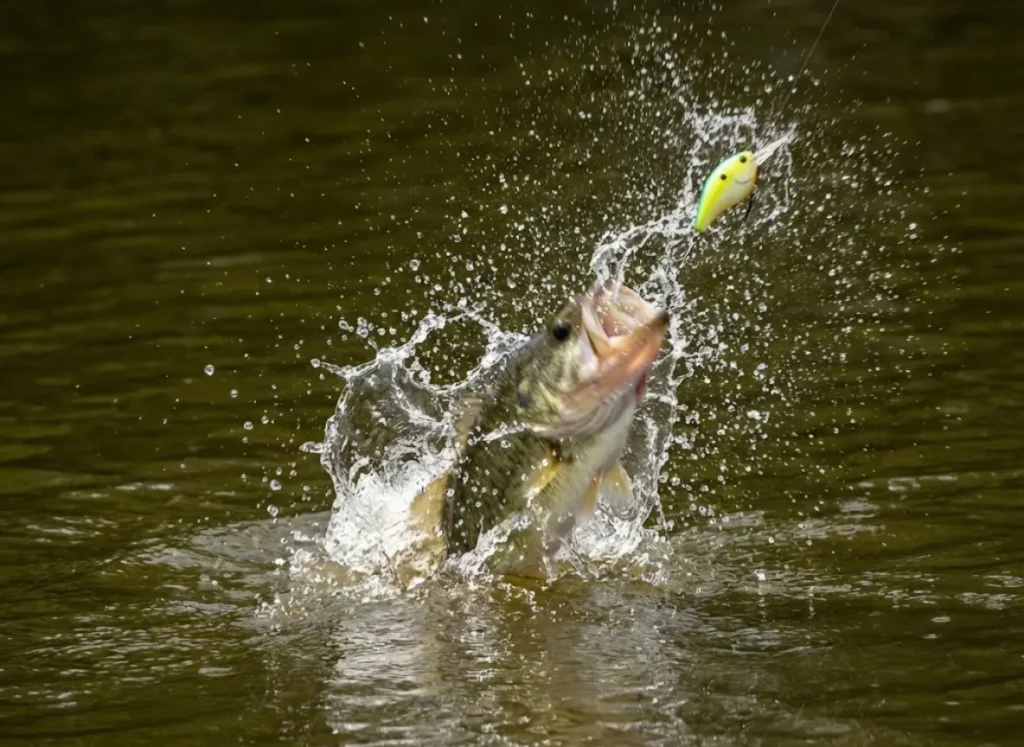
Once you have located oxygen-rich water near the thermocline, the challenge shifts. You are trying to trick a lethargic predator that is too hot to feed out of hunger.
Why Do Reaction Strikes Work When Hunger Fails?
As poikilotherms (cold-blooded), a bass’s body temperature mirrors the water. High heat drives their standard metabolic rate up, but extreme temps (>85°F) suppress foraging behavior. Research published in PubMed Central analyzes these effects, confirming the link between temperature and metabolic cost.
Despite this lethargy, their muscle fibers are primed for maximum power output. We bypass the “hunger center” of the brain and target the brainstem’s “Fixed Action Pattern” (FAP)—an involuntary reflex to flee or attack.
Speed is the trigger. Abandon slow, natural presentations like a dangling earthworm. Bass feed using suction generated by rapid mouth expansion, calculating an intercept point based on prey trajectory. A lure moving at a constant speed allows for easy calculation.
To disrupt this, utilize squarebill crankbaits to intentionally ram into stumps and rocks. If you are unsure how to fish deep diving crankbaits for this specific reaction, the key is to generate deflection using a fast retrieve or burning technique. This prediction error forces the bass to strike harder and faster to compensate.
How Does Water Depth Alter the Colors Fish Can See?
Bass are dichromats, possessing cone cells maximally sensitive to Red/Orange (614 nm) and Green (535 nm) wavelengths. A study in Current Zoology details this spectral sensitivity.
Confidence in a color is irrelevant; the choice must be based on physics and water clarity. Long wavelengths (Red/Orange) are low-energy and absorbed rapidly by water molecules. Below 10-15 feet, red lures appear dark gray or black.
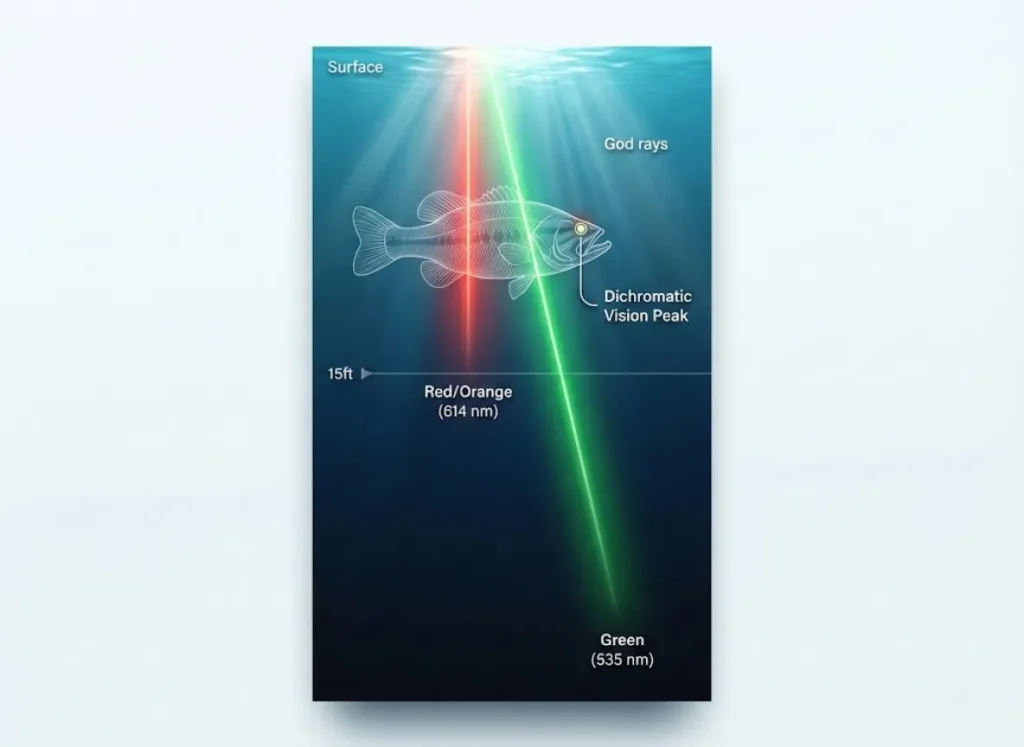
To apply this, follow a strict depth-color matrix. Red triggers the twin cones but disappears quickly, making it a “Shallow Only” option. For deep summer cranking (>15ft), switch to Green Pumpkin or translucent Blue patterns to match the remaining light spectrum. If you want to understand the biological basis for this, read our guide on how do fish see underwater.
How Do Fish Hunt in Total Darkness?
When the sun sets and light is removed entirely, the predator shifts to a radar-like system running along its flank: the Lateral Line. As circadian rhythms shift into the night, this system becomes primary. It consists of canals filled with sensory hair cells (neuromasts) that detect low-frequency vibrations (0-200 Hz).
The National Institutes of Health (PMC) explores these hydrodynamic sensory capabilities. A bass can triangulate the position of a lure in zero visibility based solely on the pressure wave it creates.
For your night fishing expedition, swap visual lures for high-displacement lures. A Colorado blade spinner bait or buzzbait moves more water than a Willow blade, creating a “thump” the fish can feel. Our night fishing guide emphasizes that steady retrieves are crucial here, allowing the fish to track the hydrodynamic trail without visual confirmation.
What Technical Adjustments Optimize Summer Presentations?
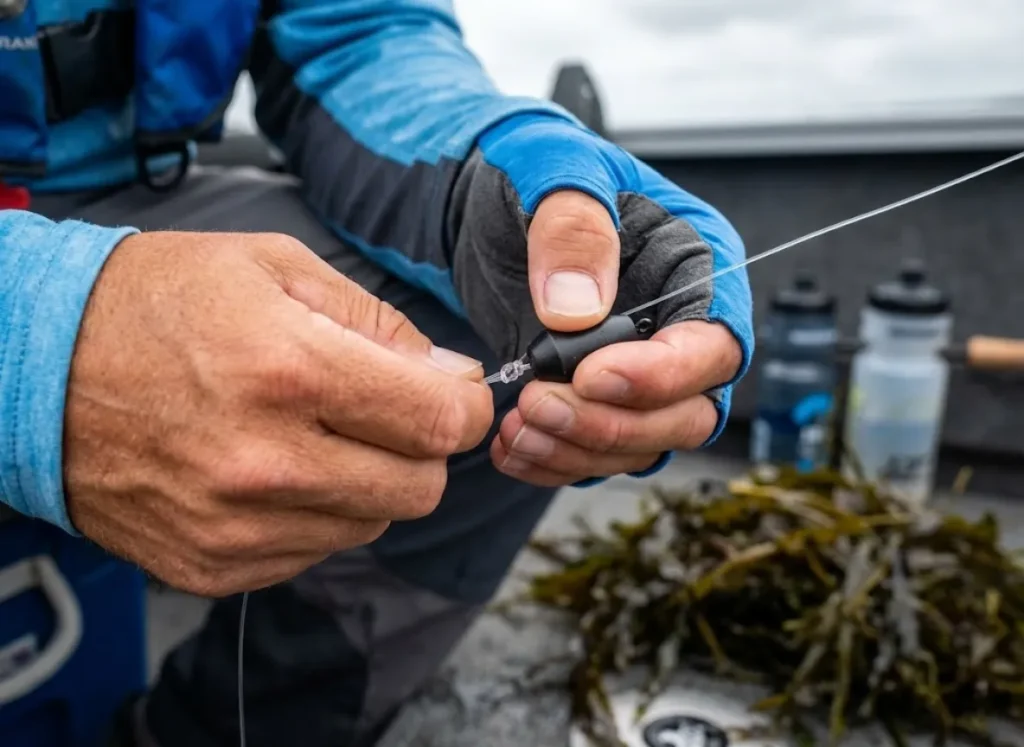
Survival in the summer requires specific tools. We look to materials science—specifically the physics of tungsten and fluorocarbon—to turn a bite into a landed fish.
Why Does Tungsten Penetrate Vegetation Better Than Lead?
To access the bunkers under Hydrilla, anglers use a technique called “Punching” with specialized punch rigs. Success here relies on density. Tungsten (Density ~19.3 g/cm³) is nearly twice as dense as Lead (Density ~11.3 g/cm³).
A 1oz tungsten weight has a 41% smaller volume than a 1oz lead weight. This drastically reduces the drag coefficient as it pushes through thick stems. While The USGS outlines the environmental benefits of non-toxic tackle, the physical advantage is what makes tungsten mandatory for punching for bass in heavy cover.
Beyond penetration, the hardness of tungsten provides superior acoustic feedback. When the weight hits a glass bead or the hook eye, it creates a high-pitched “click” that mimics a snapping crawfish shell, serving as a secondary auditory trigger under the mat. Pairing this with creature baits or soft plastics creates a deadly package.
How Does Fluorocarbon’s Refractive Index Cheat Physics?
In the calm, clear waters of summer, line visibility is a deterrent. The Refractive Index (RI) of water is ~1.33. Nylon monofilament is ~1.53-1.62, creating a visible distortion of light around the line.
Fluorocarbon has an RI of ~1.42. The Physics Classroom explains that because this is optically much closer to water, it bends light less, rendering the line nearly invisible. Utilizing 100% fluorocarbon line is essential for subsurface presentations and finesse fishing.
Fluorocarbon is also denser than water and sinks, whereas nylon creates a bow in the line. This sinking property helps deep-diving crankbaits reach maximum depth. For a full breakdown of when to use each material, refer to our comparison of braid vs fluorocarbon vs monofilament.
How Does Angler Physiology Impact Catch Rates?
The final point of failure is the biological machine holding the rod. Summer fishing places the human body in a high Wet Bulb Globe Temperature (WBGT) environment. Angler endurance becomes a limiting factor.
Cognitive decline—loss of focus and slower reaction times—begins at just 2% body weight dehydration. By the time you feel thirsty, you are already dehydrated. The CDC and NIOSH provide guidelines suggesting 8 oz of water every 15-20 minutes for heatstroke prevention.

Solar radiation is also a fatigue multiplier. A standard cotton t-shirt allows 20% of UV radiation to penetrate. Treat endurance as a skill. Wear specialized UPF shirts and boonie caps to mitigate exposure. A fatigued angler creates noise and lacks the mental sharpness to detect subtle bites. This protection extends to your eyes as well; high-quality optics are non-negotiable. Check our review of the best polarized sunglasses for fishing to ensure you are reducing eye strain.
Conclusion
Summer fishing success isn’t about luck; it’s about precision. The fish are enslaved by the Thermocline (15-25ft) and Dissolved Oxygen (>5 mg/L) levels. If you are casting into water that fails these criteria, you are wasting time.
Remember that photosynthesis peaks in the late afternoon, making the “mid-day heat” a surprisingly active window if you target the oxygen-rich shade of Hydrilla mats. When the fish are lethargic, use Reaction Strikes to override their lack of hunger, and ensure your gear leverages the physics of Tungsten density and Fluorocarbon refraction.
Stop fighting the heat and start exploiting the science. Share your best “Summer Peak” catch in the comments below and let us know which of these 9 strategies changed your game.
FAQ – Frequently Asked Questions
Is it better to fish in the morning or evening during summer?
Biologically, the Late Afternoon or Evening is often superior. Oxygen levels are at their peak due to a full day of photosynthesis, whereas mornings can be sluggish due to the oxygen crash caused by overnight plant respiration.
How do I know how deep to fish in the summer?
Locate the Thermocline on your sonar (usually 15-25ft deep) and focus your efforts at or slightly above this line. Avoid fishing significantly below this line, as oxygen levels often drop to near-zero (anoxic) in the deep, cold water.
What is the best color lure for summer bass fishing?
Use Red or Orange in shallow water (<10ft) where these wavelengths are still visible to the bass's retina. Switch to Green Pumpkin or Blue in deep water (>15ft), as red light is absorbed and appears black at these depths.
Why do fish stop biting in the middle of the day?
They don’t stop; they reposition to Shade (docks, mats) or Current to minimize metabolic cost and maximize oxygen. The slump is often an angler failure to adjust location, not a cessation of fish activity.
Risk Disclaimer: Fishing, boating, and all related outdoor activities involve inherent risks that
can lead to injury. The information provided on Master Fishing Mag is for educational and informational purposes
only. While we strive for accuracy, the information, techniques, and advice on gear and safety are not a substitute
for your own best judgment, local knowledge, and adherence to official regulations. Fishing regulations, including
seasons, size limits, and species restrictions, change frequently and vary by location. Always consult the latest
official regulations from your local fish and wildlife agency before heading out. Proper handling of hooks, knives,
and other sharp equipment is essential for safety. Furthermore, be aware of local fish consumption advisories. By
using this website, you agree that you are solely responsible for your own safety and for complying with all
applicable laws. Any reliance you place on our content is strictly at your own risk. Master Fishing Mag and its
authors will not be held liable for any injury, damage, or loss sustained in connection with the use of the
information herein.
Affiliate Disclosure: We are a participant in the Amazon Services LLC Associates Program, an
affiliate advertising program designed to provide a means for us to earn advertising fees by advertising and linking
to Amazon.com. As an Amazon Associate, we earn from qualifying purchases. We also participate in other affiliate
programs and may receive a commission on products purchased through our links, at no extra cost to you. Additional
terms are found in the terms of service.