
In this article
The rod tip loads with a heaviness that feels less like a fish and more like you are dragging a wet sock filled with stones. Twenty feet down, in the cold darkness below the thermocline, a piece of plastic collides with a limestone ledge. It ricochets wildly.
In that split second of chaos, a lethargic bass reacts not out of hunger, but out of a neurological reflex hardwired into its brainstem. This is the essence of deep cranking, a cornerstone of advanced offshore power fishing. It is a technique that demands you stop fishing for an appetite and start triggering a biological flaw.
Deep diving crankbaits are not tools for a game of chance. They require a calculated integration of freshwater sport fishing tactics, fluid dynamics, mechanical engineering, and predator psychology. True competence comes from understanding the invisible forces acting on the lure. By the time you finish this guide, you will transition from a passive caster hoping for a bite to an active “bio-hacker” who visualizes the geometry of the dive and triggers reaction strikes through calculated physics of depth.
How does the physics of hydrodynamics determine lure depth?
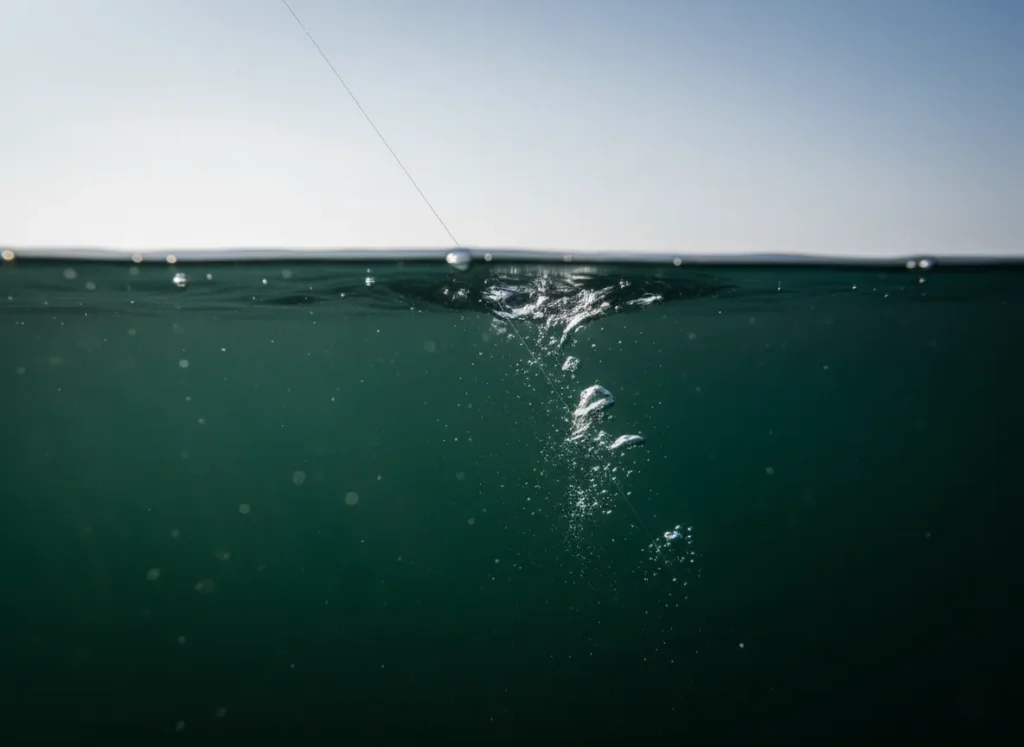
A depth rating on a crankbait box is not a promise; it is a possibility. The actual depth your lure achieves is the result of the “Dive Curve Equation,” a variable outcome of water resistance, drag, lift, and trigonometry.
Why does casting distance dictate the maximum depth zone?
A deep diving crankbait, like the popular Strike King XD or Rapala DT series, functions essentially as a hydrofoil. It requires a significant runway to overcome its own buoyancy and achieve a downward plane. The retrieve follows a parabolic trajectory: a steep descent that consumes 30-40% of the cast, a maximum depth plateau known as the “sweet spot,” and a rapid ascent caused by the boat angle.
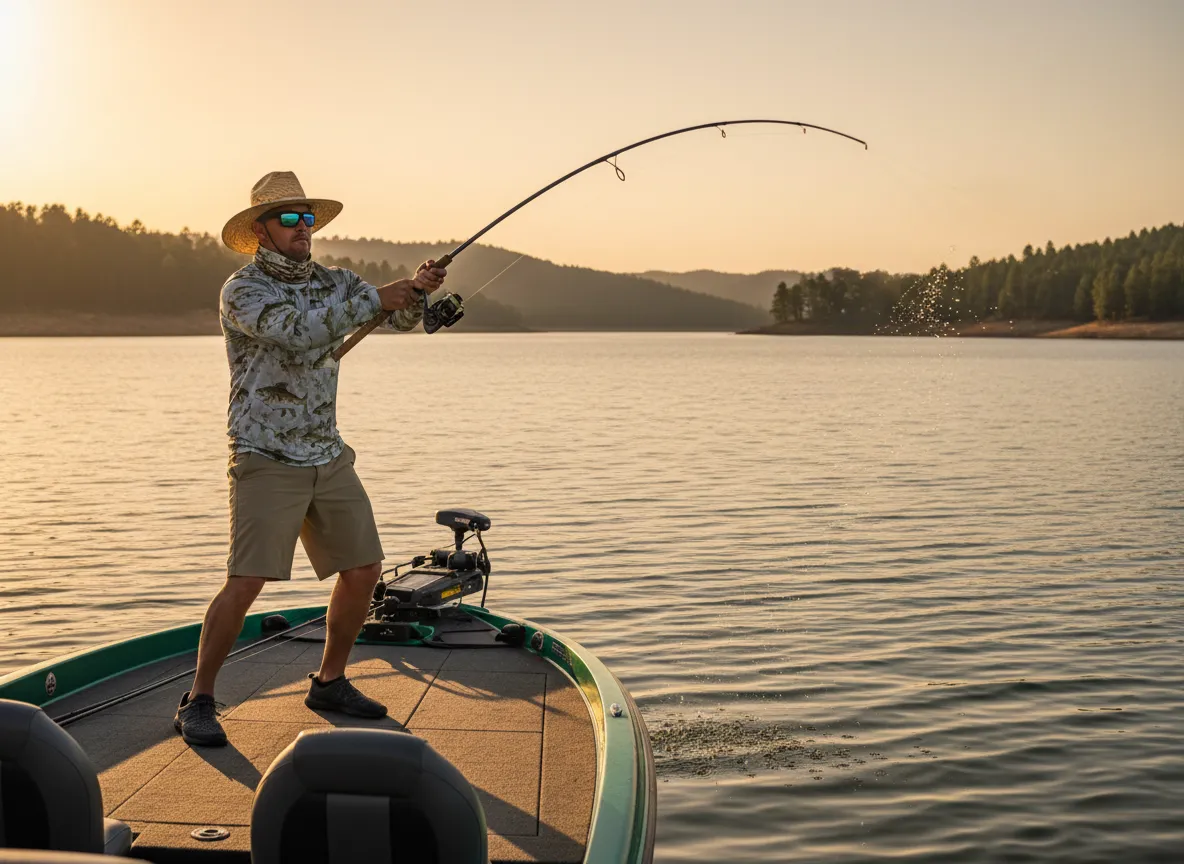
To reach a target depth of 20 feet—common in summer bass patterns or post-spawn staging—a long cast of 60 yards or more is physically required. This distance maximizes the duration of that horizontal sweet spot where the lure can grind along the bottom. Short casts result in the “Pendulum Effect.” In this scenario, the shortening angle of the fishing line pulls the lure upward before it ever reaches its potential max diving depth.
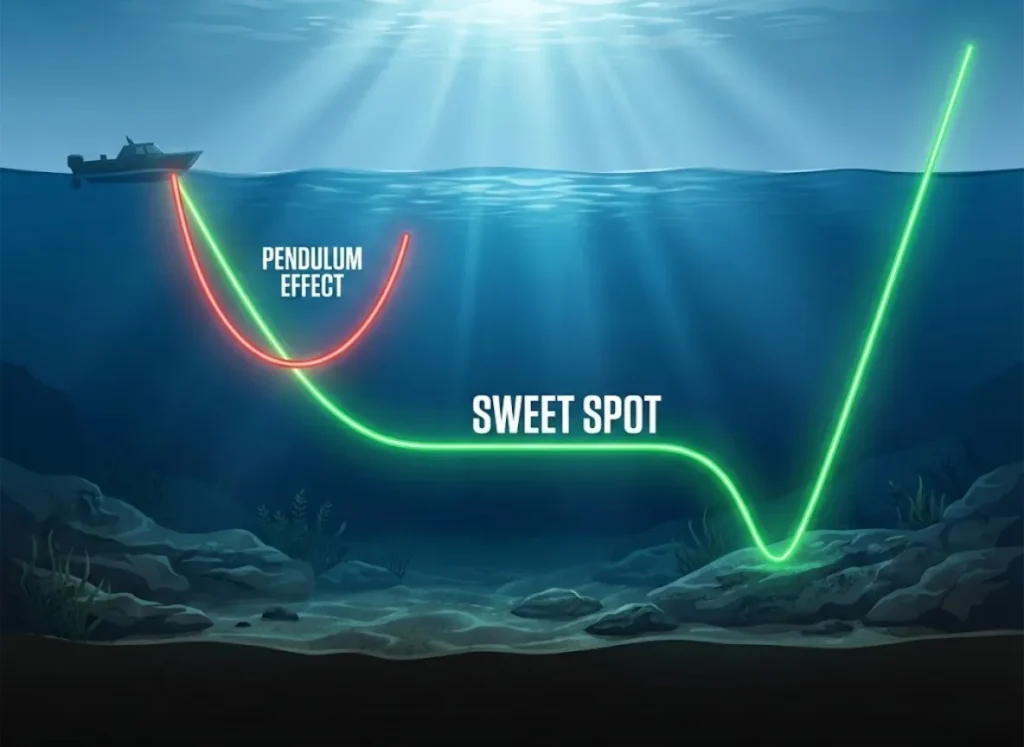
By extending the cast, you are mathematically increasing the length of the hypotenuse in the depth triangle, allowing the lure to plane out deeper for longer. This requires optimizing your gear setup using the baitcaster casting blueprint to maximize distance without backlashing.
Pro-Tip: Many modern deep divers utilize internal weight-transfer systems. Listen for the “clack” during your backswing—that is the tungsten bearing shifting to the tail. If you don’t feel that shift, snap the rod tip harder on the load-up to engage the system for maximum distance.
How does line diameter act as a variable for fluid friction and lift?
Line diameter is the single most controllable variable in depth achievement. Thicker lines create more surface area, which results in increased fluid friction, or drag. This drag creates an upward lift vector—essentially a “bow” in the line—that physically pulls the nose of the crankbait up and reduces its maximum depth.
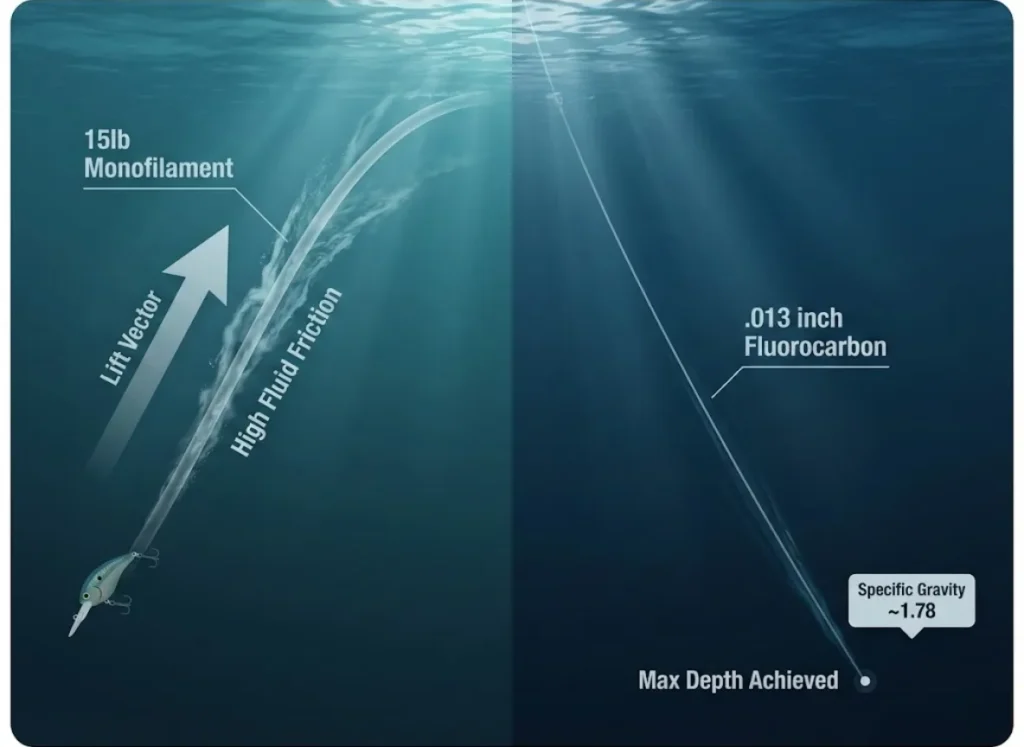
According to principles of fluid dynamics and drag coefficients, the force acting against a submerged object increases with surface area. Moving from .015 inch (monofilament line) to .013 inch (fluorocarbon line) can yield an additional 1 to 3 feet of depth simply by reducing this hydrodynamic resistance.
Material density is equally critical. When analyzing the sinking properties in our braid vs fluorocarbon vs monofilament breakdown, we see that fluorocarbon line (Specific Gravity ~1.78) sinks, aiding the dive and offering less stretch. Monofilament line (~1.13) is near-neutral and promotes lift. You must balance the risk of breakage against the reward of depth; using 10-15lb test is the standard, but dropping to 10lb is high-risk in timber, even if essential for dredging offshore ledges.
What is the “Kneel and Reel” technique and how does it alter vectors?
“Kneeling and Reeling” is a physical adjustment where the angler kneels on the deck and plunges the rod tip 2 to 3 feet underwater during the retrieve. This action lowers the origin point of the retrieve vector, flattening the angle of the line entering the water column.
By reducing the upward angle using this tip down method, the lure is allowed to stay at its maximum depth for a significantly longer portion of the retrieve. This technique, popularized by Paul Elias, can add an estimated 2 to 3 feet of functional depth to a standard deep crankbait. It is physically demanding, but often necessary when suspended bass or deep structure sit just below the standard running depth of your lure.
What gear engineering is required to manage deep water torque?
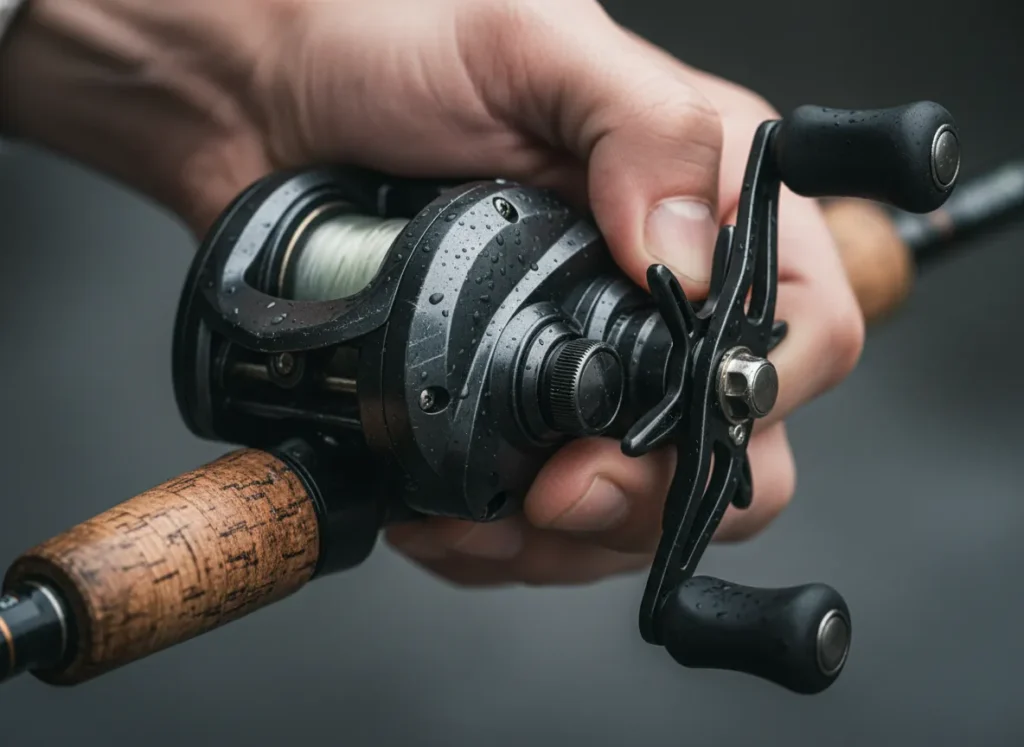
Managing the forces of deep cranking requires more than just technique; it requires a machine engineered to handle the load of hard-pulling crankbaits. This shifts the focus from hydrodynamics to mechanical engineering.
Why are low gear ratio reels the “winch” of this system?
Deep divers generate immense resistance. A high-speed reel (7.1:1 or higher) lacks the torque to move them without exhausting the angler. The optimal tool is a baitcaster reel with a gear ratio between 5.4:1 gear ratio and 6.4:1. This provides the mechanical advantage necessary to “winch” the lure through the water, aiding in fatigue management over a long day of casting.
The target metric here is “Inches Per Turn” (IPT), aiming for a recovery rate of 21-24 inches to maintain the lure’s hydrodynamic balance without blowing it out. Identifying the best baitcasting reels for bass that offer these low gear ratio reels is critical for energy conservation. A struggling angler fighting the reel loses the tactile feedback needed to detect subtle shell beds.
Why are composite or glass rods essential for the “delay”?
Graphite rods, while sensitive, have a high modulus of elasticity (stiffness) that recovers too quickly for treble hooks. Deep cranking requires rods made of Fiberglass (S-Glass/E-Glass) or Composite rods. These materials exhibit “hysteresis”—a delay in the rod’s return to straightness, often described as a moderate action or parabolic action.
When a fish inhales the lure, the glass rod absorbs the energy deeply into the blank (parabolic bend) rather than transmitting it instantly as resistance. This “delay” allows the fish to fully engulf the bait into the vacuum created by its gill flare before the line goes tight. Understanding the taper and blank construction in the parts of a fishing rod helps explain why this shock absorption is vital for preventing treble hook tear-outs and improving landing ratios.
How does the biology of the bass dictate the strike trigger?
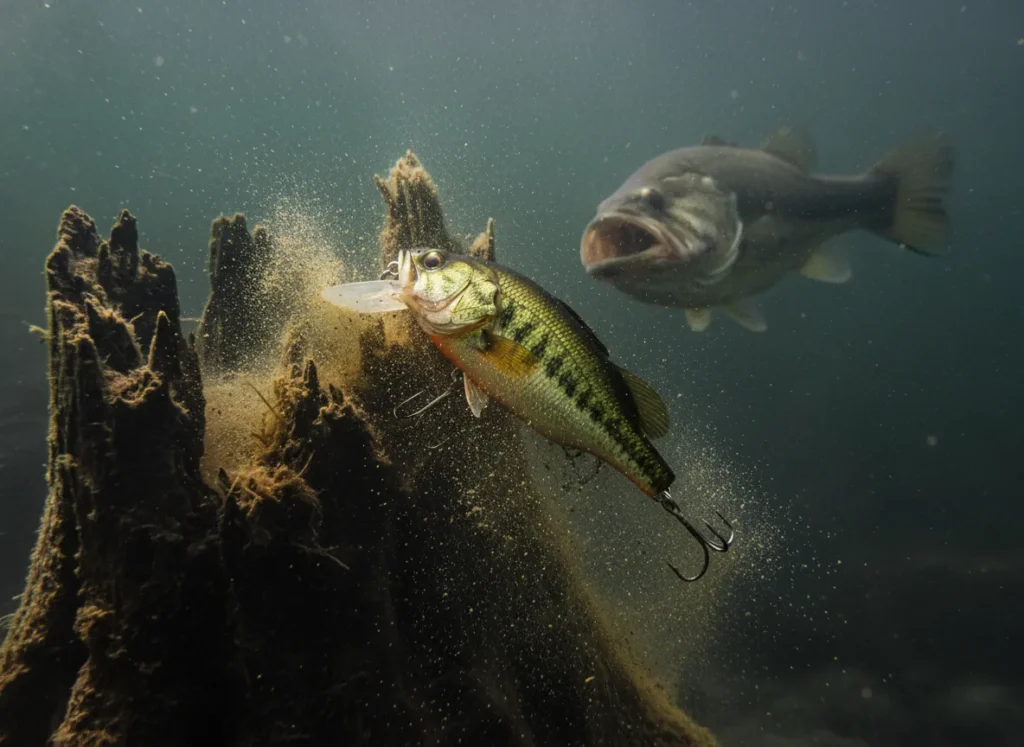
With the machine calibrated, we turn our attention to the biological entity we are trying to deceive. We are targeting the neurobiology of the bass, specifically focusing on the lateral line system and the difference between feeding and reaction strikes.
What is the role of the lateral line in detecting deep prey?
At depths of 20 feet, light penetration is minimal. Bass anglers know that fish rely on their lateral line system—a series of mechanoreceptors—to “hear” pressure waves. This system is tuned to detect low-frequency vibrations, specifically in the 10Hz to 100Hz range.
Large-lipped plastic crankbaits generate a wide, thumping displacement that broadcasts a “super-stimulus” directly into this sensitivity zone. Research on lateral line frequency sensitivity confirms that this organ contributes significantly to “hearing” particle motion. This allows the bass to track the trajectory of the lure long before they can see it visually, mimicking the signature of struggling baitfish like threadfin shad, gizzard shad, or bluegill. This sensory biology is further explored in our largemouth bass facts guide.
How does “deflection” trigger the startle reflex?
A bass following a steady retrieve is in a cognitive “decision” mode. Deflection changes this to a reflexive “reaction” mode. When the crankbait collides with a rock or stump, it ricochets erratically, momentarily breaking its rhythm and trajectory.
This sudden chaotic movement triggers the Mauthner cells in the fish’s brainstem, initiating a Mauthner cell startle response known as a “C-start.” This is a reflex that bypasses conscious hunger. The goal of the deep cranker is not to swim the bait near the bottom, but to grind along the bottom to generate these collisions. This requires selecting baits with high snag-resistance as detailed in our best lures for largemouth bass analysis.
How do you locate and interpret deep structure?
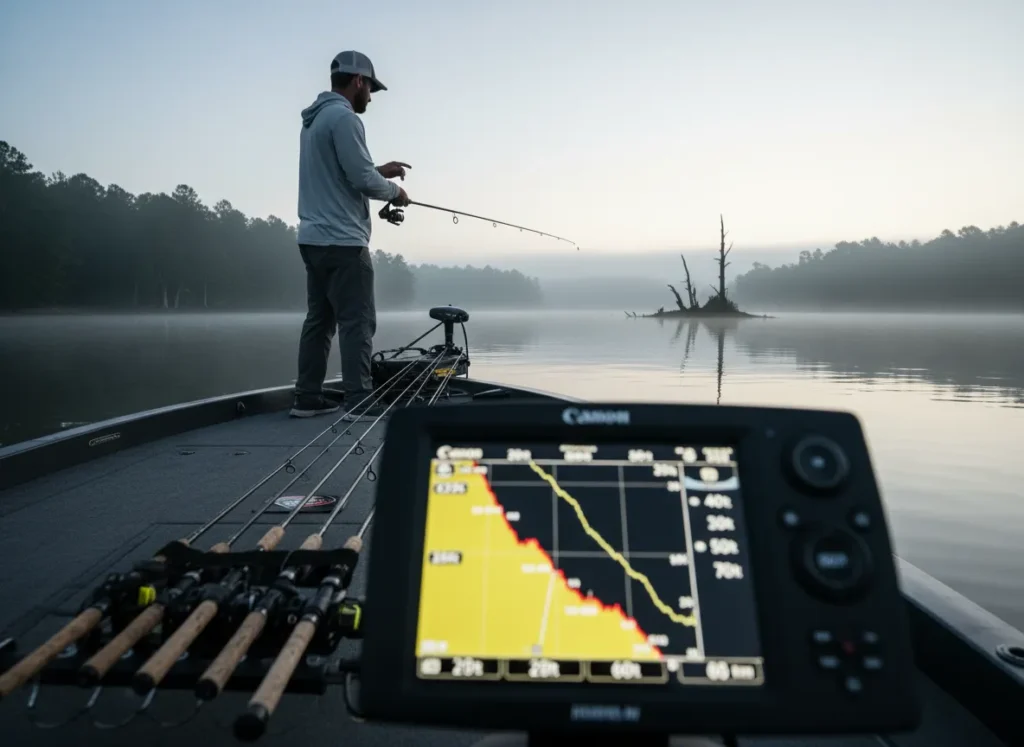
You must learn to use the lure as a remote sensing probe to map the lake bottom composition.
How does bottom composition feel through the rod? (The Tactile Dictionary)
The rod transmits specific vibration signatures that correspond to different substrates. Learning this “language” is the difference between simply casting and actually fishing deep structure.
- Clay/Mud: Feels like “mush” or dragging the bait through peanut butter. The vibration is dampened, and the rod loads heavily but smoothly.
- Rock: Transmits as distinct, hard “knocks” or “thuds.” The rod tip will bounce sharply as the square or round bill deflects off rocks.
- Shell Beds: The holy grail of offshore bass fishing. This feels like a “crisp crunch” or dragging the lure over broken glass or gravel.
- Wood: A “soft” impact followed by a sticky, spongy sensation. This requires a pause to let the bait float up and over to avoid snagging.
Bass often congregate on hard bottom spots within soft areas. Identifying the transition line where mud turns to shell—often found near creek channel bends or main lake points—is usually where the school of fish is positioned.
How do you position the boat for the perfect cast? (Triangulation)
Triangulation involves aligning the boat with two external visual landmarks (or GPS waypoints) to pinpoint the exact casting angle for a submerged structure. The cast must be lined up to bring the lure across the structure at the precise moment it reaches maximum depth.
Effective boat control requires accounting for wind and current, often utilizing spot-lock to hold position while you “lead” the target area. Verify the structure’s depth and orientation by mastering your fish finder with astute sonar reading before making your first cast. “Uphill” casting (sitting deep and casting shallow) allows the bait to dig into the ledge face, maintaining bottom contact the entire way up.
Pro-Tip: Once you trigger a school, speed is essential. Bass are competitive. If you hook a fish, try to get your lure back in the water within seconds of release to keep the school “fired up.”
Final Thoughts
Deep cranking is often misunderstood as a “chunk and wind” technique, but the reality is far more cerebral. Depth is a product of physics, heavily influenced by casting distance and line choice. Fluorocarbon line is the superior engineering choice due to its high density and low visibility.
But the gear is only the delivery system. The catch is made when the reaction bite is triggered by deflection, requiring the angler to crash the crankbait into the bottom to exploit the bass’s reflexes. Utilizing glass rods provides the necessary delay to ensure fish inhale the bait and stay pinned.
Next time you are on the water, don’t just cast; visualize the dive curves. Share your “shell bed” success stories in the comments below or explore our guide on seasonal bass migrations to know when to head deep.
FAQ – Frequently Asked Questions about Deep Diving Crankbaits
What is the best gear ratio for deep diving crankbaits?
A gear ratio between 5.4:1 gear ratio and 6.4:1 is ideal. These low gear ratio reels act as a winch, providing the torque needed to retrieve high-resistance lures without fatiguing the angler. High-speed reels often move the bait too fast and lack the power for deep-water presentations.
Why am I losing fish on my deep crankbait?
You are likely using a rod that is too stiff (Graphite). Switch to a Composite or Glass rod with a parabolic action. The spongy delay of a glass rod allows the fish to inhale the bait fully and prevents treble hooks from tearing out during the fight.
How much deeper does fluorocarbon dive compared to monofilament?
Fluorocarbon line can help a lure dive 1 to 3 feet deeper than monofilament line of the same pound test. This is because fluorocarbon is denser than water (it sinks), has a smaller diameter for less drag, and has less stretch.
How do I feel the difference between rock and shell beds?
Rock feels like a hard, distinct thud or knock that bounces the rod tip sharply. Shell beds feel like a crisp crunch or vibration, similar to dragging the lure over broken glass or gravel.
Risk Disclaimer: Fishing, boating, and all related outdoor activities involve inherent risks that
can lead to injury. The information provided on Master Fishing Mag is for educational and informational purposes
only. While we strive for accuracy, the information, techniques, and advice on gear and safety are not a substitute
for your own best judgment, local knowledge, and adherence to official regulations. Fishing regulations, including
seasons, size limits, and species restrictions, change frequently and vary by location. Always consult the latest
official regulations from your local fish and wildlife agency before heading out. Proper handling of hooks, knives,
and other sharp equipment is essential for safety. Furthermore, be aware of local fish consumption advisories. By
using this website, you agree that you are solely responsible for your own safety and for complying with all
applicable laws. Any reliance you place on our content is strictly at your own risk. Master Fishing Mag and its
authors will not be held liable for any injury, damage, or loss sustained in connection with the use of the
information herein.
Affiliate Disclosure: We are a participant in the Amazon Services LLC Associates Program, an
affiliate advertising program designed to provide a means for us to earn advertising fees by advertising and linking
to Amazon.com. As an Amazon Associate, we earn from qualifying purchases. We also participate in other affiliate
programs and may receive a commission on products purchased through our links, at no extra cost to you. Additional
terms are found in the terms of service.