
In this article
A 200-pound tuna does not care about the brand name stamped on your rod or the price of your reel. It does not respect your ego or your endurance. When the drag screams and the carbon fiber loads into a deep parabolic bend, the romanticism of the sport evaporates. What remains are rigid equations of force, distance, and angle—the cold reality of angling mechanics.
I have watched grown men weep over shattered graphite. I have also seen 120-pound anglers subdue monsters simply by understanding geometry.
In my years on the water, both guiding clients and fighting for conservation, I’ve learned that this sport is a mechanical conflict. If you fight the physics, the rod blank breaks or your back fails. If you master the machine, you turn a massive mechanical disadvantage into a tactical weapon. This guide will take you from fighting against your gear to operating it with precision. You will learn to manipulate fulcrums and vectors to land heavy loads without structural failure.
What Class of Lever is a Fishing Rod?
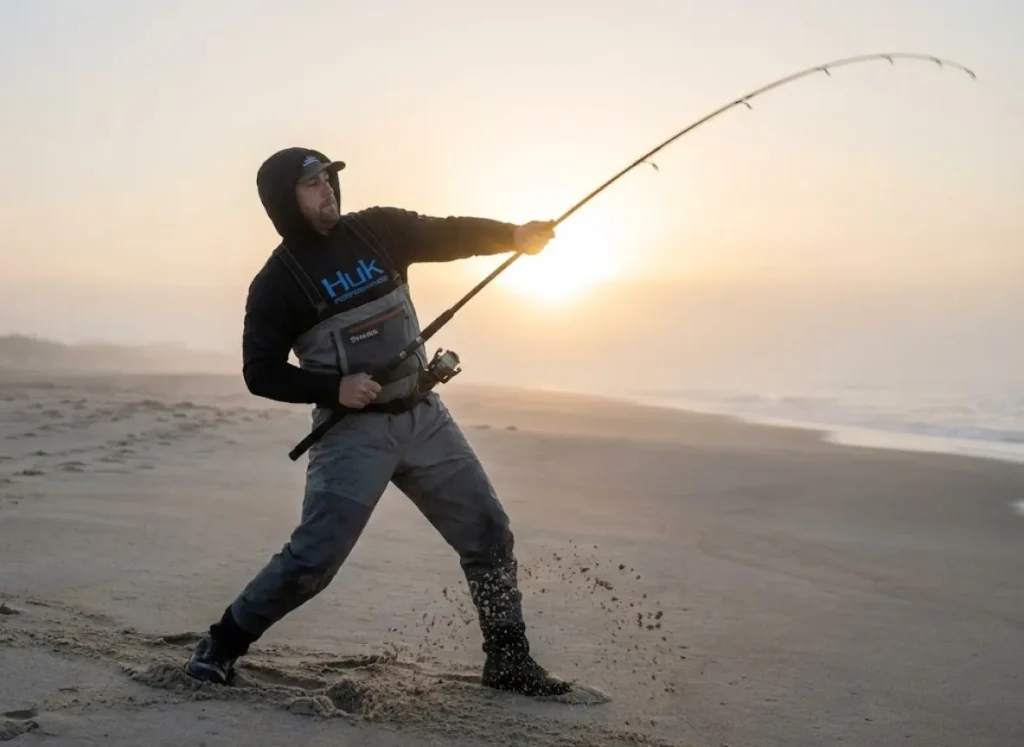
In the broader simple machines framework—which governs everything from the screw and wedge to the wheel and axle—the fishing rod is distinct. It functions primarily as a Third-Class Lever (or third order lever). In this system, the input force is applied between the pivot point and the resistance.
How does the geometry of a Third-Class Lever work?
To understand why your arms burn after five minutes of fighting a fish, you have to look at the arrangement of components in your hands. Unlike scissors or seesaws (first-class levers), where the pivot sits between the force and load, the rod setup is harder on the operator.
The Fulcrum is physically located at the rod butt. You anchor this against your hip or groin to create a stable axis of rotation.
The Effort (or effort point) is applied by your forward hand on the foregrip, effectively “sandwiched” between the fulcrum and the load. Finally, the Load (or resistance force) acts at the rod tip, generated by the fish’s mass and hydrodynamic drag. By identifying the parts of a fishing rod and where your hands sit, you can visualize the weight-force-fulcrum relationship working against you.
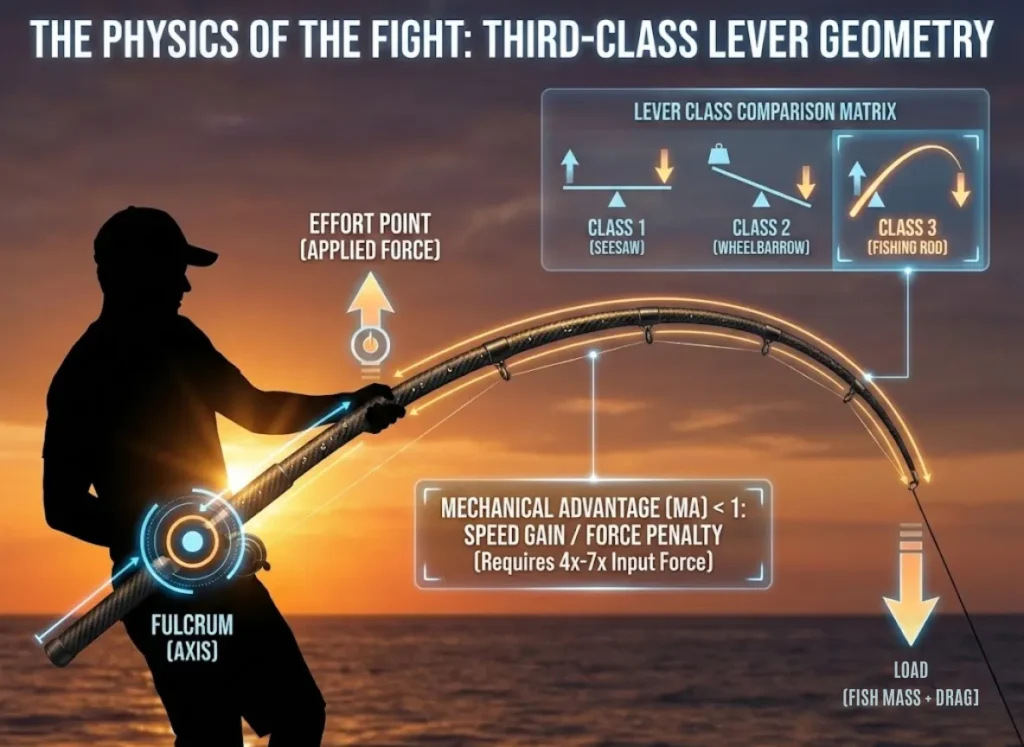
This configuration creates a Mechanical Advantage (MA) of less than 1. This means the tool is designed to reduce your output force in exchange for tip speed and distance advantage. According to the principles of third-class levers in biomechanics, we accept this trade-off because we need to multiply the velocity of the lure.
A short movement of your hand results in a massive, high-speed arc at the tip. However, this comes with a distinct “Leverage Penalty” or force disadvantage. For every pound of force the fish pulls with, you must often exert 4 to 7 times that force to maintain equilibrium.
How Does Rod Length Affect Fighting Power?
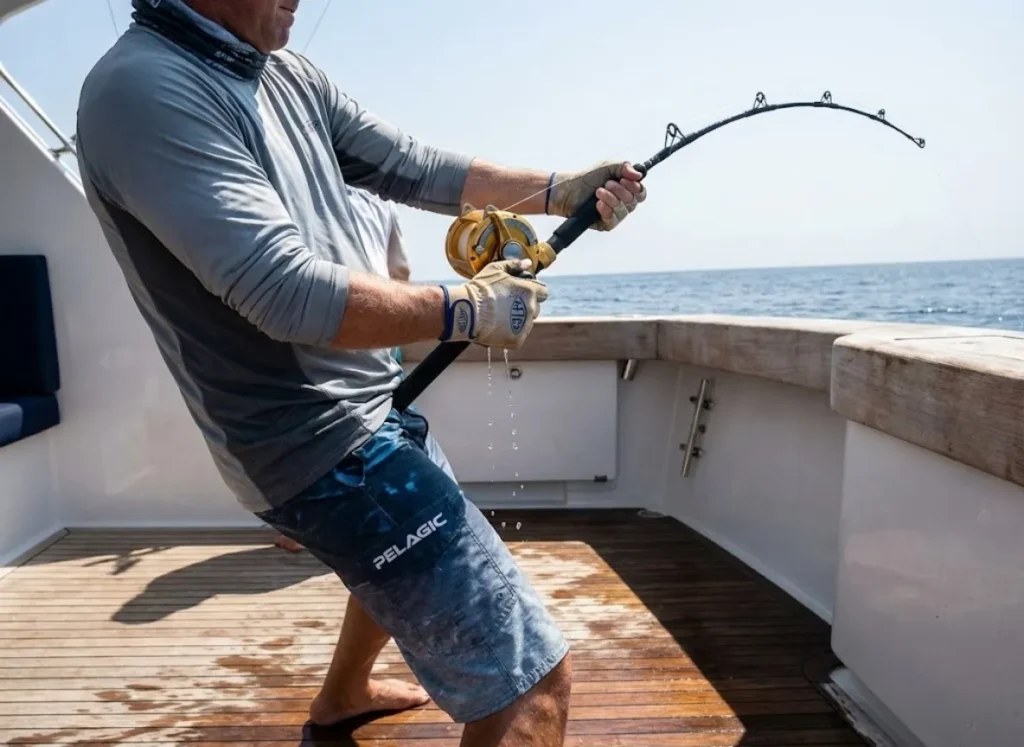
Once you accept that the rod is designed to multiply speed rather than force, the question becomes: how much harder does a longer rod actually make the fight? The answer lies in the static dimensions of your gear, specifically the overall rod length.
What is the “Leverage Efficiency Score” (LES)?
The Leverage Efficiency Score is a way to visualize the pain you are about to endure. It is essentially the ratio of your grip length to the total length of the rod. A low score, typical when selecting surf fishing rods for distance, indicates a massive advantage for casting but a severe mechanical disadvantage for lifting power.
Conversely, a high score—found in short jigging or stand-up style rods—indicates a tool optimized for vertical lifting. Any builder of a good custom rod understands this balance.
Pro-Tip: If you are targeting large pelagic species from a boat, prioritize a rod between 5’6″ and 6’0″. This “short stick” drastically reduces the lever arm working against you.
A standard 7-foot bass rod often forces the angler to exert nearly 7 times the force the fish applies. This is acceptable for a 5lb bass, but catastrophic for a 100lb tuna. Shortening the rod reduces the “Output Arm” length, directly improving your advantage.
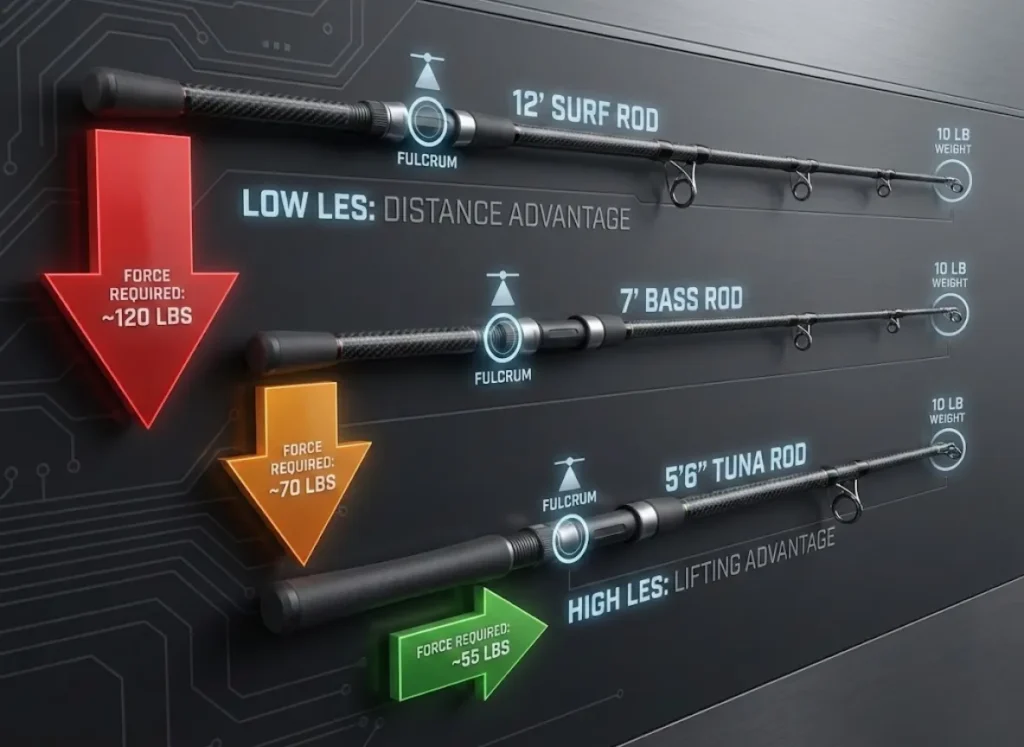
This aligns with standard torque and rotational equilibrium formulas, where reducing the radius (rod length) linearly reduces the required input torque. This explains why stand-up style rod designs evolved from 7 feet to under 6 feet as anglers moved from fighting chairs to standing on the deck.
How does the “Effective Fulcrum” change as the rod bends?
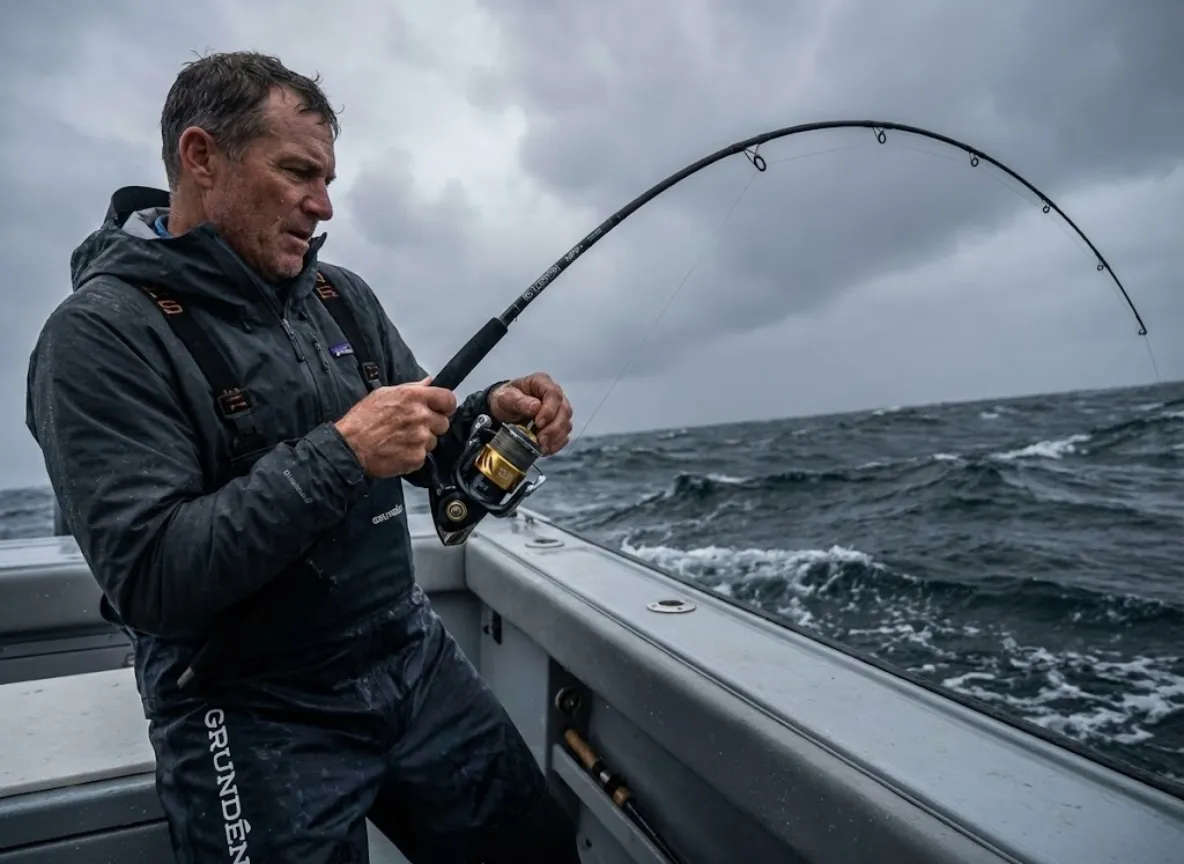
While static length provides a baseline, a fishing rod is a flexible beam, not a stiff cylindrical post. It acts as a tapered cantilever. When a rod bends into a parabolic shape, its “Effective Load Arm” shortens horizontally.
If you are understanding rod power vs action, you know that a “Slow Action” rod bends deeply toward the handle. This physically moves the tip closer to your hands. By shortening the horizontal distance in the torque equation, the rod becomes easier to manage. The rod as a spring stores potential energy.
This bending action effectively increases your Mechanical Advantage mid-fight. A deeply bent composite rod is easier to hold under load than a stiff, straight lever of the same length because the lever arm has shortened. However, “Fast Action” rods remain stiff in the bottom two-thirds. This keeps the load further away from your body.
For this to work, the material must possess a high capacity for beam deflection and strain energy to recover without fracturing. The dynamic flex allows you to exert “recovery force” efficiently. It allows you to pump the fish up as the rod attempts to straighten.
What Causes “High-Sticking” and Rod Failure?
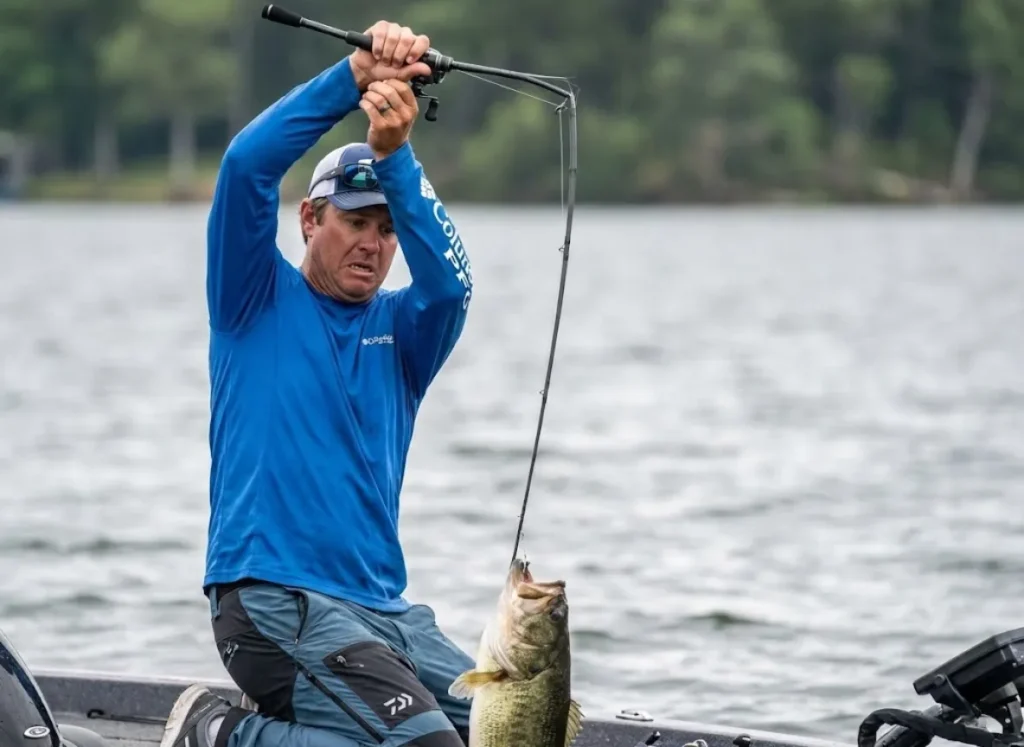
Most rod failures are not manufacturing defects; they are user errors rooted in poor angle management. The most common culprit is “High-Sticking.”
Why is the 90-degree angle critical for rod safety?
“High-Sticking” occurs when the angle between the rod butt and the line becomes acute (less than 90 degrees). This usually happens when the angle of elevation is too high while the fish is directly below the boat.
At a proper 45-degree angle of pull, the resolution of forces and vectors shows that the stress is distributed perpendicular to the blank. This utilizes the rod’s strong lower section to bear the weight. Think of the x axis (horizontal) carrying the load rather than the y axis (vertical).
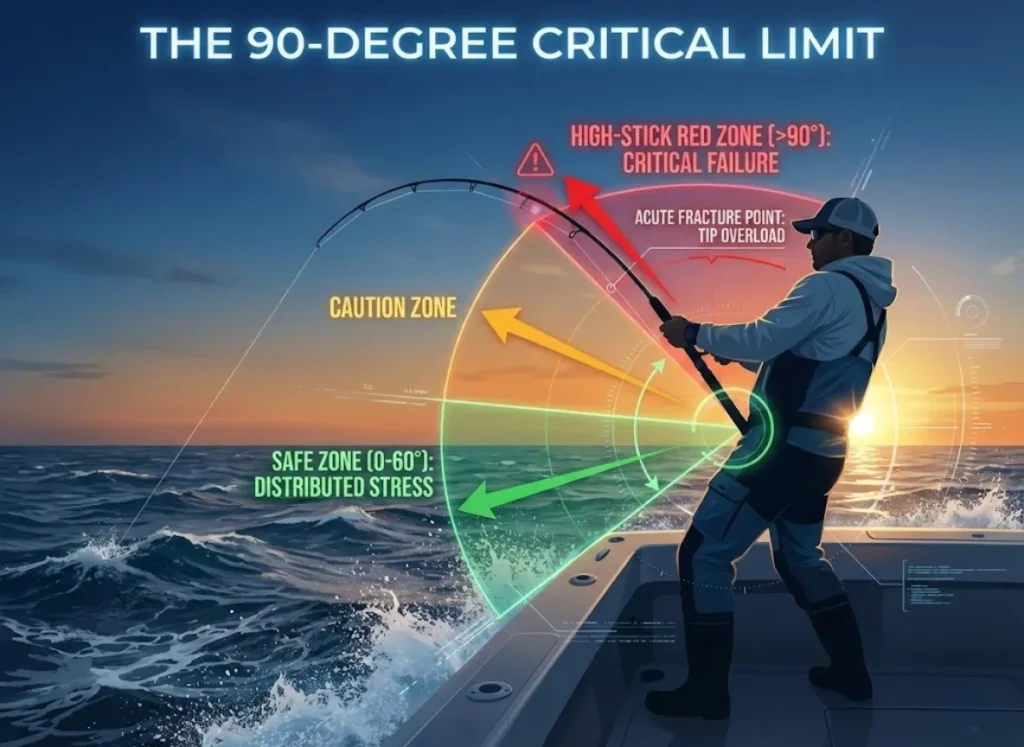
When the rod goes vertical, the bending component vanishes from the butt section. The load concentrates entirely on the fragile top few inches. This shift forces the tip to bend into a radius tighter than its critical limit.
It creates a specific failure mode common when discussing the science of graphite vs glass rods. The brittle nature of high-modulus graphite cannot withstand this acute bend. You must never pull the rod tip back past your ears. If the fish is deep, lift with the rod butt or step back to decrease the angle.
What is “Hoop Stress” and how does it break the blank?
Fishing rods are hollow tubes, not solid bars like a crowbar or nail puller. This makes them susceptible to Hoop Stress. This stress acts circumferentially around the tube wall. As a tube bends, its cross-section naturally tries to flatten from a circle into an oval. This process is known as ovalization.
In a high-stick scenario, the extreme curvature at the tip creates crushing forces. These forces exceed the compressive strength of the resin and hoop fibers. According to the mechanics of hoop stress, once the tube ovalizes beyond a critical point—vital for structural identification of the breakage—the longitudinal carbon fibers lose their support.
They buckle outward or snap inward. This sudden release of strain energy creates the characteristic “gunshot” sound of a graphite rod breaking.
How Can Anglers Shift the Fulcrum to Gain Advantage?
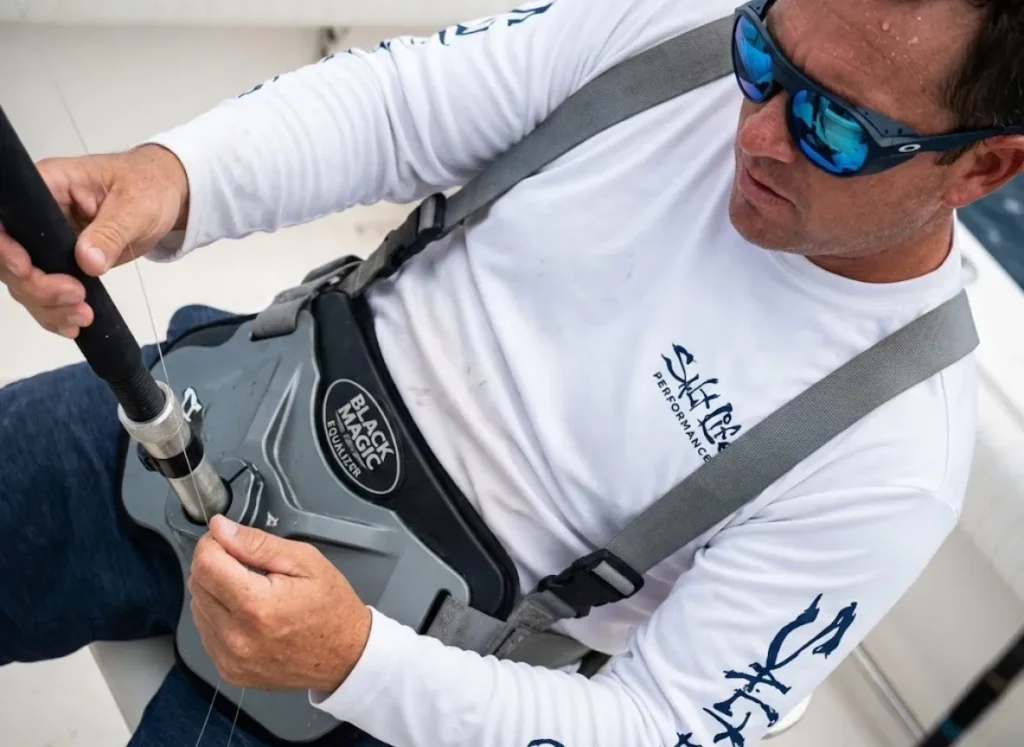
Physics isn’t just about the rod; it’s about your body. You can upgrade the human element to work within the limits of the machine.
How do fighting belts and harnesses alter the lever system?
A Gimbal Belt is a mechanical interface that shifts the fulcrum from your soft tissue or wrist to your rigid pelvic bone structure. Without a belt, you act as a Third-Class lever. You use your shoulder as a pivot and your bicep as effort, which is a weak linkage. By locking the rod butt into a low-slung belt, the pivot point moves to your hips.
Adding a kidney or bucket harness clips the reel directly to your lower back. This setup allows you to utilize proper biomechanics of lifting and leverage, shifting the load to your legs and glutes (Class 1 or 2 lever mechanics). You become as stable as a heavy wooden plank or truss.
This massive extension of the input arm improves your Mechanical Advantage. It allows you to apply 50lbs of drag pressure using body weight rather than muscular tension. Once you have this leverage, learning how to set fishing drag becomes critical, as your body can now exert enough force to snap the line if the reel isn’t calibrated correctly.
Pro-Tip: When using a harness, keep your knees slightly bent and your back straight. Lean back against the harness like you are sitting in a chair. Let your body weight lift the fish, not your arms.
The Angler’s Takeaway
Understanding the physics of your gear changes the way you fight a fish. We know that a fishing rod is a Third-Class Lever, forcing us to pay a “force tax” to gain the speed required for casting. We understand that shortening the lever is the only mathematical way to reduce the effort required to lift heavy loads.
We also know that High-Sticking is a failure of vector management that crushes the rod tube via hoop stress. By shifting the fulcrum via belts and harnesses, you transform yourself from a weak arm-lifter into a powerful, full-body lever.
Before your next trip, audit your heavy-tackle arsenal and gear selection logic. Check the length of your rods and practice your angles. The fish will test your equipment; make sure you have done the math.
FAQ – Frequently Asked Questions about Fishing Rod Physics
Is a fishing rod a 1st, 2nd, or 3rd class lever?
A fishing rod is primarily a Third-Class Lever because the effort (your hand) is applied between the fulcrum (the butt) and the load (the fish). However, from the fish’s perspective, the rod can act as a Second-Class lever where the fish pulls against the resistance of the bent blank.
Does a longer fishing rod give you more leverage?
No, a longer rod actually gives you less leverage (Mechanical Advantage) against the fish, requiring more force to lift the same weight. Longer rods provide speed leverage for casting distance, but they act as a longer lever arm against the angler during the fight.
What is High-Sticking and why does it break rods?
High-sticking is holding the rod past a 90-degree vertical angle, which transfers the load from the strong butt section to the fragile tip. This creates Hoop Stress that ovalizes and crushes the hollow graphite tube, causing it to snap.
Why are stand-up tuna rods so short?
Stand-up rods are short (5’6 – 6’0) to minimize the Leverage Penalty on the angler. A shorter rod reduces the torque the fish can apply to the angler, preventing the angler from being pulled overboard and reducing back fatigue.
Risk Disclaimer: Fishing, boating, and all related outdoor activities involve inherent risks that
can lead to injury. The information provided on Master Fishing Mag is for educational and informational purposes
only. While we strive for accuracy, the information, techniques, and advice on gear and safety are not a substitute
for your own best judgment, local knowledge, and adherence to official regulations. Fishing regulations, including
seasons, size limits, and species restrictions, change frequently and vary by location. Always consult the latest
official regulations from your local fish and wildlife agency before heading out. Proper handling of hooks, knives,
and other sharp equipment is essential for safety. Furthermore, be aware of local fish consumption advisories. By
using this website, you agree that you are solely responsible for your own safety and for complying with all
applicable laws. Any reliance you place on our content is strictly at your own risk. Master Fishing Mag and its
authors will not be held liable for any injury, damage, or loss sustained in connection with the use of the
information herein.
Affiliate Disclosure: We are a participant in the Amazon Services LLC Associates Program, an
affiliate advertising program designed to provide a means for us to earn advertising fees by advertising and linking
to Amazon.com. As an Amazon Associate, we earn from qualifying purchases. We also participate in other affiliate
programs and may receive a commission on products purchased through our links, at no extra cost to you. Additional
terms are found in the terms of service.