
In this article
You’re at the tackle counter at 6am, staring at a rack of six lens colors, about to launch into a stained tidal creek you’ve never fished. Blue, green, amber, copper, gray, rose. The mistake that comes up over and over in fishing forums is buying the lens that looks like a fishing lens instead of the one built for the light you actually fish in, and the guy behind the counter is not going to stop you. Choosing a fishing sunglasses lens color comes down to three questions: what are you trying to see, how much light is bouncing at you, and how many pairs are you willing to own. Here’s what each tint actually does and which one belongs on your face.
Base Tint vs. Mirror Coating (What You’re Actually Buying)
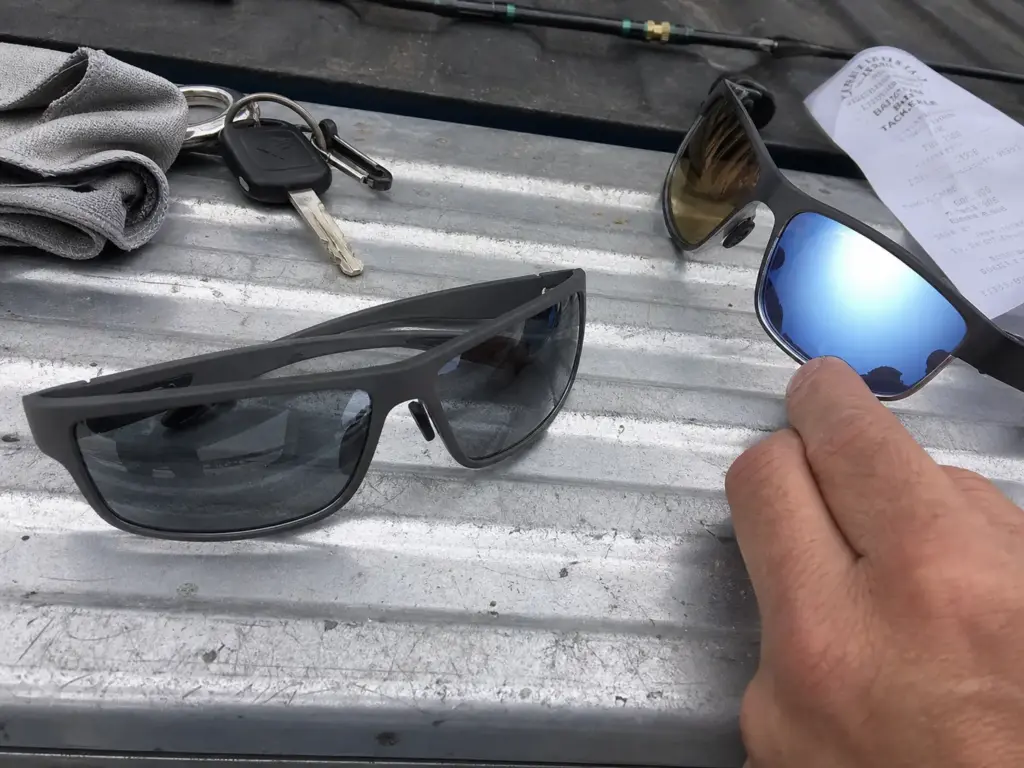
The guy at the counter says “these are the blue ones” and hands you a lens whose functional tint is gray. Two anglers can own blue mirror glasses that read water completely differently, and neither one knows why. This is where most of the money gets wasted before anyone even talks about water color.
A polarized fishing lens is three independent layers stacked in one piece of glass or polycarbonate. The polarization film kills horizontal glare bouncing off the surface. The base tint filters color and builds contrast. The mirror coating reflects somewhere between 10% and 60% of additional incoming light depending on how dense it is. Three jobs, three layers, and only one of them is named on the front of the box.
That last part is the problem. A blue mirror lens is a reflective topcoat sitting on a base tint that’s usually gray, amber, or copper underneath. The mirror color tells you almost nothing about how the lens reads water. Buy two pairs both labeled blue mirror, one over a gray base and one over a copper base, and you own two genuinely different tools that happen to look identical in the case.
Experienced anglers ask for the base tint by name at the counter. It’s the number that matters alongside VLT, short for visible light transmission, the percentage of light the lens lets through. If a listing gives you a mirror color and nothing else, you don’t have enough information to buy yet. That single habit, finding the base tint before anything else, saves more money than any other thing in this article. If you want the deeper mechanics, we cover the physics of why polarization cuts glare off the water separately.
Gray and Gray-Green Lenses (True Color, Bright Open Water)
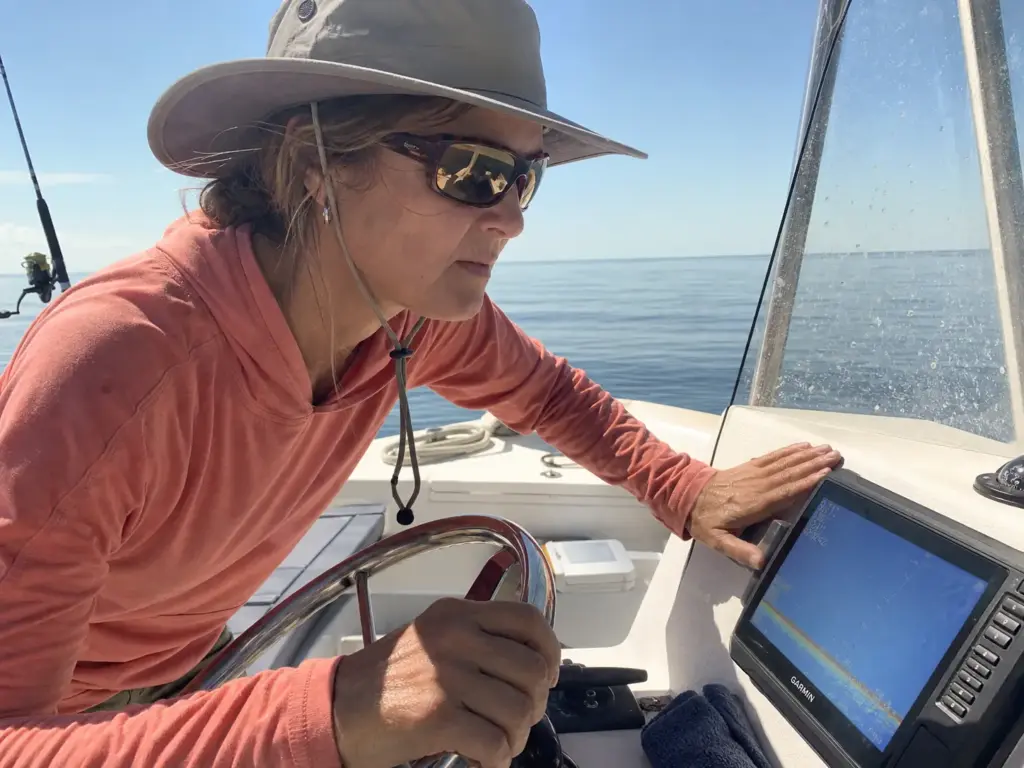
Gray is the lens nobody gets excited about and half the working boats run. It doesn’t make fish pop. It makes the day survivable.
What gray does is cut brightness while preserving true color perception. It’s a brightness filter, not a color filter, so nothing you look at gets shifted warmer or cooler. Bajío’s gray base runs around 10% VLT, the darkest of the mainstream tints, built to not fight you across eight hours of full sun on big water. That number is the whole pitch.
Gray belongs offshore, in deep or open water, and on any day built around blind casting or trolling. There’s no bottom to read out there and no fish silhouette to pick out of the grass. You’re fighting glare and eye strain, nothing else, and gray does that job without editorializing about what you’re looking at.
The Torege Pure Cratos is the budget-friendly way into a gray polarized lens, and it’s honestly the sensible first pair for someone who isn’t sure yet which tint their fishing actually calls for. Check it on Amazon before spending premium money on a guess.
If you spend the day reading a sonar screen or judging lure colors, gray is the one tint that never lies to you about what you’re seeing. Amber will warm a chartreuse skirt toward orange, and after six hours you stop noticing it’s doing that.
Where gray falls short is the part people learn a season too late. It removes glare beautifully and adds no contrast whatsoever, which makes it the wrong tool for picking a redfish out of turtle grass. If you’re also fighting to see your electronics, reading a fish-finder screen through polarized lenses has its own set of fixes worth knowing.
Amber, Copper, and Brown Lenses (Contrast and Sight Fishing)
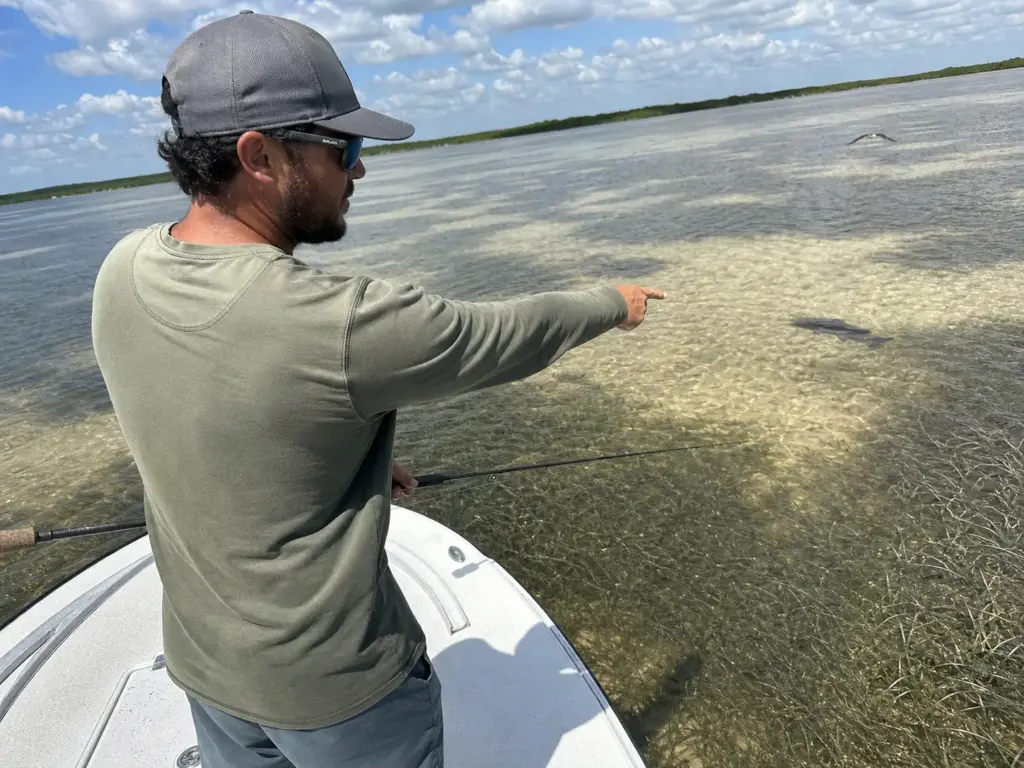
This is the tint the flats crowd names without hesitating, and the one most people file in the wrong drawer.
Copper, amber, and brown bases filter blue light preferentially. That’s the entire mechanism behind “amber makes fish pop”: blue-heavy haze is what washes out a fish’s outline against a lighter bottom, and cutting it raises contrast against sand and grass. Nothing magic, just selective filtering doing exactly what it says.
The assumption worth retiring is that amber is a low-light lens. Bajío’s brown and amber base runs around 12% VLT, built for flats, reefs, and shorelines, which makes it genuinely dark while boosting contrast at the same time. Light copper sits around 18% VLT for rivers and lakes under canopy or cloud cover, the shaded-creek-at-2pm lens, lighter because tree cover already cut the glare for you. That’s a range covering far more of the day than “for low light” suggests.
The Maui Jim Southern Cross in HCL Bronze is a textbook amber base if you want to see what the category is supposed to feel like, and it’s a premium piece of glass. Check it on Amazon if flats work is most of your fishing.
Sight-fishing anglers name copper and amber consistently, and the reason is precise: they want to see the fish, not just avoid the glare. Gray removes the glare and leaves you looking at a uniformly dim bottom. Amber gives you the edge of a tail against turtle grass at thirty feet, which is the whole game when you’re spotting fish before they spot you.
The secondary payoff is depth perception. Raising contrast against the bottom doesn’t just make a fish visible, it tells you roughly how deep it’s sitting, because you can now read the bottom structure it’s holding over. That’s why fish-spotting contrast is the metric flats anglers actually judge a lens by, not brightness.
Blue and Green Mirror Lenses (Offshore Glare and the Inshore All-Rounder)
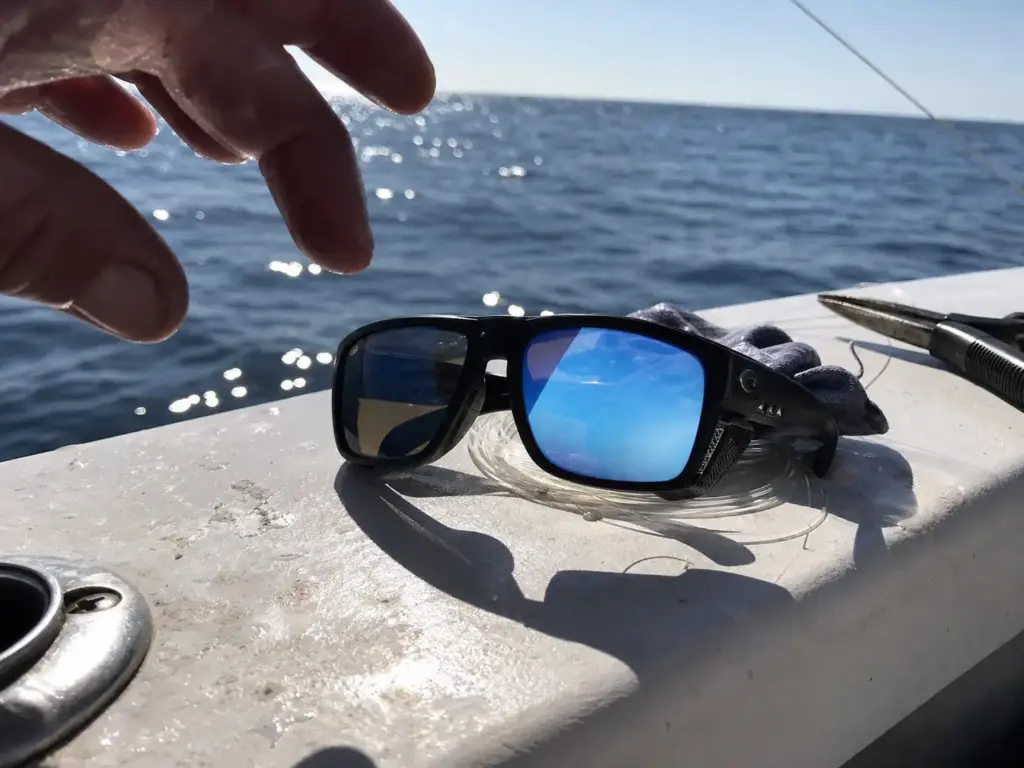
These are the lenses that look like fishing lenses, which is exactly why they get bought wrong.
Blue mirror over a gray base is the canonical bright-blue-water combination. Offshore there’s nothing but reflected sky coming at you from every direction, and the mirror knocks down overall brightness on top of what the gray base is already doing. Green mirror is the inshore middle ground, sitting comfortably in moderate to bright light across mixed water clarity, and it’s the closest thing to an all-rounder mirror you’ll find.
The decision math is simpler than the marketing. Roughly 8–18% VLT for bright sun, 18–30% for variable inshore light, and 30% or higher for overcast and low-light freshwater. Match the darkness of the lens to how much light is bouncing at you that day, not to the color you think looks correct on the water.
The Costa Del Mar King Tide 8 in 580G glass and the Bajío Cocho in LAPIS glass are both blue-mirror offshore pieces built for exactly this light, and the two of them cover the premium end of the category from different directions (King Tide 8 · Cocho).
The classic version of this mistake: buy the darkest blue-mirror pair in the shop for one offshore trip, then wear them on a stained farm pond the next weekend and never spot a single bed bass. Right lens, wrong light environment entirely. Nothing was broken except the match.
Which brings it back around. Before you pay for a mirror, check what’s underneath it. Two pairs both sold as blue mirror with different base tints are two different lenses at two different jobs, and the box won’t tell you. For readers who want the model-level decision rather than the color-level one, we keep a full breakdown of specific polarized models, glass versus polycarbonate in its own guide.
Rose, Ignitor, and Photochromic Lenses (Low Light and the Adaptive Promise)
The first and last hour are when a lot of fish get caught and when most lens choices fall apart. Photochromic gets sold as the fix. It half is.
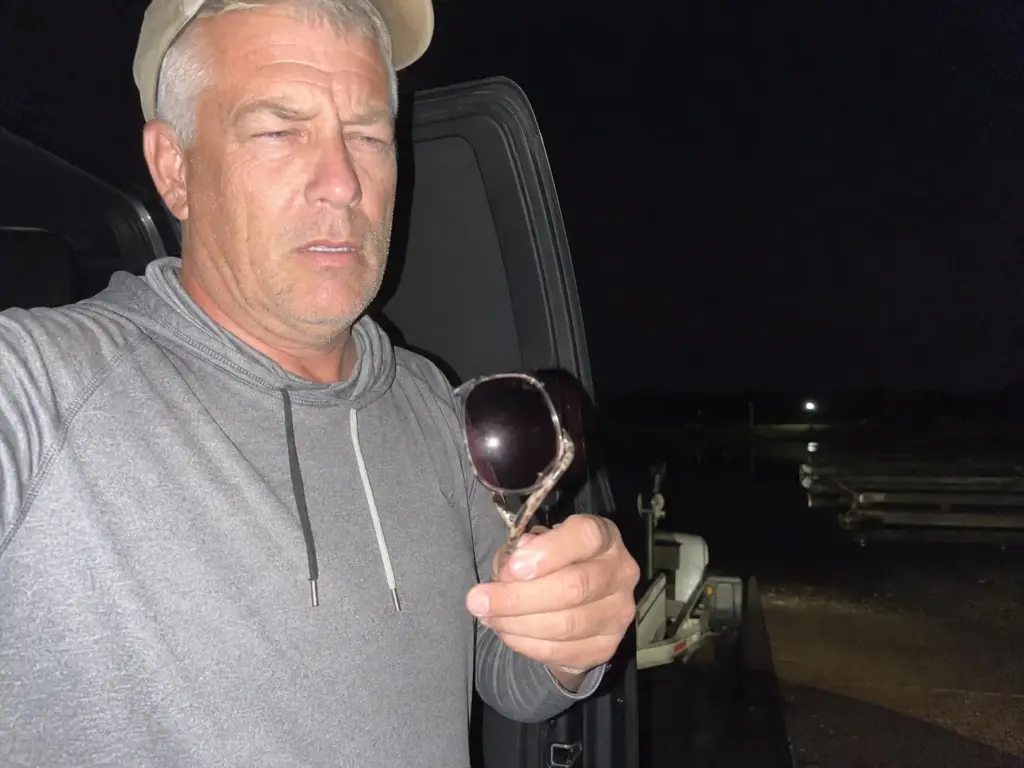
Rose and ignitor tints run high VLT, 30% and up, built for dawn, dusk, and heavy overcast. Their job is the inverse of everything above: they brighten a flat gray scene rather than darken a bright one, and they pull definition out of light that’s barely there. On a gray November morning they’re the difference between reading the water and guessing at it.
Photochromic lenses promise to handle all of it in one pair by darkening as the light comes up. The catch is physical: they only darken in response to direct UV light. Fish under a cap brim or a boat T-top and the lens may sit light exactly when you need it dark, because the shade blocking your face is also blocking the UV the lens needs to react. Anglers hit this constantly and misread it as a defective pair.
It isn’t. It’s the technology working as designed in conditions nobody mentions in the marketing copy. If you run a wide brim shading your face, which you should, you’ve built the exact condition that limits the adaptation.
The practical consequence is that anglers fishing dawn-to-dusk more often carry a second pair, rose or copper for the first hour and gray or amber for midday, than trust a single photochromic pair to transition on schedule. Where photochromic genuinely earns its money is open-cockpit boats, wading, and bank fishing, anywhere your face sits in direct sky and the lens gets the UV it’s asking for.
Match the Lens to the Technique, Not Just the Water
Every guide online sorts lenses by water type. Nobody fishes “water type.” You’re sight casting, blind casting, or trolling, and those three jobs ask completely different things of a lens.
The real question isn’t where you fish. It’s whether you’re trying to see into the water or just survive the glare sitting on top of it. Once you frame it that way the whole rack sorts itself in about ten seconds.
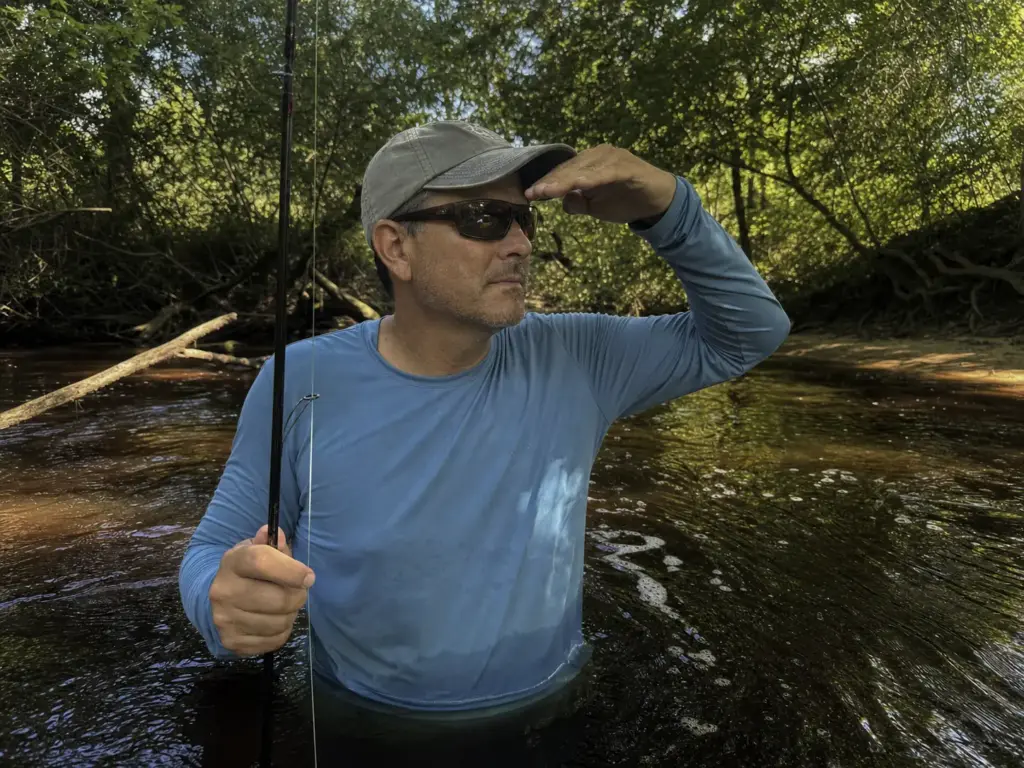
Sight casting covers flats, redfish, bonefish, bed bass, and picking a trout lie out of a riffle. You need contrast against the bottom, so copper or amber base, no debate. Gray will not build that contrast no matter how much you paid for it. This is the one case where the wrong tint doesn’t just make the day less comfortable, it makes the technique impossible.
Blind casting and trolling in open or deep water flips it. There’s no bottom to read and no silhouette to catch, so you’re buying eye comfort for eight hours and glare control on a surface that’s throwing sky back at you. Gray base, blue or green mirror if you want the extra brightness cut. Contrast isn’t doing anything for you here.
Stained, tannic, and backwater fishing is the case competitors skip, and it’s where most of the country actually fishes. Dark water eats light before it gets back to your eye, so a bright-sun lens leaves you staring at a brown wall. High-VLT amber or copper is the answer, the light copper end of the range rather than the flats-grade dark stuff. The same clarity-driven logic runs through picking soft plastic colors by water clarity, which is worth a read because it’s the same decision applied to what you’re throwing.
The tell that you bought for the wrong job shows up at the end of the day, not the middle. A lens matched to your technique means you stop noticing it’s on your face. A mismatched one means you keep lifting it to check whether that shadow was a fish. Count how many times you do that on your next trip.
When the Light Changes Mid-Trip
Every guide writes lens choice like a one-time purchase decision. A full day on the water is three or four separate light problems, and you’re wearing one answer to all of them.
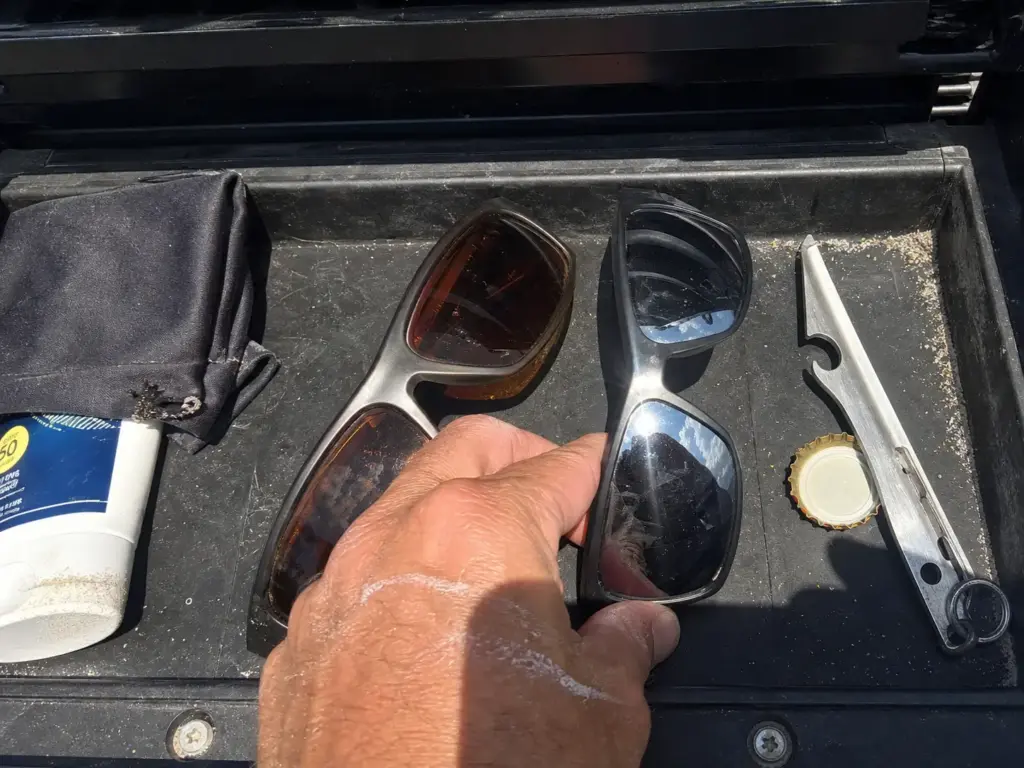
Picture the standard flats day. Flat gray light at 6am, everything soft and low contrast, and your rose or copper lens is doing real work. By 11am the same flat is gin clear and blinding, the sun is directly overhead, and the tint that was right at sunrise is now working against you. Nothing changed except the light, and the light changes every single trip.
There are three honest options and no fourth. Swap physically by carrying a second pair. Run an interchangeable-lens system and change lenses on the water. Or pick one compromise tint and accept that it’s imperfect at both ends of the day. Photochromic looks like the fourth option until you remember the brim problem from the section above, which shows up precisely on the boats where you’d be counting on it.
Most people take a fourth path nobody writes down: they tolerate the mismatch for an hour or two and keep fishing. That’s a legitimate answer, as long as you chose the tint for the hours that matter most to you rather than for the middle of the day by default. And if you fish one water type 90% of the time, stop optimizing for drift entirely. A permanent inshore and flats angler buys amber or copper, full stop, and never thinks about this again.
The Quiver of One (If You’ll Only Own One Pair)
Here’s where people waste money buying five colors when two would have covered ninety percent of their trips. Most anglers own one pair. This is the honest answer for them.
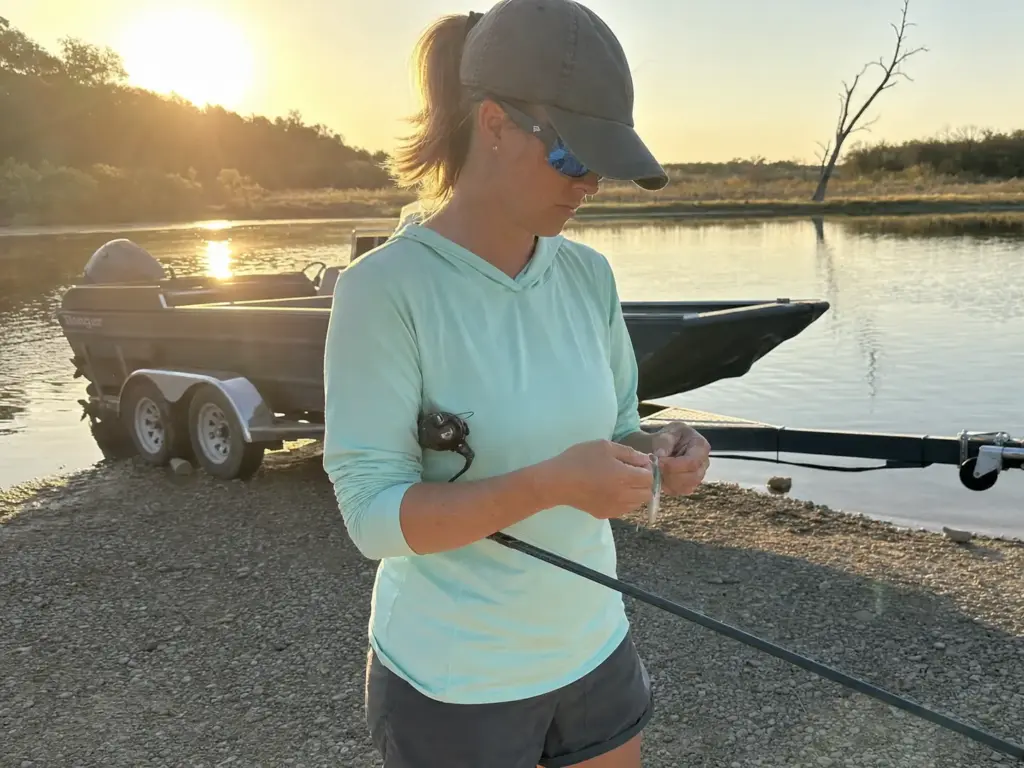
The community calls it the quiver of one: the single compromise lens you settle on when you refuse to own or carry multiple pairs. The consensus pick is a copper or amber base, and the reasoning holds up. It performs acceptably from low light through moderate bright sun, gives you contrast when there’s a bottom to read, and only really falls short in the harshest blue-water glare, where gray would have been the better tool.
Invert it if you fish blue water almost exclusively. Gray becomes your quiver of one and amber becomes the compromise you don’t need to make. The principle is the same either way: buy for the water you fish most, not for the trip you take twice a year.
One thing tint can’t fix: sunglass fit. A perfectly chosen copper base leaks light around the edges if the frame coverage is wrong for your face, and side glare sneaking in behind the lens undoes the polarization you paid for. Wrap frames and taller lenses seal that gap, which matters more on a boat than anywhere else.
Worth being straight about the trade. A compromise lens is by definition not optimal at either end of the day. That’s the deal you’re signing. What it buys you is a lens that never fails outright, which beats being perfectly matched to today’s conditions and wrong on the next three trips. Chasing the ideal tint for every outing is how people end up with four pairs and a favorite.
The buying order that actually makes sense: get the tint for the water you fish most, then only add a second pair once a specific trip type keeps punishing you for the gap. A budget-friendly polarized pair like the Torege Pure Cratos is a cheap way to test whether a second tint earns its place before committing premium money to it. And lenses are one piece of a larger kit, so it’s worth reading the full fishing apparel and sun protection system if you’re building out from here.
Conclusion
Read the base tint and the VLT, not the mirror color. The mirror is paint. The tint is the filter, and it’s the only part doing the work you care about.
Pick for what you’re trying to see. Contrast, meaning copper or amber, if you’re hunting fish in the water. Glare control, meaning gray, if you’re just trying to fish comfortably on top of it.
Whatever tint you land on, UV protection is the floor underneath it. The CDC notes that sunglasses rated UV400 and ANSI Z80.3 block nearly 100% of damaging UV radiation, and a dark lens without that rating is worse than no lens at all, because your pupils dilate behind the tint and take in more UV than they would bare. It matters more on the water than on land, since UV reflected off open water adds meaningfully to your total sun exposure from below as well as above.
Next trip, pay attention to the hour when your lenses start bothering you. That hour is the gap in your setup, and it tells you exactly which second pair, if any, is worth buying.
Frequently Asked Questions
01What color sunglass lens is best for fishing?
There is no single best color. Copper or amber wins for sight fishing shallow water, gray wins for bright open water where you are only fighting glare. If you will own one pair, copper is the safer compromise because it works across more of the day.
02Are blue or green lenses better for fishing?
Neither, exactly. Blue and green are usually mirror coatings rather than the lens base tint. Blue mirror suits bright offshore water and green mirror suits mixed inshore light, but check the base tint underneath before you decide.
03What color polarized sunglasses for fishing in low light?
Rose, ignitor, or a light copper base, anything in the 30%+ VLT range. These brighten flat dawn and overcast light instead of darkening it, which is the opposite of what a bright-sun lens is built to do.
04Do I need different lens colors for freshwater and saltwater?
Not because of the water chemistry, because of the light. Stained freshwater backwaters call for high-VLT amber or copper, while bright saltwater flats and offshore runs call for darker tints in the 8 to 18% VLT range.
Risk Disclaimer: Fishing, boating, and all related outdoor activities involve inherent risks that
can lead to injury. The information provided on Master Fishing Mag is for educational and informational purposes
only. While we strive for accuracy, the information, techniques, and advice on gear and safety are not a substitute
for your own best judgment, local knowledge, and adherence to official regulations. Fishing regulations, including
seasons, size limits, and species restrictions, change frequently and vary by location. Always consult the latest
official regulations from your local fish and wildlife agency before heading out. Proper handling of hooks, knives,
and other sharp equipment is essential for safety. Furthermore, be aware of local fish consumption advisories. By
using this website, you agree that you are solely responsible for your own safety and for complying with all
applicable laws. Any reliance you place on our content is strictly at your own risk. Master Fishing Mag and its
authors will not be held liable for any injury, damage, or loss sustained in connection with the use of the
information herein.
Affiliate Disclosure: We are a participant in the Amazon Services LLC Associates Program, an
affiliate advertising program designed to provide a means for us to earn advertising fees by advertising and linking
to Amazon.com. As an Amazon Associate, we earn from qualifying purchases. We also participate in other affiliate
programs and may receive a commission on products purchased through our links, at no extra cost to you. Additional
terms are found in the terms of service.