
In this article
The first time I saw a proper pendulum cast, I thought the angler was warming up. He was standing 20 feet back from the surf line, swinging a lead weight in a slow arc beside the rod like a clock pendulum, not facing the water at all. Then his body rotated and the rod bent hard and the sinker disappeared over the breaking waves. It landed so far out I couldn’t track where it entered the water. That was not a technique — it was a different category of cast.
The pendulum cast is the most effective distance casting method available to surf anglers, adding 25 to 35 percent more distance over a comparable static overhead cast. It’s also the most demanding cast to learn. This guide covers how it works mechanically, how to execute it step by step, the mistakes that stop most people from mastering it, and the gear setup that lets the technique do its job.
⚡ Quick Answer: The pendulum cast adds distance by using a swinging sinker to pre-load the rod before the power stroke — then body rotation, not arm strength, delivers the cast. A well-executed pendulum on a 13-foot rod with a 5 oz sinker reaches 150-200 yards where an overhead cast with identical gear tops out near 120. The catch: it takes months to execute safely and consistently, and it requires a shock leader every single time.
What the Pendulum Cast Is and Why Distance Matters in Surf Fishing
The problem the pendulum solves
In surf fishing, distance is functional. Fish that are holding beyond the breaker zone — in the trough behind the second bar, at the edge of a channel cut, or feeding in slick water past the chop — are unreachable from shore unless you can put a bait past the breaking surf. A standard overhead cast with a 9-foot rod reaches roughly 75 to 100 yards under good conditions. That’s well inside the first sandbar on most Atlantic and Gulf surf beaches.
A pendulum cast with a matched long rod setup consistently reaches 125 to 175 yards, and competitive tournament casters have exceeded 280 yards with fully dialed-in pendulum technique. That’s not a marginal improvement — it’s a different fishery. Species like pompano, red drum, and large stripers that hold in the outer trough or beyond the second bar become accessible to shore anglers who master this cast. For anglers fishing the surf fishing gear list correctly, the technique is the limiting factor, not the equipment.
Where the cast originated
The pendulum cast was developed in the UK surf fishing scene, where long distances over cold North Sea surf are often the difference between catching cod, bass, and rays versus blanking. British tournament casters refined it through the 1970s and 1980s, and the cast is now standard in competitive distance casting internationally. In the US market, it has been slower to catch on — the surf fishing tradition on the Atlantic and Gulf coasts leaned toward spinning tackle and modified overhead techniques — but it’s increasingly used by serious shore anglers targeting distance-dependent species.
The Physics Behind the Extra Distance
Why swinging the weight first matters
A static overhead cast starts from rest. The caster brings the rod back, then drives it forward in a single power stroke — the rod loads during the forward acceleration, and the sinker goes wherever the rod tip sends it at the moment of release. The maximum load the rod achieves is limited by how quickly the caster can accelerate from zero.
The pendulum cast starts the sinker in motion before the power stroke begins. The pendulum swing builds kinetic energy in the swinging lead, and when the power stroke begins, the rod loads against a weight that’s already moving — not against dead weight. The result is a deeper, faster rod bend that translates into significantly higher tip speed at release. This is the same principle that makes a sling outperform a throw: pre-loading the projectile before the power stroke dramatically increases the energy available at the moment of release.
Body rotation as the power source
The second difference from a static overhead is where the power comes from. Most anglers’ instinct is to power with the arms — push hard with the top hand, pull hard with the bottom hand. That instinct limits distance. Arms are small muscles operating on a short lever.
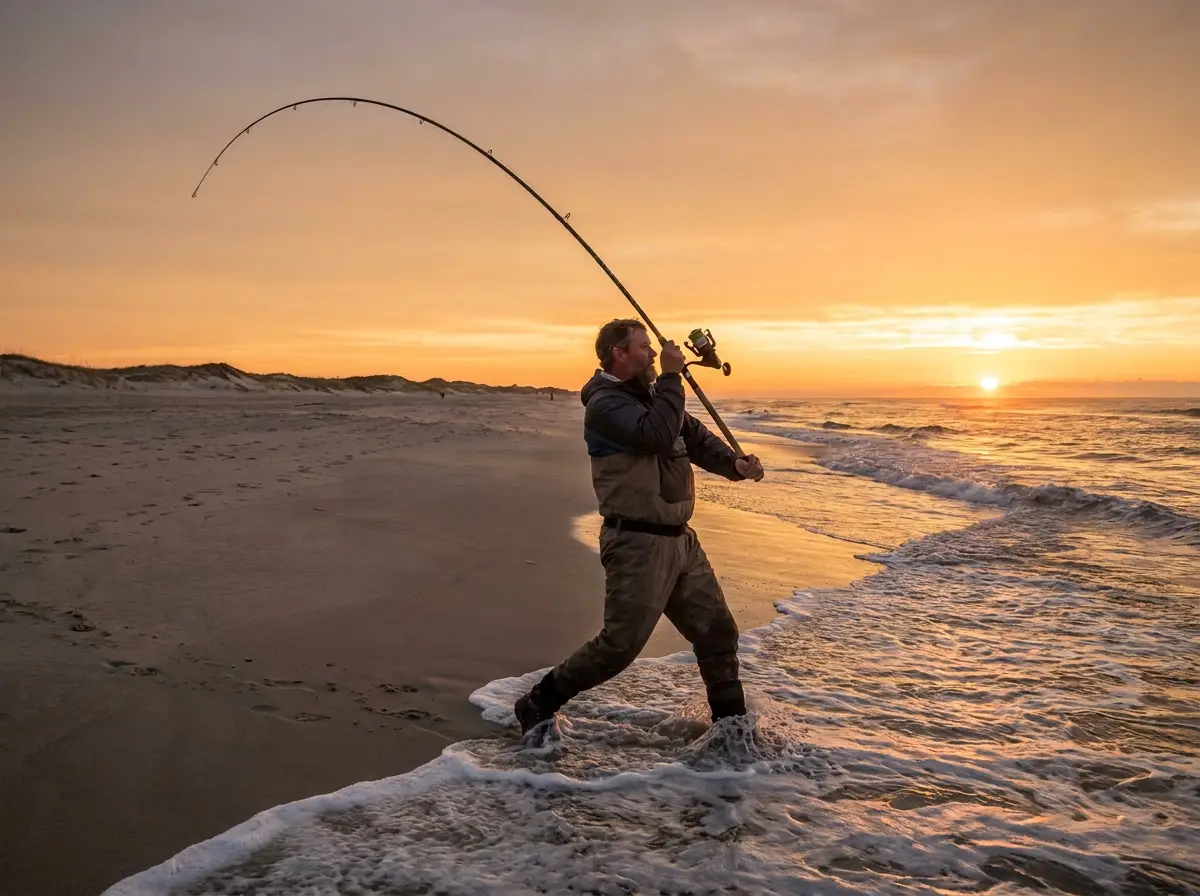
The pendulum cast is powered by the body rotating — hips, torso, and shoulders turning as a unit from facing away from the target to facing toward it. Think of a discus thrower or a hammer thrower: the body rotation drives the power stroke, and the arms transmit that rotation through the rod. Anglers who learn the pendulum and stop throwing with their arms consistently add distance once the body rotation becomes automatic.
Pro tip: Practice the rotation at home with no rod and no lead. Stand sideways to a wall, arms extended forward as if holding a rod, and practice rotating from fully twisted away from the wall to fully facing it. The rotation should feel like your hips lead, not your shoulders. That’s the power motion. Get it natural before you add the rod and weight.
Step-by-Step Pendulum Cast Execution
The setup position
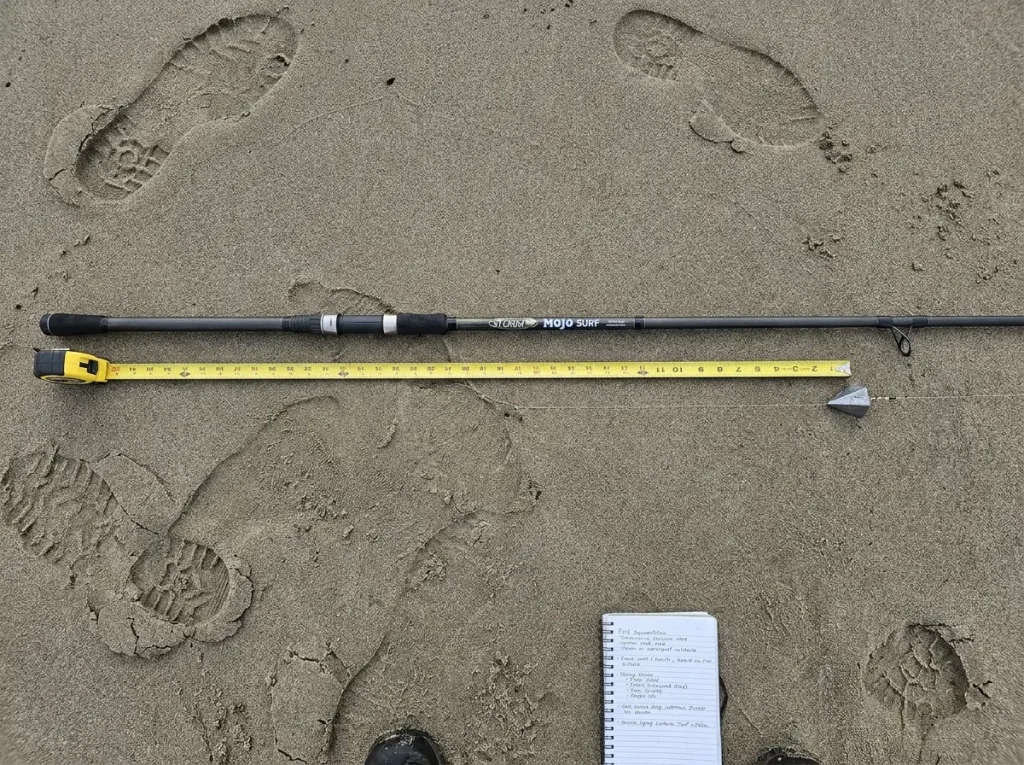
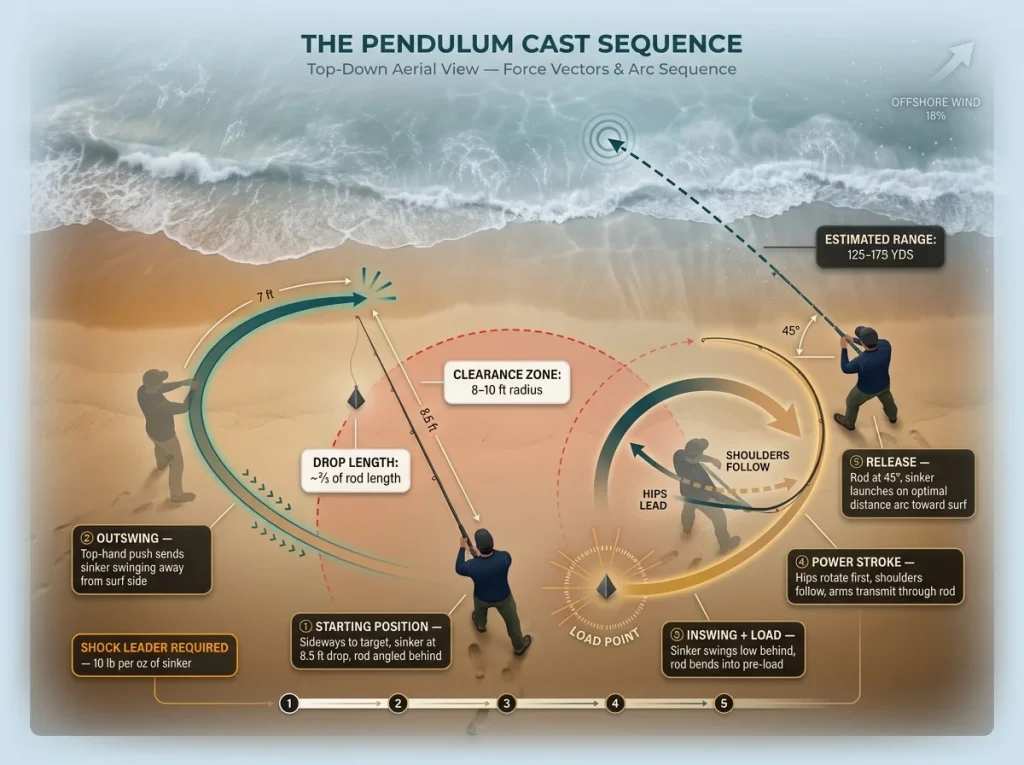
Stand with your feet roughly shoulder-width apart, positioned sideways to the target — left shoulder pointing toward the water if you’re right-handed. The rod should extend behind you at roughly 45 degrees, butt near your hip. The sinker drop should be approximately two-thirds of the rod length — for a 13-foot rod, that’s around 8.5 feet of drop between the rod tip and the sinker. This drop length is the starting point; fine-tune by a few inches once you’re consistently executing the swing.
The shock leader connection should be wound past the reel and you should have two or three turns of leader onto the spool before casting. Never pendulum cast with mainline at the ring — if you snap off under power, monofilament or braid alone will not hold.
The outswing
Initiate the cast by pushing the rod tip away from your body with a firm push of the top hand. This starts the sinker swinging away from you — the outswing. As the sinker reaches the limit of the outswing arc and begins to decelerate, it will naturally return on the inswing.
The outswing should feel like a controlled push, not a throw. You’re starting the pendulum in motion, not generating casting power yet. If you push too hard at this stage, the swing gets sloppy and the timing on the inswing becomes difficult to control.
The inswing and the load
As the sinker swings back on the inswing — toward your body and below the rod tip — begin loading the cast. The rod tip should be tracking the sinker, which is now swinging low and behind you. This is where the rod begins to bend. The sinker’s momentum is pulling the tip down and back, pre-loading the blank.
The timing cue most casters use: when the sinker reaches the lowest point of the inswing arc, the power stroke begins. This is the moment when the sinker is moving fastest and the load is deepest — the ideal launch point.
The power stroke and release
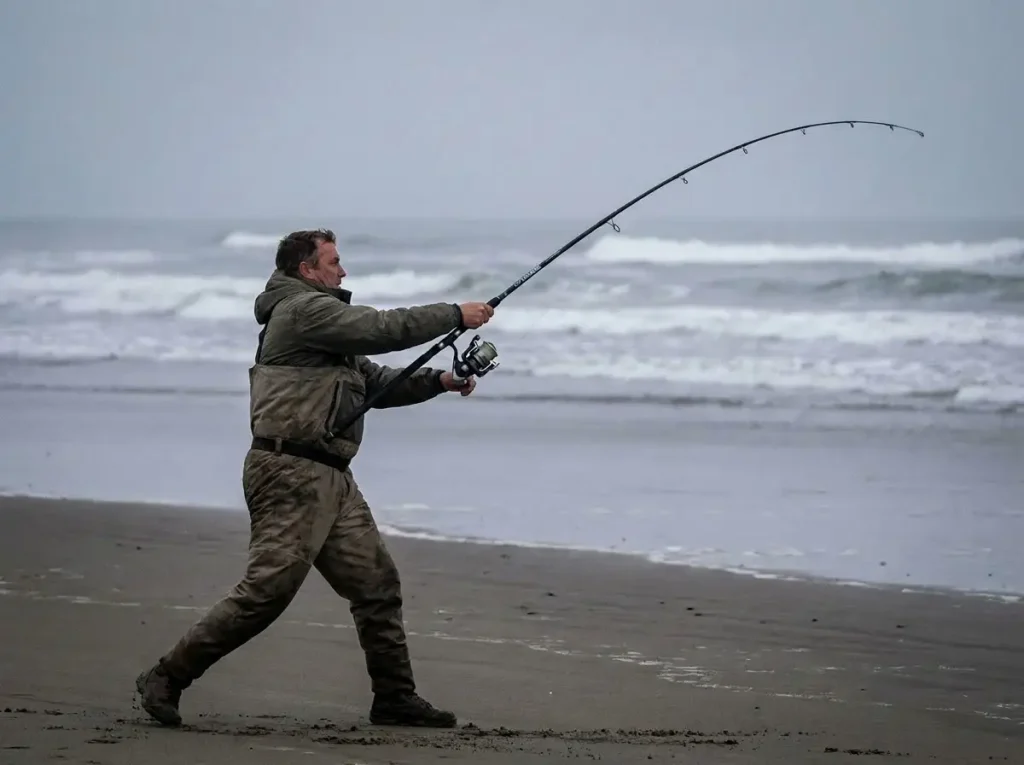
Drive the cast with body rotation. Hips rotate first, followed by shoulders, with the left arm pulling hard through the bottom of the rod and the right arm punching through the top. The rod tip traces an arc from behind you to the release point overhead, and the sinker follows that arc at significantly higher speed than your hands are moving — because the rod tip is amplifying your body rotation.
Release the line when the rod is pointing at roughly 45 degrees above the horizon toward the target. Too early and the sinker goes too high and loses distance; too late and it kicks into the sand in front of you. The 45-degree release point sends the cast on the optimal arc for distance. Our casting accuracy guide covers the release-point mechanics in more depth for anglers working on precision alongside distance.
Pro tip: Record your casts from the side with a phone propped in the sand. You can’t feel what the rod is doing during a cast, but you can see it. Watch for three things: whether the sinker is fully swinging on the inswing before the power stroke starts, whether your hips rotate before your shoulders, and whether the rod loads into a deep bend rather than staying stiff. Each of those visuals tells you exactly which part of the sequence needs work.
The Five Mistakes That Cost Distance and Cause Tangles
1. Powering on too early
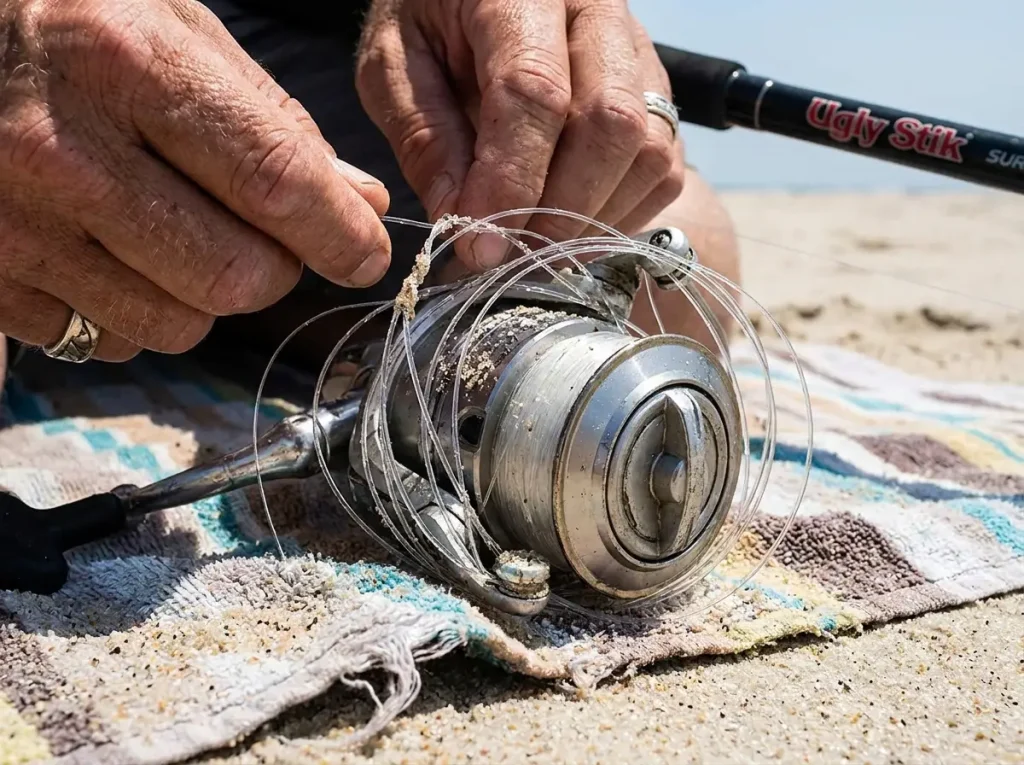
The most common mistake — and the most expensive one. If you begin the power stroke before the sinker has completed the inswing and reached the load point, you’re pushing against the sinker rather than launching it. In the best case, the cast is short. In the worst case, the lead snaps off at high speed and becomes a projectile. Powering early is how sinkers end up in parking lots and how people get hurt. Wait for the swing.
2. Throwing with the arms instead of rotating with the body
Anglers who have spent years on standard overhead casts have deeply programmed the arm-throw pattern. The pendulum requires replacing that pattern with body rotation, and the arms don’t want to comply at first. If you come off the cast sore in your shoulders and triceps, you’re throwing with your arms. If you come off the cast with mild fatigue in your obliques and hips, you’re rotating with your body. Those are different muscles.
3. Wrong drop length
Too short a drop and the sinker doesn’t swing freely — the cast is cramped and the rod doesn’t pre-load properly. Too long a drop and the swing arc becomes uncontrollable and the timing falls apart. The two-thirds-of-rod-length guideline is a starting point; find your length and mark it with a small piece of electrical tape on the leader so you can set it consistently before every cast.
4. No shock leader
This one isn’t about distance — it’s about not injuring bystanders. The pendulum cast generates forces that can snap mainline or light braid under full power. A shock leader rated at 10 pounds per ounce of sinker is the minimum standard: for a 5 oz sinker, that’s a 50 lb shock leader. The leader absorbs the snap force at the moment of maximum acceleration and contains a sinker failure rather than sending it uncontrolled. No shock leader, no pendulum cast. This applies even on a nearly empty beach.
5. Inconsistent stance and foot position
Distance casting is athletic — body position is repeatable technique, not preference. If your feet are in a different position each cast, the rotation arc changes and the timing shifts. Mark your foot positions with a heel dig in the sand while you’re learning. Once the movement is internalized, you won’t need the marks, but while you’re building the pattern, consistency in stance is what makes inconsistent casts diagnosable.
Pro tip: Learn on a grass field with a rubber practice casting weight before you take the pendulum to the beach. No hooks, no water, no audience, no incoming waves requiring you to cast on a specific timing. Repetition on grass in controlled conditions is how this cast gets wired in. Most anglers who “can’t get it” on the beach have never put in 200 dry-land reps.
Equipment Setup for Pendulum Casting
The rod
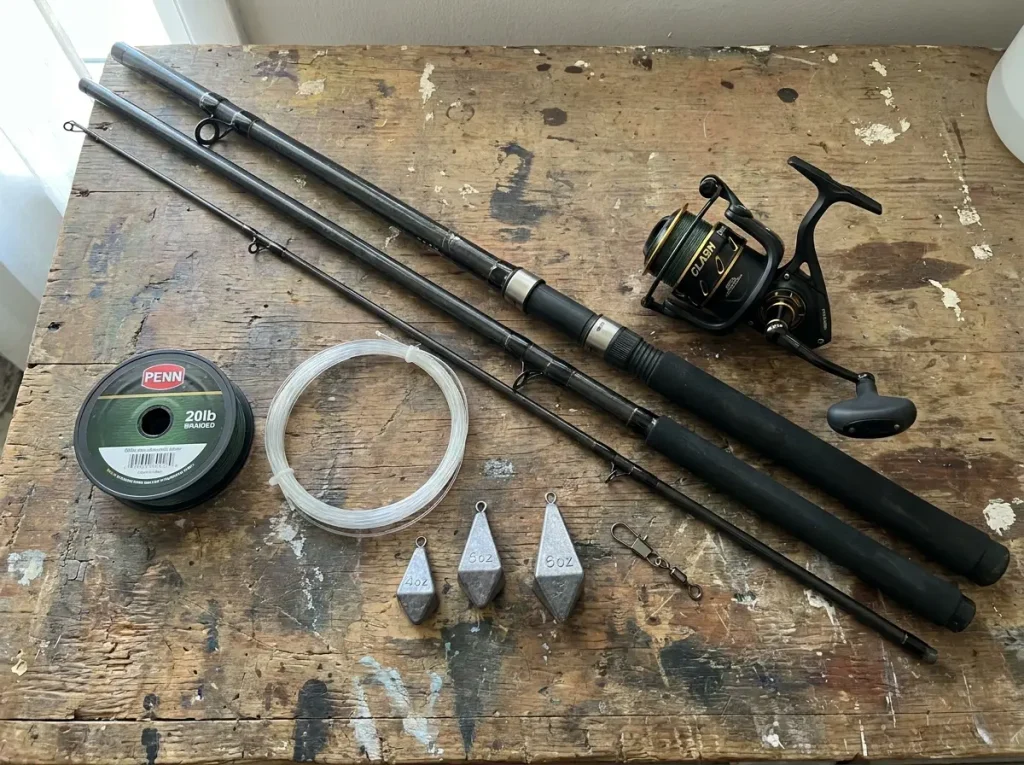
Pendulum casting requires a rod designed for it. The blank needs to be rated for significant lead weight — most dedicated surf rods rated 4-8 oz are appropriate — with enough length to generate the pendulum arc. The practical range is 12 to 14 feet; 13 feet is a common sweet spot that balances arc length with control.
A parabolic or through-action blank is preferable to a tip-action rod. You want the whole blank to load through the power stroke, not just the tip. A fast-action tip-loaded rod doesn’t bend into the deep parabolic curve that generates tip speed — it just flexes at the end and releases the load early.
The reel
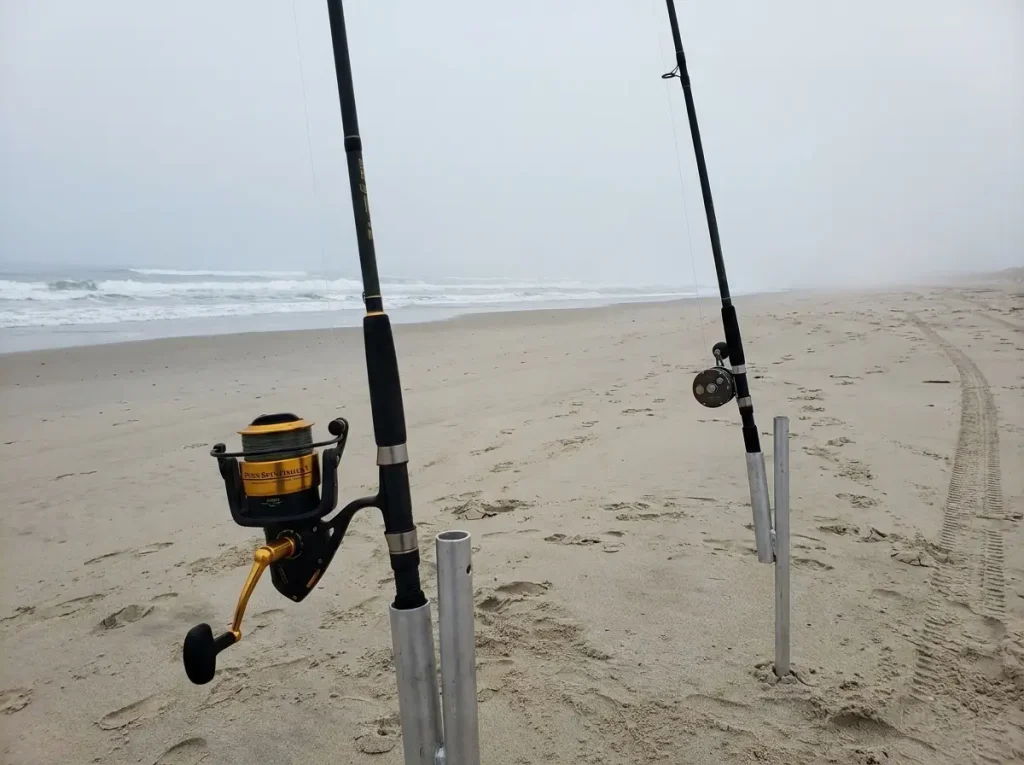
Multiplier (baitcasting) reels are the traditional choice for pendulum casting, and competitive tournament casters use them almost exclusively. A properly tuned multiplier puts the line release right at the pinch point between thumb and spool, which allows precise thumb control of the release. For maximum distances at 100+ yards, multipliers with tuned braking systems outperform spinning reels on this technique.
That said, large spinning reels in the 8000-14000 range work for surf fishing distances that don’t require tournament-level performance. If you’re comfortable on a spinning setup and targeting 100-150 yards rather than 200+, a large spinning reel with proper shock leader management will do the job. The baitcaster mechanics article covers thumbing technique that transfers directly to multiplier reel control.
Line, leader, and sinker
Braided mainline reduces air resistance and spool friction compared to monofilament — the single biggest setup upgrade that adds distance. A 20-30 lb braid mainline combined with a 50-60 lb monofilament shock leader of 20-25 feet is the standard configuration.
The sinker size sweet spot is 4 to 6 ounces for most surf setups — heavy enough to carry into the wind and maintain position in surge, light enough that the rod can load properly. A 5 oz pyramid or storm sinker on a rod rated 4-8 oz puts you in the optimal load range for distance. Go heavier than the rod rating and you’re fighting the rod; go lighter and the blank doesn’t fully load.
Pro tip: Check your shock leader connection before every cast — not once per session. The swivel or uni-to-uni connection between braid and leader is under full acceleration stress every single cast. A connection that was 90% on cast one can be 60% on cast twenty. Two minutes of inspection per session keeps that connection from failing when the cast is right.
When to Pendulum Cast — and When to Use Something Else
The conditions where pendulum casting earns its place
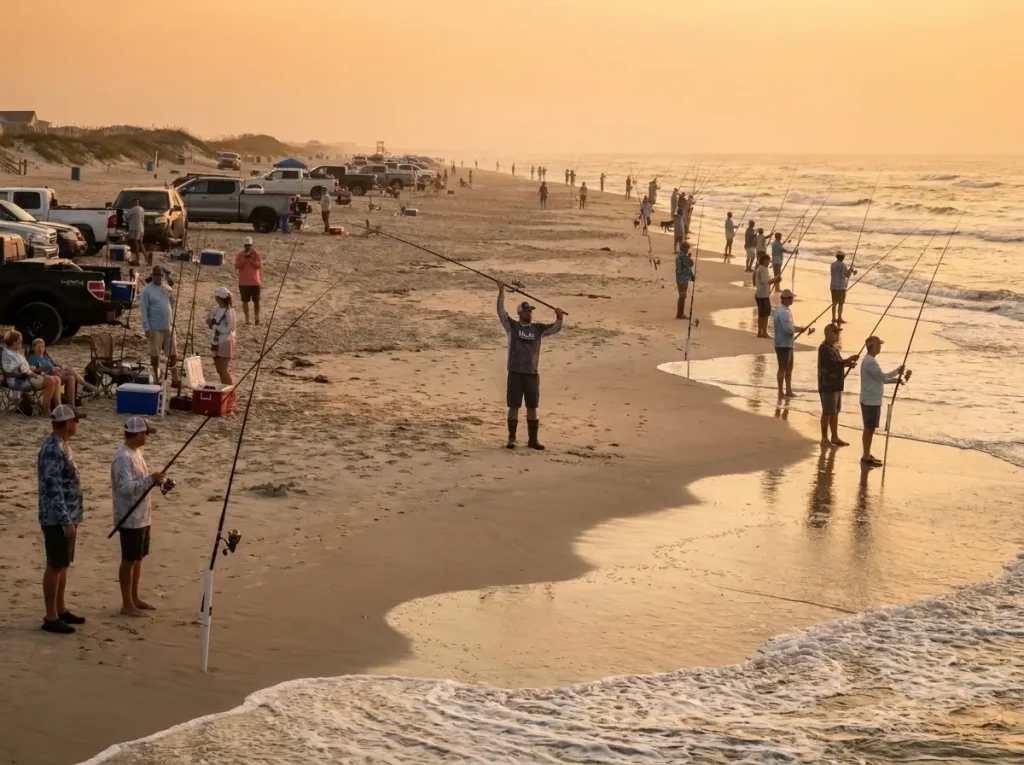
The pendulum cast makes sense when two conditions are true: you need to reach water beyond a normal overhead cast, and you have sufficient clear space to execute it safely. The swing arc behind the caster extends 8-12 feet in each direction and requires nobody within that radius. On an uncrowded beach where you can establish a clear casting lane, the pendulum is the right tool for reaching the outer trough, distant structure, or fish holding beyond the surf zone.
Windy conditions particularly favor the pendulum. The higher launch velocity means the sinker carries against headwinds better than a slower overhead cast, and the trajectory can be kept lower by adjusting the release point slightly — a lower-angle release sacrifices a few yards but cuts through wind far more effectively than a high overhead.
When to use a standard cast instead
On a crowded beach where you can’t establish a clear 15-foot zone behind your casting position, the pendulum cast becomes a liability. The physics that make it effective — high-speed sinker swing, full-body rotation, high release velocity — also make a failed cast more dangerous than an overhead. If someone walks into your swing arc during the inswing, there is no safe way to abort. On pier sections, jetties, rocky outcroppings, or any constrained casting position, use a modified overhead or off-ground cast instead.
The off-ground cast — where the sinker starts on the sand rather than in a pendulum arc — is a safer alternative that still outperforms a static overhead. It’s worth learning as a companion technique to the pendulum for situations where the full swing arc isn’t available.
Conclusion
The pendulum cast is the highest-ceiling distance technique available for shore fishing, and it earns that reputation. The physics are sound — pre-loaded rod, body rotation, 25-35% distance gain — and the results are real once the technique is functional. The path to functional is through dry-land repetition, attention to the five failure points, and patient timing rather than throwing harder.
Start with the equipment: 12-14 foot rod rated 4-8 oz, 50+ lb shock leader, 20 lb braid mainline, 5 oz sinker, and a measured drop at two-thirds rod length. Then take 200 dry-land reps on grass before the beach. Film one session from the side. If the rod is bending into a deep parabolic curve and the hips are rotating before the shoulders, the cast is working. Everything else is refinement.
FAQ
How much distance does a pendulum cast add?
A well-executed pendulum cast adds 25 to 35 percent more distance over a comparable static overhead cast with the same rod and sinker. A static overhead on a 13-foot rod with 5 oz might reach 100-120 yards; the same setup with pendulum technique regularly reaches 150+ yards, with advanced casters exceeding 180 yards in fishing conditions.
Is the pendulum cast for beginners?
No. The pendulum cast requires body coordination, timing, and rod feel that take months to develop. Beginners should learn the static overhead cast first, get comfortable with shock leaders and sinker weights, and move to pendulum technique once the fundamentals are automatic. Attempting pendulum casting without the foundation leads to tangles, fatigue, and potentially unsafe sinker releases.
What rod is best for pendulum casting?
A 12-14 foot surf rod with a parabolic action, rated 4-8 oz, is the standard starting point. The blank should load through its length — not just the tip — under full pendulum power. Popular options include dedicated surf casting models from Daiwa, Shimano, and Penn. Avoid fast-action freshwater spinning rods regardless of their length — they are not built for the compression forces of a full pendulum stroke.
Do you need a shock leader for pendulum casting?
Yes, without exception. The shock leader — rated at 10 pounds per ounce of sinker — absorbs the snap load at maximum acceleration. Fishing 5 oz means a minimum 50 lb shock leader. The shock leader should be 20-25 feet long so it wraps several turns onto the reel spool before casting. This is a safety requirement, not a performance option.
Can you pendulum cast with a spinning reel?
Yes. Large spinning reels in the 8000-14000 range handle pendulum casting for surf fishing distances in the 100-150 yard range. Tournament-level distances above 200 yards require multiplier reels for optimal line release control. For practical surf fishing rather than competition, a quality large spinning reel with braided mainline and proper shock leader will deliver the distance gains that make the pendulum worthwhile.
Risk Disclaimer: Fishing, boating, and all related outdoor activities involve inherent risks that
can lead to injury. The information provided on Master Fishing Mag is for educational and informational purposes
only. While we strive for accuracy, the information, techniques, and advice on gear and safety are not a substitute
for your own best judgment, local knowledge, and adherence to official regulations. Fishing regulations, including
seasons, size limits, and species restrictions, change frequently and vary by location. Always consult the latest
official regulations from your local fish and wildlife agency before heading out. Proper handling of hooks, knives,
and other sharp equipment is essential for safety. Furthermore, be aware of local fish consumption advisories. By
using this website, you agree that you are solely responsible for your own safety and for complying with all
applicable laws. Any reliance you place on our content is strictly at your own risk. Master Fishing Mag and its
authors will not be held liable for any injury, damage, or loss sustained in connection with the use of the
information herein.
Affiliate Disclosure: We are a participant in the Amazon Services LLC Associates Program, an
affiliate advertising program designed to provide a means for us to earn advertising fees by advertising and linking
to Amazon.com. As an Amazon Associate, we earn from qualifying purchases. We also participate in other affiliate
programs and may receive a commission on products purchased through our links, at no extra cost to you. Additional
terms are found in the terms of service.