
In this article
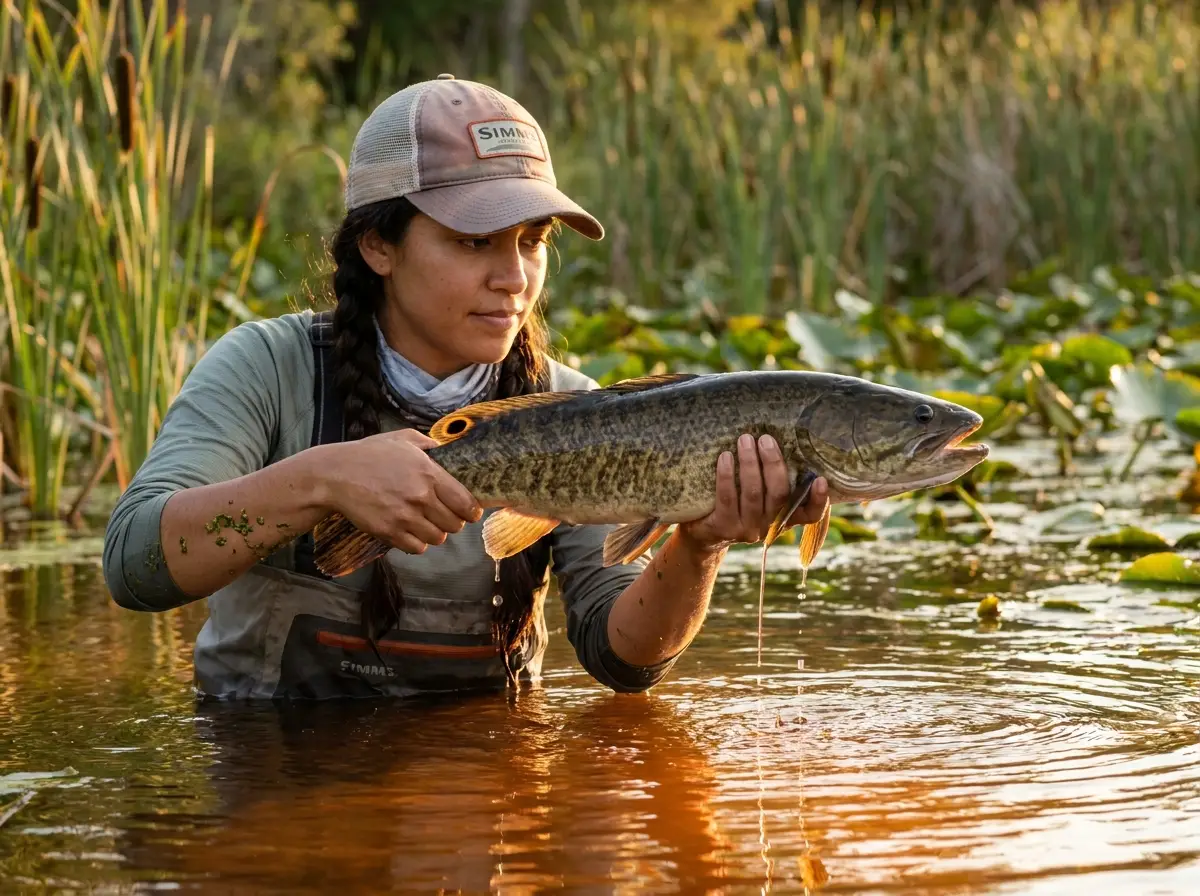
When you pull a bowfin out of a weedy backwater and it gulps air on the way into your net, something about its cold, flat stare doesn’t feel like a regular fish. That’s because it isn’t — not in the sense that bass and bluegill are regular. You just handled a fish whose family has been doing exactly this since before the first dinosaurs walked. I’ve found bowfin in backwater sloughs I’d almost written off as too murky and overgrown to hold anything worth catching, and every time I’ve had to rethink what “worth catching” means. Here’s what the bowfin actually is, where it lives, why it matters to the water you fish, and why correctly identifying one may be the most important conservation decision you make this season.
Quick Answer: Bowfin (Amia calva) are the sole surviving member of a fish lineage dating back over 150 million years, native to eastern and central North America from the St. Lawrence River to the Gulf Coast. They breathe air through a primitive lung, live in oxygen-poor habitats other fish can’t tolerate, serve as key predators in warm-water ecosystems, and are routinely misidentified as invasive snakeheads — an error with real conservation consequences.
What Is a Bowfin (and Why Its Family Tree Is Remarkable)
The Last of the Amiiformes
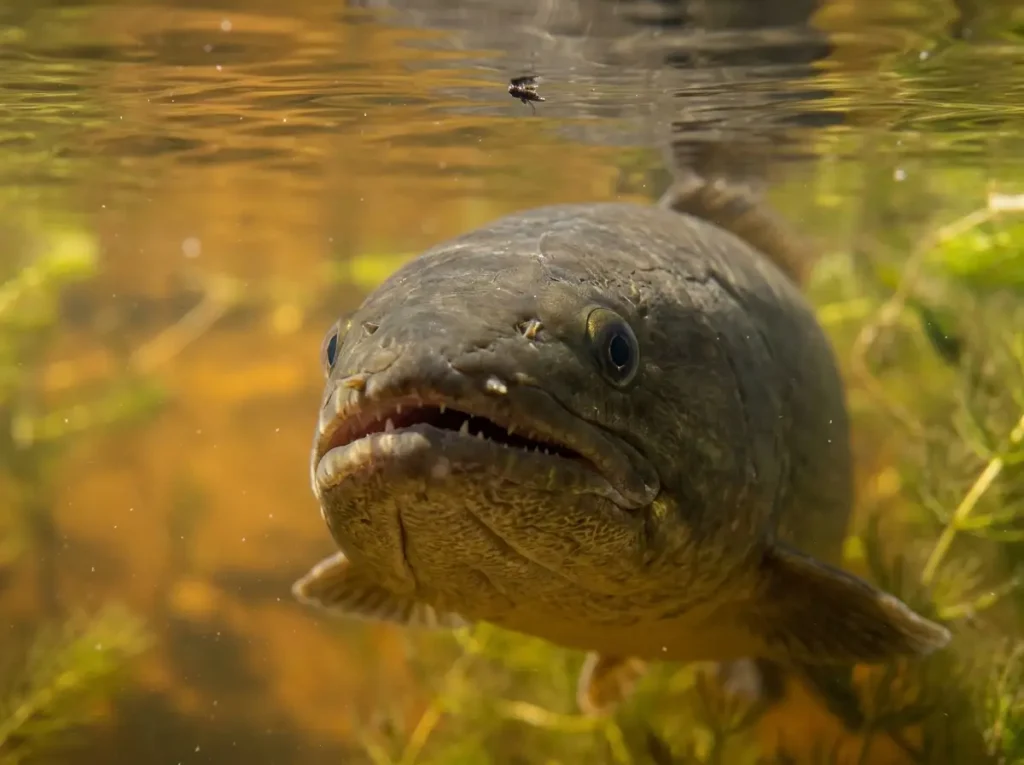
Amia calva is the only living species in the order Amiiformes and the only member of the family Amiidae. Every other species in this lineage went extinct. The bowfin didn’t. That distinction makes it what biologists call a living fossil — an organism that has survived largely unchanged through geological periods that erased virtually everything around it, including the non-avian dinosaurs, multiple mass extinction events, and the ice ages.
The Halecomorphi — the broader evolutionary group that bowfin belong to — first appeared more than 250 million years ago during the Triassic period. Fish that were recognizably similar to the bowfin you catch today were swimming in freshwater systems during the Jurassic and Cretaceous periods, roughly 150 to 65 million years ago. Every species in the long evolutionary lineage of North American native fish has a story, but few have survived on bowfin’s timeline.
How Long the Bowfin Lineage Has Existed
The numbers put this in perspective. Modern humans have existed for roughly 300,000 years. The bowfin lineage has been active for over 800 times that span. The split between the Amiidae and their closest relatives happened before any recognizable modern teleost fishes — the group that includes virtually every species you normally target — had evolved at all.
This isn’t just natural history trivia. It’s why bowfin have anatomy that looks primitive compared to “modern” fish: their scales are hard and bony (ganoid-type in ancestry, though technically cycloid in the bowfin), their skeleton retains features that advanced teleosts lost, and their air-breathing capacity is a vestige of a time when the ability to survive in low-oxygen water was the key adaptation separating survivors from those that didn’t make it.
Why Biologists Call It a Living Fossil
The term “living fossil” is used carefully in biology, and the bowfin earns it. A 2022 phylogenomic study in Scientific Reports confirmed that what’s currently classified as a single species may actually include unrecognized species diversity — meaning the bowfin’s lineage may be even more complex and ancient than previously understood. The research revealed that populations in different drainage systems may have been evolving in isolation long enough to warrant separate species consideration.
For the angler, this means the bowfin in your local lake isn’t just one species of fish — it’s a representative of a biological lineage that has maintained its core design for tens of millions of years, through conditions that made other species extinct. That’s worth a moment’s pause before you throw it back in disgust.
The Air-Breathing Machine: Bowfin Biology Up Close
The Primitive Lung That Lets Bowfin Live Anywhere
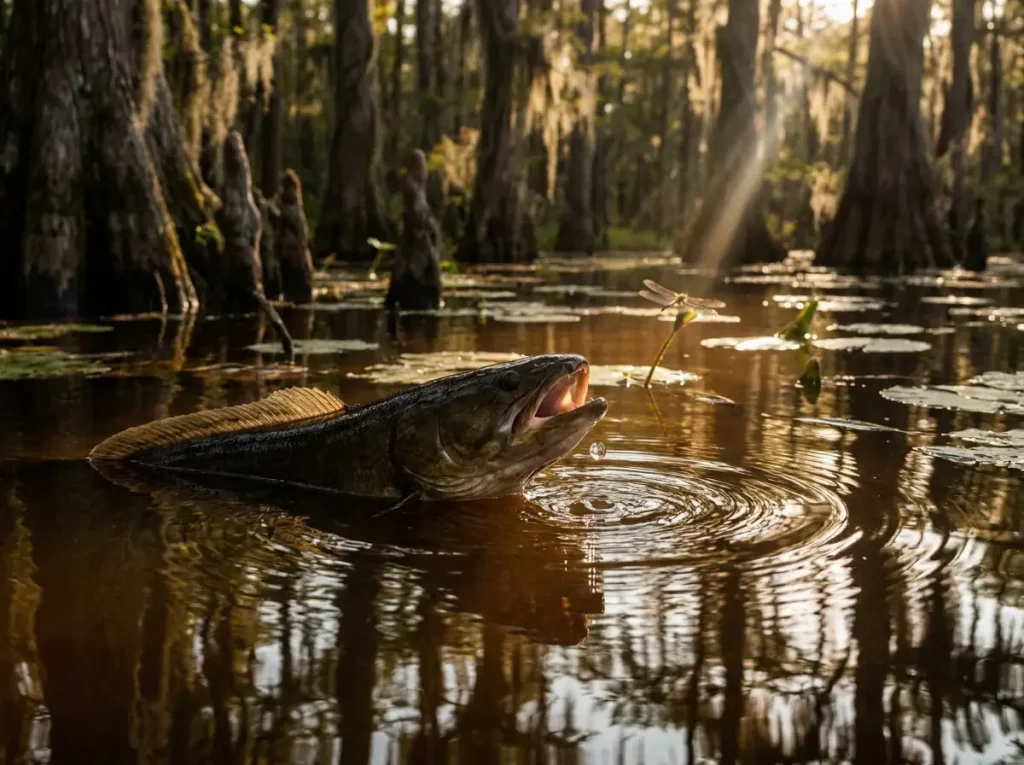
The bowfin’s most significant biological adaptation is its vascularized swim bladder, which functions as a primitive lung. In most fish, the swim bladder is purely a buoyancy organ — a gas-filled sac that controls depth. In the bowfin, the swim bladder is richly supplied with blood vessels and connected to the mouth by a duct, allowing the fish to gulp air at the surface and extract oxygen from it directly.
This is aerial respiration — the same basic principle that connects fish to the tetrapods (frogs, lizards, mammals) that eventually came out of the water. In bowfin, it’s a supplementary system, not a replacement for gills. But it’s functionally significant: bowfin can survive in warm, stagnant, dissolved oxygen-depleted water where most other fish would suffocate. They gulp air regularly, often every few minutes in warm, weedy conditions, and you can see the surface disturbance in a productive slough if you watch for it.
Physical Characteristics That Set Bowfin Apart
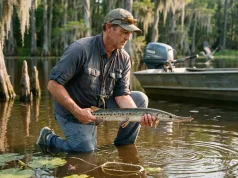
Bowfin grow to 24–30 inches in typical adult size, with females generally larger than males. Large females may exceed 10 pounds; males average 2–5 pounds. Bowfin are cylindrical and elongated, olive-green to brown on the back with a lighter mottled pattern on the sides. The most distinctive feature is the diagnostic gular plate — a bony plate positioned between the branches of the lower jaw, a structure absent in virtually every other North American freshwater fish. This single anatomical feature is the fastest way to confirm you’re holding a bowfin and not something else.
Males carry a distinctive dark spot — the ocellus — at the base of the tail, usually ringed in orange-yellow. Females have the spot but not the orange ring. A recent otolith-based age study published in the Journal of Fish Biology determined that bowfin can live more than 30 years in the wild — roughly 15 to 20 years longer than earlier estimates suggested. That finding has significant implications for how bowfishing harvest affects populations.
How Bowfin Spawn and Guard Their Young
Spawning typically runs from late April through early June when water temperatures reach 60–66°F. The male builds a nest of vegetation in shallow water near cover — a submerged log, a dense weed edge, a root tangle — then attracts a female, who deposits eggs and leaves. The female’s involvement ends at fertilization. The male’s doesn’t.
Understanding fish spawning triggers and their effect on behavior puts the bowfin’s spawning biology in context: the male fans the eggs with his pectoral fins to maintain oxygen flow, guards the nest aggressively against all comers, then shepherds the hatched fry as a tight school — sometimes called a bowfin ball — until the juveniles reach about four inches and can defend themselves. Males guarding nests have been documented attacking inanimate objects and reportedly leaping at anglers who wade too close. The parental investment is unusually high for a fish of this ancestry.
Pro tip: If you encounter a boiling mass of small fish in a shallow, weedy area in May or June that scatter when you approach, you may be looking at a bowfin brood in late juvenile stage — the male is almost certainly still nearby. Don’t wade through it. The male is doing conservation work for the ecosystem.
Where Bowfin Actually Live: Native Range in Detail
Core Range: Eastern and Central North America
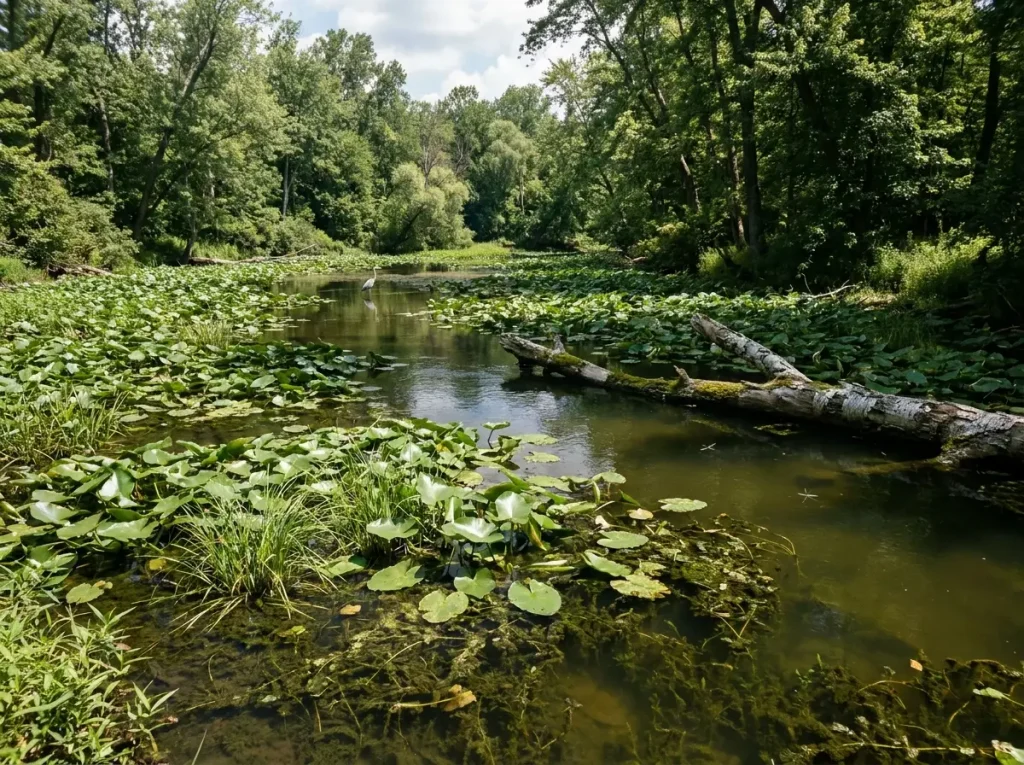
The bowfin’s native range spans eastern and central North America in a broad band from southern Canada to the Gulf Coast states. The northern boundary reaches the upper St. Lawrence River drainage in Ontario and Quebec and extends through the Great Lakes basin, including Lake Erie, Lake Ontario, Lake Huron, and the connecting waterways. The southern boundary runs along the Gulf Coast from Texas to Florida, and the western edge follows the Mississippi River drainage westward into lowland areas of the central plains.
This is not a fish of the Rocky Mountain west, the Pacific drainages, or the high-gradient streams of the Appalachian highlands. It’s a warm-water, low-gradient, vegetated-water specialist. The core of its abundance is the southeastern United States — the bottomland hardwood forests, cypress-tupelo swamps, oxbow lakes, and coastal plain rivers of the Southeast and Mid-Atlantic — and the Great Lakes basin.
Preferred Habitats Within That Range
Within its range, bowfin select for specific conditions: warm water, heavy aquatic or emergent vegetation, slow or zero current, abundant cover (logs, root tangles, undercut banks), and low-to-moderate water clarity. Backwaters, swamps, vegetated lake coves, oxbows, river sloughs, and the weedy margins of reservoirs all qualify.
The air-breathing adaptation makes bowfin comfortable in habitats that exclude most other predatory fish. A warm, oxygen-depleted swamp that holds no bass or muskie may hold excellent bowfin populations precisely because their competition for prey has been filtered out. This is the bowfin’s ecological niche: the warm, dark, vegetated places that other apex predators vacate, which is also why they’re excellent indicators of where certain lake management approaches need adjustment.
Where Bowfin Are Rare or Protected
At the northern and eastern edges of its range, bowfin populations become sparse and localized. In Pennsylvania, the bowfin is listed as a Species of Concern by the Pennsylvania Natural Heritage Program, found only in the Presque Isle area of Lake Erie and a few locations in the Delaware and Susquehanna drainages. The Pennsylvania Fish and Boat Commission has noted that wasteful harvest — particularly from bowfishing tournaments — is pushing the species toward threatened status in the state.
Vermont, New Hampshire, and much of New England represent the far northern and northeastern margins of the range, where populations are patchy and more vulnerable to pressure. Understanding the parallels with how other native species lose range at their margins is useful context — bowfin are not the last species to quietly lose ground without many anglers noticing.
Why Bowfin Matter to Anglers and the Ecosystem
Bowfin as Trophic Stabilizers
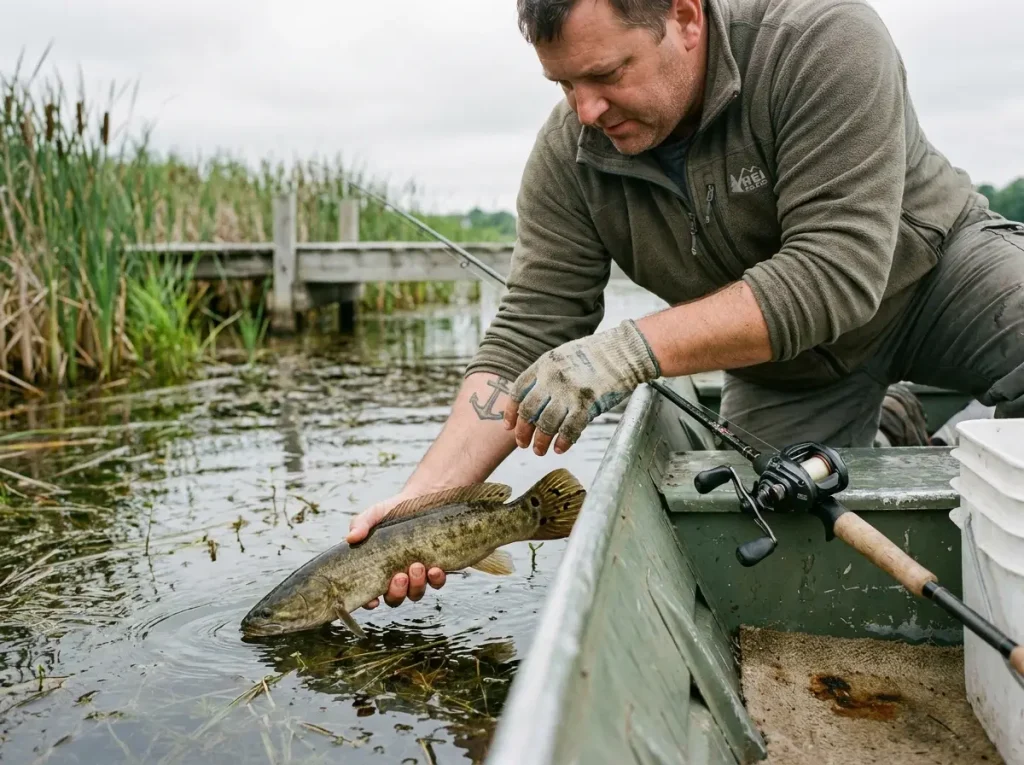
In the food web of a warm vegetated lake or river system, the bowfin functions as a trophic stabilizer. Research from the foraging ecology literature describes bowfin as high-trophic-level piscivores that maintain generalist feeding at the population level while individual fish may specialize on specific prey. The practical effect: bowfin fill predator roles that remain unfilled when other apex species decline or are absent.
When muskellunge populations drop in a system due to angling pressure or habitat change, the predation gap doesn’t simply close — prey fish populations expand, altering the balance of the food web. The same dynamic that drives muskie management decisions plays out in systems where bowfin are the dominant predator: their removal releases panfish populations, which increases pressure on zooplankton and aquatic invertebrates, which degrades water quality. The cascade is real, even when it’s slow.
What a Healthy Bowfin Population Signals
Bowfin require reasonably good water quality despite their air-breathing tolerance. They tolerate low dissolved oxygen but not chronic toxicity, not heavy sedimentation, not the absence of invertebrate prey. A waterbody that maintains a healthy bowfin population has functional predator-prey dynamics and enough habitat complexity to support the species through all life stages.
Anglers who find bowfin in a water body they’d previously dismissed as low quality should reconsider the assessment. The presence of a spawning bowfin population suggests: functional vegetation, cover, adequate prey (fish, crayfish, frogs, invertebrates), and water quality above the floor that bowfin require. That’s not a “trash fish” environment — it’s a functional ecosystem that happens to look uninviting. Proper fish handling and prompt release of bowfin caught incidentally is basic practice given what their presence signals.
The Conservation Pressure Most Anglers Aren’t Watching
The bowfin faces a conservation dynamic that’s new and moving fast. Bowfishing participation has grown significantly across the Southeast and Midwest, with bowfin increasingly targeted at night in shallow spawning areas during the spring window. Separately, a bowfin roe (caviar) market has developed — bowfin eggs resemble sturgeon caviar well enough to be marketed as “Cajun caviar” and have commercial value.
These two pressures are combining with a life history that makes the bowfin more vulnerable than it appears. A fish that can live 30+ years and doesn’t reach sexual maturity until age 2–3 can’t sustain high harvest rates at the population level — which is exactly the same math that makes bowfishing certain species ethically complicated. Most anglers don’t know this yet. Most regulations haven’t caught up with the new harvest reality.
Pro tip: In states where bowfin have no daily bag limit or season, that’s a regulatory gap, not an endorsement of unlimited harvest. Catch-and-release for bowfin is becoming the mark of an informed angler — especially during the spring spawn when males are most accessible and most critical to the next year class.
Bowfin vs. Snakehead: The ID Guide That Matters
Why Anglers Confuse These Two Fish
The northern snakehead (Channa argus) is an invasive species from Asia that established itself in several US states beginning around 2002 and has spread through the mid-Atlantic and parts of the Southeast. It is elongated, has a long dorsal fin, breathes air at the surface, and lives in warm, vegetated, slow-water habitats. So does the bowfin. The visual similarity at a glance — especially for an angler who has seen neither up close — generates routine misidentification in both directions.
The consequences aren’t symmetric. A snakehead that’s released and allowed to reproduce is an ongoing invasion problem. A bowfin that’s harvested because an angler thought it was a snakehead is a native fish unnecessarily taken from the ecosystem. The USFWS has addressed the snakehead confusion problem directly, noting that misidentification is among the most common issues in invasive species reporting for this species.
The Key Differences at a Glance
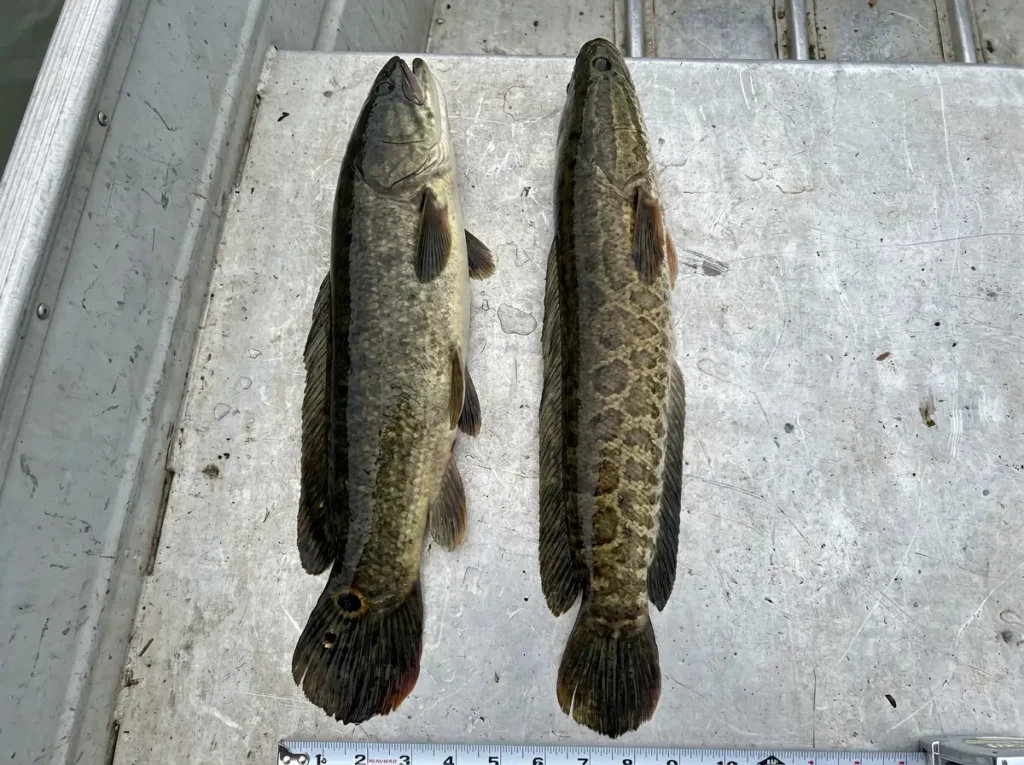
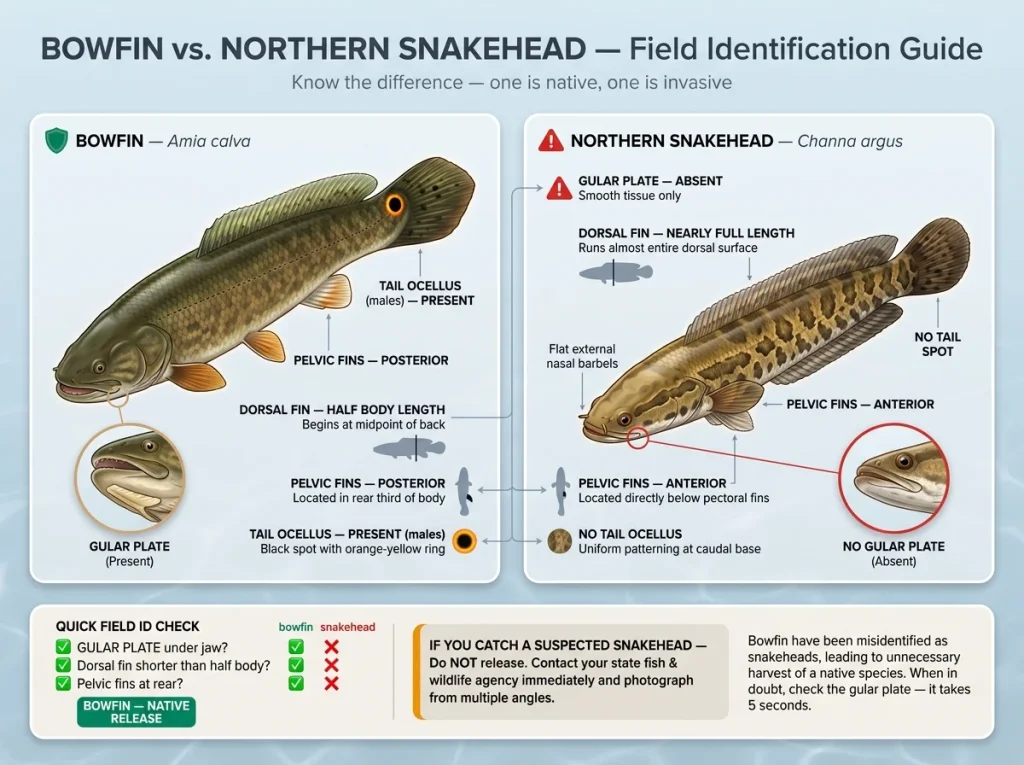
The fastest, most reliable identification feature is the gular plate — the hard, bony plate visible on the underside of the bowfin’s lower jaw, between the jaw branches. Snakeheads have no such structure. If you turn the fish and see that plate, you have a bowfin. This check takes five seconds.
Secondary features for confirmation: the bowfin’s dorsal fin runs approximately half the length of its back; the snakehead’s runs nearly the full dorsal surface. Pelvic fins on a bowfin are positioned well back toward the tail; on a snakehead, they sit directly below the pectoral fins (much further forward). Males bowfin carry the black-and-orange tail ocellus; snakeheads have no comparable marking. Snakeheads also have small nasal barbels on the snout; bowfin do not.
What to Do When You’re Not Sure
If you catch an air-breathing, elongated fish in slow, weedy water and you can’t immediately confirm identification, the default is: do not harvest until you’re certain. Check the underside of the jaw for the gular plate. Count the dorsal fin rays — bowfin dorsal fins have 47–50 rays; snakehead dorsal fins have fewer (approximately 29–36). Photograph the fish. Your state’s aquatic invasive species reporting protocols include contacts and apps for submitting suspected snakehead sightings; use them if you genuinely believe you’ve caught one.
Pro tip: Snap a photo of the underside of any fish you suspect might be a snakehead before releasing or harvesting. The gular plate question resolves immediately in a photo, and you’ll have documentation if it turns out to be a reportable sighting.
Conclusion
Three things that change how you see bowfin: First, a fish that has been doing this for 150 million years has earned more than “trash fish” status — it’s the most resilient predator in most of the warm-water systems you fish. Second, its presence is a system health signal, not a sign that the water is degraded. Third, correctly identifying it versus a snakehead may matter to your state’s invasive species reporting database — and to the bowfin you’d otherwise unnecessarily harvest.
Release them. They were here before the bass, and if we’re deliberate about it, they’ll outlast this era too.
Q1 Is a bowfin the same as a snakehead?
No — bowfin (Amia calva) are native North American fish with a 150-million-year lineage; snakeheads (Channa argus) are invasive fish from Asia that established in the US around 2002. The fastest way to tell them apart: turn the fish over and look for the bowfin’s distinctive bony gular plate under its lower jaw. Snakeheads lack this structure entirely.
Q2 Are bowfin good to eat?
Bowfin are edible but considered low-quality table fare — firm, white flesh with a mild flavor that deteriorates quickly if not iced immediately. Most anglers choose to release them. The roe, however, is increasingly marketed as Cajun caviar and is considered a delicacy; this growing roe harvest is one of the conservation pressures the species now faces in some regions.
Q3 How old can bowfin get?
A 2022 study using otolith analysis confirmed wild bowfin can live more than 30 years — roughly double the lifespan earlier estimates assumed. This matters for conservation: slower-reproducing, long-lived fish are more vulnerable to harvest pressure than their abundance might suggest.
Q4 Do bowfin hurt or help fishing?
Bowfin help healthy fish ecosystems by functioning as trophic stabilizers — apex predators that regulate prey fish populations and fill predator gaps when other species decline. They don’t meaningfully compete with bass and sunfish for food or habitat; they occupy different water and target different prey. A system with healthy bowfin is generally a system with functional predator-prey dynamics.
Q5 Where do bowfin live in the US?
Bowfin are native to eastern and central North America — from the Great Lakes and St. Lawrence River drainage south through the Mississippi basin to the Gulf Coast, with range extending east along the Atlantic coastal plain. They prefer warm, vegetated, slow-moving water: backwaters, swamps, weedy lake coves, and oxbow lakes.
Risk Disclaimer: Fishing, boating, and all related outdoor activities involve inherent risks that
can lead to injury. The information provided on Master Fishing Mag is for educational and informational purposes
only. While we strive for accuracy, the information, techniques, and advice on gear and safety are not a substitute
for your own best judgment, local knowledge, and adherence to official regulations. Fishing regulations, including
seasons, size limits, and species restrictions, change frequently and vary by location. Always consult the latest
official regulations from your local fish and wildlife agency before heading out. Proper handling of hooks, knives,
and other sharp equipment is essential for safety. Furthermore, be aware of local fish consumption advisories. By
using this website, you agree that you are solely responsible for your own safety and for complying with all
applicable laws. Any reliance you place on our content is strictly at your own risk. Master Fishing Mag and its
authors will not be held liable for any injury, damage, or loss sustained in connection with the use of the
information herein.
Affiliate Disclosure: We are a participant in the Amazon Services LLC Associates Program, an
affiliate advertising program designed to provide a means for us to earn advertising fees by advertising and linking
to Amazon.com. As an Amazon Associate, we earn from qualifying purchases. We also participate in other affiliate
programs and may receive a commission on products purchased through our links, at no extra cost to you. Additional
terms are found in the terms of service.