In this article
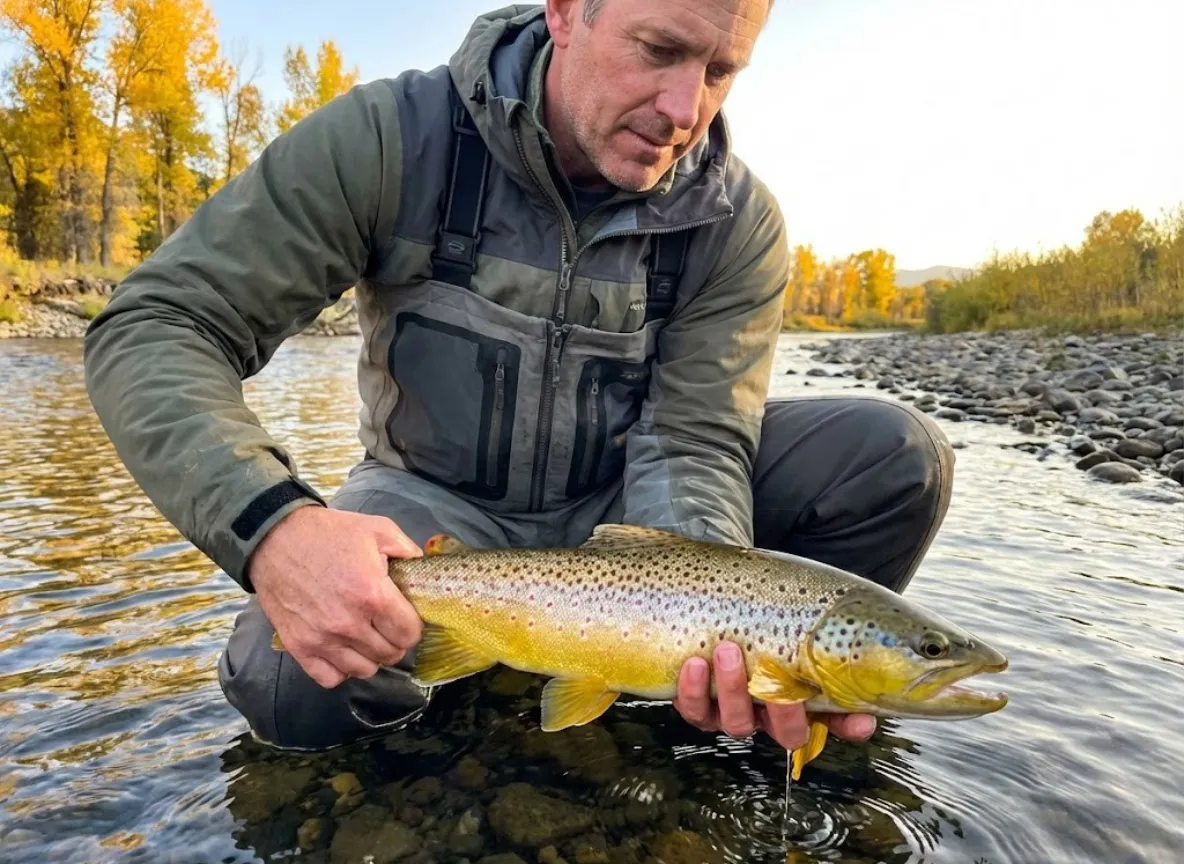
The first cast landed three inches from an undercut bank—perfect. The second strip brought a flash of butter-yellow flanks and a jaw like a vise clamping shut. Six pounds of river-bred German brown trout thrashed against the current, a fish that had survived a decade by being smarter than every angler who’d waded this stretch before me.
Twenty years of guiding have taught me one uncomfortable truth: luck runs out. The anglers who consistently put big brown trout on the reel aren’t fishing harder—they’re fishing smarter. They understand why these fish behave the way they do, and they use that knowledge to stack the odds.
This is your crash course in Salmo trutta biology—the water temperature thresholds that dictate when browns feed aggressively, the sensory systems that determine what they can and can’t detect, and the dietary shift that transforms a 12-inch trout into a 24-inch ambush predator. By the time you’re done, you’ll approach brown trout not as a mystery to guess at, but as a biological system to decode.
⚡ Quick Answer: Brown trout are most active and aggressive between 54°F–66°F (12°C–19°C). At 16+ inches, they become obligate piscivores requiring large prey like sculpins and crayfish. Their lateral line detects vibrations from 50–150 Hz, so lures that “thump” (Colorado blades, deer-hair heads) outperform silent presentations—especially at night. Match your tactics to their biology, and you’ll outfish the guessers every time.
Taxonomy and Life History: The Three Morphs That Define Brown Trout Behavior
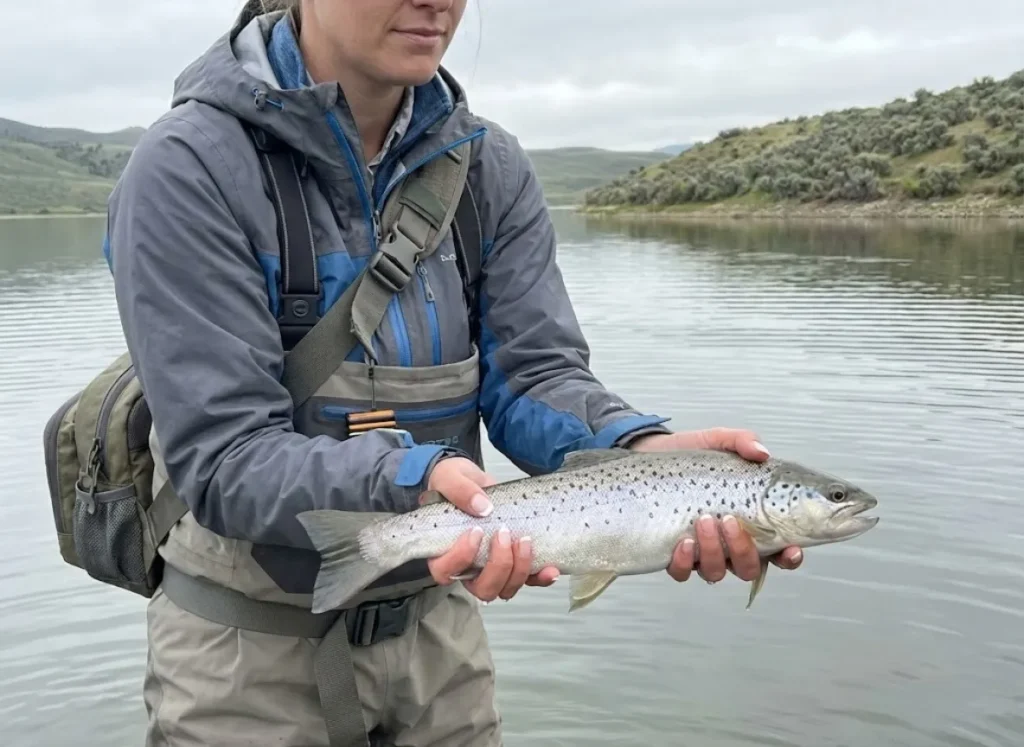
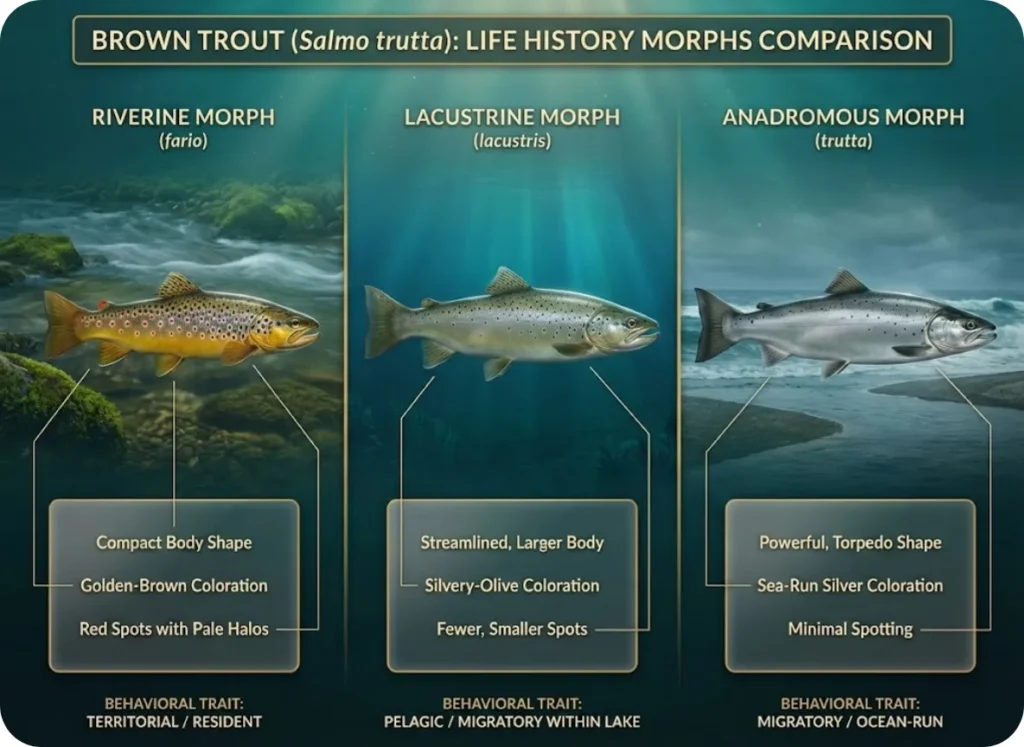
Here’s something most anglers miss: not all brown trout behave the same way because they’re not functionally the same fish. Wild brown trout exhibit three distinct life-history morphs—riverine, lacustrine, and anadromous. Same species, different operating systems.
The Riverine Morph: Your Classic Stream Brown
The resident brown trout completes its entire life cycle in flowing water. Phenotypically, these fish sport golden-to-brown flanks with a profusion of black and red spots with white halos. In nutrient-poor waters, they retain parr marks well into adulthood. The “Von Behr strain” introduced from Germany’s Black Forest in 1883 exemplifies this look. The USGS species profile on Salmo trutta documents the full distribution and life-history classification of these introduced populations.
Behaviorally, riverine browns are structure addicts. They rely on what biologists call thigmotaxis—the instinct to stay in contact with physical cover. Undercut banks. Submerged logs. Root wads. If your target water produces deep-bodied, yellow-flanked fish with prominent red spots, think “German genetics” and put your casts tight to structure. These fish rarely cruise open water.
The Lacustrine Morph: The Lake-Run Silver
Lake trout morphs (historically called the “Loch Leven strain” after their Scottish origin, introduced 1885) migrate to lakes and reservoirs to mature. The shift to open water triggers a transformation: guanine deposits mask the vibrant riverine colors, rendering the fish silver with dark X-shaped spots. This counter-shading creates open-water camouflage.
These fish are wired differently. Faster growth rates. Tendency toward schooling. Less territorial aggression. In reservoir settings, expect lacustrine browns to suspend in the water column and cruise for prey—trolling or cast-and-retrieve tactics often outperform dead-drift presentations. Understanding how rainbow trout compare in metabolism and behavior helps you target each species appropriately.
The Anadromous Morph: Sea Trout
Sea trout represent the anadromous strategy, migrating to the ocean to exploit marine biomass before returning to freshwater to spawn. Here’s the remarkable part: resident and anadromous forms are genetically indistinguishable. The decision to migrate is facultative—driven by individual metabolic demands and early growth rates.
Researchers use otolith aging to reconstruct migration histories. Strontium-to-calcium ratios in these ear bones reveal whether an individual spent time in saltwater. High strontium = marine phase.
Pro tip: If your river holds both resident and sea-run fish, target the main stem during spring and fall migration windows. Sea-run browns often push into systems they’ve been absent from for months—and they’re aggressive feeders recovering lost condition.
Thermal Biology: The Master Factor Controlling When Browns Bite
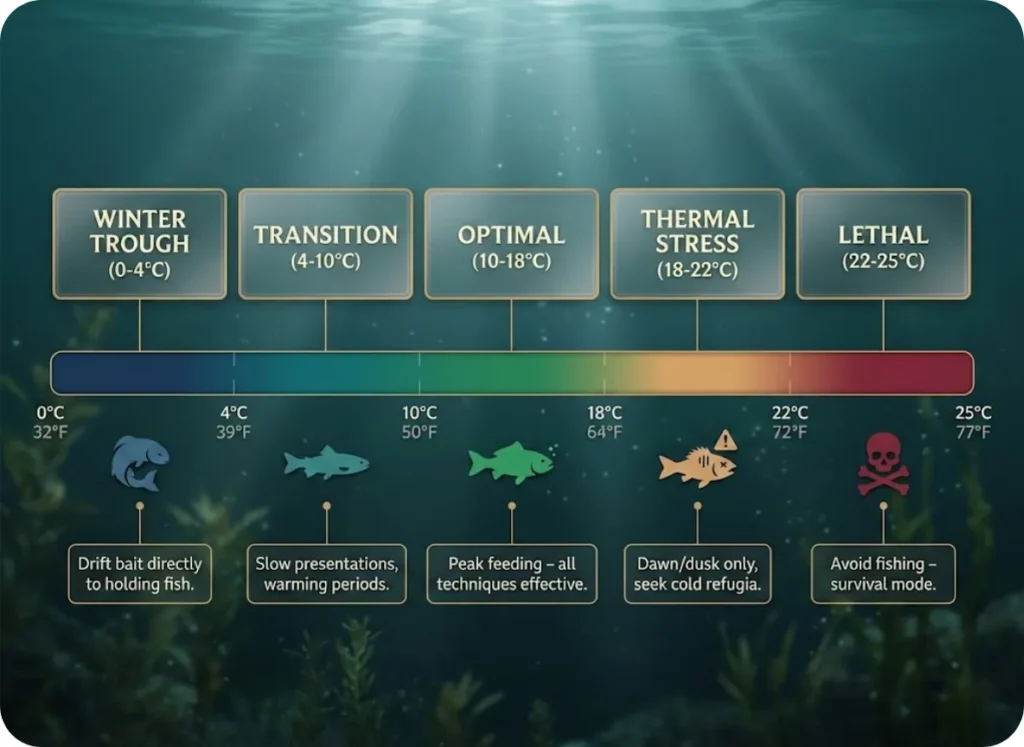
Temperature isn’t just “a” factor in trout fishing—it’s the factor. As cold-blooded organisms, brown trout run on the thermal regime of their environment. Metabolism, digestion, activity level—all dictated by degrees.
The Optimal Window: 54°F–66°F (12°C–19°C)
This is the Goldilocks zone where brown trout are most active, most aggressive, and most willing to chase prey. Within this range, metabolism is fast enough for rapid food processing but not so fast that energy costs outstrip intake. Your reaction-bite tactics (streamer fishing, active retrieves) work best here.
Understanding the Q10 coefficient that governs fish metabolism helps you predict feeding intensity across temperature changes.
Pro tip: Carry a stream thermometer. When water temps hit 56°F–64°F, throw your biggest streamers with aggressive strips. The fish are in kill mode.
Thermal Stress and the Oxygen Squeeze: >66°F (19°C)
Above this threshold, dissolved oxygen decreases while the fish’s metabolic demand for oxygen increases. This creates the “oxygen squeeze.” Fish abandon feeding territories and seek thermal refugia—spring seeps, spawning tributaries, deep pools with cold-water inputs.
Catch-and-release mortality climbs fast in warm water due to lactic acid buildup. At 68°F (20°C), consider putting the rod down. Ethical angling means knowing when to stop.
Critical Thermal Maximum: 73°F–77°F (23°C–25°C)
Above this range, systemic failure occurs. Notably, brown trout possess a slightly higher water temperature tolerance than brook trout or Atlantic salmon, which is why they colonize marginal warm-water habitats where native salmonids perish. The UK Environment Agency’s thermal biology report on salmonids documents these critical thresholds in detail. In warming rivers, browns are often the “last trout standing.”
The Winter Trough: <39°F (4°C)
When temps drop below 39°F, metabolism grinds to a crawl. Digestion can take days. Fish migrate to deep, slow “wintering holes” to minimize energy expenditure. They will feed, but they will not chase—the bait must drift directly to them.
The Sensory Arsenal: How Brown Trout Perceive Your Lure
To catch a brown trout consistently, you need to understand how it perceives the world. Spoiler: not like you do.
Mechanoreception: The Lateral Line System
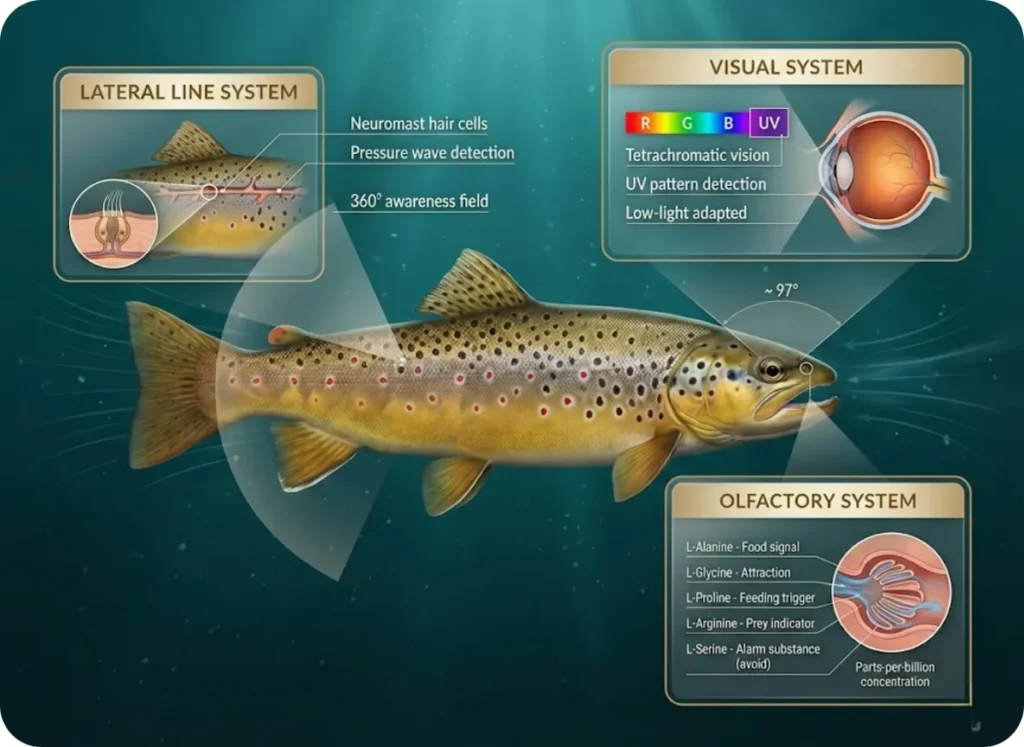
Running along the flank and branching over the head is a canal of mechanosensory cells called the lateral line. It detects particle displacement and pressure waves—essentially, it functions as distant-touch.
Peak sensitivity falls in the 50 Hz to 150 Hz range, which corresponds to the thump of a tail beat or the distress struggles of a baitfish. In turbid water or total darkness, the lateral line allows the fish to create a three-dimensional “hydrodynamic image” of its surroundings. Understanding the neuromasts that power the lateral line gives you a deeper appreciation for this sensory system.
This biology validates your tackle choices. Colorado blades on spinners produce strong, low-frequency thumping that aligns with peak lateral-line sensitivity. Streamer flies with bulky, water-pushing heads—spun deer hair like a Muddler Minnow or Zoo Cougar—create turbulence patterns that mimic a fleeing or injured fish. At night, displacement matters more than profile.
Vision: Tetrachromatic and Tuned for Low Light
Brown trout possess tetrachromatic vision—detecting red, green, blue, and Ultraviolet (UV). Their retinas are packed for photon capture, making them effective crepuscular and nocturnal predators. Virginia Tech’s guide to fish sensory capabilities provides excellent academic context on these visual adaptations.
Snell’s Window governs surface visibility. Light refraction creates a ~97-degree cone of vision above the fish. Outside this cone, the surface acts as a mirror reflecting the bottom. An angler standing tall breaks the window and becomes visible against the sky. Stay low, stay in the mirror zone.
Water absorbs long wavelengths first. Below 10–15 feet, red lures appear grey or black. Blue, green, and UV-reflective materials maintain visibility at depth. But at night fishing depths, contrast is king. A black fly silhouettes sharply against faint sky illumination—making it the most visible target after dark.
Chemoreception: Olfaction and the Amino Acid Triggers
The brown trout’s olfactory system detects chemical signals at parts-per-billion concentrations. Research identifies four key amino acid triggers: L-Alanine, L-Glycine, L-Proline, and L-Arginine. These compounds signal “food” to the trout’s brain.
Conversely, mammalian skin excretes L-Serine—a potential alarm substance. This is the basis for the old guide trick of rubbing hands with river mud before handling tackle.
Pheromone communication guides homing migrations. Trout imprint on their natal stream’s unique chemical signature, and bile acids released by other trout act as aggregation cues during the spawn.
The Diet Shift: Why Big Browns Demand Big Flies
Here’s where the science gets tactical. The transition from aquatic invertebrates to fish is the most critical event in the life history of a trophy brown trout. This shift is driven by the biological imperative to maximize caloric intake while minimizing energy expenditure.
The Piscivory Thresholds
Research shows piscivory can begin as early as 13 cm (~5 inches)—small trout consuming fry and minnows. But the obligate switch happens around 40 cm (~16 inches). At that size, invertebrate drift cannot provide sufficient caloric density for continued growth. The fish must switch to high-calorie prey: sculpins, crayfish, juvenile fish, large amphibians.
Prey size preference runs roughly 20–30% of predator body length. But brown trout are gape-limited predators constrained only by mouth size—and they’ve been documented eating prey up to 50% of their own length. NIH research on adaptive flexibility in brown trout feeding validates these prey-size dynamics.
Cannibalism and the Trophy Equation
Brown trout are more predatory and piscivorous than many other species of trout. In many systems, the primary food source for large browns is juvenile brown trout—including their own species, plus brook trout and rainbow trout. Stomach analyses from the Au Sable River in Michigan showed large trout replacing insects almost entirely with fish and crayfish.
If you’re throwing size 18 nymphs for 20-inch browns, you’re speaking the wrong language. Match your fly size to the forage these fish now require: 4–6 inch articulated streamers that mimic baitfish and sculpins. Learning how crappie exhibit similar ontogenetic diet shifts helps you understand this pattern across species.
The Ambush Economy
Large trout become sit-and-wait predators. They select holding lies with current breaks (low energy cost) adjacent to fast water (high food delivery). They wait for a high-calorie meal to drift or swim by, then engage in a short, high-speed burst.
A big brown won’t expend energy rising for a size 22 midge unless insects are so dense the fish can practically filter-feed with near-zero movement. This is why streamer fishing produces the biggest fish.
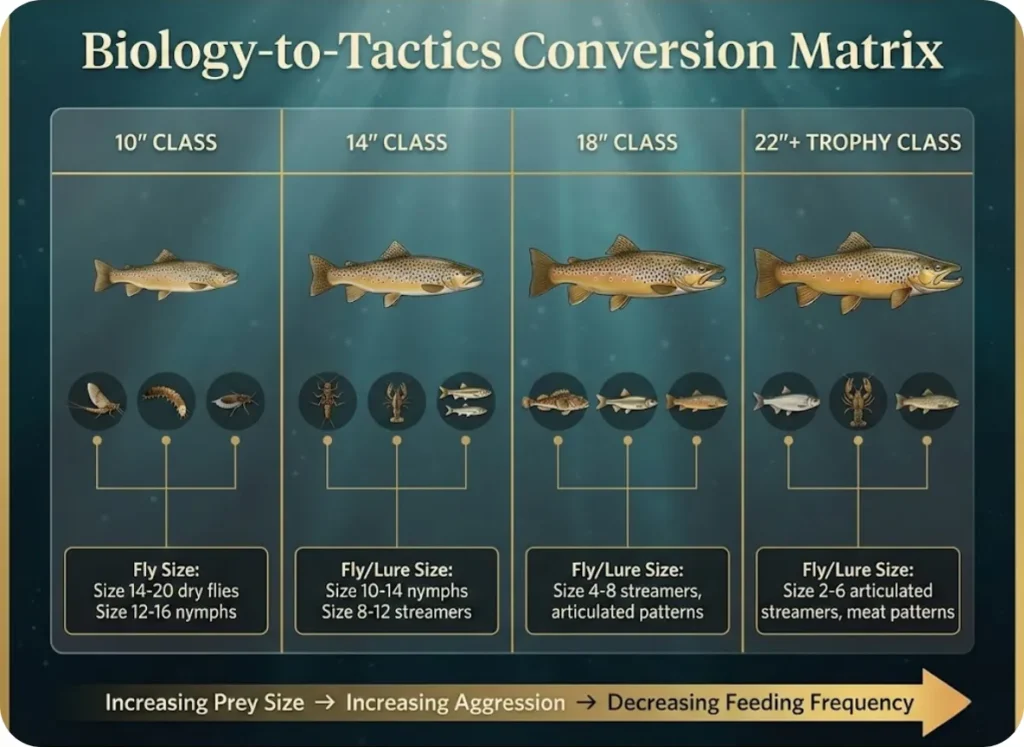
Pro tip: “Match the forage” applies to predators too. If the river holds abundant sculpins, throw sculpin patterns. If baby browns are the primary forage, articulated trout streamers work.
Longevity and Age: Why That Big Brown May Be Older Than You Think
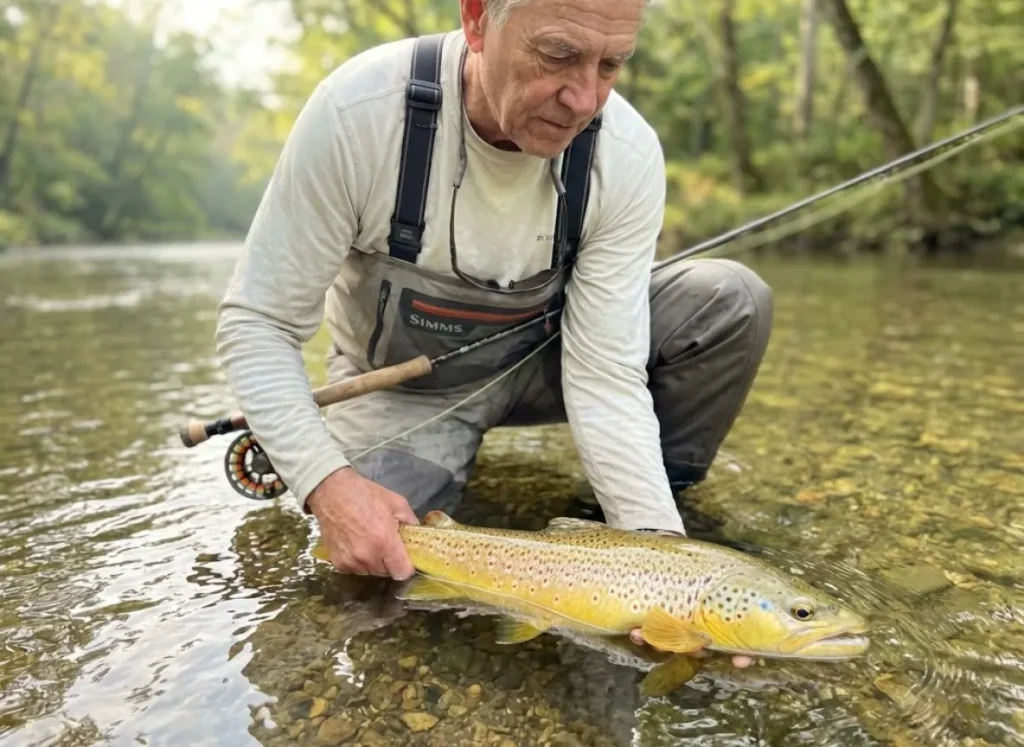
Trophy browns aren’t just big—they’re ancient. A landmark study in Switzerland’s Bernese Alps used otolith micro-analysis to identify a brown trout that was 38 years old. That shatters the conventional 10–12 year estimate and proves the species’ potential in stable, protected environments.
Those ear bones—calcium carbonate structures that accrete layers annually like tree rings—are the gold standard for age determination. The NIH study on otolith microchemistry in Salmo trutta demonstrates how Strontium:Calcium ratio analysis can distinguish freshwater residence phases from marine phases in the same individual.
What does this mean at the stream? That 28-inch butter-yellow brown you just landed might be 15–20 years old—older than some anglers on the water. Handle with the respect due an elder. Wet your hands, keep the fish in water, minimize air exposure, and use barbless hooks or pinch your barbs. These fish didn’t survive two decades by luck.
Proper catch-and-release techniques that protect these ancient fish aren’t just ethics—they’re the difference between a healthy trout population and a hollowed-out fishery.
Tactics That Match the Biology: Applying Science to the Water
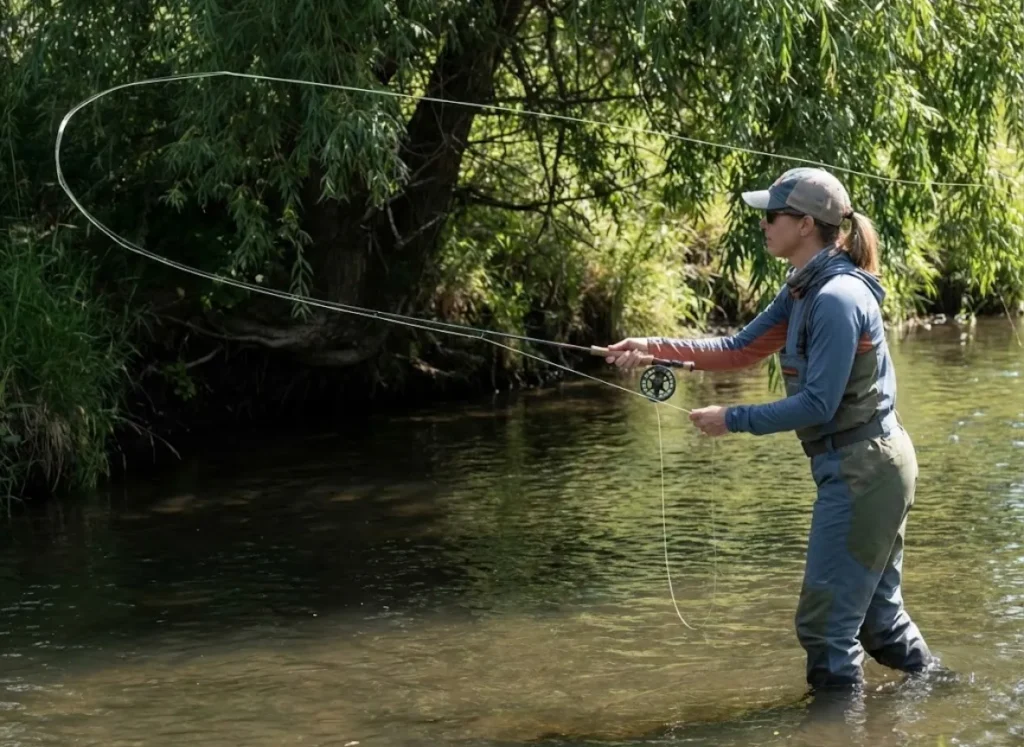
Everything above means nothing if you can’t translate it to the reel. Here’s how the science becomes fish.
Streamer Fishing: Triggering the Reaction Bite
Legendary angler Kelly Galloup built his reputation on one insight: large trout are predators wired to kill. When a large object moves fast and erratically through their territory, the response is reflex-driven—processed by the brainstem before the fish can analyze whether it’s “real” prey.
A slow, steady retrieve invites inspection and rejection. A violent jerk-strip mimics a dying or fleeing fish and triggers the predatory reflex. The fly must land inches from structure and move immediately. A stationary fly is debris. A moving fly is lunch.
Galloup’s axiom: “Don’t fish to yesterday’s bite.” Adapt retrieve speed and fly size to the fish’s daily mood.
Night Fishing: When Lateral Line Dominates Vision
Large brown trout are photophobic. To catch the biggest fish, you often have to fish after dark with mouse patterns or bulky streamers.
In darkness, color is irrelevant. Use lures that thump—spinners with Colorado blades, flies with water-displacing heads like the Woolly Bugger or Muddler Minnow. A black fly provides the sharpest silhouette against faint sky illumination. New Moon (darkest night) is often the peak window. Total darkness emboldens big browns to leave sanctuary pools and hunt shallow riffles where forage fish congregate.
The Drag-Free Drift
When insects are the primary food source, the math changes. Trout expect food to drift at exact current speed. Drag—the artificial speeding of your fly—signals that the object isn’t natural.
Trout hold in the boundary layer, the zone of slower water created by bottom friction. Nymphs using pheasant tails and similar patterns must be weighted to penetrate the fast surface current and reach that near-bottom strike zone.
Scent Tactics
Bait or scents fortified with L-Alanine, L-Glycine, and L-Proline tap into evolutionary food-recognition pathways. Learning the science behind fishing scent attractants helps you select effective products.
Egg patterns leveraging cured trout eggs or salmon eggs release amino acid plumes that mimic the natural protein wash of the spawning season—a primal trigger in fall and spring. And neutralize L-Serine (human scent) by rubbing hands with stream mud before handling terminal tackle.
Conclusion
Brown trout aren’t random. They’re outputs of physiology. The 54°F–66°F window tells you when they’ll chase. The lateral line’s 50–150 Hz sensitivity tells you what lure characteristics matter in low light. The 16-inch piscivory threshold tells you why big browns ignore small flies.
Stop guessing. Start applying the biology. Carry a thermometer. Throw streamers that displace water. Target structure during the optimal temperature window.
And when you release that 24-inch butter-yellow flank back into the current, know you might be holding a fish older than your career. Treat it accordingly.
The river is not a game of chance. It’s a game of biology. And now, you know the rules.
FAQ
How do you identify a brown trout vs. a rainbow trout?
Brown trout have a square caudal fin (not forked), black and red spots with distinct pale halos, and lack the pink lateral stripe of rainbows. Their spots never extend onto the tail fin, and mature males develop a pronounced kype (hooked jaw).
What is the best water temperature for brown trout fishing?
The optimal range is 54°F–66°F (12°C–19°C). Within this window, browns are most active and willing to chase prey. Above 68°F (20°C), consider stopping to protect the fishery from catch-and-release mortality.
Are brown trout native to North America?
No. Brown trout were introduced to the United States in 1883 (Von Behr strain from Germany) and 1885 (Loch Leven strain from Scotland). They are native to Europe, western Asia, and North Africa—and are now listed among the world’s worst invasive species.
What is the world record brown trout?
The IGFA all-tackle world record is 44 lb 5 oz (20.10 kg), caught in New Zealand’s Ohau Canal in 2020. These fish benefit from feedlot conditions downstream of salmon farms—atypical compared to wild trout populations.
Do brown trout eat other trout?
Yes. Large predatory freshwater browns (16+ inches) are notoriously cannibalistic, consuming juvenile brown trout, brook trout, rainbow trout, as well as sculpins, crayfish, and amphibians.
Risk Disclaimer: Fishing, boating, and all related outdoor activities involve inherent risks that
can lead to injury. The information provided on Master Fishing Mag is for educational and informational purposes
only. While we strive for accuracy, the information, techniques, and advice on gear and safety are not a substitute
for your own best judgment, local knowledge, and adherence to official regulations. Fishing regulations, including
seasons, size limits, and species restrictions, change frequently and vary by location. Always consult the latest
official regulations from your local fish and wildlife agency before heading out. Proper handling of hooks, knives,
and other sharp equipment is essential for safety. Furthermore, be aware of local fish consumption advisories. By
using this website, you agree that you are solely responsible for your own safety and for complying with all
applicable laws. Any reliance you place on our content is strictly at your own risk. Master Fishing Mag and its
authors will not be held liable for any injury, damage, or loss sustained in connection with the use of the
information herein.
Affiliate Disclosure: We are a participant in the Amazon Services LLC Associates Program, an
affiliate advertising program designed to provide a means for us to earn advertising fees by advertising and linking
to Amazon.com. As an Amazon Associate, we earn from qualifying purchases. We also participate in other affiliate
programs and may receive a commission on products purchased through our links, at no extra cost to you. Additional
terms are found in the terms of service.