In this article
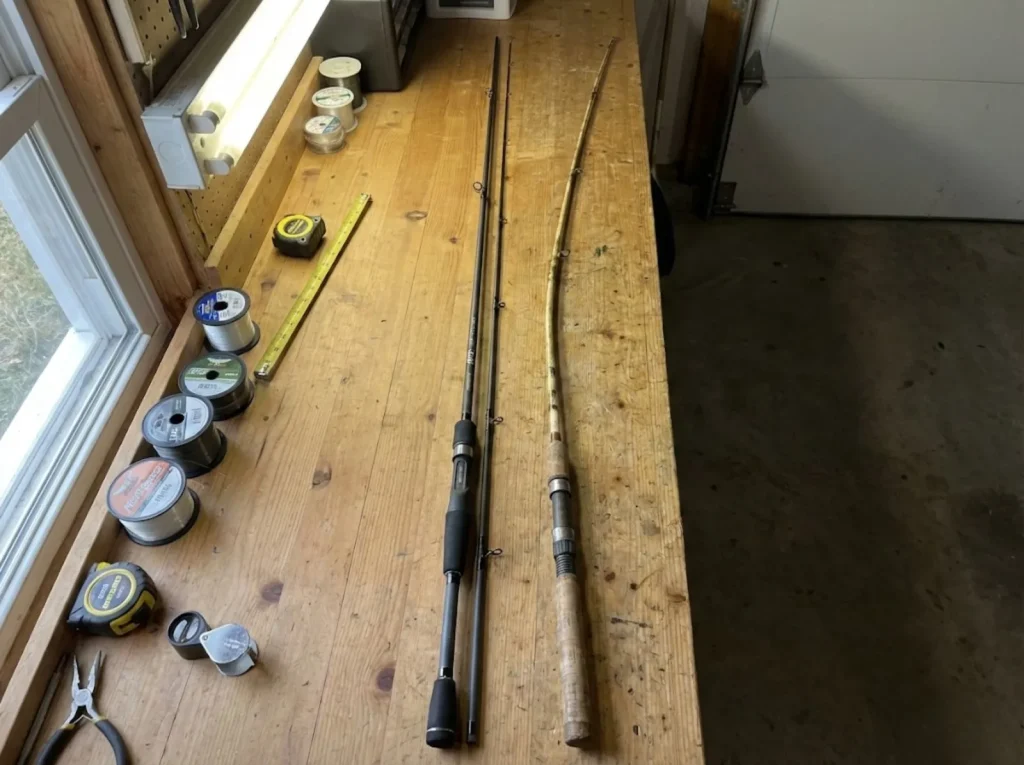
Last spring I pulled a $400 G. Loomis NRX out of the corner where it had been leaning all winter. The rod looked fine—no chips, no cracks, no obvious damage. Then I strung it up and saw it: a slow, sickening curve to the left that no amount of warming or flexing would fix. Permanent rod set. Five months of lazy storage turned a one-piece masterpiece into a crooked noodle.
After two decades of maintaining my own collection and helping other anglers salvage theirs, I’ve watched this exact scenario play out hundreds of times. The rod doesn’t break. It just remembers the wrong shape. And by the time you notice, the damage is done.
This guide covers the material science behind vertical fishing rod storage, exactly how to set up a rack system (DIY or commercial) that prevents warping, and the climate-specific protocols that keep graphite blanks, epoxy finishes, and cork grips intact season after season.
⚡ Quick Answer: Store fishing rods vertically at a true 90° angle, tip-up, in a rack with both upper and lower retention points. Keep the storage area between 60°F–77°F with 40%–60% relative humidity. Use soft-touch or foam-lined rack contacts—never hard plastic cradles. A $15 PVC build works as well as a $200 commercial rack if you follow these three rules.
Why Vertical Storage Protects Your Investment
The Physics of Rod Set (And Why Leaning Counts)
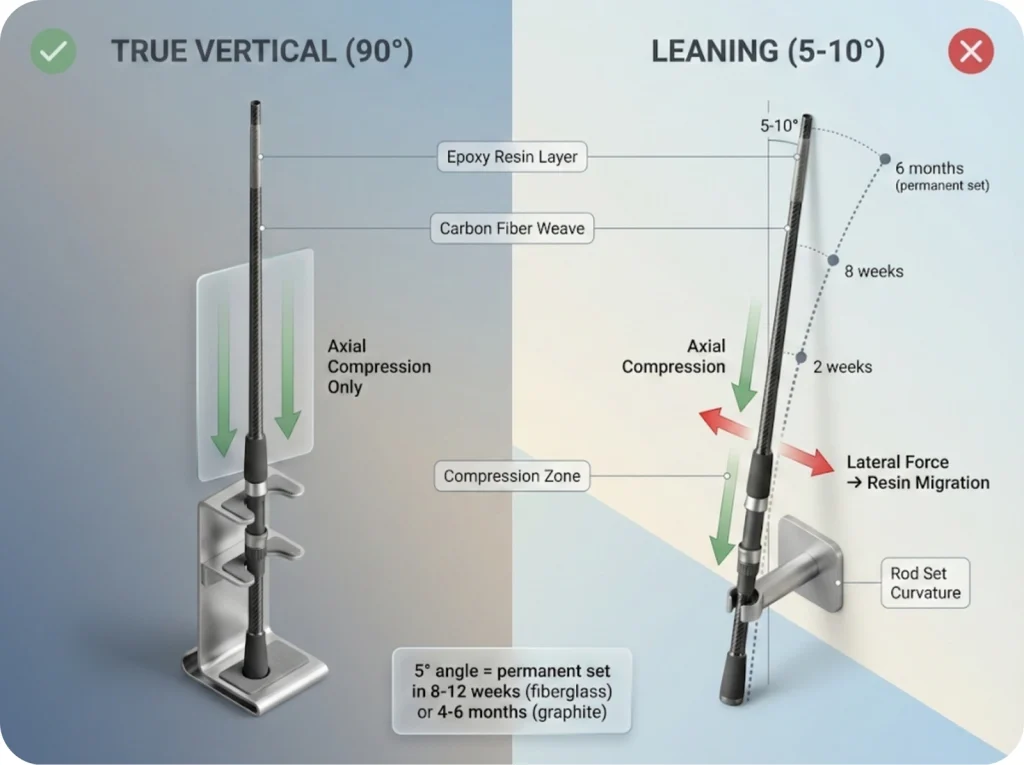
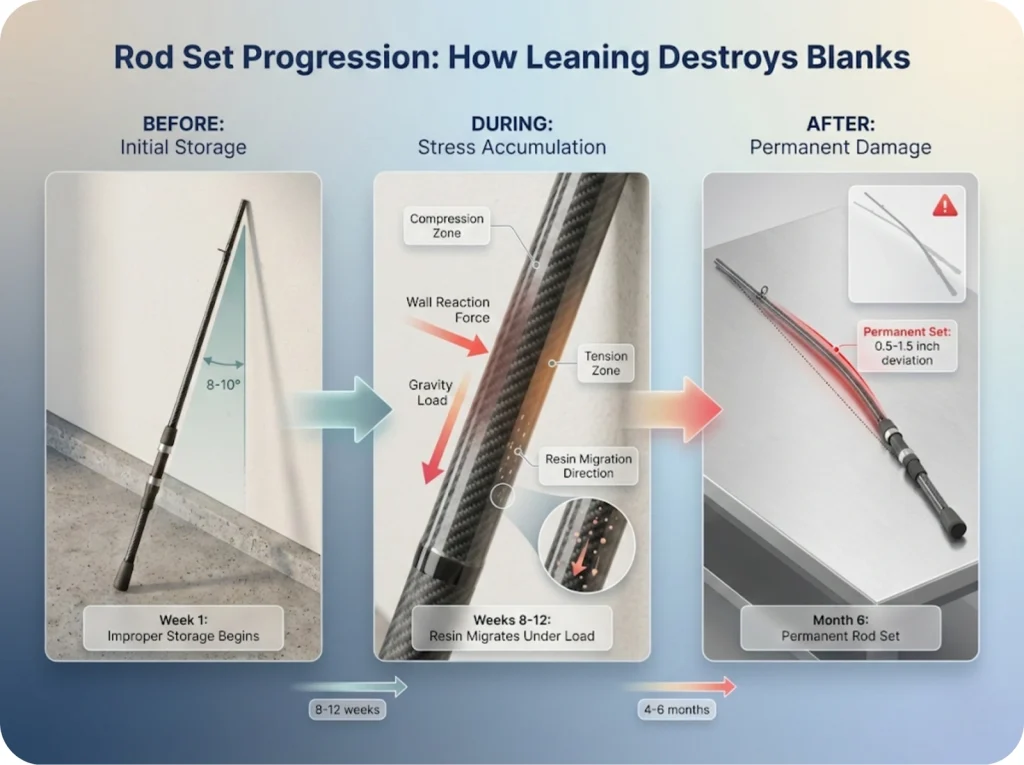
Here’s what most anglers don’t realize: even leaning a rod at a 5° angle creates enough sideways force for gravity to go to work on the blank. The epoxy resin holding those carbon fibers together behaves like a very slow liquid over long timescales. Leave a rod leaning for a few months, and that resin gradually migrates, locking the fibers into a curved position. That’s rod set—and it’s permanent.
Fiberglass rods are actually worse. They’re more flexible by nature, which means the material has more “memory” and retains bent positions faster than graphite. A fiberglass blank can develop noticeable set in as little as 8–12 weeks if stored wrong.
Pro tip: If you’ve been leaning rods in a garage corner all winter, check each one by sighting down the blank from butt to tip before your first trip. You’ll catch the curve before it costs you a fish.
And this isn’t just about cosmetics. According to North Fork Composites’ rod failure analysis, a rod blank that can dead-lift 20–30 lbs can shatter under a half-pound load if the surface fibers have been compromised by compression bruising from improper racking. That microscopic ding against a garage shelf? It destroys the blank’s hoop strength—the circular cross-section ovalizes under load and fails catastrophically.
Tip-Up vs. Tip-Down: The Orientation Debate
Tip-up storage keeps the heavier butt section at the bottom, distributing gravity’s load along the blank’s strongest axis. Tip-down does the opposite—concentrating weight on the thinnest, most delicate section of the rod.
Store a rod tip-down with a reel attached, and you’ve created a cantilever problem. That reel’s weight pulls on the ferrule junction, accelerating set at the exact point where your rod is most vulnerable. For fly rods with delicate tiptops, tip-up storage eliminates contact stress on the section that costs the most to replace.
Vertical vs. Horizontal: What the Numbers Show
Vertical storage reduces your floor footprint drastically. The KastKing V15, for example, fits 15 rods in just 18 linear inches of wall space. A horizontal rack holding the same number needs 7+ feet of wall length—not happening in most single-car garages.
But space isn’t the only advantage. Horizontal racks without continuous support along the entire blank create two sag points at the rack contacts. That’s dual-axis stress on a tube designed to flex in one direction. When a rod hangs vertically at a true 90°, the only force acting on it is axial compression—the mode graphite handles best. Understanding the physics behind graphite and fiberglass sensitivity helps explain why this matters so much.
Setting Up Your Vertical Storage System
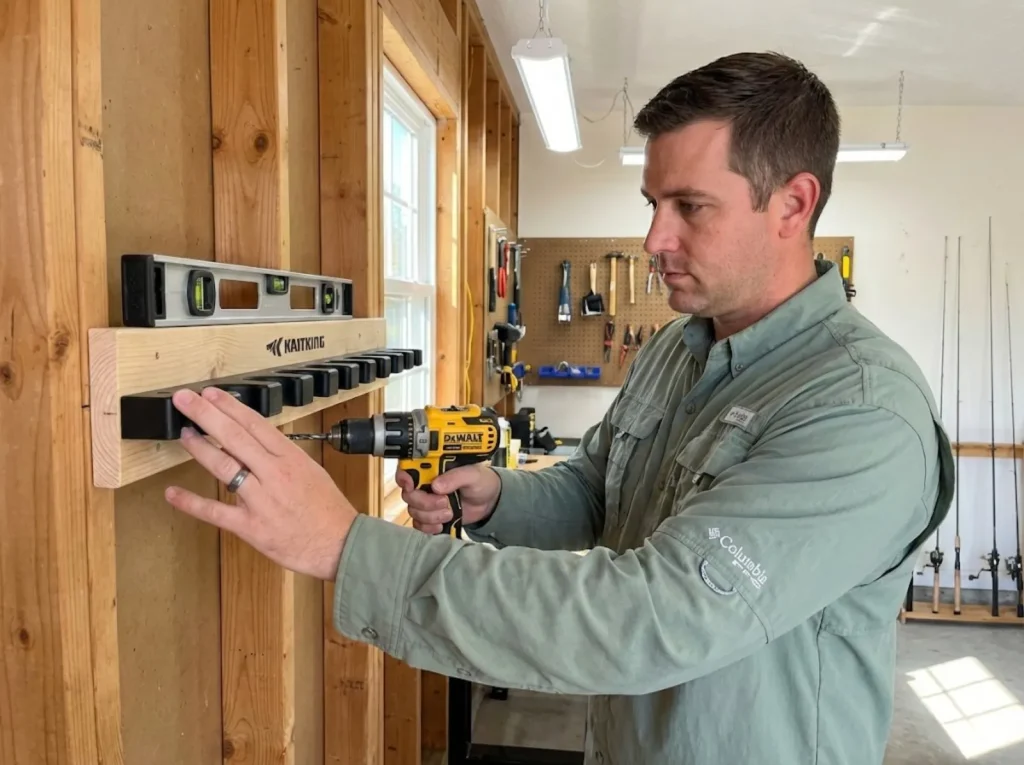
DIY Builds: The $15 PVC Rack That Works
You don’t need to spend $200 to store rods properly. A trip to the hardware store and 45 minutes of work gets the job done.
PVC SDR 26 is the standard pipe grade—its inner diameter (1.5 inches) accepts most rod butts without binding. Cut your slots 5.5–7 inches center-to-center to clear spinning and baitcasting reels. Mount the upper retention rail at 36–42 inches from the floor (hip height) for easy access that doesn’t introduce lean during retrieval.
Use a 1×4 or 1×6 hardwood board for the upper rail instead of plywood. Hardwood prevents the ferrule dings that happen when rod sections connect and bump against a rough surface. Anchor everything into wall studs on 16-inch centers—standard US framing—and each stud handles 40+ lbs without issue.
Pro tip: If your rod rack sits on bare concrete, elevate the bottom tray 4–6 inches. Concrete radiates cold that can push localized temperatures below the epoxy’s safe threshold, even when the rest of the garage feels fine.
Commercial Racks: What’s Worth the Money
If DIY isn’t your thing, here’s what actually matters in a vertical rod rack:
The KastKing V15 uses staggered reel heights that double storage density by nesting reels at alternating positions. Its tacky polymer grip material grabs blanks without the bruising that hard plastic cradles cause—critical if you’re racking high-modulus graphite. Understanding how carbon fiber modulus affects the rod blank you’re storing puts this feature in perspective.
The Rush Creek Creations 30-Rod Rotating Rack uses a lazy-Susan base that allows corner placement with 360° access. If you own 15+ combos, this solves the “I can’t reach the rod in the back” problem.
StoreYourBoard’s Garage Door Rack mounts directly to garage door panels, using dead overhead space most anglers never think about. Just check your opener’s lift capacity first—adding 20 lbs of rods and hardware to the door can strain an older motor.
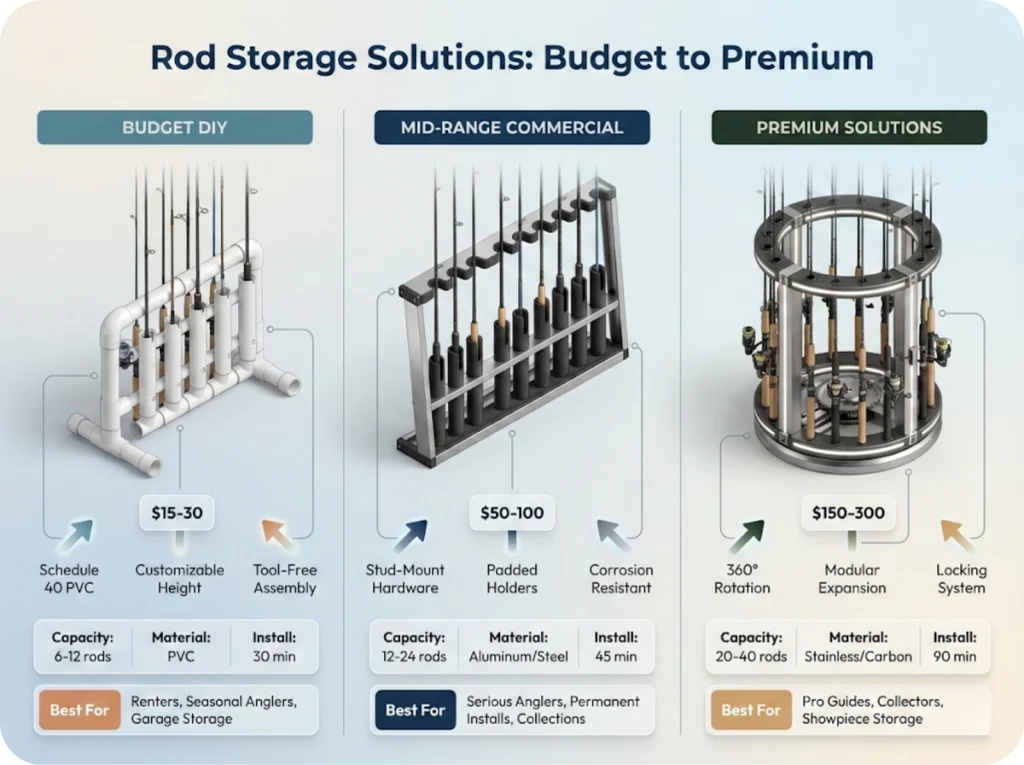
Garage Door, Wall, or Freestanding: Choosing Your Mount Type
Wall-mounted racks are the most stable option. Direct stud connection eliminates sway and provides the firmest anchor for heavy rod collections. Best for permanent installations.
Freestanding racks offer portability but need a weighted base to prevent tipping. In earthquake-prone areas, bolt them to the wall anyway. A toppled rack full of rods is an expensive disaster.
Garage door racks are the space-saving garage rod solution nobody talks about enough. They keep rods overhead and out of high-traffic zones. But check that motor capacity—it matters.
Why Your Rod Material Changes the Storage Rules
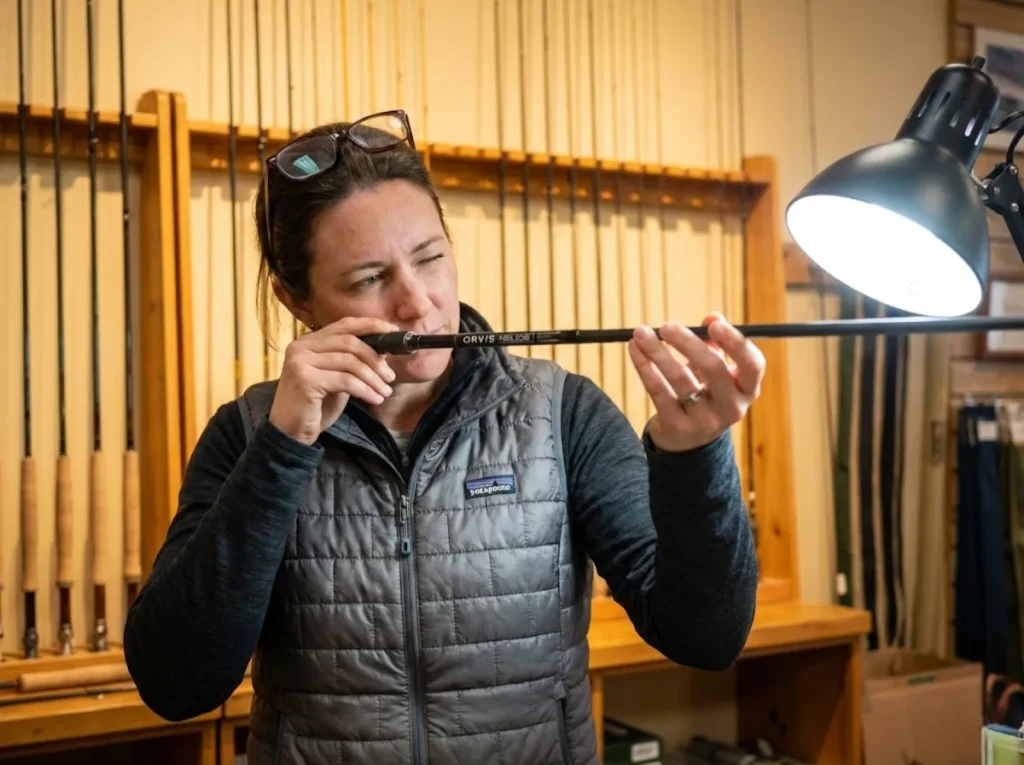
High-Modulus Graphite: Handle With Respect
Not all fishing rods are created equal when it comes to storage sensitivity. Graphite modulus ranges from 36 million to 60+ million on the G. Loomis scale. Higher modulus means stiffer, lighter, more sensitive blanks—and dramatically more brittle ones.
Here’s the trade-off most anglers miss: the higher the modulus, the thinner the blank walls need to be to hit that weight target. Thinner walls mean a single tap against a garage shelf can create an invisible surface fracture that shreds the blank’s hoop strength. The rod that can handle a 30-lb tuna can’t survive a bump from a rake handle. Oval, compress, shatter.
Soft-touch polymer or foam-lined rack slots aren’t a luxury for these blanks—they’re mandatory. Hard plastic cradles are the enemy. And if you want to know what actually voids your rod warranty, “impact damage from improper storage” is right near the top of every manufacturer’s rejection list.
Fiberglass and Composite: More Forgiving, Not Bulletproof
Fiberglass has lower modulus—more flex, more forgiveness on impact—but greater susceptibility to permanent rod set because the fibers retain bent positions more readily. Composite blanks (graphite/glass blends) combine both failure modes: watch for impact bruising AND memory set.
Fiberglass tolerates wider temperature swings but still degrades under UV. The resin matrix breaks down, not the fibers. For fly rod tubes: store rods outside the tube in a rack where air circulates. Tubes trap moisture and prevent the blank from equalizing to room temperature.
The Prepreg Factor: What Holds Your Rod Together
Modern rod blanks are built from prepreg—carbon fiber or fiberglass sheets pre-impregnated with a resin system. That resin has a temperature threshold where it shifts from rigid to rubbery. For most rod epoxies, that point sits around 150°F.
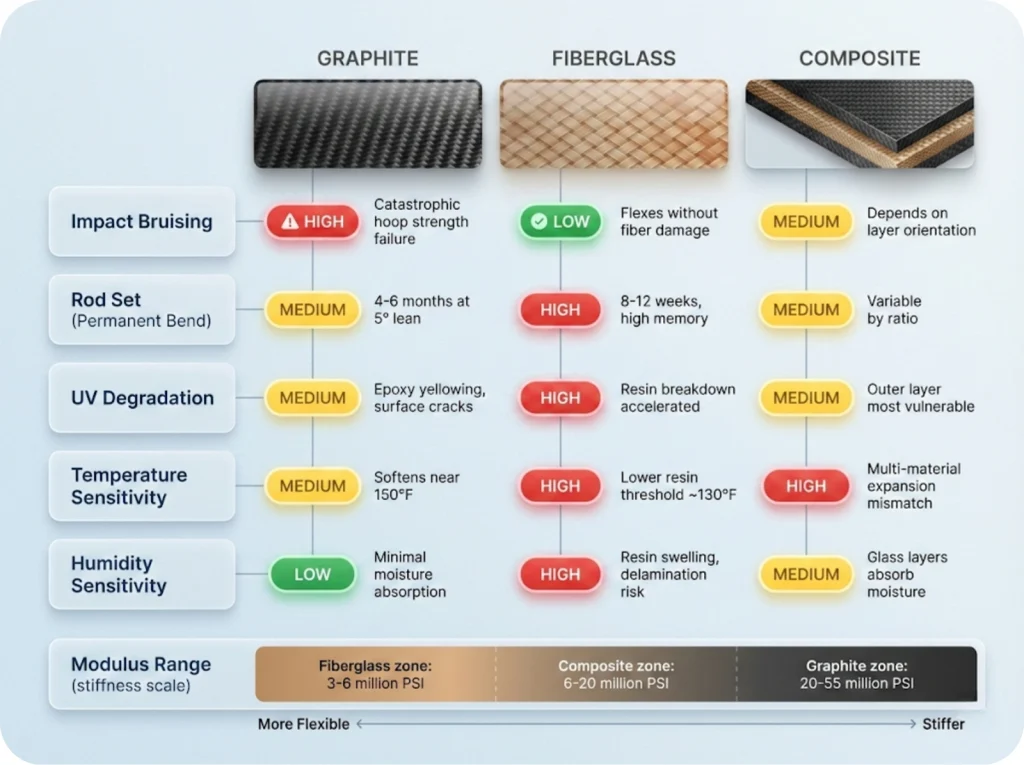
In a sun-baked garage hitting 130°F+ during summer, you’re approaching that number. The resin softens. Any static load—leaning, pressure from a tight rack slot—can permanently reshape the blank. Factor in that epoxy shelf life runs 1–2 years unopened, and years of UV exposure degrade the resin further. Older rods need more storage care, not less.
Climate, Humidity, and the Enemies of Stored Rods
Temperature: The Silent Killer in Your Garage
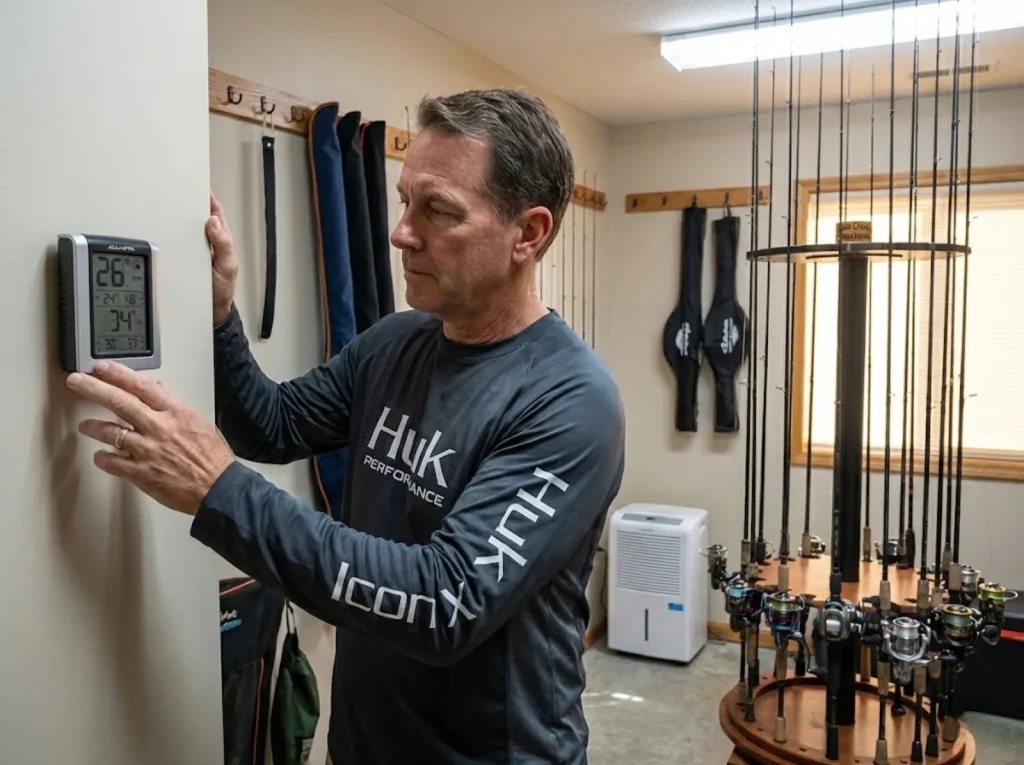
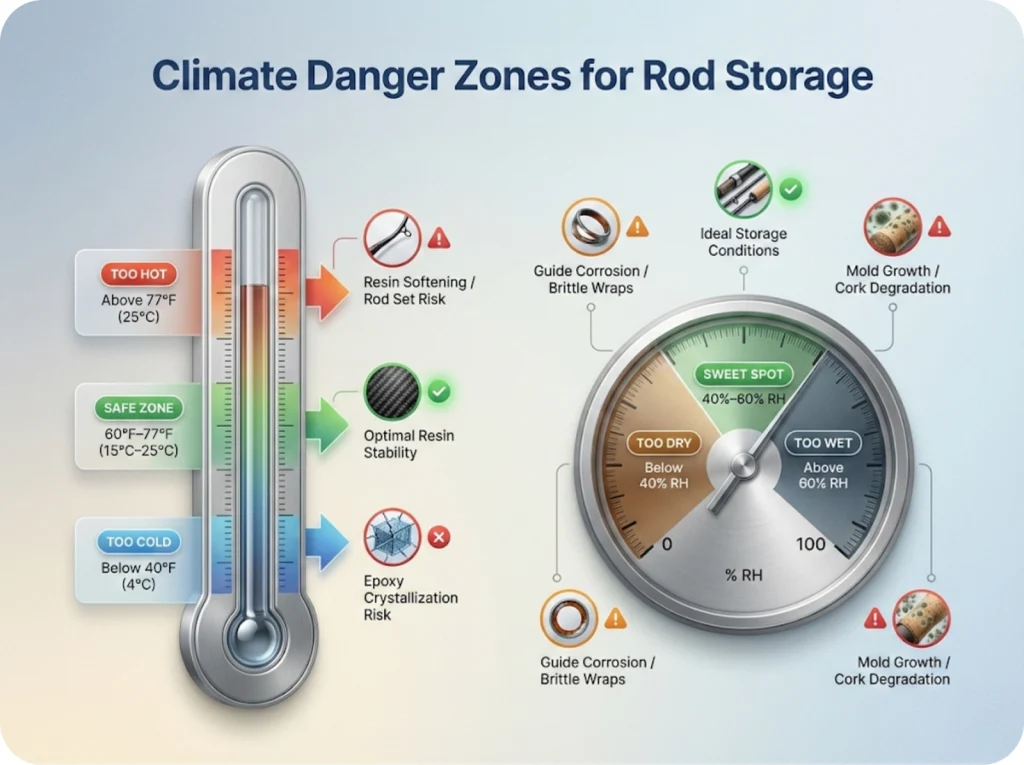
Optimal storage temperature sits between 60°F and 77°F. Above 77°F, epoxy degradation accelerates. Below 40°F, resin crystallization becomes a real risk—the epoxy turns brittle and loses its flexibility.
Garage walls transmit exterior temperatures directly. Never rack rods against an exterior wall during winter. That wall might read 25°F even when the interior air feels reasonable. Recovery from crystallized resin is possible (a 120°F water bath can restore properties as a last resort), but prevention is the obvious move.
Humidity and Saltwater: The Hygroscopic Brine Effect
Keep relative humidity between 40% and 60% RH. Above 60%, mold attacks cork grips and corrosion eats guide frames.
Salt is the hidden accelerator. It’s hygroscopic—it actively pulls moisture from the air. Any salt residue left in the guides after a trip creates a corrosive brine that gravity pulls straight down the blank and into the reel seat. This is why the rinse protocol matters: use a mist setting, NOT high pressure. A blast forces salt deeper into bearings and guide inserts instead of removing it.
After rinsing, dry guides with a microfiber cloth before racking. Residual droplets in guide eyes act as micro-lenses that concentrate UV damage. For our full saltwater corrosion prevention protocol, the same principles apply whether gear is on the boat or on the rack.
UV Exposure: Why Your Garage Window Matters
UV specifically degrades the epoxy resin matrix that binds carbon fibers—not the fibers themselves. A rod stored near a window for one summer can lose measurable blank integrity without any visible discoloration. Rack rods away from direct light, or use rod sleeves for long-term protection. Color-coded sleeves serve double duty: UV shield plus quick identification on tournament mornings.
Pro tip: Color-code your rod sleeves—red for inshore, blue for offshore, green for freshwater. On tournament mornings, you’ll sort the rod locker in 10 seconds instead of fumbling through identical cloth socks.
The Seasonal Maintenance Calendar
End-of-Season Protocol
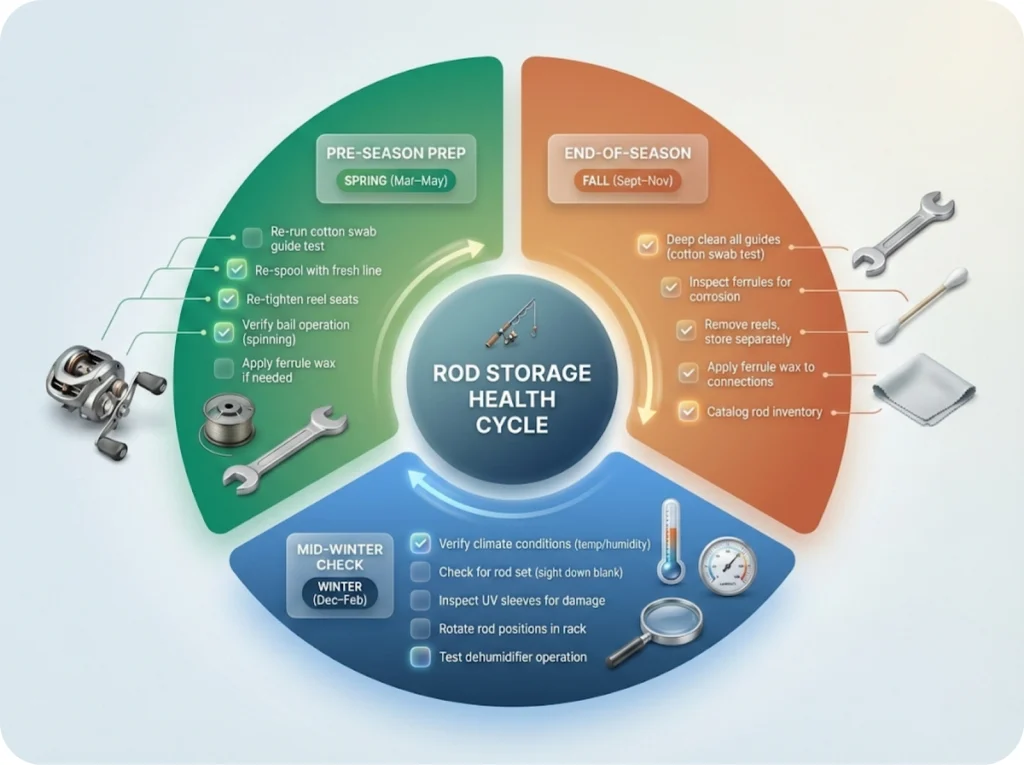
Strip old line before storing—especially monofilament and fluorocarbon, which develop aggressive memory coils over a winter in storage. Loosen all reel drags to near-zero. Tight drags compress carbon fiber washers for months, causing the jerky, inconsistent drag performance that ruins your first hookset of the season.
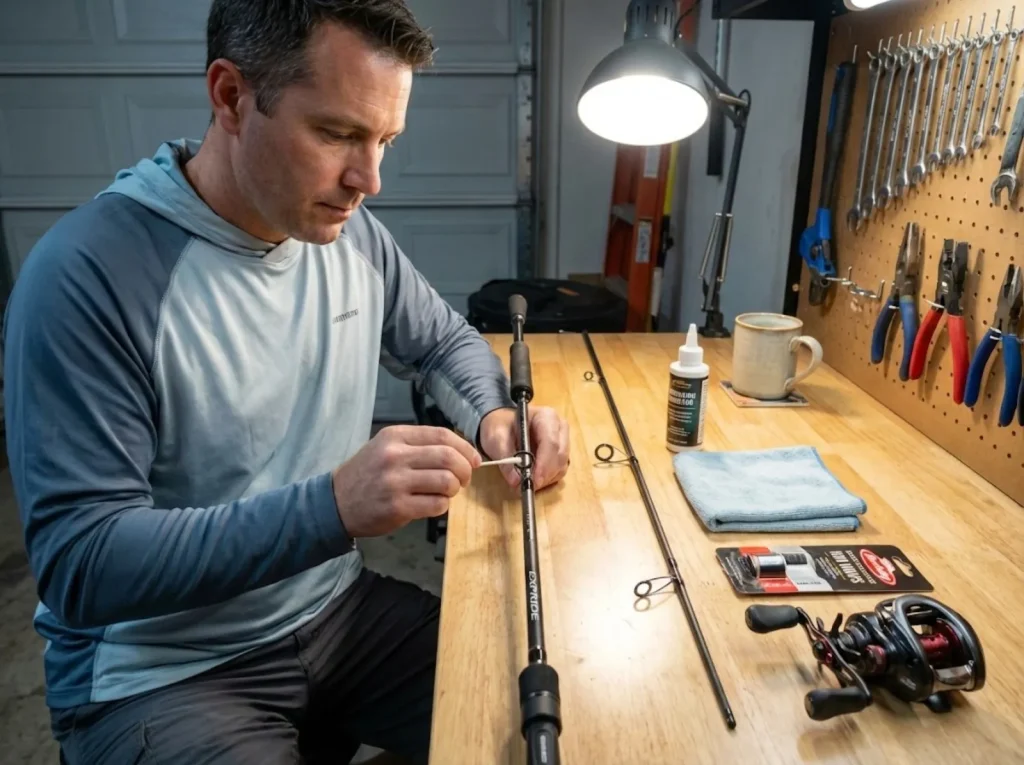
Clean cork grips with mild soap and warm water. Apply cork sealant if you see pitting. Run corrosion inhibitor over every guide frame, paying extra attention to the insert edges. And perform the cotton swab test: run a cotton swab through each guide insert. If it snags, the ceramic is micro-cracked and needs replacing before storage—not after it saws through your line on opening day.
Following our 3-phase post-trip cleaning protocol before racking ensures nothing is going into storage dirty. The Massachusetts Division of Fisheries and Wildlife recommends the same approach—clean, dry, and loosen drags before any long-term storage.
Mid-Winter Check
Inspect the storage area for humidity spikes. Condensation on windows or walls means the air is too wet. If rods sit on a garage wall, verify they aren’t touching the cold surface directly. Check for pest intrusion—mice chew through cork handles and rod sleeves more often than you’d think. And confirm reel drags are still loosened. Family members and curious kids tighten them without realizing the damage.
Pre-Season Prep
Re-run the cotton swab test on every guide before spooling fresh line. Check ferrule connections for corrosion or stiffness and apply a thin coat of ferrule wax if needed. Re-spool with new line. Re-tighten reel seats and verify bail operation on spinning reels.
Pro tip: Reverse your braid at the end of the season. The fresh, unused line from the bottom of the spool moves to the top—free “new” line without buying a thing.
Storage Mistakes That Destroy Rods (And How to Fix Them)
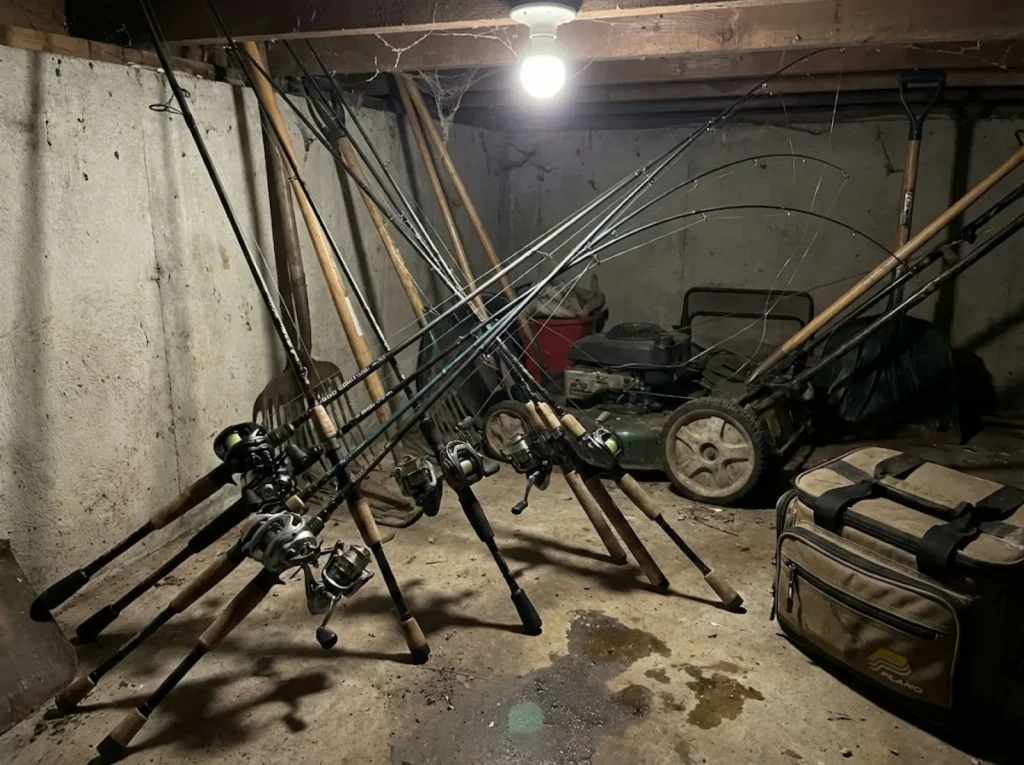
Leaning Rods in Corners
Even a “vertical-ish” lean at 5–10° creates enough perpendicular force for gravity-assisted rod set. The fix: true 90° vertical in a rack with both upper and lower retention points. Never rely on friction against a wall.
Time-to-set varies by material. Graphite blanks may take 4–6 months. Fiberglass can develop noticeable set in 8–12 weeks. Either way, leaning is a gamble with your fishing gear. Knowing how hook keepers prevent storage accidents is another layer of protection—loose hooks dragging across other blanks during retrieval cause the same kind of surface damage.
Storing With Tight Drags and Wet Gear
Tight drag during storage crushes carbon fiber washers, leading to jerky, unpredictable performance. Always back off to near-zero before racking.
Storing rods wet from a trip drives moisture into ferrule joints, guide inserts, and reel bearings. The result? The “Frozen Reel Surprise” on opening day—moisture crystallizes in bearings during cold storage, seizing the spool. Never use WD-40 or Vaseline for reel lubrication during storage. Both gum up close-tolerance bearings. Use a purpose-made reel oil.
Ignoring Guide Inserts and Reel Seats
Micro-cracks in ceramic guide inserts are invisible to the naked eye but will saw through your line on the first hard hookset of the season. Galvanic corrosion between dissimilar metals in the reel seat—aluminum meeting stainless steel—accelerates in humid storage. The cotton swab test takes 30 seconds per rod. That’s 5 minutes for a 10-rod collection to catch a problem before it costs you a fish of a lifetime.
Conclusion
Three things protect your rods better than anything else: true vertical storage at 90° with dual contact points, a climate-controlled environment between 60°F–77°F, and a 15-minute seasonal maintenance routine that catches problems before they cost you money.
Your rod material dictates your protocol. High-modulus graphite needs soft-touch racks and careful handling. Fiberglass needs protection from memory set. Both need protection from UV and temperature extremes.
Grab a cotton swab tonight and run it through every guide on your favorite rod. If it snags, you just caught a problem before it ruined a trip. That’s what proper rod storage is really about—not organizing your garage, but protecting the gear that puts fish in the net.
FAQ
Is it better to store fishing rods vertically or horizontally?
Vertical storage is better for long-term rod protection. The primary load on the blank is axial compression, which graphite and fiberglass handle well. Horizontal storage creates two sag points at the rack contacts that induce lateral stress and accelerate rod set, especially in fiberglass blanks.
Should fishing rods be stored tip-up or tip-down?
Store them tip-up. The butt section is the thickest, heaviest part and belongs at the bottom. Tip-down storage concentrates weight on the thinnest section, compresses delicate guide inserts, and creates cantilever stress at the ferrule if a reel is attached.
How far apart should fishing rod holders be spaced?
Space slots 5.5 to 7 inches center-to-center. This clears spinning and baitcasting reels without wasting wall space. Racks with staggered reel heights like the KastKing V15 can reduce spacing further by nesting reels at alternating heights.
Can I store fishing rods in a hot garage?
Only with temperature control. Epoxy degradation accelerates above 77°F, and a sun-baked garage can hit 130°F+ in summer, softening the resin and turning any static load into a permanent deformation. Insulate the storage area or move rods indoors during peak summer.
How do I prevent fishing rods from warping in storage?
Three non-negotiables: true vertical orientation at 90° with upper and lower retention points, temperature between 60°F–77°F with 40%–60% relative humidity, and soft-touch or foam-lined rack contacts that prevent compression bruising on the blank surface.
Risk Disclaimer: Fishing, boating, and all related outdoor activities involve inherent risks that
can lead to injury. The information provided on Master Fishing Mag is for educational and informational purposes
only. While we strive for accuracy, the information, techniques, and advice on gear and safety are not a substitute
for your own best judgment, local knowledge, and adherence to official regulations. Fishing regulations, including
seasons, size limits, and species restrictions, change frequently and vary by location. Always consult the latest
official regulations from your local fish and wildlife agency before heading out. Proper handling of hooks, knives,
and other sharp equipment is essential for safety. Furthermore, be aware of local fish consumption advisories. By
using this website, you agree that you are solely responsible for your own safety and for complying with all
applicable laws. Any reliance you place on our content is strictly at your own risk. Master Fishing Mag and its
authors will not be held liable for any injury, damage, or loss sustained in connection with the use of the
information herein.
Affiliate Disclosure: We are a participant in the Amazon Services LLC Associates Program, an
affiliate advertising program designed to provide a means for us to earn advertising fees by advertising and linking
to Amazon.com. As an Amazon Associate, we earn from qualifying purchases. We also participate in other affiliate
programs and may receive a commission on products purchased through our links, at no extra cost to you. Additional
terms are found in the terms of service.