
In this article
You bought the shirt in April, wore it maybe forty days, and washed it maybe twenty times. By September the shoulders are letting light through, and nothing on the tag ever warned you that could happen. That gap between what a UPF 50+ label promises on day one and what the fabric actually does in month five is the most useful thing to understand before you buy another long-sleeve fishing shirt, and it is measurable: a 2023 laundering study ran seven UPF garments through 50 wash cycles and watched two of them lose most of their protection. Below is how to tell which kind of sun protection clothing you’re holding before you pay for it, why a boat deck is harsher than a trail under the same UV index, and the six shirts that hold up.
Here is the short version, sorted by how you actually fish.
| Pick | Shirt | UPF | Why it wins |
|---|---|---|---|
| Best Vented Button-Down | Columbia PFG Tamiami II | 40 | Mesh back vent that moves air on a stalled skiff |
| Best for Heat | Free Fly Bamboo Shade Hoodie | 50+ | Bamboo blend stays soft instead of clammy |
| Best Budget Hooded | Baleaf Sun Protection Hoodie | 50+ | Tight polyester-spandex weave, nothing to wash out |
| Best Casting Mobility | Mountain Hardwear Crater Lake | 50+ | Dropped shoulder seams sit off the joint |
| Best Ultra-Budget | Hanes Cool DRI 2-Pack | 50+ | Two shirts for less than one premium sleeve |
| Best Women’s Fit | Outdoor Research Astroman Air | 30–50+ | Laser-cut vents in a cut built for women |
What a UPF Rating on a Fishing Shirt Actually Buys You
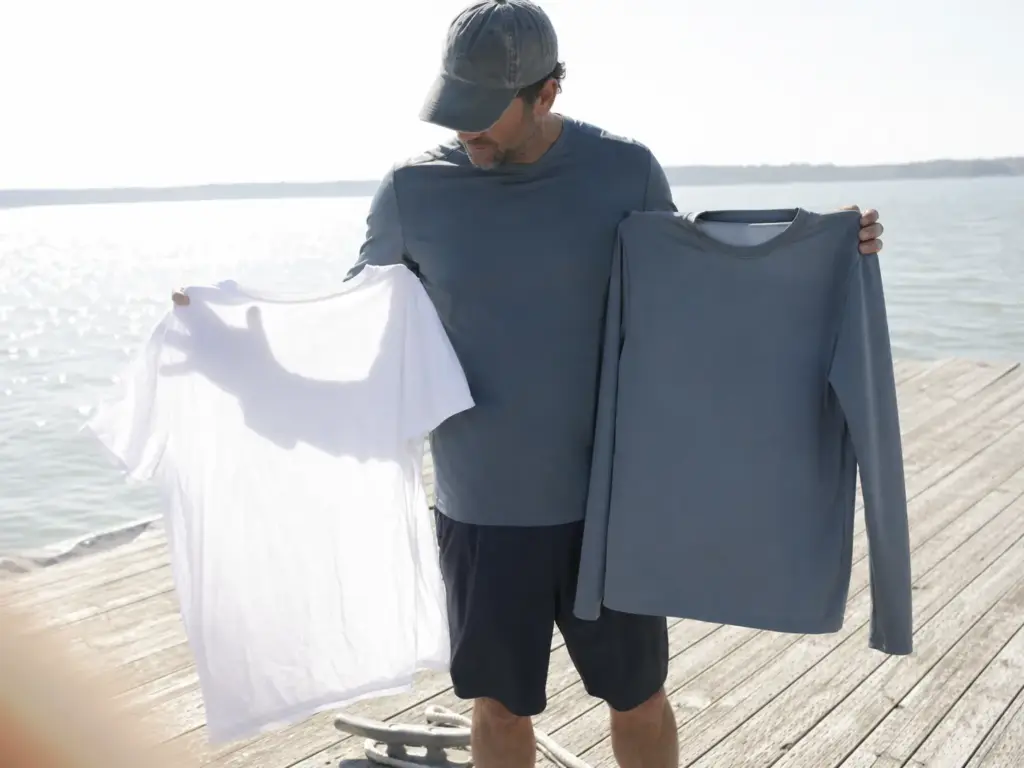
UPF stands for Ultraviolet Protection Factor, and unlike SPF, it measures UVA and UVB together rather than burn potential from UVB alone. The number is a fraction: UPF 50 lets roughly one fiftieth of ultraviolet light through, which works out to about 98 percent blocked. UPF 30 through 49 rates as very good, UPF 50 and above rates as excellent.
Most people assume the jump from 30 to 50 is the difference between covered and exposed. It is about a point and a half of ultraviolet transmission. Real money is better spent on coverage, fit, and whether the protection lasts.
The gap that actually matters is between any rated shirt and the cotton tee half the boat ramp still fishes in. The Skin Cancer Foundation puts a plain white cotton tee at roughly UPF 7, and at UPF 3 once it’s wet. A dark long-sleeve denim shirt, by contrast, runs somewhere near UPF 1,700. Fabric, color, and weave do the work. Price does not.
That wet number is the one that lands. Everybody reading this has fished a full day in a soaked cotton shirt and felt reasonably covered. That shirt was running about UPF 3 by lunch, which is roughly the protection of standing there in nothing at all.
One independent mark on a tag is worth looking for: the Skin Cancer Foundation’s Seal of Recommendation requires a minimum of UPF 50. Everything else printed on a hangtag is a brand grading its own homework.
There is also a sizing trap nobody warns you about. Buying a size down so the shirt looks sharp stretches the knit across the shoulders and pulls the fibers apart, which opens gaps in exactly the fabric that points at the sun during an overhead cast. The Foundation states this outright: tight clothing can stretch and reduce protection. The shirt is only one layer of the wider sun protection system that includes your hat, gaiter, gloves, and eyewear, and it works best when the rest of that kit is doing its job too.
Why the Water Doubles Your Sun Exposure
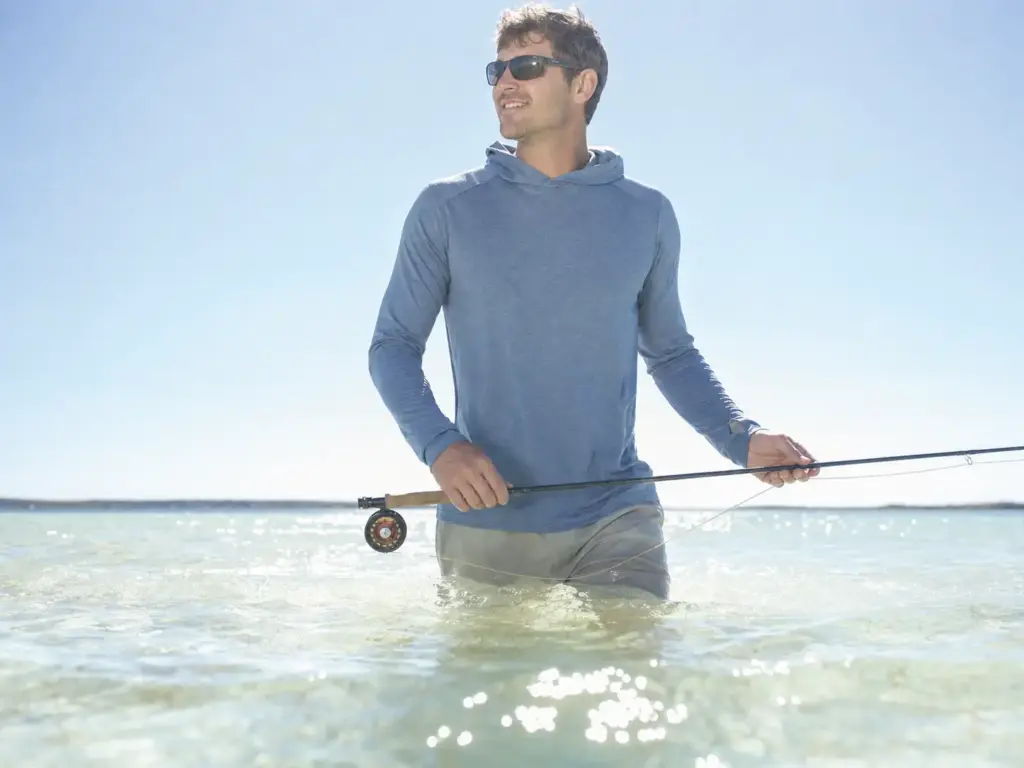
Here is the part hiking-oriented gear roundups never account for. Every UV index number you see on a weather app is measured for a person standing on the ground. You are not standing on the ground. You are standing on a reflective surface that throws a substantial fraction of the ultraviolet load back up at you from below.
Calm freshwater reflects roughly 3 to 10 percent of incoming UV. Open ocean and large lakes run 10 to 25 percent. Choppy saltwater, which is most days worth fishing, hits 20 to 30 percent, with the worst numbers at high sun when a rippled surface acts like a field of small angled mirrors. That is water UV reflection, and it is not a rounding error.
Stack it up and total boat deck sun exposure runs 25 to 40 percent above the same activity on land under an identical index reading. Eight hours on the water is closer to ten or eleven hours ashore. The EPA’s UV Index scale treats 8 and above as the threshold where extra protection stops being a suggestion, and on the water you are effectively living a category higher than the app says.
You can see the proof on your own face. The surfaces that burn on a hard flats day are the ones facing down: under the chin, inside the nostrils, the underside of the forearms, the backs of the hands. A wide-brim hat protects none of them, because the light is not coming from above. This is the reason a fishing shirt is not just a hiking shirt with a bass on the chest.
The other half of the math is sunscreen. Chemical sunscreen starts sweating off within 40 to 80 minutes of hard activity, so an honest eight-hour day is six to ten reapplications. Nobody performs six to ten reapplications with wet hands, a fish in the net, and a bite window closing. Fabric is the only layer that does not expire mid-morning, which is why the backs of your hands are worth covering too: they take reflected UV all day and almost never get a second coat.
You can date a fishing burn by where it sits. Shoulders and the back of the neck means you spent the day facing away from open water. Chin and nostrils means you were on a reflective surface at high sun, and no hat was ever going to fix it. If that is your pattern, you need coverage on the underside, which is what a hood, a gaiter, and long sleeves buy you.
Why Two “UPF 50+” Shirts Age Completely Differently
Two shirts on the same rack, same tag, same number. One of them is still rated after three seasons. The other one is a layer by the following July. The tag will never tell you which is which, because the tag reports the number and not where the number comes from.
What the Wash Study Actually Found
A 2023 laundering study published through the NIH library ran seven UPF garments through 50 wash cycles, measuring protection every ten. Brand A, which used a nano-zinc finish, fell 78 percent, from UPF 567 down to UPF 126. Brand D, with an undisclosed treatment, fell 70 percent, from 492 to 151.
The other five brands held within about 20 percent of their starting value across all 50 cycles. One of them carried no UV finish whatsoever. Another held the maximum assignable value of 2,000 through the entire run despite a polyester composition similar to a shirt that did not hold. The authors’ conclusion was plain: textile compositions carrying UV finishes can lose effectiveness during laundering.
The methodology is the part that should get your attention. This was cold water and ordinary commercial detergent, not a stress test, not bleach, not hot cycles. Two of seven shirts still lost most of what you paid for under conditions gentler than what a saltwater shirt actually lives through.
Industry ranges fill in the rest of the picture. Premium topical finishes are engineered to survive 40 to 50 washes. Cheap ones start fading at 10 to 20. A shirt that left the factory at UPF 50 can realistically be sitting somewhere around UPF 20 to 25 after 20 to 40 cycles, which for a serious angler is a single season.
Topical Finish vs Inherent Protection
There are three ways a shirt can block ultraviolet, and only one of them washes away.
Chemically treated UPF means a UV absorber was applied to finished fabric, the way a stain guard is applied to upholstery. It performs on day one and degrades on a schedule. Inherent UV protection by weave means the fabric physically blocks light because a tight polyester-spandex knit leaves less gap between fibers for photons to slip through. There is nothing to strip off, so UPF retention stays flat for the life of the garment. The third path, which almost nobody explains, is mineral protection: titanium dioxide or zinc oxide particles embedded inside the fiber during manufacturing rather than coated onto the outside. Those are permanent too.
Wash degradation has accelerators. Hot water, optical brighteners, enzyme detergents, and high-alkalinity formulas all attack topical finishes directly. So does a saltwater season, where every trip runs the fabric through a salt, sun, and wash cycle that a hiking shirt never sees. If you want the deeper physics of how a weave stops ultraviolet before any coating gets involved, that mechanism is worth understanding in full, because it is what separates a shirt you buy once from a shirt you buy every spring.
How to Tell Before You Buy
You can sort this out standing in the aisle with your phone. Five checks, in order of how much they tell you.
- Read the spec-sheet vocabulary. The words finish, treatment, applied, and coating mean topical, and topical washes off. The words inherent, tightly woven, fiber construction, and embedded mean permanent.
- Treat a wash-count claim as a confession. “Maintains UPF 50+ through 100 washes” is a brand telling you there is a finish with a service life. Nobody quantifies inherent protection in wash cycles, because inherent protection does not have a cycle count.
- Check the construction numbers. Polyester or polyester-spandex, tight knit, a fabric weight of at least 4 oz per square yard, in a mid to dark color. That combination is inherent by construction regardless of what the marketing copy says.
- Look for the test standard. AATCC 183 is the US test method, and it matters because it rates fabric wet as well as dry. A bare “UPF 50+” with no standard named tells you almost nothing.
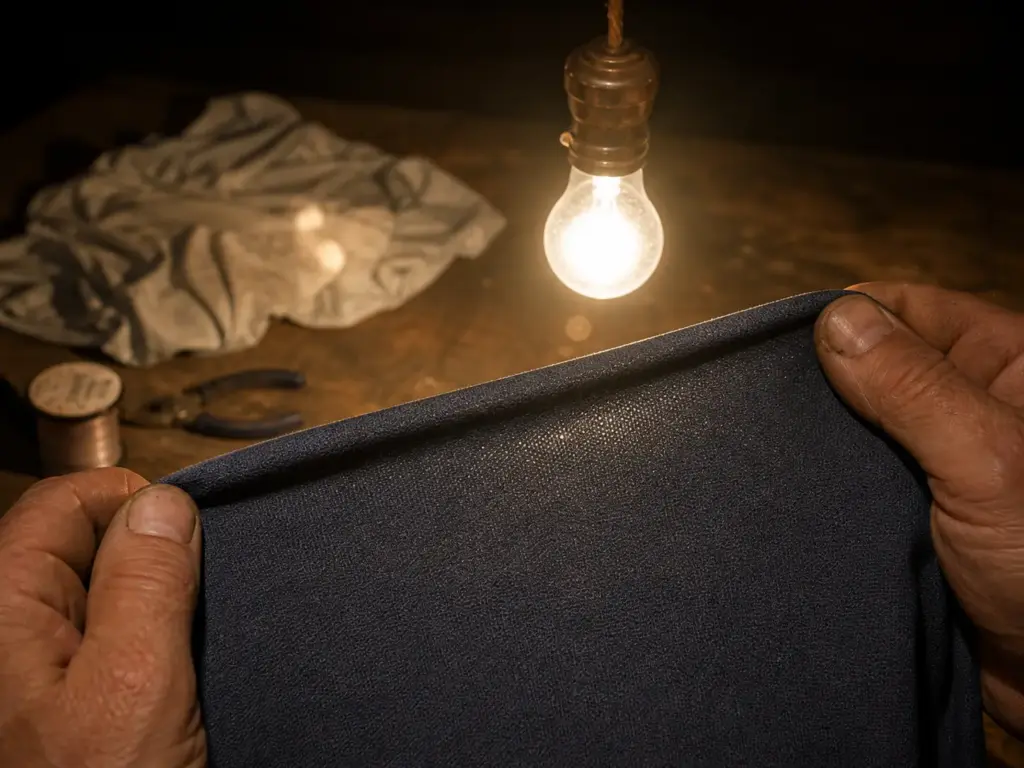
- Run the bulb test. Hold the fabric up to a bare light bulb and look. If you can see the weave clearly, the protection is coming from a coating rather than from the cloth.
The Breathability Trade-Off Nobody Names
Here is the tension inside every sun shirt ever made. The same tight weave that makes protection permanent is the weave that moves the least air. Protection and airflow are pulling against each other, and no marketing department will admit it, which is why the most protective shirts can also be the hottest.
Good designs solve it mechanically rather than chemically: mesh back panels, laser-cut perforations under the arms, dropped-weight jersey knits that hold the weave tight while cutting mass, and evaporative cooling that activates when the fabric is wet. Bad designs solve it by loosening the weave and printing a bigger number on the tag.
Offshore crews do not fight the protection-versus-airflow trade-off, they flood it. The forum consensus is a spray bottle, a mister, or just a bucket of water over the shoulders every hour. Cooling fabrics work wet and do very little dry, and that operating instruction appears on exactly zero hangtags.
Where a Fishing Shirt Binds on the Backcast
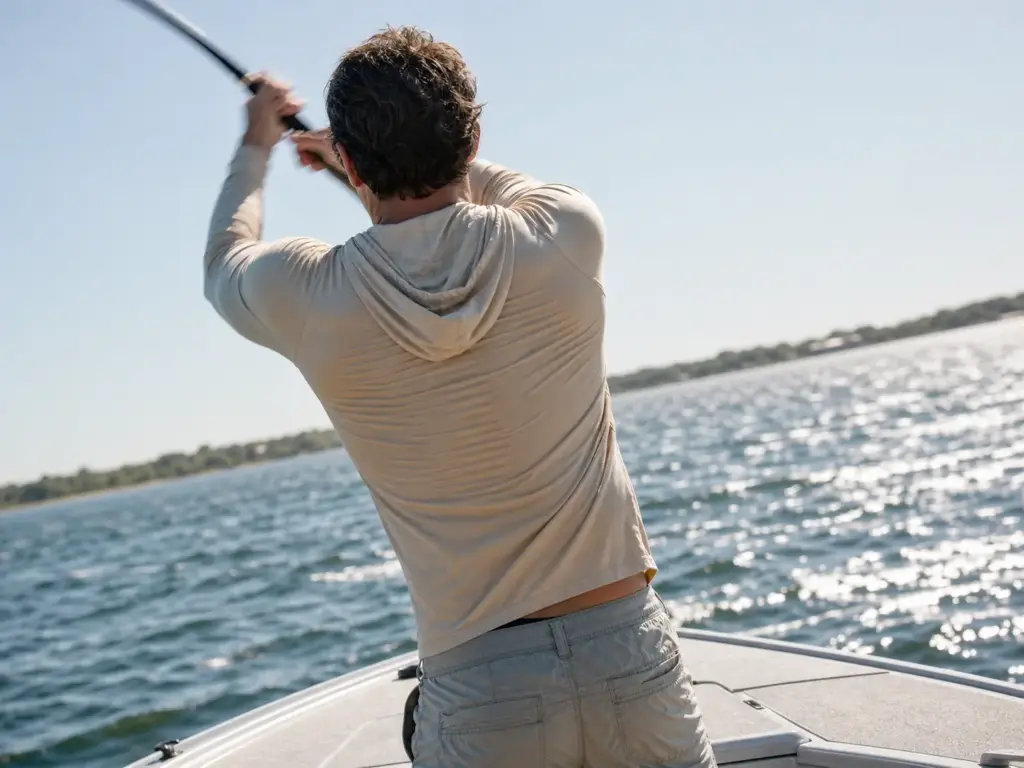
You never find a fit problem in a store. A shirt sold on range of motion can still bind on the third cast of the morning, when the hem walks out of your waistband and you spend the next eight hours tugging it back down.
The failure point is almost always the shoulder-to-sleeve seam, and specifically where it sits relative to the joint. On a full overhead cast the upper arm rotates and lifts through a wide arc. A traditional set-in seam parked directly on top of that pivot has nowhere to go, so it drags the entire shirt upward with the arm. That is the hem climbing, and that is the fabric biting into the armpit at the top of the stroke.
Two construction fixes exist. A raglan sleeve runs the seam diagonally from collar to underarm, removing it from the joint entirely. A dropped shoulder moves the seam down onto the upper arm instead. Both get the stitching off the pivot from different directions, and the Mountain Hardwear Crater Lake in the roundup below is the clearest example of the dropped-shoulder approach in this price band.
The underarm gusset is the other half of the solution. It is a diamond-shaped panel set into the armpit that spreads tension across four seams rather than one. Without it, the armpit fabric is the only material stretching, which is why the armpit is the first place a cheap sun shirt tears.
You can test all of this in a fitting room without a rod in your hand. Put both arms straight overhead, palms together. If the hem climbs more than a couple of inches, or you feel tension under the arm, that shirt will annoy you on every single cast for as long as you own it. Then run the second test: reach one arm across your chest to the opposite shoulder and feel for pull across the shoulder blade. Both movements happen a few hundred times a day, and a full overhead stroke is the movement that exposes every fit problem a shirt has.
This is also where the sizing tension from earlier resolves. Too tight opens the weave and costs you protection. Too loose flaps in the wind and catches on gear. Correct seam geometry and a real gusset are what let you buy your actual size and still move freely, which is the whole point of paying for casting mobility instead of just reading the phrase on a hangtag.
Hoods, Gaiters, and the July Problem
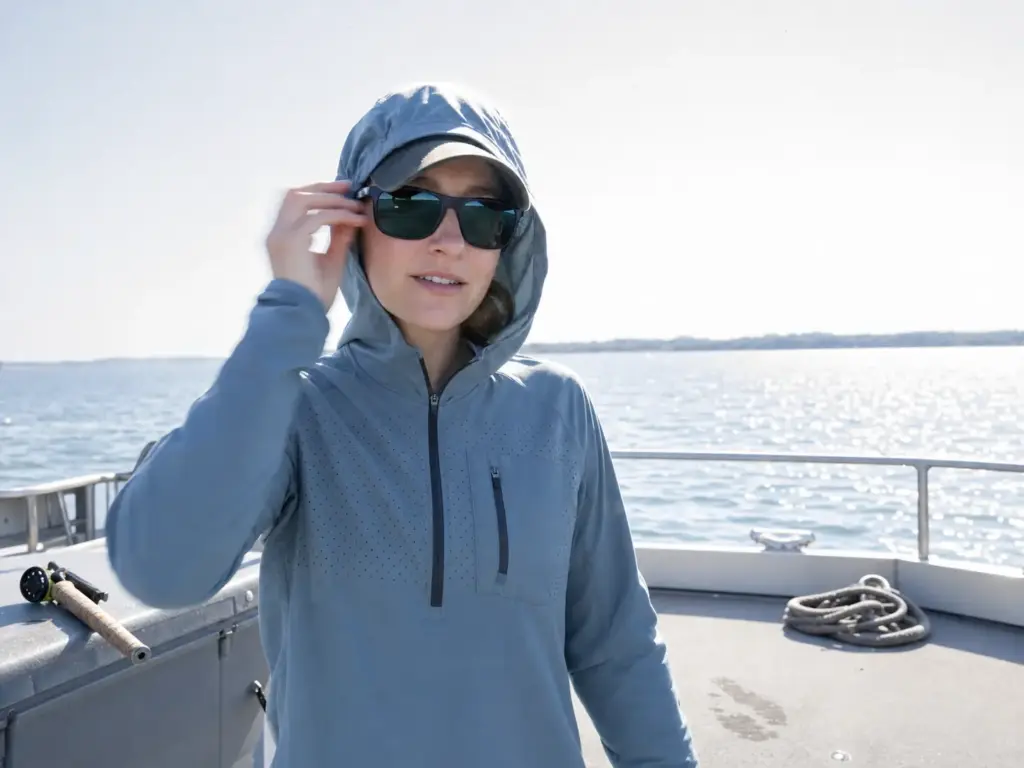
Everybody buys the hood-and-gaiter combo for the flats photo. Ask around and the same answer keeps coming back: it goes up at dawn and comes down by nine.
What the integrated hood genuinely adds is real. It covers the neck, the ears, and the sides of the face, which are precisely the surfaces a wide-brim hat leaves open and precisely where reflected light lands. Thumb loops do the same job at the other end, keeping the backs of the hands covered without a separate glove. On a genuinely brutal day, that coverage is the difference between finishing the trip comfortable and finishing it counting the hours.
Then there are the four things nobody mentions in a product description.
Fogged sunglasses come first. A gaiter routes every exhale straight up into your polarized lenses, and it is worst in humid, windless conditions, which describes essentially every flats dawn. Second is the temple conflict: the arm of your sunglasses and the edge of the hood are competing for the same inch of skull, and with the hood up the glasses shift off their intended plane, which means you lose part of the glare rejection you paid for. If you fish behind good lenses, how the temple arms sit against your head is not a small detail. Third is hearing. Hood up with a motor running and you lose the audio reference that keeps a shared boat running smoothly. Fourth is heat. An integrated gaiter in July turns your neck into a heat pocket, and that single fact explains why so many anglers pay extra for the feature and then wear it around their shoulders all day.
The honest alternative is less elegant and more useful: a hood with no attached gaiter, plus a separate neck gaiter or buff you can pull up and drop independently. Two pieces means you can cover your neck without covering your face, or cover your face for twenty minutes and drop it again without pulling the hood off your head.
One more design note that only matters if you throw a cast net. A long-running offshore forum thread on this exact question opened with a request for a shirt with no buttons so the net would not snag, and the replies agreed unanimously. If a net is part of your day, a button-front is out no matter how well it vents.
Two shirts belong in this conversation that you cannot reliably buy on Amazon. The Coolibar Andros is the canonical hood-plus-integrated-gaiter build and one of the few carrying the Skin Cancer Foundation Seal, and the HUK Icon X is the benchmark the offshore crowd measures wicking and heat management against. Both sell mostly direct and through specialty dealers, so neither gets a link here.
What’s Worth Paying For and What’s Hangtag Hype
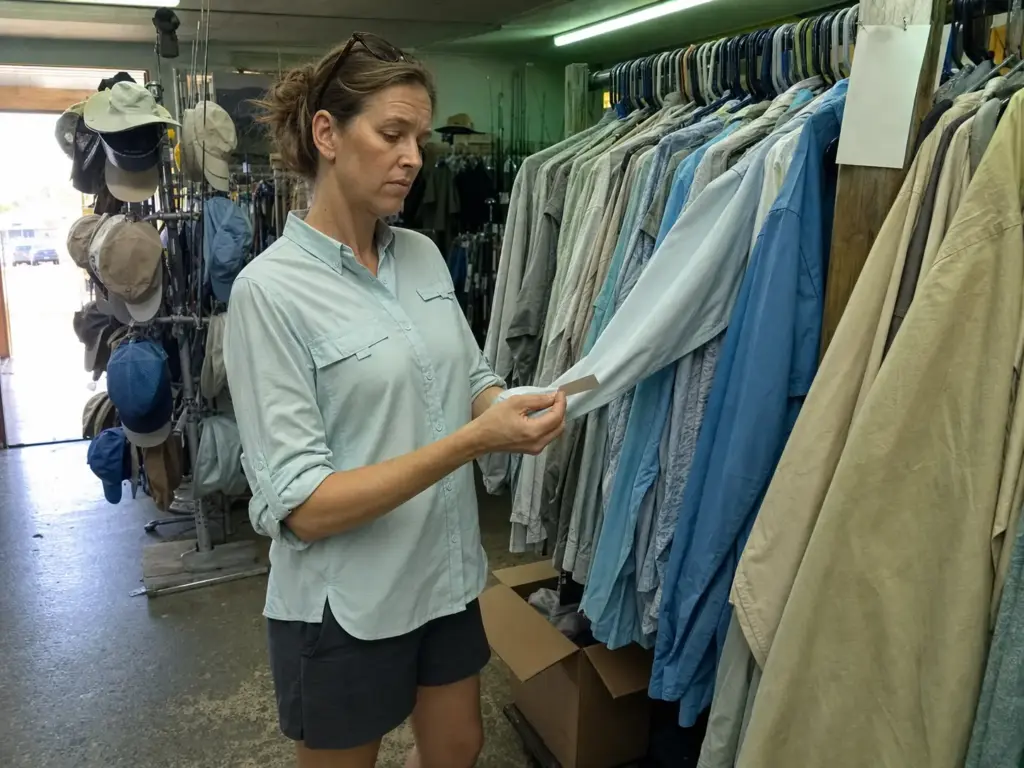
Quality sun shirts land in a fairly narrow band, roughly $30 to $90 for something that will hold up over a few seasons. Push past that band and you are usually paying for a brand name, a camo pattern, or a fabric with a trademark symbol after it. Here is what is inside that premium.
Phase change fabric is real physics. The material absorbs and releases latent heat as it shifts state, and in a thick jacket that capacity does meaningful work. In a four-ounce shirt the thermal mass is small and the effect is transient. In humidity, with continuous sweat production, ordinary evaporative cooling does far more. Verdict: real science, marginal shirt.
Antimicrobial and odor-control finishes work. They genuinely reduce smell between washes, and if you wear the same shirt three days running on a trip, you will notice. Two problems. It is a convenience feature rather than protection, and many of these are topical finishes, which means they degrade in the wash on exactly the schedule the UV finishes do. You are paying a premium for something with an expiration date nobody prints.
Camo is cosmetic. A fish is not evaluating your pattern from below the surface. The camo premium runs 20 to 40 percent across several lines and is the single easiest cut on this list.
Wash-count claims are the one to watch. “Maintains UPF 50+ through 100 washes” reads as reassurance and functions as an admission, for the reason covered above: inherent protection does not get measured in cycles.
One habit helps here: learn which trademark does which job. Columbia’s Omni-Shade, AFTCO’s AFBLOCK, and Simms’ SolarFlex are names for ultraviolet blocking, while Omni-Freeze Zero and AFTCO’s I.C.E. are names for cooling. They get printed on the same hangtag and they are not answering the same question.
Evaporative cooling, the family that includes Omni-Freeze Zero and I.C.E., is the exception that actually delivers. Owners of multiple pieces report the effect is noticeable and repeatable. The catch is the operating instruction the hangtag omits: it works wet. Dry, on a windless deck, you will not feel much of anything.
UPF 30 versus UPF 50 is the last one. That is 96 to 97 percent against 98 percent. Do not pay 40 percent more for a point and a half if the cheaper shirt covers more skin, fits better, or vents better. It is the same gap that shows up between what a fabric claim promises and what the fabric does once you are standing in it, and reading past the claim is a skill worth having across your whole kit.
Worth naming here: the AFTCO Samurai is the shirt the offshore forums bring up unprompted, and it is noticeably heavier than a HUK Icon X. That weight is a liability in July on a hot deck and an asset in cold spring water. Neither maintains a reliable Amazon listing, so neither is a pick below.
The strongest budget argument in this category comes from the forums, not from a brand. In one thread where premium shirts were being debated, several people who fish offshore for a living made the case for plain Hanes long sleeves bought by the pack, and nobody had a good rebuttal. Salt destroys clothing. Buying gear you are willing to destroy is a legitimate strategy.
Best UPF Fishing Shirts by Use Case
Six shirts, six different jobs. Every one has a live Amazon listing, and the reasoning for each traces back to something above rather than to a spec sheet. The selection logic ran in this order: inherent protection over topical finishes, seam geometry that survives a full casting stroke, ventilation that does something mechanical rather than adjectival, and coverage that accounts for light coming up off the water as well as down from the sky.
Best Vented Button-Down: Columbia PFG Tamiami II
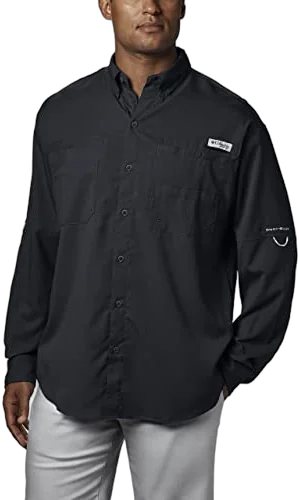
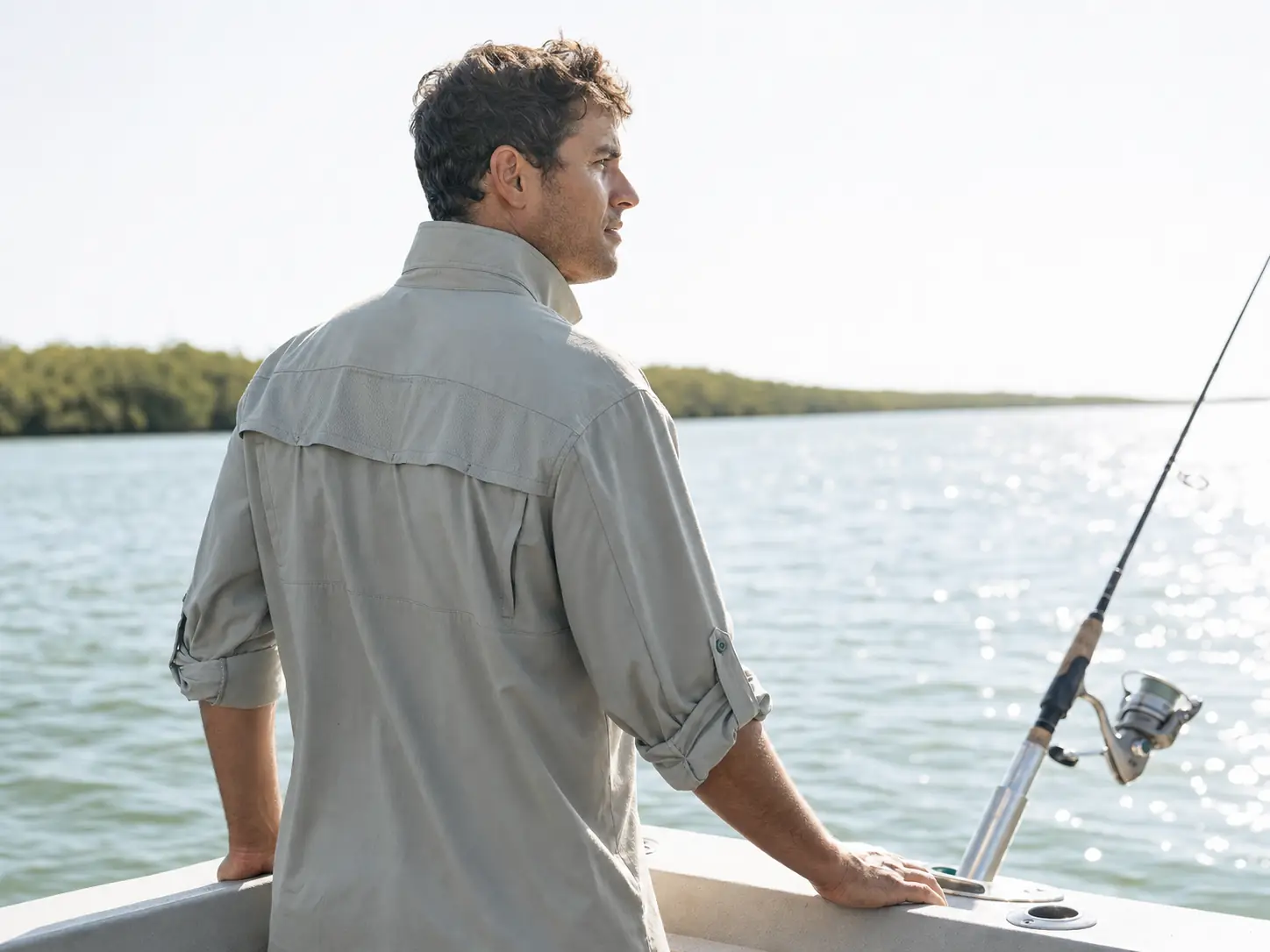
The Tamiami is the shirt for people who want a collar they can pop, pockets they can reach, and airflow that does not depend on the fabric being wet. Columbia’s Omni-Shade rating here is UPF 40 rather than 50, which by the math above costs you about one percentage point of transmission. The venting is worth more than that point on a still August afternoon.
Two honest caveats. The first is the button front, and it is disqualifying for anyone who throws a cast net, per the forum consensus above. The second is that a woven button-down has less stretch than a knit hoodie, so if your casting stroke is aggressive, run the overhead fitting-room test before committing. If you want the same open-air feel without buttons, the Hanes two-pack below is the cheap workaround.
Best for Hot, Humid Days: Free Fly Bamboo Shade Hoodie
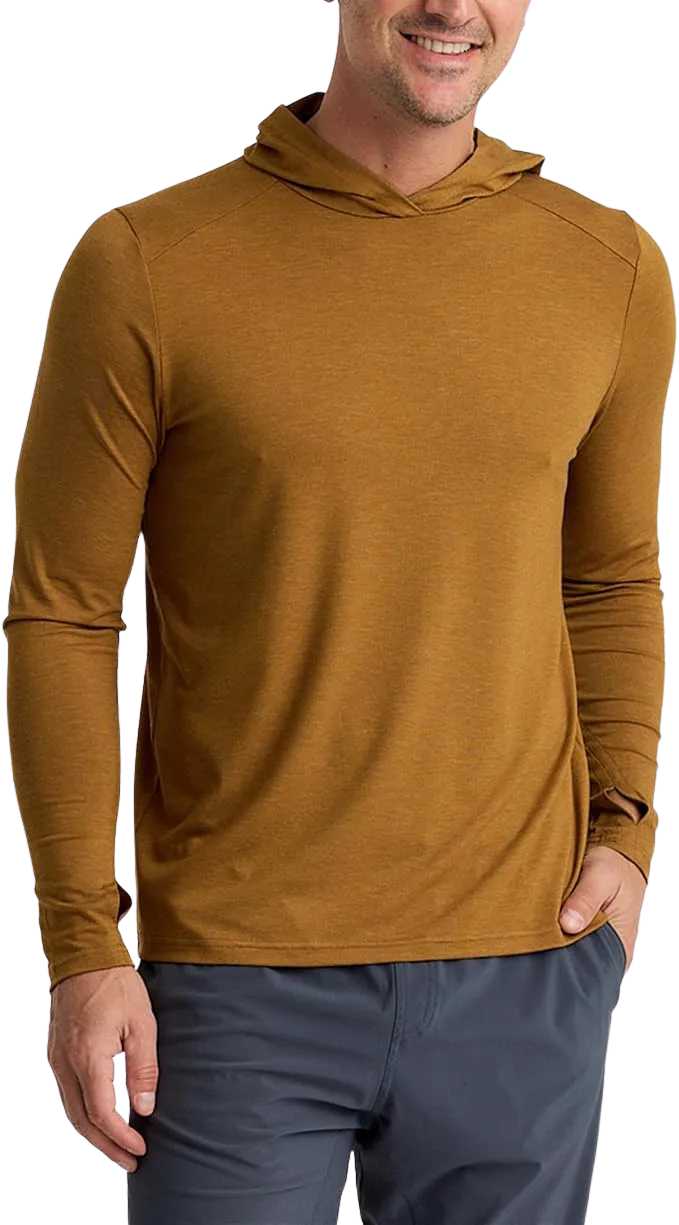
Straight polyester in high humidity has a specific failure mode: it stops wicking once it is saturated and then it sits on your skin. The bamboo-viscose portion of this blend has better moisture regain and a smoother hand, which is why people describe it as feeling less like gear and more like a shirt. That is the whole argument for paying more here.
The trade-off is that a natural-fiber blend is not as quick dry as a pure synthetic, so on a cold, breezy morning this is not the shirt you want soaked. It is a July and August specialist. If you fish shoulder seasons more than midsummer, the Crater Lake below is the better all-rounder, and the Baleaf hoodie gets you a similar silhouette for meaningfully less money.
Best Budget Hooded: Baleaf Sun Protection Hoodie
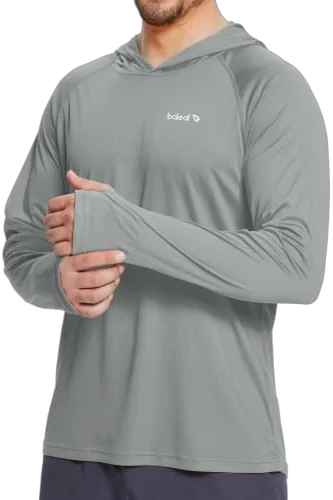
If you read the wash-degradation section and want the cheapest way to act on it, this is the shirt. The polyester-spandex construction sits squarely in the category described above as inherent by weave, which means the fifty-wash question mostly does not apply to it. That is a strange thing to be able to say about the least expensive hoodie on the list.
What you give up is refinement. The hood is functional rather than well-engineered, the fabric hand is unremarkable next to the Free Fly, and the sizing runs closer to athletic than relaxed, so size up if you like room. None of that changes what the shirt is for, which is covering skin reliably for a long time without anyone feeling bad when it eventually gets ruined.
Best for Casting Mobility: Mountain Hardwear Crater Lake Hoody
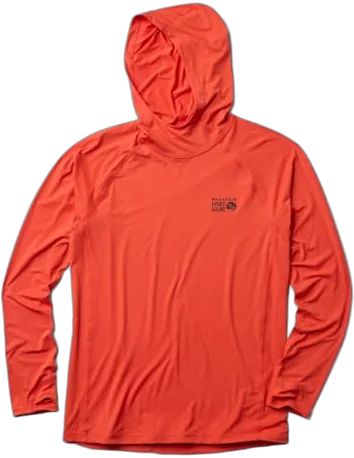
Run the arms-overhead test in this one and the difference is obvious. Because the shoulder seam sits below the joint, lifting your arms moves the sleeve without dragging the torso, and the hem stays roughly where you left it. The three-piece hood is shaped rather than folded flat, so it sits under a cap instead of bunching at the crown, which sounds like a trivial detail until you have worn one that does not.
Mountain Hardwear is a climbing brand rather than a fishing brand, which shows up in both directions. You get genuinely good pattern work and a low thumbhole placement designed for people who spend hours with their arms up. You do not get rod-specific pockets, a cast net consideration, or fishing-oriented colorways. For anyone who fly fishes or throws all day, that is a fair trade. The Baleaf is the alternative if the price is more than the mobility is worth to you.
Best Ultra-Budget: Hanes Cool DRI Long Sleeve, 2-Pack
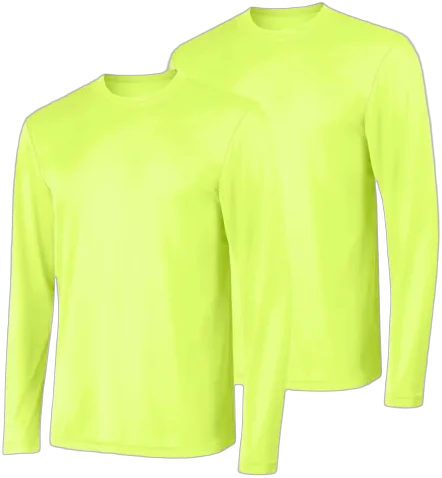
Nothing about this shirt is engineered for fishing. It is a plain crew neck with no hood, no thumbholes, no gusset, no vent, and no consideration given to a casting stroke. What there is, is a UPF 50+ rating on a plain polyester knit, in a two-pack, at a price where losing one to a hook tear or a fuel spill costs you nothing worth thinking about.
That is a legitimate strategy rather than a compromise. Salt, sun, and whatever comes off a fish you just cleaned destroy clothing on a schedule, and building a rotation of disposable shirts around one good one is how a lot of experienced people actually operate. Use these as your working shirts and save the Free Fly or the Crater Lake for the days that matter.
Best Women’s Fit: Outdoor Research Astroman Air Sun Hoodie
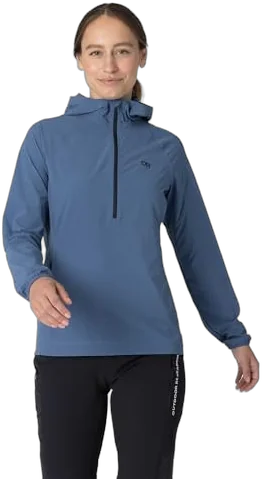
Most women’s sun shirt recommendations are a men’s shirt with a note attached, which is why this one gets its own slot. The pattern accounts for a different shoulder-to-hip ratio, and the sleeve length works without cuffs swallowing your hands, which matters more than it sounds when you are trying to use thumbholes.
Read the colorway before you buy. The rating spans UPF 30 to 50+ depending on the color, and the lightest options sit at the bottom of that range, which is a direct illustration of the color-and-weave point from the opening section. Pick a mid or dark tone and you get the full number. Pick the palest one because it looks cool and you have paid for a shirt in the 96 percent band.
How to Keep a Sun Shirt Working All Season
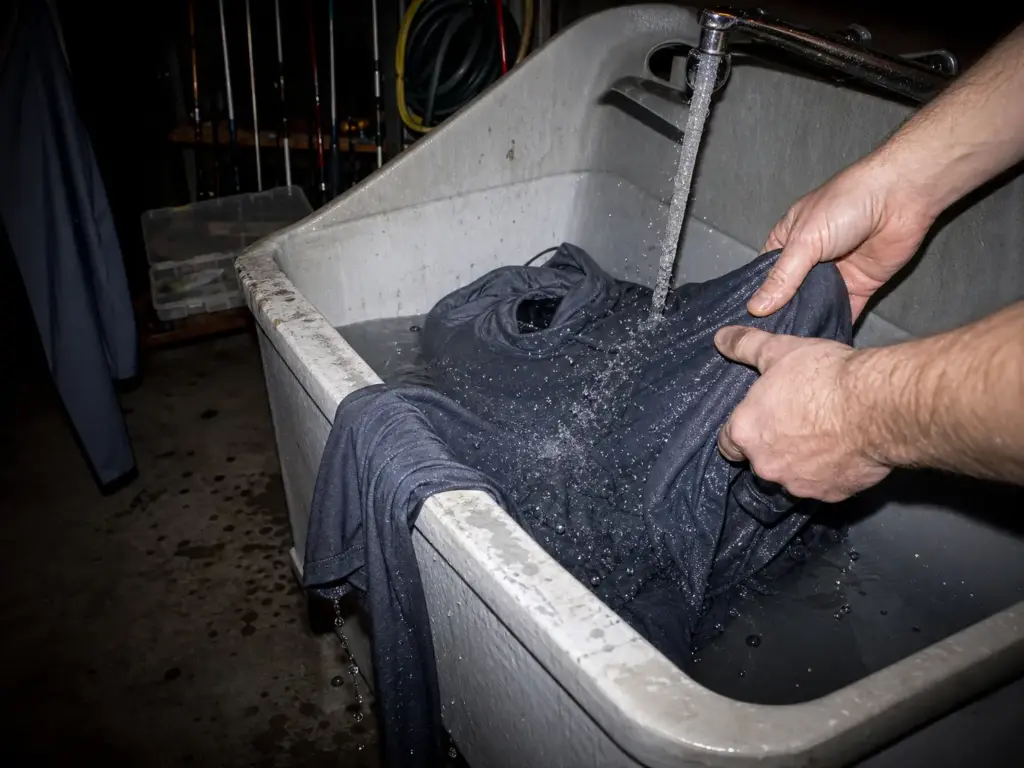
Nobody reads a care tag, and on a treated shirt that habit is the difference between three seasons and one. This is the cheapest performance you will ever buy back.
- Wash cold with a mild detergent. Hot water and high-alkalinity formulas strip topical finishes faster than anything else you do. Single highest-leverage habit on the list.
- Skip optical brighteners and enzyme detergents. Bright-whites formulas are actively hostile to a UV coating. The irony is that optical brighteners built into a fresh garment can raise its rating slightly, while the detergent version chews the coating off over time.
- Rinse the salt out the same day. Dried salt crystals abrade fibers between washes, and the salt, sun, and wash sequence is what finishes off a saltwater shirt. It is the same freshwater rinse that keeps salt from chewing through waders, applied to a lighter garment.
- Air dry. Machine heat accelerates finish breakdown and cooks the elastane that holds a tight weave tight. A shirt that has lost its stretch has also lost some of its rating.
- Know when it is finished. Hold it to a bulb again. If the weave has opened up since you bought it, or the shoulders have gone thin and translucent, that shirt is a layer now. On an inherent-weave shirt this takes years. On a treated one it can take a single hard season.
Conclusion
The tag gives you a number. The spec sheet tells you whether the number survives, so read for the words inherent and tightly woven, and treat any promise about wash counts as an admission rather than a feature.
Water throws a quarter to a third of the ultraviolet load back up at you, so buy for the surfaces that face down. Chin, forearms, and the backs of your hands burn on days your shoulders never do.
The shirt you actually wear beats the expensive one hanging in the closet. Fit, venting, and coverage decide which one you reach for, and not one of those three is printed on a hangtag.
Before your next trip, take whatever sun shirt you already own and hold it up to a light bulb. That thirty-second check tells you more about what you are wearing than the tag ever did, and it tells you whether you are actually shopping or just curious.
Frequently Asked Questions
01What is the best UV shirt for fishing?
It depends on how you fish: the Columbia PFG Tamiami II for a vented button-down, the Free Fly Bamboo Shade Hoodie for heat, the Baleaf hoodie on a budget. The criterion that outranks brand is whether the protection comes from the weave or from a coating.
02Do UPF shirts actually work?
Yes. A UPF 50 shirt blocks about 98 percent of ultraviolet light, against roughly UPF 7 for a white cotton tee and UPF 3 once that tee is wet. The caveat is durability: they keep working only if the protection lives in the fabric rather than in a finish that launders off.
03What shirts are sun safe for fishing?
Long-sleeve, tightly woven polyester or polyester-spandex, mid to dark in color, at least 4 oz per square yard, ideally tested to AATCC 183. Loose-weave cotton, pale colors, and any fabric you can see the weave through against a light bulb do not qualify.
04Is Coolibar or Solbari better?
Both build to certified UPF 50+, so the protection difference is negligible. For anglers the real split is cut and hood design rather than rating. Neither maintains a reliable Amazon presence, which is why neither appears as a linked pick above.
05How long does UPF protection last in a fishing shirt?
It depends entirely on which kind you bought. Premium topical finishes are engineered for 40 to 50 washes and cheap ones fade at 10 to 20. In a 50-cycle study, two of seven shirts lost 70 to 78 percent of their rating while five held steady, because their protection came from the weave.
Risk Disclaimer: Fishing, boating, and all related outdoor activities involve inherent risks that
can lead to injury. The information provided on Master Fishing Mag is for educational and informational purposes
only. While we strive for accuracy, the information, techniques, and advice on gear and safety are not a substitute
for your own best judgment, local knowledge, and adherence to official regulations. Fishing regulations, including
seasons, size limits, and species restrictions, change frequently and vary by location. Always consult the latest
official regulations from your local fish and wildlife agency before heading out. Proper handling of hooks, knives,
and other sharp equipment is essential for safety. Furthermore, be aware of local fish consumption advisories. By
using this website, you agree that you are solely responsible for your own safety and for complying with all
applicable laws. Any reliance you place on our content is strictly at your own risk. Master Fishing Mag and its
authors will not be held liable for any injury, damage, or loss sustained in connection with the use of the
information herein.
Affiliate Disclosure: We are a participant in the Amazon Services LLC Associates Program, an
affiliate advertising program designed to provide a means for us to earn advertising fees by advertising and linking
to Amazon.com. As an Amazon Associate, we earn from qualifying purchases. We also participate in other affiliate
programs and may receive a commission on products purchased through our links, at no extra cost to you. Additional
terms are found in the terms of service.