In this article
The water at Sheldon Lake was knee-deep on the shallowest flat, frogs cranking behind us in the dark, and I had a bowfin on 50-pound braid folding my frog rod in half against a wall of hydrilla. That was the moment I stopped thinking of Houston as a city and started thinking of it as a fishery. One that stretches from polluted bayous to a 90,000-acre reservoir where white bass run thick enough to turn the birds sideways.
After two decades fishing every water type within a hundred miles of the 610 Loop, the challenge is never finding water. It’s knowing which water matches the species, the access, and the risk you’re willing to take. This guide breaks it all down by ecosystem type so you can match gear and expectations to the right water before you leave the driveway.
⚡ Quick Answer: Houston sits at the intersection of five distinct water types, each holding different species and requiring different approaches. Freshwater reservoirs like Lake Conroe and Lake Livingston produce bass and catfish with full boat ramp access. Lake Fayette, a power plant cooling reservoir 110 miles out, holds trophy bass year-round thanks to higher water temperatures. Urban bayous like Buffalo Bayou and Sheldon Lake offer free bank access but carry serious toxicity advisories. Galveston Bay delivers world-class redfish and speckled trout fishing across 22,760 acres of oyster reef. Pick your water type first, then plan the trip.
How Houston’s Water Types Shape Your Fishing
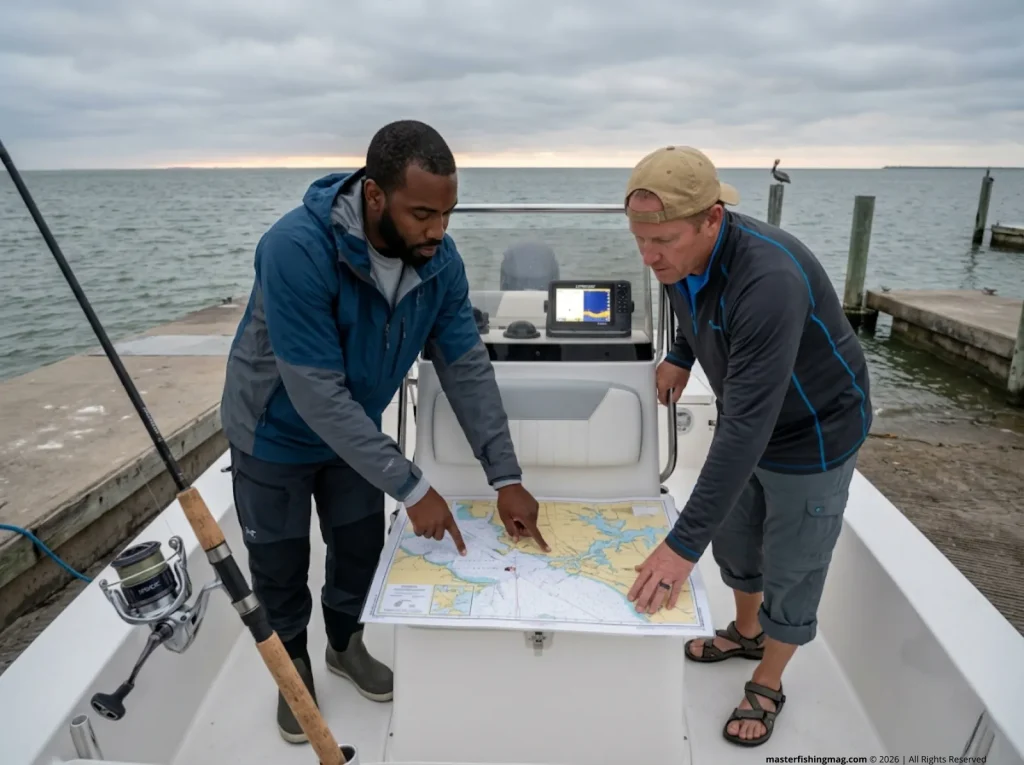
Freshwater Reservoirs vs. Coastal Estuaries vs. Urban Bayous
Houston sits where the Post Oak Savannah meets the Gulf Coastal Plains, creating a mix of freshwater reservoirs, brackish estuaries, and urban fluvial systems all within a two-hour drive. Each behaves differently and demands different tackle.
Freshwater reservoirs like Lake Conroe and Lake Livingston are structure-oriented fisheries with public boat ramps and stocking programs. Galveston Bay is Texas’ largest estuary at roughly 1,600 square kilometers, driven by a salinity gradient from the Trinity Delta to the Gulf passes. Urban bayous like Buffalo Bayou and the San Jacinto River are a different animal. Surface roughness, not depth, determines where ambush predators hold, and toxicity advisories mean you’re fishing catch-and-release whether you planned to or not.
Pro tip: Most guys pick water by distance. Pick it by species and structure instead. You’ll drive 20 extra minutes and catch three times the fish.
The Comparison Matrix: Matching Water to Your Weekend
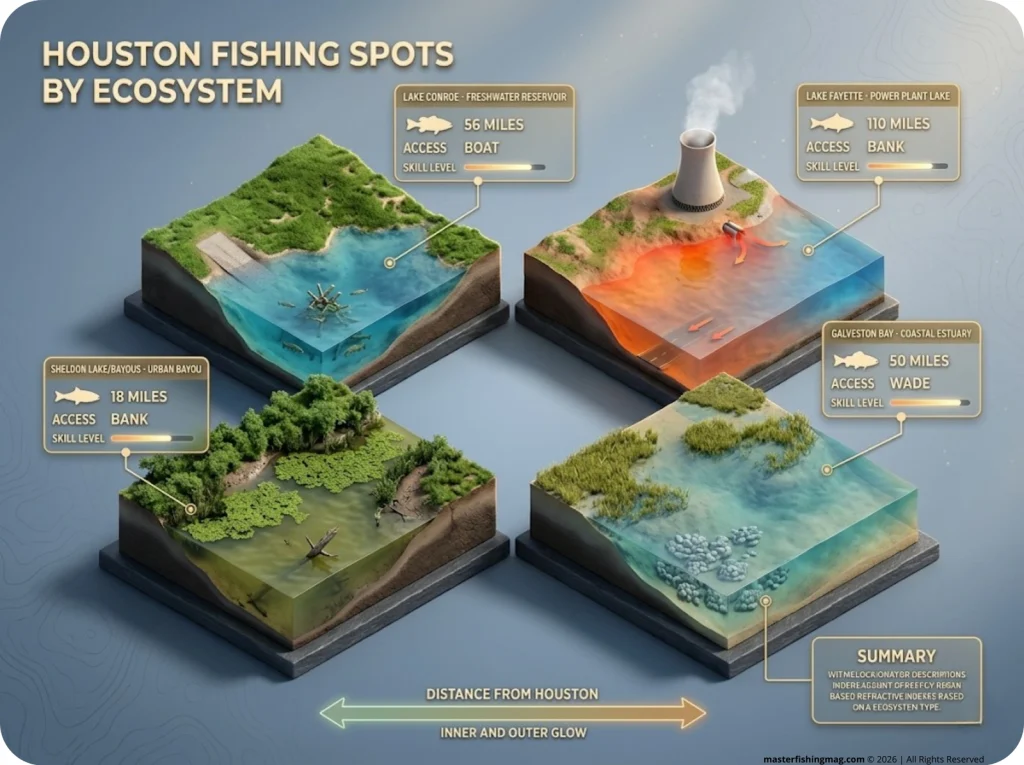
Here’s the side-by-side breakdown sorted by the five things that actually matter. Distance from Houston, water type, target species, access type, and skill level.
Lake Conroe: 56 miles, freshwater, largemouth bass and hybrid striped bass, full boat ramp access, intermediate. Sheldon Lake: 18 miles, freshwater wetland, bowfin and bass, free bank access, no fishing license required. Galveston Bay: 50 miles, estuarine/brackish, speckled trout and redfish, boat/kayak/wade, intermediate to expert. Lake Fayette: 110 miles, power plant cooling reservoir, trophy bass year-round, boat-only, experienced anglers.
The framework for choosing a fishing spot based on ecosystem analysis applies directly to every waterway on this list.
Inland Reservoirs — Where Structure and Stocking Programs Win
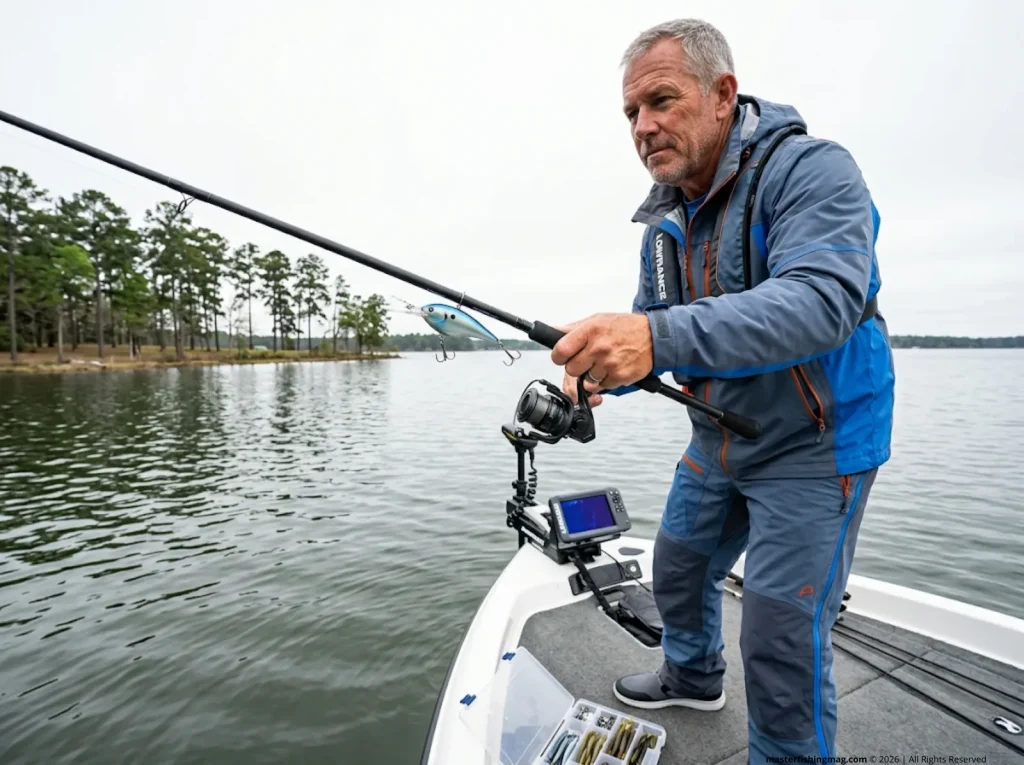
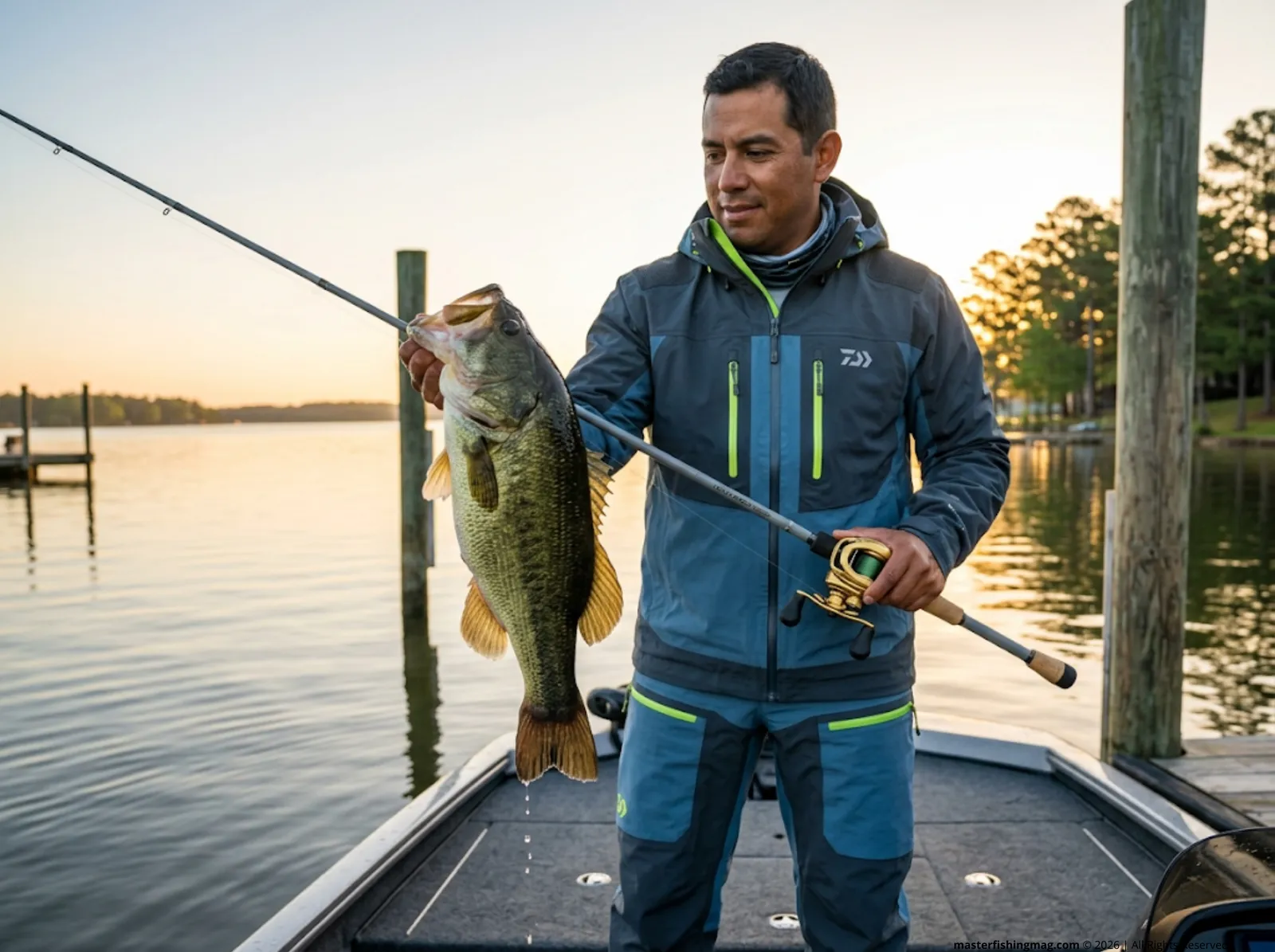
Lake Conroe: Florida-Strain Bass and the 14 Man-Made Reefs
Lake Conroe covers 20,118 acres, impounded in 1973, max depth around 79 feet. Primary forage base is Gizzard Shad, Bluegill, and Longear Sunfish.
TPWD stocks Florida Largemouth Bass annually for superior growth genetics. The lake record stands at 15.93 pounds (2009), and Toyota ShareLunker entries exceeding 13 pounds show up regularly.
The key is the 14 man-made reef sites. These structures function as energy hubs where prey congregates, cutting the foraging cost for bass. You need precise electronics to identify the transition from flat silty bottom to high-profile vertical structure. For the technical breakdown, fishing structure points and humps with sonar covers the exact approach.
Seasonal patterns run predictable. Early spring means Chatterbaits and lipless cranks on pre-spawn flats in 2-4 feet. Summer pushes bass deep; dropshot and vertical jigging at 15-20 feet on the thermal strata. Fall triggers schooling on forage shad chasing cooler inflows. Winter loads them into deep creek channels where slow jig presentations produce.
Pro tip: Skip the featureless southern shorelines. The Caney Creek arm on the Sam Houston National Forest side holds the best cover. Five miles of restored native vegetation, and most weekday anglers never run that far.
Lake Livingston: White Bass Runs and the Turbid Water Challenge
Lake Livingston runs between 83,000 and 90,000 acres, average depth 23 feet, mirroring Trinity River discharge through 12 tainter gates. Turbid, highly eutrophic, and the levels swing fast during heavy rain.
This is the premier White Bass fishery in the Houston region. Every spring, these fish push up Trinity River tributaries to spawn. TPWD gill net data showed a 20-year low in 2025, but angler catch rates remain productive for those matching Threadfin Shad with small spinners and jigs. For the jigging spoon tactics that work during surface boils, catching schooling white bass during surface boils covers the full system. The Trinity River’s flow-through dynamics are well documented in the USGS hydrodynamic model of Lake Houston residence time.
Largemouth recruitment suffers from siltation smothering spawning beds. The Friends of Lake Livingston (FoLL) propagate water willow (Justicia americana) to stabilize shorelines and create nursery habitat. Those water willow patches are the most reliable sign of biological activity in an otherwise featureless, muddy environment.
Blue catfish dominate, with commercial harvest allowed under 14 inches. The alligator gar record sits at 207 pounds (2018), and that fishery runs strictly catch-and-release.
The Power-Plant Advantage — Lake Fayette’s Thermal Microclimates
How Discharge Canal Temperatures Keep Bass Active Year-Round
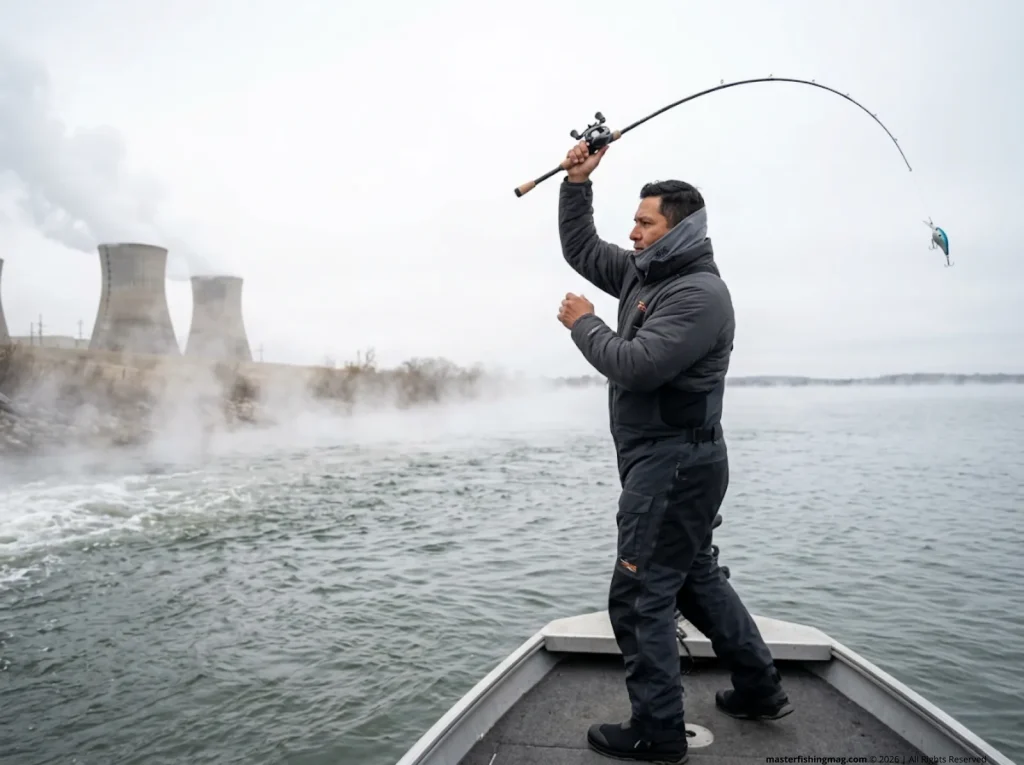
Fayette County Reservoir is only 2,400 acres, impounded in 1978, but it punches above its weight. The lake functions as a cooling pond for steam-electric power generation, creating a thermal microclimate unlike anything else near Houston.
In a typical southern reservoir during winter, water temperature drops into the 40s and bass go semi-dormant. At Fayette, the discharge canal runs in the mid-90s or higher. Bass stay in a high-metabolic feeding state, hammering shad that stack against the discharge current. Capt. Pete Dodge: “The power plant raises the water temperature and keeps bass active in winter. Find the shad, and you’ll find the bass.”
Think in thermal zones. Discharge canal at 90-100°F demands high-speed crankbaits. Canal edges at 80-90°F produce on topwater and swim jigs. Main lake points at 70-80°F are Carolina rig territory. Remote coves at 60-70°F fish best with a Texas rig. The strategy for winter fishing near warm water discharges covers the broader pattern.
Submerged Roadbeds and the Carolina Rig Working Angle
Primary structure is submerged roadbeds and old tank dams that serve as travel routes between thermal zones. Heavy Carolina rigs with 1-oz tungsten weights maintain bottom contact. The go-to trailer is a centipede-style “French fry” soft plastic or a lizard. Both outperform standard worms here.
Side-scan sonar is not optional. The roadbed slope determines your crankbait dive angle, and a Strike King 6XD hits the right depth on the break. Most competitors mention crankbaits generically without explaining why dive angle matters on angled structure.

Urban Bayous — Current Seams, Bowfin, and Toxicity Warnings
Manning’s n and Where Ambush Predators Hold
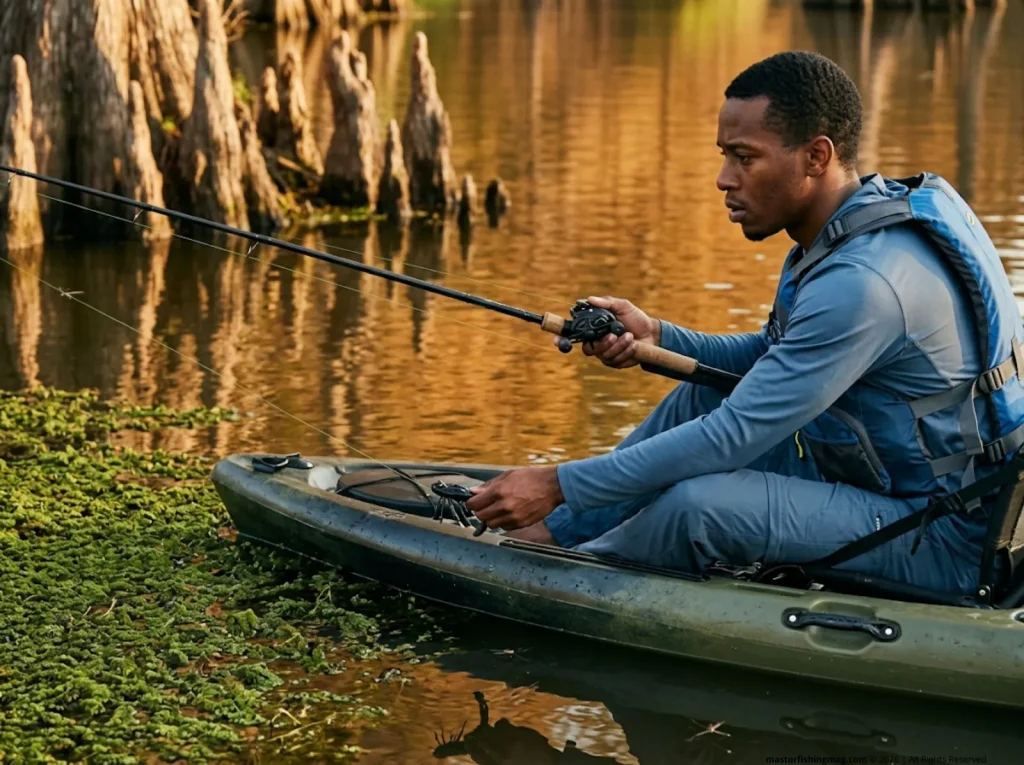
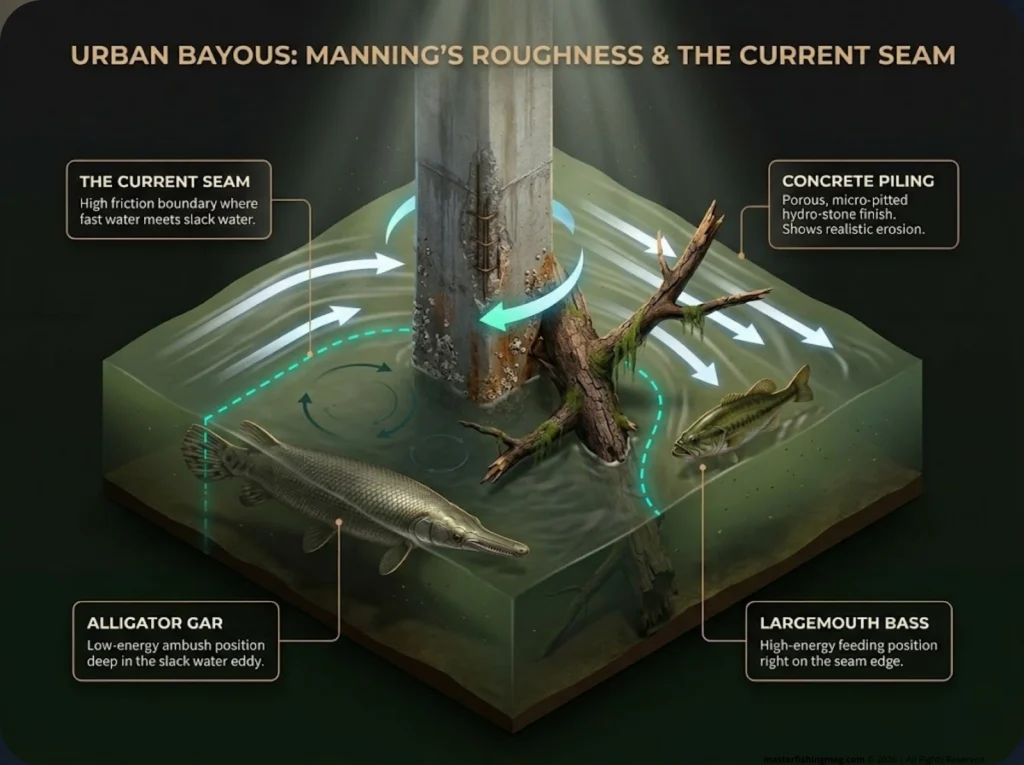
Houston’s bayous are fluvial systems where surface roughness dictates water speed and ambush positioning. The concept is captured by Manning’s roughness coefficient, which quantifies how much friction a channel bed creates. In practice, it’s simpler than it sounds: rougher bottom and more structure means slower water and more places for predators to hide.
Clean, straight concrete channels have minimal roughness. No eddies, no ambush refuge. Fish use these as highways, not homes. Earth-bed winding channels with moderate roughness create stable eddies and consistent largemouth bass habitat. Heavy timber and weedy zones with high roughness? That’s prime alligator gar territory. These fish sit in the slack water behind bridge pilings and fallen trees, conserving energy while striking prey swept past on the current seam.
Sheldon Lake State Park is the standout. Mean depth 3 feet, max depth 10-20 feet. An unusual fishery for bowfin (Amia calva) and grass pickerel that draws fly anglers throwing “meat whistle” flies. Entry is free, no fishing license required for park-based fishing, and you’ll need minimum 50-pound braid when frog fishing the heavy hydrilla slop. Alligators are active here and at Brazos Bend, so maintain at least 30 feet of distance.
Fish You Shouldn’t Eat: The Ship Channel Toxicity Map
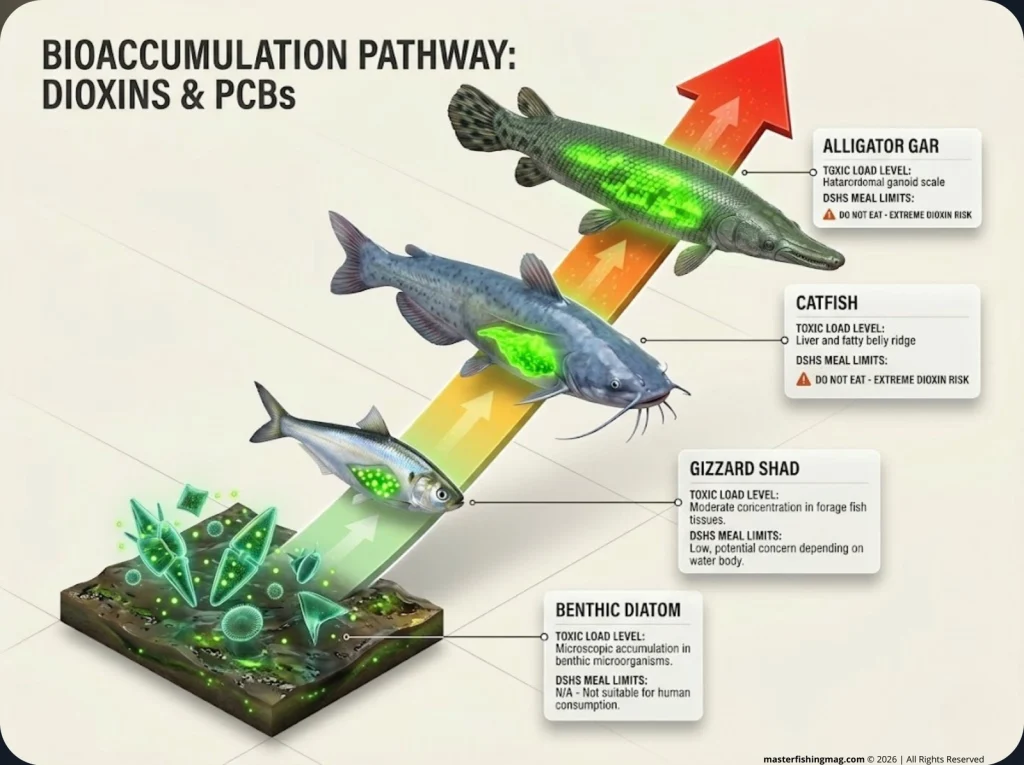
This matters more than any lure recommendation. The San Jacinto River Waste Pits introduced significant levels of Dioxins and PCBs into the bayou system. These chemicals are fat-soluble and persistent. They enter the food chain through algae and bottom-dwelling organisms, concentrate as they climb the food chain, and reach their highest levels in long-lived, fatty fish.
All species in the Houston Ship Channel and contiguous waters are under a DO NOT EAT advisory for women and children due to PCBs and Dioxins. Upper Galveston Bay catfish carry a DSHS meal limit of 8 ounces per month. Alligator gar and blue catfish carry the highest toxic load because they’re big, old, and fatty. Leaner species like bass and white bass fall in the moderate risk range.
Dr. Loren Raun, Chief Environmental Science Officer at the Houston Health Department, put it bluntly: “It is not safe to eat fish out of Brays Bayou. Fish in the ship channel swim into the bayous. Those cause cancer.” You can verify the full list of Texas fish consumption bans and health advisories through TPWD’s Outdoor Annual.
Catch-and-release practices are always safe in advisory waters. But if you keep fish from these areas, remove the skin and all dark fatty tissue, then bake or broil to let the contaminated oils drain. And once you’ve released a fish, handle it right. The protocols for science-based catch and release techniques apply everywhere, but they’re mandatory here.
Pro tip: Assuming a fish is safe to eat because it looks healthy and the water looks clear is the most common mistake an angler makes near Houston. Check the advisory first. Every time.
Galveston Bay — Reading the Salinity Gradient for Specks and Reds
How Freshwater Inflows Move the Salt Wedge and the Fish
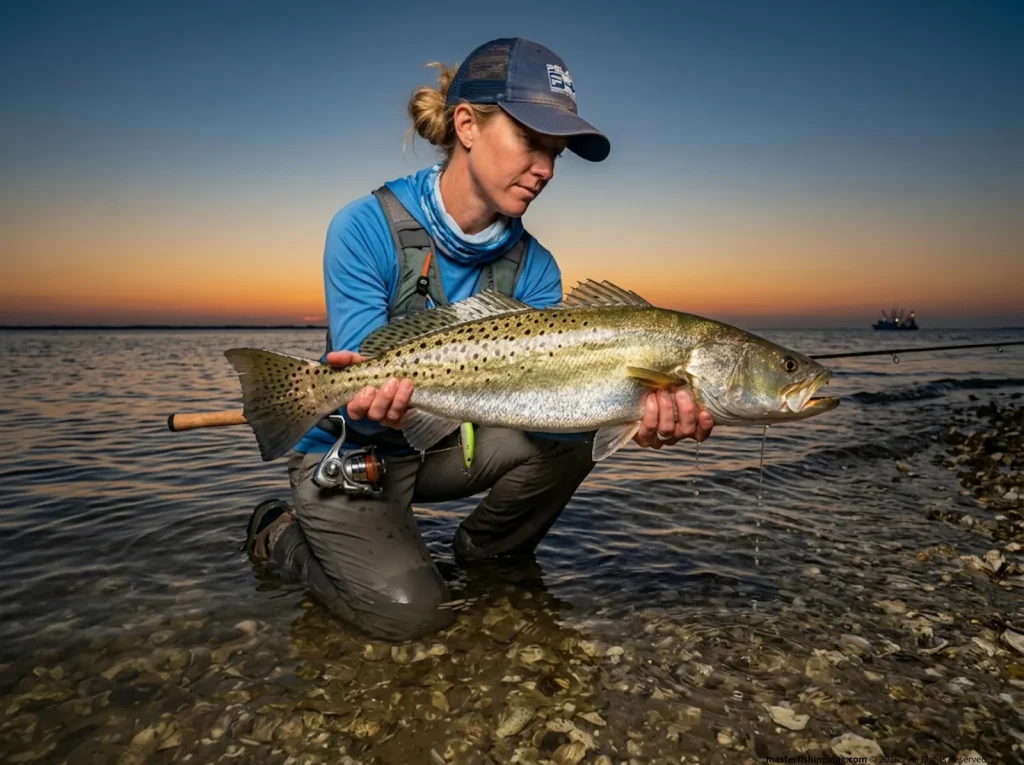
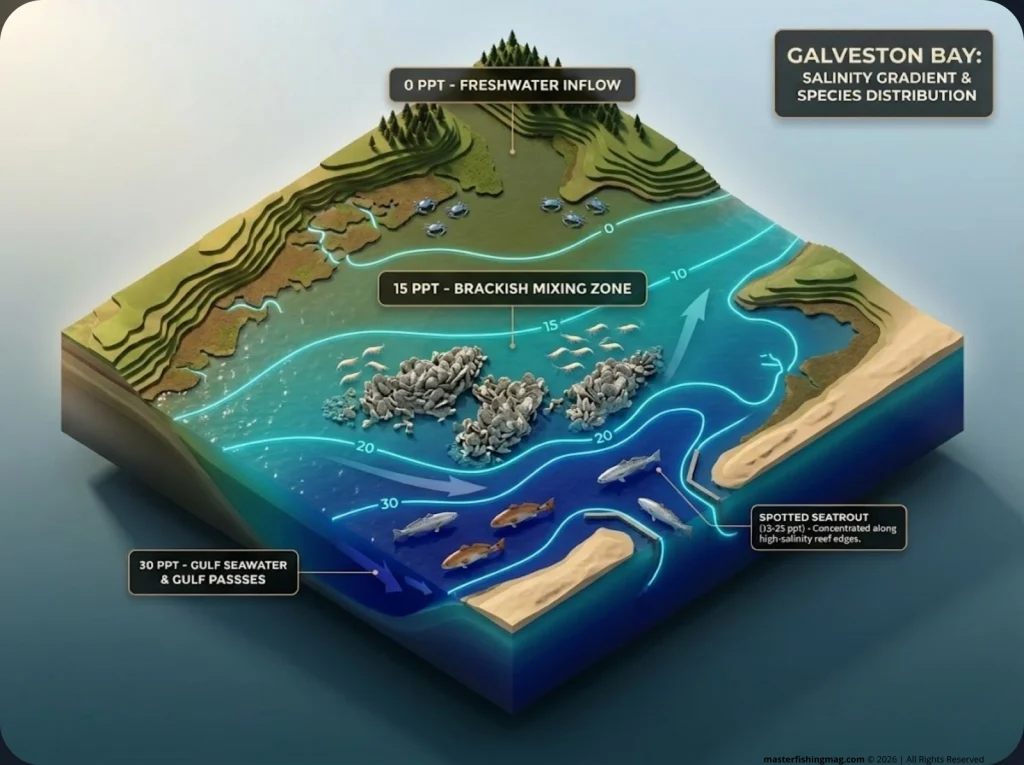
Galveston Bay is a positive estuary receiving enough freshwater from the Trinity and San Jacinto Rivers to maintain a distinct salinity gradient. That gradient runs from 0 ppt at the Trinity Delta to 30 ppt at the Gulf passes. Species sort themselves along that line: Blue Crab at 0-15 ppt, White Shrimp at 10-15 ppt, Spotted Seatrout at 15-25 ppt, Eastern Oyster at 10-20 ppt.
The targeting zone is the salt wedge, where saline Gulf water slides under the lighter freshwater layer. During high inflows, the wedge pushes downbay, concentrating specks near jetties and reefs. During drought, hypersaline conditions creep upbay. Hurricane Harvey dropped salinities to near zero, wiping out oysters on a massive scale. The guide to brackish water fishing tactics for estuarine environments covers how these shifts affect your approach.
Oyster Reefs as Fish-Holding Structure
The bay holds 22,760 acres of public oyster reef. Oysters filter up to 50 gallons of water per day, improving clarity and supporting the entire inshore food web.
Software like Reef Recon lets you visualize transitions between mud, shell rake, and solid reef. In high current, redfish and speckled trout stack on the down-current side where the structure creates a pocket of slower water. Skip the obvious crowded reefs. The subtle substrate transitions most anglers ignore are where the fish are.
Gator Trout: Why the Big Ones Need Different Handling
Gator trout are Spotted Seatrout exceeding 27-30 inches, almost exclusively female. They produce exponentially more eggs than younger fish. Harvesting a 30-inch sow trout removes more reproductive capacity than keeping a dozen 16-inchers.
These fish are extremely susceptible to handling stress. In water above 80°F where oxygen is thin, survival after a hard fight gets precarious. Capt. Wayne Davis: “If we net ’em, we get the hooks out and keep them in the water. Handle them less. They’re old fish, they can’t be beat up.”
Handling protocol is non-negotiable: wet hands only, horizontal support, rubber-mesh nets, and a figure-8 revival motion until the fish kicks away. The Release Over 20 initiative and sow trout conservation promotes keeping mid-sized fish and releasing the breeders.
Gear, Licensing, and the Logistics Most Guides Skip
TPWD Licensing and Regulations You Actually Need to Know
Every angler 17 or older needs a valid fishing license through the TPWD Outdoor Annual. Freshwater, saltwater, and combo packages are available, with non-resident options. Bag and length limits vary by lake and species. Largemouth bass slot limits change lake to lake and require checking individual sticker regulations for Conroe, Livingston, and Fayette. Red Drum carry a 3-fish daily bag with a 20-28 inch slot. Spotted Seatrout get a 5-fish daily bag with a 15-inch minimum.
TPWD stocked 26,622,193 fish statewide in 2024. Knowing which lakes are stocked with Florida genetics versus wild-managed fisheries sets realistic expectations before you launch. For kayak anglers looking at saltwater combo setups and planning a bay trip, the rundown of kayak fishing spots along the Texas coast covers the access points and species you’ll encounter.
Saltwater Gear That Survives Houston Humidity
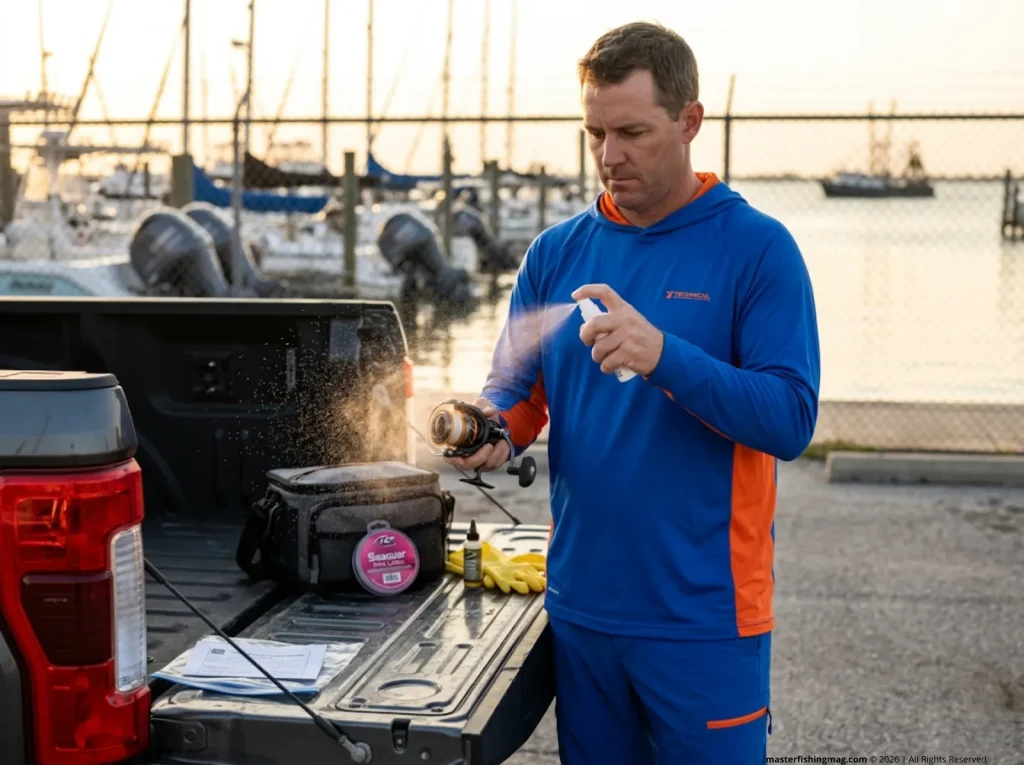
“Saltwater-ready” is a marketing term. Most reels marketed that way are not actually waterproof, and the maintenance mistake most people make is rinsing with a high-pressure hose. That drives salt crystals past the seals and into the drivetrain. Mist them. Then stand the reel on its handle overnight and let gravity do the work.
The Daiwa Revros 3000H gives you 8 bearings and sturdy alignment, but it’s not fully sealed and requires diligent misting after every trip. The Okuma Startus 7 is a budget workhorse for crabbing but lacks the refinement for finesse inshore work. The Laguna-5Bi comes in at $39 and fails immediately if fully submerged. The honest answer is that mag-sealed bearings or high-grade stainless steel components are the only reliable defenses against galvanic corrosion in Houston’s humidity.
Pro tip: Rinsing saltwater reels with high-pressure hoses just drives the salt deeper into the gears. Mist them with a spray bottle. Then stand them handle-down overnight. That single habit will double the life of a budget reel.
Conclusion
Three things to take away from this guide.
First, pick water by ecosystem, not just by distance. A 20-minute drive to the wrong water type wastes more time than a 90-minute drive to the right one. Second, check toxicity advisories before you keep anything. Houston’s bayous produce great fights but carry real health risks. The DSHS consumption advisories are not optional reading. Third, handle big fish like the irreplaceable breeders they are. Wet hands, horizontal support, rubber nets, and minimal air exposure. The 30-inch gator trout that swims away is worth more to every angler than the one on the stringer.
Next time you’ve got a free Saturday morning, skip the “nearest lake” habit. Pull up this guide, match a water type to your gear, and target a species you’ve never chased from a piece of structure you’ve never fished. That’s how you stop putting in hours and start putting fish in the net.
FAQ
Do you need a fishing license to fish in Houston?
Yes. Any angler 17 or older needs a valid Texas fishing license, available through the TPWD Outdoor Annual. The one exception is Sheldon Lake State Park, a designated Community Fishing Lake where no license is required for park-based fishing.
Can you eat the fish out of Houston bayous?
It depends on the species and the specific waterway. All fish in the Houston Ship Channel and contiguous bayous, including Brays Bayou, are under DSHS consumption advisories for PCBs and Dioxins. Catch-and-release is always safe. If you keep fish from advisory areas, remove the skin and dark fatty tissue, then bake or broil to let the contaminated oils drain.
Where is the best place to catch bass near Houston?
Lake Conroe is the premier largemouth bass fishery within a two-hour radius, thanks to annual Florida-strain stockings and 14 man-made reef sites. Lake Fayette offers trophy-class bass year-round due to higher water temperatures from the power plant discharge, but it’s a longer drive at roughly 110 miles.
Are there free fishing spots near Houston?
Sheldon Lake State Park offers free entry and no fishing license requirement. Tom Bass Regional Park and Mary Jo Peckham Park provide free bank access with a valid state license. Buffalo Bayou gives you miles of public bank access in the city center, though all fish should be released due to toxicity advisories.
What is the best time of year to fish Galveston Bay?
Fall, September through November. Cooling water temperatures push speckled trout and redfish onto the flats and reef edges in predictable patterns. The Texas Slam of redfish, trout, and flounder in one day is most achievable during the fall mullet run.
Risk Disclaimer: Fishing, boating, and all related outdoor activities involve inherent risks that
can lead to injury. The information provided on Master Fishing Mag is for educational and informational purposes
only. While we strive for accuracy, the information, techniques, and advice on gear and safety are not a substitute
for your own best judgment, local knowledge, and adherence to official regulations. Fishing regulations, including
seasons, size limits, and species restrictions, change frequently and vary by location. Always consult the latest
official regulations from your local fish and wildlife agency before heading out. Proper handling of hooks, knives,
and other sharp equipment is essential for safety. Furthermore, be aware of local fish consumption advisories. By
using this website, you agree that you are solely responsible for your own safety and for complying with all
applicable laws. Any reliance you place on our content is strictly at your own risk. Master Fishing Mag and its
authors will not be held liable for any injury, damage, or loss sustained in connection with the use of the
information herein.
Affiliate Disclosure: We are a participant in the Amazon Services LLC Associates Program, an
affiliate advertising program designed to provide a means for us to earn advertising fees by advertising and linking
to Amazon.com. As an Amazon Associate, we earn from qualifying purchases. We also participate in other affiliate
programs and may receive a commission on products purchased through our links, at no extra cost to you. Additional
terms are found in the terms of service.