
In this article
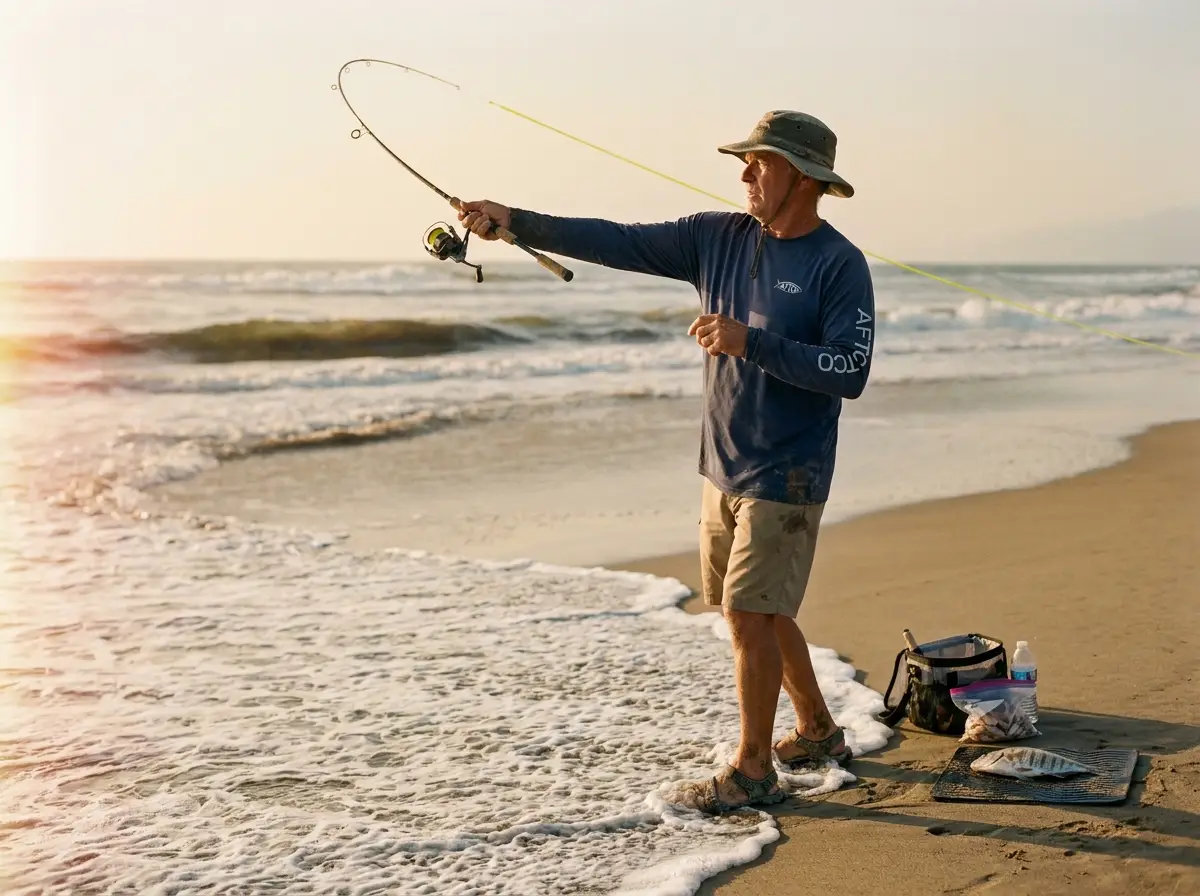
The first time you drive to a California beach to catch surfperch, it doesn’t feel like fishing — it feels like guessing. You pick a stretch of sand that looks as good as any other, make a cast into the breakers, and wait. Nothing. The angler two hundred yards down the beach is landing fish every few minutes, and the water between you looks identical.
It’s not random. They found the trough.
Surfperch are among the most accessible fish on the Pacific coast — no boat, no charter, no elaborate rig required. They’re abundant from March through July along beaches in California, Oregon, and Washington, and they’ll eat simple baits on simple gear. But “simple gear” is where most guides stop, and it’s where most anglers stay stuck. Knowing where surfperch hold, how to read a beach before your first cast, and when to move rather than wait is what separates people who catch fish consistently from people who drive home empty-handed.
Quick Answer: To catch surfperch from shore, arrive during the incoming tide — within an hour of high tide is prime — and cast into the trough between the first and second wave lines. Use a Carolina rig with a 3/4- to 1-ounce egg sinker and size 4 or 6 hook on a 20-to-30-inch fluorocarbon leader. In summer, use fresh sand crabs; in winter, switch to Berkley Gulp! 2-inch Sandworms in camo. Keep moving every six to eight casts if you’re not getting bit.
Where Surfperch Actually Hold in the Surf Zone
Surfperch (family Embiotocidae) are not random. They’re structure-dependent feeders that hold in predictable locations whenever current, water clarity, and bait availability cooperate. Understanding that structure is what the whole approach is built on.
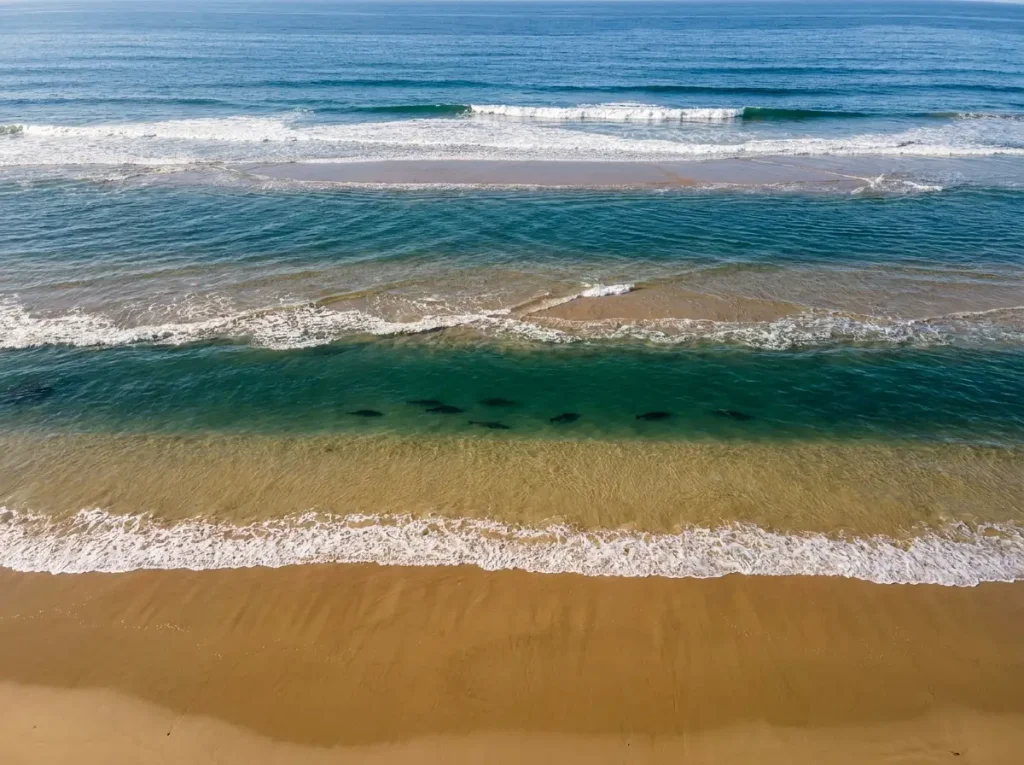
The primary holding area on any surf beach is the trough — a long, relatively calm depression in the sand that runs parallel to the shore, positioned between two lines of breaking waves. Waves break on the outer sandbar, reform, and break again on the inner bar closest to shore. Between those two breaking points there’s a zone of slower, deeper water. That’s the trough.
Surfperch hold along the bottom of that trough, using the depth for cover and letting wave action wash food — sand crabs, marine worms, small crustaceans — down to them from both sides.
Secondary holding areas include any visible dark patch of water (dark means deeper), holes or depressions you can spot from shore, the seams where rocky or cobble structure meets sandy bottom, and the downstream side of jetties and pier pilings where current concentrates bait.
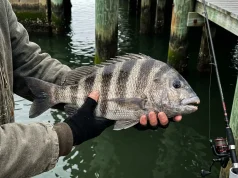
The most common surfperch you’ll encounter depends on where you’re fishing. Along California beaches south of Santa Barbara, barred surfperch (Amphistichus argenteus) dominate the surf zone. Move north through central and northern California and into Oregon and Washington and redtail surfperch (Amphistichus rhodoterus) become the primary target.
The Oregon Department of Fish and Wildlife documents nine surfperch species along the Oregon coast alone, with fish reaching up to 2 pounds and schools holding within 30 feet of shore during peak season. Both species behave similarly — they school loosely, feed near the bottom, and are most active during the spring and early summer spawning period.
A Quick Word on Scouting Before You Rig Up
Before you even open the tailgate, look at the water from the parking lot or the top of the dune access. On a calm day, surfperch structure is readable from a distance: darker water marks the trough, white foam marks the breaking bars, and visible current channels cutting through the bars show where wave energy — and food — is concentrating. That two-minute scan tells you more than two hours of blind casting from the wrong spot.
How to Read a Beach Before Your First Cast
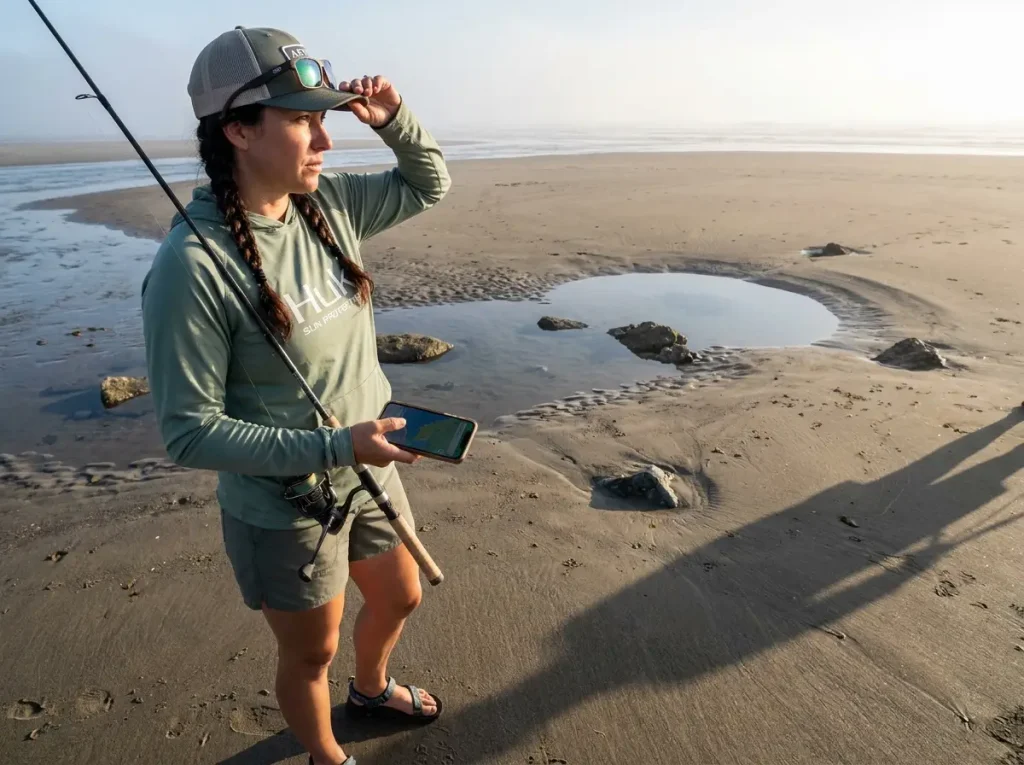
Low tide is research time. Walk the beach before you fish it — the same stretch you plan to work at high tide — and pay attention to the bottom structure that will be underwater when the water rises.
What you’re looking for: depressions and holes in the sand, rocky patches, exposed rocks that will become submerged structure, and the edges of sandbars. Any depression larger than three feet across that will sit in three to six feet of water at high tide is a surfperch holding spot. Mark your GPS or line up a beach landmark — a pier piling, a specific rock on the bluff, a discolored patch on the cliff face — so you can find it when the tide comes back up.
Steeply sloped beaches hold more fish than flat ones. Steeper gradient means wave energy moves more food through the trough system faster, and surfperch respond to that feeding opportunity. Beaches with mixed sand and small pebbles, or mixed sand and rock, hold fish all year. Pure sand beaches hold fish most reliably in spring and summer when sand crab beds are active along the water line.
Rip currents deserve attention for the opportunity they represent, not just the hazard. A rip current pulls water and everything in it — sand crabs, worms, broken mussel — seaward through a gap in the bar. Surfperch line up in and around rip channels the same way river fish sit in current seams: positioned where food concentrates without requiring them to fight maximum flow. You don’t cast into the strongest rip; you cast to the edges, where food is washing through but fish can hold easily.
Pro tip: If the beach looks completely flat at low tide, check for mussel beds on any exposed rock structure. Mussel-encrusted rocks hold pile perch and rubberlip perch year-round, even when barred surfperch scatter into deeper water during slow periods. Mussels as bait on those rocks during incoming tide is one of the most reliable cold-water presentations on the central California coast.
The guide to reading waves and surf fishing troughs goes deeper on identifying structural features from the beach using wave patterns alone — a useful read before your first session on unfamiliar water.
Rigs, Hooks, and Weight Selection
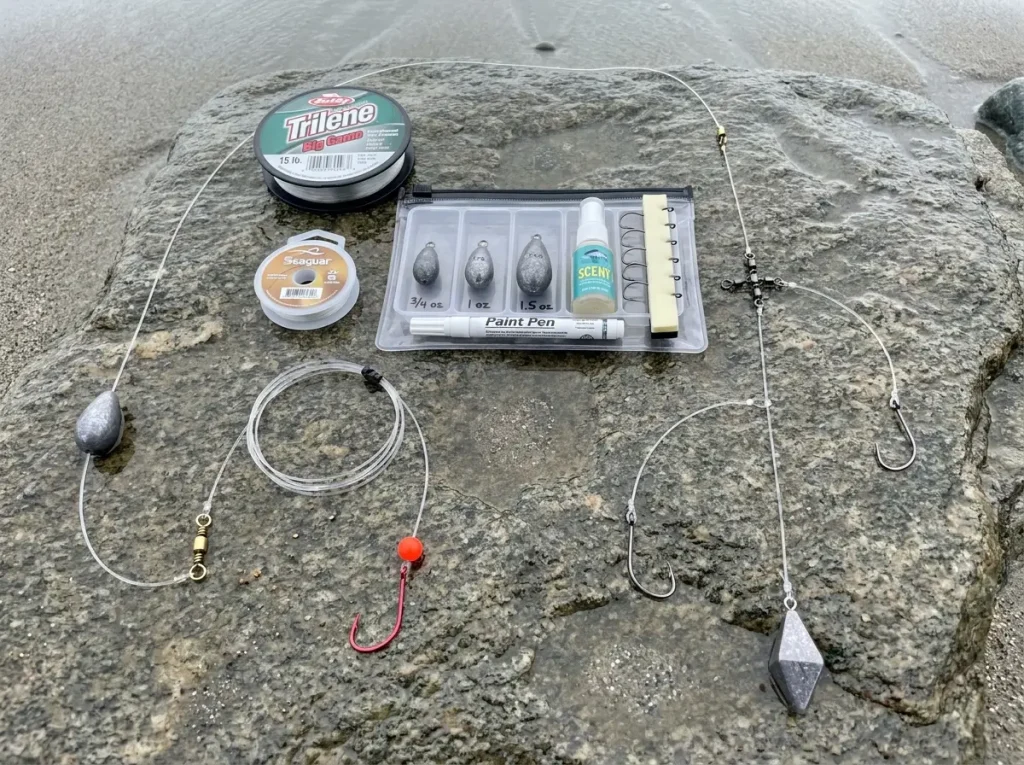
Two rigs cover virtually every surfperch situation from shore: the Carolina rig for roving sandy beaches and the high-low rig for stationary fishing around structure. Both are simple, and the choice between them comes down to whether you’re moving or staying put.
The Carolina rig is the go-to for open beach fishing. Slide an egg sinker onto your main line, tie a barrel swivel, then attach 20 to 30 inches of 8- to 10-pound fluorocarbon leader and tie on a size 4 or size 6 baitholder hook. The sinker rides freely on the line above the swivel, which means a surfperch can pick up the bait and move without feeling immediate resistance. This matters — surfperch have tough, bony mouths and will drop a bait quickly if they feel tension on the take.
The high-low rig uses a 3-way swivel or dropper loop setup with two hooks at 12 and 16 inches above the sinker. This is effective when you’ve found a good trough and want to stay in one place — near a jetty, at a deep hole, or over a rocky bottom edge. Two hooks in the zone at different heights covers more options without additional effort.
For hook sizing: surfperch have small mouths. A size 4 or size 6 is the correct range for most baits. Go larger than a size 2 and you’ll miss bites and get clean pulls on the jump. Chemically sharpened hooks matter here more than in most freshwater applications — surfperch mouths are bony and a dull hook requires significantly more force to drive home than a needle-sharp one.
Sinker weight follows wave height, not personal preference. In 2- to 3-foot surf on light tackle, 3/4 to 1 ounce is right. In 4- to 5-foot surf with heavier gear, step up to 1.5 to 2 ounces.
The goal is a sinker that drifts slowly down the beach with the current with slight encouragement from the reel — not one that sits completely static (unnatural) and not one that tumbles too fast to stay in the fish zone. A bait washing through the trough at roughly the pace of the current imitates a natural food item in wave wash far better than a dead-stopped presentation.
Line setup: For Southern California lighter surf, 10 to 15 lb braid as main line with a 20 to 30-inch fluorocarbon leader in 8 to 10 lb is standard. For the heavier surf conditions of central and northern California, Oregon, and Washington, 15 to 30 lb mono straight through — or 20 to 30 lb braid with a heavier fluorocarbon leader — handles the load. Braid gives you more sensitivity and better control in wind; mono forgives more on the hook-set in rough water. Either works.
For rod and reel, an 8- to 10-foot medium spinning rod handles most surfperch situations. The best surf fishing rods for distance and power covers the full range from light SoCal setups to the 11- and 12-foot sticks needed when you need to punch bait past heavy shore break.
Bait by Season: Sand Crabs, Marine Worms, and the Attractor Bead
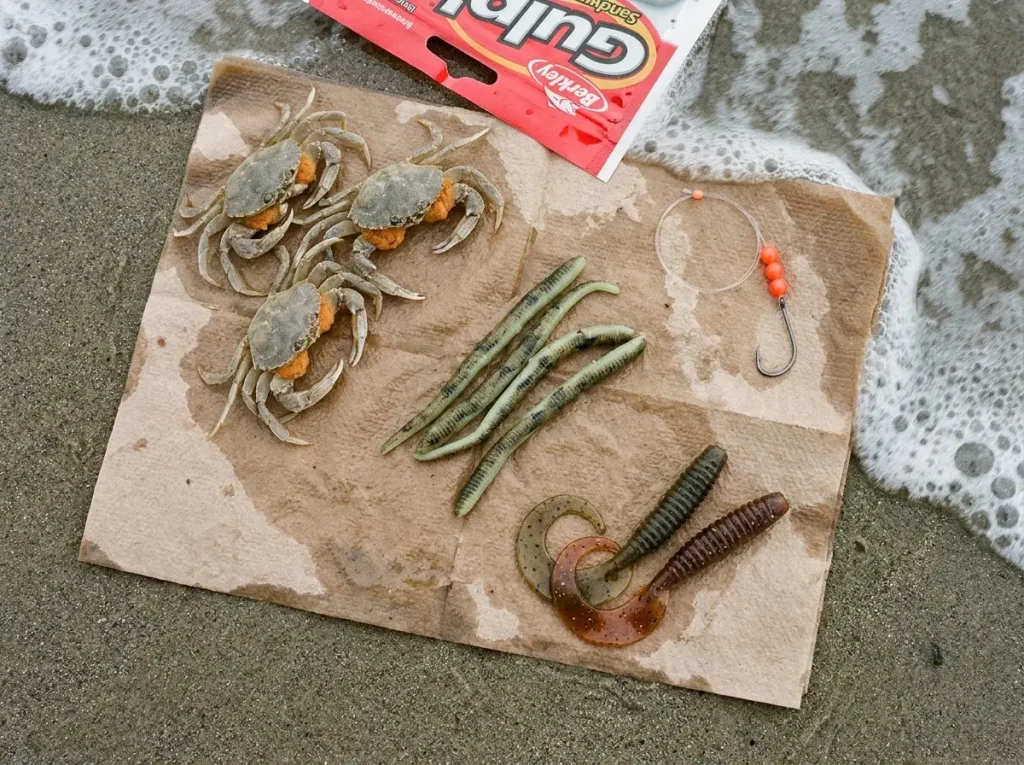
Surfperch eat what the beach is producing, and what the beach produces changes by season. Fishing the right bait at the right time is the difference between a consistent catch and a slow day.
Spring through early summer (March through July) is sand crab season. Sand crabs — also called mole crabs (Emerita analoga) — concentrate in the swash zone where waves run up and recede, and surfperch follow them into shallow water during this period. One medium sand crab or two to three small ones on a size 4 hook fished on a Carolina rig is the most reliable presentation when crabs are present.
Hook the crab through the soft underside with the point exposed. Fresh-caught crabs from the swash zone outfish crabs collected the previous day every time — the scent and movement cues degrade quickly.
Late summer and fall is when sand crab populations thin as water cools. This is when Berkley Gulp! 2-inch Sandworms in camo become the primary bait. Thread the Gulp! worm on the hook with the point exiting two-thirds down the body, not at the tail — a tail-exiting hook point gets masked by the curling worm and you’ll miss bites.
These baits hold on the hook better than natural worms in surf conditions and produce bites across all surfperch species on the Pacific coast.
Winter and tough conditions: When fish are slow and conditions are cold, a small curlytail grub — motor oil, watermelon, or root beer — on a light Carolina rig adds a visual and movement trigger that static baits don’t have. The tail kick in wave movement draws attention even from fish that aren’t actively feeding.
The attractor bead is the single addition most casual surfperch guides skip. Before tying on your hook, thread a small red or orange 4mm faceted bead onto the leader. It rides just above the hook and imitates the red-orange coloration of a sand crab’s egg mass — a visual trigger that surfperch key on in clear water conditions.
Professional surfperch guides use this consistently. It costs nothing, adds no complication to the rig, and produces measurably more bites when the water is clear enough for fish to see it.
Pro tip: Check hook sharpness every few casts when fishing rocky or pebble beaches. Surfperch have tough, bony mouths, and a hook dragged across rocks quickly loses its point. Run the hook tip across your thumbnail — if it scores the nail cleanly, it’s sharp; if it slides across, retie. Sharp hooks on small surf perch mouths make the difference between a clean hook-up and a pulled fish on the first jump.
The Incoming Tide Window and When to Show Up
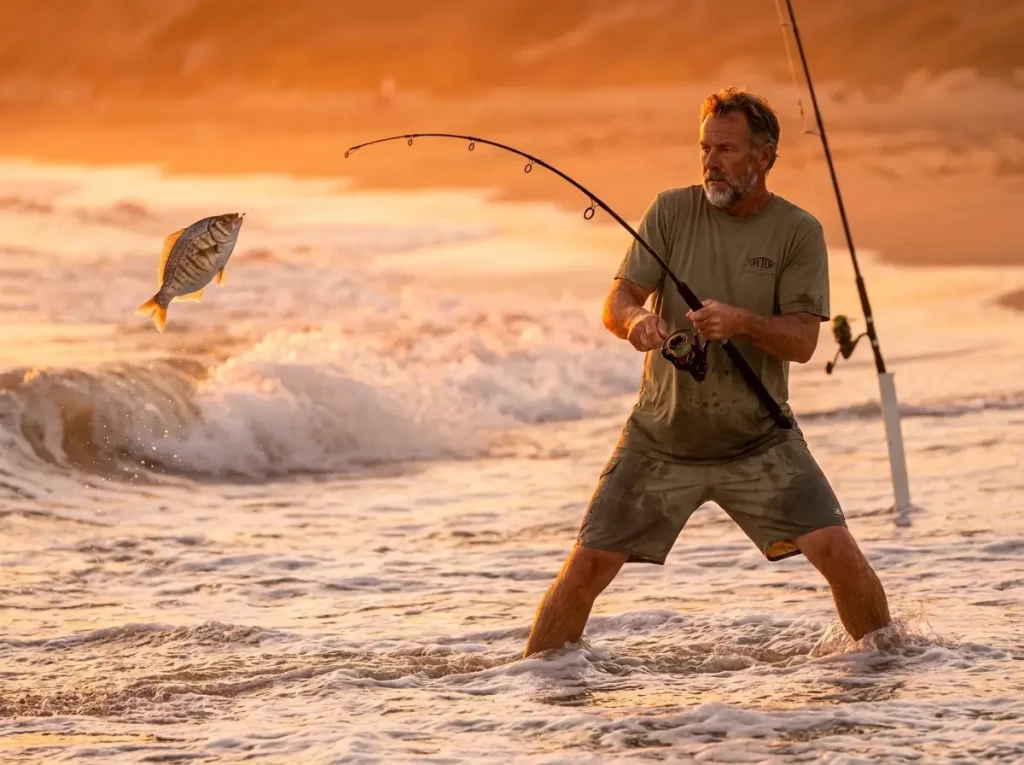
The single most important factor in surfperch fishing from shore is not bait, not rig, and not casting distance. It’s tide timing.
The best fishing happens on the incoming tide, from one to two hours before high tide through the first hour of the outgoing. Incoming tide pushes warm, oxygenated water against the shore, activates sand crabs in the swash zone, dislodges worms and crustaceans from sandy bottom, and generally turns on the food supply in the trough.
Surfperch move shoreward with the incoming water, following the food. At low tide, the trough is often too shallow to hold fish. At dead high tide, fish scatter across a wide area and become harder to locate. The two hours before high tide is the sweet spot on most beaches.
In spring and early summer, the incoming tide window aligns with the spawning period. Females carrying live pups (surfperch are live-bearers, not egg-layers) move into the shallowest accessible water during this period, and the largest fish of the year are closest to shore during the pre-spawn and spawning window. This is when fish over 2 pounds are a realistic target from the sand.
For understanding why tide velocity matters as much as tide height, how to read tides for fishing success breaks down the current-speed component that most basic tide charts don’t show — the incoming tide at maximum velocity often produces more fish than the slack period right at high tide.
Pro tip: When the incoming tide begins pushing water through a rip channel, position yourself on the edge of that rip rather than directly in it. Food is washing through the channel and surfperch stage on the quieter edges where current is slower — exactly the way river fish hold in current seams rather than in the maximum flow.
The Roving Technique: Why Moving Beats Waiting
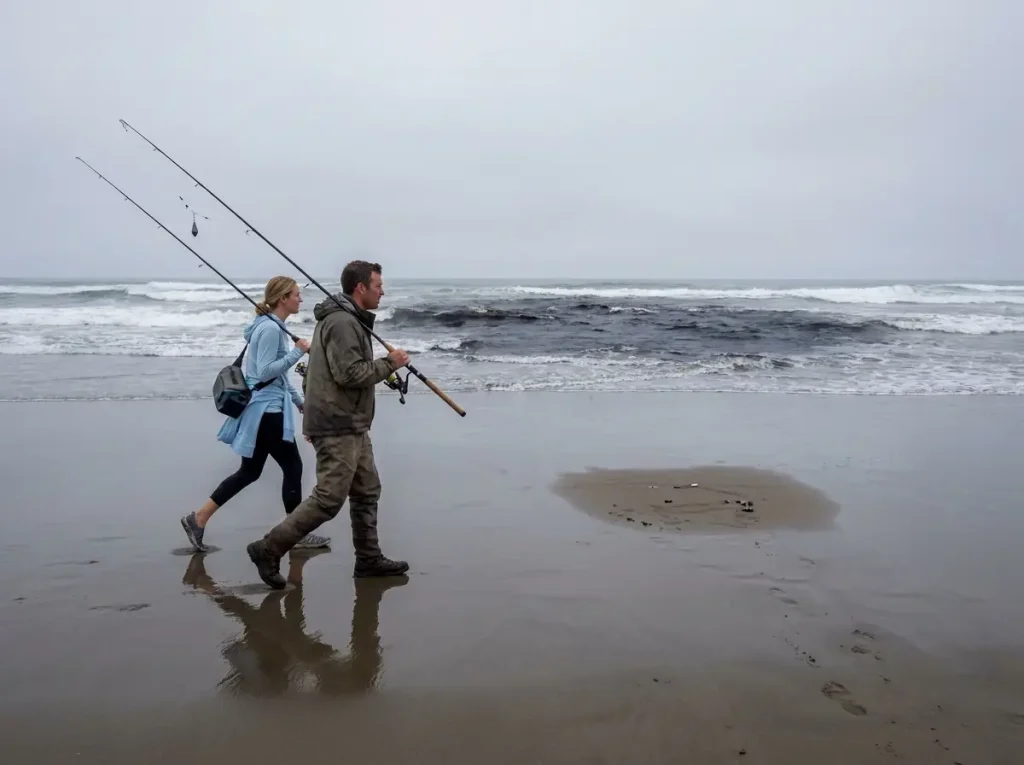
The least effective surfperch strategy is planting yourself in one spot for two hours. Surfperch school loosely and move constantly, especially outside of the peak spring and early summer period when sand crab concentrations draw them into predictable areas. If you’re not getting bit, the fish are almost certainly somewhere else on that beach.
The roving technique is simple: make six to eight casts into a trough or hole, working different angles and distances. If no bite, pick up and walk 50 to 100 yards down the beach and repeat. You’re sampling the beach systematically, not guessing randomly. When you find the school — four bites in ten minutes is a school — slow down and work that zone thoroughly before it moves.
How you retrieve matters within the technique. After the cast, let the sinker reach bottom and allow the rig to drift slowly with the current. Give it occasional turns of the reel handle to keep it moving, but don’t retrieve steadily — steady retrieval pulls the bait through the water column unnaturally.
The ideal presentation has the bait washing slowly through the trough, touching bottom intermittently, drifting like a natural food item in wave wash. Keep slack out of the line while maintaining that slow drift.
When you feel a tap, don’t set the hook immediately. Surfperch engulf a bait and often back up slightly before moving off. Setting on the first tap frequently pulls the bait away before the fish has it properly. Wait for a second pull or steady tension before driving the hook home.
For the mechanics of maximizing casting distance when the trough is further out than you can comfortably reach, the pendulum cast technique for surf fishing distance is worth learning — it’s not just for competition anglers.
Conclusion
Three adjustments that immediately improve surfperch results from shore: fish an incoming tide rather than random timing; cast into the trough rather than the open beach (watch where waves are not breaking); and keep moving rather than waiting in one spot. Everything else — rig, bait, sinker weight — matters, but these three decisions determine whether you’re fishing where the fish are or waiting for them to arrive.
The fish aren’t hard to catch once you’re fishing the right water. The beach just takes reading first.
For the full picture of shore and beach fishing across species, surf fishing for beginners — field-tested gear and tactics covers rod selection, reading structure, and multi-species approach beyond surfperch.
Q1 What is the best bait for surfperch?
Fresh sand crabs are the best bait in spring and early summer when sand crab beds are active in the swash zone. In fall and winter, Berkley Gulp! 2-inch Sandworms in camo, live marine worms from a coastal tackle shop, or small curlytail grubs in natural colors take over. Match what the beach is producing seasonally rather than using one bait year-round.
Q2 What tide is best for surfperch fishing?
The incoming tide, specifically the one to two hours before high tide, is consistently the most productive window across California, Oregon, and Washington beaches. Surfperch follow food shoreward with incoming water. Dead low tide puts fish too far out, and dead high tide scatters them. Time your arrival so you’re rigged up and fishing as the tide begins to push.
Q3 What size hooks should I use for surfperch?
Size 4 or size 6 baitholder hooks are correct for most surfperch fishing. Surfperch have small, bony mouths, and larger hooks reduce hook-up rates significantly. Keep hooks chemically sharpened — check the point on your thumbnail every few casts when fishing around rocks or pebbles.
Q4 What time of year is best for surfperch from shore?
March through July is peak season across the Pacific coast range. Surfperch move into shallow water to spawn during this period, and the largest fish — females heavy with pups — are accessible from the beach. The bite continues through fall and into winter, but fish are typically smaller and less concentrated than during the spring spawning window.
Q5 Can you catch surfperch from a jetty or pier?
Yes, and jetties and piers often hold fish year-round when beach surfperch are less active. Fish the downstream (leeward) side of the jetty, use heavier sinkers (1 to 2 ounces) to hold bottom in current, and bring mussels in addition to sand crabs and worms — pile perch and rubberlip perch that hold around rocky jetty structure respond well to mussel meat when other baits are slow.
Risk Disclaimer: Fishing, boating, and all related outdoor activities involve inherent risks that
can lead to injury. The information provided on Master Fishing Mag is for educational and informational purposes
only. While we strive for accuracy, the information, techniques, and advice on gear and safety are not a substitute
for your own best judgment, local knowledge, and adherence to official regulations. Fishing regulations, including
seasons, size limits, and species restrictions, change frequently and vary by location. Always consult the latest
official regulations from your local fish and wildlife agency before heading out. Proper handling of hooks, knives,
and other sharp equipment is essential for safety. Furthermore, be aware of local fish consumption advisories. By
using this website, you agree that you are solely responsible for your own safety and for complying with all
applicable laws. Any reliance you place on our content is strictly at your own risk. Master Fishing Mag and its
authors will not be held liable for any injury, damage, or loss sustained in connection with the use of the
information herein.
Affiliate Disclosure: We are a participant in the Amazon Services LLC Associates Program, an
affiliate advertising program designed to provide a means for us to earn advertising fees by advertising and linking
to Amazon.com. As an Amazon Associate, we earn from qualifying purchases. We also participate in other affiliate
programs and may receive a commission on products purchased through our links, at no extra cost to you. Additional
terms are found in the terms of service.