
In this article
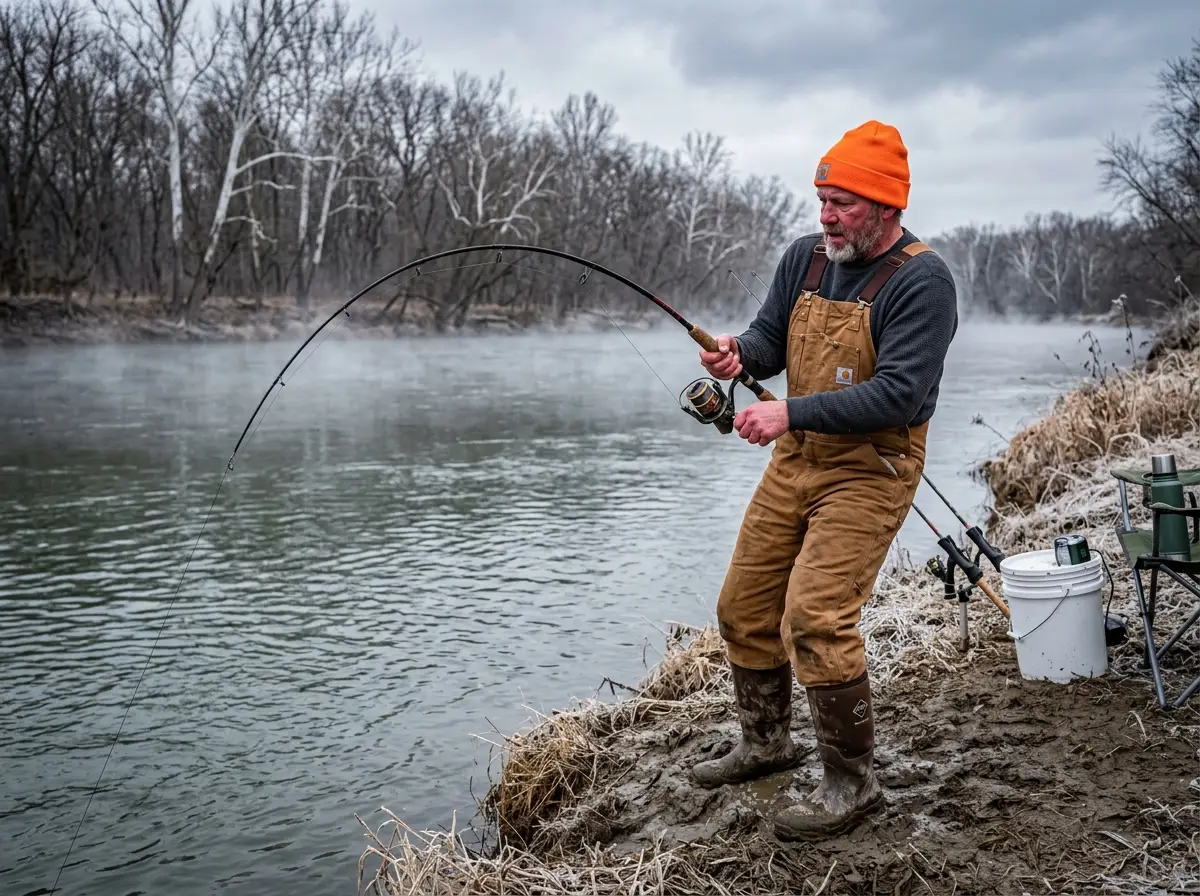
Most anglers pull their catfish gear when water temperatures drop below 50°F. That’s a mistake I kept making for years until a guide on the Tennessee River handed me a rod in January and put me on a pile of blue cats stacked in a scour hole 30 feet deep. Catfish don’t stop feeding in winter — they relocate, slow down, and get predictable. Here’s how to find the deep holes they’re using and the specific tactics that put fish in the boat when everyone else is home.
Quick Answer: Catfish bite in cold water but concentrate in deep wintering holes where temperature stays stable. Target slack-current depressions on rivers and channel ledges on lakes using fresh cut shad on short-leader rigs. Blue and channel catfish feed actively down to the low 40s°F; flatheads slow below 50°F but still bite near blowdown structure.
Why Cold Water Changes Everything About Catfish Behavior
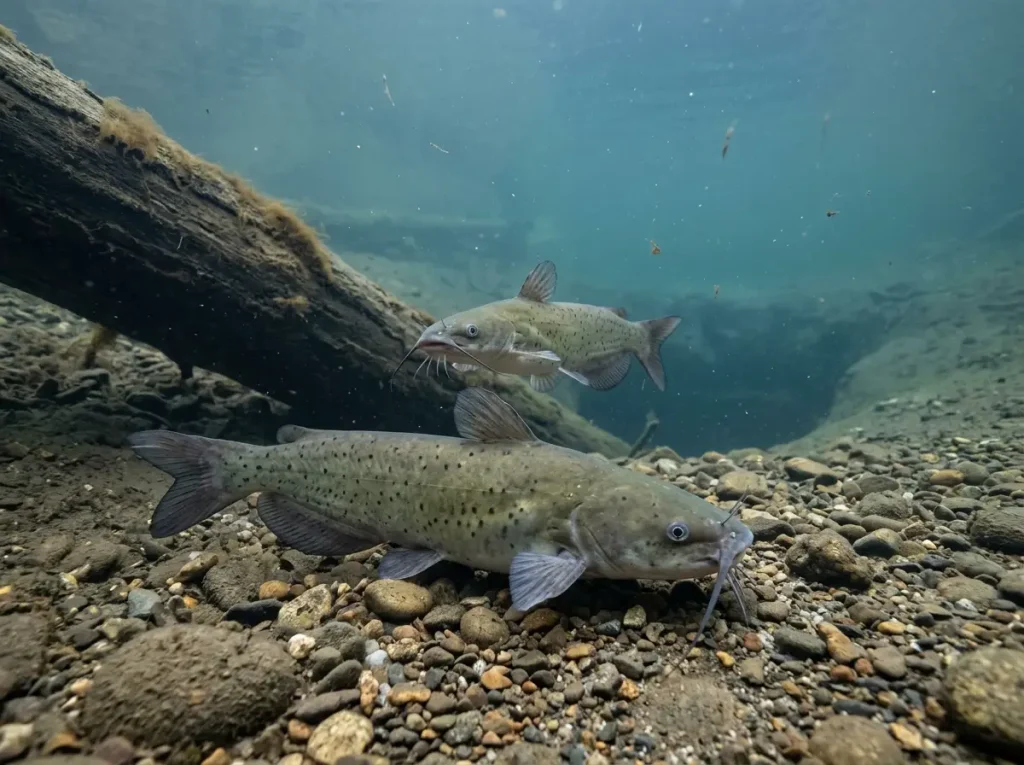
The number one reason anglers fail at winter catfishing isn’t wrong bait or wrong location — it’s wrong expectations. They fish like it’s July and wonder why nothing happens.
How Water Temperature Controls Catfish Metabolism
Catfish are cold-blooded. Their body temperature matches the water, and when that water drops, every metabolic process slows with it. Digestion takes longer, and movement costs more energy relative to the calories they take in.
A blue catfish that eats aggressively every few hours in 75°F water might feed once a day — or less — when the water hits 45°F.
This matters because it changes how you present bait. Summer catfish chase. Winter catfish wait. Understanding how water temperature controls fish metabolism and feeding is the difference between adapting your approach and blaming the fish.
The Alabama Cooperative Extension’s research on winter catfish feeding confirms what river guides see every season — metabolic rate drops proportionally with water temperature, but feeding doesn’t stop entirely.
The Temperature Thresholds That Shift Feeding Patterns
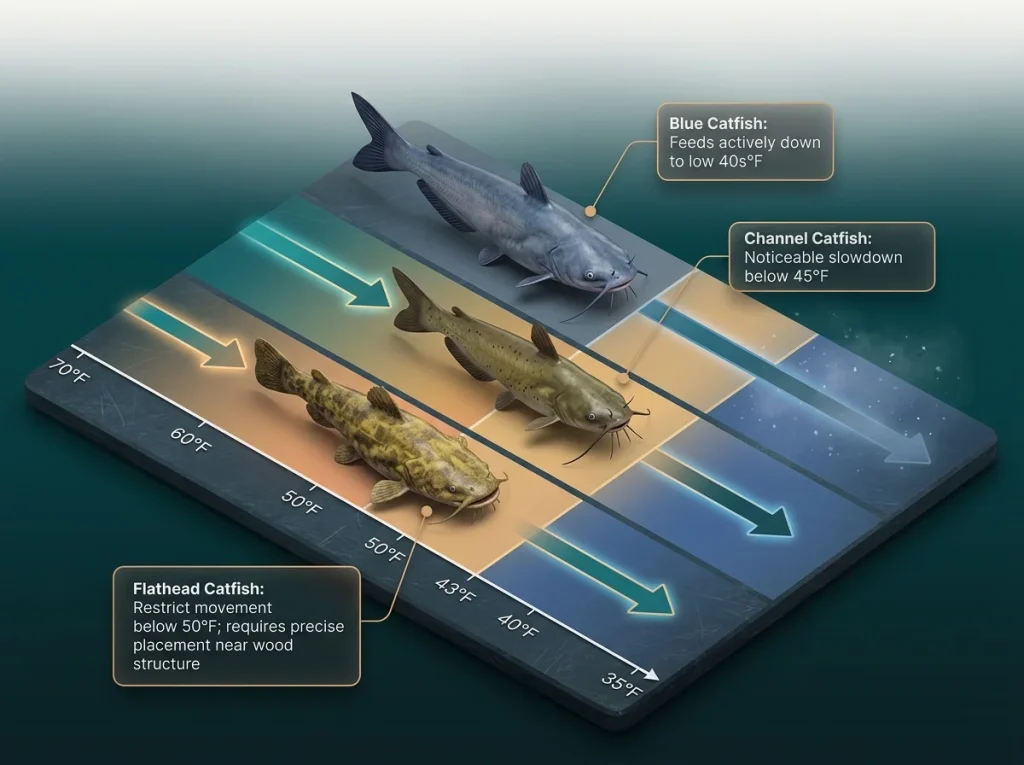
Not all catfish species respond the same way to cold water. Blue catfish stay the most active, feeding down into the low 40s°F and occasionally biting in water as cold as 38°F. Channel catfish follow a similar pattern but tend to shut down a few degrees sooner — expect a noticeable slowdown below 45°F.
Flathead catfish are the outliers. Most guides say they stop biting at 50°F, and most guides are almost right. Flatheads don’t chase bait below 50°F, but they’ll eat a live shad parked right in front of their face at a blowdown tree. The difference is presentation, not biology.
How to Find Deep Wintering Holes on Rivers and Lakes
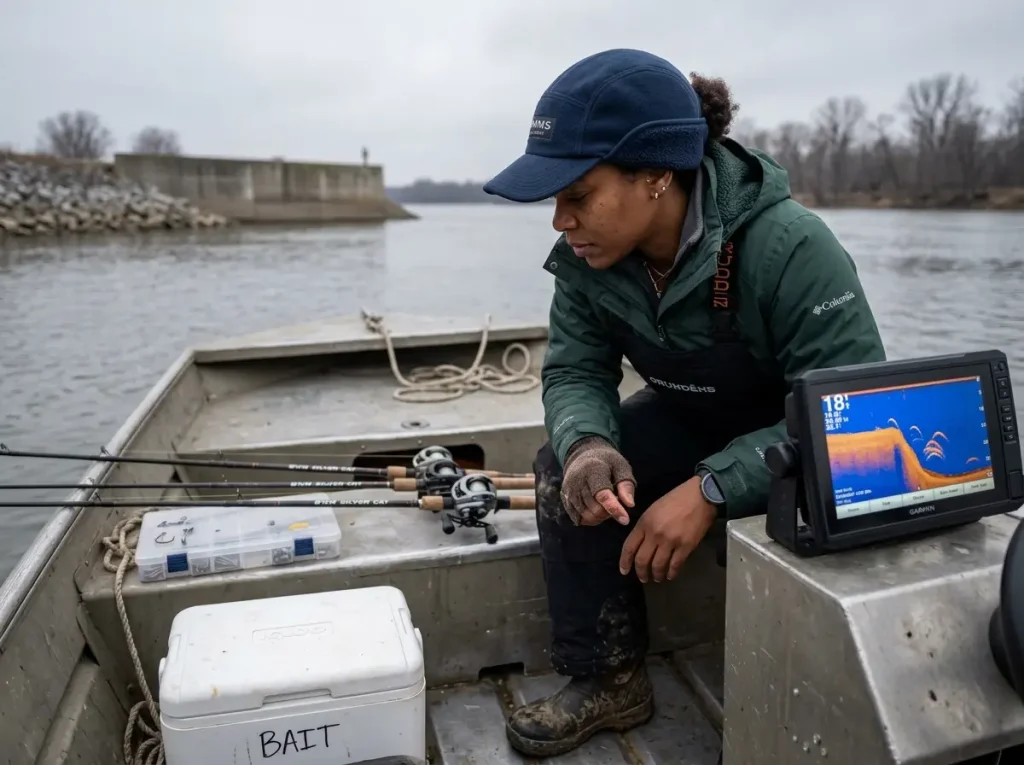
Finding catfish in winter is a location game first and a bait game second. The fish aren’t scattered — they’re piled up in specific deep-water areas that offer thermal stability and reduced current.
River Structure That Holds Winter Catfish
On rivers, the best wintering holes share two features: depth and slack current. Catfish don’t want to fight current when their metabolism is running at half speed. Look for deep outside bends where the channel carves the deepest trough, scour holes below wing dikes where current digs out a depression, and the first shelf on the inside of a sharp bend where the bottom drops from 12 feet to 25.
Tailraces below dams can be outstanding on days with stable generation schedules. The warmer water discharge concentrates bait and catfish, but the bite dies when flow changes abruptly. Check the Army Corps schedule before you launch.
Pro tip: A good wintering hole holds catfish year after year. Once you find one, mark it. You’ll come back to it every December and find fish in the same spot.
Lake and Reservoir Wintering Hole Patterns
Lakes follow a different structure pattern. Catfish in reservoirs winter along the old river channel ledges — the drop-offs where the pre-impoundment river bed meets the flooded flat. Humps and points that touch the main channel are high-percentage areas because catfish can slide between the feeding flat above and the deep resting water below.
Use contour maps to identify the sharpest depth transitions. A gradual slope from 15 to 20 feet doesn’t concentrate fish. A ledge that drops from 15 to 30 feet in a boat length does. When reading water temperature at depth vs. surface, look for the zone where temperature stabilizes — that’s where catfish hold.
Mark First, Fish Second — Using Sonar to Find Stacked Catfish
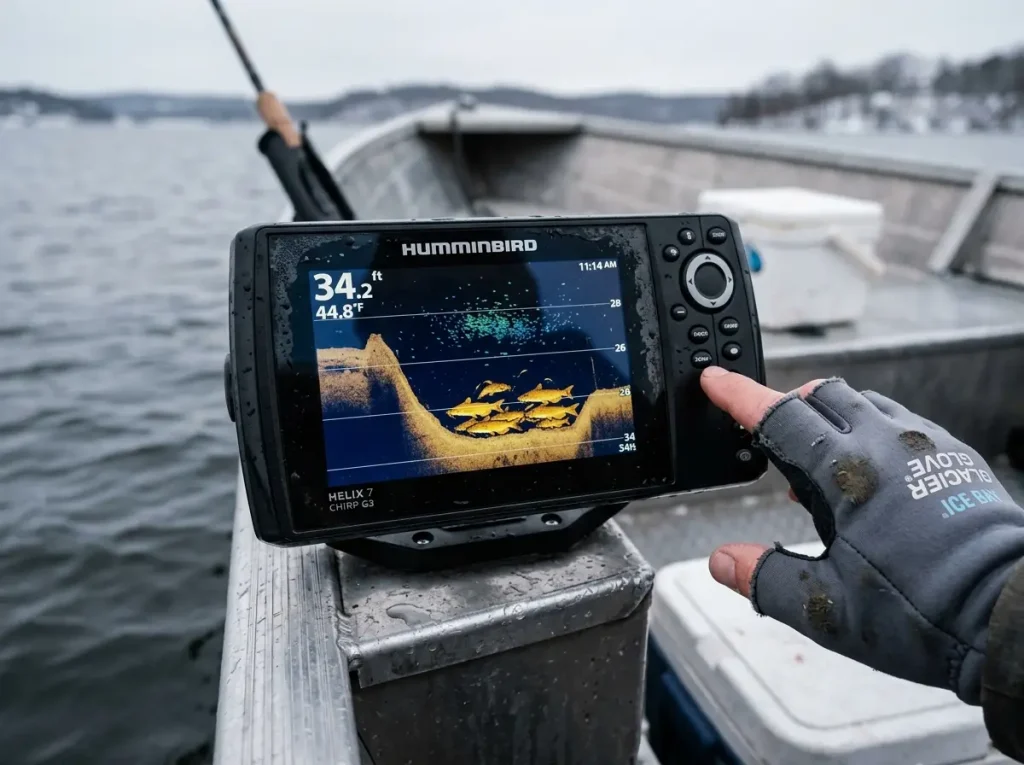
Winter is a “mark first, fish second” season. Blind-casting into a wintering hole without checking your electronics is a gamble you don’t need to take. The fish are concentrated — your job is to confirm they’re home before you drop bait.
What Winter Catfish Look Like on Your Screen
Stacked winter catfish show as tight clusters of arcs near the bottom — not scattered individual marks across the water column. You’re looking for a pile, not a patrol. On a quality CHIRP unit, you’ll see defined arcs grouped within 3 to 5 feet of the bottom at the deepest point of the hole.
If you see loose marks spread across 10 to 15 feet of water column, that’s likely bait or incidental fish. Real wintering catfish stack tight.
Reading Bait Balls and Bottom Structure
Dense clouds of marks hovering 5 to 10 feet above the bottom are shad schools — and that’s a strong confidence signal. Winter catfish want to be near their food even when they’re not actively feeding. If you mark bait but no arcs below it, the catfish haven’t moved in yet. Come back in a week.
Pro tip: Don’t spend more than 30 minutes on a spot without marks. Move to the next hole on your list. Winter catfish don’t wander — if they’re not on your screen, they’re somewhere else.
Winter Catfish Aren’t Always on the Bottom
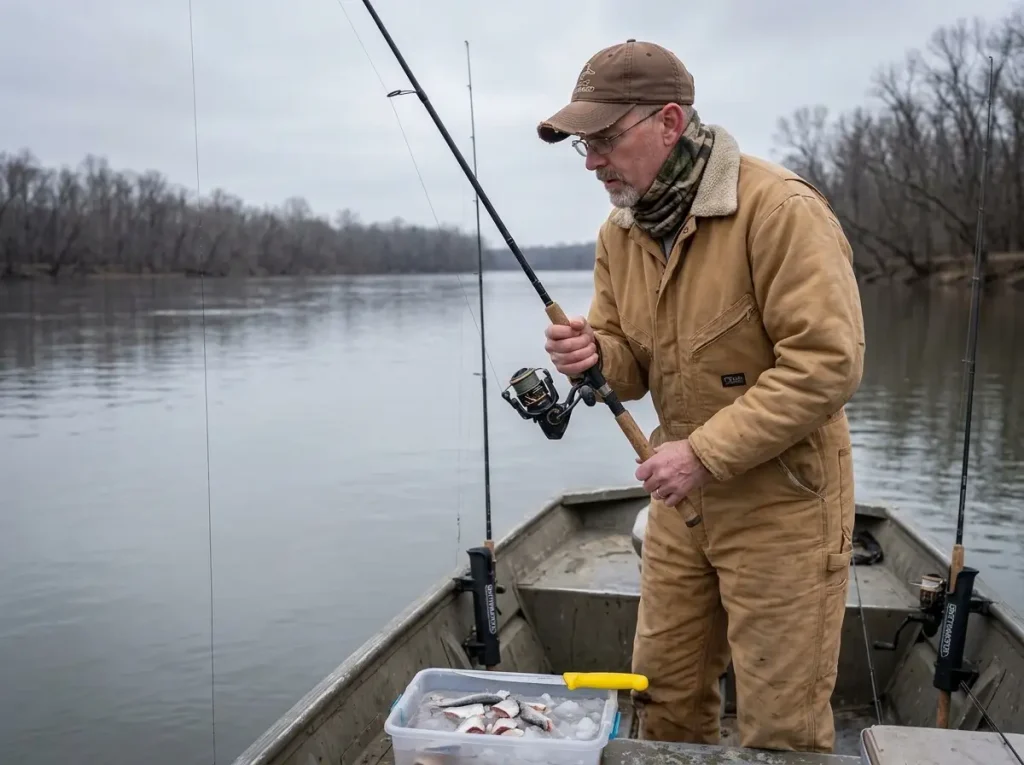
Here’s the part every other winter catfish article gets wrong. They all say “fish the bottom.” Pro tournament anglers are catching winter catfish suspended 2 to 12 feet off the bottom, and it’s not accidental.
Why Catfish Suspend in Slack Current
When current is minimal — deep reservoir channels, backwater sloughs, wide river pools — catfish have no reason to pin to the bottom. They hold at whatever depth the temperature and dissolved oxygen suit them. On rivers with moderate current, they stay down. In slack water, they rise.
David Shipman, a B’n’M tournament pro, runs heavier weight to keep his line vertical and checks multiple depth zones until he finds the band where fish are holding. He’s caught blue catfish suspended 10 feet off the bottom in 35 feet of water during low-current winter conditions.
How to Adjust Your Presentation for Suspended Fish
Drop your bait to the bottom first, then reel up in 2-foot increments every 10 minutes until you find the zone. Once you connect, note the depth on your fish finder and set your other rods to match.
A slip float rig is the easiest way to hold a bait at a precise depth off the bottom. Set the float stop at the depth where fish are marking and let the rig do the work.
Bait Selection and Presentation for Cold Water Catfish
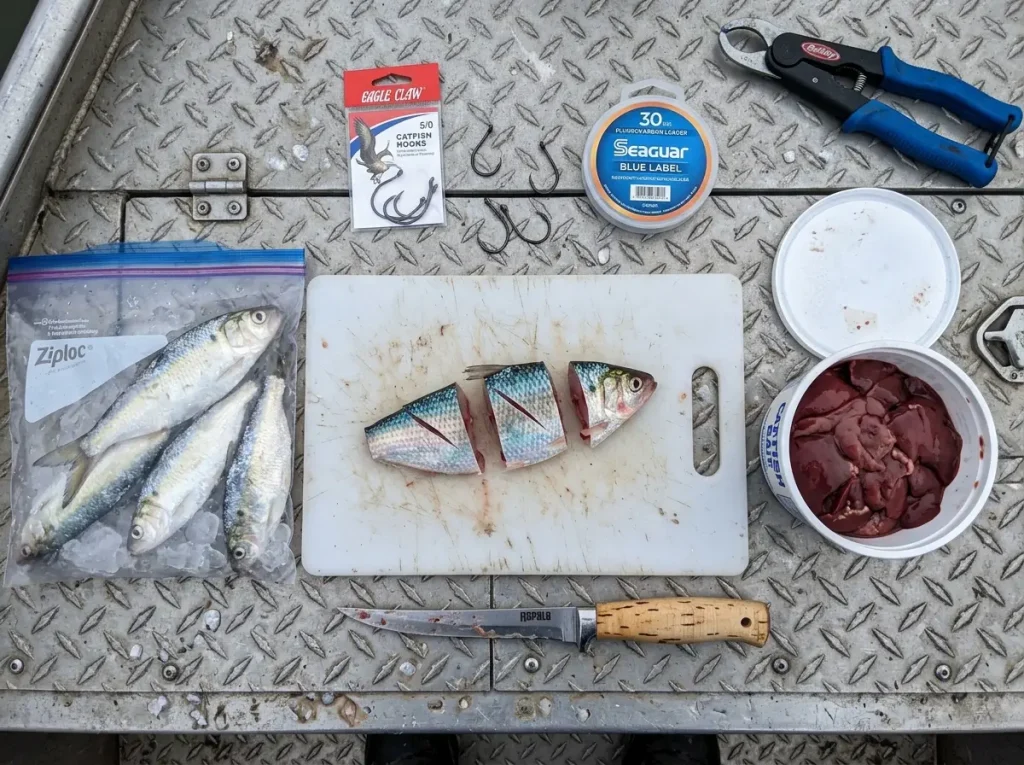
Summer bait rules don’t apply in cold water. Everything slows down — scent dispersal, bait breakdown, catfish interest. You need to adjust both what you use and how you use it.
Why Fresh Cut Bait Outperforms Everything Else in Winter
Scent is the primary trigger for winter catfish. They’re not chasing — they’re waiting for something to drift into range and smell right. Cut bait releases oils and amino acids slowly in cold water, creating a scent trail that works even when the current barely moves. Understanding how fish use scent to find bait explains why fresh bait outperforms frozen bait by a wide margin in winter.
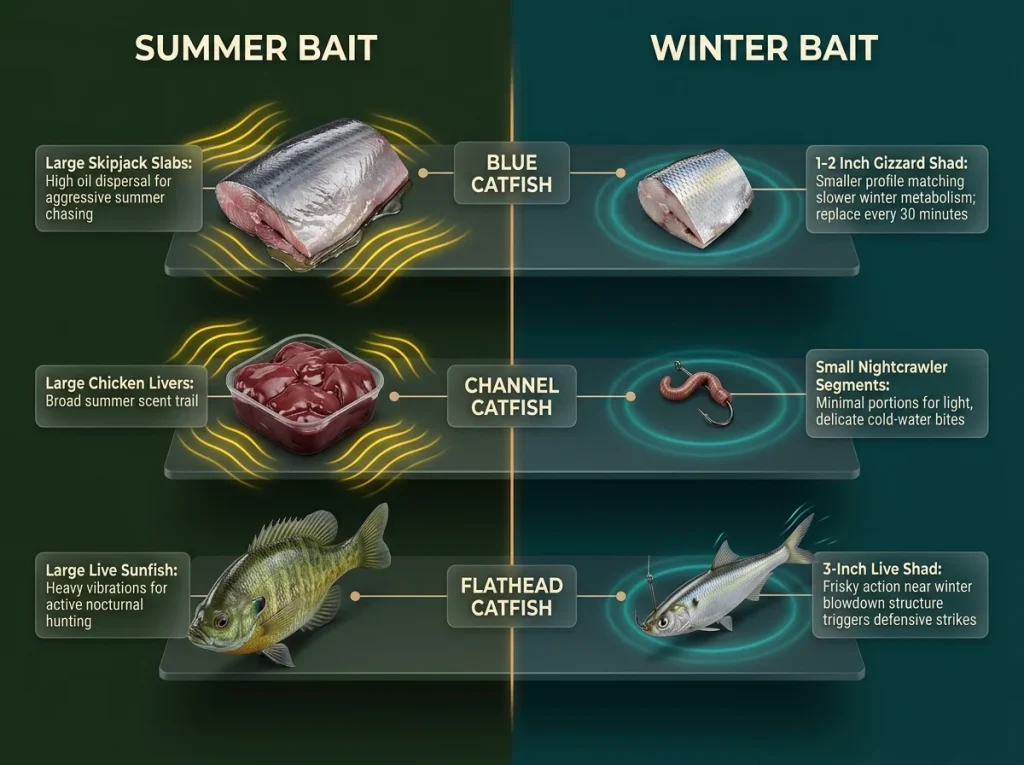
Fresh-cut gizzard shad is the top pick for winter blue catfish. B’n’M pro David Magness switches from skipjack herring to shad specifically for cold water, casting a net for 2 to 3-inch threadfin and gizzard shad in warm-water discharges near power plants. The smaller profile matches what winter catfish are willing to eat.
Replace your bait every 30 minutes. Cold water slows scent dispersal, but it also means your bait washes out and loses effectiveness faster than you’d think.
Downsizing Bait and Matching Winter Forage
Your summer skipjack slab is too much bait for a fish burning half the calories. Trim pieces to 1 to 2-inch chunks with the skin on — the skin holds the hook better and releases scent longer. For channel catfish, chicken livers and nightcrawlers still produce, but keep portions smaller than summer.
Live shad actually last longer as bait in cold water. B’n’M pro Joey Pounders gets 25 to 30 minutes of good lively action per bait in winter versus only 5 to 10 minutes in hot summer water. The cold keeps them frisky — and a lively shad on a hook near a blowdown tree is hard for a flathead to ignore. For background on shad biology and seasonal availability, knowing what’s in the water at your lake or river helps match the forage.
Rigs and Gear Adjustments for Winter Catfishing
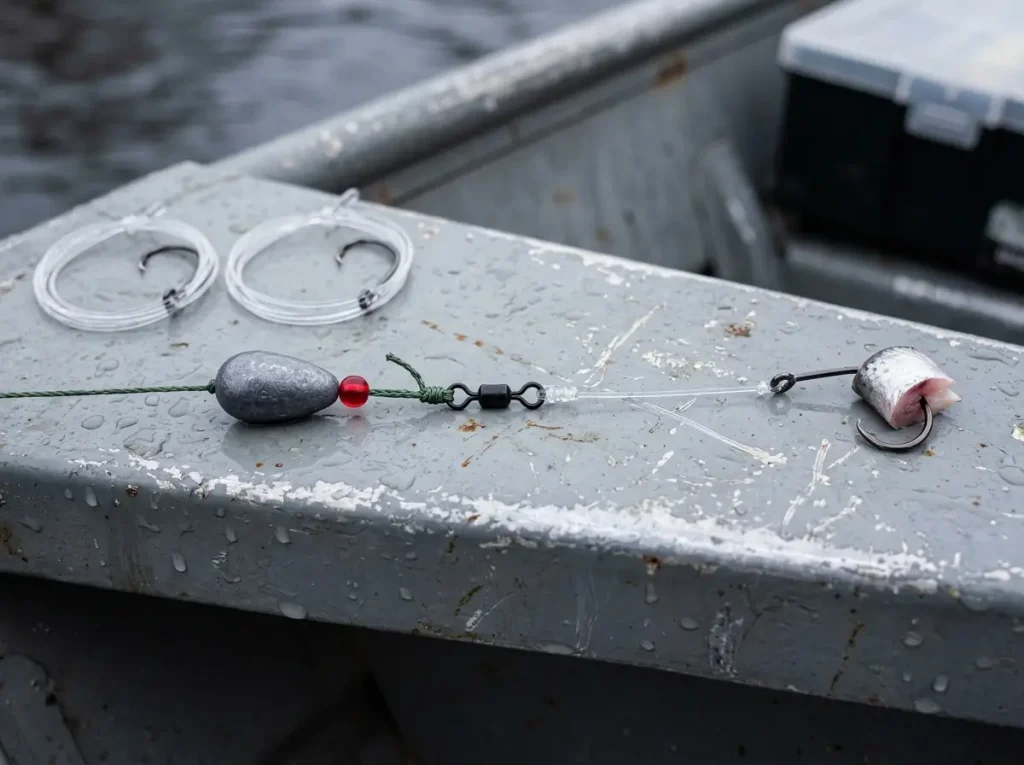
Winter bites are soft. A catfish in 44°F water doesn’t slam the bait and run — it picks it up, mouths it, and moves off slowly. Your gear needs to account for that.
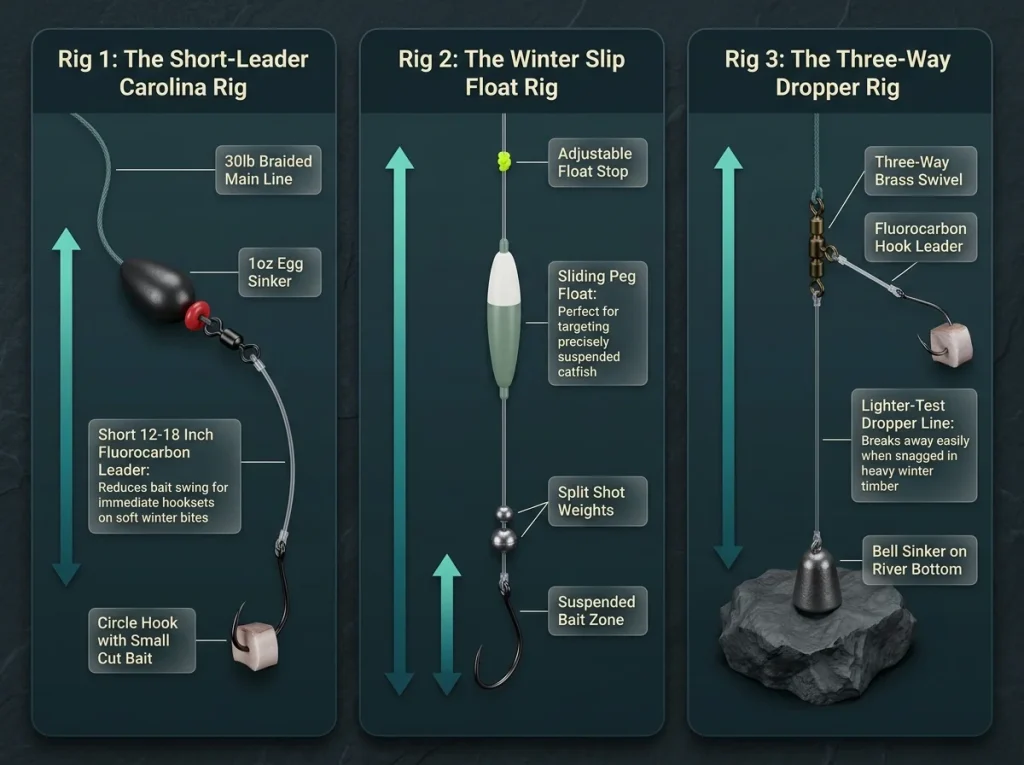
Three Rigs That Work in Cold Water
Carolina rig with a short leader — 12 to 18 inches instead of the 24 to 36 inches you’d run in summer. The shorter leader reduces swing, keeps the bait closer to the sinker, and helps the right circle hooks for catfish find the corner of the mouth on a slow, deliberate take. Use a 1-ounce egg sinker on a 30-pound braided main line with a fluorocarbon leader to the hook.
Slip float rig — the best option for fishing suspended catfish or lifting bait 2 to 4 inches off a silty bottom. A peg float keeps the bait clean and visible at a precise depth. Set your float stop, clip on a split shot, and let the rig hold your bait exactly where the fish are marking.
Three-way dropper rig — run this over rock and timber where snags eat Carolina rigs. Tie a lighter-test dropper line to the sinker so you lose the weight instead of the whole rig when you hang up. The mainline-to-leader connection stays intact.
Rod, Reel, and Line Adjustments for Light Winter Bites
Use a rod with a softer tip than your summer stick. B’n’M pro Bob Crosby switches to the Bumping rod for winter anchor fishing because the softer tip lets a lethargic catfish pick up the bait without feeling resistance. A stiff rod tip pulls the bait away from a slow bite.
Lighten your drag. Cold air stiffens reel grease and makes drag response less predictable. Set it lighter than you think you need — you can always tighten during the fight. Check drags before every session.
Pro tip: Stagger your rods to cover three depth zones — the lip of the ledge, the top of the drop, and the base of the hole. You’ll find the feeding band faster than fishing one depth.
Flathead Catfish in Winter — Why Most Anglers Give Up Too Early
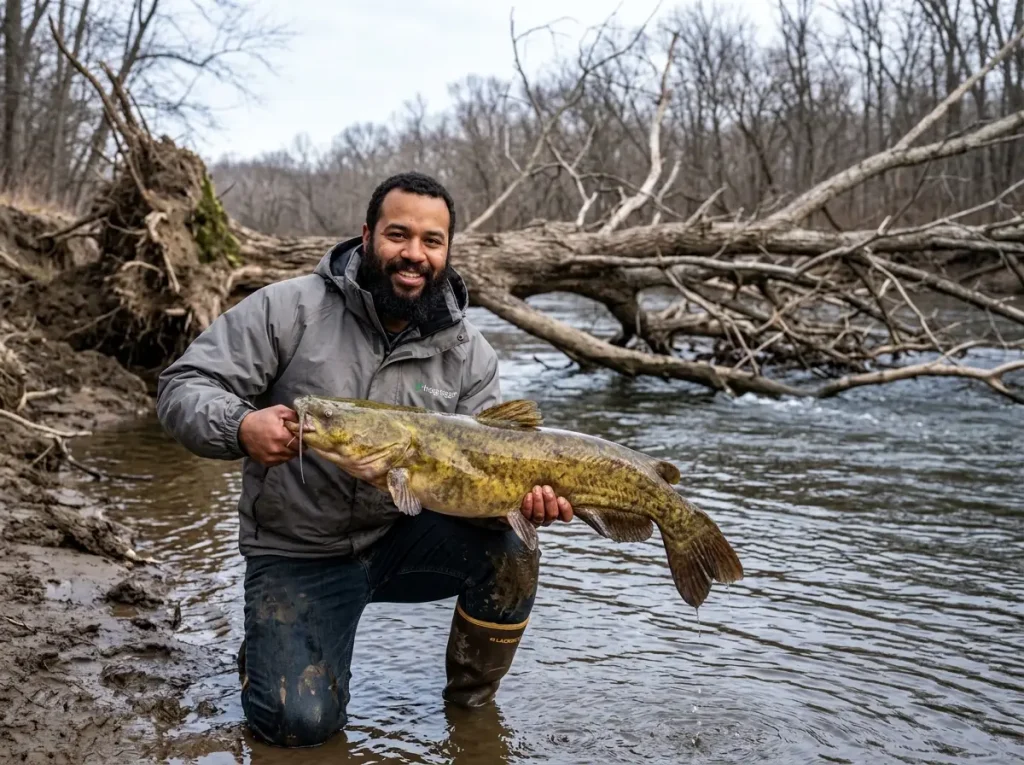
Every winter catfish article says flatheads don’t bite in cold water. That’s not quite true — and the anglers who know the difference catch fish when everyone else writes the species off.
Where Flatheads Stack Up in Cold Water
The key difference between flathead behavior in summer and winter is congregation. In warm water, flatheads spread out — one fish per piece of structure, territorial and solitary. In winter, they pile up together. Joey Pounders, a B’n’M tournament pro who targets flatheads year-round, finds them stacked 5 to 6 fish deep at single blowdown trees during cold months.
His method: scout 10 to 12 blowdown trees in a 2-mile stretch of river before making a single cast. Look for fallen cottonwoods or sycamores with root balls still attached to the bank and main trunks angling into the water. The tangled branches create current breaks and ambush cover that flatheads use as winter shelter. Understanding flathead catfish behavior and feeding patterns helps explain why wood structure matters more than depth alone for this species.
County wildlife research on winter catfish patterns confirms the congregation pattern — flatheads move from dispersed summer territories into tight winter groups.
Live Bait Tactics for Winter Flatheads
Flatheads want live bait in any season, and winter is no exception. A live 3-inch shad on a short leader pinned to the upstream edge of a blowdown tree is the presentation. Don’t overthink it.
Pro tip: When you catch a flathead from a blowdown tree in winter, don’t move. There are likely 5 to 6 more holding in the same structure. Rebait and drop right back in the same spot.
Conclusion
Winter catfishing comes down to three things: find the deep water where temperature stays stable, confirm fish are present with your electronics before you commit, and present fresh bait on short rigs tuned for light bites. The fish are there — they’re just concentrated, predictable, and waiting for an angler who slows down enough to match their pace.
Don’t let 44°F water temperatures keep you on the couch. The guys catching 50-pound blues in January found the same wintering holes you’re driving past.
Q1 What water temperature do catfish stop biting?
Catfish don’t stop biting at a specific temperature. Blue catfish feed actively down to the low 40s°F. Channel catfish slow below 45°F but still eat. Flatheads reduce feeding significantly below 50°F but will take a live bait presented directly in front of them near structure.
Q2 What is the best bait for catfish in winter?
Fresh-cut gizzard shad or threadfin shad is the top choice for blue and channel catfish in cold water. Cut the pieces small — 1 to 2 inches — and replace every 30 minutes. For flatheads, live shad on a short leader near blowdown trees outperforms cut bait.
Q3 Where do catfish go when the water gets cold?
Catfish move to the deepest, most thermally stable water available. On rivers, that means scour holes below wing dikes, deep outside bends, and tailraces. On lakes and reservoirs, look for old river channel ledges and deep humps near the main channel.
Q4 Do catfish bite better in cold or warm water?
Catfish bite more frequently in warm water because their metabolism runs higher. But winter catfish concentrate in predictable locations, making them easier to find. A well-placed bait in a wintering hole can produce faster action than blind-casting across a summer flat.
Q5 How deep do catfish go in winter?
Depth depends on the water body. On rivers, catfish winter in holes ranging from 20 to 40 feet. On deep reservoirs, they may hold along channel ledges at 30 to 60 feet. The key isn’t absolute depth — it’s the deepest spot with stable temperature and reduced current near their location.
Risk Disclaimer: Fishing, boating, and all related outdoor activities involve inherent risks that
can lead to injury. The information provided on Master Fishing Mag is for educational and informational purposes
only. While we strive for accuracy, the information, techniques, and advice on gear and safety are not a substitute
for your own best judgment, local knowledge, and adherence to official regulations. Fishing regulations, including
seasons, size limits, and species restrictions, change frequently and vary by location. Always consult the latest
official regulations from your local fish and wildlife agency before heading out. Proper handling of hooks, knives,
and other sharp equipment is essential for safety. Furthermore, be aware of local fish consumption advisories. By
using this website, you agree that you are solely responsible for your own safety and for complying with all
applicable laws. Any reliance you place on our content is strictly at your own risk. Master Fishing Mag and its
authors will not be held liable for any injury, damage, or loss sustained in connection with the use of the
information herein.
Affiliate Disclosure: We are a participant in the Amazon Services LLC Associates Program, an
affiliate advertising program designed to provide a means for us to earn advertising fees by advertising and linking
to Amazon.com. As an Amazon Associate, we earn from qualifying purchases. We also participate in other affiliate
programs and may receive a commission on products purchased through our links, at no extra cost to you. Additional
terms are found in the terms of service.