
In this article
The scute sliced through my palm like a serrated blade—three inches of gashed flesh from one careless grab at a thrashing 30-inch juvenile. Blood dripped onto the deck while the sturgeon’s prehistoric armor gleamed in the morning sun, completely indifferent to the damage it had caused.
After two decades guiding on the Columbia and Sacramento Rivers, I’ve learned that respecting these living fossils means understanding what you’re handling. Those bony ridges running down a sturgeon’s back aren’t decorative. They’re 200-million-year-old defensive weapons that can send you to the ER if you’re careless—or cause serious harm to the fish if you’re ignorant.
This guide breaks down the evolutionary science behind sturgeon scutes armor, explains how to identify species by their scute counts, and gives you the exact protocols for safe handling. No biology degree required—just practical knowledge that keeps both you and these ancient fish intact.
⚡ Quick Answer: Sturgeon scutes are bony armor plates made from neural crest-derived bone—not scales. Sharp on juveniles, potentially dangerous in all sizes. Use cut-resistant gloves, rubber mesh nets, and keep fish over 60 inches in the water at all times. Identify species by the post-dorsal scute: Green Sturgeon have one behind the dorsal fin, White Sturgeon have none.
The Evolutionary Science Behind Sturgeon Armor
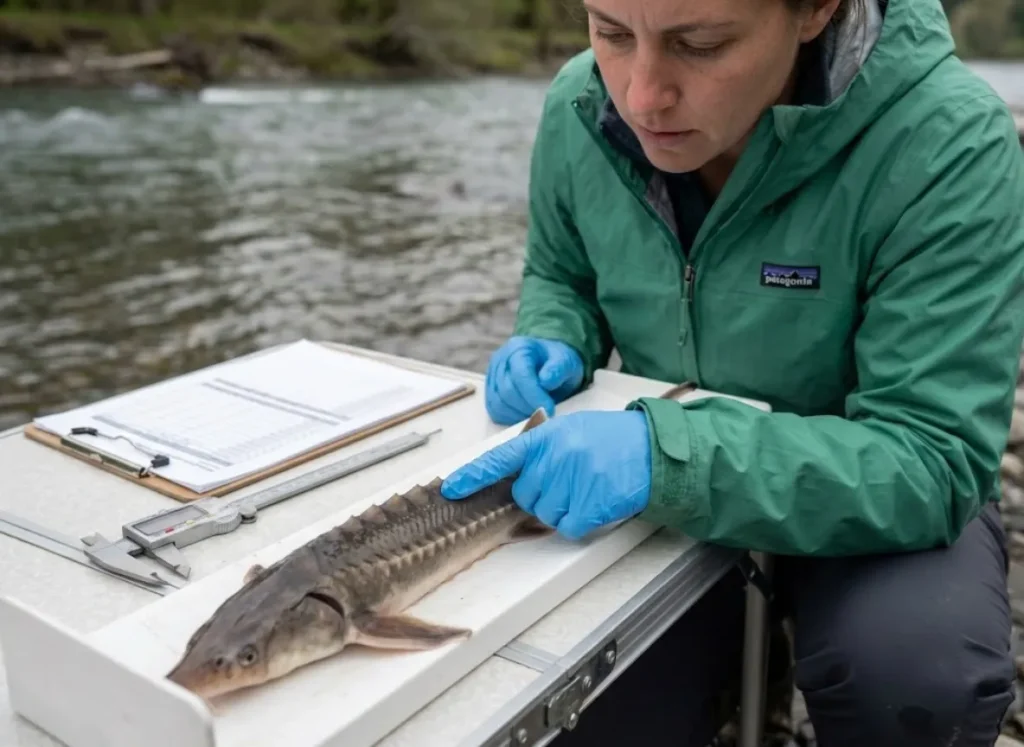
Most anglers call them “scales” and leave it at that. They’re wrong—and that misunderstanding leads to bloody hands and dead fish.
Sturgeon scutes are modified ganoid scales that trace their origin to something called trunk neural crest cells. If that sounds like university jargon, here’s the simple version: these are the same embryonic cells that form skull bones in you and me. In most fish species, those cells stopped contributing to body armor millions of years ago. Sturgeon never got the evolutionary memo.
Neural Crest Origins—Why These Aren’t Regular Scales
Research published in the Proceedings of the National Academy of Sciences tracked fluorescent dyes through sterlet sturgeon embryos and watched those cells migrate from the developing spinal cord directly to where scutes eventually form. It’s a primitive developmental pathway that modern bony fishes like bass and salmon abandoned long ago.
This makes Acipenser transmontanus and Acipenser medirostris—White and Green Sturgeon—genuine living fossils carrying armor-building genes that most vertebrates lost before dinosaurs walked the earth. The bone forms through something called intramembranous ossification, which simply means it develops directly in the skin membrane without needing a cartilage template first.
Pro tip: That rough, sandpaper texture on an old adult’s back? Those are the same scutes, just worn smooth after decades of rooting along river bottoms.
What Scutes Are Made Of (And What They’re Missing)
Ancestral ganoid scales had multiple layers—an enamel-like outer coating called ganoine and a middle layer of dentine (the same stuff in your teeth). Sturgeon lost both during evolution. What remains is pure cellular bone, lighter than gar scales but every bit as sharp when the fish is young.
The osteoblasts that build this bone originate from those neural crest cells I mentioned—not the mesoderm tissue that forms your skeleton. For anglers, what matters is this: those razor edges on a juvenile sturgeon aren’t there by accident. They’re the product of ancient developmental programming that’s been refining dermal armor for 200 million years.
Understanding this fish slime coat biology helps you protect both the scute system and the mucous barrier that keeps sturgeon healthy after release.
The Hidden Function—Scutes as External Tendons
Defense is the obvious job, but there’s more. Recent biomechanical studies show those five longitudinal scute rows act as an external tendon system. They stiffen the posterior body, allowing more efficient transmission of muscular force to the powerful heterocercal tail.
For you, this explains why sturgeon fight with that sustained, head-shaking power run rather than the explosive bursts of salmon or bass. The armor isn’t just protection—it’s part of the propulsion system.
This research linking PNAS research on neural crest-derived dermal armor proves what guides have suspected for years: these ancient vertebrate fish are engineered differently at the molecular level.
Identifying Species by Scute Counts—White vs Green Sturgeon
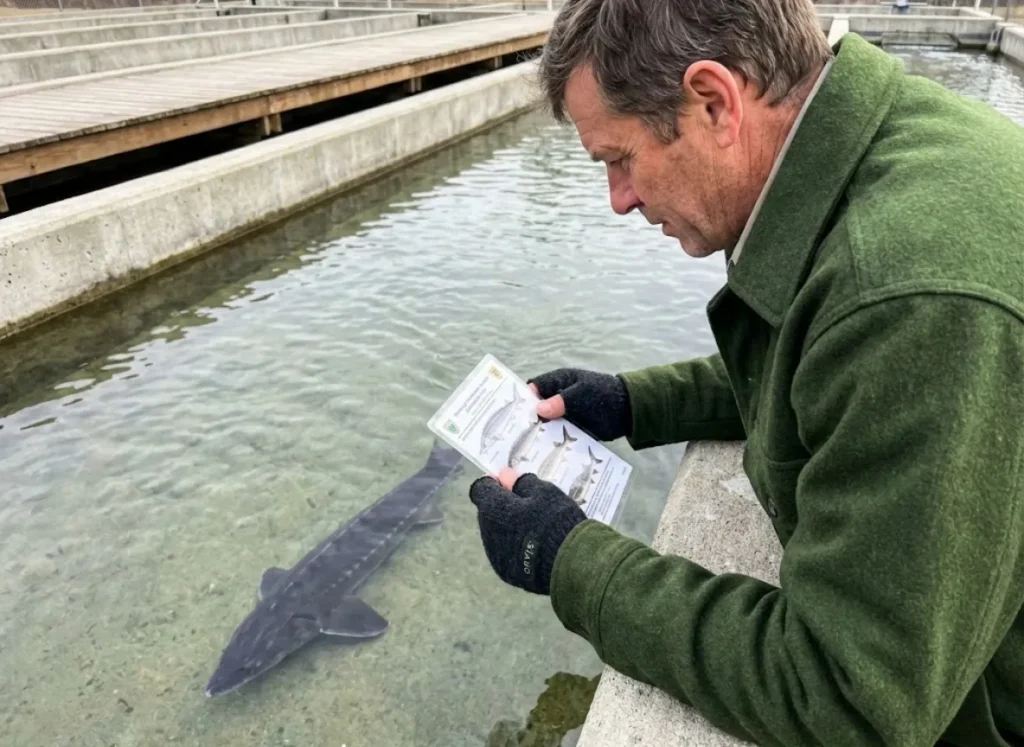
Misidentifying a Green Sturgeon as a White and handling it incorrectly can result in fines, criminal charges, or harm to a threatened species. The good news: one physical feature tells you everything you need to know.
White Sturgeon (Acipenser transmontanus) Identification
The White Sturgeon is the largest freshwater fish in North America, capable of exceeding 20 feet and 1,800 pounds. Here’s the armor profile:
Dorsal Row: 11-14 dorsal scutes along the back. The critical feature: no scutes behind the dorsal fin.
Lateral Rows: 38-48 diamond-shaped scutes per side, lighter in color against the grey body.
Ventral Rows: 9-12 scutes running along the belly.
Vent Placement: Located BEHIND the pelvic fins—this is a reliable field marker when coloration is ambiguous.
Experienced anglers on the Columbia River and Fraser call the legal-sized ones “keepers” and the oversized giants “overs.” Both require careful handling.
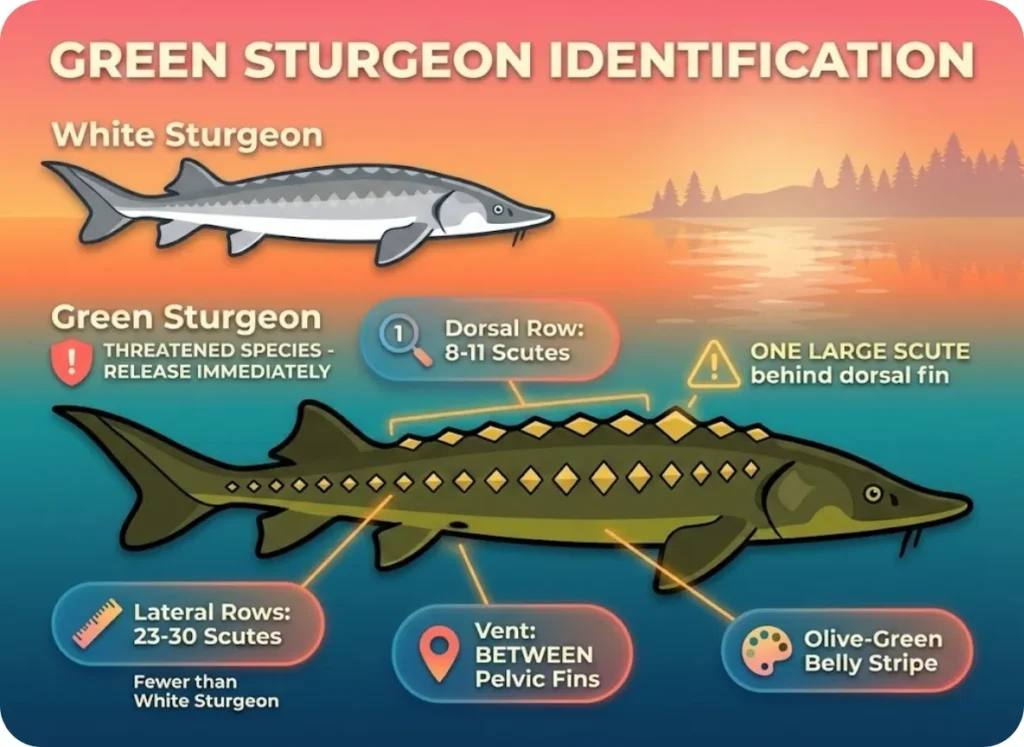
Green Sturgeon (Acipenser medirostris) Identification
Green Sturgeon are smaller, more marine-oriented, and protected as a threatened species in the Southern Distinct Population Segment. Know these markers:
Dorsal Row: Fewer scutes (8-11 dorsal scutes). The diagnostic feature: ONE LARGE SCUTE behind the dorsal fin.
Lateral Rows: 23-30 scutes—noticeably fewer than White Sturgeon.
Ventral Rows: 5-10 scutes, with two distinctive rows of 4-8 behind the vent.
Vent Placement: Located BETWEEN the pelvic fins—not behind them.
Coloration: Olive-green belly stripe, yellowish scutes against a dark olive body.
According to NOAA’s Green Sturgeon species profile, the Southern DPS remains federally threatened. Mishandling carries serious legal consequences.
The Post-Dorsal Scute—The One Feature That Matters
Here’s your field rule: Green Sturgeon = 1 scute behind the dorsal fin. White Sturgeon = 0.
This single feature works even on smaller fish where coloration can fool you. NOAA and state agencies use it as the primary diagnostic criterion. Before attempting any photo or measurement, locate that post-dorsal position. If you see a scute, it’s Green—release immediately without removing from water.
The skills used here mirror those covered in our field identification guide for hybrid fish—quick visual markers that prevent costly mistakes.
Why Sturgeon Scutes Can Ruin Your Day (The Hazard Profile)
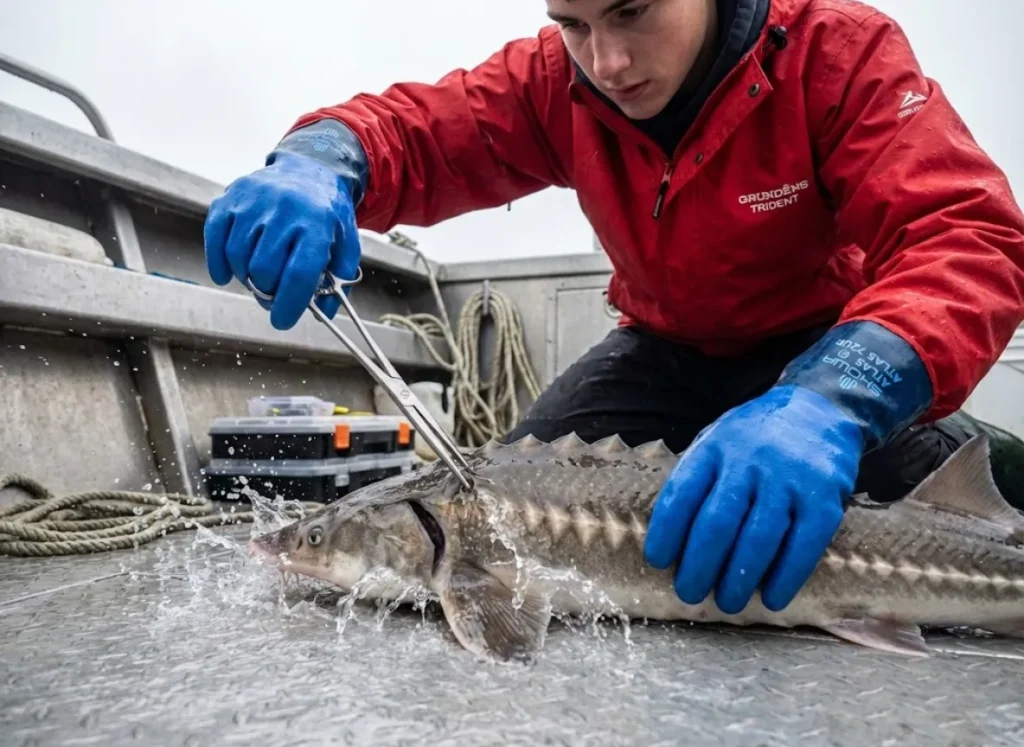
That armor serves the fish well against predators. It also poses real hazards to anglers who don’t respect it.
The “Shaker” Problem—Juvenile Sharpness
West Coast guides call sub-legal sturgeon “shakers”—and the name hints at the problem. You want to shake them off the hook, not wrestle them.
Juvenile scutes are razor-sharp with recurved, thorn-like spines that haven’t worn down yet. Fish under 4 feet are the most dangerous to handle. The Columbia River guide community has a saying: “Shakers cut you. Overs crush you.”
Adult sturgeon scutes become blunted and abraded after decades of bottom-feeding contact, but larger fish bring different problems—weight, thrashing power, and the leverage to cause serious injury even with dulled armor.
Laceration Mechanics—Why These Cuts Are Different
Scute cuts aren’t clean. The bone tears tissue rather than slicing it, creating jagged wounds that don’t close neatly like a knife cut. You’re left with irregular edges that are difficult to clean and slow to heal.
The immediate danger is contamination. Estuarine environments where sturgeon live are full of bacteria, debris, and organic matter. Deep punctures from the recurved spines can embed bone fragments in the wound, complicating treatment.
The Vibrio Threat—When a Cut Becomes Life-Threatening
The brackish waters of the Sacramento River, Columbia River delta, and Great Lakes tributaries are reservoirs for Vibrio vulnificus—an opportunistic bacterial pathogen that enters through open wounds.
In healthy individuals, this means localized skin infections and swelling. In immunocompromised people—those with liver disease, diabetes, or other conditions—it can trigger necrotizing fasciitis or fatal sepsis.
The protocol is simple: wash any scute wound IMMEDIATELY with soap and fresh water. If redness, pain, or swelling develops, get medical attention without delay. As noted in WorkSafeBC’s fish spine puncture safety bulletin, fish spine injuries are classified as potentially “serious and life-threatening.”
This is why building a marine first aid kit belongs on every sturgeon angler’s pre-trip checklist.
Pro tip: Keep a bottle of saline wound wash and waterproof bandages in your tackle bag. When you’re three hours from a clinic, field first aid is all you’ve got.
Gear Selection for Scute-Proof Handling
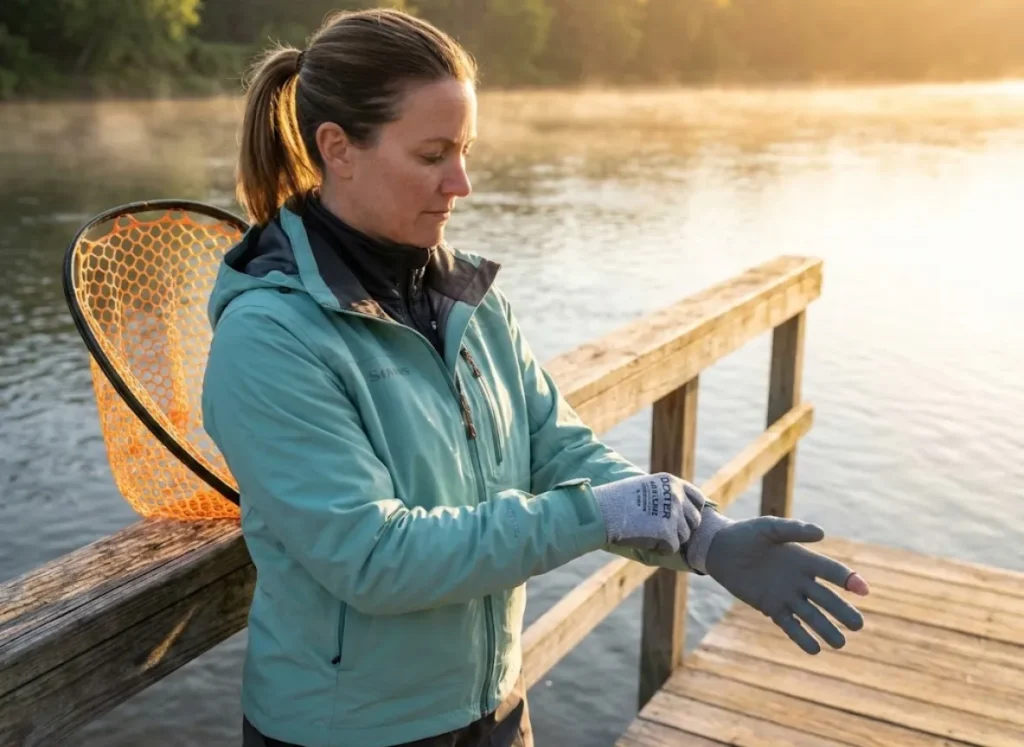
The right equipment protects you AND the fish. Cheap shortcuts cost more than they save.
Glove Technology—Material Science That Matters
Forget cotton and wool. They absorb slime, don’t resist punctures, and strip the fish’s protective mucous coating on contact.
Nitrile-coated or rubber-dipped gloves are the standard. They provide a bacterial barrier, resist slime absorption, and grip better on wet surfaces. For cut resistance, look for ANSI Level 5 or higher—brands like Dexter Sani-Safe and Fish Monkey are proven in the field.
The trade-off is dexterity. Heavy Kevlar gloves block cuts but absorb slime and reduce feel. “Dipped” options like the Showa Atlas 720R give you waterproofing, grip, and protection without the bulk.
Pro tip: Never handle juveniles bare-handed. The “scute burn” abrasion pattern from cradling an unprotected shaker isn’t worth it, and you’re damaging the fish’s slime coat in the process.
For broader options, see our complete fishing gloves guide.
Net Technology—Why Rubber Is Non-Negotiable
Knotless rubber mesh nets are the gold standard for sturgeon. Here’s why:
A study reviewed in the Chinook Observer found that knotless nylon mesh caused 1.5 times the mucous loss compared to bare hands. Large rubber-coated nets had the LOWEST mucous damage of any material tested.
Traditional knotted nylon acts like a cheese grater on the fish’s slime coat AND catches on scute edges. This creates entanglement, prolongs air exposure, and injures both fish and angler. Rubber mesh prevents snagging, speeds release, and preserves the fish’s immune barrier.
Our fish-friendly net selection guide covers the specific models worth buying.
Safe Handling Protocols—From Hookup to Release
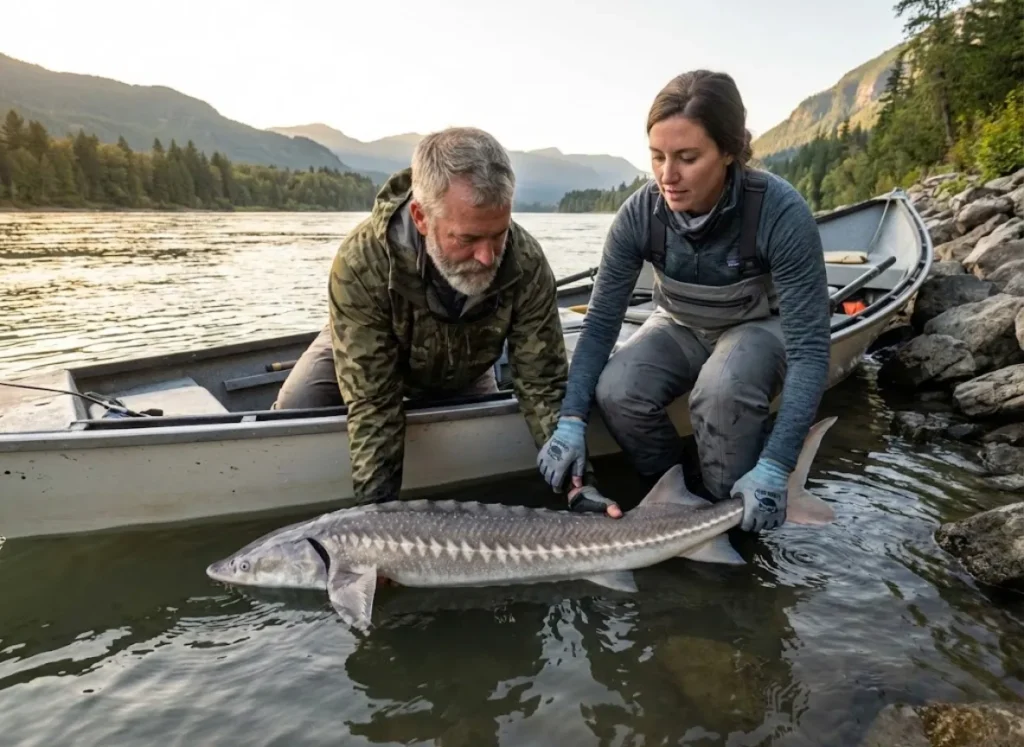
The Fraser River Sturgeon Conservation Society tracked mortality rates across gear types. Their findings should guide every angler’s behavior when practicing catch-and-release fishing.
The “Keep It Wet” Mandate
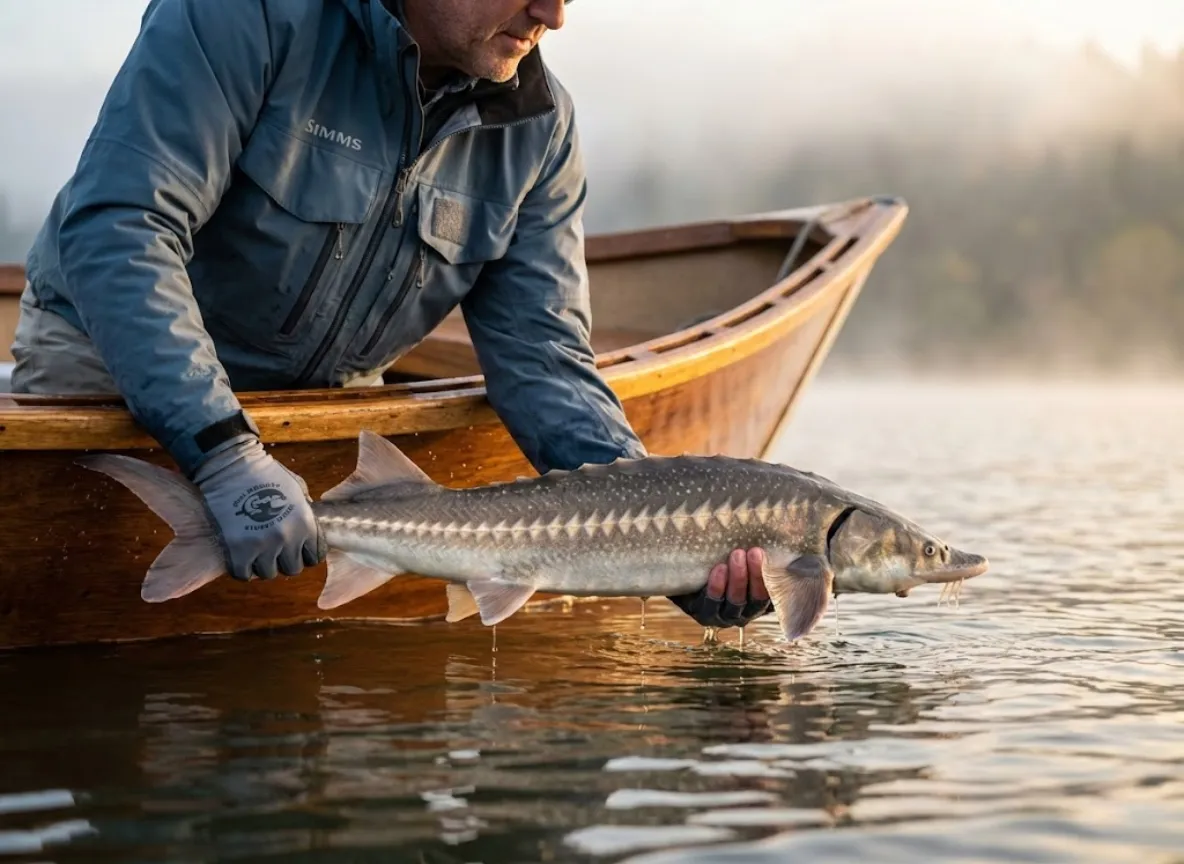
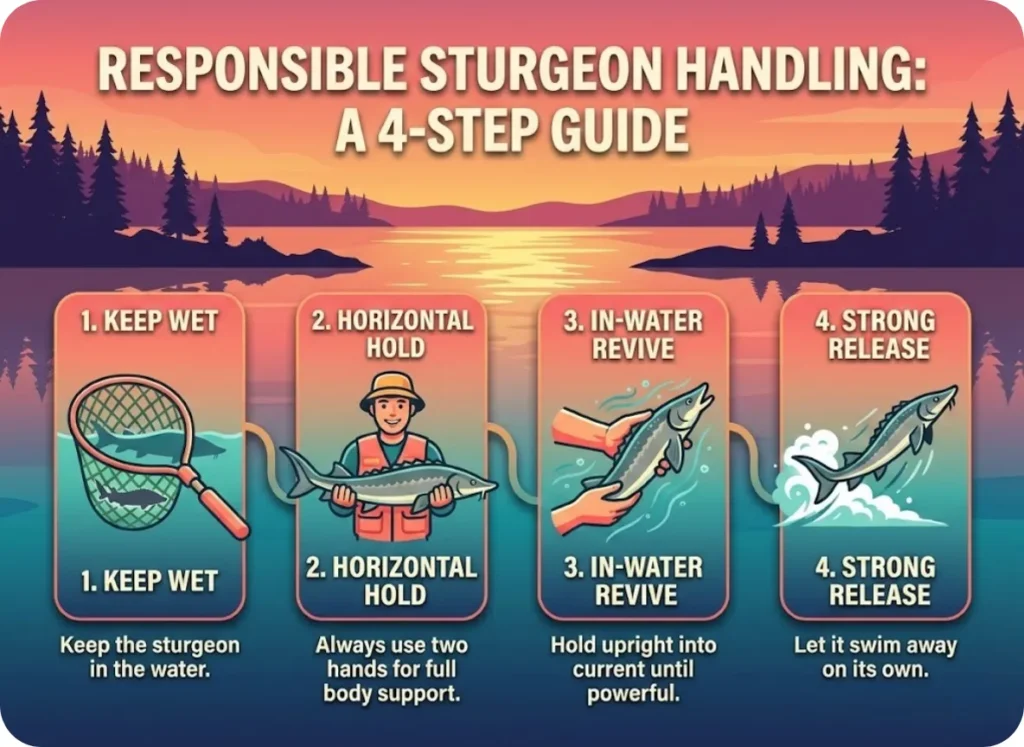
For sturgeon over 60 inches (5 feet), most regulations mandate the fish MUST NOT leave the water. The reason is structural: sturgeon skeletons are largely cartilaginous except for the skull and scutes. They can’t support their own body weight outside water.
Lifting large fish causes internal organ compression, spinal stress, and delayed mortality you’ll never see. Fraser River data shows catch-and-release angling mortality at just 2.6% post-release—but only when proper in-water handling best practices are followed.
Compare that to set gillnets at 46.9% mortality. The gear type and handling method are everything.
Following science-based catch and release techniques directly impacts whether that fish survives the encounter.
The Two-Hand Rule
If a smaller sturgeon must be lifted, support it HORIZONTALLY with two hands:
- One hand under the pectoral girdle (the chest area behind the gills)
- One hand under the caudal peduncle (the narrow section before the tail fin)
Never hold vertically by the gills or tail. This causes spinal damage and gill collapse in a fish whose internal structure isn’t designed for vertical suspension.
Never use “tail-roping” techniques. They’re often illegal and cause caudal damage that impairs the fish’s ability to swim normally after release.
Keep the fish low over the gunwale or deck to minimize drop distance if it thrashes. Good proper fish holding techniques apply across species.
Resuscitation Protocol
Hold the fish facing upstream into the current. Let oxygenated water flow naturally over the gills. Don’t pump the fish back and forth vigorously—this damages gill rakers and is less effective than steady flow.
Wait until the fish powers away on its own. A sluggish departure means more recovery time is needed. Watch for strong, sustained tail kicks before letting go.
Pro tip: If there’s no natural current, slowly troll forward at idle speed with the fish in the water until it recovers. Movement creates flow over the gills.
The NOAA’s sturgeon safe handling guidelines provide the federal standard for these protocols.
Conservation Context—Why Proper Handling Matters
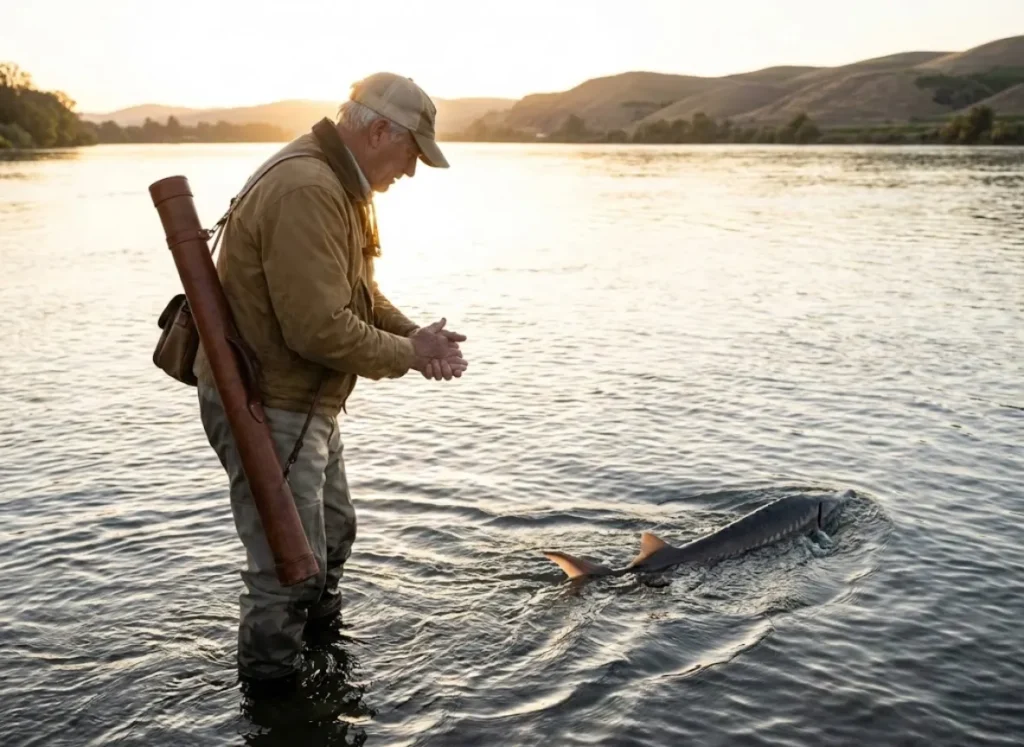
You’re not just protecting one fish. You’re participating in the survival of a lineage that’s outlasted every mass extinction in Earth’s history—until now, when most sturgeon species face sturgeon populations collapse worldwide.
Gear-Type Mortality Comparison
The data from Fraser River research tells the story:
Rod-and-Reel Angling: Direct mortality below 0.012%, post-release mortality approximately 2.6%.
Set Gillnets: Post-release mortality 46.9%—nearly 50 times higher.
Trawl Bycatch: NOAA models estimate 5.2% mortality for Green Sturgeon incidentally caught in commercial fisheries.
Recreational anglers using proper techniques are allies of sturgeon recovery, not threats.
The Kootenai Crisis—A Cautionary Tale
The Kootenai River White Sturgeon population has seen almost zero juvenile sturgeon recruitment since 1974. Dam-altered flow regimes disrupted the spawning conditions these fish evolved to require.
This is now an aging, endangered population where every individual matters. White Sturgeon can live over 100 years—a 104-year-old specimen is documented. Green Sturgeon typically reach 60-70 years.
When you release a sturgeon, you may be releasing an animal older than your grandparents. And given the recruitment failures, it may never be replaced.
Understanding the angler’s role in fish conservation means recognizing that every handling decision has consequences beyond the individual encounter.
Conclusion
Know your armor. Sturgeon scutes are neural crest-derived bone plates—not scales. They’re sharp as razors on juveniles and capable of causing serious infections in brackish water environments. Respect the hazard.
ID before you touch. One scute behind the dorsal fin means Green Sturgeon—a threatened species with strict handling requirements. No scute means White. That single feature determines your legal and ethical obligations.
Gear up, stay wet. Cut-resistant gloves, rubber mesh nets, and in-water handling aren’t suggestions. They’re requirements for protecting yourself and a 200-million-year-old lineage that’s now more vulnerable than at any point in its existence.
Next time you feel that ancient weight on the line—the head-shaking power run of something that swam with dinosaurs—you’ll know exactly what you’re holding and how to return it to the water with both of you intact.
FAQ
What are sturgeon scutes made of?
Sturgeon scutes are bony plates made of cellular bone that develops from trunk neural crest cells—the same embryonic cell type that forms skull bones in other vertebrates. They lost the enamel-like ganoine layer found on ancestral modified ganoid scales, leaving pure bone that’s lighter but still sharp on juveniles.
Are sturgeon scutes dangerous to handle?
Yes, particularly on juveniles under 4 feet. The scutes have sharp, recurved spines that cause deep lacerations. These wounds are prone to bacterial infection, including potentially life-threatening Vibrio vulnificus in brackish waters. Cut-resistant gloves are essential for sturgeon handling safety.
How do you tell White Sturgeon from Green Sturgeon?
The most reliable field marker is the post-dorsal scute. Green Sturgeon have ONE scute behind the dorsal fin; White Sturgeon have NONE. Green also have fewer lateral scutes (23-30 vs 38-48), and the vent is between the pelvic fins rather than behind them.
What gloves protect against sturgeon scute cuts?
Nitrile-coated or rubber-dipped gloves with ANSI Level 5 cut resistance or higher. Brands like Dexter Sani-Safe and Fish Monkey are field-proven. Avoid cotton or wool—they absorb slime and lack puncture protection for scute injury risk prevention.
Why must large sturgeon stay in the water?
Sturgeon have largely cartilaginous skeletons that can’t support body weight out of water. Lifting causes internal organ compression and spinal stress. Post-release mortality increases significantly when fish are removed from water. Keep sturgeon over 60 inches submerged at all times following proper safe handling techniques.
Risk Disclaimer: Fishing, boating, and all related outdoor activities involve inherent risks that
can lead to injury. The information provided on Master Fishing Mag is for educational and informational purposes
only. While we strive for accuracy, the information, techniques, and advice on gear and safety are not a substitute
for your own best judgment, local knowledge, and adherence to official regulations. Fishing regulations, including
seasons, size limits, and species restrictions, change frequently and vary by location. Always consult the latest
official regulations from your local fish and wildlife agency before heading out. Proper handling of hooks, knives,
and other sharp equipment is essential for safety. Furthermore, be aware of local fish consumption advisories. By
using this website, you agree that you are solely responsible for your own safety and for complying with all
applicable laws. Any reliance you place on our content is strictly at your own risk. Master Fishing Mag and its
authors will not be held liable for any injury, damage, or loss sustained in connection with the use of the
information herein.
Affiliate Disclosure: We are a participant in the Amazon Services LLC Associates Program, an
affiliate advertising program designed to provide a means for us to earn advertising fees by advertising and linking
to Amazon.com. As an Amazon Associate, we earn from qualifying purchases. We also participate in other affiliate
programs and may receive a commission on products purchased through our links, at no extra cost to you. Additional
terms are found in the terms of service.