
In this article
The reel screamed—a high-pitched, nerve-grinding whine that cut through the morning mist every time I cast. My Curado had been butter-smooth for three seasons, but now it sounded like it was dying. I was convinced the spool bearings were shot. Turns out, I was about to waste $40 on a problem that cost nothing to fix.
After 20 years of maintaining my own reels—and watching fellow anglers throw money at problems that didn’t need it—I’ve learned the difference between a bearing that needs a bath and one that needs a burial. This guide shows you exactly how to diagnose your fishing reel bearings, when to clean them, when to replace them, and when upgrading to ceramic bearings actually makes sense.
⚡ Quick Answer: Most “worn out” bearings just need a proper solvent flush and one drop of oil. If your reel whines, clean and re-lube. If it grinds, the bearing races are pitted and need replacement. For saltwater anglers, ceramic hybrid bearings cost more upfront but outlast stainless by 3-5x—saving money over time.
The Physics of Bearing Failure: Understanding What’s Actually Going Wrong
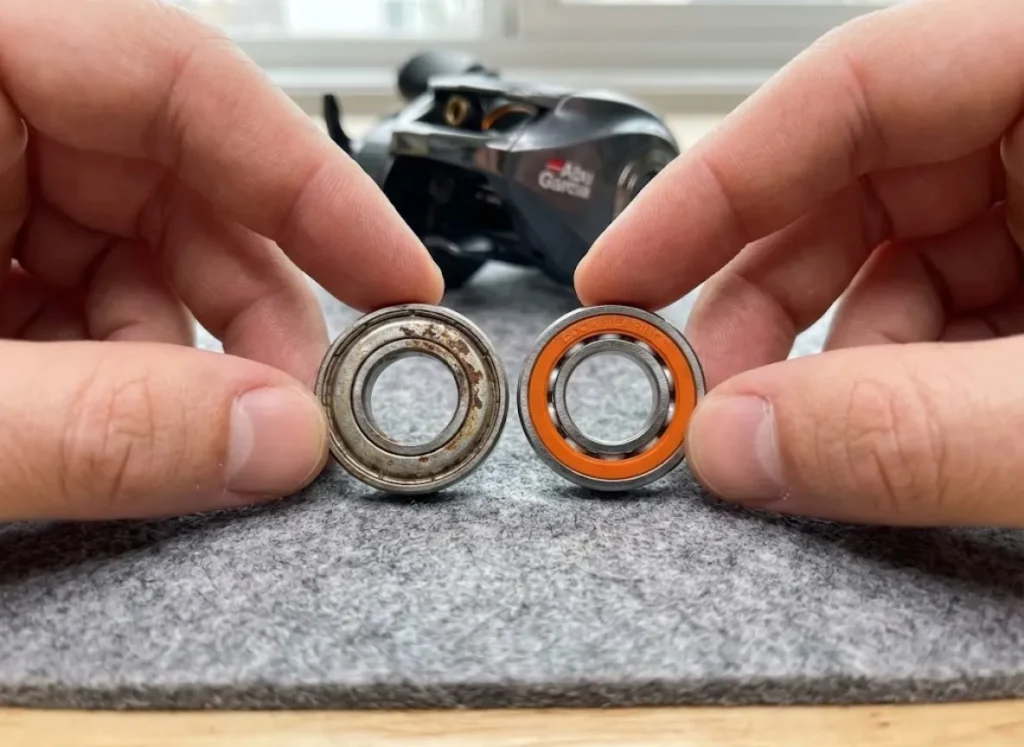
Before you crack open your reel or order replacement parts, you need to understand why bearings fail. The distinction between cleanable problems and terminal damage saves you time, money, and frustration.
Why Saltwater Is Your Bearing’s Worst Enemy
That 440C stainless steel in your spinning reel or baitcasting reel bearings? It’s corrosion-resistant—not corrosion-proof. Here’s what actually happens when salt gets involved.
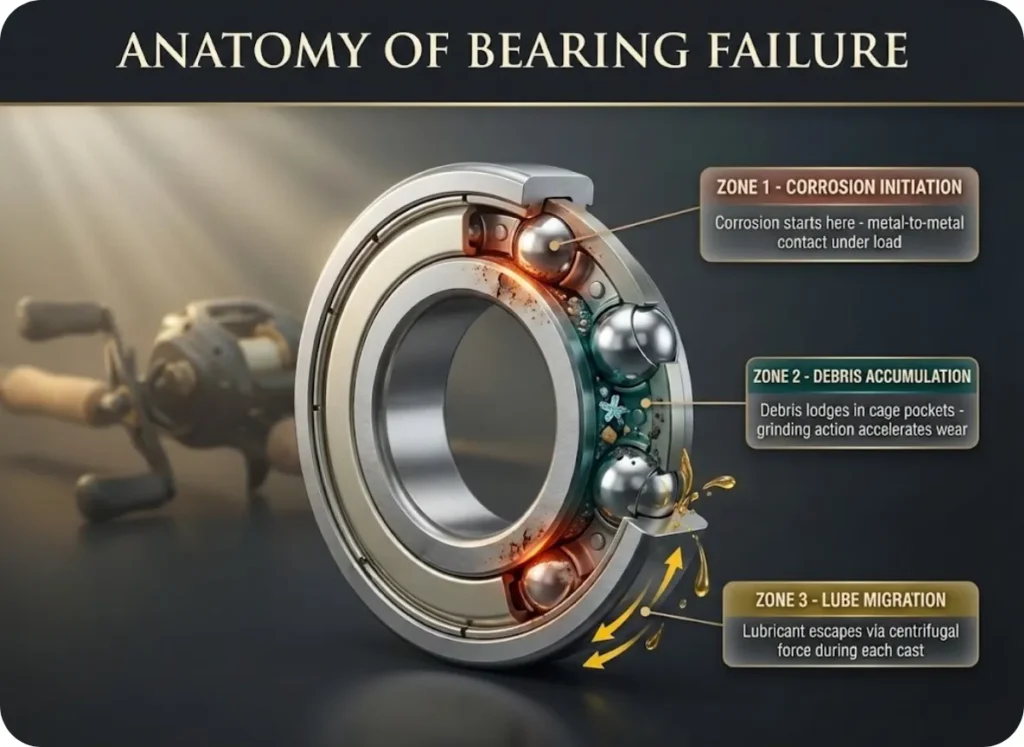
Chloride ions in saltwater attack the protective chromium oxide layer that keeps steel safe. Once that passive layer breaks down, microscopic pitting forms on the races—the inner and outer rings where the balls rotate. You can’t see these pits with the naked eye, but you’ll feel them.
During a hard surf cast, your spool can hit speeds exceeding 20,000 RPM. At those speeds, even micrometer-scale pits create vibration. That’s the grinding feel anglers describe as a “coffee grinder.” The critical thing to understand: cleaning cannot reverse material removal. If the grind comes from pitting rather than debris, that bearing is dead.
Pro tip: The moment you feel grinding under load, stop wasting time with solvent flushes. Pitted races can’t be fixed—only replaced.
The “Coffee Grinder” vs. The “Screaming Reel”: Know the Difference
These two failure modes sound different and mean completely different things for your repair strategy.
Grinding (the “coffee grinder”) is continuous tactile roughness you feel through the handle. This typically indicates pitting corrosion on the race surfaces—permanent damage that cleaning won’t fix.
Screaming or whining is a high-pitched sound during the cast. This is usually lubricant starvation. The oil film has broken down, and you’re getting metal-on-metal contact or cage chatter. The good news? Catch it early, and a proper cleaning plus re-lubrication restores full function.
The danger zone is ignoring the whine. Prolonged operation without proper lube leads to micro-welding—a failure mode where steel balls momentarily fuse to the race under heat, tearing tiny grooves when they break free. That’s permanent damage that started as a simple oil shortage.
Lube Migration: Why Your Bearings Keep Going Dry
Ever wonder why your spool bearings need more attention than the gears? It comes down to physics.
Low-viscosity oils get ejected from the bearing system via centrifugal force at high RPM. Every cast sends microscopic amounts of oil flying outward. That’s why monthly oiling is critical for spool bearings, even if the gears are still well-lubricated.
Grease solves the migration problem, but it creates another: fluid drag. Put grease in a spool bearing and watch your casting distance plummet. The thick lubricant resists high-speed rotation.
Premium bonding oils like TSI 321 offer a middle ground. They chemically adhere to the metal surface, providing a thin protective film that doesn’t fling off during casts. If you’re serious about performance, understanding the visual lubrication map for fishing reels helps you apply the right product in the right place.
The 3-Symptom Bearing Audit: A Field Diagnostic Protocol
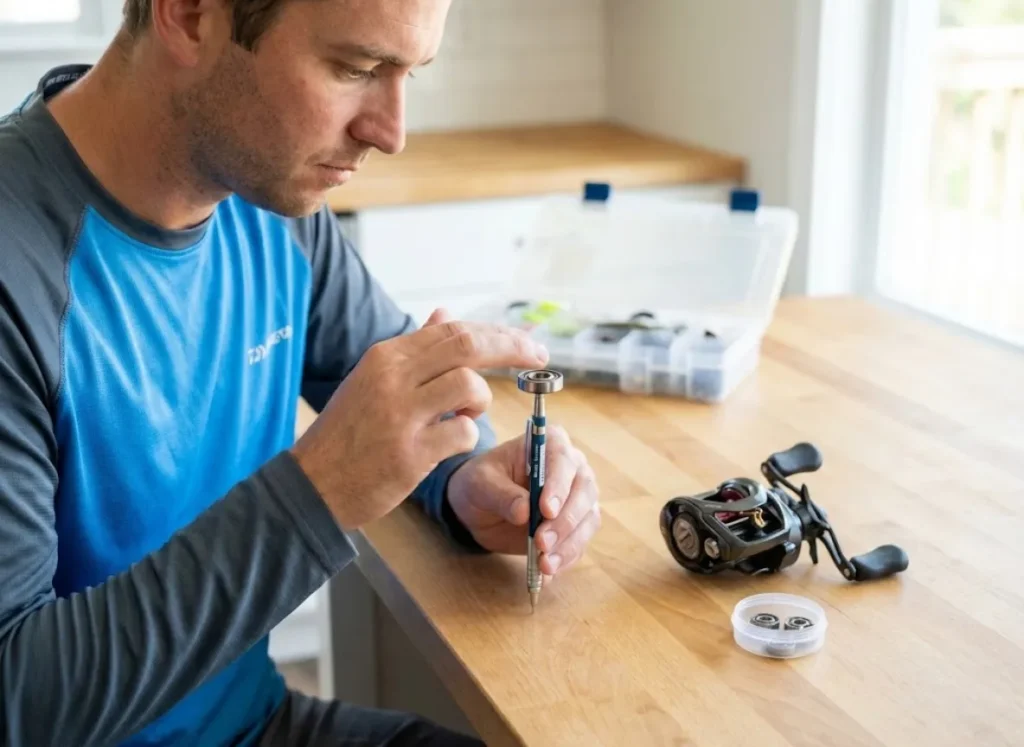
You don’t need expensive tools to diagnose bearing problems. This three-test protocol gives you professional-level diagnosis using items you already have at home.
The Tension Test: Isolating the Noise Source
This test tells you whether your noise is coming from the line roller bearing or somewhere deeper in the reel.
Reel in against resistance—hook a fence post, have a buddy hold the lure, or just retrieve under drag pressure. Listen carefully. Now cut the tension. If the noise stops immediately when you remove line pressure, your culprit is the line roller bearing, not the internal gears or spool bearings.
The line roller sits right at the bail and gets drenched with water on every cast. It’s constantly wet from line dripping, making it the most frequently failed bearing on spinning reels. The good news: it’s also the easiest to access and replace.
The Spin Test: Checking Bearing Health by Hand
This is the pencil spin test that reel technicians use worldwide. It requires removing the bearing from your reel first.
Place the bearing on the tapered tip of a mechanical pencil or wooden dowel. The narrow point centers the bearing. Give it a spin with your finger. A healthy stainless steel bearing should spin for 10-15 seconds if dry, or 3-5 seconds if oiled. It should run silently.
If it stops abruptly, feels gritty like there’s sand inside, or makes a hissing sound, the bearing is compromised. Try a solvent flush first. If it still feels gritty after cleaning and drying, the races are pitted. Time to replace.
Pro tip: I use a mechanical pencil—the narrow tip centers the bearing perfectly for an accurate spin test.
The Q-Tip Test: Detecting Race Pitting
This test catches damage invisible to the eye but critical to performance.
After cleaning your bearing, take a cotton swab and run it gently across the inner and outer race surfaces—the polished channels where the balls roll. On a healthy bearing, the cotton glides smoothly.
If the cotton fibers snag or catch on the metal, you’ve found pitting. Those microscopic craters are invisible to the naked eye but fatal to bearing performance. No amount of oil fixes a pitted race. Replace it.
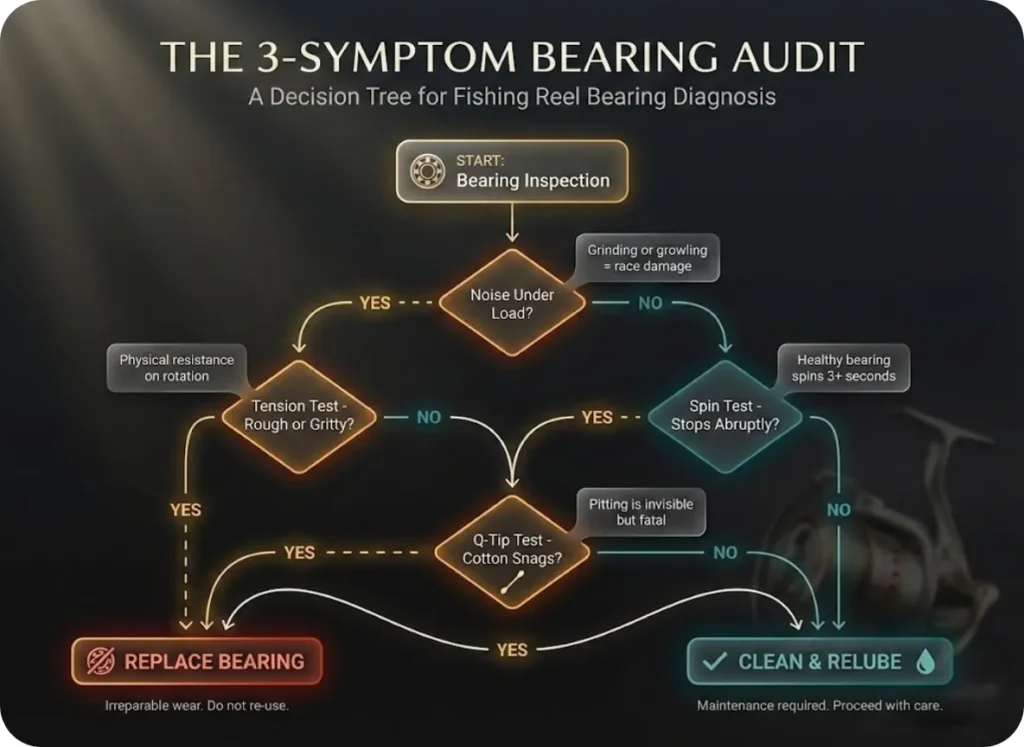
After diagnosing your bearings, a good 3-phase post-trip gear washing protocol prevents you from repeating the problem.
Solvents and Safety: The Chemistry of Bearing Cleaning
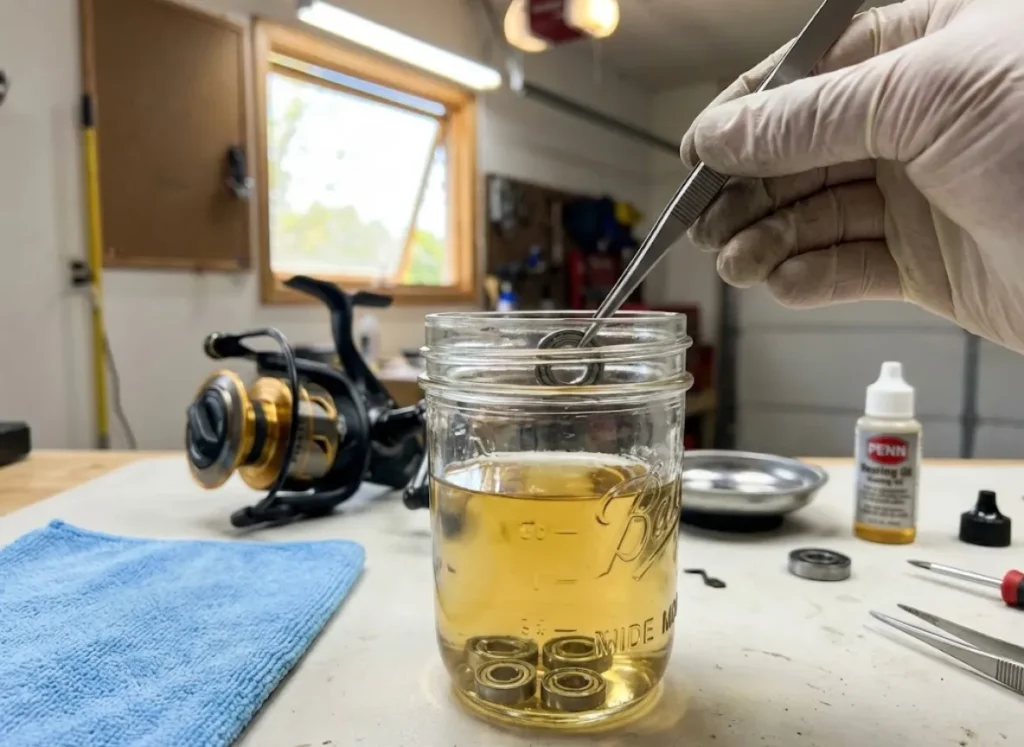
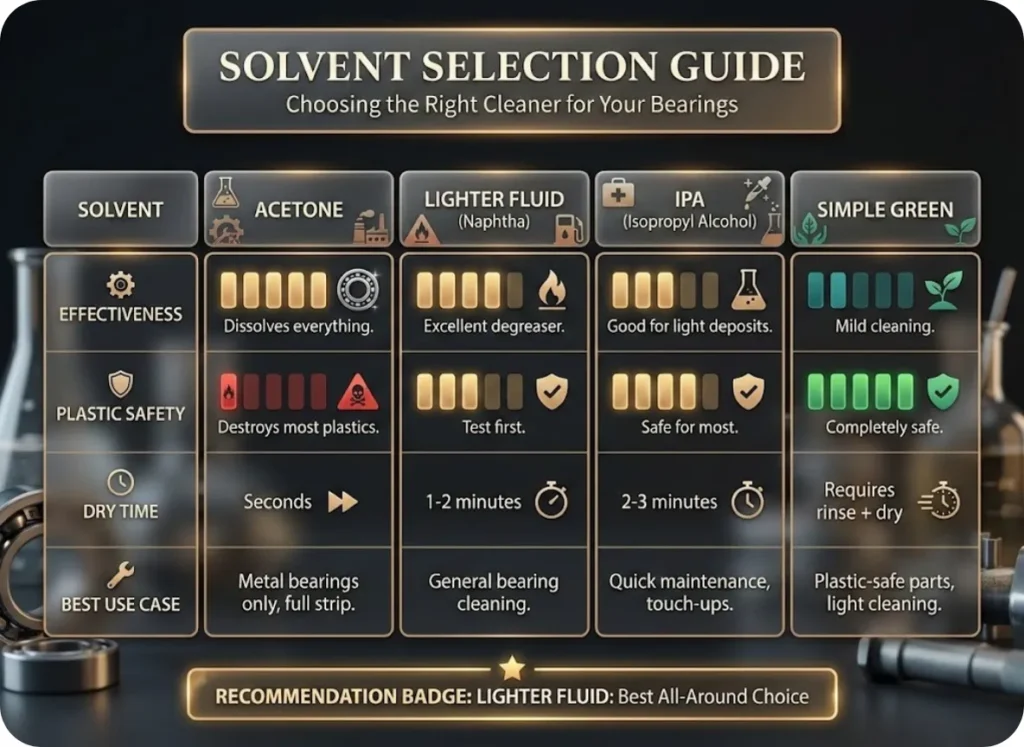
When cleaning wins the diagnosis, you need to choose your solvent carefully. The wrong choice can destroy your reel’s plastic components or leave residue that attracts more contamination.
Acetone vs. Lighter Fluid vs. Simple Green: Which to Use
Acetone is the nuclear option. It strips polymerized grease and marine gunk instantly. But it’s aggressive—soaking any bearing with a plastic cage or rubber seal in acetone melts those components. Never use acetone with the bearing still in your reel. Remove it completely first.
Lighter fluid (naphtha) cleans effectively and leaves a slight oily residue that acts as temporary rust protection while you work. It’s less aggressive than acetone and safer for occasional plastic contact, though removal is still wise.
Isopropyl alcohol (99%) is gentler on plastics but has a catch: it’s hygroscopic, meaning it absorbs moisture from the air. Unless you dry the bearing immediately and thoroughly, you’re potentially introducing water into the race.
Simple Green is water-based and biodegradable—safe for plastics and the environment. But it requires rapid, thorough drying. Flash rust can develop within hours on wet steel.
Whatever you use, spent solvent mixed with marine grease is hazardous waste. Don’t pour it down the drain. Check EPA guidelines for household hazardous waste disposal for proper handling.
The Magsealed Warning: Don’t Void Your Warranty
If you own a Daiwa reel with Magseal technology, step away from the solvent.
Magsealed bearings use magnetic ferrofluid oil to create a waterproof barrier. Any solvent contact strips that proprietary oil completely, destroying the waterproofing and voiding your warranty. Shimano also reserves the right to void warranties on user-modified or non-authorized repairs.
Pro tip: Before you crack open any high-end reel, check the warranty terms. Some repairs are covered free—and your DIY attempt could void that coverage.
Drying Your Bearings Without Destroying Them
Compressed air seems like the obvious drying solution, but it’s dangerous. Uncontrolled air pressure can spin a bearing to RPMs that exceed the cage’s structural limits, potentially causing it to explode in your hand.
Always hold the inner race stationary while applying compressed air. Better yet, let bearings air-dry on a lint-free cloth or use a hair dryer on low heat. Apply one drop of oil immediately after drying to prevent flash rust.
Ceramic vs. Stainless: When Upgrading Makes Sense
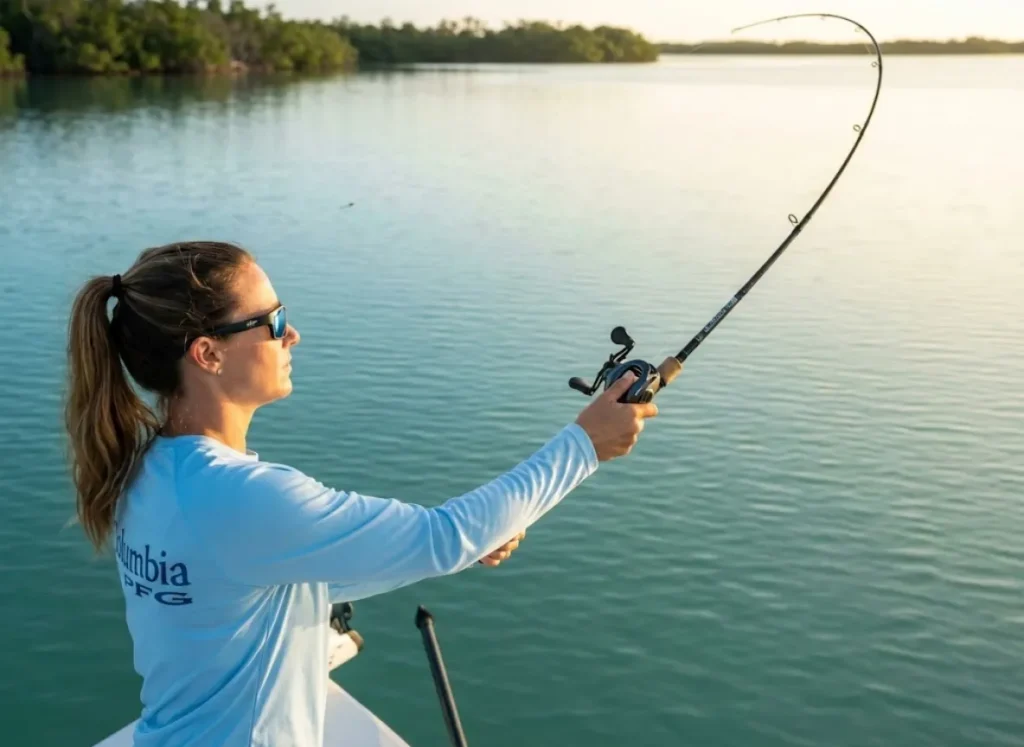
Marketing makes every upgrade sound essential. Here’s the honest assessment of when ceramic hybrid bearings deliver real value—and when you’re wasting money.
The Physics Advantage: Why Ceramics Cast Farther
Ceramic bearings from brands like Boca Bearings and Spool Speed use Silicon Nitride (Si3N4) balls in steel races. This material is about 40% less dense than steel.
Lower mass means lower start-up inertia. The spool accelerates faster during the initial phase of your cast—the moment when you’re trying to get that lure moving from a dead stop. Field tests show casting distance gains of 15-33% depending on your reel’s condition and age.
For finesse anglers fishing light lures, this matters most. Getting a 1/8-ounce jig moving requires overcoming that initial resistance. Ceramic balls reduce it measurably.
Understanding unified casting logic for accuracy helps you maximize the performance gains from upgraded bearings.
The Trade-Off: Brittleness and the “Knuckle Buster” Problem
Ceramic is harder than steel but brittle. It doesn’t deform—it shatters.
Drop a reel with ceramic bearings on concrete, and the balls may crack or fracture. Steel balls would simply dent (a failure mode called Brinelling). For anglers who fish from kayaks, rough surf, or rocky banks, this brittleness matters.
There’s also the acoustic issue. Ceramics are notably louder than steel—they produce a “hiss” or “whir” that sounds alarming if you’re not expecting it. That’s normal, not damage.
And faster spools create more bird’s nest potential. After installing ceramics, you’ll need to recalibrate your brake adjustment knob or mechanical brake. Experienced anglers call this the “knuckle buster” learning curve because untrained thumbs get punished.
The Real ROI: Cost-Benefit for Saltwater Anglers
Here’s where the math actually works out:
Stock stainless bearings cost $3-8 each and last 1-2 years in regular saltwater use. Ceramic hybrids from Boca Bearings or Spool Speed run $15-27 but last 3-5 years because the ceramic balls don’t corrode. Over a five-year period, ceramics often cost less than repeatedly buying stainless replacements.
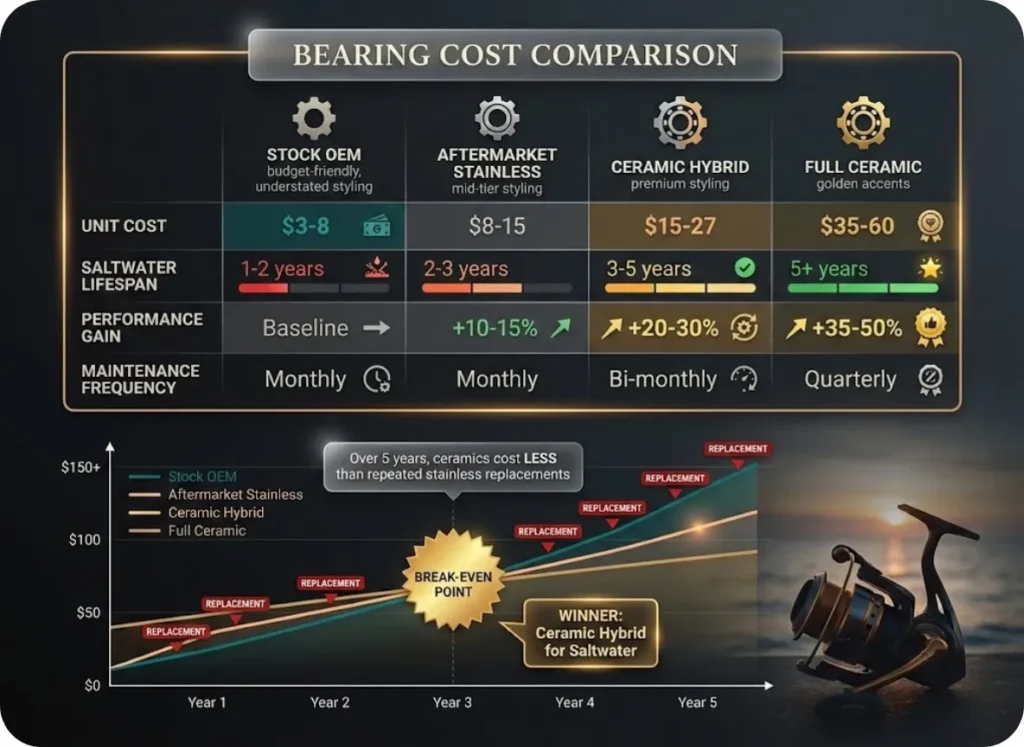
For freshwater-only anglers with proper reel maintenance routines, the upgrade is harder to justify. Stainless works fine with regular care. But if you’re fishing salt regularly—especially on extended fishing trips or deep-sea fishing excursions—ceramics pay for themselves.
The Maintenance Schedule: Prevention Is Cheaper Than Replacement
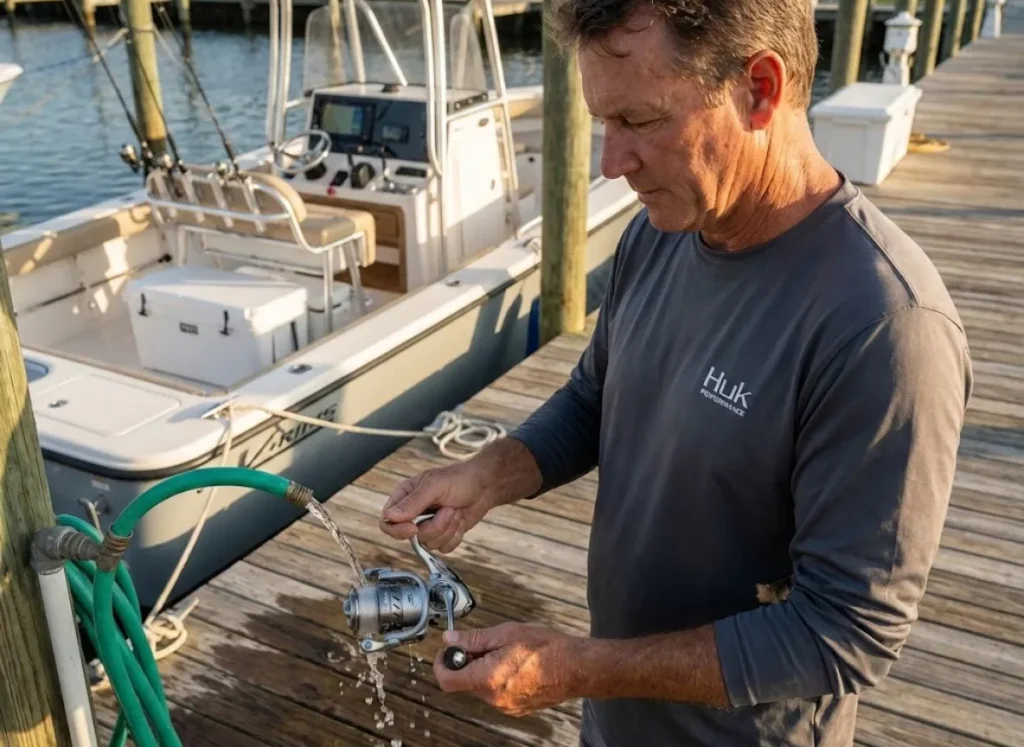
Prevention beats repair every time. This tiered maintenance protocol keeps bearings healthy year-round.
The 4-Level Triage Protocol
Level 1 (After Every Trip): Freshwater rinse the entire reel. Apply a drop of oil to the handle knobs and bail arm pivot points. This takes two minutes and stops salt from crystallizing.
Level 2 (Monthly or Every 5 Trips): Remove the spool and apply a single drop of oil to each spool bearing. That’s it—one drop, not a bath. Over-lubrication causes churning, generates heat, and sends oil migrating onto your drag washers.
Level 3 (Seasonal or Quarterly): Full solvent flush and re-lubrication of all accessible bearings. Remove, clean, dry, and re-oil.
Level 4 (Annual): Complete teardown and inspection for pitting. Replace any compromised bearings. This is your deep audit.
For saltwater anglers, Level 1 is mandatory after every trip. Level 3 should happen every 3-6 months. The full 3-Tier gear care protocol extends bearing life dramatically.
Oil vs. Grease: Matching Lubricant to Location
This is where many anglers go wrong with reel maintenance.
Oil goes where speed matters: spool bearings, line roller bearings, handle knob bearings. Use ISO 22-68 rated oils or bonding formulas like TSI 321.
Grease goes where load protection matters: main gears, pinion support bearings, drag washers. The thicker viscosity protects high-pressure contact points.
Never put grease in a spool bearing. The viscosity creates massive fluid drag at casting speeds, killing your distance. And watch the over-lubrication—too much oil migrates to your drag washers, causing slippage. Master setting fishing drag correctly to understand why this matters.
Pro tip: One drop is enough. If oil is dripping out of your bearing, you’ve used too much.
Conclusion
Diagnosing bearing problems doesn’t require expensive tools or professional expertise—just a pencil, a Q-tip, and the knowledge to interpret what you find.
The grind is terminal, the whine is fixable. A grinding feel means the races are pitted beyond repair. A whining sound usually means lubricant starvation that cleaning and oiling can solve.
Diagnose before you decide. The Tension Test, Spin Test, and Q-Tip Test give you accurate diagnosis in minutes.
Ceramics pay off in salt. The 3x upfront cost delivers 3-5x longer lifespan—net savings over time for regular saltwater anglers.
Next time your reel starts screaming mid-cast, grab a pencil and a Q-tip before reaching for your wallet. That bearing might just need a bath—not a burial.
FAQ
How do you know if reel bearings are bad?
Perform the pencil spin test—a healthy bearing spins 10-15 seconds silently. If it stops abruptly, feels gritty, or hisses, it is compromised. A grinding feel under load usually means terminal damage; a whining sound may just need cleaning and oil.
How often should you replace fishing reel bearings?
With proper maintenance, stainless bearings last 1-2 years in saltwater, 3+ years in freshwater. Ceramic hybrids last 3-5 years in salt. Monthly oiling and quarterly deep cleaning extend bearing life dramatically.
Are ceramic bearings worth it for fishing reels?
For saltwater anglers, yes. Ceramics don’t corrode, last 3-5x longer than stainless, and provide 15-33% casting distance gains. The higher upfront cost ($15-27 vs. $3-8) pays off over 3-5 years. For freshwater-only fishing, the upgrade is optional.
Can you clean fishing reel bearings?
Yes, if the damage is contamination (debris or old grease) rather than corrosion (pitting). Flush with lighter fluid or acetone (bearing removed from reel), then re-oil with one drop. If it still feels gritty after cleaning, the races are pitted—replace it.
What causes fishing reel bearings to fail?
Three main causes: saltwater corrosion attacking the steel’s protective layer; lubricant starvation from centrifugal oil migration; and debris contamination from sand, salt crystals, or dirt. Regular rinsing and monthly oiling prevent all three.
Risk Disclaimer: Fishing, boating, and all related outdoor activities involve inherent risks that
can lead to injury. The information provided on Master Fishing Mag is for educational and informational purposes
only. While we strive for accuracy, the information, techniques, and advice on gear and safety are not a substitute
for your own best judgment, local knowledge, and adherence to official regulations. Fishing regulations, including
seasons, size limits, and species restrictions, change frequently and vary by location. Always consult the latest
official regulations from your local fish and wildlife agency before heading out. Proper handling of hooks, knives,
and other sharp equipment is essential for safety. Furthermore, be aware of local fish consumption advisories. By
using this website, you agree that you are solely responsible for your own safety and for complying with all
applicable laws. Any reliance you place on our content is strictly at your own risk. Master Fishing Mag and its
authors will not be held liable for any injury, damage, or loss sustained in connection with the use of the
information herein.
Affiliate Disclosure: We are a participant in the Amazon Services LLC Associates Program, an
affiliate advertising program designed to provide a means for us to earn advertising fees by advertising and linking
to Amazon.com. As an Amazon Associate, we earn from qualifying purchases. We also participate in other affiliate
programs and may receive a commission on products purchased through our links, at no extra cost to you. Additional
terms are found in the terms of service.