
In this article
The jig had been falling for over a minute. At 500 feet, you feel nothing—no tick, no bottom, just the slow pull of 800 feet of braid disappearing into the abyss. When I finally made contact, the hit came as a subtle loading of the rod tip. Three wraps of the handle later, the fish was gone. I’d set the drag at 20 pounds—my usual shallow-water setting—and that “ghost drag” at the empty spool snapped my 30lb leader like thread.
After two decades chasing reef fish and pelagics in these deep water zones, that break taught me more about the physics of vertical jigging than any gear catalog ever could. Here’s what I wish someone had told me before I dropped my first metal jig past the 400-foot mark—and exactly how to avoid repeating my expensive mistake.
⚡ Quick Answer: The 500ft depth threshold marks where standard jigging fails. Keep your line angle under 20 degrees from vertical, set surface drag at 8-10 lbs (it doubles as the spool empties), use 25% thinner braid like PowerPro Maxcuatro, and never pump the rod—fight with the reel using the “winch” method. A descending device is mandatory for any fish coming up from these depths.
The Physics Behind the 500ft Threshold
Why Standard Techniques Fail Past 400 Feet
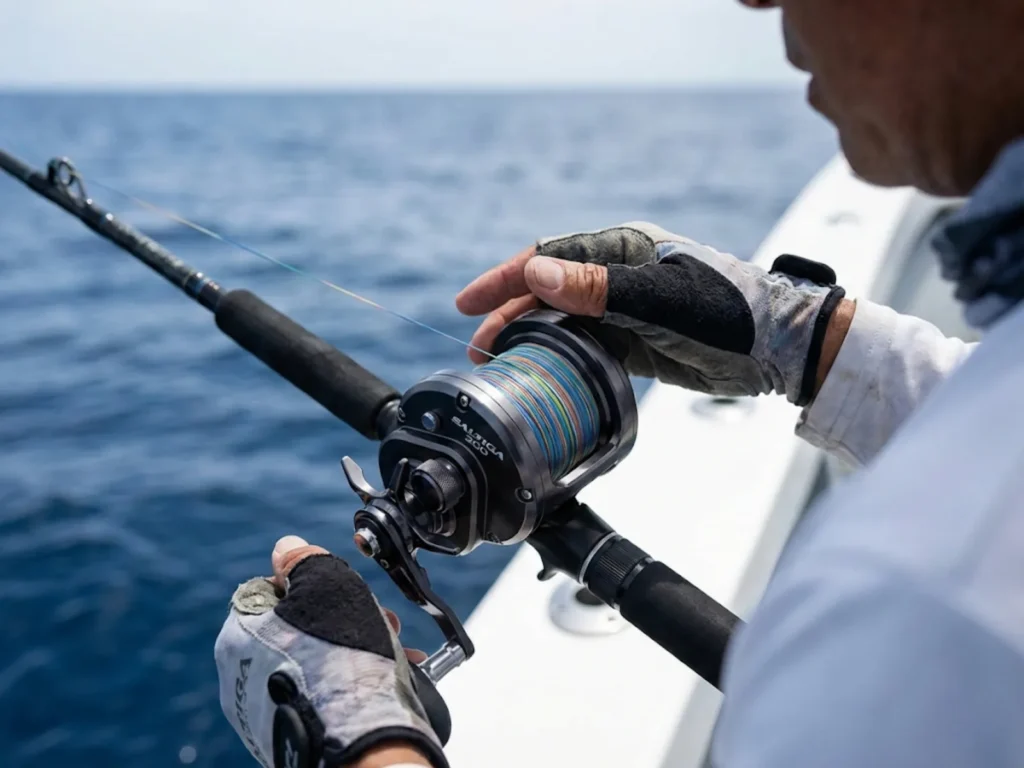
The problem isn’t your rod or your rhythm—it’s the water column itself. At 500 feet, you’re deploying 800+ feet of braided line that acts like a sail in the current. Every inch of that diameter soaks up drag across multiple current layers often moving in opposite directions.
The old 1-2-3 rhythm beat that works beautifully in 100 feet? It dies somewhere around 400. The line stretch and resistance eat your rod input before it ever reaches the jig. Your carefully timed pitch turns into mush at the terminal end.
The baseline rule—1 gram per foot—tells you a 500-foot drop needs a 500g jig. That works in calm conditions with light current. Add moderate current (0.5-1.0 knots) and you need to bump that weight by 25%. Heavy current pushes it to 50% more. Fast drift conditions with cross-currents? You’re looking at 750g to 1000g just to maintain bottom contact.
Pro tip: If you can’t feel the jig working, you’ve lost verticality. Drop heavier or go thinner—but never both at once, or you’ll mask the real problem.
The critical angle is 15-20 degrees from vertical. Once your line exceeds that, the energy from your rod tip transfers to horizontal tension instead of vertical presentation. The jig stops fluttering and just drags sideways. Fish ignore it.
Understanding thermocline identification and fishing depth becomes essential here—those current shears at thermal boundaries are exactly where your line starts bowing.
The Line Diameter Revolution
This is where most anglers get it wrong. They obsess over breaking strength when they should be obsessing over line diameter. At 500 feet, thin is everything.
PowerPro Maxcuatro uses Honeywell Spectra HT fiber to achieve a 25% reduction in diameter for equivalent strength. Their 30lb test runs 0.23mm stated versus standard 30lb at around 0.28mm. That difference sounds small—until you multiply it across 800 feet of deployed line.
The surface area of all that braid creates a massive “sail” catching every knot of current. Thinner diameter means far less drag. You can drop a lighter jig and maintain the same angle, or keep your current weight and stay vertical in conditions that would bow out thicker line.
Independent testing shows Maxcuatro 30lb actually breaks at 42.74lbs—that’s 142% of rated strength. You’re not giving up power for that thinner profile.
The Jig Weight Adjustment Matrix
The 1g/ft rule is your starting point, not your answer. Here’s how to adjust based on what the water is doing:
Neutral current (0-0.5 knots): Standard formula applies. 500 feet = 500g vertical jig.
Moderate current (0.5-1.0 knots): Add 25% weight. You’re now looking at 625g for that same 500-foot drop.
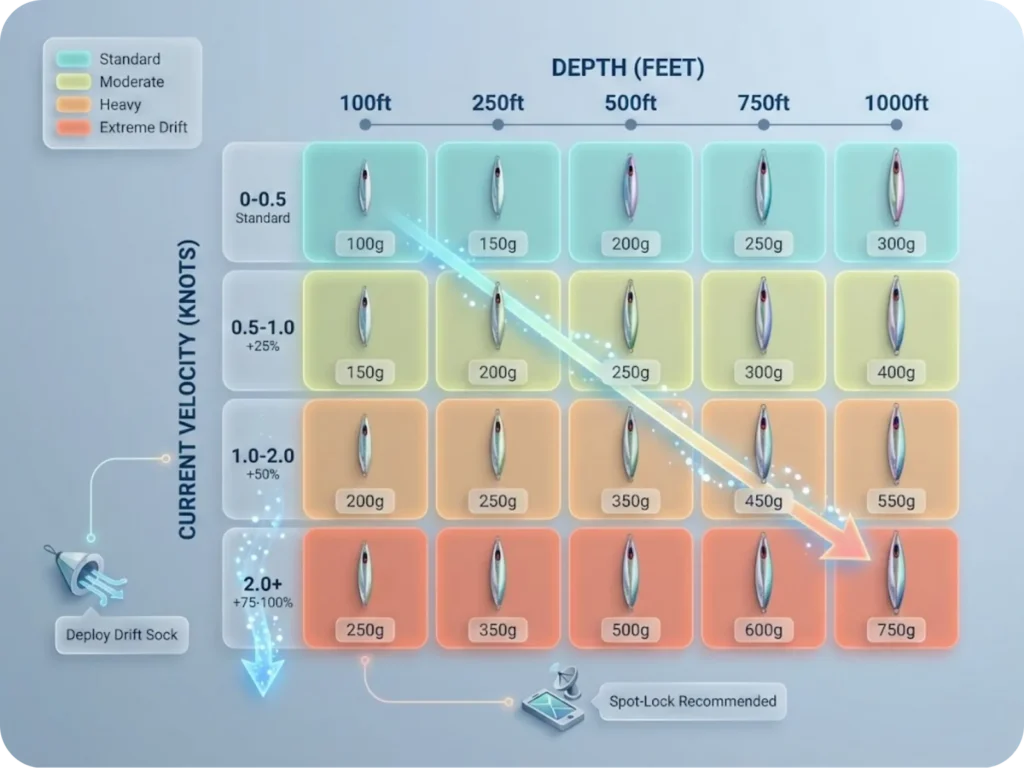
Heavy current (1.0-2.0 knots): Add 50%. That’s 750g territory—you’re into the Submission Fishing Samurai weight class.
Fast drift with cross-current: Add 75-100%. If you’re burning through heavy jigs just to touch bottom, consider deploying a drift sock or using GPS Spot-Lock to neutralize boat drift management.
The Empty Spool Problem: Why Your Drag Doubles at Depth
Torque Amplification at the Reel
Here’s the $500 lesson I learned the hard way: your reel’s drag setting lies to you at depth.
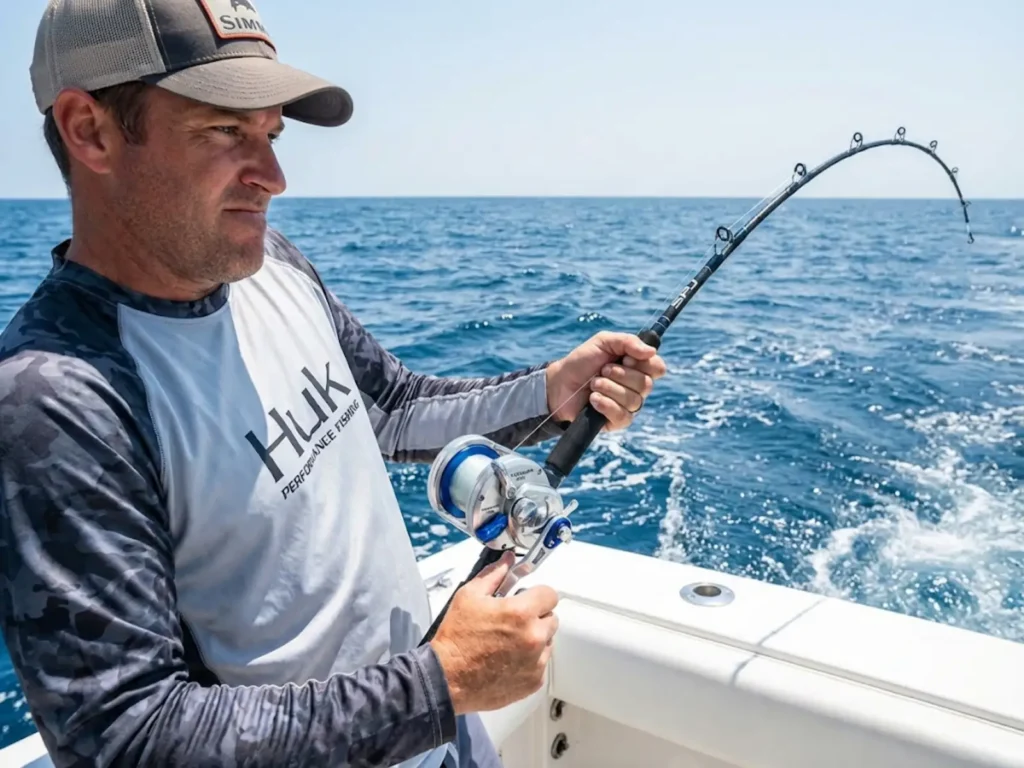
The spool works as a lever arm. When the spool is full, that lever arm is long. When you’ve deployed 500 feet of line, the spool radius shrinks dramatically—and the lever arm shortens with it.
With a shorter lever, the same drag tension requires more force to overcome. Field data shows that a drag set to 20lbs at the surface effectively becomes 40-60lbs when the spool is at half capacity. That “ghost drag” routinely exceeds leader strength, hook hold, or both.
This explains the “mystery breaks” that happen halfway up. You hook a good fish, fight it for 10 minutes, and then—nothing. The effective drag exceeded what your system could handle.
The fix is counterintuitive: set your surface drag lighter than you think you need—8-10lbs for deep drops. The spool depth contraction will do the rest. Resist the urge to crank down when a big fish runs at depth. The emptying spool is already increasing pressure automatically.
Understanding drag system physics helps you anticipate this behavior before it costs you a fish-of-a-lifetime.
Retrieval Rate Collapse
Your reel’s gear ratio is a fixed number—but what actually reaches the jig isn’t fixed at all.
Retrieval inches per turn depends on spool circumference. A reel rated at 46 inches per crank might deliver only 30 inches when you’re down 500 feet with a half-empty spool. That 35% loss of speed kills your ability to work speed jigging techniques that rely on rapid bursts.
The solution comes from specialized deep water reels. The Shimano Ocea Jigger series uses narrow spool designs that minimize diameter loss as line deploys. High gear ratio options—like the 2000NR-HG at 6.2:1—compensate for reduced circumference. The Torium reel at $220-300 is functional but lacks the longevity of the Ocea Jigger at $539-689.
Star Drag vs Lever Drag at Depth
For vertical jigging deep water technique, star drags beat lever drags. Here’s why.
Star drags disengage the spool completely during free spool. Zero friction on the drop means lightweight jigs reach 500 feet faster. Lever drags maintain some resistance even in free spool, slowing your drop.
Star drags also don’t impose side-loads on bearings when you increase pressure. Lever drags often force you to fight harder as drag increases—physically exhausting when you’re winching a 40lb grouper from the abyss.
The Shimano Grappler paired with an Ocea Jigger 2000NR-HG (22lb max drag) handles most South Florida reefs work. For heavy-duty stuff—tilefish, giant grouper, swordfish—step up to the Ocea Jigger 4000 with its 40lb max drag.
Deep Water Jig Selection: Hydrodynamic Profiles That Work
The Shimano “Butterfly” System
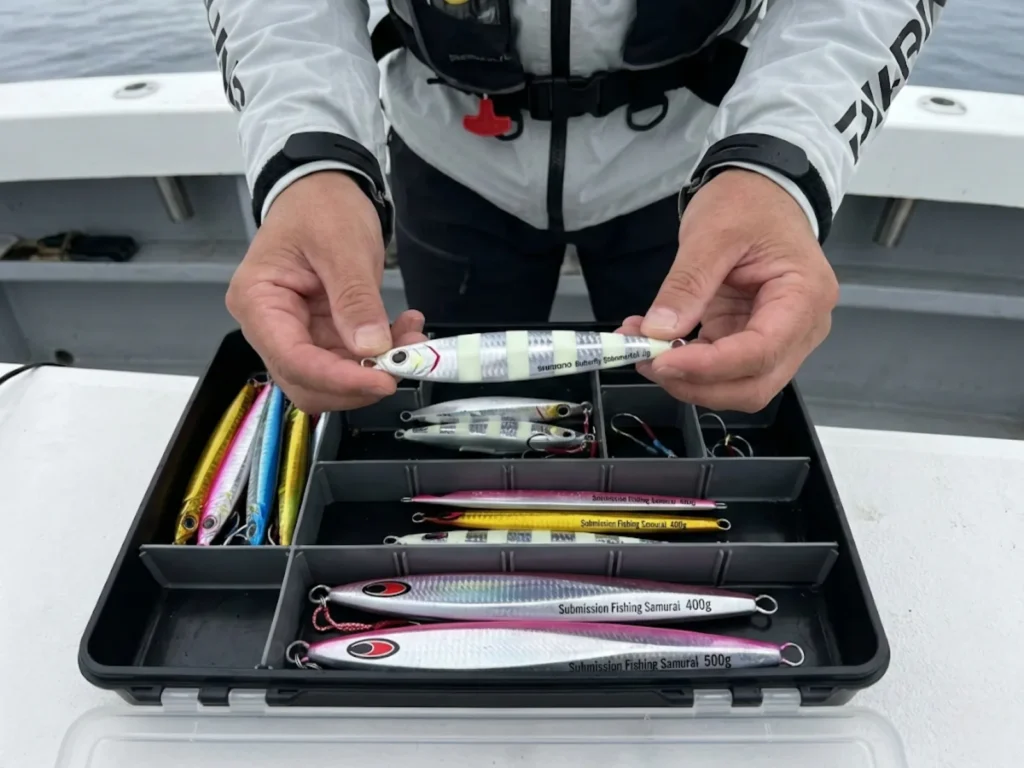
Shimano’s butterfly-style jig lineup covers the full spectrum of deep water applications, but each profile behaves differently at 500 feet.
The Shimmerfall jig uses a “Flat Stick” slender design that sinks fast—cutting water like a knife. But on the pitch, it transitions to a flutter action. Through-wire construction handles heavy jaws. At 210g max weight, you may need heavier options for true 500-foot work in current—but for mild conditions, it’s deadly.
The Wingfall jig runs wider with a teardrop shape and “cradle swing” action on the fall. Scale Boost holographic technology mimics baitfish scales using reflected bioluminescence. Beautiful action, but that wide profile catches current hard at 500 feet—save it for slow drift days.
The Flat Fall wobbles horizontally as it drops, center-balanced for stability. The slow sink rate makes 500-foot work difficult unless you’re running 300g+ versions.
Understanding fish vision and lure color selection explains why color matters less than contrast and glow at these depths.
Heavy Metal Solutions for the Abyss
When Shimano’s weights top out, boutique manufacturers fill the gap.
Submission Fishing’s Samurai and Heavy Ogre come in 400g, 500g, and 600g—purpose-built for the 500ft depth threshold and beyond. The asymmetrical “knife” profile slices current, minimizing travel time to bottom. Through-wire eyelets and fade-resistant paint acknowledge that deep structure is abrasive.
These quality jigs cost $21-36 each. Budget for losing $100+ in terminal tackle per trip. Bottom composition at 500 feet is unforgiving, and sharks patrol these zones.
Color Strategy in Zero Visibility
Forget what works in shallow water. At 500 feet, you’re fishing the aphotic zone.
Red light disappears within 15-30 feet. By 500 feet, the environment has gone monochromatic blue-violet. Standard “natural” colors are invisible.
Glow jigs with zebra patterns (stripes of phosphorescent paint) create high contrast that mimics deep-sea bioluminescence. UV-reflective coatings bounce invisible energy back as visible light to fish with UV-sensitive vision. Solid black or dark purple (“Kyorin Blue Pink”) silhouettes strongly against faint downwelling light.
Pro tip: Charge your glow jigs with a UV flashlight every 10 drops. The luminescence fades faster than you think at these depths.
Slow Pitch Jigging Protocol: The Recoil Mechanic
The Five-Phase Sequence
Slow-pitch jigging dominates deep water because it uses the rod’s recoil rather than the angler’s muscle. At 500 feet, that matters—you can’t sustain aggressive snapping for a full day.
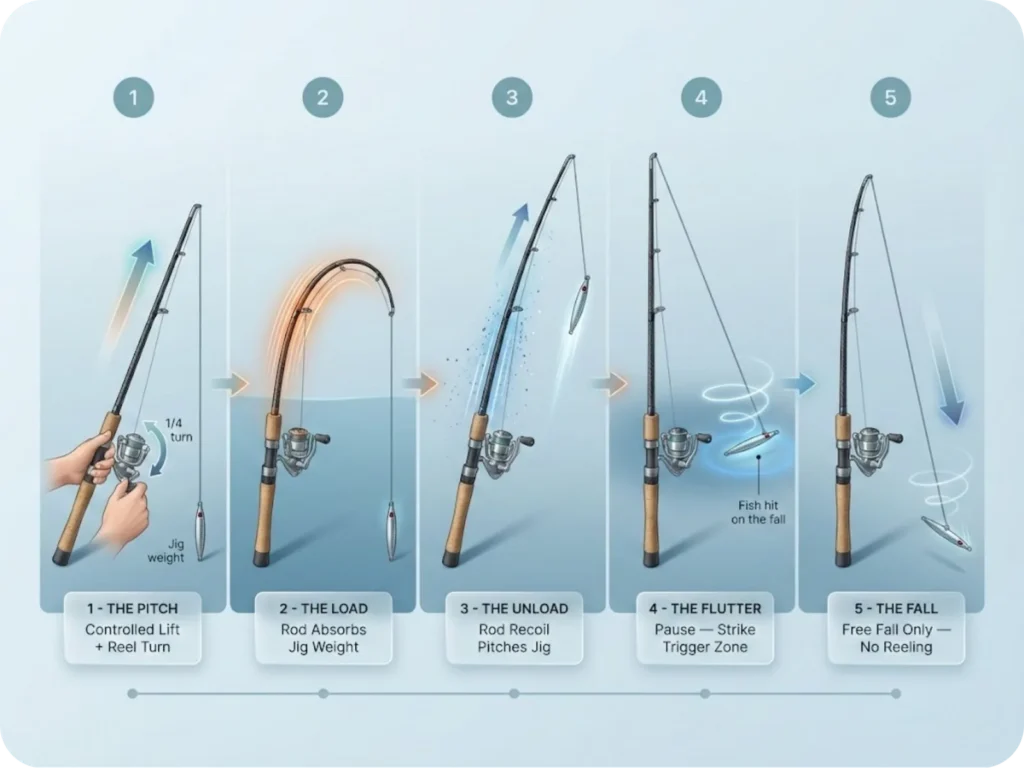
Here’s the sequence, phase by phase:
The Pitch: Synchronized reel handle turn (1/4 to 1 full rotation) combined with a gentle rod lift. Not a yank—a controlled lift.
The Load: The rod tip absorbs the weight of your 500g jig, bending into the parabolic section.
The Unload: The rod springs back—recoils—pitching the jig upward through the water column.
The Flutter: You pause. The jig, momentarily weightless, turns horizontal and flutters down. This is the strike trigger. Fish hit on the fall.
The Fall: Follow the line down with your rod tip, but don’t reel. Free fall only. Reeling during the fall kills the flutter action.
At 500 feet, your pitch must be more deliberate than in shallower water. Direct the rod lift outward to help manage line angle. Extend your pause—the lag time caused by all that line means the jig needs extra seconds to complete its action.
Understanding rod action for lure manipulation clarifies why SPJ rods are designed for recoil, not lifting.
High-Speed Vertical for Pelagics
When tuna and amberjack ignore the slow-pitch jigging approach, shift to the “escaping prey” method.
Drop to bottom. Immediately whip the rod handle under your arm while cranking the reel as fast as physically possible. You’re simulating baitfish fleeing for the surface—triggering pure reaction strikes.
This only works with “knife” slender jigs—long and thin to minimize drag. Flat Fall profiles create too much resistance, exhausting you and bowing the line. Reserve this technique for confirmed pelagic marks on your sonar ‘s physically demanding to prospect with.
The “Dead Stick” Alternative
Sometimes the technique is no technique at all.
Hold the jig perfectly still, 6 inches off bottom. Let the boat’s subtle rocking impart microscopic movement—a lifelike quiver that aggressive snapping could never replicate. Negative-mood fish respond to this when nothing else works.
The freshwater Lake Trout variant—the “Cookie Method”—tips the jig with a piece of sucker belly, adding scent trail to the visual presentation. Essential for deep water bass and trout in 100-300 foot zones of the Great Lakes and northern Canadian lakes.
Failure Mode Analysis: Why You Lose Fish at 500ft
Rod Failure: The High-Sticking Error
SPJ rods are engineered for lure manipulation, not for lifting. They’re high-carbon, thin-walled—built to recoil, not to winch.
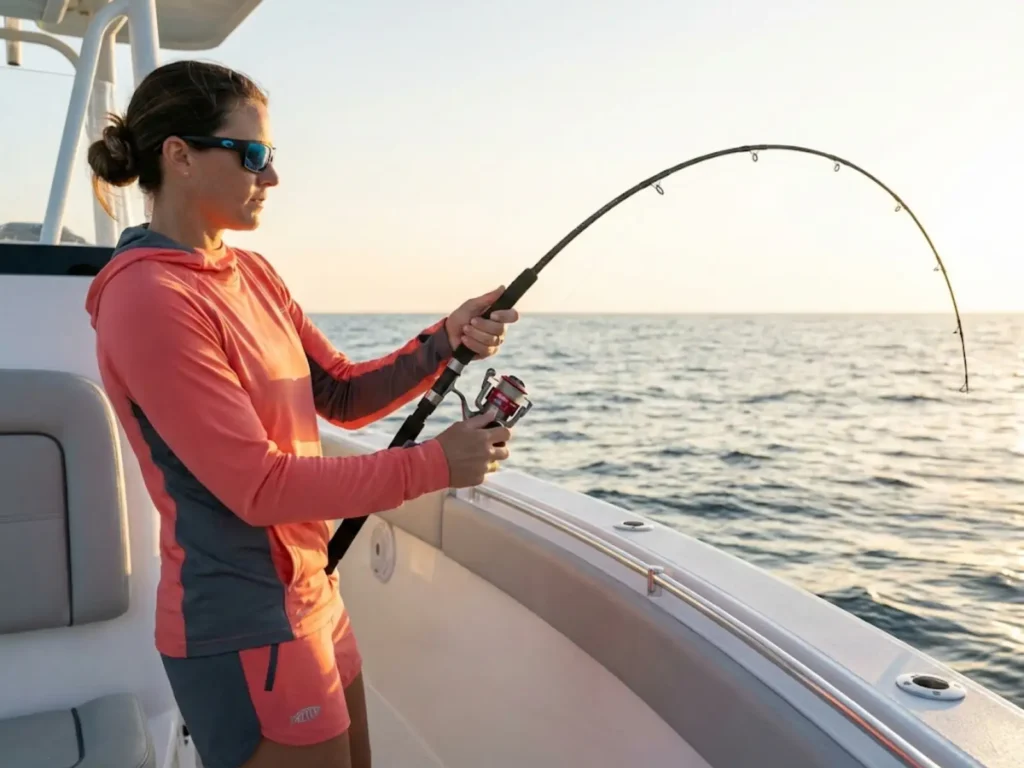
The killing error is “high sticking”—lifting the rod past 60-90 degrees while fighting a fish. This transfers load from the powerful butt section to the fragile tip. The result: catastrophic snap, often at the worst possible moment.
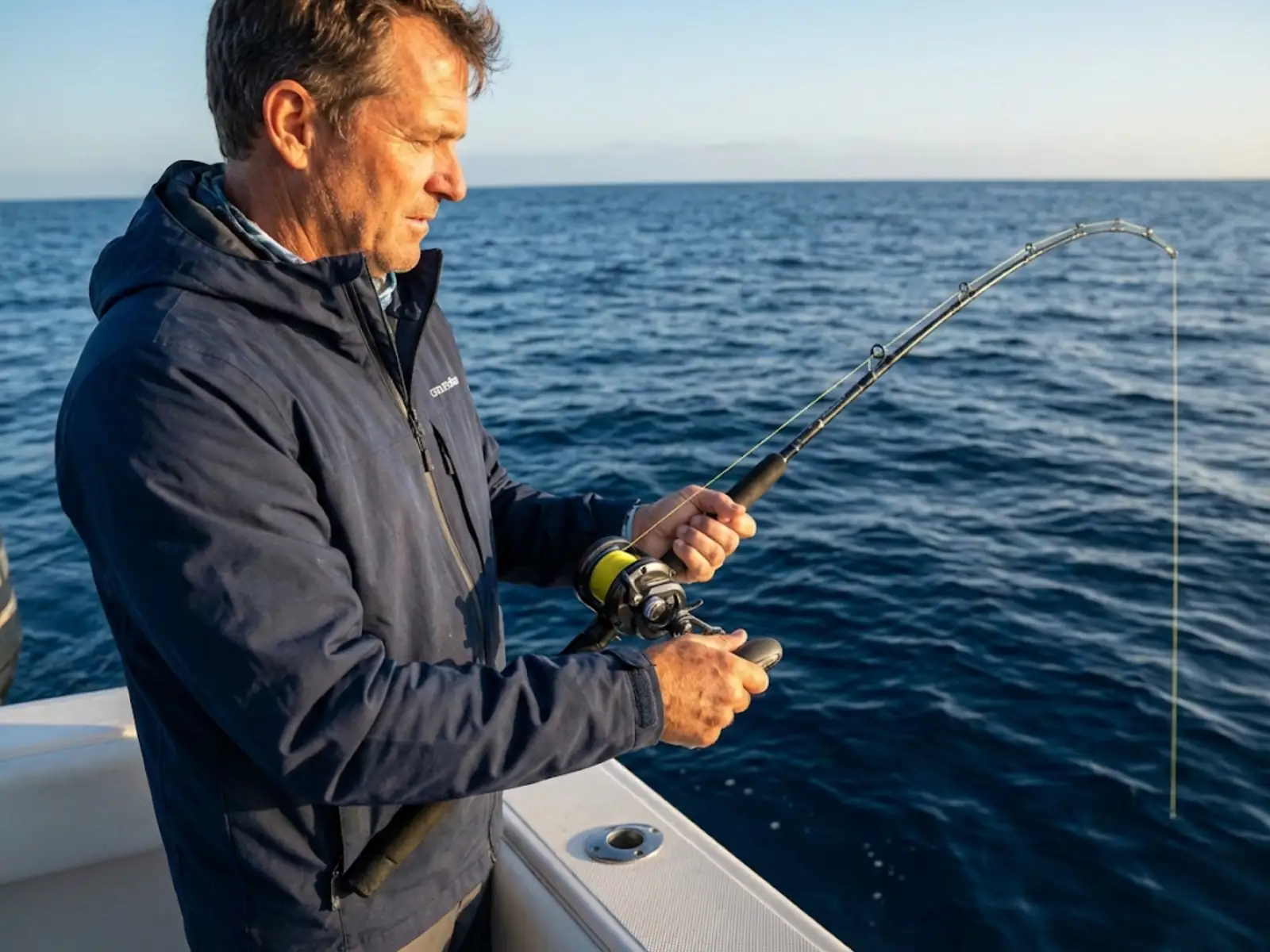
Correct protocol: point the rod tip down toward the water or parallel to the surface. Fight with the reel’s torque. The rod should only load deep in the parabolic butt section—never the tip.
Knowing fishing rod warranty exclusions for high-sticking might save you an expensive surprise when that warranty claim gets denied.
Pro tip: “The rod is the antenna, not the winch. Let your reel do the work.” —Benny Ortiz, Shimano Pro
The “Mystery Break” Diagnosis
Line failures at depth get blamed on bad braid, but the real causes are mechanical:
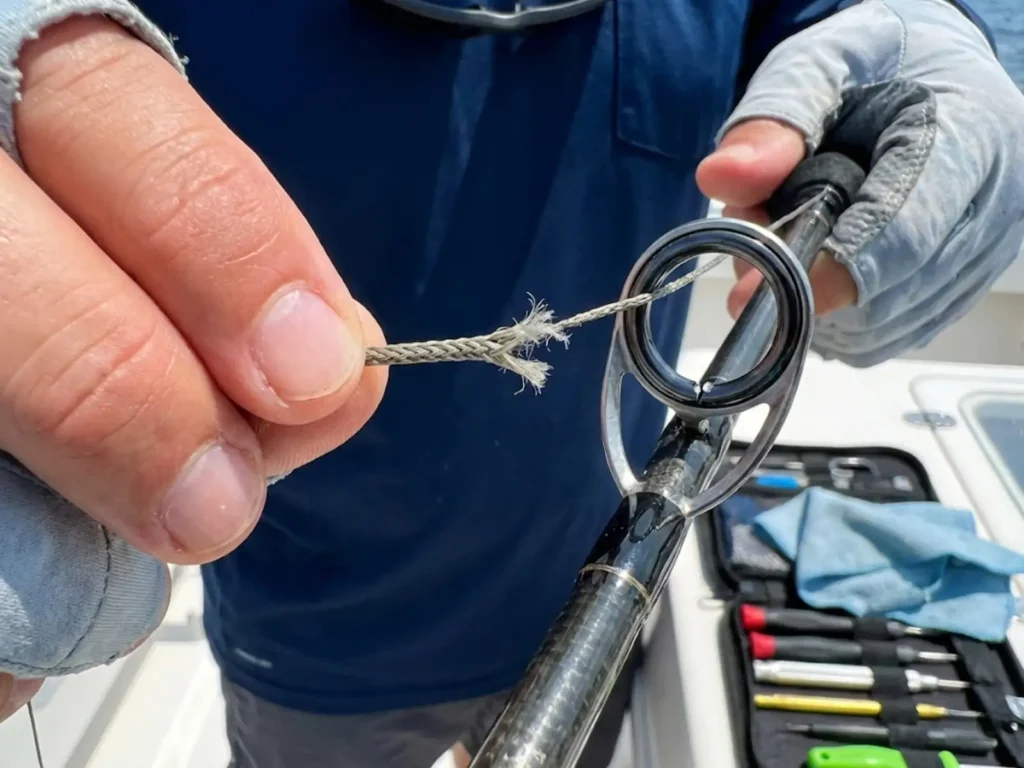
Guide abrasion: Micro-fractures in ceramic rod guides act like razors under 500-foot tension. Run a cotton swab through every guide monthly—any snag means replacement before your next trip.
Spool dig-in: Line spooled under light tension buries under the outer layers when a heavy fish runs. On the next burst, the line catches and snaps instantly. Deep-water reels must be machine-spooled under heavy tension.
Heat shear: Extended drag runs generate friction heat at the rod tip and line roller. Braided line has a low melting point—prolonged runs without lubrication can degrade integrity in a single fight.
Hook Hole Enlargement Prevention
The extended fight time from 500 feet—often 10+ minutes—gives the hook time to wear a larger hole in the fish’s jaw. If you “pump” the rod, creating momentary slack, the hook simply falls out of the enlarged opening.
The fix is the “winch” method: maintain constant, unwavering tension by reeling steadily. Point your rod at the fish. Use the reel’s superior torque. Never pump. This keeps the hook pinned regardless of how much the hole has enlarged.
The Ethical Imperative: Barotrauma and Descending Devices
Pressure Changes and Fish Survival
Every fish you bring from 500 feet to the surface undergoes violent decompression.
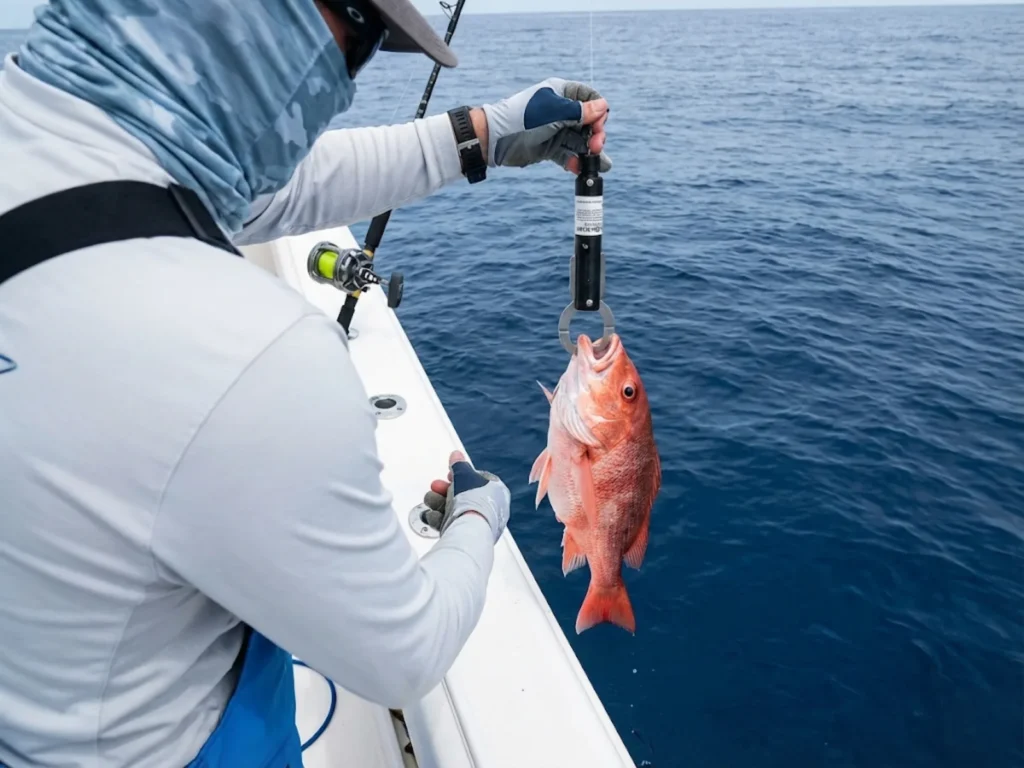
At 500 feet, that fish is under roughly 16 atmospheres of pressure. At the surface, it’s down to 1 atmosphere. The gases in the swim bladder expand explosively—crushing organs, forcing the stomach out through the mouth, bulging the eyes.
Most vertical jigging targets—grouper, snapper, rockfish—have closed swim bladders that can’t rapidly off-gas. Releasing a bloated fish is a death sentence. It cannot submerge, becoming easy prey for sharks and birds, or dying of exposure.
The ethical angler accounts for this before the first drop, not after the first fish. Consult the Return ‘Em Right barotrauma mitigation guidelines backed by NOAA for safe release protocols.
Descending vs Venting: The Protocol
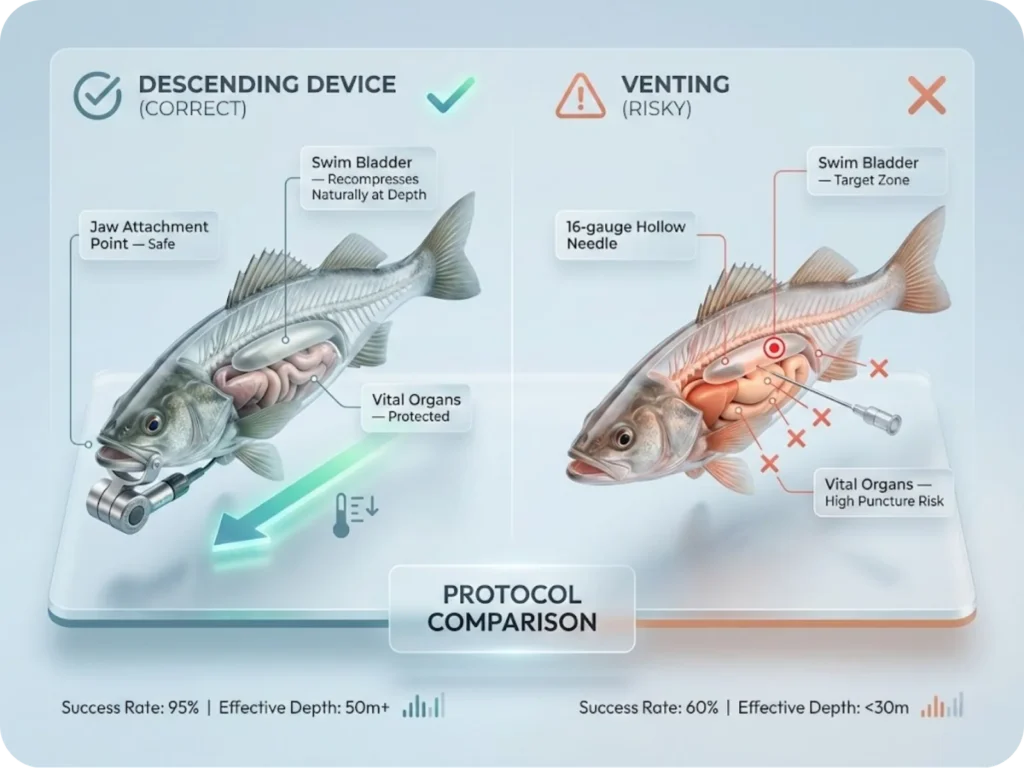
Descending devices are the gold standard. Tools like the SeaQualizer attach to the fish’s jaw and carry it back down to depth, releasing automatically at a preset pressure. The gases re-compress naturally, reversing barotrauma symptoms without surgery. The device also protects the fish from surface predators during recovery.
Venting—puncturing the swim bladder with a 16-gauge hollow needle—is riskier. Done incorrectly, you puncture vital organs. Even done correctly at 500-foot depths, the gas volume may be too high for venting to help.
Any vessel working past 100 feet must carry rigged descending gear. It’s as essential as the reels themselves. See our roundup of the best fish descending devices for one-handed use to find what fits your cockpit setup.
Conclusion
The 500ft depth threshold isn’t just a number—it’s where vertical jigging transforms from feel to applied physics.
Three principles will determine whether fish come over the rail or vanish into the void: Keep your line angle under 20 degrees by matching diameter to conditions and weight to current. Set surface drag at 8-10 lbs because the emptying spool amplifies pressure automatically. Fight with the reel, not the rod—point down, winch steady, never pump.
Next time you drop past 400 feet and feel the jig go silent, pay attention to your line angle during the fall. That exact moment when the scope builds? That’s where standard technique dies—and where the 500ft threshold rule takes over.
FAQ
What weight jig do I need for vertical jigging at 500 feet?
Start with the 1g/ft rule (500g for 500ft), then adjust for current. Add 25% in moderate current, 50% in heavy current, or up to 100% in fast drift conditions. Line diameter matters as much as jig weight—switching to 25% thinner braid often works better than adding more lead.
What’s the difference between vertical jigging and slow pitch jigging?
Vertical jigging is the broad category of dropping lures straight down. Slow-pitch jigging is a specific technique using the rod’s recoil to work the jig. The rod loads under the jig’s weight, then pitches it upward as it springs back. At 500ft, SPJ is preferred because it conserves energy during extended sessions.
How do I prevent losing fish halfway up from deep water?
Most deep-water losses come from hook hole enlargement during extended fights. Abandon pump and wind—it creates slack that lets the hook fall out. Use the winch method: point the rod at the fish and reel steadily with constant tension.
Why does my drag feel stronger when fishing deep?
As line deploys, the spool diameter shrinks. The smaller spool requires more force to pull line against the same drag setting. Effective drag can double at half-spool capacity. Set surface drag 30-40% lighter than your shallow water settings.
Can I use freshwater bass tackle for deep vertical jigging?
No. Freshwater gear lacks the line capacity, drag power, and torque for 500ft+ drops. Lake Trout jigging at 100-200ft works with adapted medium-power rods, but saltwater deep drops require specialized reels like the Shimano Ocea Jigger or Daiwa Saltiga and SPJ rods rated for jigs up to 600g.
Risk Disclaimer: Fishing, boating, and all related outdoor activities involve inherent risks that
can lead to injury. The information provided on Master Fishing Mag is for educational and informational purposes
only. While we strive for accuracy, the information, techniques, and advice on gear and safety are not a substitute
for your own best judgment, local knowledge, and adherence to official regulations. Fishing regulations, including
seasons, size limits, and species restrictions, change frequently and vary by location. Always consult the latest
official regulations from your local fish and wildlife agency before heading out. Proper handling of hooks, knives,
and other sharp equipment is essential for safety. Furthermore, be aware of local fish consumption advisories. By
using this website, you agree that you are solely responsible for your own safety and for complying with all
applicable laws. Any reliance you place on our content is strictly at your own risk. Master Fishing Mag and its
authors will not be held liable for any injury, damage, or loss sustained in connection with the use of the
information herein.
Affiliate Disclosure: We are a participant in the Amazon Services LLC Associates Program, an
affiliate advertising program designed to provide a means for us to earn advertising fees by advertising and linking
to Amazon.com. As an Amazon Associate, we earn from qualifying purchases. We also participate in other affiliate
programs and may receive a commission on products purchased through our links, at no extra cost to you. Additional
terms are found in the terms of service.