
In this article
Walk into any tackle shop in December and the wall is lined with ice fishing line and cold-weather formulas promising to fix everything that goes wrong once the water turns cold. Most of it you don’t need. Ask anyone who’s spent a January morning hole-hopping for perch: the angler with limp mono is fishing while the one who spooled leftover summer fluorocarbon is picking coils off the reel. The line that behaves in the cold usually isn’t the one with the loudest label, and figuring out cold water line performance comes down to a few simple facts about how each line reacts to freezing.
Here is how the three line types stack up the moment the water turns cold.
| Line Type | How It Acts in the Cold | Freezing & Iced Guides | Best Use |
|---|---|---|---|
| Monofilament | Stays limp and flexible even below zero; low memory in a cold formula; built-in stretch | Resists freezing best; surface ice snaps off with a finger | The cold-weather default; tip-ups, panfish, forgiving presentations |
| Fluorocarbon | Low stretch, low visibility, sinks fast; standard summer formula stiffens below ~20°F | Won’t ice from the inside, but surface ice clings harder once it forms | Clear-water leaders and finesse; cold formulas for deep cold |
| Braid | Most sensitive, lowest memory, zero stretch | Freezes worst; the weave wicks water into a frozen cable and locks the guides | Heated shelters or roughly 20°F and up |
How Mono, Fluoro, and Braid Behave in Cold Water
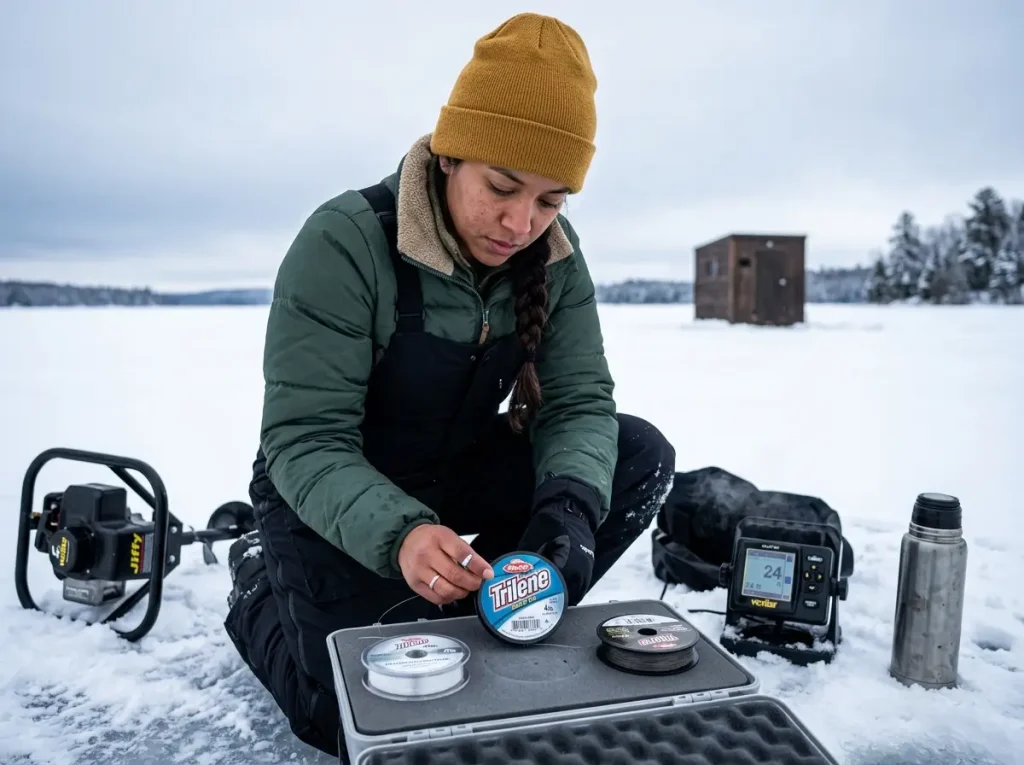
Before we get into the why, here’s the short version of the mono vs fluoro vs braid question every cold-water angler should carry in their head. The three lines behave like three different personalities once it gets cold, and knowing which is which saves you a frustrating morning. If you want the ground-level version of how each line type is built and where it shines, our complete guide to fishing line covers all of it, and this article is the cold-weather chapter.
Monofilament Is the Cold-Weather Default
Monofilament is the line that keeps behaving when everything else gets difficult. It stays flexible and resists ice buildup better than the other two, even when the thermometer drops below zero. It also carries natural line stretch, which gives you forgiveness on a hard hookset and a livelier flutter on a jig. For most people fishing most cold days, plain mono is the answer, and it happens to be the cheapest of the three.
Fluorocarbon Brings Stealth With a Stiffness Catch
Fluorocarbon earns its spot on different merits. It nearly vanishes in clear water, sinks fast, stretches very little, and shrugs off abrasion. That makes it the leader of choice in cold, gin-clear winter water where fish get a long, slow look at everything you throw.
The catch is that standard fluoro, the kind built for summer bass fishing, stiffens and turns brittle below about 20°F. Spool that straight onto an ice reel and you’ll fight coils all day.
Braided Line Is Sensitive Until It Freezes
Braided line, sometimes sold as superline, gives you the most sensitivity and the least line memory of anything on the shelf. Inside a heated shelter, it’s a genuine pleasure to fish. Out in the wind at single digits, it’s the worst of the three, because the woven fibers soak up water that freezes into a stiff cable and locks your guides shut.
Braid is a tool for specific situations, not a do-everything default. We dig into where it actually earns its keep in our guide to the best braided fishing line, and the short version is that the cold is not its season.
The clearest way to see the difference is to watch all three handled side by side on a cold day.
Why Cold Water Changes Your Line
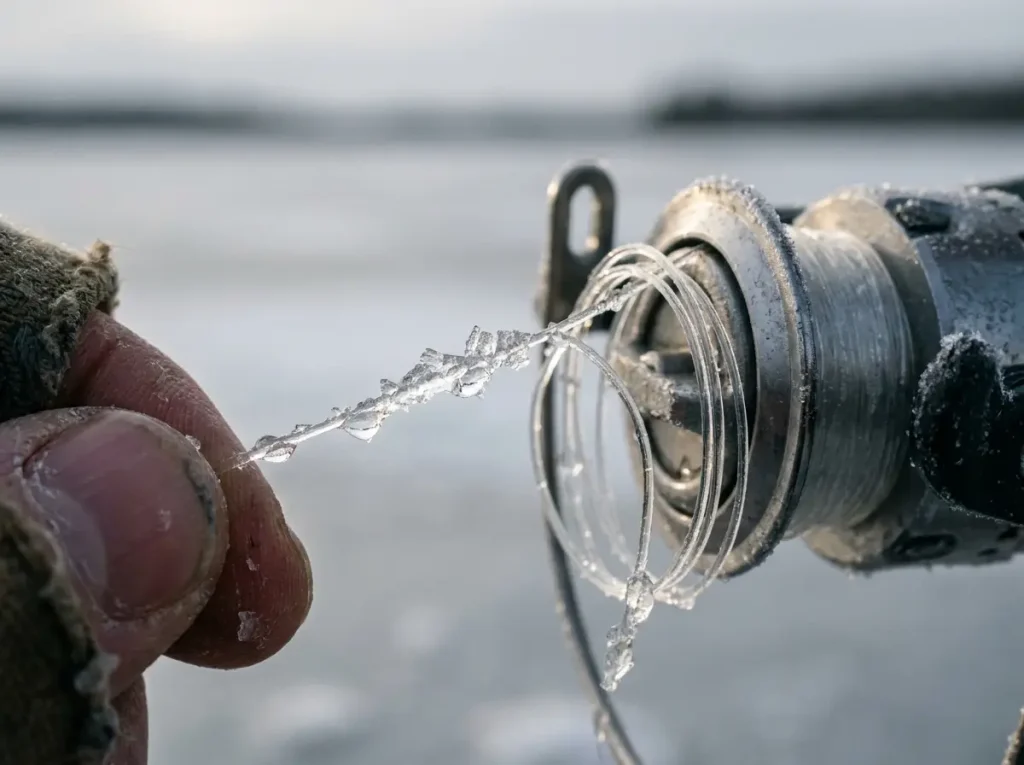
Most articles tell you mono is flexible and braid freezes. Few tell you why, and the why is what lets you predict how any line will act before you spool it. It comes down to one thing: water gets into your line, and in the cold that water freezes.
Mono Soaks Up Water, Then It Freezes Inside
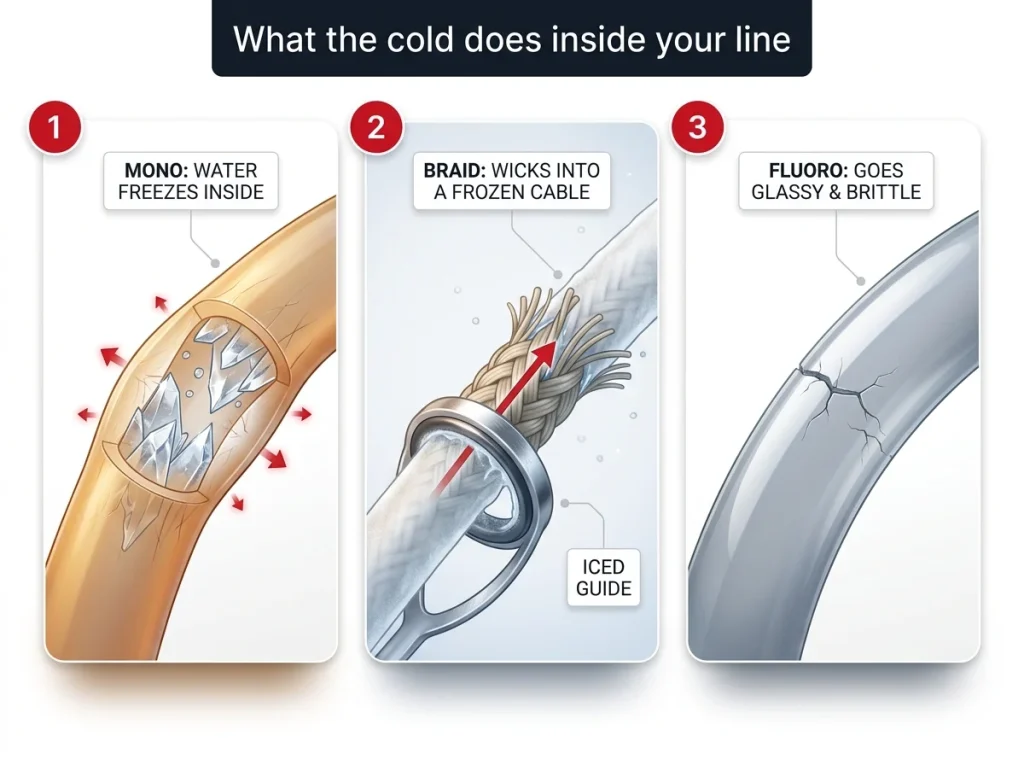
Here’s the fact that explains almost everything: nylon monofilament absorbs roughly 8 to 10 percent of its weight in water, while fluorocarbon absorbs about 0.2 percent, which is basically nothing. Mono is a sponge. In the cold, the water it has soaked up freezes inside the strand, and that’s exactly why it stiffens and wants to coil. The upside is that mono is built to flex, so it tolerates this better than you’d expect and stays the most manageable line out there in deep cold.
Braid’s Weave Wicks Water Into a Frozen Cable
Braid isn’t one solid strand. It’s a weave of fine fibers, and that weave behaves like a wick. Water absorption climbs right up into the line, then freezes, and you end up with a frozen rope instead of supple line.
The same trapped water bonds to your rod guides and glazes them shut. That’s the whole mechanism behind “braid freezes,” and no amount of wishful thinking changes the physics of a wet weave in freezing air.
Why Standard Fluoro Goes Glassy
Fluorocarbon doesn’t ice from the inside, since it barely drinks any water. Its cold-weather problem is different.
Regular fluoro is pure PVDF tuned for temperate water, and below about 20°F that polymer loses flexibility and gets glassy. It coils, it kinks, and on a bad day it snaps. Cold-weather and ice formulas add ingredients that keep the line supple, which is the real reason an “ice” fluoro can be worth it while your summer spool is not.
The Strength Penalty Nobody Warns You About
This is the part that quietly costs people fish. Monofilament can lose up to about 25 percent of its rated breaking strength after extended exposure to freezing water. Your 10-pound mono can be fishing like a 7-pound line by the time the good one bites.
The fix is simple and free: retie after a hard cold day, and respool when the line has taken a beating. If you want a sense of how often that should happen across a season, we lay out the cadence in our piece on when to change your fishing line by type.
The story that keeps coming up in walleye circles is the fish that came unbuttoned because the “10-pound” mono had quietly become a 7-pound line after a brutal cold morning. Retie your knot after every few hours of hard freezing, not because the knot slipped, but because the line above it got weaker than the number on the spool says.
Line Memory and Coiling When It’s Freezing
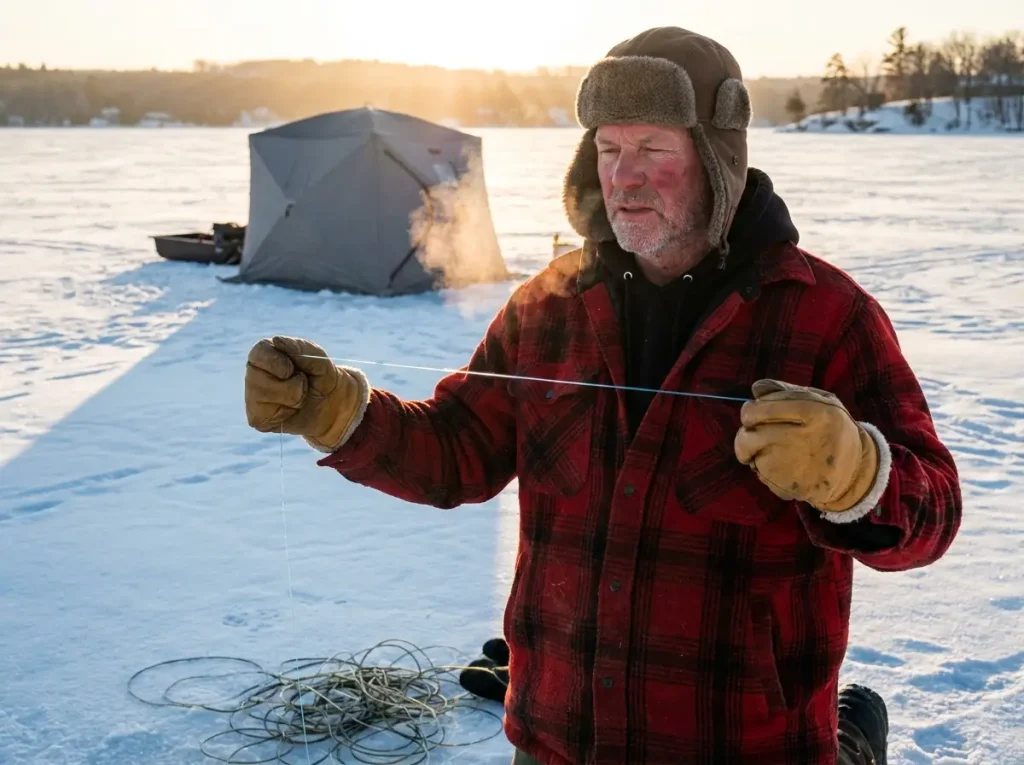
Everyone has fought it: you drop your jig and the line springs off the spool in tight loops like a slinky. That’s line memory, the line holding the shape of the spool, and the cold makes it worse than any other condition. The good news is that memory is one of the easiest cold-water problems to manage.
Why the Cold Makes Memory Worse
Cold doesn’t create memory out of nothing. It amplifies the memory a line already has. A limp, low-memory mono or copolymer barely coils even in freezing air, while a stiff, old, or cheap line turns into a spring.
This is why the line you buy matters more than any spray or trick. Start with a supple line built for the cold, and most of the coiling problem disappears before you ever reach the water. Our deep dive on what causes line memory and how to prevent it gets into the mechanics, and all of it hits harder when the temperature drops.
Managing Coil on the Ice and Off
Two habits keep coil under control. First, don’t overfill your spool, since a packed spool throws bigger loops. Second, stretch the line out before you fish by pulling off a long section and running it through your fingers, which relaxes the worst of the set. If you’re jigging, the weight of the lure slowly works coils out as you fish, but a bad case will haunt your first dozen drops.
Spooling Fresh Before a Cold Trip
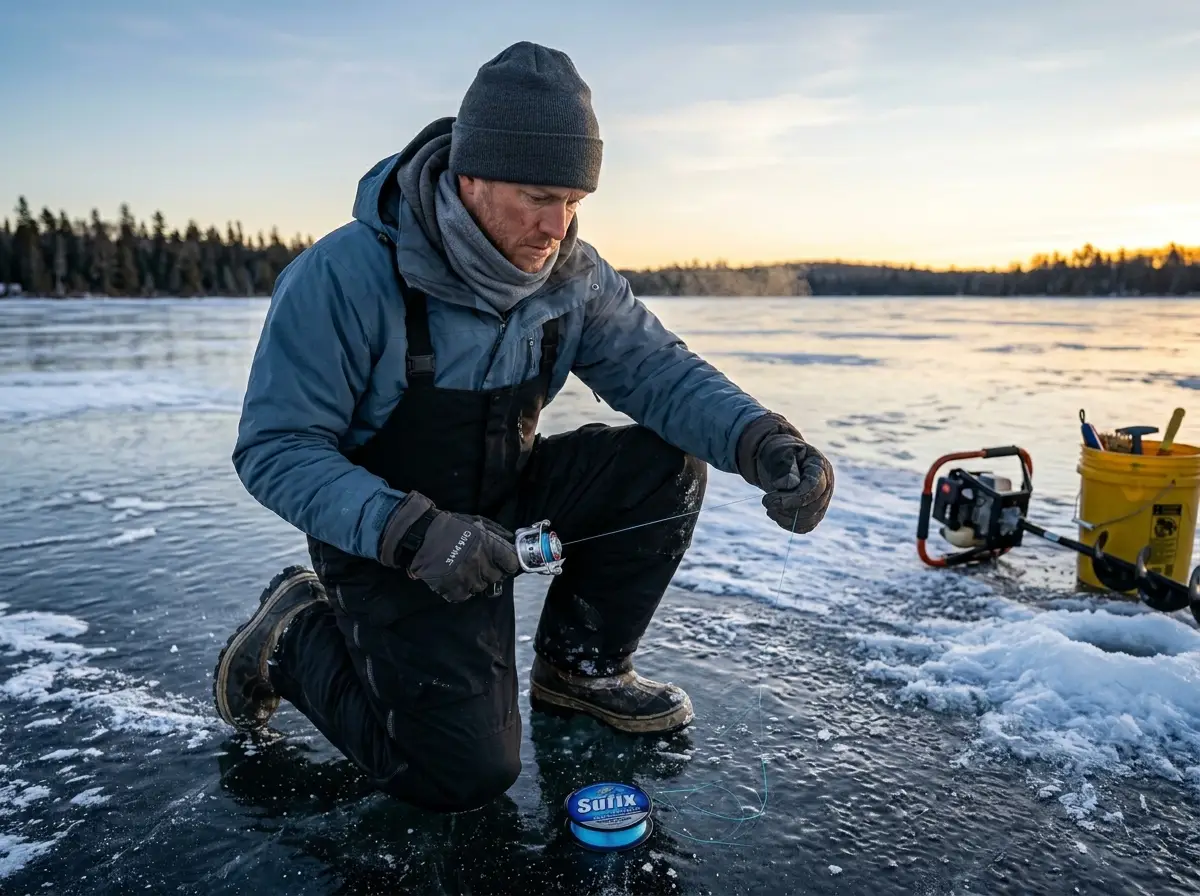
The single best move is starting the cold season with fresh, limp line. A short soak of the filled spool in warm water before you head out relaxes the line and knocks down memory for the first few hours. For a cold-water main line that fights coil on its own, a good pick is the Sufix Ice Magic Cold Water Monofilament, which uses a low-temperature formula and a water-repellent coat to stay soft when the air is well below freezing. It’s an inexpensive, do-everything mono for tip-ups and general jigging.
Spool up the night before and leave the reel somewhere warm, then drop it in a sink of warm water for a few minutes right before you leave. Warm, relaxed line goes on the spool with far less set, and you buy yourself a morning of coil-free fishing before the cold catches up.
Freezing and Iced-Up Guides
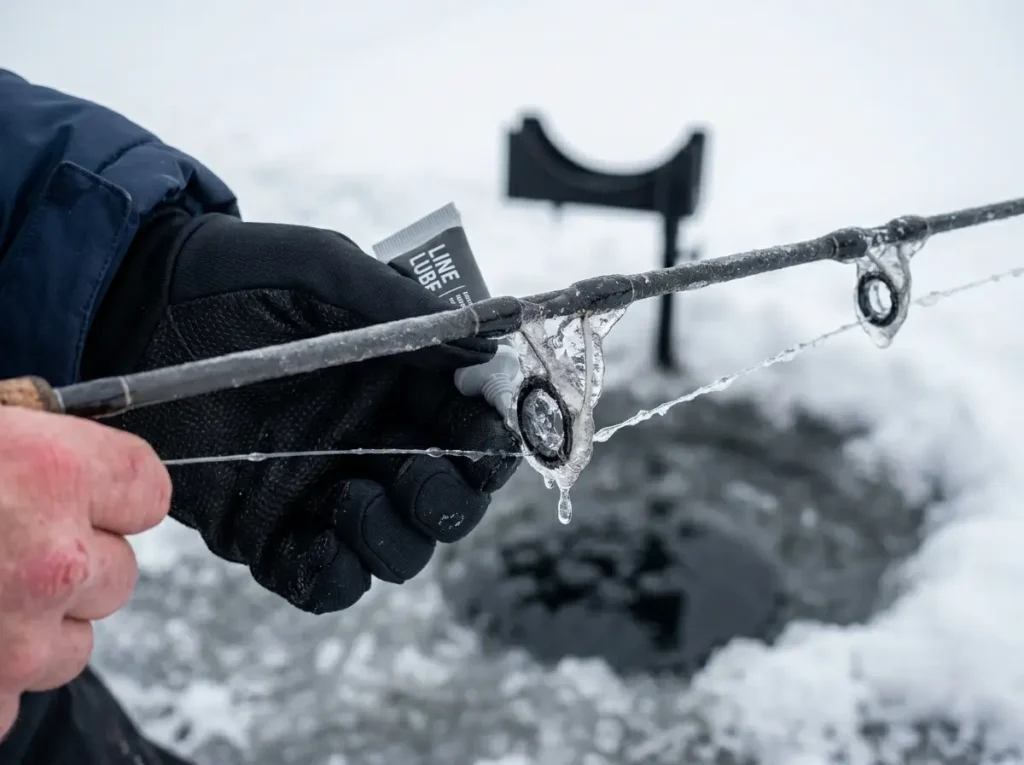
Few things end a cold trip faster than guides glazed shut and a frozen rope where your line used to be. The freezing problem is mostly a braid problem, and the fixes are cheap, fast, and almost never mentioned until the bottom of an article. Here they are up front.
Why Braid Freezes the Worst
Braid’s weave wicks water into the line and against your guides, where it freezes into a cable and a glaze, the classic braid freeze-up. As a rule, braid is workable on the ice only when the air is roughly 20°F or warmer, or when you’re fishing inside a heated shelter.
Below that, in open wind, it freezes faster than its sensitivity is worth. This isn’t a knock on braid as a line. It’s just the wrong tool for cold open air, and the right one in a warm flip-over.
Field Fixes for Iced Guides
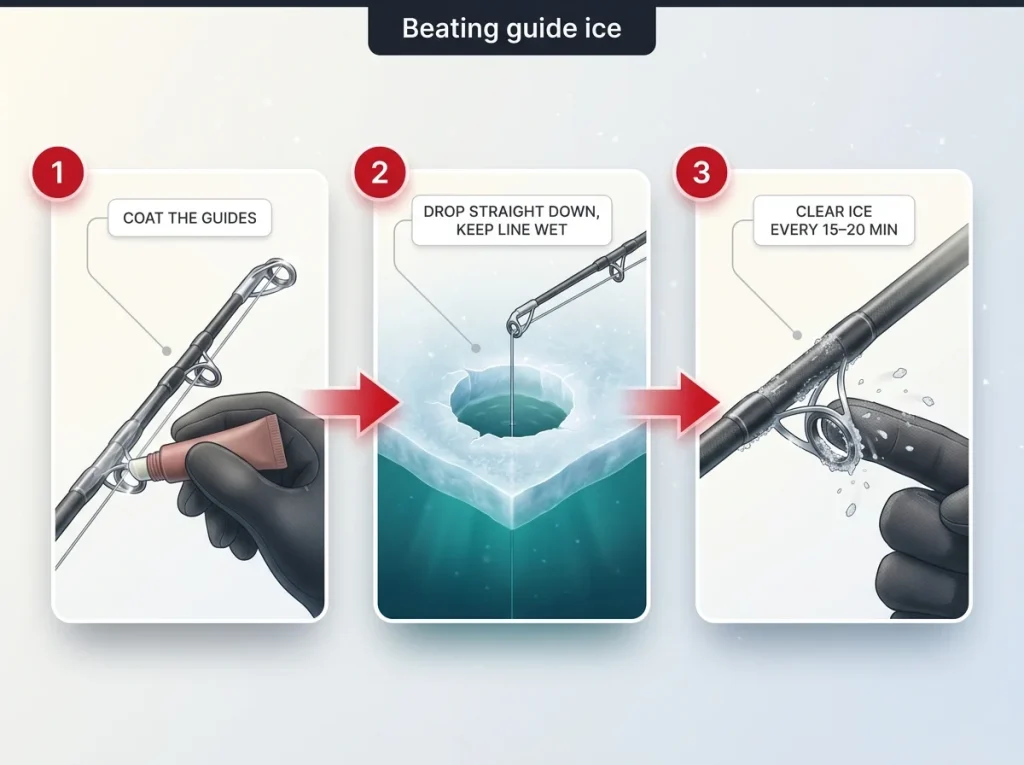
The cheapest fix on earth lives in your pocket. A silicone or PTFE line conditioner, or even a tube of lip balm like Carmex or Burt’s Bees, smeared on your line and rod guides keeps ice from grabbing hold. Reapply every two to three hours.
A dedicated paste like Loon’s Stanley’s Ice Off does the same job if you’d rather carry one made for it. None of this is expensive, and all of it beats sitting in the truck thawing your rod tip.
Keep the Line Out of the Air
The less line you leave hanging in freezing air, the less of it can freeze. Fish straight down the hole instead of at an angle, and keep your line under the surface, because the water is warmer than the air above it. Then run a gloved finger through each guide every 15 to 20 minutes to clear ice before it locks up.
If your rod has cheap metal guides, know that ceramic-insert guides ice noticeably slower, which is worth remembering when you buy your next setup. For the braid that holds up best when braid is genuinely the call, the Sufix 832 Advanced Ice Braid uses a hydrophobic coating that actually slows the freeze, and some ice braids add a slick PTFE coating for the same reason. That coating, not the marketing, is the real feature.
Keep a tube of lip balm in your bibs pocket all winter. The moment your top guide starts glazing, run the balm around it and the next two guides. It’s the cheapest guide-ice fix there is, and it lives in your pocket instead of back in the truck.
Stretch, Sensitivity, Abrasion, and Visibility in the Cold
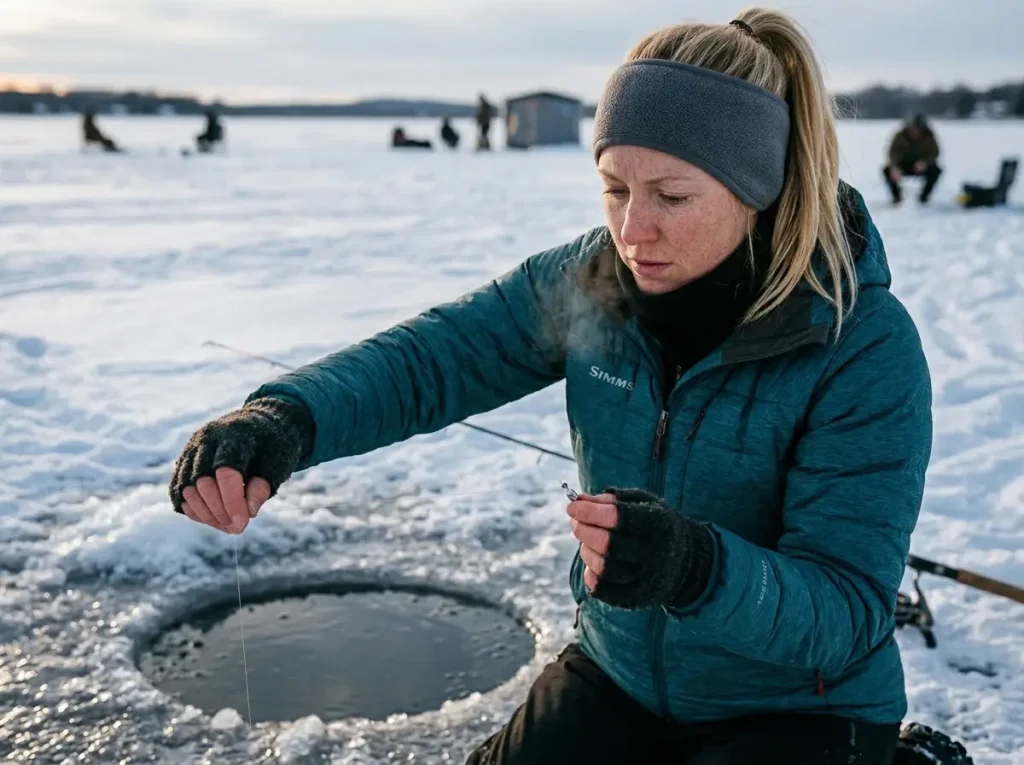
Cold water doesn’t just change how a line handles. It changes what you feel on a bite and what the fish sees on the other end. These are the tradeoffs that decide hookups on the slow, subtle takes that cold water is famous for.
Stretch Versus Sensitivity
Mono’s stretch is forgiveness. It cushions a hard hookset on light line, protects a knot on a tip-up, and gives a jig a softer, fluttering fall. The price is a little less feel.
Fluorocarbon and braid trade that cushion for bite detection, telegraphing the faint tick of a cold fish mouthing a bait. Neither is better in the abstract. On a finicky panfish day you may want feel, while on a light biting walleye you may want the forgiveness, and knowing which is which is half the battle.
Abrasion at the Hole and Under the Ice
Cold-water fishing puts your line against sharp edges more than you’d think, from the rim of the ice hole to rocks and timber the fish are holding on. Abrasion resistance is where fluorocarbon shines, which is one reason it makes such a good leader. There’s a quirk worth knowing too: once surface ice does start to form, it bonds harder to smooth fluoro than to slightly rougher mono. You can snap guide-ice off mono with a gloved finger more easily than off a glassy fluoro line.
Visibility in Clear, Cold Water
Winter water is often gin-clear, and fish get a long look at your line. This is fluorocarbon’s home turf. Its refractive index sits around 1.42, very close to water itself, so it bends light almost the same way the water does and nearly disappears.
That low visibility is why so many cold-water anglers run a fluoro leader even when their main line is something else. If the physics of why fluoro vanishes interests you, we break it down in our piece on fluorocarbon visibility physics. For a cold-specific fluoro that stays limp where standard PVDF goes glassy, the P-Line Floroice Fluorocarbon is built for exactly this, with a coating that keeps it supple in deep cold.
What to Actually Spool by Target
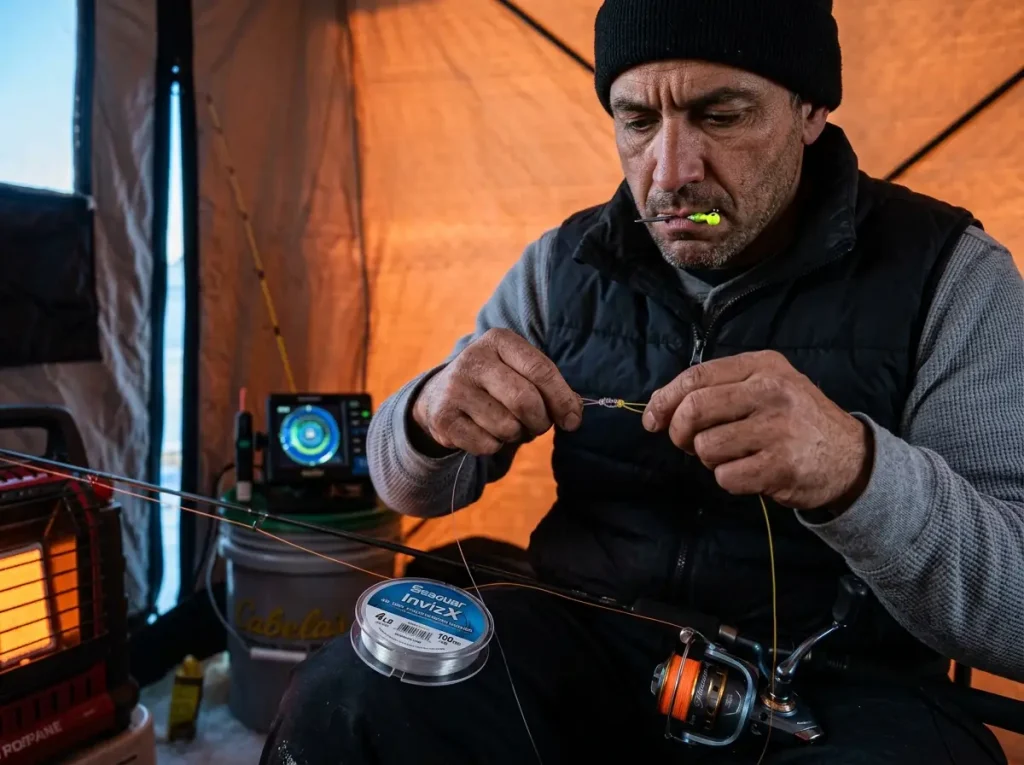
Enough theory. Here’s what to put on the reel, sorted by what you’re chasing. The numbers below are starting points that have earned their keep across a lot of cold mornings, not rigid rules.
Panfish and Light Jigging
For bluegill, crappie, and perch on small jigs, a limp 2 to 4 lb test mono is hard to beat. It’s manageable in the cold, forgiving on light hooksets, and cheap enough to respool often, which is what you want for panfish ice fishing. The default here is an ice mono like the Berkley Trilene Micro Ice, a small line diameter, low-stretch mono that resists the kinks and coils that wreck light-line fishing in the cold. It’s the line that just keeps behaving when the temperature drops.
Walleye, Pike, and Bigger Jigging
Walleye jigging lives comfortably on 6 to 8 lb test line, while northern pike call for a step up in pound test and usually a leader to handle their teeth. If the numbers feel arbitrary, our beginner’s guide to how pound test really translates to the fish you’re after puts them in context. For your tip-up line, run heavy mono or Dacron, never braid, because braid sitting open to the air freezes into a solid cable while you wait.
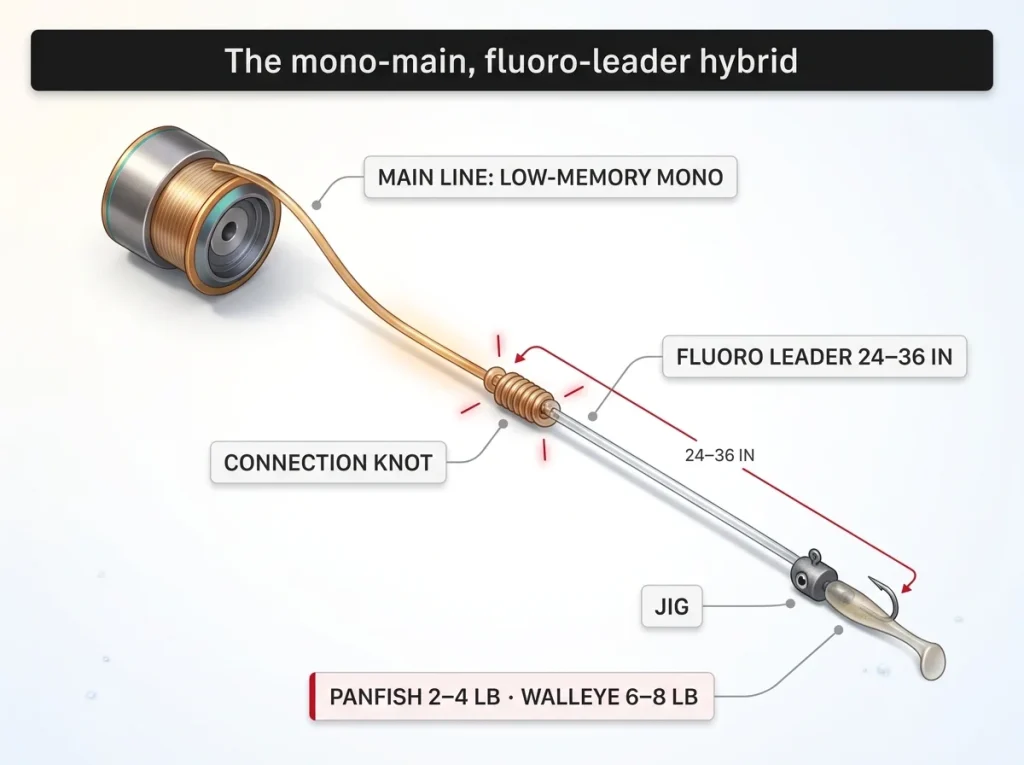
The Mono-Main, Fluoro-Leader Hybrid
Here’s the setup most experienced cold-water anglers settle on: a low-memory mono or copolymer main line with a 24 to 36 inch fluorocarbon leader. You get manageability and shock absorption up top, plus stealth and sensitivity down where the fish actually sees the line. A proven leader for this is the Seaguar InvizX, a supple 100 percent fluorocarbon that ties clean knots and disappears in clear water. Connect it to your main line with a solid leader knot like the Alberto knot, tie your jig on with a Palomar knot, and retie that connection after a hard cold day so the freeze-weakened section doesn’t fail on the best fish of the morning.
Is Special Ice Line Worth It? And Cold Water Beyond the Ice
Now the question the tackle wall doesn’t want you to ask out loud. Do you actually need special cold-water line? For most anglers, most of the time, the honest answer is no.
When Ice-Formula Line Earns Its Price
Special line earns its money in specific cases, not as a blanket rule. A cold-formula fluorocarbon like the P-Line Floroice is genuinely better than a summer spool when you’re doing clear-water finesse presentations and need a leader that stays supple in deep cold. A hydrophobic ice braid like the Sufix 832 Advanced Ice is worth it when you fish a heated shelter or in air around 20°F and up and want braid’s sensitivity without the worst of the freeze. Those are real situations with real benefits.
When Regular Cold-Weather Mono Is Plenty
Outside those cases, a limp cold-weather mono covers nearly everything, and you don’t need a label with snowflakes on it to get there. Even line makers admit it. A plain, supple mono manages coil, takes the cold, and forgives the light bites that define winter fishing.
I’d spool a quality limp mono before I’d pay a premium for a specialty line I’d only notice the difference with on the rarest days. A line like the Berkley Trilene XL, a smooth, low-memory all-purpose mono, handles cold water fine for a fraction of the fuss.
Cold Open Water Past the Hard Stuff
Cold water isn’t only ice. Early spring and late fall open water, where you’re chasing steelhead, winter trout, or cold-front bass, still punishes a stiff line with memory and poor manageability. The difference is that guide icing mostly isn’t an issue out there, so a limp mono or a good fluoro leader matters far more than any “ice” label.
The freeze-strength penalty still applies after a hard frosty morning, so retie just the same. For bank anglers working cold water once the ice is off the picture, our guide to cold-water tactics for when the bass go quiet pairs naturally with the right line choice.
Conclusion
Cold-water line comes down to three things. Mono is the cold-weather default, the most flexible, the most freeze-resistant, and the most forgiving line you can spool. The why is simple once you see it: water gets into the line and freezes, so the line that drinks the least and stays limp wins. And most anglers don’t need a special ice line at all, because a quality cold-weather mono covers it, with ice formulas earning their price only for clear-water finesse or shelter braid.
So keep it simple this winter. Spool a limp mono, add a short fluorocarbon leader if you want stealth in clear water, tuck a tube of lip balm in your bibs, and retie after a brutal cold day. Do that and your line stops being the reason the good fish gets away.
Frequently Asked Questions
01Is mono or fluorocarbon better for cold water?
Mono is the better all-around cold-water line because it stays flexible, resists freezing, and forgives light hooksets. Fluorocarbon wins as a leader in clear water for its low visibility and abrasion resistance, but standard fluoro stiffens below 20°F.
02How do I keep my fishing line from freezing to the rod guides?
Smear line conditioner or lip balm on your line and guides and reapply every few hours. Fish straight down with the line submerged, run a gloved finger through the guides every 15 to 20 minutes, and switch from braid to mono in cold open air.
03Can I use my regular summer fishing line in cold water?
A limp summer mono works fine in cold water and you don’t strictly need an ice formula. Avoid spooling standard summer fluorocarbon, though, since it gets stiff and brittle below about 20°F and coils badly on the reel.
04Why does fluorocarbon get brittle in cold weather?
Standard fluorocarbon is pure PVDF, a polymer tuned for temperate water, and below roughly 20°F it loses flexibility and turns glassy. Cold-weather and ice formulas add ingredients that keep the line supple, which is what makes them worth it in deep cold.
05Does fishing line color matter in cold, clear water?
It matters more in winter than any other season, because cold water is usually gin-clear and fish get a long look. A clear fluorocarbon leader is the safest choice, since its refractive index is close to water and it nearly disappears.
Risk Disclaimer: Fishing, boating, and all related outdoor activities involve inherent risks that
can lead to injury. The information provided on Master Fishing Mag is for educational and informational purposes
only. While we strive for accuracy, the information, techniques, and advice on gear and safety are not a substitute
for your own best judgment, local knowledge, and adherence to official regulations. Fishing regulations, including
seasons, size limits, and species restrictions, change frequently and vary by location. Always consult the latest
official regulations from your local fish and wildlife agency before heading out. Proper handling of hooks, knives,
and other sharp equipment is essential for safety. Furthermore, be aware of local fish consumption advisories. By
using this website, you agree that you are solely responsible for your own safety and for complying with all
applicable laws. Any reliance you place on our content is strictly at your own risk. Master Fishing Mag and its
authors will not be held liable for any injury, damage, or loss sustained in connection with the use of the
information herein.
Affiliate Disclosure: We are a participant in the Amazon Services LLC Associates Program, an
affiliate advertising program designed to provide a means for us to earn advertising fees by advertising and linking
to Amazon.com. As an Amazon Associate, we earn from qualifying purchases. We also participate in other affiliate
programs and may receive a commission on products purchased through our links, at no extra cost to you. Additional
terms are found in the terms of service.