In this article
The Red Snapper’s gills were still pumping when I cut the line. The hook was buried somewhere past its throat, deep in the esophagus where my pliers couldn’t reach without tearing tissue. I’d seen enough dead fish over twenty years of guiding to know what came next if I tried to dig it out. Instead, I clipped the leader flush to its jaw and watched it descend back to 60 feet, the small circle hook still embedded. Three weeks later, a research diver photographed that same fish—identified by a distinctive scar pattern—feeding actively on a nearby reef. The hook was gone. The fish had survived.
That outcome wasn’t luck. It was biology. Where a hook penetrates a fish’s anatomy determines survival more than any other single factor—more than your handling technique, more than water temperature, more than the length of the fight. This article breaks down the science behind hooking location mortality, the gear choices that keep hooks where they belong, and the handling decisions that give released fish the best shot at swimming away for good.
⚡ Quick Answer: Fish hooked in the jaw survive at rates above 90%, while fish hooked in the gills or esophagus die 67-87% of the time regardless of handling. The single most effective thing you can do is use circle hooks for bait fishing (reduces deep hooking by 75-81%) and cut the line immediately if a fish swallows the hook. Attempting removal causes four times more mortality than leaving the hook in place.
The Anatomical Hierarchy of Hooking Mortality
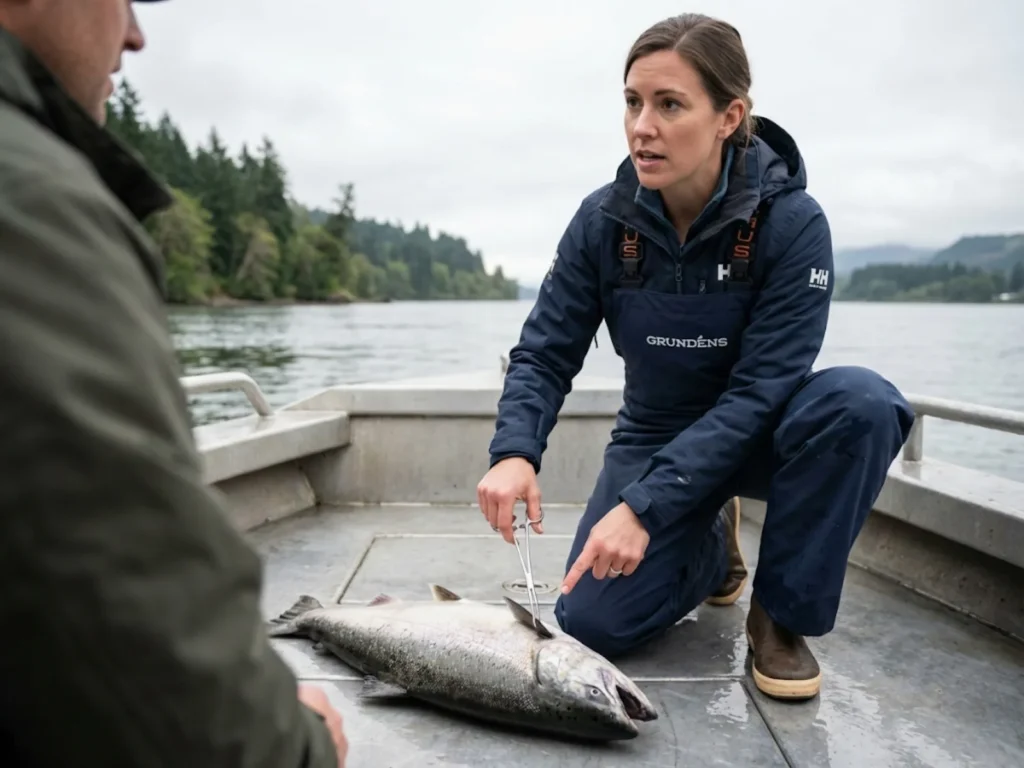
The reason hook location matters so much comes down to tissue type and organ proximity. A hook in the jawbone causes minimal physiological disruption—the mandible is dense bone designed to withstand crushing forces during feeding. A hook in the esophagus sits millimeters from the heart, and an upward hook set can drive the point through the thin esophageal wall directly into the sinus venosus.
Necropsy studies from Washington Department of Fish and Wildlife reveal something uncomfortable: fish that appear vibrant at release often die minutes later from internal injuries invisible from the outside. A Chinook Salmon hooked in the esophagus suffers 67.3% mortality compared to 2.3% for jaw-hooked fish. That’s a 29-fold difference from the same species, same water, same angler skill—just a different hook placement.
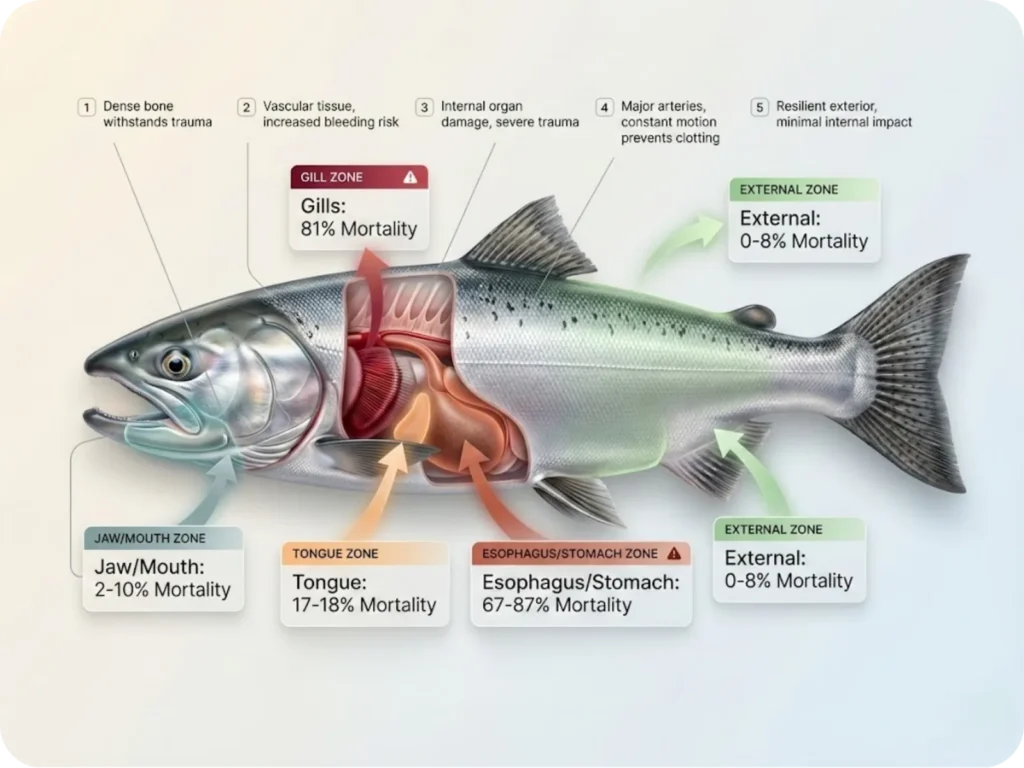
Gill hooking is the single most lethal location across all salmonid species. The gill arches contain major arteries and delicate filaments designed for oxygen transfer, not trauma. Unlike jaw tissue, which can form fibrin clots, gill tissue is in constant motion during respiration, preventing any wound from sealing. Chinook Salmon gill-hooked show 81.6% mortality despite representing only 5.1% of the catch.
Pro tip: If you feel the hook “pop” during the set and the fish immediately goes limp or spins erratically, you’ve likely hit the gills or esophagus. That soft, tearing resistance—rather than the solid thunk of bone—is your first indicator to prepare for a cut-the-line release.
The jaw and mouth represent the survival zone. Rainbow Trout jaw-hooked in laboratory simulations survived at 96.99% and showed no impairment in feeding mechanics or weight gain over 30-day observation periods. These structures evolved to handle the forces of suction feeding and prey manipulation—a clean puncture wound heals rapidly.
For more context on how circle hooks reduce deep hooking by 75-81%, that link covers the mechanical reasons behind their effectiveness.
Gear Selection: Engineering Hook Location Outcomes
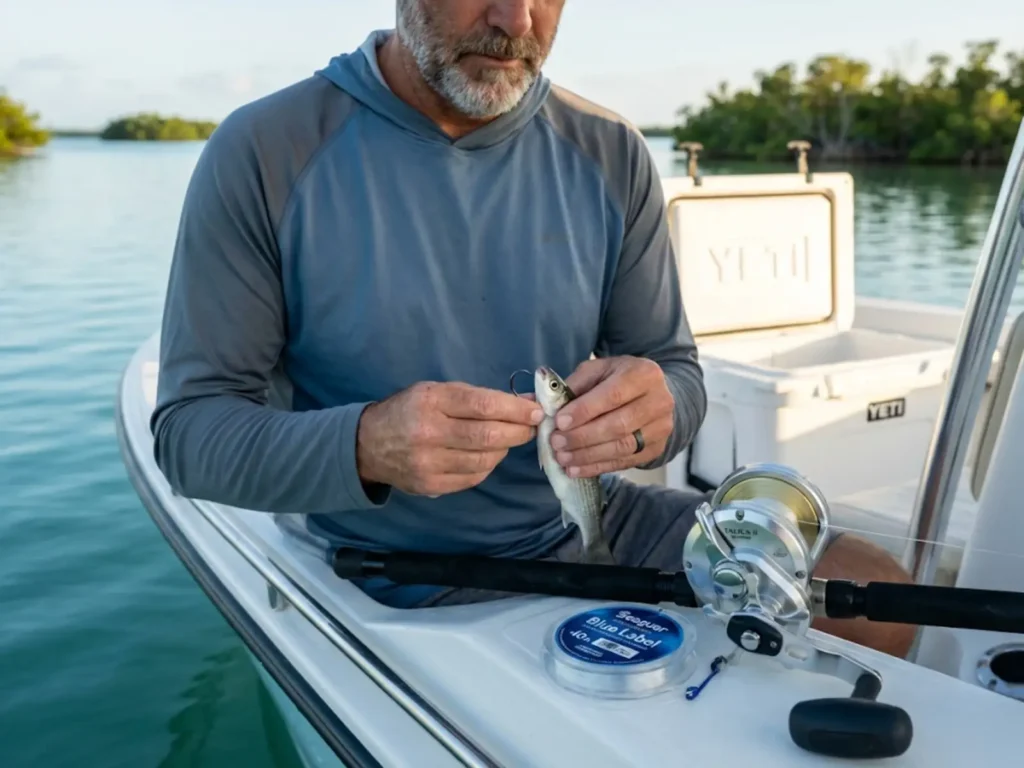
Your terminal tackle directly controls where hooks end up. A global meta-analysis of 42 studies on pelagic longline fisheries found circle hooks significantly reduced mortality for 12 species, with zero species showing worse outcomes compared to J-hooks.
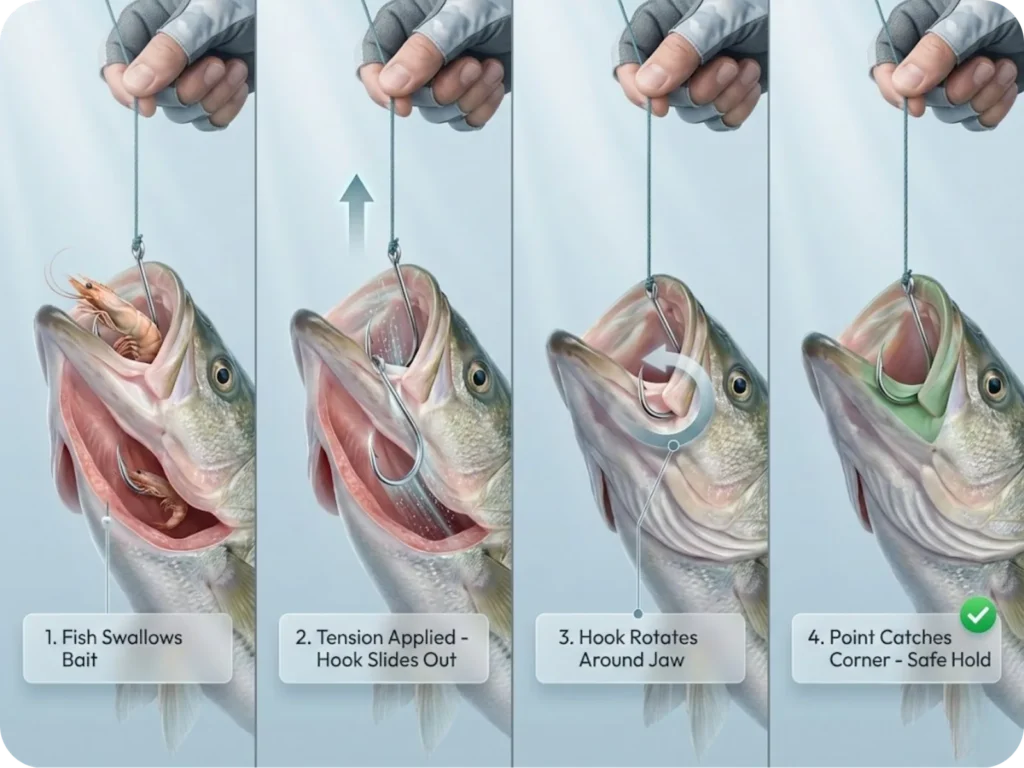
The circle hook works through a specific mechanical sequence. When a fish swallows the baited hook and tension is applied, the inward-facing point prevents snagging on soft tissue. The hook slides out of the esophagus, rotates around the jawbone as the eye clears the mouth, and the point catches the corner of the mouth in cartilaginous tissue. According to NOAA Fisheries catch-and-release guidelines, circle hooks dramatically reduce gut hooking while maintaining catch effectiveness.
The primary barrier to adoption? Anglers assume they’ll catch fewer fish. The data says otherwise—catch rates with circle hooks were actually greater for 11 species including tunas. Striped Bass and marine species consistently show 95% jaw hooking frequency with circle hooks compared to 50-60% with J-hooks.
Bait fishing creates the highest deep hooking risk because of swallow time. Fish locate natural bait via chemoreception and often ingest it fully before you feel the strike. Atlantic Salmon caught on worms and prawns exhibit the highest incidence of deep hooking precisely because the bait sits too long.
Pro tip: When using circle hooks with bait, resist the urge to “set” with a sharp upward jerk. Reel down until you feel weight, then apply steady pressure. The hook will rotate and set itself in the corner of the mouth. A traditional hookset drives the point into whatever tissue it’s touching—often the throat.
Treble hooks pose significant collateral damage risk. Brook Trout data shows over 80% of severely bleeding fish caught on treble-hooked spinners died within 48 hours. When the same lures were equipped with single hooks, mortality dropped to 42%—likely due to less complex tissue damage from fewer penetration points.
Barbed vs barbless shows less direct mortality impact than you might expect if hook location is identical. The primary benefit of barbless hooks is reduction in handling time and tissue trauma during removal. For novice anglers, barbless hooks significantly reduce fumbling time spent out of water—and that air exposure is what kills.
For a practical guide on converting lure trebles to inline singles, that modification maintains catch rates while dramatically reducing gill injury.
Environmental Multipliers: When Conditions Turn Injuries Lethal
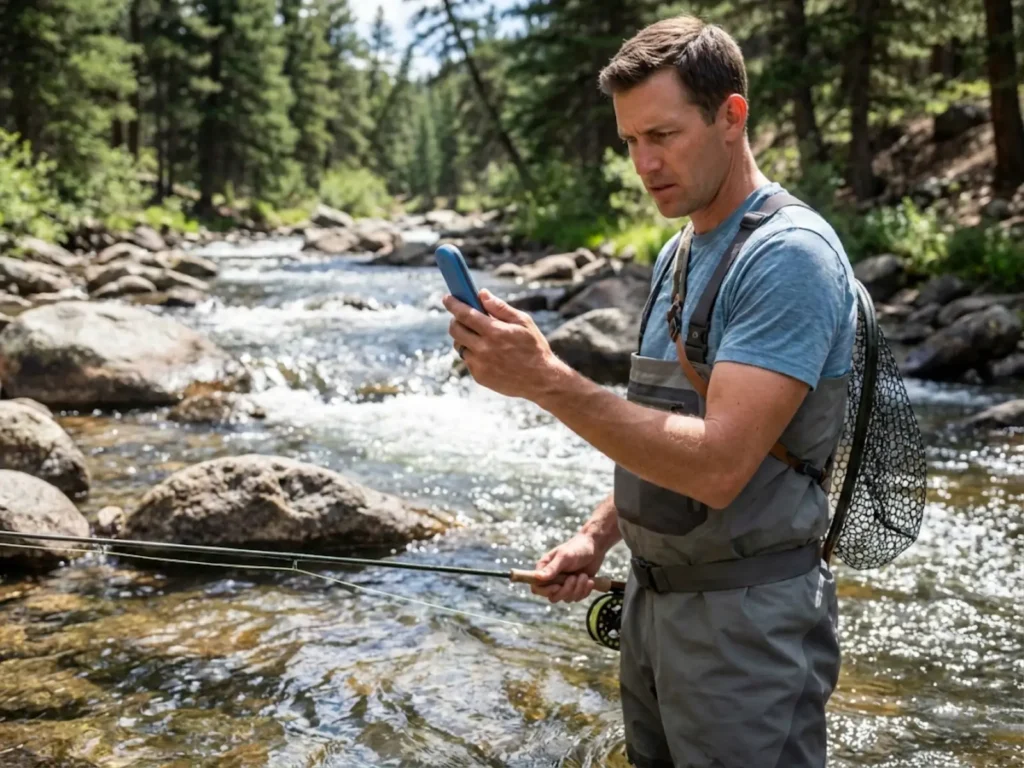
Anatomical injury doesn’t occur in a vacuum. The fish’s ability to survive a wound depends heavily on environmental conditions—factors that act as mortality multipliers, pushing sublethal injuries into the lethal range.
Water temperature creates a respiratory squeeze. As temperature rises, a fish’s oxygen demand increases while oxygen solubility in water decreases. Atlantic Salmon mortality is negligible below 12°C but escalates to 80% when water exceeds 18°C, particularly after exhausting fights. Cutthroat Trout show 1.5% mortality when water is below 16°C but surge to 60% mortality above 20°C. Brook Trout hit 40% mortality at 19°C with zero mortality in the 16°C group.
These thresholds provide the biological reason behind “Hoot Owl” restrictions that close fisheries in the afternoon during summer. Angling for salmonids when water exceeds 20°C carries unacceptably high catch-and-release mortality risk regardless of handling skill or gear type.
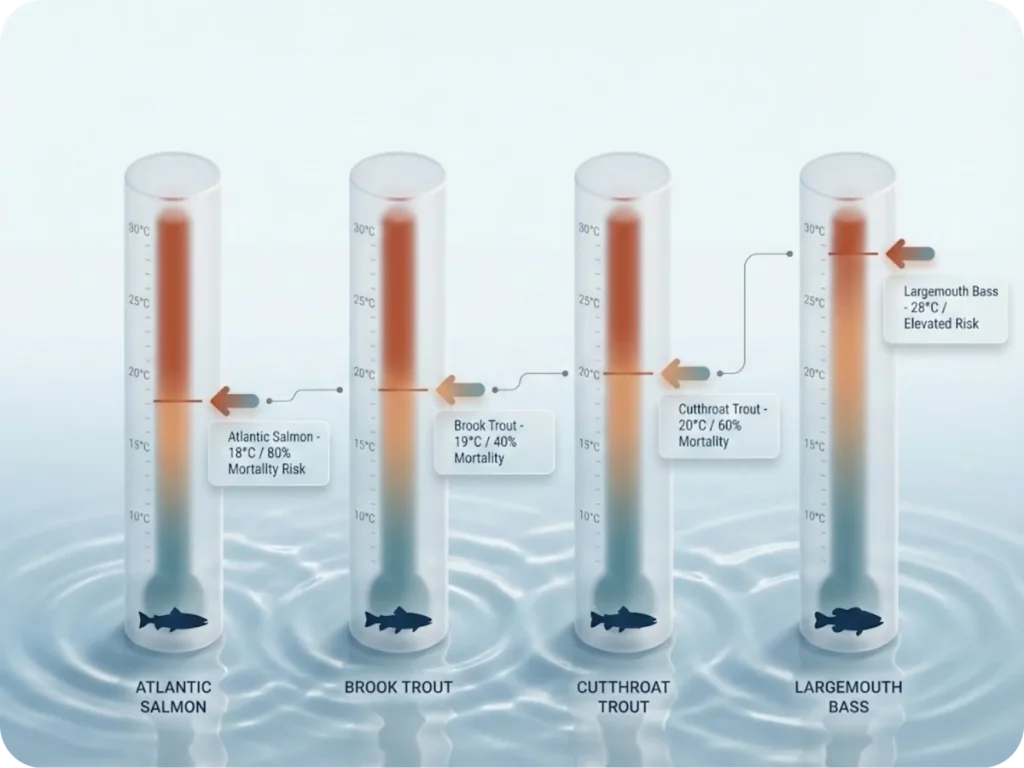
Pro tip: Carry a digital thermometer clipped to your vest. If water temp hits 20°C for trout or 28°C for bass, switch to early morning or late evening fishing only, or stop entirely. The fish you release at 2 PM in 22°C water has a coin-flip survival chance regardless of how carefully you handle it.
Air exposure collapses delicate gill lamellae, which are supported by water buoyancy. Lifting a fish out of water halts gas exchange immediately—it can’t uptake oxygen or excrete carbon dioxide. The timeline is strict: 0-10 seconds is generally safe, over 30 seconds shows reflex impairment and loss of equilibrium, over 60 seconds is often lethal for trout and salmon after exhausting fights.
A telemetry study on Tarpon found that the single mortality event was a fish lifted from the water for a photograph. That brief interval required for a “hero shot” made the difference between life and death.
For deeper understanding of the biochemical cascade, see this article on cortisol stress response in fish.
Handling Protocols: The Final Determinant of Survival
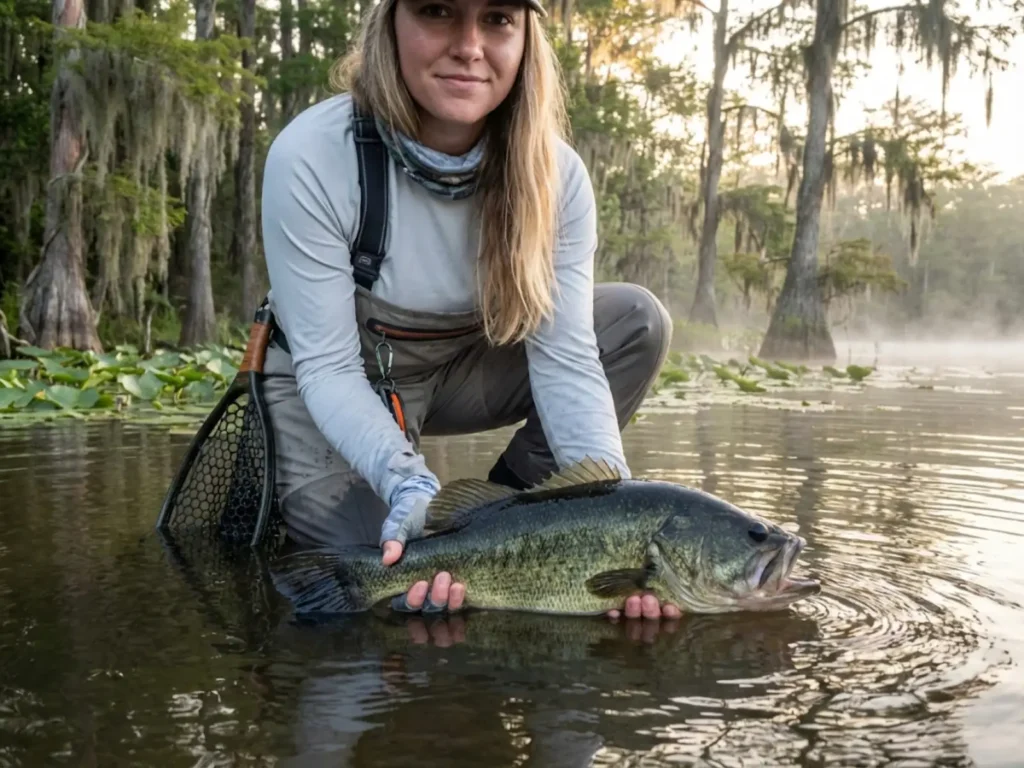
When prevention fails and a fish is deep hooked, the angler’s handling technique becomes the final determinant. The most critical decision: cut the line or attempt removal?
A pervasive myth in angling culture is that leaving a hook in a fish is a death sentence. The science says the opposite—attempting to remove a deep hook is far more lethal than leaving it.
Bluegill controlled studies show the removal group suffered 40% mortality after 48 hours while the cut-line protocol group showed only 9% mortality. That’s four times the survival odds just by clipping the leader. Common Snook studies showed similar results—the cut-line group exhibited superior survival while the removal group suffered from hemorrhage and tissue trauma during extraction.
What happens to retained hooks? Bluegill data shows 46% expelled the hook within 48 hours, and over 70% expelled it within 10 days. Hooks that aren’t expelled get encapsulated in fibrous scar tissue, isolating them from vital organs. Standard bronze or carbon steel hooks corrode and degrade over time in the fish’s digestive tract. As Florida FWC’s catch-and-release guidelines recommend, if a hook is swallowed, cut the line as close to the hook as possible—the non-stainless steel hook will eventually corrode.
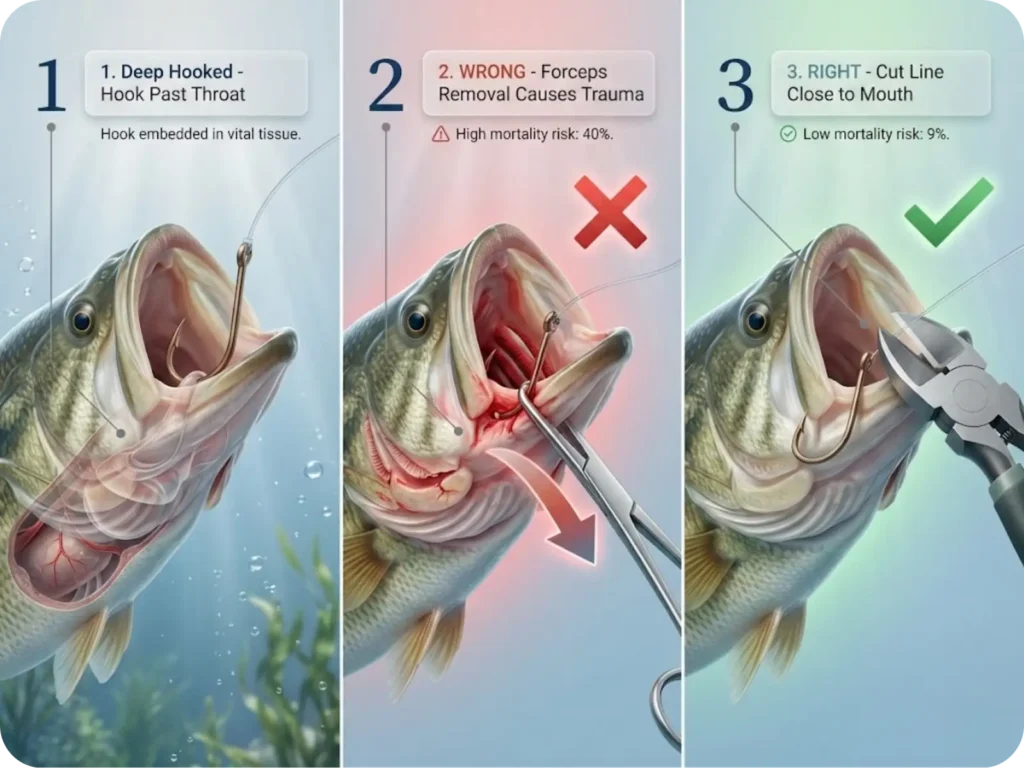
The cut-line protocol is simple: clip the leader as close to the mouth as possible without manipulating the hook. Do not pull, twist, or probe. Use wire cutters or line nippers to make a clean cut. If you can’t see the hook point without opening the fish’s mouth wide or using forceps to probe, it’s too deep—cut immediately.
Pro tip: If using circle hooks, the hook is more likely to be in the corner of the mouth even if it feels deep. Gently open the mouth and visually confirm before deciding to cut. Circle hooks rarely penetrate past the pharynx.
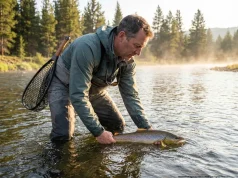
Proper fish handling follows the KeepEmWet principles: minimize air exposure, keep the fish in water during unhooking, support the body properly. Fish are covered in a protective mucous layer that acts as the primary barrier against pathogens. Contact with dry hands, boat carpets, or soil strips this layer and opens the door to fungal infections.
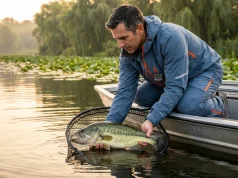
Wet your hands before touching the fish. If it’s over 5 lbs, always use a two-handed hold—one hand under the belly, one supporting the tail. “Lipping” is acceptable for small bass but can dislocate the jaw in larger fish.
For step-by-step release protocol, see the 60-second rule for fish handling.
Species-Specific Mortality Profiles
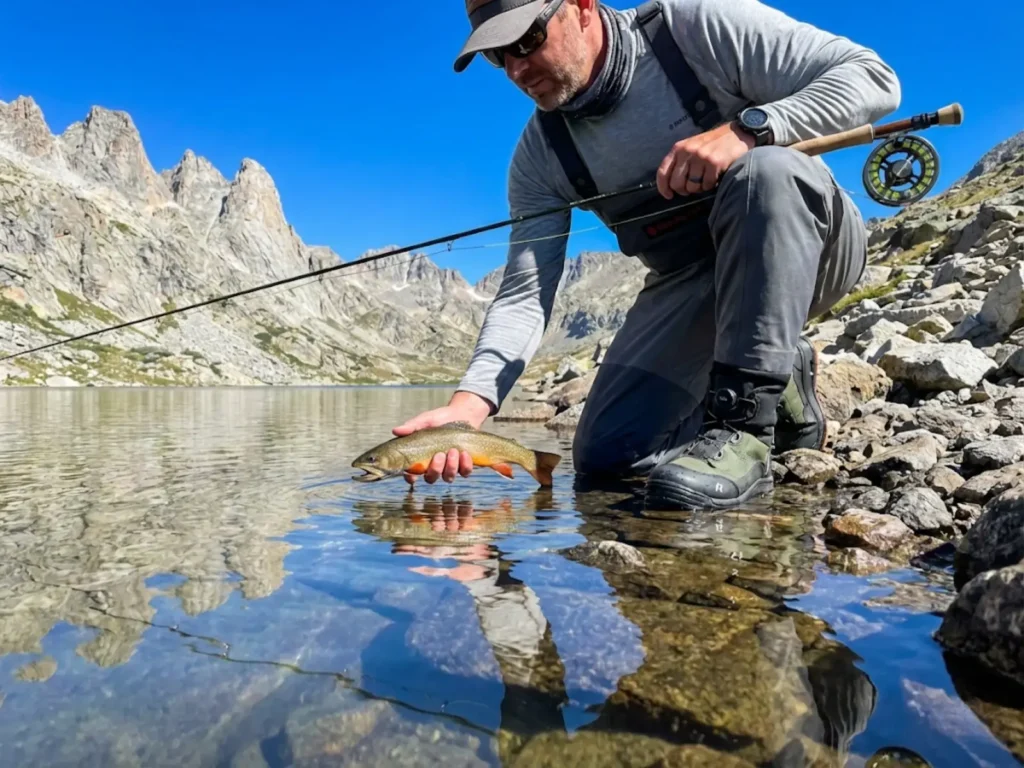
Different fish handle angling stress differently. Understanding your target species lets you tailor gear and handling to their vulnerabilities.
Salmonids—salmon, trout, char—are among the most sensitive species. High oxygen requirements, delicate scales that dislodge easily, and low thermal tolerance make them vulnerable. The 67-81% mortality for internal hooking in Chinook defines the risk profile. Water temperature over 18°C and deep hooking with bait are the primary mortality drivers.
If you’re targeting salmonids in summer, check water temp before you rig up. If it’s above 18°C, consider switching species or locations. The ethical calculation changes when you know 8 out of 10 deep-hooked fish will die regardless of handling skill.
Centrarchids—bass and sunfish—are generally more resilient to hypoxia and handling. They tolerate warmer, lower-oxygen environments better than salmonids. But they’re highly susceptible to deep hooking due to their suction feeding mechanism—they can inhale soft plastics and live bait entirely before you detect the strike.
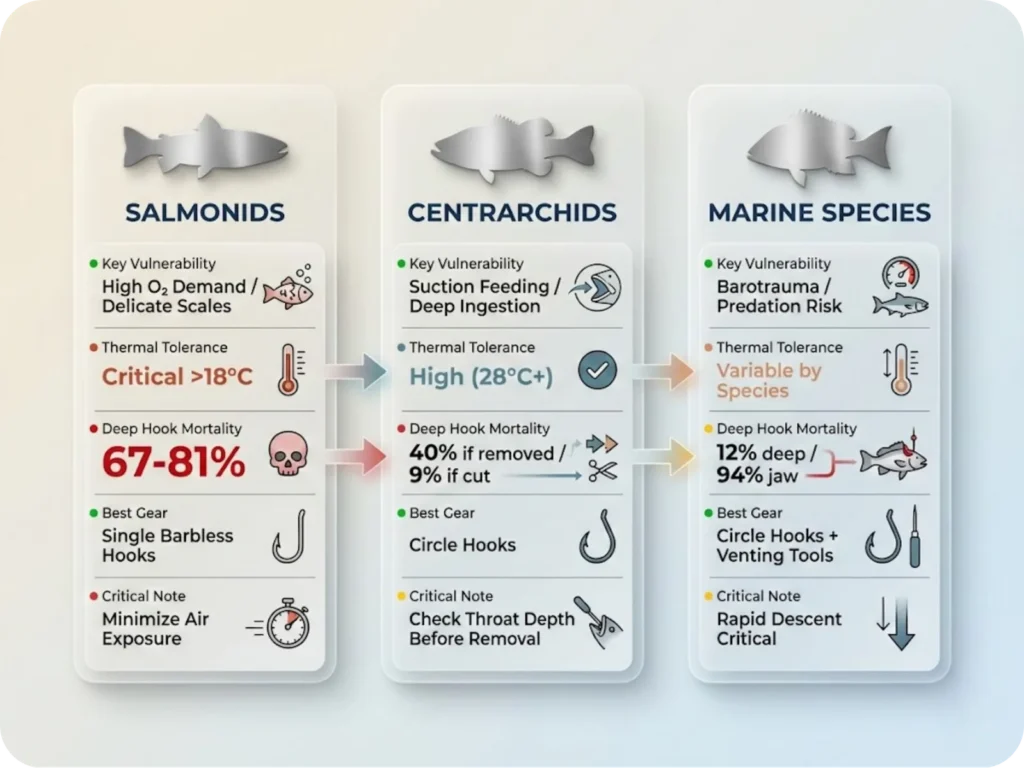
Circle hook adoption in bass fishing has shown massive potential. Over 80% of circle hook catches are in the lip or cheek. The 40% mortality for hook removal in Bluegill versus 9% for cutting the line is the definitive case study for this group.
For detailed Smallmouth Bass sensory physiology and vulnerability, that link covers bass-specific handling.
Marine species face the dual threat of post-release predation and barotrauma. A fish that survives hooking and handling may still be eaten by sharks if it exhibits equilibrium loss or impaired swimming. Red Snapper show 94% survival for jaw-hooked fish but only 12% for deep-hooked fish regardless of recompression—making avoidance of deep hooking via circle hooks the only viable strategy.
Angler Behavior and the Psychology of Hook Removal
The hardest part of catch and release isn’t the technique—it’s overcoming the psychological biases that drive bad decisions.
The “swam away fine” bias is the most dangerous cognitive error. Anglers judge survival by immediate release vigor, but mortality is often delayed 12-72 hours. A fish that swims away may die from metabolic acidosis or get eaten by a predator due to equilibrium loss. The angler assumes success and never learns otherwise.
The “surgery fallacy” drives anglers to perform fatal extractions. We remove splinters and foreign objects from our own bodies, so we assume the same logic applies to fish. But fish physiology is fundamentally different—they can expel or encapsulate hooks naturally. Cutting the line feels like giving up, but it’s actually the responsible choice based on biology, not emotion.
Forum threads are full of anglers expressing guilt when forced to cut the line on a deep-hooked fish. “I felt like I was abandoning it.” That emotional response drives harmful extraction attempts. Education must reframe the ethical narrative: leaving the hook is an act of mercy, not negligence.
Mandatory gear regulations—requiring circle hooks for bait fishing in specific fisheries—work when coupled with education on why the rule exists. Dynamic closures based on real-time water temperature protect fish populations when they’re most vulnerable.
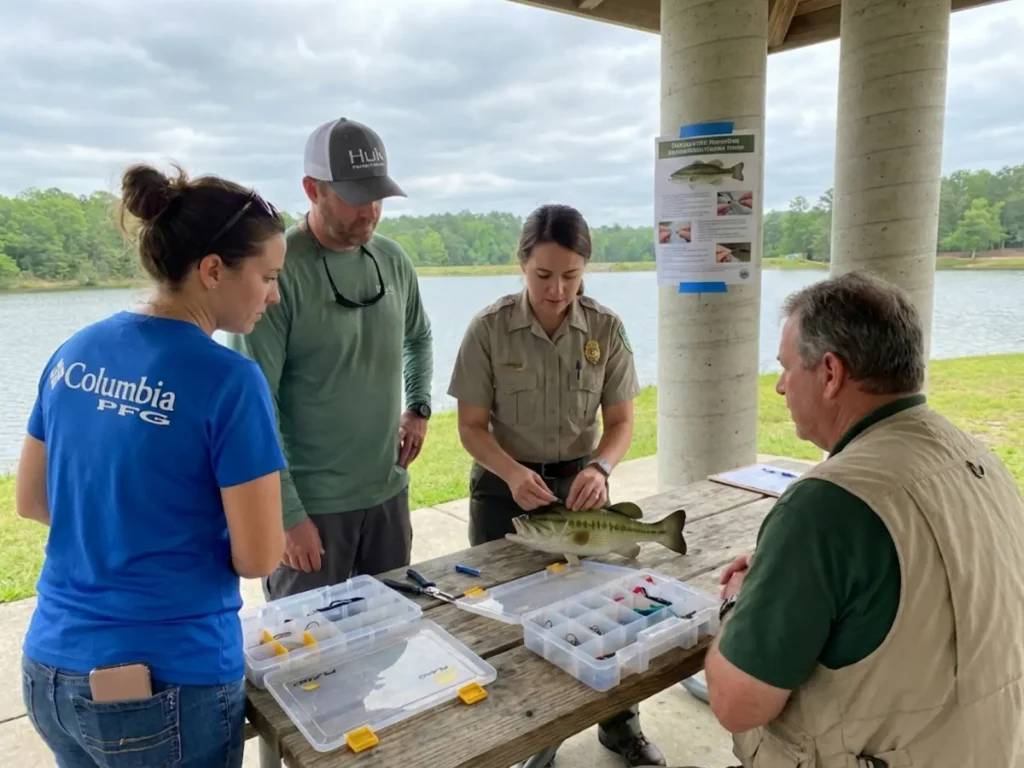
Join a local catch-and-release workshop or conservation group if you can. Seeing necropsy data and handling demonstrations in person changes behavior more effectively than reading articles alone.
For broader conservation efforts, consider angler stewardship and habitat restoration—there’s more to fisheries health than just handling fish properly.
Conclusion
Where you hook a fish is the primary determinant of whether it lives or dies after release. Jaw-hooked fish survive at rates exceeding 95%, while esophageal and gill-hooked fish face mortality rates of 67-87%. That’s not about angler skill—it’s anatomy. But you control the variables that determine hook location.
Three things to do starting now: Use circle hooks for bait fishing. Cut the line immediately on any deep-hooked fish without hesitation. Check water temperature before you fish, and stop when conditions turn dangerous for your target species.
The fish that swims away from your hands today may die twelve hours later from injuries you couldn’t see, or it may thrive for another decade. The difference is in the details you control.
FAQ
What percentage of fish die after catch and release?
Mortality varies dramatically by hooking location: jaw-hooked fish show 2-10% mortality, while esophageal or gill-hooked fish show 67-87% mortality depending on species. Water temperature, air exposure, and handling technique also significantly impact survival.
Is it better to cut the line or remove the hook when a fish is deep-hooked?
Cut the line immediately. Bluegill studies show 40% mortality when hooks are removed from deep-hooked fish versus 9% mortality when the line is cut. Fish naturally expel or encapsulate hooks—46% expel within 48 hours, over 70% within 10 days.
Do barbless hooks actually make a difference in fish survival?
Barbless hooks don’t significantly reduce mortality if hook location is identical, but they dramatically reduce handling time and tissue trauma during removal. The primary benefit is faster release with less air exposure, not direct mortality reduction.
At what water temperature should I stop catch-and-release fishing for trout?
Stop fishing for trout when water temperature exceeds 20°C (68°F). Atlantic Salmon show 80% mortality above 18°C, Cutthroat Trout show 60% mortality above 20°C. The combination of thermal stress and fight-induced metabolic exhaustion becomes unrecoverable.
Do fish survive after being hooked in the gills?
Gill-hooked fish have the highest mortality of any anatomical location: 81.6% for Chinook Salmon, 71.4% for Lake Trout. The gill arches contain major arteries and delicate filaments that cannot clot due to constant respiratory movement. Over 80% of severely bleeding gill-hooked fish die within 48 hours.
Risk Disclaimer: Fishing, boating, and all related outdoor activities involve inherent risks that
can lead to injury. The information provided on Master Fishing Mag is for educational and informational purposes
only. While we strive for accuracy, the information, techniques, and advice on gear and safety are not a substitute
for your own best judgment, local knowledge, and adherence to official regulations. Fishing regulations, including
seasons, size limits, and species restrictions, change frequently and vary by location. Always consult the latest
official regulations from your local fish and wildlife agency before heading out. Proper handling of hooks, knives,
and other sharp equipment is essential for safety. Furthermore, be aware of local fish consumption advisories. By
using this website, you agree that you are solely responsible for your own safety and for complying with all
applicable laws. Any reliance you place on our content is strictly at your own risk. Master Fishing Mag and its
authors will not be held liable for any injury, damage, or loss sustained in connection with the use of the
information herein.
Affiliate Disclosure: We are a participant in the Amazon Services LLC Associates Program, an
affiliate advertising program designed to provide a means for us to earn advertising fees by advertising and linking
to Amazon.com. As an Amazon Associate, we earn from qualifying purchases. We also participate in other affiliate
programs and may receive a commission on products purchased through our links, at no extra cost to you. Additional
terms are found in the terms of service.