In this article
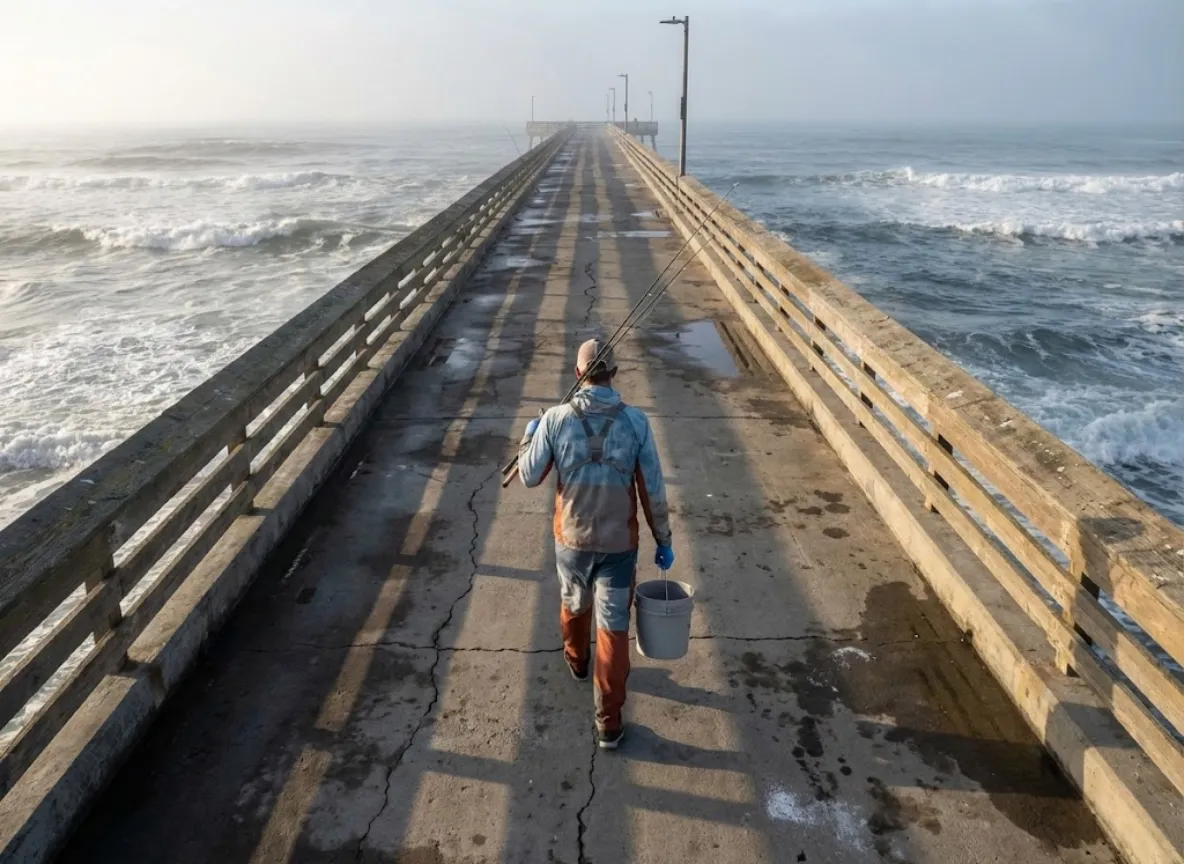
The concrete deck vibrates under your feet as a six-foot swell slams into the pilings below. You aren’t just standing on a wooden walkway for ice cream and sunsets; you are suspended over a linear transect of the Pacific Ocean, accessing deep-water biology without stepping on a boat.
Most visitors see a boardwalk. But for the tactician, the California pier fishing scene is a calculated grid of zones, currents, and ambush points. I’ve spent decades walking these planks, from the foggy rails of Pacifica Pier in the Bay Area to the sun-bleached decks of Huntington Beach Pier visible from Pacific Coast Highway. Success isn’t about luck. It is about treating the fishing pier as a complex biological cross-section.
In this angler’s tactician guide, we will move beyond the “tourist” view. You will learn the specific legal exemption that grants you license-free access and how to dissect the three distinct habitat zones under your feet. We will also cover the mechanical rigging necessary to pull big fish from the heavy cover of the pilings.

What defines the unique “Public Pier” privilege in California law?
Before we wet a line, we need to clarify your right to be there. California offers a privilege found in few other states, but it is often misunderstood, leading to unnecessary citations.
How does Section 1.88 exempt anglers from licensing requirements?
The California Code of Regulations regarding public ocean piers (Title 14, Section 1.88) creates a specific exemption: any person sport fishing from a “public pier” does not need to purchase a sport fishing license. Some anglers mistakenly refer to this as a free fishing loophole, but it is essentially a codified right designed to ensure equitable ocean access for all residents, regardless of economic status.
To qualify, the structure must meet three strict criteria. It must be connected to the shoreline, allow unrestricted public access, and be built or function primarily for the purpose of fishing. This definition strictly excludes jetties and breakwaters unless they form the “most seaward protective boundary” of an ocean harbor. This nuance frequently leads to citations for uninformed anglers fishing internal jetties or a private pier who assume the exemption applies everywhere.
However, a free pass on the fishing license does not mean a free pass on the rules. All size limits, bag limits, and seasonal closures remain in full force for fisheries like salmon, halibut, and rockfish. You must still carry a Report Card for specific species like Spiny Lobster or Sturgeon. For a broader look at how conservation is funded, read our guide to understanding fishing licenses, which explains the vital role these regulations play.
Pro-Tip: Even though you don’t need a license, I always recommend carrying a digital or physical copy of the current regulations. Wildlife officers patrol piers frequently, and demonstrating that you are informed and compliant builds immediate rapport.
How do you decode the “Tactical Grid” of a pier ecosystem?
Novice fishermen walk to the end of the pier because they believe deeper water holds bigger fish. This is a mistake. To fish effectively, you must visualize the pier as three distinct biological habitats rather than a single location.
Why is the Surf Zone considered the “Corbina Highway”?
The first 200 feet of the pier, where waves break over sand bottom bars, is the most overlooked yet productive sector. This “littoral zone” is highly oxygenated and turbulent, churning up sand crabs and marine worms. This is the hunting ground for the California corbina and Barred Surfperch.
Targeting these species requires “sight casting.” You aren’t blindly throwing bait; you are looking down between the planks or over the rail to spot dark, cruising shadows. The hydrodynamics here require light tackle. Heavy sinkers will bury in the sand or scare wary corbina feeling the inertial mass.
Success relies on timing the “wash.” You want to present your bait right as a wave recedes, mimicking a sand crab dislodged by the current. This requires the same specialized mastering shore fishing techniques used by surf casters, but applied from a vertical vantage point.
How do the Mid-Pier and End Zones function as distinct habitats?
Moving past the breakers, the environment shifts. The mid-pier zone acts as an artificial reef. Hundreds of pilings encrusted with mussels create a vertical ecosystem for Pile Perch, rockfish, and Sargo. Fishing here is vertical. You must drop bait directly alongside the piling—the “shadow line”—where fish ambush prey. This is a masterclass in strategies for fishing heavy cover, as a hooked fish will instantly try to wrap you around the barnacles.
The end-pier intersects the deep water column. This is pelagic territory, hosting migratory paths of schooling Pacific mackerel, Bonito, and occasionally Thresher shark. Here, the bottom composition often changes to mud or deep sand, prime territory for halibut and Bat Rays.
Tactics here shift to “water column management.” You need rigs that can target different depths simultaneously to locate where baitfish are holding. Currents are significantly stronger at the end, requiring heavier “torpedo” sinkers to keep lines vertical and prevent tangling with neighboring anglers.
Which Southern California piers offer the best specialized zones?
Not all fishing piers are created equal. The geography of the Southern California coastline dictates which zones are most productive.
Why is Huntington Beach Pier the “Surf Specialist” HQ?
Spanning 1,856 feet, Huntington Beach Pier is the tactical center for surf fishing. The gradual beach gradient creates a massive, productive surf zone. The primary target here is the California corbina, often called the “poor man’s bonefish” due to its fighting power in shallow water.
Anglers should focus entirely on the first 200 feet. Use light fluorocarbon leaders and sand crabs harvested directly from the beach below during low tide. Because the water is shallow and the fish are visual predators, having the best polarized fishing sunglasses is non-negotiable for spotting cruising fish before they spot you.
While the end of the pier offers seasonal Bonito, the high friction of paid parking (up to Huntington Beach parking rates of $30/day) makes the “quick strike” surf mission the most economically viable strategy. Note that overhead casting is prohibited due to heavy tourist traffic; you must master the “underhand flip.”
How do Newport and Santa Monica differ in deep-water access?
Newport Beach Pier (McFadden Wharf) sits near the head of the Newport Submarine Canyon. This geological anomaly brings deep water species like California Scorpionfish (Sculpin) into shallow range. You can target excellent table fare usually reserved for boat anglers, provided you use heavy Dropper Loop rigs to hold bottom against canyon currents. It sits just north of Balboa Pier, offering a similar but distinct structure profile.
Santa Monica Pier, by contrast, sits over a vast sandy shelf. This makes it a premier location for halibut, which ambush baitfish around the lower end-decks. Unlike the rock-heavy Redondo Beach Fishing Pier or the Venice Fishing Pier further south, Santa Monica is a sand-specialist’s haven. It also features lowered railing sections (34 inches), making it the gold standard for ADA accessibility and wheelchair access.
However, anglers must be hyper-aware of health advisories. Santa Monica lies within the “Red Zone” of historical DDT contamination. Consult the health advisory map for Santa Monica Bay before keeping any catch. White Croaker (Kingfish) should absolutely not be consumed from this area.
Pro-Tip: If you target Sculpin at Newport, exercise extreme caution. Their dorsal spines carry a potent venom. Carrying long-nose pliers and a lip-grip device is mandatory. Review our definitive guide to fishing safety for protocols on handling hazardous marine life.
Where are the “Heavyweight” piers of Central and Northern California?
Leaving the warm water bight, we head north where the Pacific Ocean turns colder, rougher, and holds heavier game.
Why is Pacifica Pier the undisputed king of heavy tackle?
Pacifica Pier is the premier land-based location for Dungeness crab and King salmon in Northern California, but the conditions are notoriously harsh. The primary technique here is “Crab Snaring,” an active method using a castable bait cage with monofilament loops. Unlike the calmer waters of Brisbane Fishing Pier or Oyster Point Pier inside the bay where hoop nets are common, Pacifica’s surf destroys passive gear.
Standard freshwater gear will fail here. The combination of heavy snares (6-10 ounces), strong currents, and the need to winch crabs through the surf zone demands braided line (50lb+) and stiff rods. You need to understand decoding rod power vs action to select a “Heavy Power” stick capable of launching these payloads without snapping.
During summer salmon runs, the “Trolley Rig” dominates. This allows anglers to slide live bait 100 yards out on a “zip line” anchor system. Closures are frequent during high surf events, so always check the current status of Pacifica Municipal Pier before driving.
How does the Santa Cruz Wharf utilize “Fishing Wells” for access?
At 2,745 feet, the Santa Cruz Wharf is the longest fishing pier in California. It features unique “fishing wells”—large rectangular openings in the deck. These are designed for “Poke Poling,” a technique using short, stout rods to drop baited hooks directly into the mussel-encrusted crevices of the pilings.
This is the most effective method for extracting structure-oriented rockfish (Grass, Brown, Black) and Cabezon that would never venture out to open sand. This specialized approach requires a strategic breakdown of terminal tackle to minimize snags in the rocks.
Logistically, the wharf allows you to drive your vehicle onto the deck (for a fee). This Santa Cruz Wharf parking access makes it ideal for anglers with heavy coolers. It sits adjacent to the famous Santa Cruz Beach Boardwalk, distinct from the quieter Capitola Wharf or Seacliff State Beach Pier to the south. The wharf also offers restrooms, fish cleaning stations, and several restaurants serving fish chowders if the bite is slow.
What specific rigging maps ensure success in each zone?
Knowing where to go is half the battle; the other half is understanding the mechanics of the rigs that actually hook the fish.
Why is the Carolina Rig essential for the Surf Zone?
The Carolina rig (C-Rig) is designed to separate the weight from the bait using a sliding egg sinker above a swivel. In the surf zone, this configuration allows the current to move the bait naturally—like a tumbling sand crab—without dragging the heavy sinker.
Physics dictate that a fixed weight would cause a corbina to sense the “anchor” immediately and spit the bait. The sliding mechanic buys you critical seconds. To understand why sinker shape matters, read our modern guide to fishing weights. Leader length is also key; a short leader (18 inches) keeps the bait near the bottom strike zone. Always follow sustainable bait collection regulations when harvesting sand crabs.
How do the Sabiki and Trolley Rigs dominate the End Zone?
The Sabiki rig uses biomimicry, presenting a chain of small hooks dressed with fish skin or mylar to simulate a school of panicked plankton or fry. It is the primary tool for catching mackerel or Smelt. Be aware of recreational fishing gear restrictions regarding the number of hooks allowed per line.
The Trolley Rig solves the problem of casting live bait. It uses a heavy “anchor line” cast far out, and a separate “slider” clip that sends the live bait down the line like a zip line. This keeps your anchovy lively in the strike zone for Threshers or salmon. Since this method relies on healthy bait, mastering our guide on how to keep bait alive is essential for keeping your offering attractive after the cast.
Conclusion
Pier fishing in California is more than just dropping a line in the water; it is a tactical engagement with the ocean’s edge.
- Legal Access: Public piers offer a unique license-free privilege, but this applies strictly to structures defined by Section 1.88.
- Zoning Strategy: Success comes from matching the rig to the zone—Carolina rigs for the Surf, Dropper Loops for Pilings, and Trolley/Sabiki rigs for the deep End Zone.
- Regional Selection: Choose your pier based on the target: Huntington Beach Pier for surf finesse, Newport Pier for structure battles, and Pacifica Pier for heavy seasonal hauls.
- Safety First: Always consult OEHHA consumption maps and respect the power of the ocean.
Whether you are visiting Imperial Beach Pier in the south, Pismo Beach Pier in Central California, or the Eureka Boardwalk in the north, the principles remain the same. Check the local tide charts, inspect your leader for frays, and head to the pier with a plan, not just a hope. Share your “Zone 1” success stories in the comments below.
FAQ – Frequently Asked Questions
Do I really not need a fishing license on California piers?
Yes, but only on public piers as defined by Title 14, Section 1.88. This includes most major municipal piers but excludes inland jetties or private wharves. Always check specific signage at the entrance regarding fishing license requirements.
What is the best time of day to fish off a pier?
The Golden Hours of dawn and dusk are universally best, but tide is the real driver. A flood tide (incoming) generally pushes clean water and baitfish toward the pier, triggering feeding activity.
Can I sleep overnight on fishing piers?
It varies by location. Piers like Ocean Beach Pier (San Diego) are open 24/7, while others like Huntington Beach close at midnight. Even on 24-hour piers, sleeping is generally prohibited to prevent encampments. Check for night fishing lights and specific curfew rules.
Is the fish caught from Santa Monica Pier safe to eat?
Exercise extreme caution. The area is in a Red Zone for DDT or PCBs. OEHHA advises against eating White Croaker or Barred Sand Bass, while other species like halibut have strict consumption limits.
Risk Disclaimer: Fishing, boating, and all related outdoor activities involve inherent risks that can lead to injury. The information provided on Master Fishing Mag is for educational and informational purposes only. While we strive for accuracy, the information, techniques, and advice on gear and safety are not a substitute for your own best judgment, local knowledge, and adherence to official regulations. Fishing regulations, including seasons, size limits, and species restrictions, change frequently and vary by location. Always consult the latest official regulations from your local fish and wildlife agency before heading out. Proper handling of hooks, knives, and other sharp equipment is essential for safety. Furthermore, be aware of local fish consumption advisories. By using this website, you agree that you are solely responsible for your own safety and for complying with all applicable laws. Any reliance you place on our content is strictly at your own risk. Master Fishing Mag and its authors will not be held liable for any injury, damage, or loss sustained in connection with the use of the information herein.
Affiliate Disclosure: We are a participant in the Amazon Services LLC Associates Program, an affiliate advertising program designed to provide a means for us to earn advertising fees by advertising and linking to Amazon.com. As an Amazon Associate, we earn from qualifying purchases. We also participate in other affiliate programs and may receive a commission on products purchased through our links, at no extra cost to you. Additional terms are found in the terms of service.