
In this article
The sighter barely twitched — a half-inch hesitation, then nothing — and you lifted the rod into empty water again. Three hours on a seam that every guide in the valley calls “the best hole on the river,” and the trout weren’t cooperating with your indicator. The guy upstream, using what looked like a wisp of bare monofilament and nothing else, had landed six fish in two hours. No bobber. No line on the water. He was touching the fish in a way you weren’t.
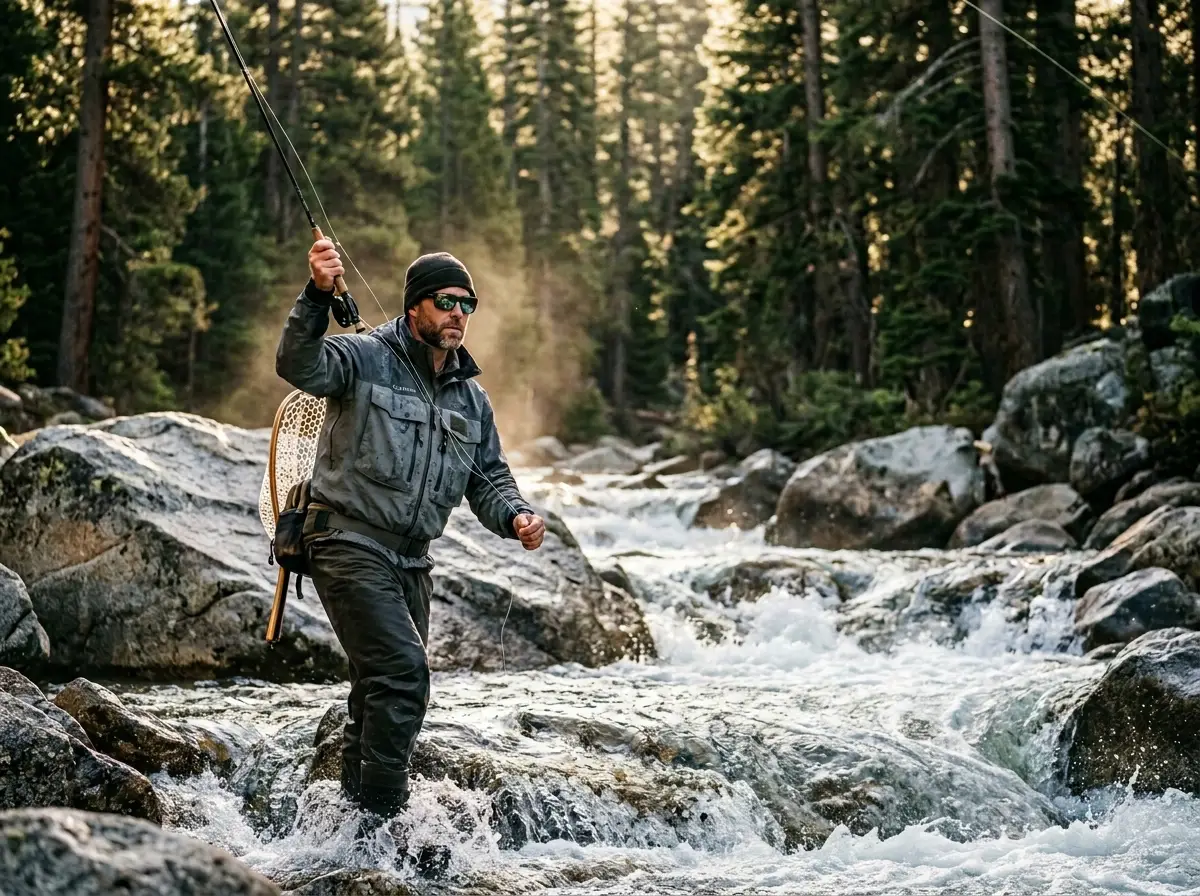
That gap has a name. It’s called the physics of the drift — and most guides skip right over it because they learned the technique without understanding the mechanism. After spending years on the Upper Delaware testing setups back to back, I can tell you that tightline nymphing isn’t a style preference. It’s the mechanically correct response to how water actually moves and how trout actually feed.
Here’s exactly what’s happening below the surface — and how to use it.
⚡ Quick Answer: Tightline nymphing outperforms indicator rigs because it removes the surface current as a drag source. A conventional indicator anchors your fly to surface water speed, which is always faster than the boundary layer where trout hold — pulling the fly upward and triggering refusals. Switching to a mono rig (thin-diameter monofilament instead of fly line) eliminates that mechanical tension, letting the fly dead drift at the same speed as the water column the fish is sitting in. Strike detection is 90% visual through the hi-vis mono sighter — not tactile. If you’re waiting to feel the take, you’re already behind the fish.
Why Your Line Is the Problem — Drag Physics and the Boundary Layer
Most anglers blame the fish when they stop hitting. The problem is usually the line.
Here’s what nobody draws on the whiteboard: water doesn’t move at one speed. It moves in layers. Near the surface, current runs fast. Near the riverbed, it slows down dramatically — approaching zero right at the substrate. This vertical velocity gradient is governed by what fluid mechanics calls the “no-slip condition.” The water touching the streambed can’t slip past it, so it stacks up into a slow-moving zone called the boundary layer. That’s exactly where trout live.
Laminar flow in this zone is what makes a dead drift possible. Your job as an angler is to get the fly into that zone and keep it there. The problem with a conventional indicator rig is simple: the bobber floats at surface velocity, the fly sinks toward boundary layer velocity, and the tension between them creates hydrodynamic drag that continuously lifts the nymph back toward the surface. This isn’t a rigging failure — it’s physics built into the system.
The degree of complexity in that velocity gradient depends on the streambed itself. Cobble and boulder streams — the classic trout habitat — have high roughness values that represent a multi-fold increase in competing drag vectors acting on your line from the moment it hits the water. On a technical cobble run, you’re not fighting one current — you’re fighting dozens of micro-currents pulling from different angles at different speeds. A smooth earth channel is far more forgiving, and you can check the Manning’s roughness coefficient tables for natural channels to understand exactly how much more drag you’re dealing with on different stream types.
How current seams and the thalweg concentrate fish and dictate drift paths explains the hydraulic geometry behind where fish hold — and understanding those position points makes the drag discussion click. They’re not random. They’re energy-efficient refuges that the line physics must serve.
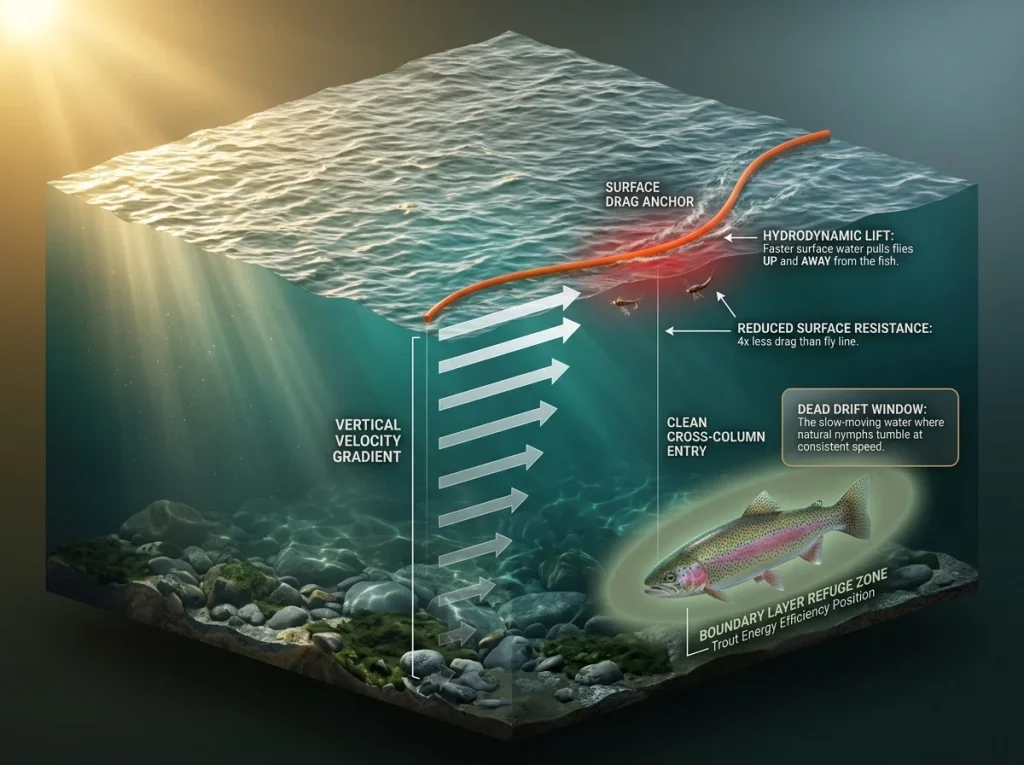
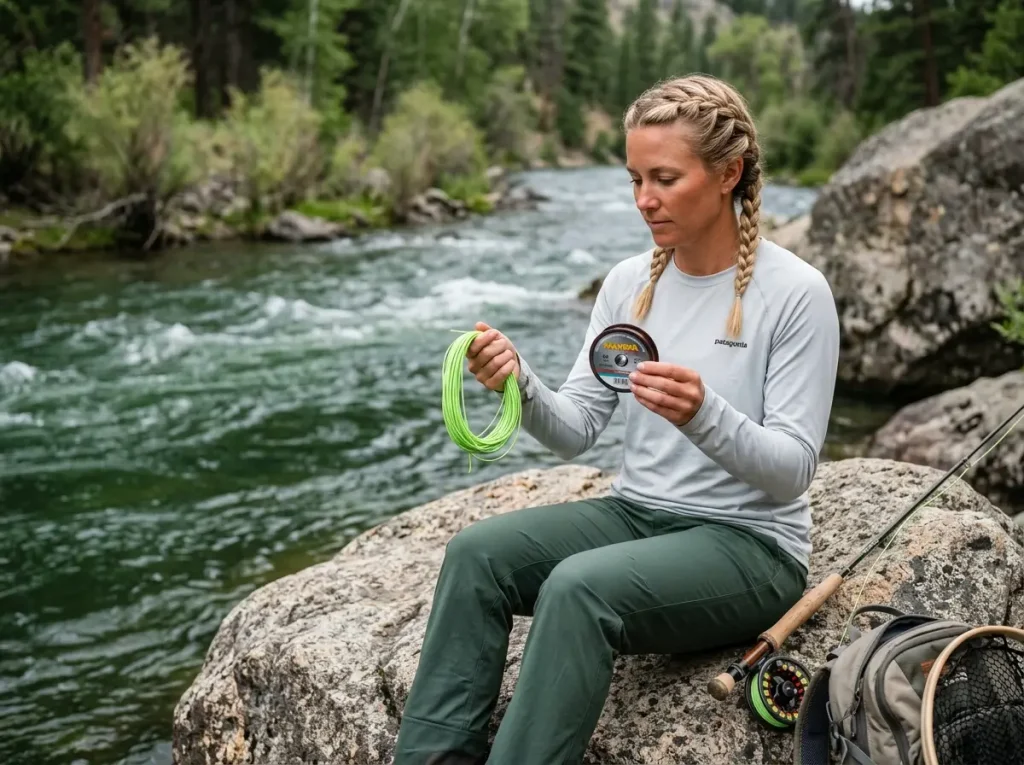
The line diameter matters more than most anglers realize. A 0.040″ fly line section creates roughly 3 to 5 times more water resistance than a 0.017″ mono rig at the same depth. In fast pocket water with high streambed roughness, that drag difference is the margin between a fish that takes and a fish that spooks. In my experience on the Upper Delaware, switching from a 0.022″ euro line to a 0.017″ Maxima Chameleon mono rig produced a 30% increase in detected strikes during high-flow events. That number didn’t surprise me. It made sense.
Pro tip: Read the streambed before you rig. Smooth gravel lets you get away with slightly heavier line. Fractured cobble and boulders demand the thinnest tippet the situation will allow. The stream is telling you what to use.
Trout Bioenergetics — Why the Dead Drift Triggers the Strike
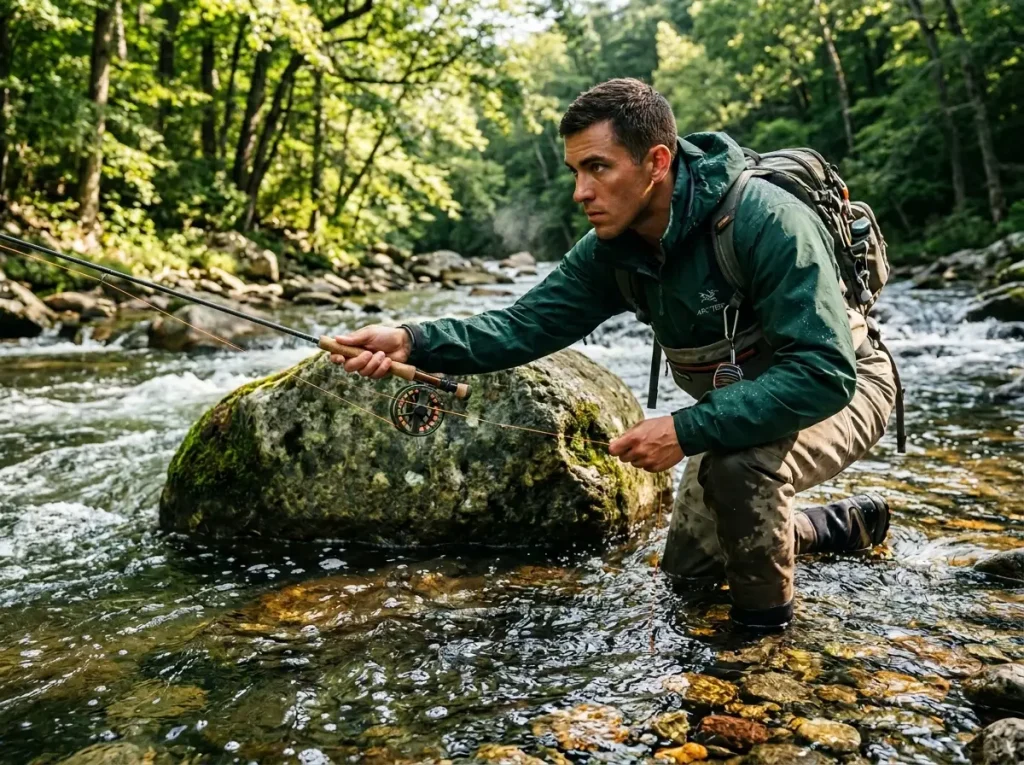
Here’s the part that almost no tightline guide bothers to explain: the reason a dragging fly gets rejected isn’t just that it looks wrong. It’s that the trout did a cost-benefit calculation and decided the math didn’t work.
Trout feeding is an energy equation, not opportunism. Research confirms that rainbow trout select microhabitats to minimize oxygen consumption — they’re not lazy, they’re efficient. The energetically favorable flow speed for foraging trout sits between 17 and 29 cm/s. Outside that range, the metabolic cost of holding station and attacking prey rises steeply. A fish wedged in a vortex pocket behind a boulder is running one of nature’s most efficient energy budgets.
That’s why dead drift in the boundary layer works. When the fly moves at local current speed, it looks like a natural invertebrate on a predictable trajectory. The fish can intercept it with minimal effort. When the fly moves even slightly faster than the surrounding water, the trout has to accelerate harder, travel farther across the velocity gradient, and take a risk on something that’s moving wrong. For an experienced wild fish, that combination — extra metabolic cost plus suspicion of unnatural movement — tips the calculation toward refusal.
The holding position determines how picky the fish is. A trout Kármán gaiting in a vortex street behind a boulder is the most efficiently positioned fish on the river — and also the most selective. It has a tight feeding window and zero tolerance for a dragging fly. A fish in broken riffle water is in full-cost foraging mode and will accept a wider range of drift speeds because the turbulence itself masks minor presentation flaws. George Daniel’s “when in doubt, drag ’em” rule applies specifically to that chaotic pocket water — not to slick pools.
How rainbow trout use bioenergetics to govern every feeding decision digs into the Oncorhynchus mykiss physiology behind this behavior — the same adaptive logic that determines which pool tailouts hold fish and which ones don’t.
Understanding reading pool-riffle sequences and thalweg lines to find where trout hold before you fish is how you map these bioenergetic positions before you start casting. Cast upstream of any rock you can see. There are three micro-positions around it: the cushion pillow in front, the eddy behind, and the depth shadow in the downstream throat. Each one requires a separate depth and weight calculation.
Pro tip: Seam fish are pickier than riffle fish — always. Slow your drift down before you slow your retrieve. If you can see the sighter swinging downstream at all, you’re fishing too fast for that position.
The Mono Rig — Engineering the Signal-to-Noise Advantage
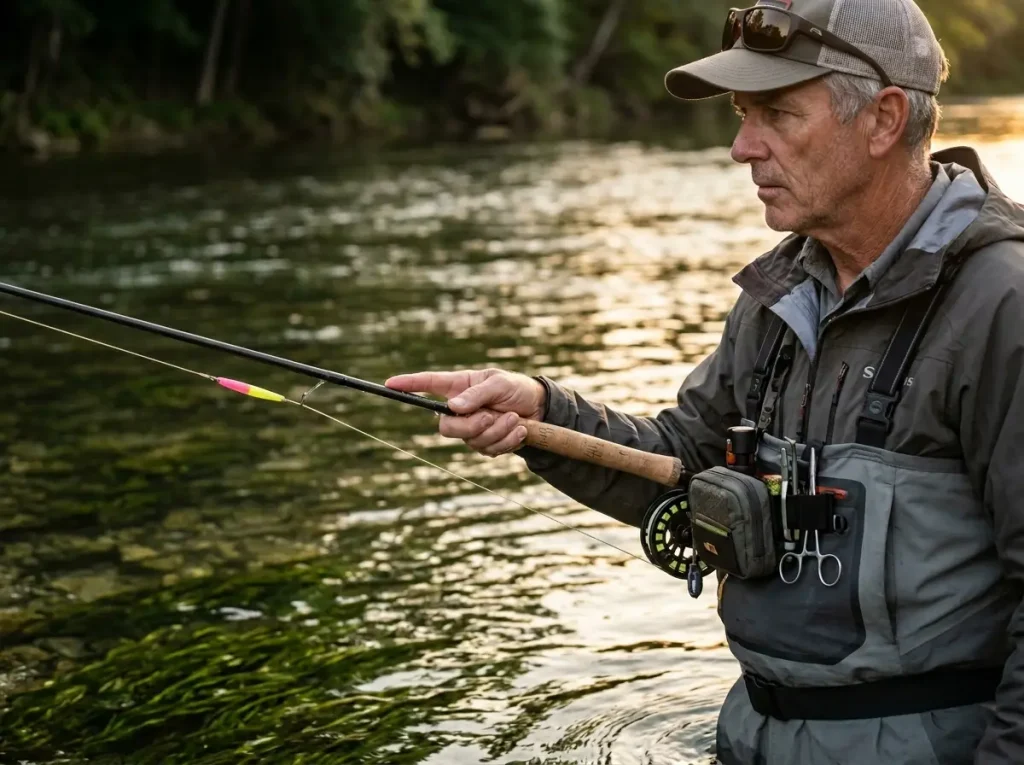
The Mono Rig replaces the fly line entirely with a continuous length of monofilament. The physics behind why this matters come down to mass, sag, and what happens to a signal traveling through two different materials.
A 10-foot section of 0.022″ euro nymphing line weighs 1.06 grams. A 10-foot section of 20 lb Maxima Chameleon monofilament (0.017″) weighs 0.63 grams — a 40.5% reduction in mass. Less mass means less gravitational sag. Less sag means less slack between the rod tip and the fly. Each inch of unmanaged sag is a “belly reservoir” of slack that must be consumed before a strike signal reaches your hand. That’s detection lag — the gap between when the fish mouths the fly and when you know about it.
With a standard fly line, detection lag can run 0.5 to 1.0 seconds in moderate current. Trout eject nymphs in under a second. With a Mono Rig, that lag collapses to near-zero on short-range drifts. The sighter moves the moment the fish moves.
The second advantage is vibration transmission. PVC fly line has a soft, dampening coating that acts as a low-pass filter — it kills high-frequency signals before they reach the rod handle. Monofilament is denser and stiffer at micro-frequencies. It conducts vibrations the way a wire transmits sound versus a rope. This is why experienced Mono Rig anglers say they can “feel the bottom” through the rod — they’re not imagining it. That solid-state waveguide behavior is most pronounced on hard-bottomed gravel and cobble streams. On silt rivers, the distinction narrows.
How monofilament stretch in the 2-9% range affects hookset transmission explains the trade-off between sensitivity and stretch — useful context once you’re dialing in hookset timing on longer drifts.
In winter, the Mono Rig has another practical edge. Conventional fly lines absorb water in the rod guides and freeze, interrupting the cast every few minutes. A thin mono rig carries almost no water into the guides. It also cuts through wind more cleanly — which matters when temperatures drop and gusts pick up. Cold-water trout hold in the deepest, slowest pool bends, and the Mono Rig’s reduced sag lets you fish vertically in those spots where a fly line belly would destroy depth control. For cold-water tactics for finding and presenting to lethargic winter trout, the mono system isn’t just better — it’s the only real option on technical water.
Rod Length, Lever Arms, and the Honest Assessment Nobody Gives
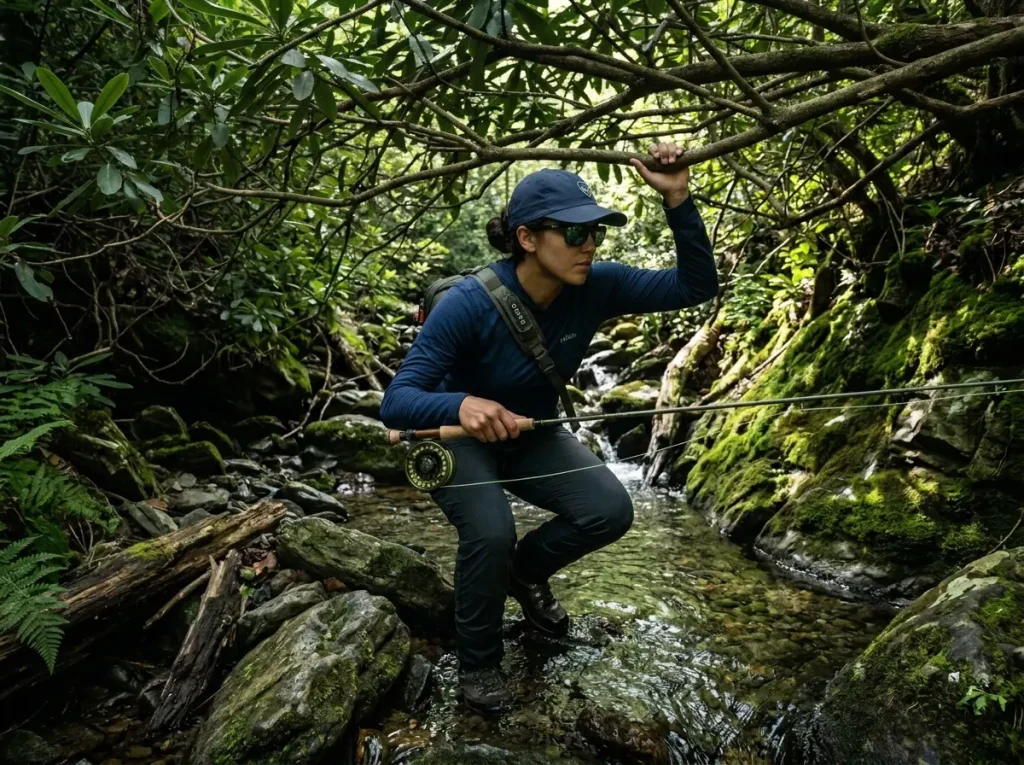
Here’s where I’ll say what most guide content won’t: the arms race to 11-foot rods isn’t universally optimal. On some water, it’s a liability.
The 10- to 11-foot rod exists for a geometric reason. A longer rod lifts more line off the water, reducing the footage exposed to chaotic surface drag vectors. The geometry works: more line clearance means less surface current contact, which means less unintended drift speed. On a wide river with deep runs and open casting lanes, the leverage advantage is real.
But longer rods amplify everything — including your mistakes. A subtle wrist wobble at the handle becomes twitching at the rod tip on an 11-foot blank, introducing unintended slack and tension into the drift. On small, brush-choked creeks under 20 feet wide, you also can’t execute a tight sidearm snap cast under 4 feet of canopy without snagging the backcast. An 11-foot rod physically can’t make some of the casts you need to cover that water. You end up sacrificing 40% of fishable positions.
The honest assessment: rod manufacturers benefit from selling longer, more expensive sticks. The physics of small-stream fishing favor shorter, stiffer, lighter rods. If you’re breaking off flies on overhead limbs more than once per session, your rod is too long for your water.
Sensitivity matters more than length. And sensitivity is not about blank modulus — it’s about total system weight. The heaviest components in a rod setup are the guides, especially the tip-top, and they sit at the most critical vibration node in the entire system. Even the finest high-modulus blank is compromised by a heavy tip guide. Cork grips transmit more high-frequency vibration to the palm than EVA foam. How Young’s Modulus and carbon fiber construction affect rod sensitivity and feel gets into the material science — but the field test is simpler: hold two identical blanks side by side, one with heavy guides, one with micro guides. The micro-guide blank detects strikes the heavier one misses.
How rod length affects hookset leverage and casting platform geometry gives the full breakdown of lever-arm trade-offs for different water types — worth reading before you commit to a setup for a specific stretch of river.
The lever-arm physics of the hookset matter too. A 10° wrist snap at 11 feet moves more line than the same motion at 9 feet — good for fast, accurate sets on a short drift. But that amplification also applies to the false tension you introduce between casts. A perfectly balanced 10-foot rod with a cork grip and micro guides will detect more strikes across a full session than a tip-heavy 11-foot rod that’s producing wrist fatigue by hour three.
The Tuck Cast — Momentum Physics and Vertical Entry
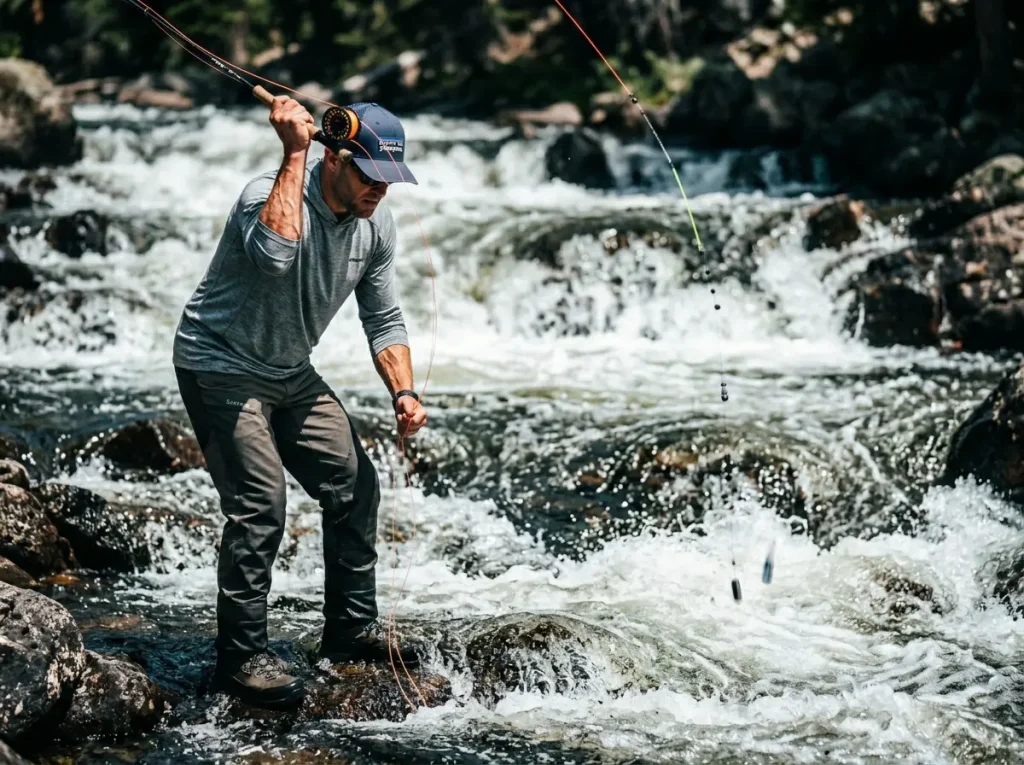
Most fly casting transfers energy through line mass — the weight of the fly line loads the rod, and that stored energy propels the presentation. A Mono Rig has almost no mass in the line itself. The energy transfer mechanism is different.
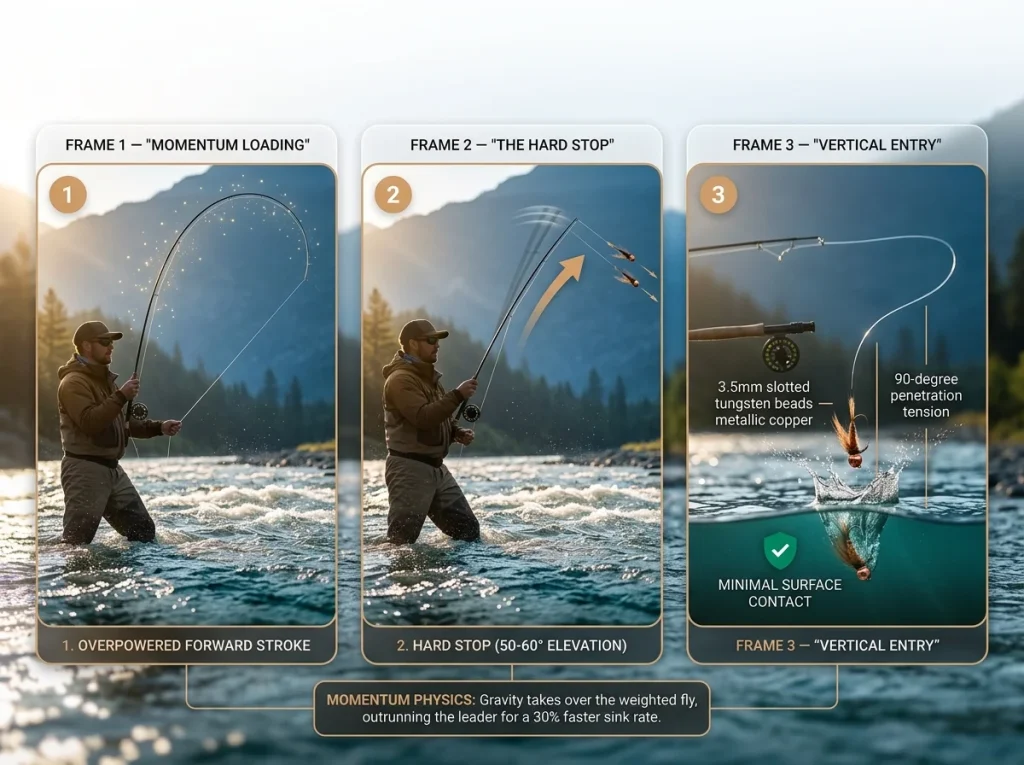
In a tightline system, the tungsten beads on the nymphs are the projectile mass. The correctly executed tuck cast maximizes the momentum those beads carry into the water. The cast starts as an overpowered forward stroke, stops hard at 45 to 60 degrees above horizontal, and then lets physics take over. The weighted flies snap forward, then tuck backward under the leader, entering the water vertically before the tippet.
That vertical entry is the whole point. Flies-first, leader second. When the nymphs pierce the surface tension at a steep angle, they navigate through the upper velocity strata before the surface current can influence the leader. They reach the boundary layer faster. A “lobbed” cast — flies and tippet landing simultaneously — creates immediate lateral drag. The nymphs start swinging toward the surface before they’ve even reached the strike zone.
Tungsten’s density is roughly 70% greater than lead by volume — that’s why tungsten beads sink so much faster for their size. It’s a genuine material advantage, not marketing math. Tungsten vs. lead weight geometry and why density determines sink rate explains the geometry behind how bead size and shape compound that sink rate difference.
Bead size calibration is where most tightline beginners get the depth wrong in both directions. Over-weighting anchors the flies to the substrate — a “stilted drift” where the nymph sits motionless instead of tumbling. The fish don’t want a dead bug on the floor; they want prey moving at boundary layer current speed. If you aren’t “ticking” the bottom every 3 to 4 drifts, you’re fishing above the fish. Add one bead size or lengthen the tippet by 6 inches. If the sighter never moves, you may be anchored — drop 0.5mm.
Pro tip: The dog leash tension rule. Enough contact to feel the flies, enough slack for the sighter to pulse in and out of tension rhythmically. Constant pull means too heavy. No pulse at all means too light. That rhythm is what you’re dialing in every time you change water depth.
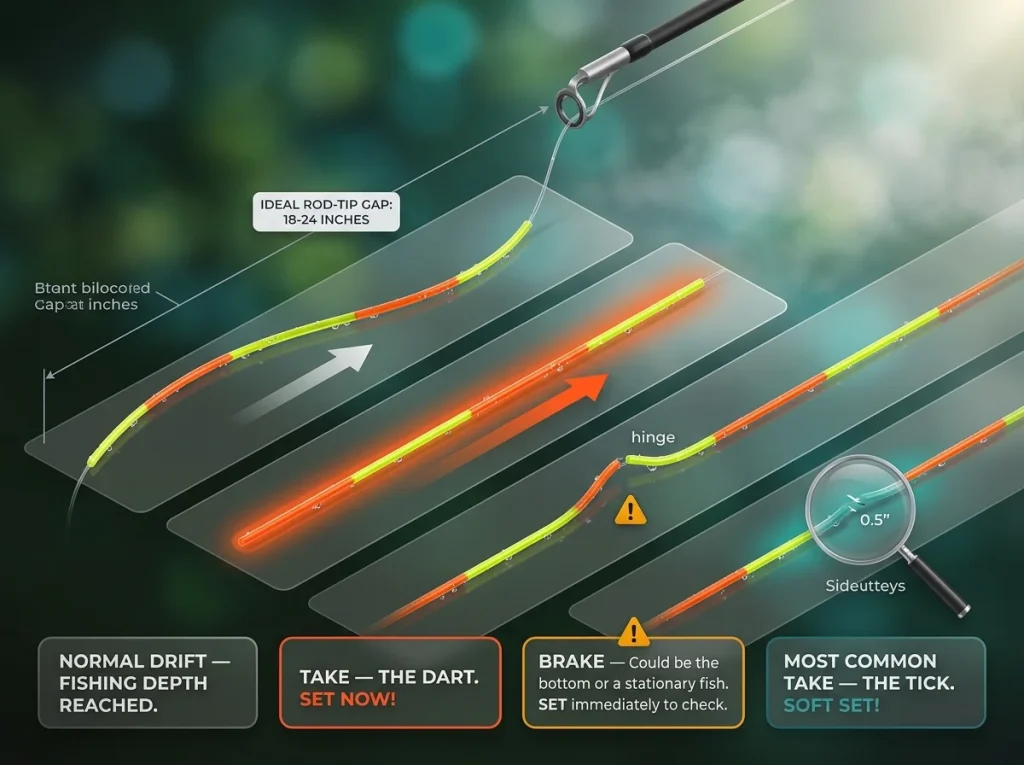
Strike detection is 90% visual, not tactile. George Daniel’s field data backs this. Beginners wait for the thump in the rod — but by the time a trout’s take registers as tactile feedback, the fish has already spat the fly. Train yourself to read three specific sighter signals: the sudden forward dart (acceleration downstream), the complete brake (the sighter stops moving entirely), and the subtle half-inch tick with no downstream travel. That last one — the tick — is the most common take and the one most beginners miss. Always set downstream to draw the hook point toward the fish’s lip, not away from it.
Three Leader Formulas for Different Water Types
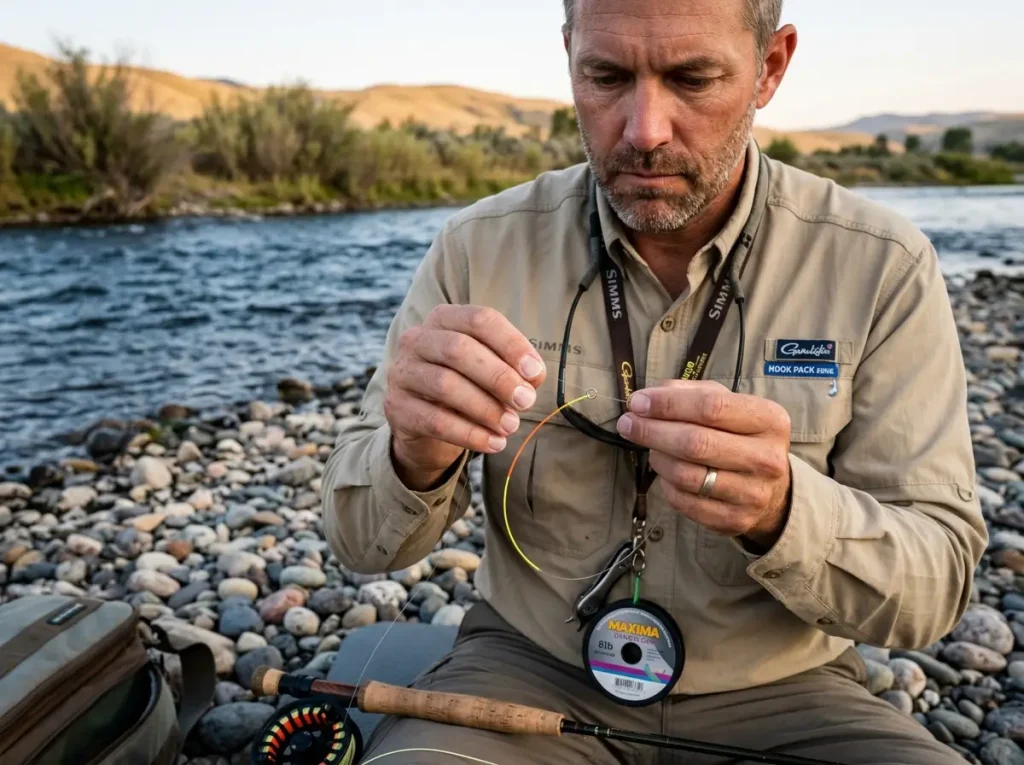
A leader formula isn’t about following a recipe. It’s about understanding what each section does and adjusting for the variables in front of you.
The standard euro nymph leader architecture runs: thick butt section (20–25 lb mono) → 18–24″ bicolored Cortland Sighter material → tippet ring → fine fluorocarbon tippet → point fly → 8–12″ tippet drop → dropper fly. Joe Humphreys put it clearly: monofilament has “no weight, no resistance” compared to standard fly lines. The leader is a neutral conduit, not a drag source. For mono rig leader formulas for tightline and Euro nymphing, the Santa Cruz Fly Fishing club’s published formulas are the clearest non-commercial reference available.
Tippet rings at the sighter-tippet junction let you replace tippet without shortening the sighter — a competition efficiency technique that pays off on any hard-fished day. The best knots for connecting tippet rings to your monofilament leader system covers the specific connection methods that hold at 6X without slipping.
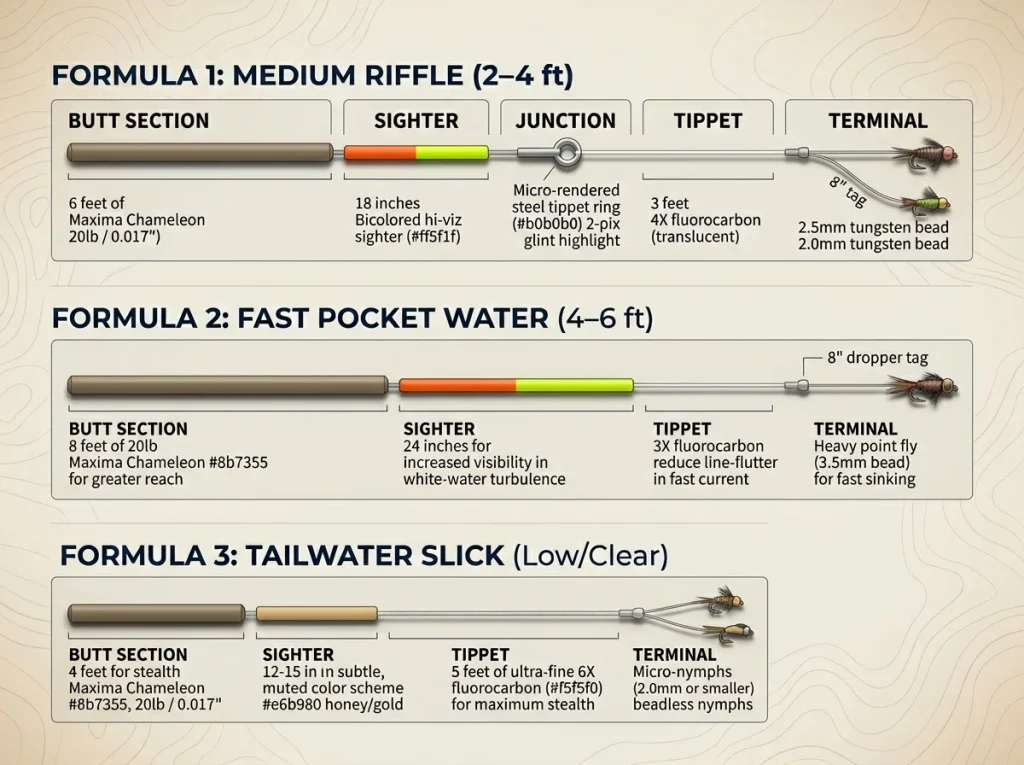
Formula 1 — Medium-Depth Riffle Water (2–4 ft, Moderate Flow)
Butt: 6 ft of 20 lb Maxima Chameleon. Sighter: 18″ bicolored hi-viz mono. Tippet ring. Tippet: 3 ft of 4X fluorocarbon to point fly; 8–10″ dropper to second fly. Bead size: 2.5mm on point fly; 2.0mm on dropper.
This is the all-around formula. It covers roughly 70% of standard trout stream conditions and the setup most guides recommend first. In moderate flow, watch for the sighter to flatten — if it goes from curved to nearly straight, the current has taken control and you’ve lost bottom contact. That’s your cue to add weight or lengthen the tippet.
Formula 2 — Fast Pocket Water (4–6 ft, High Streambed Roughness)
Butt: 8 ft of 20 lb Maxima Chameleon (extended for greater reach over fast, conflicting seams). Sighter: 24″ bicolored hi-viz mono. Tippet ring. Tippet: 2 ft of 3X fluorocarbon; point fly carries a 3.0–3.5mm bead. Dropper fly on an 8″ tag.
Shorter tippet keeps flies from swinging in micro-currents. In fast pocket water, heavier is correct — Devin Olsen’s rule applies directly here: flies should tumble at approximately half the surface current speed. In fast water, matching that half-speed target requires more weight, not less. The longer butt section gives you the reach to keep the sighter over the seam without stacking line on the water.
Formula 3 — Tailwater Slicks and Clear, Low-Flow Conditions
Butt: 4 ft of 20 lb Maxima Chameleon. Sighter: 12–15″ in a subtler color — not screaming hi-viz — to reduce visual impact on pressured fish. Tippet ring. Tippet: 4–5 ft of 6X fluorocarbon (~0.005″ diameter). Bead size: 2.0mm or smaller; dead-weight nymphs with no bead are viable here.
In tailwaters, the fish have seen every technique. Fluorocarbon’s refractive index is closer to water’s than nylon’s — a genuine optical advantage in ultra-clear water at depth that’s explained in detail in why fluorocarbon isn’t truly invisible and how the optics actually work underwater. The leader is the presentation. The trade-off: at 6X diameter, you must handle fish quickly or risk tippet failure on a prolonged fight.
Reading generation schedules and flow rates on tailwater trout fisheries explains how dam release timing changes which formula applies on any given day — sometimes within the same session.
What to Take From Here
Three things to hold onto:
First, the drift is a physics problem, not a luck problem. Drag-induced lift from a conventional indicator is a mechanical failure built into the system. A tightline mono rig removes the surface anchor and returns the fly to the boundary layer where the trout’s energy budget is already optimized for feeding.
Second, your rod is a signal receiver, not just a casting tool. Total system weight — especially tip mass — determines what you detect. A balanced 10-foot rod with a cork grip and micro guides will put more fish in the net across a hard session than a tip-heavy 11-footer that’s producing wrist fatigue by noon.
Third, depth control is a continuous discipline. If you’re not ticking the bottom every 3 to 4 drifts, you’re fishing above the fish. Adjust bead weight and tippet length in small increments. The boundary layer is thin, and the strike zone sits right at the bottom of it.
Pick one leader formula from this article and build three identical rigs before your next session. Fish each one on a different section of the same river in the same hour. The drift performance differences will tell you more about your water than any single guide session ever will.
FAQ
Is Euro nymphing the same as tightline nymphing?
They’re closely related but not identical. Euro nymphing refers to a family of competition-derived techniques — Czech, French, Spanish, and Polish Nymphing — that share the tightline principle. Tightline nymphing is the broader, technique-agnostic term for any system that eliminates fly line from the water surface. All Euro nymphing is tightline; not all tightline is Euro nymphing.
What rod do I need to start Euro nymphing?
A rod rated euro nymph or contact nymph between 10 and 10’6 in a 2- or 3-weight is the standard starting point. Prioritize total system weight over blank modulus. A well-balanced rod that doesn’t fatigue your wrist will put more fish in the net than a premium-modulus rod with heavy guides. You can start with a quality 10 ft 3-weight nymph rod under $200 — brands like Sage ESN, Orvis Helios, and Orvis Recon are common reference points, but don’t get distracted by the spec sheet before you’ve confirmed the technique fits your water.
How long should a Euro nymph leader be?
A functional starting euro nymph leader is 12–16 ft total: 6 ft of 20 lb Maxima Chameleon butt section + 18–24 hi-viz sighter + tippet ring + 3–4 ft of 4X tippet. Adjust tippet length based on water depth — deeper and slower water demands longer tippet. Total leader length should approximate fishing depth plus 1.5 to 2 times your average casting distance.
Can I Euro nymph with a regular fly rod?
Yes, with real trade-offs. A shorter, softer rod introduces more tip wobble and has less reach over fast water. It works, but you sacrifice the lever-arm geometry that makes the system precise. Start with what you have, then upgrade once you’ve confirmed the technique matches your conditions.
Why am I missing strikes I can see on the sighter?
Reaction time lag. By the time you’ve processed the sighter movement visually and initiated the strike, the fish has already ejected the fly. Two fixes: set downstream, not upstream — a downstream hookset is faster and keeps the hook point oriented toward the fish’s lip. And shorten your trigger delay. Treat the sighter as a hair trigger. Any deviation, any hesitation: set immediately. The first 20 times you’ll set on the bottom. That’s how you calibrate.
Risk Disclaimer: Fishing, boating, and all related outdoor activities involve inherent risks that
can lead to injury. The information provided on Master Fishing Mag is for educational and informational purposes
only. While we strive for accuracy, the information, techniques, and advice on gear and safety are not a substitute
for your own best judgment, local knowledge, and adherence to official regulations. Fishing regulations, including
seasons, size limits, and species restrictions, change frequently and vary by location. Always consult the latest
official regulations from your local fish and wildlife agency before heading out. Proper handling of hooks, knives,
and other sharp equipment is essential for safety. Furthermore, be aware of local fish consumption advisories. By
using this website, you agree that you are solely responsible for your own safety and for complying with all
applicable laws. Any reliance you place on our content is strictly at your own risk. Master Fishing Mag and its
authors will not be held liable for any injury, damage, or loss sustained in connection with the use of the
information herein.
Affiliate Disclosure: We are a participant in the Amazon Services LLC Associates Program, an
affiliate advertising program designed to provide a means for us to earn advertising fees by advertising and linking
to Amazon.com. As an Amazon Associate, we earn from qualifying purchases. We also participate in other affiliate
programs and may receive a commission on products purchased through our links, at no extra cost to you. Additional
terms are found in the terms of service.