
In this article
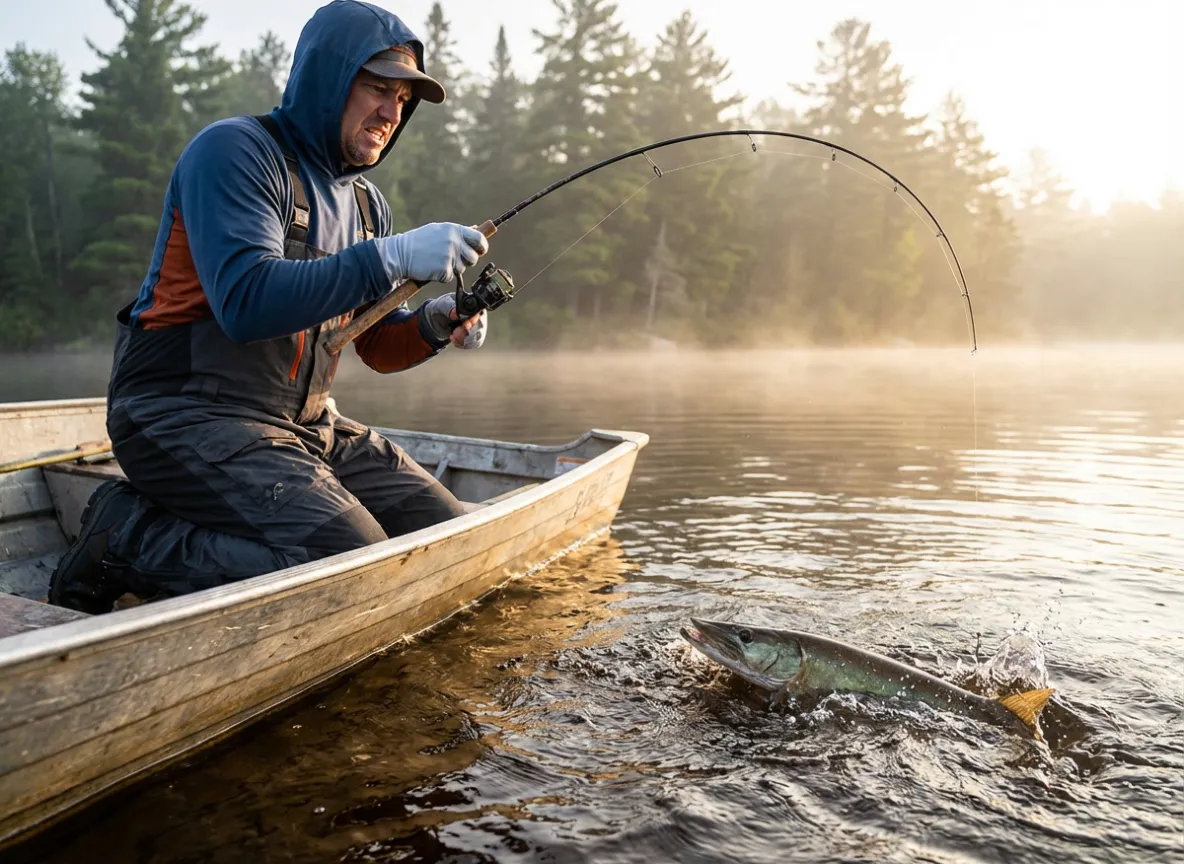
Your shoulder burns from the repetitive weight of the rod, and the silence of the lake has stretched for eight hours. Then, twenty feet from the boat, a forty-inch shadow detaches itself from the darkness of the weed line, tracking your lure with predatory indifference.
This moment—the conversion of a following fish into a catch—is not an accident. It is the calculated result of specific musky gear choices, biological understanding, and execution. To catch a Muskellunge is to overcome statistical improbability with methodical precision. It requires shifting your mindset from hoping for luck to apex predator trophy hunting.
Why is the Muskellunge known as the “Fish of 10,000 Casts”?
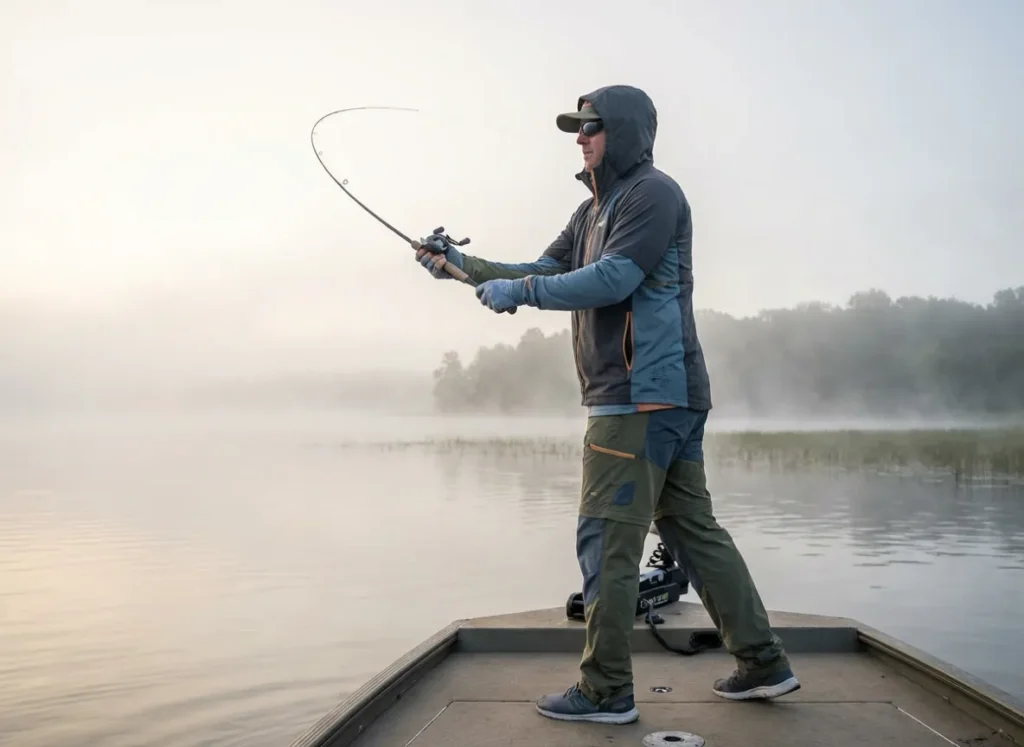
The nickname stems from the exceptionally low population density of the species compared to other freshwater sport fishing targets, often counting only a few adult individuals per acre of water.
How do biology and population density influence the hunt?
Muskies are apex predators that operate on a different biological rhythm than walleyes or crappie. Because they are cool-water ectotherms, they do not feed casually. They feed in calculated windows driven by environmental factors. This scarcity means the angler is hunting individual specimens rather than schools. You must cover water efficiently to identify high-percentage ambush points.
The challenge is compounded by their glacial growth rate. Data on growth rates indicate a 50-inch fish in the Canadian Shield may take 17 to 20 years to reach that trophy benchmark. These are long-lived survivors. A 48-inch musky has seen hundreds of muskie lures. To trigger a strike, you often need help from the weather, specifically predicting a pre-frontal feeding frenzy driven by dropping barometric pressure and approaching storms.
Once you accept the rarity of the quarry, you realize that going hours without a bite isn’t failure—it’s the baseline of the muskie hunt.
What specialized gear is required to land a Musky?
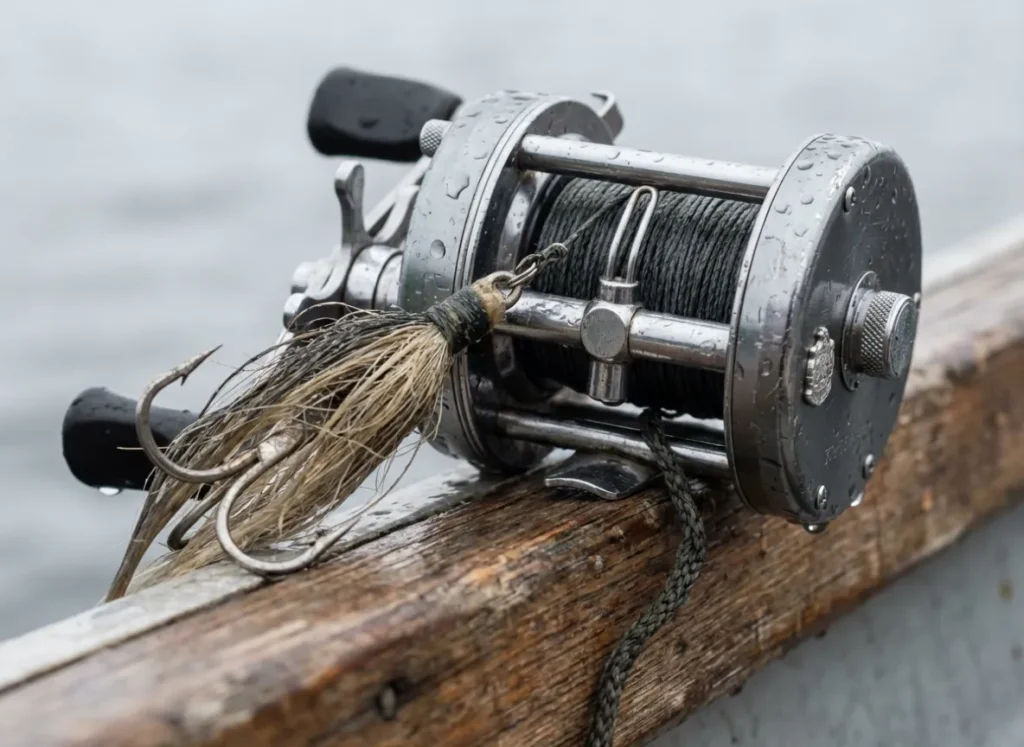
You need a dedicated musky gear checklist featuring “Heavy” to “Extra Heavy” power equipment capable of casting heavy musky baits weighing 4 to 16 ounces.
How do you select the correct rod and reel for heavy lures?
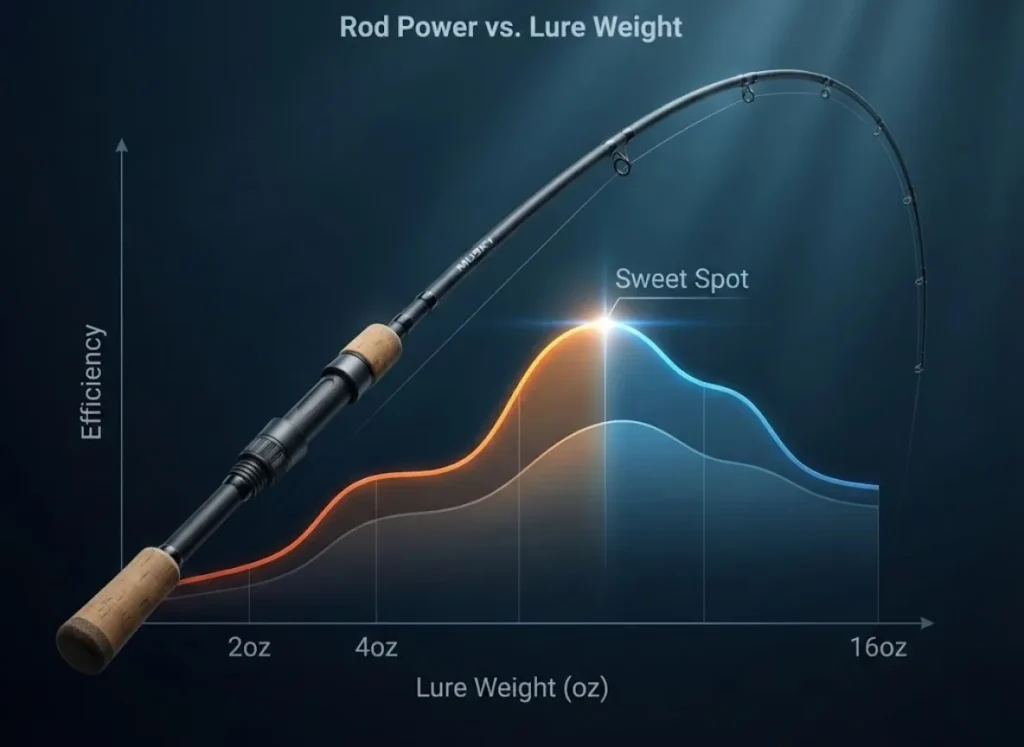
Musky fishing is a discipline of physics. Standard tackle simply cannot generate the force required to set a hook. Modern 8-9ft heavy rods from brands like St. Croix or Fenwick are the standard. This length serves two purposes: it allows for longer casts to cover more water, and critically, it enables deeper and wider boatside maneuvers.
When looking at baitcasting reels, torque is king. You are essentially using a winch. Lower gear ratios (around 5.3:1) are preferred for pulling high-drag bucktails and Double Cowgirls without exhausting the angler. Conversely, high ratios (7.6:1), found in reels like the Shimano Tranx or Abu Garcia Revo Beast, are necessary to pick up slack quickly when working jerkbaits like Suicks or Bobbies. State agency muskie gear guidelines emphasize that your drag system must handle 20-30lbs of pressure. A large fish will surge violently near the boat; if the drag stutters, the line snaps.
Pro-Tip: Durability matters more than weight. Reels like the Shimano Tranx or Daiwa Lexa HD feature rigid aluminum frames. This prevents gear misalignment under the heavy torque of retrieving massive lures.
To better comprehend the backbone required for this fishing style, it helps to start by understanding rod anatomy and how power ratings differ between species.
Fluorocarbon vs. Wire: Which leader material is superior?
The leader is your insurance policy against razor-sharp muskie teeth and abrasive gill rakers. Standard monofilament stands zero chance here. Heavy fluorocarbon leaders (100-130lb) have become the modern standard for soft plastics and inline spinners. They offer high abrasion resistance and are nearly invisible underwater.
However, single-strand wire leader (174lb+) remains essential for specific applications. If you are fishing walk-the-dog topwater lures or glide baits, the stiffness of wire prevents the lure from fouling on the line during erratic movements.
Hydrodynamics also play a role. Thick fluorocarbon creates drag that can lift a lure, while thin 7-strand wire cuts the water, allowing crankbaits to dive deeper when trolling. Regardless of material, the strategic plan for muskie management relies on anglers using tackle that minimizes break-offs.
Always check your leader for nicks after catching a fish or snagging rocks. This is a mandatory safety protocol. You should also understand the broader differences in braid vs fluorocarbon vs monofilament to ensure your main line (usually 80lb braid like Berkley x9) matches your leader choice.
What tactical approaches maximize your odds?
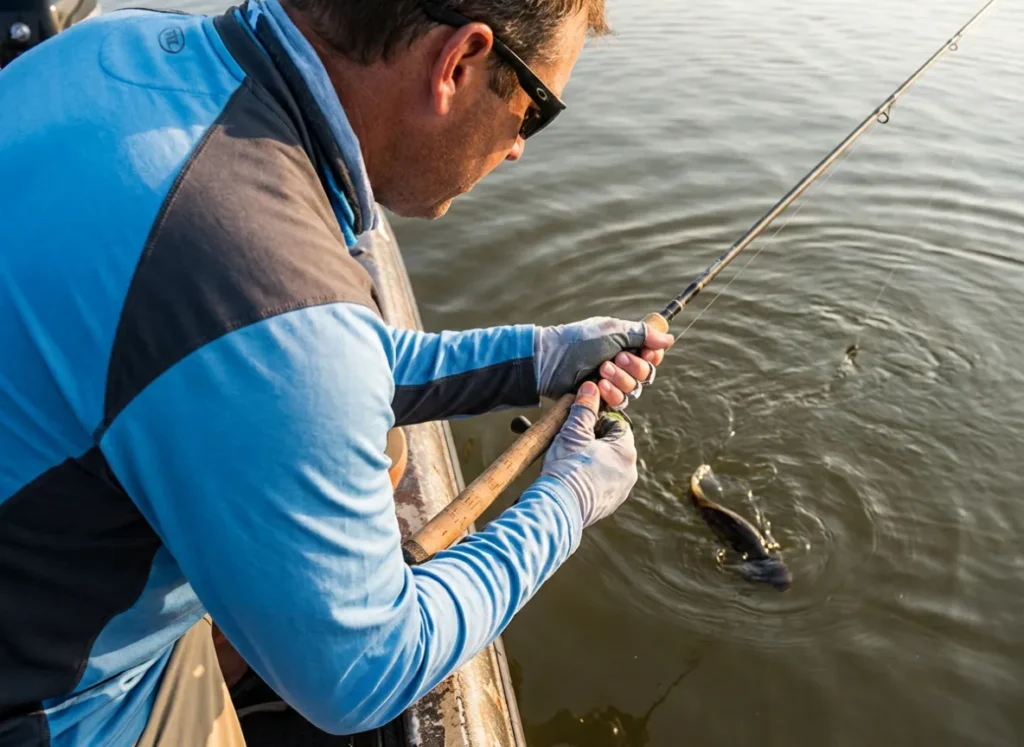
Success comes from locating fish based on seasonal patterns and executing technical maneuvers like the figure-8 maneuver to trigger a reaction.
How do seasonal shifts dictate location and presentation?
Muskies move predictably based on water temperature and forage. In Pre-spawn and ice-out fishing scenarios, they utilize solar-heated shallow bays (less than 5ft) and pencil reeds. Smaller bucktails and glide baits are highly effective here for new musky anglers.
As the Summer Peak arrives, fish push to main lake structures like rock reefs, points, and deep weed lines filled with cabbage or coontail. High-speed retrieves, known as “burning,” trigger reaction strikes in the warm water. The Fall Transition brings the “feed bag” phenomenon. As water cools, seasonal habitat use and home range telemetry shows fish targeting large forage like white suckers or ciscoes on steep drop-offs.
Pro-Tip: Pay attention to turnover. When the water hits the 50-degree threshold, main lake oxygen levels destabilize. Move to non-turning water, such as isolated bays, current breaks, or river sections to find active fish.
Solunar synchronization acts as a multiplier. Fishing your best spots during a Moon Major, as explained in Solunar Theory, can drastically increase success rates when it coincides with low light conditions.
Why is the “Figure 8” maneuver critical for conversion?
The Figure-8 maneuver is a boatside tactic that forces a following musky to make a reactive decision by simulating prey attempting a last-second escape. It accounts for up to 50% of all strikes.
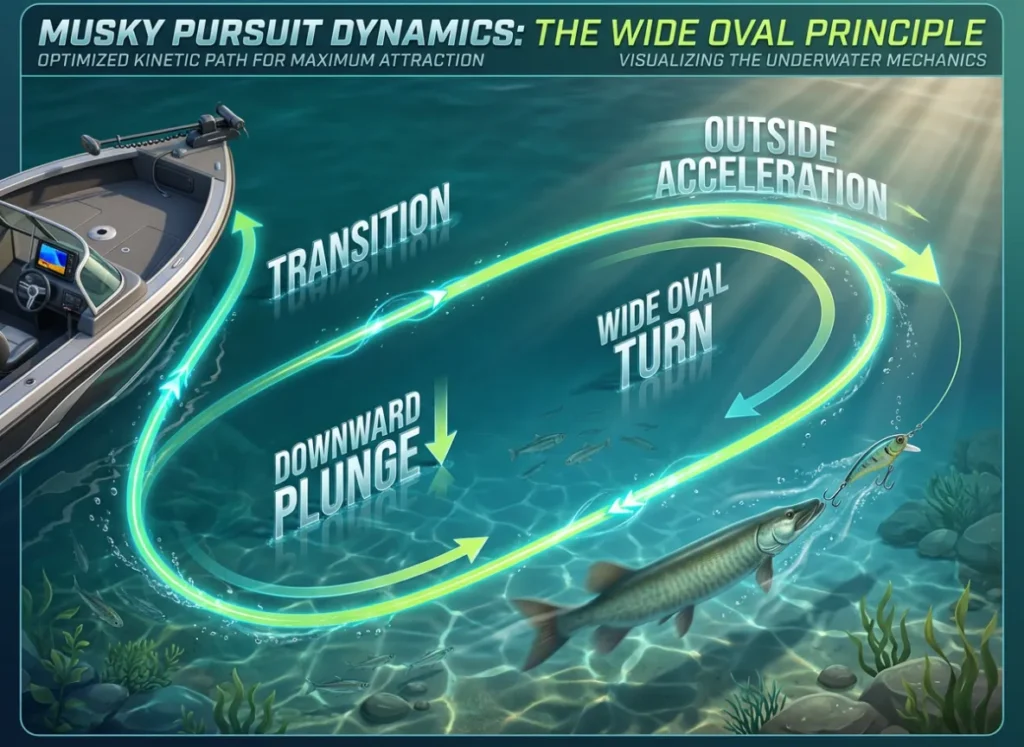
The transition must be seamless. Do not stop reeling before sweeping the rod tip down into the water (2-3 feet deep) to begin the motion. The shape is often a wide oval or “L-turn” rather than a tight 8. This allows the long, stiff body of the fish to turn without hitting its spinal flexibility limit.
Speed is the trigger. Accelerate the lure on the outside of the turn to mimic escape velocity. To execute this properly, you must spot the fish early, which requires a quality pair of polarized fishing sunglasses to cut the glare.
What is the ethical framework for Safe Release?
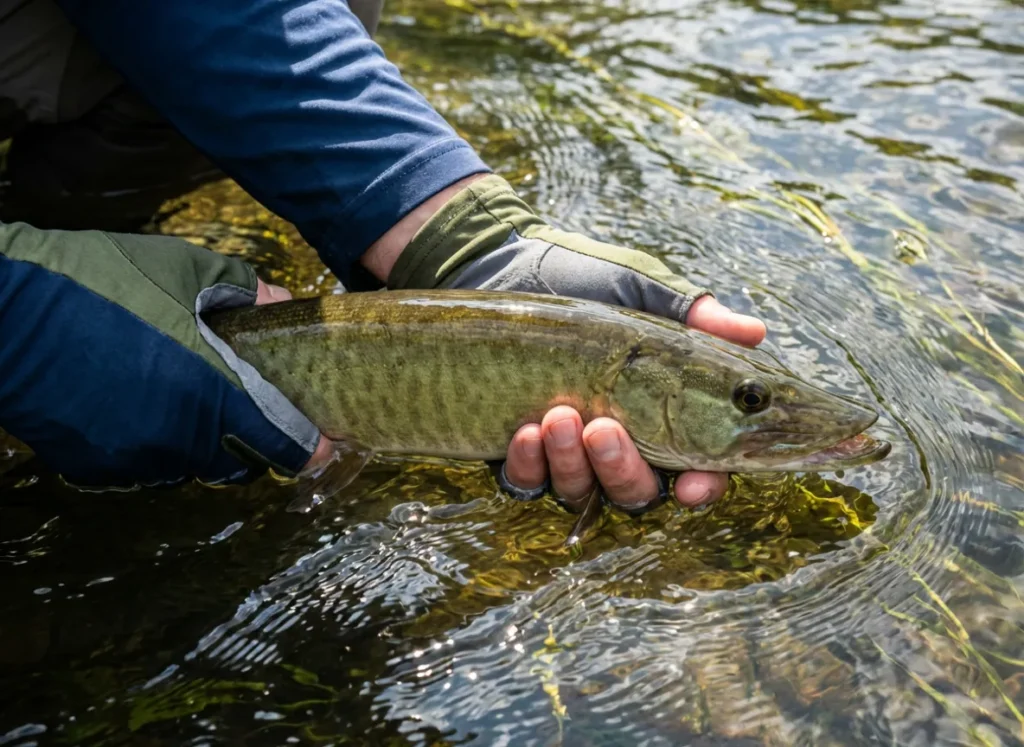
Conservation is the most critical skill a musky angler can possess. You must use proper tools, catch-and-release procedures, and observe lethal temperature thresholds.
How do you perform a surgical release on a trophy fish?
Preparation is key. Powerful hook cutters (like Knipex), long-nose pliers, and jaw spreaders must be ready before the fish is even netted. Keep the fish in the water inside a large landing net. The net acts as a “wet pen” where the fish can recover while you unhook it.
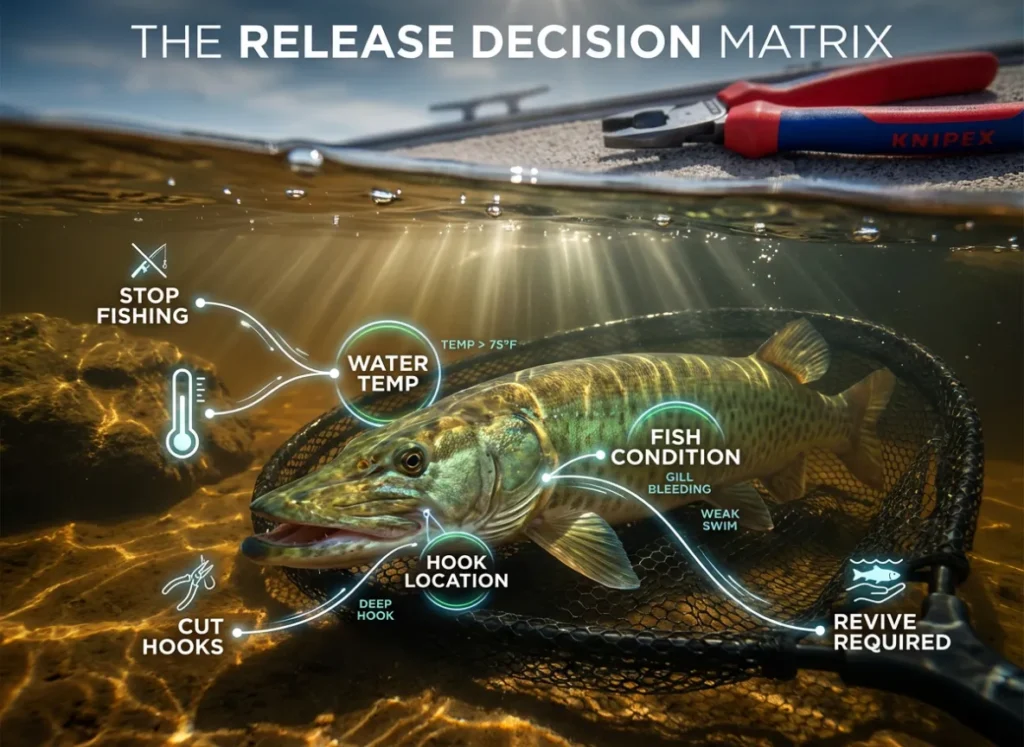
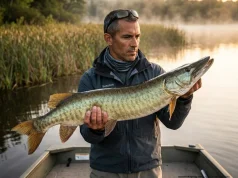
If a hook is deeply embedded or near the gills, cut the hook immediately with bolt cutters. Do not try to back it out. Hooks are cheap; a 20-year-old fish is irreplaceable. When lifting the fish for a photo, use a “Gill Plate Grip,” sliding fingers inside the gill cover but strictly avoiding the red gill rakers.
Never hold a musky vertically. Their heavy internal organs are not supported by their skeletal structure out of water. Following established handling and release tips ensures the fish survives to fight another day. Ensure you are using fish-safe landing nets with coated mesh to protect their slime coat.
Why is water temperature a lethal factor?
Muskies are cool-water fish. Research indicates that catch-and-release mortality spikes significantly when water temperature exceeds 80°F (27°C).
At high temperatures, the lactic acid buildup from the fight causes delayed mortality. A fish that swims away aggressively may die hours later due to physiological acidosis. Scientific papers evaluating catch-and-release mortality suggest that serious muskie hunters should observe a “safe zone” below 75°F.
Responsible anglers stop targeting muskies entirely when surface temps hit 80°F. Conservation is a long game. Preserving these genetics is vital. This mindset is central to all ethical catch and release techniques.
Final Thoughts
To catch a musky, you must respect the science behind the sport. Metabolism dictates when they feed. Physics dictates the gear you use. The Figure 8 converts curiosity into aggression. And stewardship ensures the fishery survives.
Ready to tackle the apex predator? Explore our guide on “The Science of Catching Musky: Weather, Lures & Location” for a detailed analysis of atmospheric conditions, or verify your setup with our rod and reel reviews.
FAQ – Frequently Asked Questions
What is the best time of day to catch a musky?
Muskies are most active during low-light periods (dawn and dusk) and during moonrise or moonset. Overcast days and approaching weather fronts often extend the feeding window throughout the day.
Can I use my heavy bass gear for musky fishing?
Generally, no. Bass gear lacks the backbone to set hooks in a musky’s bony jaw and the drag power to handle the fight. You risk exhausting the fish to the point of death or snapping the line.
Do muskies lose their teeth in the summer?
No, this is a persistent myth. Muskies replace teeth individually throughout the year, but they never lose them all at once. A lack of bites in summer is usually due to abundant forage or stable high pressure.
Why do muskies follow the lure but not bite?
Follows usually indicate a fish is curious but not triggered. The lure might be moving too slowly or lacks erratic action. This lazy behavior is why the speed change of a Figure 8 is necessary.
Risk Disclaimer: Fishing, boating, and all related outdoor activities involve inherent risks that
can lead to injury. The information provided on Master Fishing Mag is for educational and informational purposes
only. While we strive for accuracy, the information, techniques, and advice on gear and safety are not a substitute
for your own best judgment, local knowledge, and adherence to official regulations. Fishing regulations, including
seasons, size limits, and species restrictions, change frequently and vary by location. Always consult the latest
official regulations from your local fish and wildlife agency before heading out. Proper handling of hooks, knives,
and other sharp equipment is essential for safety. Furthermore, be aware of local fish consumption advisories. By
using this website, you agree that you are solely responsible for your own safety and for complying with all
applicable laws. Any reliance you place on our content is strictly at your own risk. Master Fishing Mag and its
authors will not be held liable for any injury, damage, or loss sustained in connection with the use of the
information herein.
Affiliate Disclosure: We are a participant in the Amazon Services LLC Associates Program, an
affiliate advertising program designed to provide a means for us to earn advertising fees by advertising and linking
to Amazon.com. As an Amazon Associate, we earn from qualifying purchases. We also participate in other affiliate
programs and may receive a commission on products purchased through our links, at no extra cost to you. Additional
terms are found in the terms of service.