
In this article
I’d been staring at the same hump for twenty minutes, casting to what the contour map promised was a 15-foot drop-off, when a charter captain idled past and hollered: “You’re thirty yards off—that map’s from 1952.” He was right. The structure I was fishing didn’t exist anymore; decades of siltation had erased it. That’s when Buck Perry’s words finally clicked: “The fish are distinct from the water. They relate to the bottom.”
After twenty-five years chasing bass across reservoirs, natural lakes, and muddy farm ponds, I’ve learned that reading lake maps is the single skill that separates anglers who catch fish from those who just go fishing. The difference is seeing what’s invisible to the naked eye—the fish migration highways that guide every migration, every ambush, every big-fish moment.
Here’s exactly how to decode any lake contour map, identify the three structural patterns that consistently hold fish, and stop casting blind. Whether you’re studying bathymetric maps on your phone or tracing lines on paper, this is the framework that works.
⚡ Quick Answer: Lake contour maps reveal three high-probability fish-holding patterns: Constrictions (saddles and funnels that concentrate baitfish), Confluences (where creek channels meet structure), and Corners (points and inside turns that create ambush cover). Learn to spot these shapes on your map, match them to the season, and you’ll fish where fish actually live instead of guessing.
Contour Lines 101: Reading the Lake’s Blueprint
Contour lines—or isobaths, if you want the technical term—connect points of equal depth on a map. This is the foundation of bathymetric analysis, which the USGS defines as the scientific measurement of water depth in lakes and oceans. Each line represents a fixed depth interval, usually 5 or 10 feet. The magic isn’t in the lines themselves; it’s in the space between them.
When lines bunch together like wrinkles on a forehead, you’re looking at a steep drop-off, a bluff, or a ledge where the lake bottom falls away fast. Bass, walleye, and crappie love these breaklines because they can change depth zones—and the pressure and temperature that come with them—without swimming far. Winter fish stack here.
When lines spread apart, you’re on a gradual flat or shallow water. These are the spawning grounds and transition zones during spring and fall, when fish cruise horizontally chasing baitfish. The breakline—the exact point where flat meets steep—is the stopping point on every migration route.
How Depth Intervals Shape Your Strategy
Standard maps use 5- or 10-foot contour intervals. That’s fine for orientation, but it’s too coarse for precision structure fishing. HD maps with 1-foot intervals reveal micro-structure—small ditches, tire reefs, isolated rock piles—that coarse maps miss entirely. If you’re fishing pressured water, those hidden details are where the unharassed fish live.
Here’s the trap nobody warns you about: on reservoirs, water depths fluctuate daily. A map showing 10 feet over a shoal becomes a navigation hazard if the lake is drawn down 15 feet. That “hump” you’re trying to fish? It’s now dry ground. Always check real-time gauge data before trusting any map in unfamiliar waters.
Steep vs. Gradual: What the Slope Tells You
Mike Iaconelli said it best about winter bass: “Look for tight contour lines that are bunched together. Winter bass live on 45-degree banks, riprap dams, and main-lake points where a creek channel swings against them.” That’s the vertical imperative—when metabolism slows, fish want to change depth with minimal effort.
Gradual flats, on the other hand, are spring and fall territory. Bass cruise these zones chasing shad, so you need to intercept them rather than sit still. On your map, wide-spaced lines tell you where to cover open water. Tight contour lines tell you where to sit and wait.
Paper Maps vs. Digital: The Modern Hybrid Approach
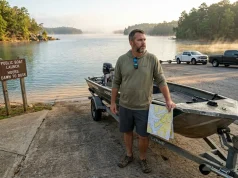
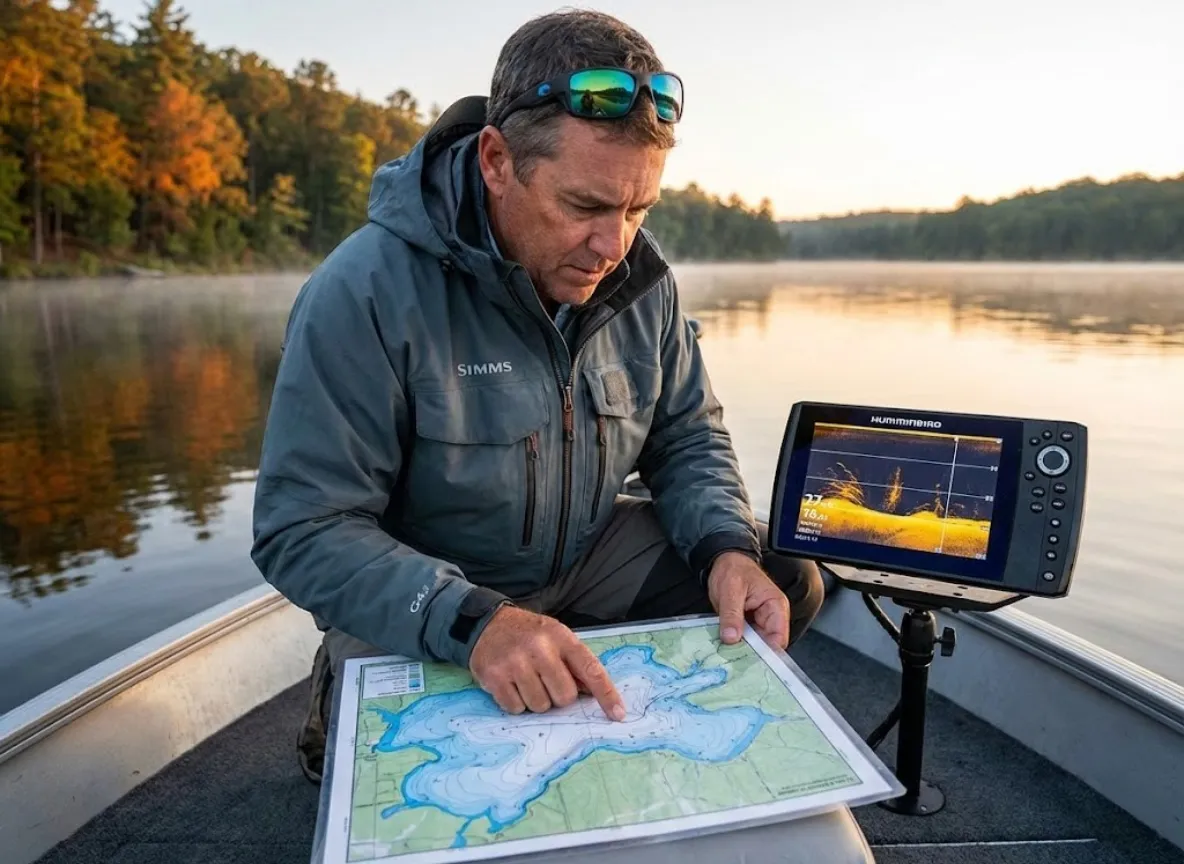
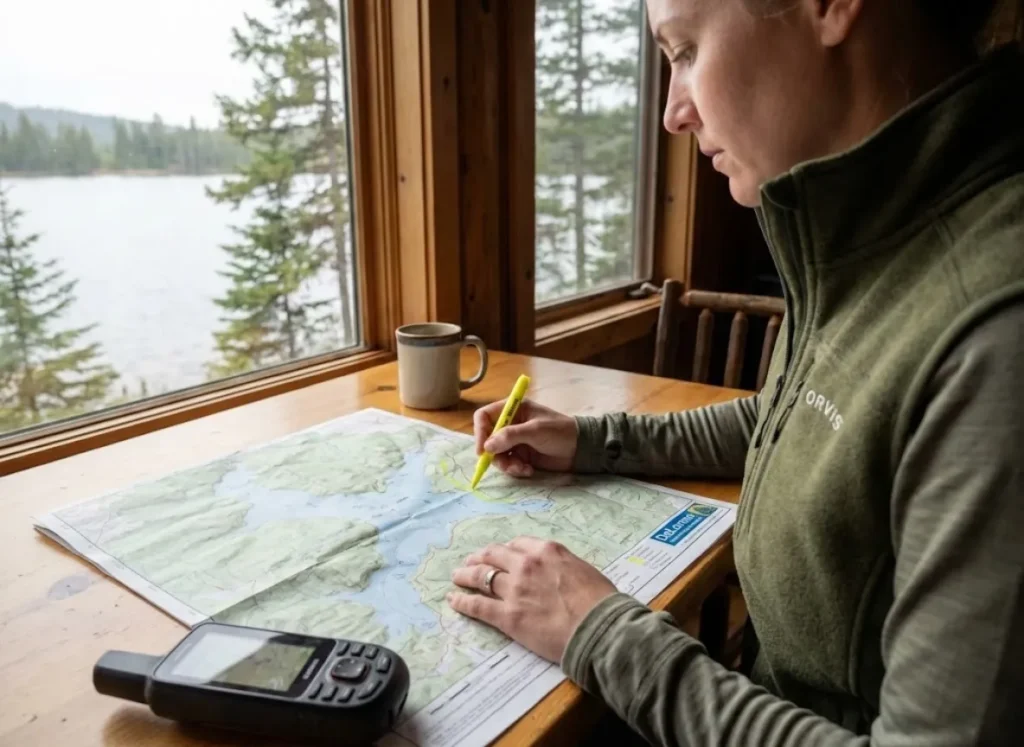
There’s a reason veteran guides still spread paper maps across the hood of their trucks before launch. Small screens—even 12-inch units—can’t show the big picture. You can’t see how a creek arm relates to the main river channel, or identify which coves face northwest for early spring warmth. Paper maps let you “sector” the lake in advance, circling high-probability zones in your pre-trip map study.
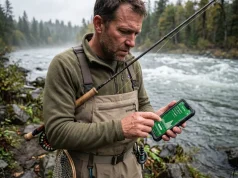
But digital has its place. Platforms like Navionics, LakeMaster, and C-MAP offer real-time positioning and layers of data that paper maps can’t match. The smart approach? Plan on paper, navigate on digital. Use the best fishing apps for detailed mapping once you’re on the water, and verify structure with your fish finder.
Pro tip: Try Google Earth‘s historical imagery slider. Scroll back to drought years, and you’ll see submerged roadbeds, rock piles, and laydowns that are invisible on any bathymetric chart. Those hidden structures hold fish no one else is fishing.
Pattern #1—Constrictions: The Funnel Effect
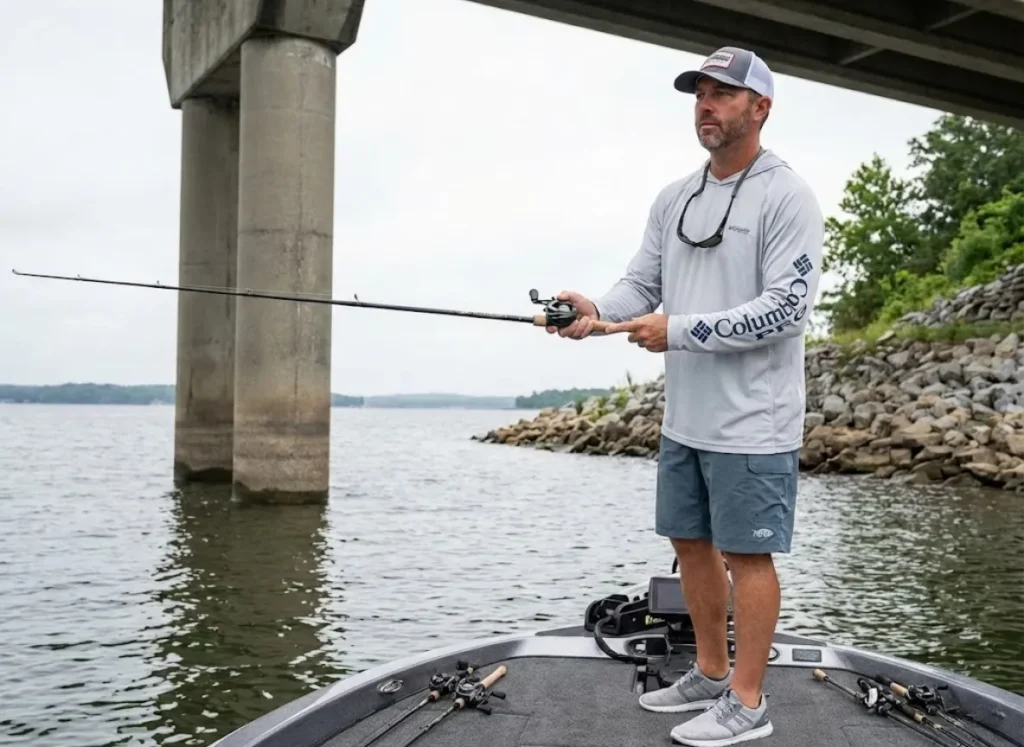
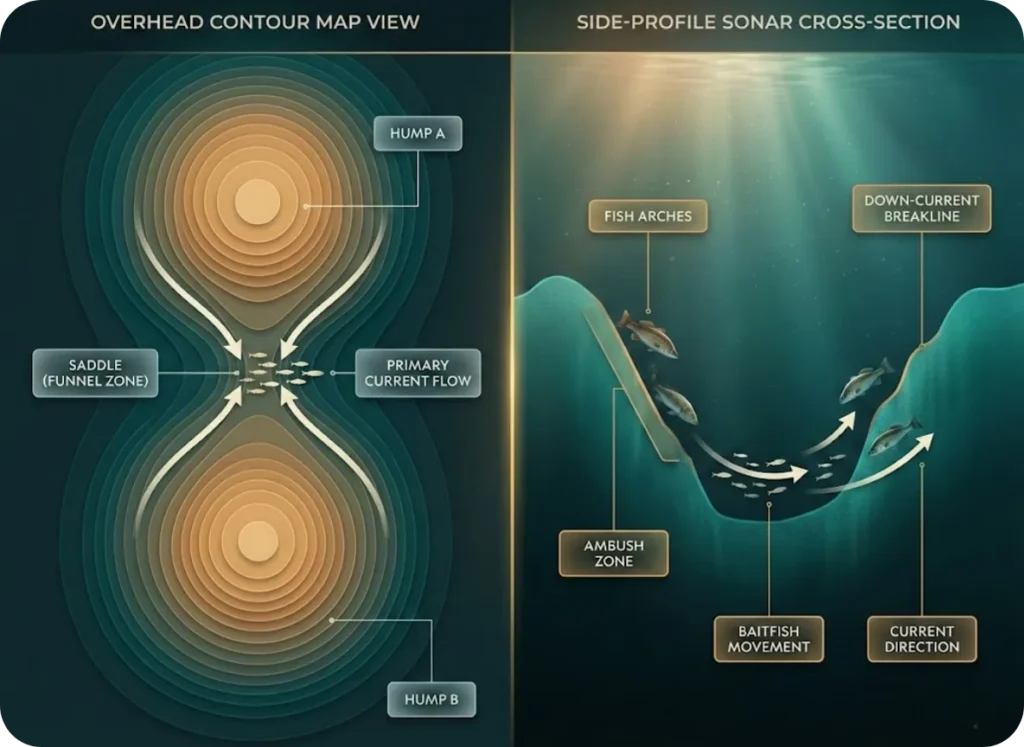
Constrictions are nature’s funnels. They’re the spots where the water body pinches together, either horizontally (bridges, causeways, narrow necks) or vertically (saddles between underwater humps). When water narrows, current accelerates and baitfish get disoriented and swept along predictable lanes. Predators position themselves at the exit, waiting.
The saddle is the most overlooked constriction on any map. It’s the low point between two high structures—picture a mountain pass connecting two peaks. On your depth map, look for an hourglass shape between two “bullseye” patterns (concentric circles indicating humps). The shallowest point between the highs is the saddle crest. Fish hold on the down-current breakline, right where the saddle floor drops into deep water.
Identifying Saddles on Your Map
Finding saddles is simple once you know what to look for. Scan for two sets of closed circular contours—those are your humps—and trace the narrow isthmus connecting them. Current direction matters: when wind blows across a saddle, water accelerates through the gap, pushing baitfish into the funnel. No wind, no funnel effect. Fish scatter.
Post-spawn timing is prime saddle season. After bedding, big females stage on saddles that connect spawning sanctuaries to deep water. It’s the first offshore stopping point, and they’re hungry. Learn about tracking pre-spawn bass transition routes to understand the full spring spawn migration pattern.
Bridge Funnels and Man-Made Choke Points
Causeways, railroad bridges, and dam tailraces create permanent constrictions with built-in bonus structure. Rip-rap—the rock reinforcement along these man-made features—provides crayfish habitat and ambush cover for every predator in the lake. On your map, these structures show as straight, uniform steep contours along roadbeds.
Night fishing under lighted bridges is a cheat code. The light attracts baitfish, concentrating them in predictable zones. The constriction funnels current. The rip-rap provides fish-holding cover. Stack those factors together and you’ve got a feeding station that works 12 months a year.
Pro tip: Don’t fish the first piling. Bass get educated there. Move to the third or fourth piling, where fishing pressure is lighter but the funnel effect is still working.
Pattern #2—Confluences: Where Worlds Collide
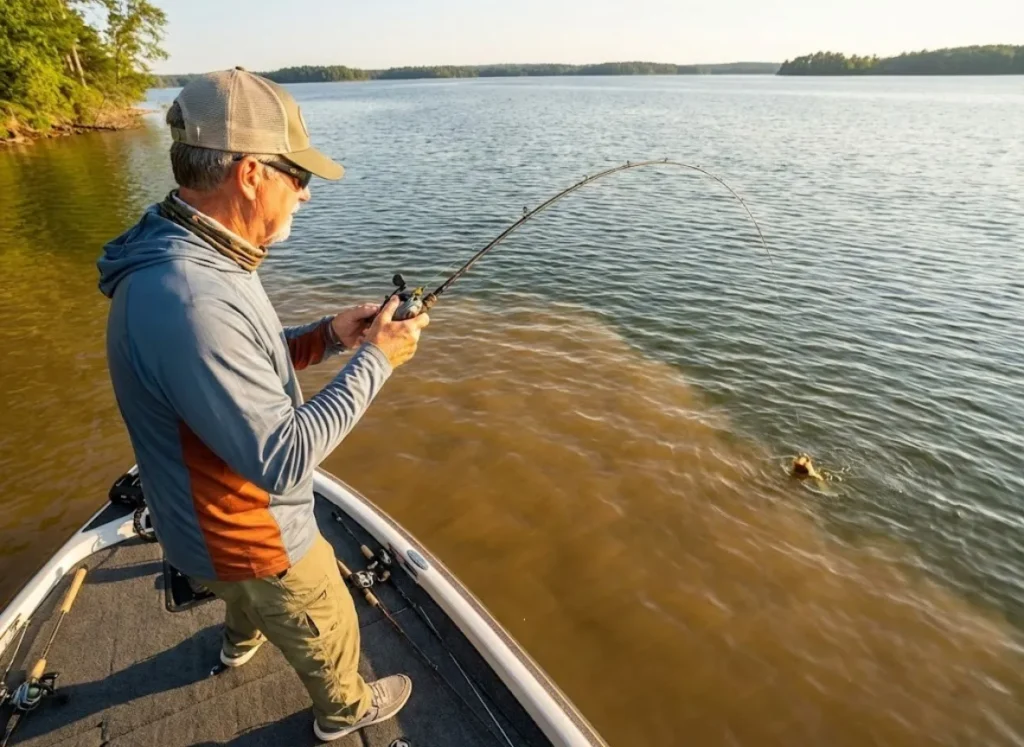
Confluences occur where two distinct water bodies or structural features intersect. Think of a creek mouth meeting the main lake, a clear water inflow mixing with stained main-lake water, or a river channel swinging into contact with a bank or point. These intersections create gradients—in temperature, turbidity, and current speed—that fish exploit.
The “seam” is the sweet spot. It’s the visible line where conditions change, and bass love to hold just inside the comfortable water while watching prey drift past. You can sometimes see the seam as a color change—stained creek water meeting clear waters—but even when it’s invisible, it’s there.
Creek Mouths—The Seasonal Intersection
Creek mouths bring oxygenated, warmer (spring) or cooler (late summer) water into the main lake. On your map, look for V-shaped contours pointing inland—that’s the creek channel entering deep water. Pre-spawn staging happens at the first deep bend inside the creek. Post-spawn fish stack at the creek’s main-lake intersection.
During the fall turnover—when surface water cools and mixes with deep water, disrupting dissolved oxygen levels—creek arms and secondary creeks stabilize before the main lake. Clear water and active fish concentrate here while the main lake goes dead. Understanding how water level changes affect fishing adds another layer to this pattern.
Channel Swings—The Vertical Advantage
The channel swing is the most consistent pattern in structure fishing, and it works year-round. On your map, trace the deepest contour line—that’s the river channel, or thalweg—and identify where it touches the shoreline. This “contact point” brings sanctuary depth directly against a feeding shelf, giving fish immediate vertical access to both worlds.
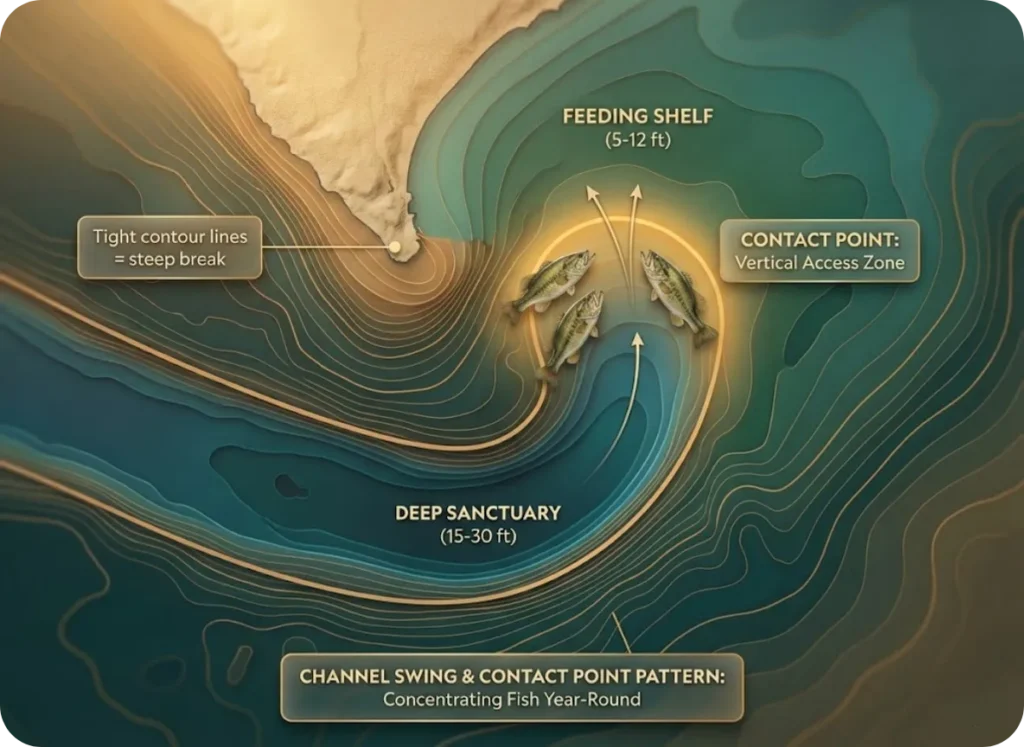
Winter depth staging bass hold on channel bends against 45-degree banks—tight contour lines confirm the structure. Summer bass school where points intersect channel drops. The principle never changes: fish want the shortest path between deep-water safety and shallow water food. The physics of current seams explain why these spots concentrate fish.
Pattern #3—Corners: Points, Bends, and Inside Turns
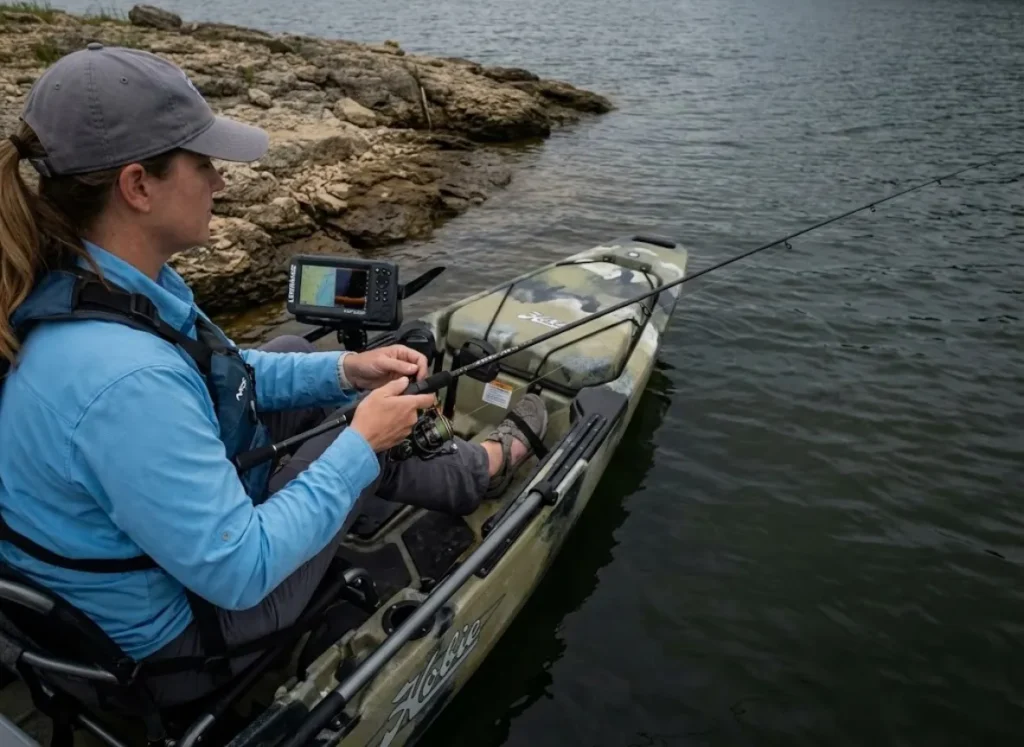
Corners disrupt water flow, creating slack zones where predators hold without expending energy. Every point, bend, and inside turn is a corner—and corners are where fishing spots stack up on every lake.
Points are submerged peninsulas that extend into the lake. On your map, they appear as protruding V or U shapes pushing into deep water. “Primary points” are main-lake features; “secondary points” are smaller features inside coves and creek arms. Points intercept migrating schools, so position yourself on the deep-water side where fish stage before moving shallow.
Primary vs. Secondary Points—Knowing the Difference
Primary points extend from the main lake shoreline into open water. They’re the first structures fish encounter when migrating from deep zones and the last stop before spawning sanctuaries. On depth maps, they show deeper contours reaching farther from shore.
Secondary points are smaller and found inside coves and creek arms. They’re spawn and post-spawn structures. Start on main-lake points during summer and winter when fish hold offshore; work secondary points during the spawn. It’s a simple seasonal fish movement toggle that eliminates dead water.
Reading Inside Turns for Post-Frontal Success
The inside turn is the geometric inverse of a point. Where a point projects outward, an inside turn cuts back into the structure—the “armpit” or V-shaped indentation where contour lines bend back toward shore. On your map, look for tight loops of lines retreating toward the shoreline.
These pockets collect sediment, debris, and slightly warmer water. When high-pressure bluebird skies shut down every exposed spot, bass tuck into inside turns and go dormant. Throw a shaky head or drop shot rig deep into the cut and let it sit. Post-frontal fish won’t chase, but they’ll eat something that sits in their face. The science of barometric pressure’s effect on fish holding positions explains why.
Seasonal Calibration—When Each Pattern Shines
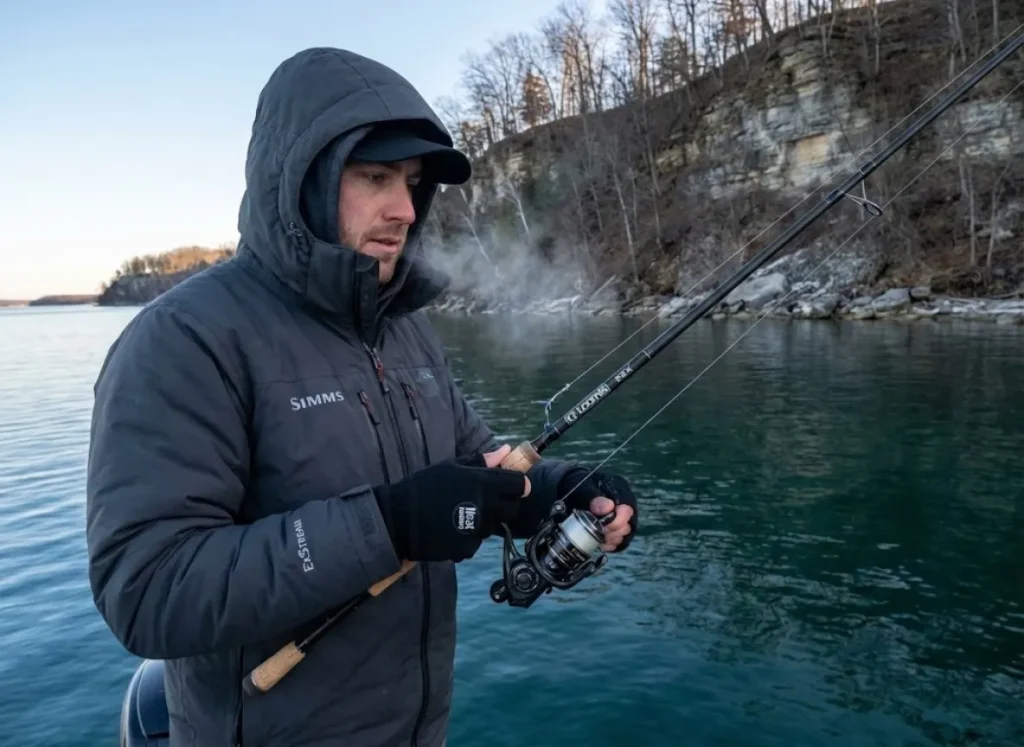
Every pattern has a prime season. Fish the wrong pattern at the wrong time and you’ll throw at empty water.
Winter means vertical. When water drops below 50°F, metabolism slows and fish stack on the tight contour lines you can find—vertical bluffs, 45-degree banks, and channel swings against main-lake points. Target 25-40 feet in natural lakes. Ken Cook, a fisheries biologist turned pro angler, put it simply: “Bass are cold-blooded—they just eat less.” Don’t expect aggressive feeding; slow presentations over deep-water winter areas win.
Pre-spawn means migration. Look for subtle V-shaped indentations in flat contours—these are “ditches,” the commuter lanes fish use to move from deep winter haunts to shallow areas. Focus on northwest-facing gradual flats, which warm first due to sun angle and wind protection. This is prime spring spawn migration time.
Summer means ledges. Current oxygenates offshore ledge systems, attracting baitfish and triggering schooling behavior. The intersection of a long point with a channel drop is the super-spot—confluences and corners converging. Understanding dissolved oxygen levels and their impact on gamefish explains why some offshore structure holds fish while identical-looking structure stays barren.
Fall means instability. During the fall turnover—a phenomenon the Missouri Department of Conservation explains as surface water cooling and sinking to mix with deeper layers—dissolved oxygen goes haywire and fish scatter to shallow flats and creek backs. Corner patterns—inside turns and secondary points—produce when the main lake goes dead. The thermocline breakdown determines how long this chaotic window lasts.
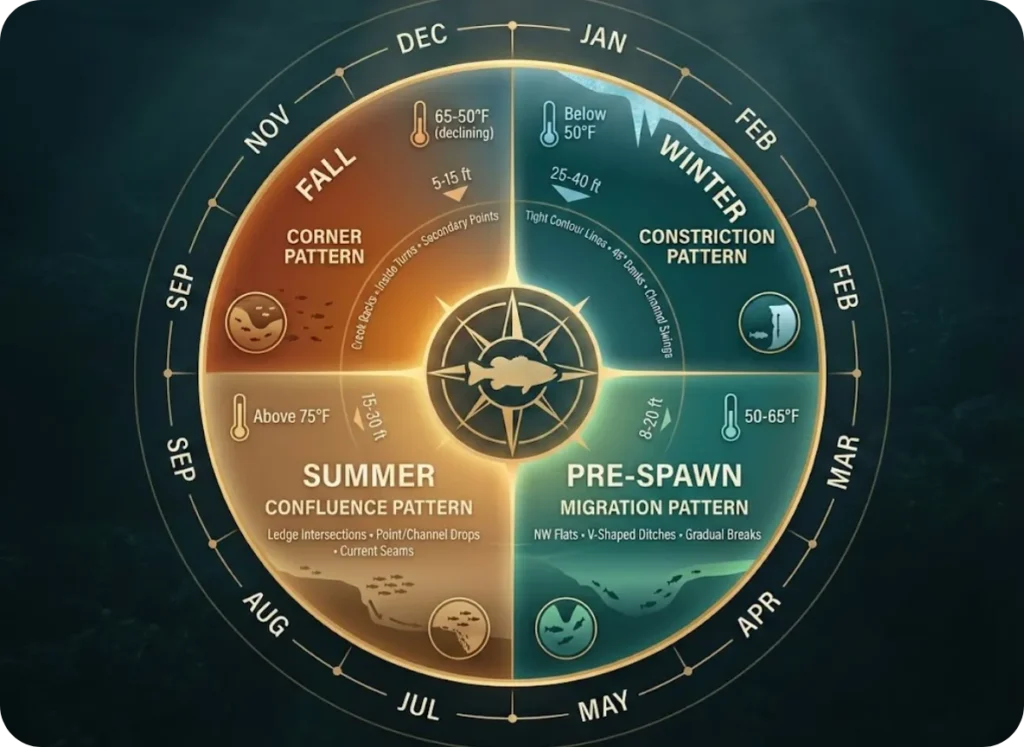
Pro tip: Keep a seasonal cheat sheet in your boat: Winter = Tight Contour Lines / Summer = Ledge Intersections / Spring = NW Flats + Ditches / Fall = Creek Backs + Inside Turns. Glance at it before your first cast.
Mapping Technology—Digital Tools That Reveal What Your Eyes Can’t
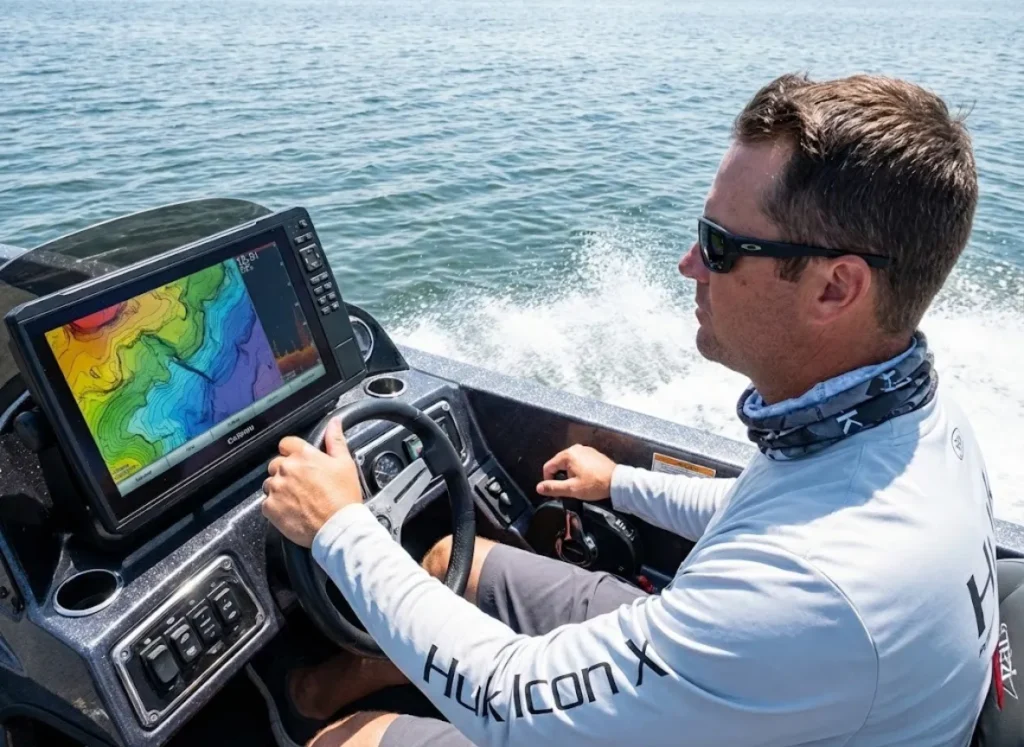
The maps on your phone or GPS unit aren’t created equal. Many digital charts still rely on pre-1940 USGS surveys—lead-line measurements that miss isolated hazards, fail to show map siltation changes, and lack the resolution for serious structure fishing.
Modern solutions have changed the game. Relief shading—a feature on Garmin and Navionics units—processes sonar data into 3D shadow maps, eliminating traditional contour lines entirely. FLW pro Andrew Upshaw described it perfectly: “It’s like draining the lake. I can see holes in points, exact cuts on ledges, and little intricate details that other maps just don’t give you.”
Crowdsourced bathymetric maps fill the gaps where government surveys never reached. Platforms like C-MAP Genesis and Navionics SonarChart Live aggregate user sonar logs to generate 1-foot contours on waters that were previously unmapped. If you’re fishing small private lakes, rural reservoirs, or any water with high sedimentation rates, crowdsourced data is the only source of current information.
Navionics, C-MAP, and LakeMaster—What Each Does Best
Navionics (owned by Garmin) dominates the mobile app space. Its SonarChart Live feature creates custom maps HD in real-time as you idle over new waters. LakeMaster (Humminbird exclusive) offers the critical Water Level Offset feature—adjust the map to current reservoir levels so the structure depths match reality. C-MAP Genesis excels at 1-foot contour crowdsourcing for unmapped waters.
The key insight: Navionics and C-MAP work across brands via mapping chips. LakeMaster only runs on Humminbird units. Choose your ecosystem carefully. And no matter what platform you use, always verify map data with your fish finder’s actual sonar returns.
The Free vs. Paid Mapping Spectrum
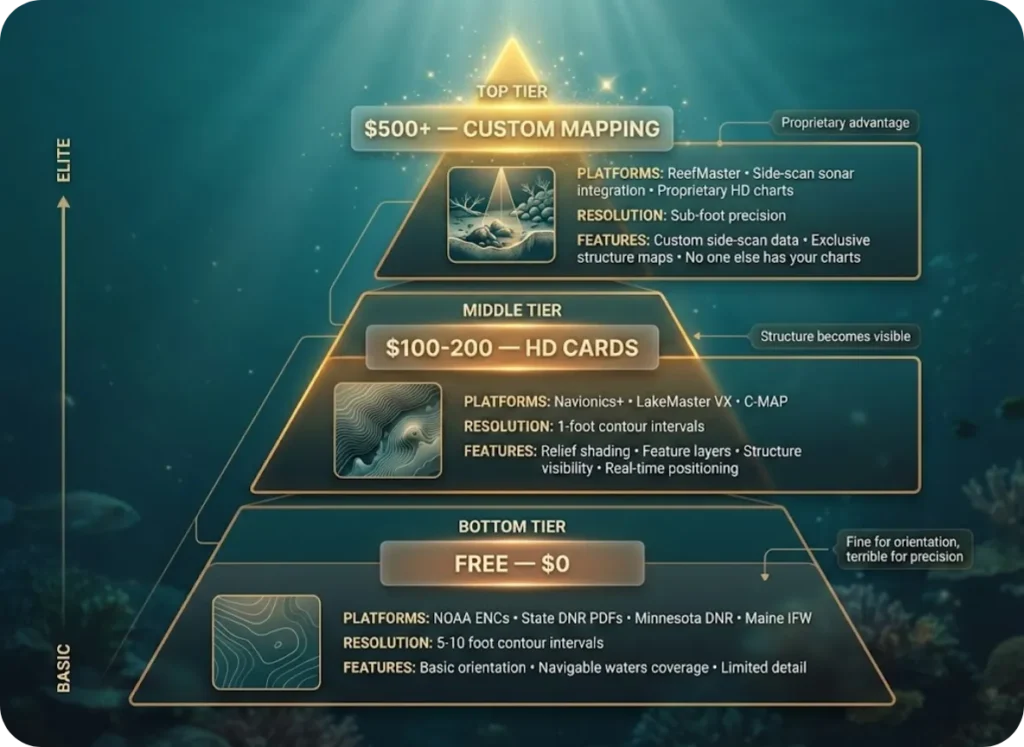
Free options exist. NOAA ENCs cover navigable rivers and coastal waters. State DNR PDF maps often show basic contours. Minnesota DNR and Maine IFW provide some of the best free lake maps in the country. But free maps typically run 5-10 foot intervals—fine for orientation, terrible for precision.
At $100-200, Navionics+ and LakeMaster VX cards deliver 1-foot contours, relief shading, and feature layers that make structure visible. For $500+, you can integrate side-scan sonar mapping through software like ReefMaster, creating proprietary HD charts no one else has.
The common mistake? Buying expensive electronics and running free maps with 10-foot contours. That Humminbird Helix won’t help if the data feeding it is garbage.
Conclusion
Lake contour maps aren’t decoration—they’re prediction tools. Learn to see the Three Cs framework (constrictions, confluences, corners) and you’ll see where fish stage before your first cast lands.
Remember the basics: Tight contour lines mean steep drop-offs. Wide lines mean gradual flats. Saddles funnel baitfish. Channel swings bring depth to structure. Inside turns hold post-frontal fish. Match the pattern to the seasonal fish movement and you’ll fish smarter than 90% of the anglers on any given lake.
Before your next fishing trip, pull up your favorite lake‘s depth map and circle every saddle, channel swing, and inside turn you can find. Then verify one with your sonar. That moment when the fish finder confirms what the map predicted—that’s when you stop fishing water and start fishing structure.
FAQ
Are lake contour maps accurate?
Accuracy varies dramatically. Many digital maps use pre-1940 USGS surveys that miss siltation and isolated hazards. Crowdsourced platforms like C-MAP Genesis offer more current data, but always verify critical structure with your own sonar before trusting any map in unfamiliar waters.
What is the best free lake mapping app for fishing?
For free options, Fishbrain and onXmaps offer social waypoints and basic bathymetric maps. NOAA ENCs provide official navigation charts. However, free apps typically have 5-10 foot contour intervals—fine for orientation but insufficient for precision structure fishing.
How do you find fishing spots on a lake map?
Look for the Three Cs framework: closed circular contours (humps), hourglass shapes (saddles), channel lines touching structure (swings), and V-shaped indentations (inside turns). These structural features concentrate fish because they offer energy-efficient holding positions near depth transitions.
What is a saddle in fishing terms?
A saddle is the low point between two high structures—like a mountain pass. On depth maps, it appears as an hourglass shape between two bullseye patterns. Saddles funnel current and baitfish, making them prime ambush zones for predators staging between deep water and shallow zones.
How does water level affect contour map accuracy on reservoirs?
Contour maps show static depth, but reservoir levels fluctuate daily. A map indicating 10 feet over a hump becomes dangerous if the lake is drawn down 15 feet. Use real-time gauge data and LakeMaster’s Water Level Offset for map accuracy troubleshooting on fluctuating waters.
Risk Disclaimer: Fishing, boating, and all related outdoor activities involve inherent risks that
can lead to injury. The information provided on Master Fishing Mag is for educational and informational purposes
only. While we strive for accuracy, the information, techniques, and advice on gear and safety are not a substitute
for your own best judgment, local knowledge, and adherence to official regulations. Fishing regulations, including
seasons, size limits, and species restrictions, change frequently and vary by location. Always consult the latest
official regulations from your local fish and wildlife agency before heading out. Proper handling of hooks, knives,
and other sharp equipment is essential for safety. Furthermore, be aware of local fish consumption advisories. By
using this website, you agree that you are solely responsible for your own safety and for complying with all
applicable laws. Any reliance you place on our content is strictly at your own risk. Master Fishing Mag and its
authors will not be held liable for any injury, damage, or loss sustained in connection with the use of the
information herein.
Affiliate Disclosure: We are a participant in the Amazon Services LLC Associates Program, an
affiliate advertising program designed to provide a means for us to earn advertising fees by advertising and linking
to Amazon.com. As an Amazon Associate, we earn from qualifying purchases. We also participate in other affiliate
programs and may receive a commission on products purchased through our links, at no extra cost to you. Additional
terms are found in the terms of service.