
In this article
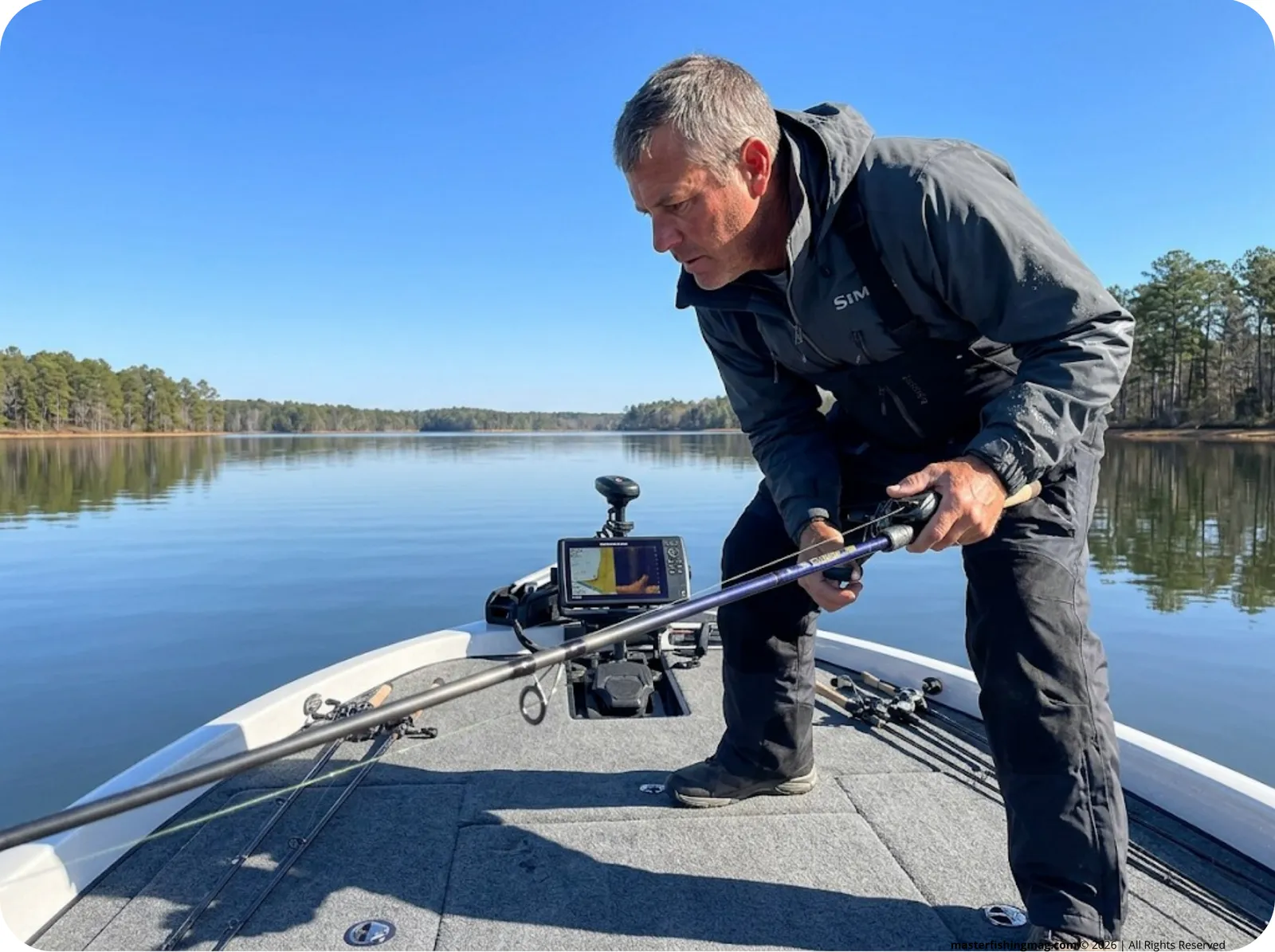
The walleye was on the screen — tight to the bottom, a thick arch you could count on — and it hadn’t moved in four casts. You downsized to a 1/8 oz jig, split-shotted it, put it right on top of the fish. Nothing. The cold front had settled in 18 hours earlier, and that walleye wasn’t “gone.” It was stuck. Its swim bladder still hadn’t finished the slow chemical math of recompression. After guiding on these waters for over two decades, I’ve watched this scene play out more times than I can count — anglers burning gas between spots, chasing fish that physically cannot respond. They blame the moon, the wind, the season. The answer is simpler. It’s physics.
Here’s exactly what’s happening inside those fish, hour by hour — and the one narrow window when they can’t say no.
⚡ Quick Answer: Fish shut down after a cold front because of three compounding physiological problems, not because barometric pressure directly hurts them. First, physoclistous species like bass, walleye, and perch need 24–48 hours to re-inflate a compressed swim bladder through slow blood-diffusion chemistry. Second, a temperature-driven metabolic slowdown slashes appetite — a fish that gorged before the front has zero need for food. Third, bluebird skies post-front strip away the ambush predator’s visual advantage, pushing fish into deep, defensive positions. Fishing recovers in Phase III, roughly 36–72 hours post-front, when the barometer stabilizes and afternoon solar warming triggers short feeding windows.
The Pressure Math That Changes Everything
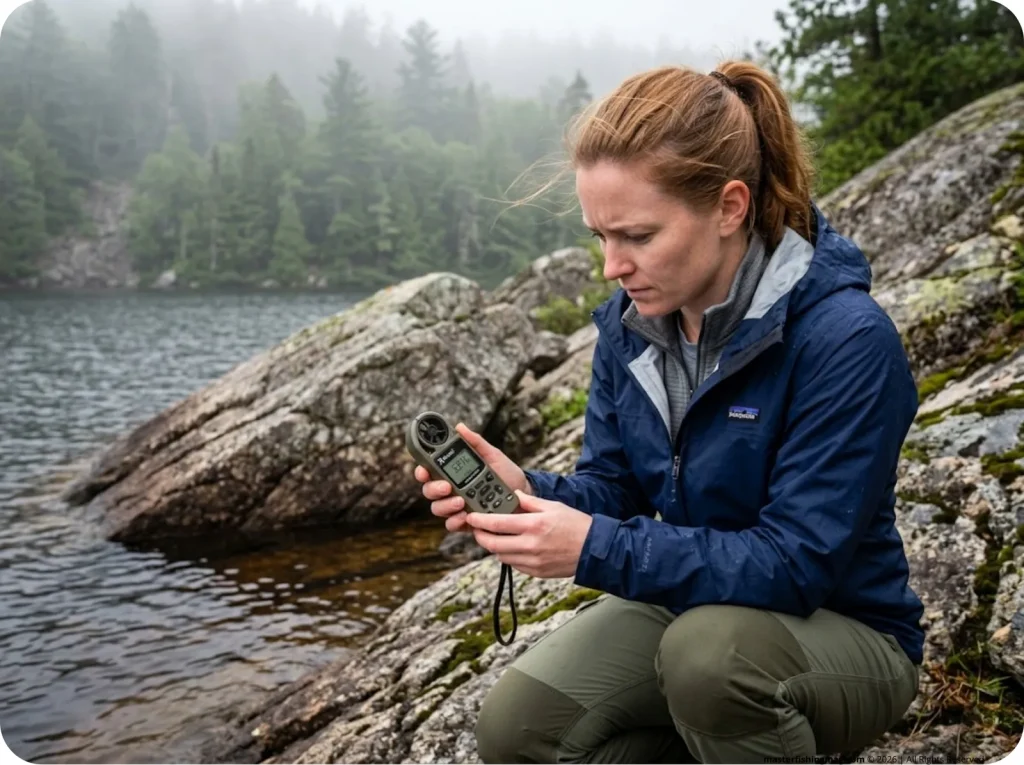
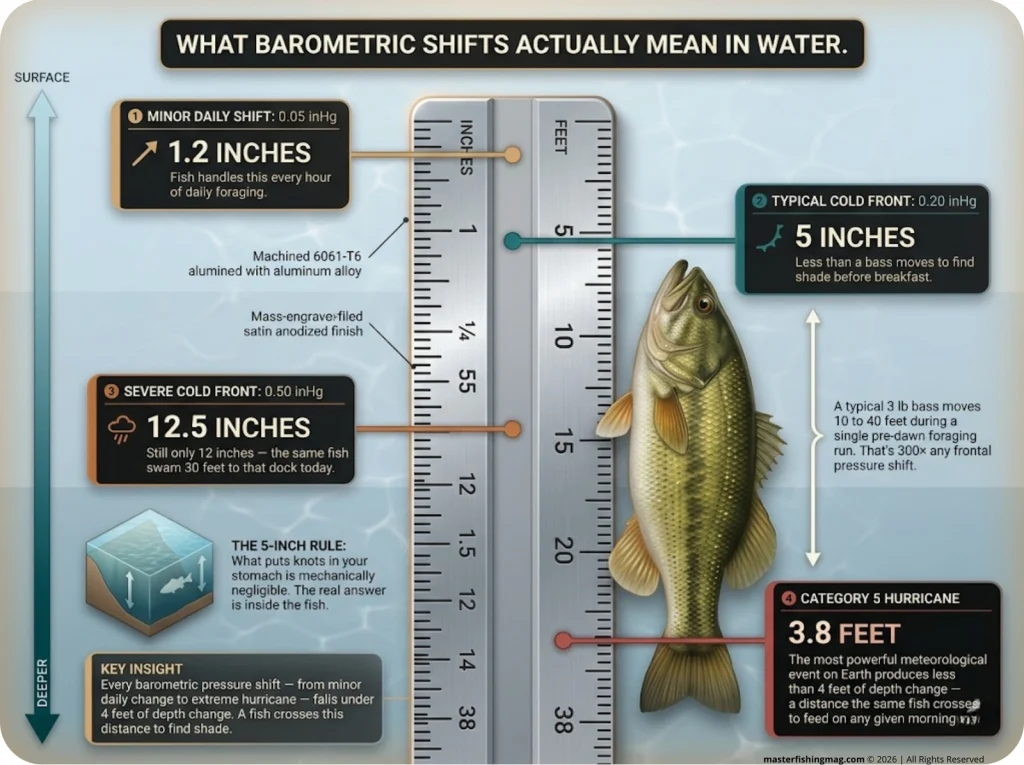
Here’s where most anglers — and most fishing articles — get it wrong. Barometric pressure doesn’t physically hammer fish into the bottom. The numbers don’t support it.
Standard atmospheric pressure at sea level runs 29.92 inches of mercury. A severe cold front might drop or raise that reading by 0.2 to 0.8 inHg over 24 to 48 hours. Sounds significant. But water is roughly 800 times denser than air, which means hydrostatic pressure increases by one full atmosphere every 33 feet of depth. A 0.20 inHg barometric shift equals less than five inches of depth change in hydrostatic pressure terms. Even a Category 5 hurricane — a meteorological event that rewrites coastlines — only produces a pressure shift equal to about 3.8 feet of depth change. That’s the 16-inch depth equivalence on the low end of normal frontal activity.
A bass routinely moves 10 to 40 feet while foraging before breakfast. No fish is being “paralyzed” by a five-inch shift.
So why does barometric pressure matter at all? Because it’s a signal. Fish carry sensory equipment — the lateral line, inner ear otoliths — that detects infrasound and hydrodynamic shifts correlated with frontal passage. The pre-front pressure drop mobilizes baitfish and triggers aggressive feeding before the biological costs arrive. The falling barometer is the starting gun, not the hammer. Understanding how barometric pressure translates into actual fishing tactics starts with accepting that pressure is the trigger, not the bullet.
Pro tip: If a barometer app is your primary fishing tool, you’re using the right instrument for the wrong reason. It tells you when the front arrived, not how bad the fishing will get. The swim bladder timeline does that.
The pressure/depth table from the research makes this concrete: a minor daily fluctuation of 0.05 inHg shifts hydrostatic pressure by about 1.2 inches. A typical pre-frontal storm arrival at 0.20 inHg equals roughly five inches. A severe cold front at 0.50 inHg is just 12.5 inches. The fish handles every single one of those shifts every time it moves between feeding layers. The 0.18 inHg shift that puts knots in your stomach is physically negligible compared to the 10- to 40-foot depth changes those same fish execute daily. That’s the “5-inch rule” — and it’s why the real answer lies elsewhere.
Swim Bladder Anatomy and the Physoclistous Delay
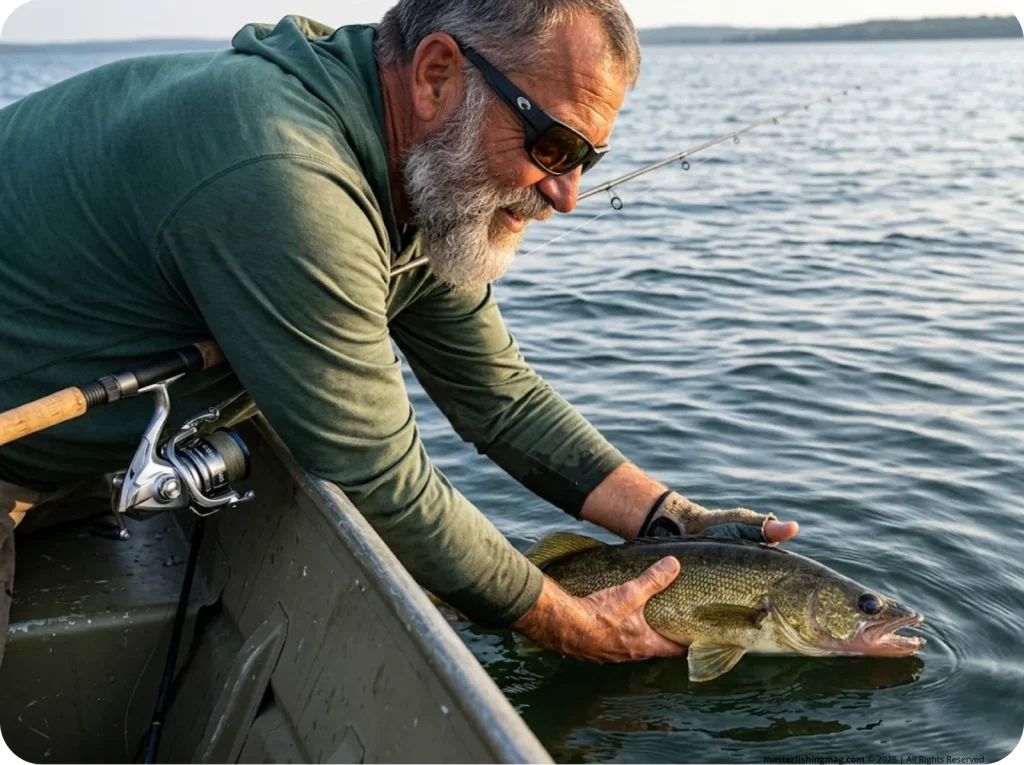
This is the part nobody explains. Why does trout fishing stay productive 12 hours after a front when walleye and bass fishing collapses? It’s anatomy, not preference.
Two evolutionary lineages exist: physostomous and physoclistous. Trout, salmon, carp, and herring are physostomous — they have a physical pneumatic duct connecting the swim bladder to the esophagus. When external pressure drops and the bladder expands, a trout can simply vent the excess gas through its mouth — what researchers call the “Gasspuckreflex.” To increase buoyancy, it gulps air at the surface. Adjustment is near-instantaneous. The front barely registers.
Bass, walleye, perch, and cod are physoclistous — sealed system, zero connection to the gut. Gas is regulated entirely through the bloodstream via the rete mirabile and gas gland, a countercurrent capillary network that acidifies blood to force oxygen into the bladder. Deflation runs through the oval window, a thin vascularized membrane that resorbs gas into the circulatory system for expulsion through the gills. The whole process runs on chemical diffusion — and that takes between 4 and 48 hours depending on the species and the magnitude of the shift.
When the post-front high pressure arrives, the bladder gets compressed. The fish has slight negative neutral buoyancy — it costs muscular energy to stay at any given depth. During the physoclistous delay, that fish is not in pain. But it is energetically disadvantaged, burning calories just to hold position while its blood chemistry slowly catches up. The complete mechanics of swim bladder pressure regulation are what separate the “inexplicable” lockjaw from a fully predictable biological event.
The volume of gas involved is smaller than most anglers imagine. During a major frontal passage, the volume change in a bass’s swim bladder is roughly 10% — about half a teaspoon of gas. That’s a small number, but it’s enough to shift the fish’s center of buoyancy and force a physiological response.
The recovery data from barotrauma studies confirms the timeline. When Atlantic cod are rapidly decompressed from depth — the same mechanism in an extreme version — 87% successfully re-inflate their swim bladders and return to neutral buoyancy within 72 hours. That 72-hour window is not folklore. It mirrors the physoclistous delay under frontal conditions. Barotrauma recovery and the DESCEND Act protocols give the full picture on why this physiology matters for catch-and-release practices too.
Pro tip: When the bite was outstanding the afternoon before the front, be skeptical of tomorrow. That meal is still sitting in the stomach. The fish knows it.
The Metabolic Shutdown — Temperature Matters More Than Pressure
Fish are obligate poikilotherms — their biochemical rates are governed entirely by the surrounding water temperature. No internal thermostat. No compensation mechanism. What happens in the water happens in the fish.
The standard rule: for every 18°F (10°C) drop in water temperature, biological reaction rates roughly halve. Heart rate, digestion speed, enzyme activity, muscular contraction rate — all cut in half. A strong cold front can drop air temperature 30°F in hours. Shallow feeding flats follow, dropping 5 to 10°F within 24 hours. Even a 5°F temperature drop produces a 15 to 25% decrease in metabolic cost for the fish. That’s not a minor inconvenience — that’s temperature effects on fish feeding and digestive processes playing out in real time, reshaping an entire fish’s relationship with food.
Now layer in what researchers call the Full Stomach effect. The pressure drop pre-front mobilizes zooplankton toward the surface: baitfish follow the plankton, gamefish follow the baitfish. Bass and walleye often gorge for 12 to 24 hours before a front arrives. That is an evolved strategy — bank as many calories as possible before conditions deteriorate. Post-front, the temperature-driven enzyme slowdown extends gastric emptying time significantly. Digestion that normally takes 12 hours now runs 36 hours or more.
A fish with a compressed swim bladder, a belly full of bluegill, and a metabolism running at half speed has three separate physiological reasons to ignore your lure. That’s not bad luck. That’s basic biology working exactly as designed. Understanding how water temperature directly controls lure cadence and presentation speed is where most anglers leave results on the table.
One exception worth knowing: in late summer and early fall, a cold front can paradoxically improve fishing. Stratified lakes with low-oxygen surface layers can “turn over” when a front cools the surface enough to break stratification. Fish that were compressed into a narrow oxygen corridor suddenly have the entire water column available. The result is often an aggressive, short-lived feeding response. The physics of lake turnover and what it means for dissolved oxygen covers this exception fully.
Optical Physics — Bluebird Skies and the Predator’s Disadvantage
Post-front conditions aren’t just physiologically difficult for fish — they create a tactically catastrophic visual environment. The high-pressure system that follows a cold front produces the single worst optical setup an ambush predator can face.
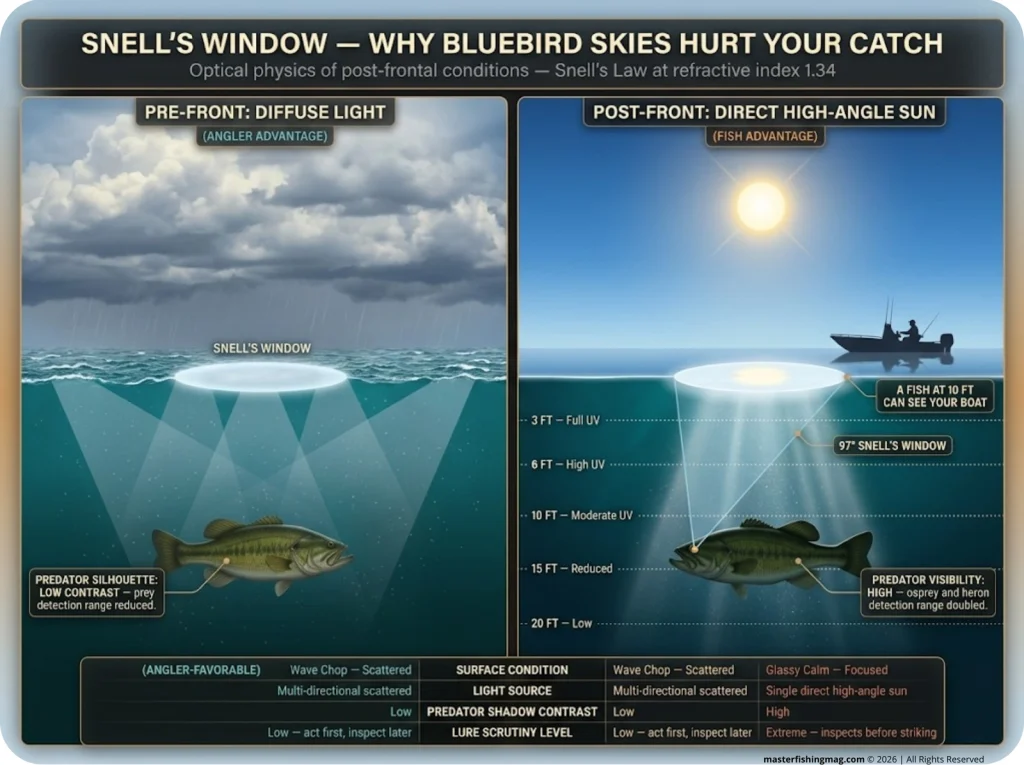
Pre-front, cloud cover and wave chop act as a light diffuser. Photons scatter in every direction, creating shadow zones ideal for a bass or walleye to hide in while approaching prey. Sky clarity is low, turbidity is often elevated, and the predator’s silhouette is broken up by surface disturbance. Low light is the ambush predator’s battlefield. That’s not a romantic angling notion — it’s the optical physics of how these fish evolved to hunt.
Post-front? Bluebird skies, glassy water, maximum sky clarity and UV penetration. Surface calm means no light scattering. Forage fish can now detect approaching predators from greater distances. Gamefish become visible to ospreys and herons, pushing them into deep cover or heavy structure. And in that high-clarity water, they can closely inspect any artificial lure — detecting incorrect hardware proportions, unnatural retrieve cadence, line diameter, and color mismatch. Lures that would get eaten in pre-front turbidity get studied and passed over.
Snell’s Law governs what a fish sees above the waterline: a cone of roughly 97° based on water’s refractive index of approximately 1.34. Under calm, clear post-front water, that window is maximally sharp. A fish 10 feet down can see your boat. It can see you. Long casts are not optional — they are a mechanical requirement. How water clarity changes lure color contrast and fish detection range breaks this down at the species level.
Line choice becomes non-negotiable. Fluorocarbon has a refractive index of 1.42 — much closer to water’s 1.34 than standard monofilament at 1.50. In bluebird skies and glassy water, your line matters more than your lure. Why fluorocarbon’s refractive index makes it the right choice in clear post-frontal water is not marketing copy — it’s plain optics.
The 72-Hour Frontal Timeline — Hour by Hour
Stop guessing and start timing. The frontal timeline is predictable. Here’s what’s actually happening inside a physoclistous fish across the 24–72 hour frontal passage window.
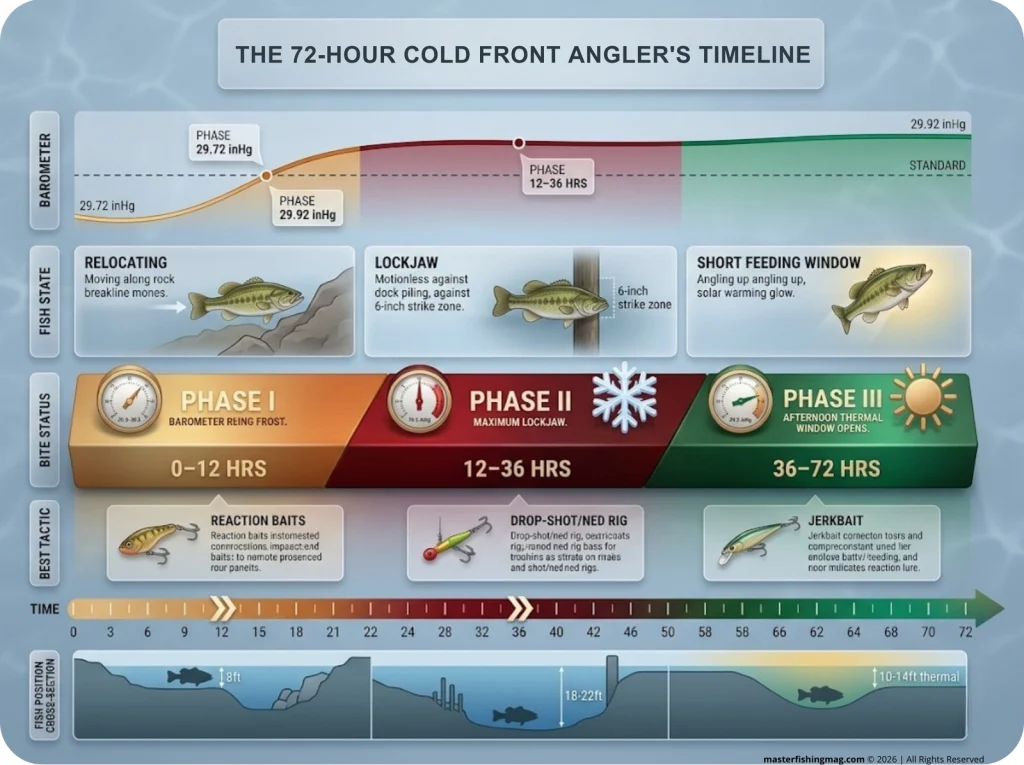
Phase I (0–12 hours post-front): Barometer rising rapidly — 0.1 to 0.5 inHg over 2 to 4 hours. Wind shifts from SW or S to NW or N — that’s your field diagnostic for frontal passage. Fish are repositioning from shallow feeding flats to the nearest deep-water breakline or heavy structure — thick dock pilings, laydown timber, matted vegetation. The bite is declining fast but not zero. The 30 minutes immediately after a wind shift is a hidden feeding window. Fish haven’t finished repositioning. Run reaction baits fast along transition edges.
Phase II (12–36 hours post-front): This is maximum lockjaw. Atmospheric equilibrium has shifted. Physoclistous bladders are compressed at their maximum. Metabolic cost is at its floor. Pre-frontal meals are still digesting. And bluebird skies overhead complete the disadvantage. The strike zone physically shrinks from feet to inches around the fish’s nose — they will not chase anything. Techniques that fail: fast cranking, swimbaits, topwater, anything that requires the fish to move laterally. Techniques that work: drop-shot rigged directly on confirmed fish marks, shaky-head twitched with 5 to 60 second pauses, Ned rig at rest on the bottom. The target is a reflex jaw snap, not a voluntary feeding decision. The complete systematic troubleshoot when fish refuse to bite maps every Phase II scenario in detail.
Phase III (36–72 hours post-front): Barometer flattens near 29.92 inHg, wind softens and shifts southwest or south, afternoon solar warming begins. Gas glands catch up. Pre-frontal meals finish digesting. Short afternoon feeding windows develop — typically 60 to 120 minutes — triggered by 1 to 3°F warming of shallow, dark-bottom bays. A major solunar phase during this afternoon window stacks the feeding triggers in your favor. Reading the barometer to identify the Phase III stabilization window is the tactical read that separates productive Day 3 sessions from another blank.
The 72-hour window is not arbitrary. It directly mirrors the physiological rebalancing period from barotrauma recovery studies. Research on fish energy savings and metabolic suppression during cold water periods confirms what field observation has shown for generations — this is documented biology, not folklore.
One exception: river fish. Wind velocity and current require constant locomotive energy. A river smallmouth relating to a current seam behind a boulder is burning calories whether it wants to or not. Turbidity in river systems also buffers the bluebird skies optical effect. River fish during a Phase II event remain more catchable than their lake-dwelling counterparts — slower presentations, tighter to structure, but catchable.
Overcoming the Shutdown — Tactics Built on the Physics
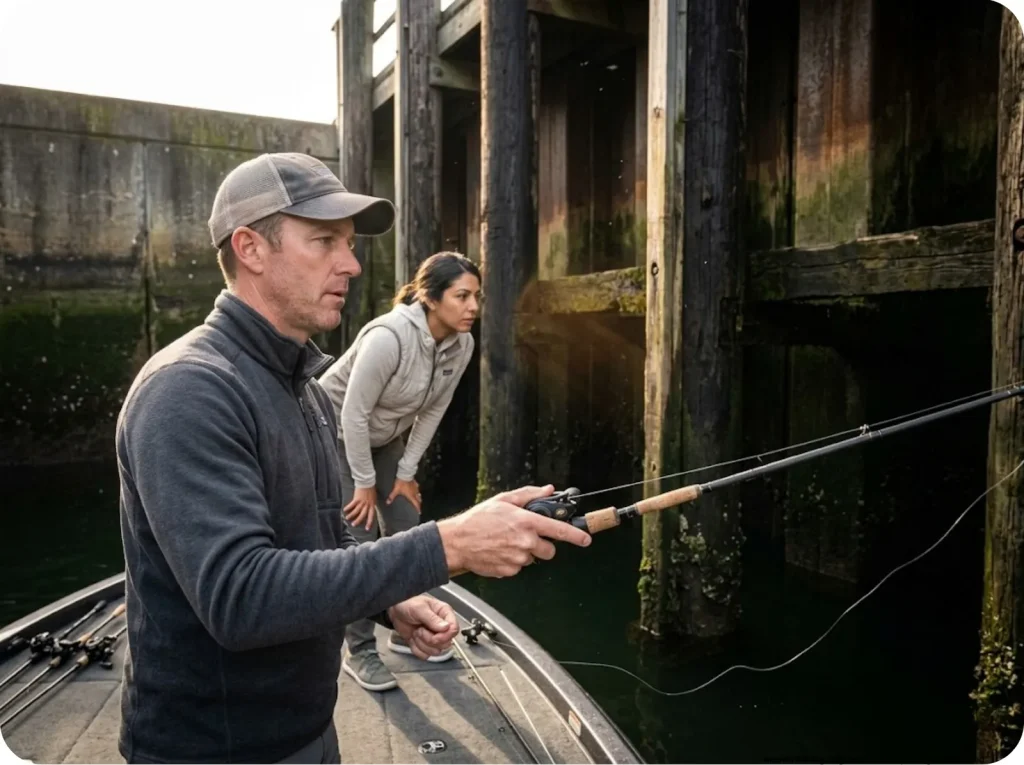
The fundamental principle is matching your lure action level to the fish’s energy budget. A fish with suppressed metabolism and compressed buoyancy will not spend significant energy on a meal. Your job is to put low-energy protein directly in its face, inside the 6-inch strike zone, long enough to trigger a reflex.
Finesse presentation during Phase II: Drop-shot places the bait at the fish’s eye level without requiring lateral movement. Shaky-head nose-down vibrates in place on the bottom, triggering jaw snaps rather than pursuit. Ned rig — ElaZtech plastic, near-neutral buoyancy, smallest possible profile — self-rights on the bottom at rest. Strike detection matters: run high-visibility braid mainline to a 6–8 lb fluorocarbon leader and watch the braid for tick-taps the rod won’t transmit. A fish with suppressed metabolism bites slowly. A violent hookset often pulls clean out of a loose jaw. Medium speed, firm pressure.
Location logic: The relocation pattern is predictable — nearest deep-water sanctuary adjacent to the pre-front feeding area. Bass move to 15–22 foot main lake points, offshore humps, dock structure. Walleye slide to deep basin edges, rock structure at 18–28 feet, protected bays. Perch go tight to the bottom in the deepest available water, schooling tighter under high-pressure conditions. Forward-facing sonar changes Phase II completely — it’s the most reliable way to confirm exact fish position for sub-6-inch strike zone targeting. Targeting offshore deep-water bass with the 5X rule maps the same deep-water location logic in detail.
The Afternoon Thermal Window: Don’t launch at first light after a cold front. The water is at its thermal minimum, the fish are at their biological floor. From roughly 10 AM onward, dark-bottomed shallows — stumps, dark rock piles, decomposing wood — absorb solar radiation and warm 1 to 3°F faster than open water. By 1 to 3 PM local time, fish are moving up from 15 to 22 feet into 8 to 12 feet on thermally active structure. The feeding window typically runs 60 to 120 minutes — shorter in wind, longer on calm cloudless afternoons. When that window opens, transition from finesse baits to moderate-action presentations. Full-power fishing waits until the barometer has been stable for 6 to 12 hours. Matching jerkbait cadence to post-frontal water temperature has specific timing guidance on this transition.
On barometric charts and fishing gadgets: barometric fishing watches that promise to “predict” bites are marketing tools. Atmospheric equilibrium doesn’t determine catch rates on its own — the physoclistous delay timeline does. A barometer is a useful instrument for knowing which phase you’re in. It does not tell you where the fish went or how to reach them. The physics do that.
Pro tip: Switch to 6–8 lb fluorocarbon after a front. In clear post-front water with high sky clarity, your line is visible long before your lure is suspicious. The refractive index difference between fluorocarbon and standard mono is not subtle in these conditions — fish can see mono in bluebird skies with the kind of detail that shuts down bites before they start.
Conclusion
Three things to carry away from this:
First, the physoclistous delay is real and species-specific. Bass, walleye, and perch need 24 to 48 hours for buoyancy compensation after a cold front. Trout don’t — their physostomous system vents in seconds. Same weather event, completely different metabolic cost. Knowing which species you’re chasing tells you how long to wait before you’re actually fishing with a chance.
Second, water temperature does more damage than pressure. The halving of metabolic demand per 18°F drop, combined with a gorged stomach from pre-front aggressive feeding, leaves physoclistous fish with three separate reasons to ignore any presentation during Phase II. Understanding this prevents six wasted hours of high-confidence casting at fish that are physically incapable of cooperating.
Third, the timing clock is real and predictable. Phase III begins 36 to 72 hours post-front. The analytical angler who waits for the 1–3 PM frontal timeline afternoon window on Day 2 or 3 will out-fish the angler who hammers the water at dawn on Day 1. Print the three-phase timeline. Tape it inside your tackle box lid. Next front that rolls through, run your sessions against the phases rather than your gut — and compare the result to your last outing under bluebird skies.
FAQ
Does barometric pressure actually hurt fish?
No — the physics don’t support it. A major cold front produces a barometric shift equal to a fish moving roughly 5 inches deeper in the water column. That’s mechanically trivial compared to the 10 to 40 foot depth changes fish make during normal daily foraging. What does affect fish is the biological response triggered by that pressure signal — specifically the physoclistous swim bladder’s slow adjustment timeline and the metabolic suppression from dropping water temperature.
How long after a cold front do fish bite again?
For physoclistous species — bass, walleye, perch — the full physiological rebalancing period is typically 36 to 72 hours post-front. A short feeding window often appears in the afternoon of Day 2 as solar heating warms shallow, dark-bottom areas by 1 to 2°F, temporarily restarting suppressed metabolisms. Full normal activity returns once the barometer has stabilized near 29.92 inHg for 6 to 12 hours. Solunar phase timing during that window accelerates recovery significantly.
Why do trout bite after a cold front when bass don’t?
Anatomy. Trout and salmon are physostomous — they have a physical connection between their swim bladder and esophagus, allowing near-real-time venting or gulping to adjust buoyancy. Bass and walleye are physoclistous — sealed system, gas regulated entirely through the bloodstream via chemical diffusion, requiring 4 to 48 hours for full adjustment. Same front, completely different biological cost.
Do fish go deeper when pressure is high?
Yes, but not because high pressure pushes them down. Post-front high pressure compresses the swim bladder, leaving physoclistous fish with slight negative buoyancy — staying shallow costs muscular energy. Moving deeper reduces the hydrostatic pressure differential and conserves energy. Additionally, bluebird skies and high light penetration make shallow ambush positions untenable. Both physiology and behavior point the same direction: down.
What is the best lure to fish after a cold front?
The smallest profile with the slowest possible movement — a drop-shot with a 3 to 4 natural-colored plastic, a shaky-head Ned rig, or a 1/16 oz finesse bait with 5 to 15 second pauses after each micro-movement. The goal is placing a low-energy meal inside the 6-inch strike zone that defines Phase II. Lure speed matters more than lure brand. Exact position relative to the fish matters more than color. The specific bait matters less than its size, cadence, and placement.
Risk Disclaimer: Fishing, boating, and all related outdoor activities involve inherent risks that
can lead to injury. The information provided on Master Fishing Mag is for educational and informational purposes
only. While we strive for accuracy, the information, techniques, and advice on gear and safety are not a substitute
for your own best judgment, local knowledge, and adherence to official regulations. Fishing regulations, including
seasons, size limits, and species restrictions, change frequently and vary by location. Always consult the latest
official regulations from your local fish and wildlife agency before heading out. Proper handling of hooks, knives,
and other sharp equipment is essential for safety. Furthermore, be aware of local fish consumption advisories. By
using this website, you agree that you are solely responsible for your own safety and for complying with all
applicable laws. Any reliance you place on our content is strictly at your own risk. Master Fishing Mag and its
authors will not be held liable for any injury, damage, or loss sustained in connection with the use of the
information herein.
Affiliate Disclosure: We are a participant in the Amazon Services LLC Associates Program, an
affiliate advertising program designed to provide a means for us to earn advertising fees by advertising and linking
to Amazon.com. As an Amazon Associate, we earn from qualifying purchases. We also participate in other affiliate
programs and may receive a commission on products purchased through our links, at no extra cost to you. Additional
terms are found in the terms of service.