
In this article
The first time I drove past a tribal salmon hatchery on the Columbia, I had no idea why it was there or who ran it. I figured it was just another state-funded operation. It wasn’t. After years of fishing treaty waters from the Columbia to Lake Mille Lacs to Puget Sound, I learned that most non-tribal anglers fish over 19th-century legal ground every weekend without realizing it. This is the plain-English explainer for what tribal fishing rights actually are, the court cases that defined them, how the 50% rule really works, and how to fish treaty water without being the loud guy at the boat ramp.
Quick Answer: Tribal fishing rights are pre-existing rights that tribes reserved when they signed treaties with the U.S. government in the 1800s — not privileges granted by states. The Boldt Decision (1974) confirmed treaty tribes can take up to 50% of harvestable fish in shared waters and co-manage fisheries with state and federal agencies. Why this still shapes your local fishing might surprise you.
What Tribal Fishing Rights Actually Are
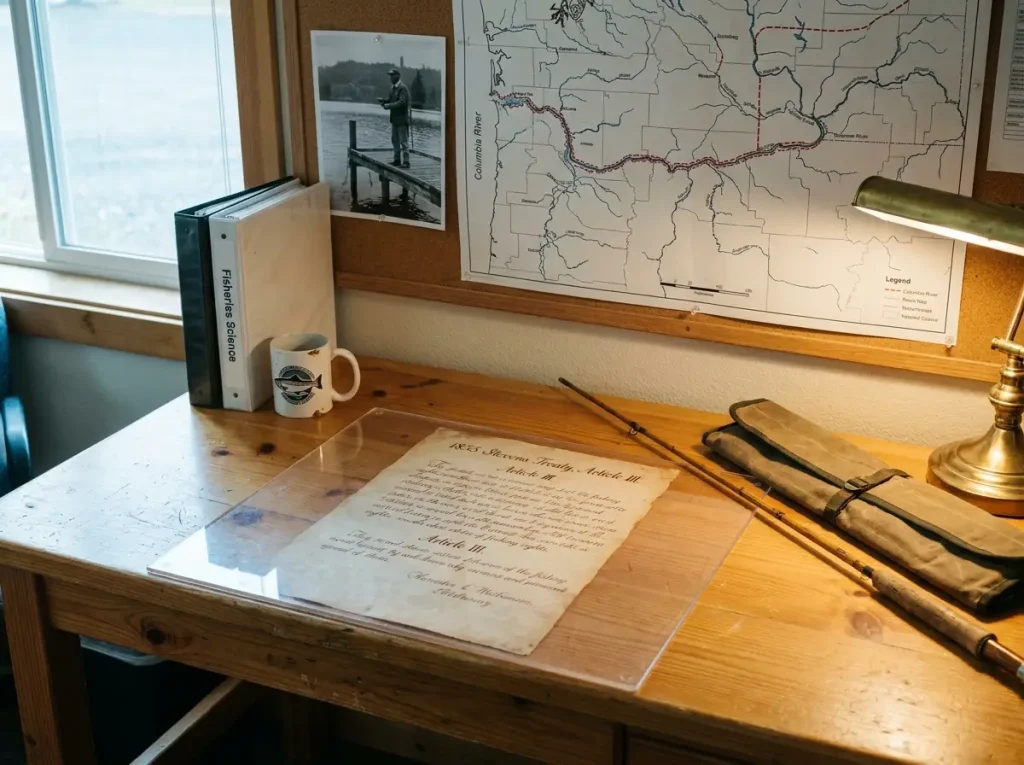
The most common misconception is that tribal fishing rights are something the U.S. government gave to tribes. They aren’t. Treaties weren’t gifts — they were contracts. Tribes ceded land and resources in exchange for keeping certain rights they already exercised. Fishing was usually one of those reserved rights.
The Reserved Rights Doctrine
The U.S. has ratified roughly 374 treaties with Native nations. The legal principle that emerged from these is called the reserved rights doctrine — anything not explicitly given up in the treaty was kept by the tribe. This is the opposite of how most laws work. A state fishing license is a privilege the state grants to you. A tribal fishing right is a pre-existing right the tribe never gave up. The U.S. Department of Justice maintains a public-facing page on tribal treaty hunting and fishing rights that lays this out clearly.
Treaties as Contracts
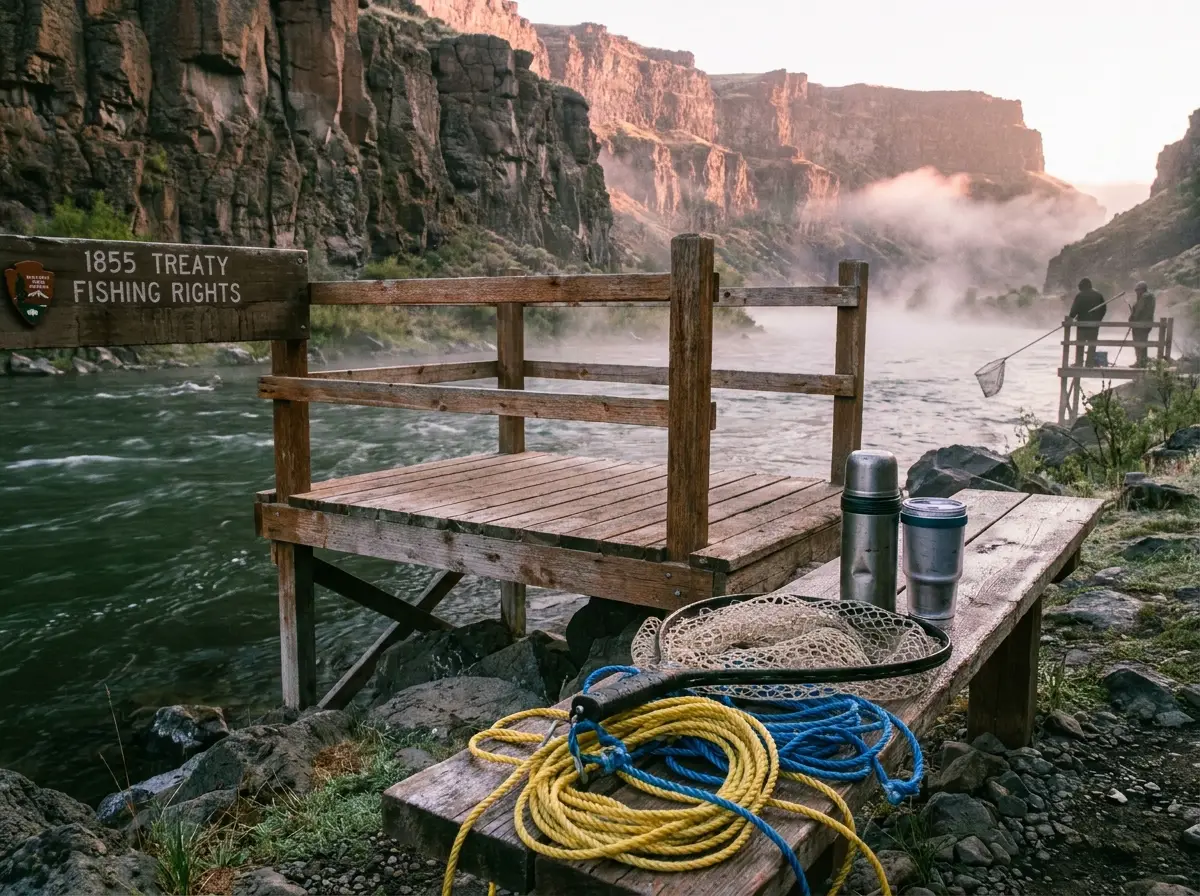
The 1855 Stevens Treaties in the Pacific Northwest, the 1837 Treaty of St. Peters in the Great Lakes, the 1854 Treaty of La Pointe — each was a negotiated contract. The U.S. wanted land. Tribes wanted to keep fishing the rivers their families had fished for generations. Both sides signed. The treaty language matters: phrases like “the right of taking fish at all usual and accustomed grounds and stations is further secured to said Indians, in common with all citizens of the Territory” appear with minor variations across most Pacific Northwest treaties. Those exact words still drive court rulings today.
How They Differ From State Regulations
State fishing licenses regulate non-tribal anglers in non-treaty contexts. Tribal fishing rights operate on a different legal track — federal treaty law, which sits above state law in the hierarchy. State conservation regulations can apply to tribal fishers in some narrow circumstances (Tulee v. Washington, 1942), but only when the regulation is necessary for conservation and applies equally. A state can’t simply tell a treaty tribe when, where, or how to fish. That’s not opinion — it’s how the U.S. Supreme Court has ruled, repeatedly.
The Court Cases That Defined Modern Treaty Fishing
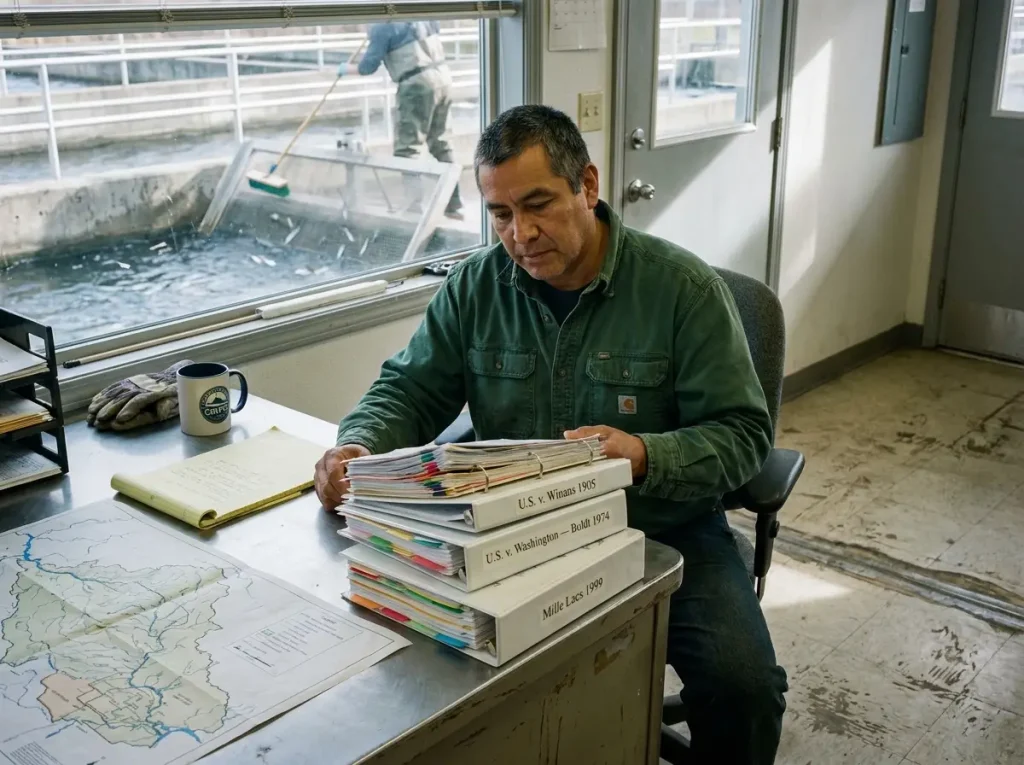
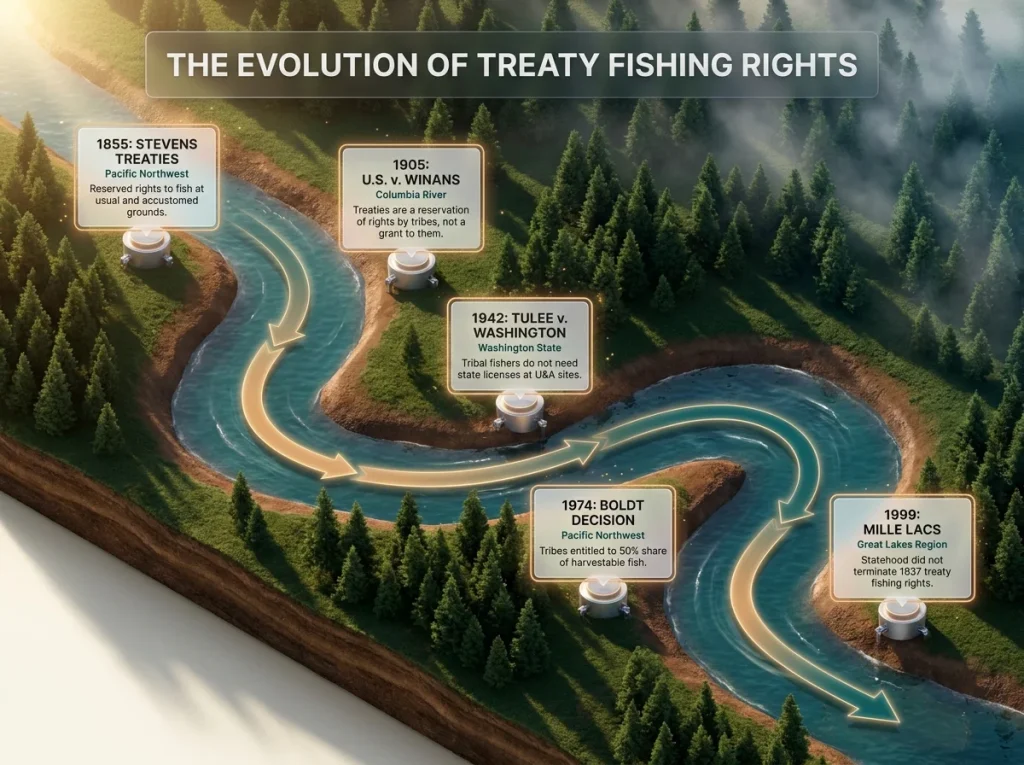
Four court cases produce roughly 95% of what you’ll encounter as an angler on treaty water. Each one answered a question the previous case had left open.
Winans and Tulee — The Foundation
United States v. Winans (1905) was the first major fishing-rights case at the Supreme Court. The Yakama Nation argued that the 1855 treaty preserved their right to fish at off-reservation sites along the Columbia River. The Court agreed. Justice McKenna’s opinion contained one of the most-quoted lines in Indian law: the treaty was “not a grant of rights to the Indians, but a grant of rights from them — a reservation of those not granted.” That single sentence shaped every fishing-rights case that came after. Tulee v. Washington (1942) added the detail that treaty fishers don’t need state licenses at usual and accustomed places, though states can regulate methods when conservation genuinely requires it.
The Boldt Decision
United States v. Washington — the Boldt Decision — is the most consequential fishing-rights ruling in U.S. history. Judge George Boldt issued his first decision in February 1974 and ruled that the treaty phrase “in common with” means a literal sharing of the harvest, fifty-fifty. The Pacific Northwest tribes who were parties to the treaties got the right to half the available salmon and steelhead. The U.S. Supreme Court affirmed Boldt in 1979. The ruling reorganized salmon management on the West Coast overnight and created the co-management framework that still operates today.
Mille Lacs and the Great Lakes
Most people don’t know that Great Lakes tribes have similar treaty rights. Minnesota v. Mille Lacs Band of Chippewa Indians (1999) was the case where the Supreme Court confirmed that the 1837 Treaty of St. Peters reserved fishing, hunting, and gathering rights for the Ojibwe across the ceded territory in Minnesota and Wisconsin. The court rejected Minnesota’s argument that statehood had ended those rights. The Mille Lacs decision is to the Great Lakes what Boldt is to the Pacific Northwest. If you fish Lake Mille Lacs, the Wisconsin Northwoods, or much of northern Michigan, you’re fishing in ceded treaty territory — even if you didn’t know it. The same conservation pressures that shape the native range of brook trout often overlap with treaty management zones.
“Usual and Accustomed” — The Phrase That Decides Everything
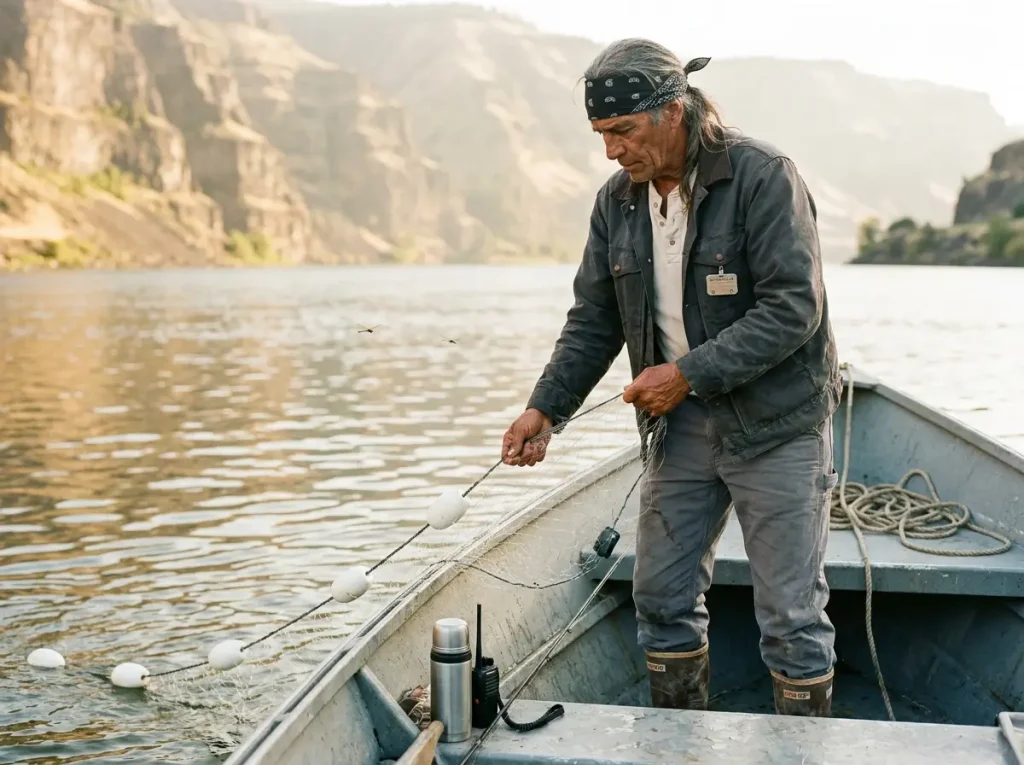
Two words from an 1855 treaty draft still tell tribes where they can fish today. “Usual and accustomed” — usually shortened to U&A in management documents — defines the geographic scope of treaty fishing rights.
How U&A Is Mapped
U&A places are the historic fishing grounds a tribe used at the time the treaty was signed. They’re identified through anthropological evidence, oral history, archaeology, and historical records. Once a court determines a U&A area for a tribe, that determination is permanent — the tribe can fish there regardless of whether the area falls inside or outside their current reservation. This is why you see tribal fishers on the Columbia far below their reservation boundaries, or Ojibwe spearfishers on Wisconsin lakes that aren’t on any reservation map. They’re fishing where their ancestors fished, and the law recognizes that history.
Why Geography Differs By Tribe
Each tribe’s U&A area is unique. The Yakama Nation’s U&A includes specific stretches of the Columbia, the Yakima, and the Klickitat. The Lummi Nation’s U&A covers Puget Sound salt water. The Lac Courte Oreilles Band of the Ojibwe Nation has U&A across the ceded territory of Wisconsin’s Northwoods. There’s no single map of “treaty waters.” There are dozens of overlapping maps, one per tribe per treaty. The dam removal work on the Klamath River and its impact on fisheries is a case where tribal U&A territory drove much of the long restoration push.
What This Means for Anglers
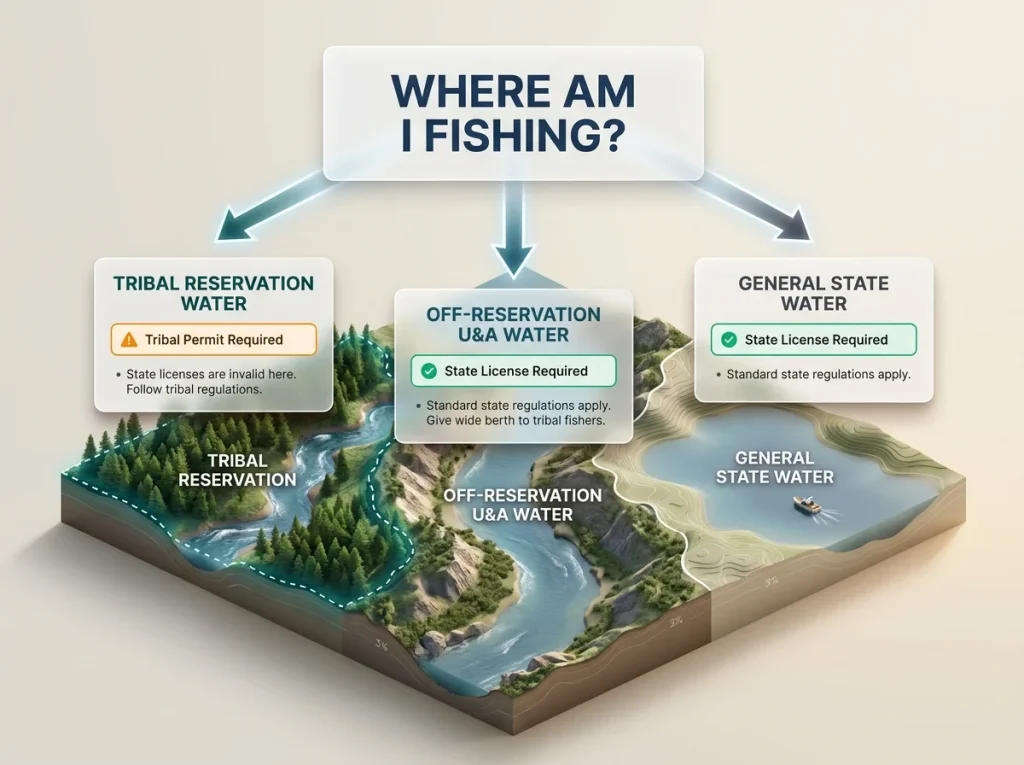
If you fish Pacific Northwest rivers, Puget Sound, the Columbia system, the Great Lakes, or much of the Upper Midwest, you’re probably fishing somewhere that overlaps with at least one tribe’s U&A. That doesn’t change your right to fish under a state license. It does change how you should think about the water — you’re sharing it with people whose families fished there before any state existed.
Pro tip: Before fishing unfamiliar treaty water, check the relevant tribal commission website. The Columbia River Inter-Tribal Fish Commission (CRITFC) and the Great Lakes Indian Fish & Wildlife Commission (GLIFWC) publish run-timing data, season dates, and management updates that are often more accurate than the state agency for tribal-managed species.
How the 50% Allocation Actually Works
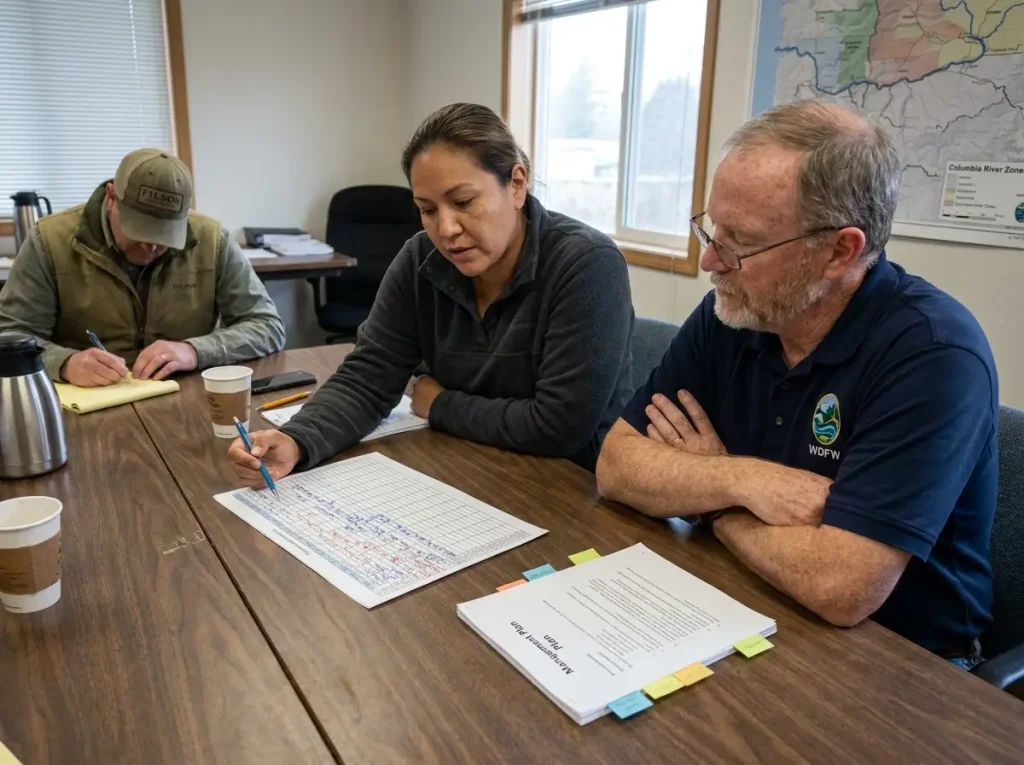
The “50% rule” from the Boldt Decision is the most-misunderstood number in fisheries management. Most non-tribal anglers think it means tribes always take half the fish. That’s not what the rule says.
What “In Common With” Means
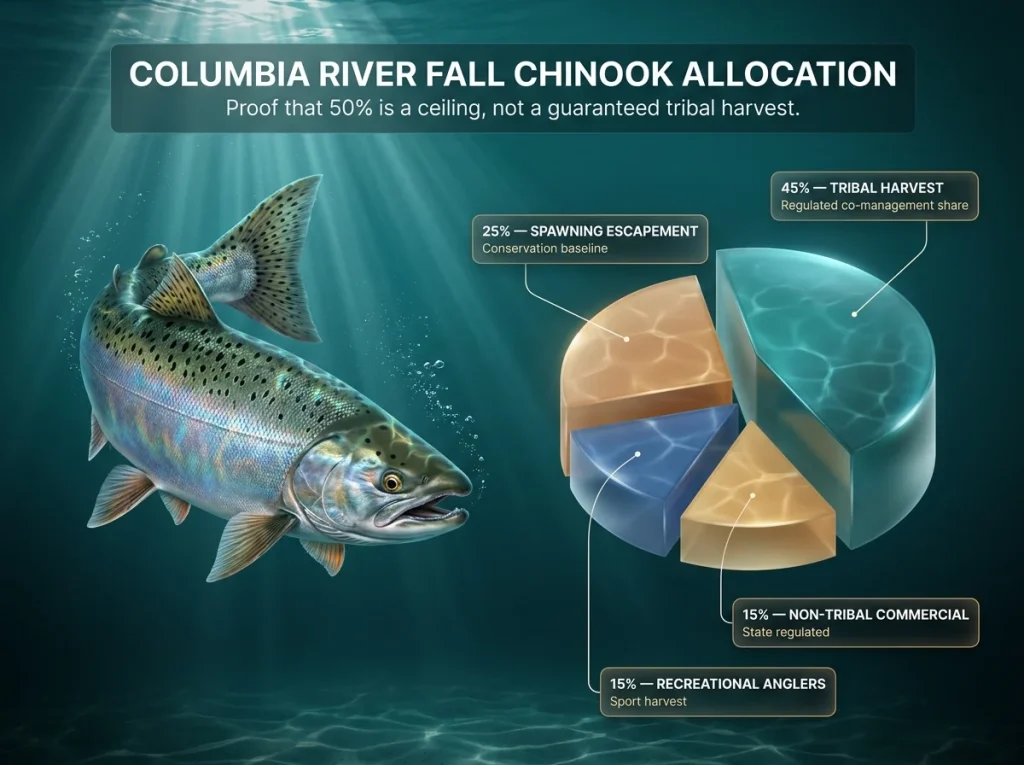
Boldt interpreted the treaty phrase “in common with” to mean a fair, equal share — fifty-fifty between tribal and non-tribal harvest. The Supreme Court affirmed that reading in 1979. But the ruling doesn’t guarantee tribes will harvest 50%. It establishes 50% as the maximum allowable tribal share when run sizes allow it. If conservation requires reduced fishing, both sides reduce. If non-tribal fisheries don’t take their full share, the tribal share doesn’t expand to fill the gap.
Why 50% Is a Ceiling Not a Floor
In practice, the 50% number is recalculated every year based on the projected run size, hatchery vs wild fish counts, conservation targets, and escapement needs. NOAA Fisheries coordinates with tribal sovereign nations on the West Coast through the formal co-management process. A typical Columbia River fall chinook run might be split with maybe 45% to tribal harvest, 30% to non-tribal commercial and recreational, and 25% allowed to escape upstream to spawn — and those numbers shift every year based on the science.
How Allocation Gets Set Each Year
State agencies, federal agencies, and tribal fisheries commissions meet annually before each major run to set allocations. The process is technical and slow. Run-size projections come from smolt counts, ocean conditions, hatchery returns, and historical patterns. Conservation triggers — minimum escapement levels, wild-fish protections, ESA-listed stocks — limit total harvest before allocation is even split. The same science that drives why certain waters are catch-release-only drives the conservation triggers in tribal allocation negotiations.
Geographic Differences — Pacific Northwest, Great Lakes, and Beyond
The treaty waters you fish depend on which 1850s map you’re standing on. Two regions account for most of the active treaty fisheries in the U.S., with smaller pockets elsewhere.
Pacific Northwest and the Boldt Zone
The Stevens treaties of 1854–1855 cover most of Western Washington, parts of Oregon, and reach into Idaho. Boldt’s ruling applied to the Washington tribes party to those treaties — Tulalip, Lummi, Suquamish, Quinault, Makah, Yakama, and others. Co-management between Washington Department of Fish and Wildlife and the affected tribes covers salmon, steelhead, halibut, shellfish, and most other treaty fisheries. The Columbia River is co-managed by Oregon, Washington, Idaho, and the four Columbia River treaty tribes (Yakama, Umatilla, Nez Perce, Warm Springs). Anglers heading to the Columbia for salmon and steelhead trips are fishing in the most legally complex, well-documented co-managed system in the country.
Great Lakes and the Chippewa Treaties
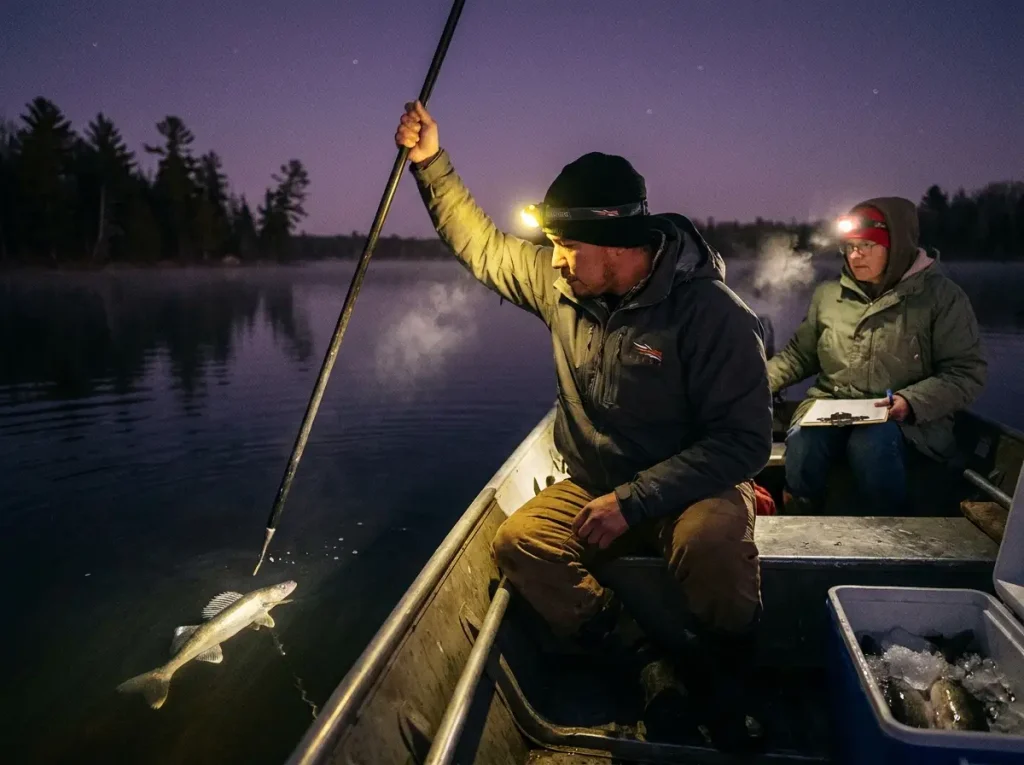
The 1836, 1837, 1842, and 1854 treaties between the U.S. and various Ojibwe (Chippewa) bands cover huge areas of Michigan, Wisconsin, and Minnesota. The Mille Lacs decision affirmed those rights in 1999. The Great Lakes Indian Fish & Wildlife Commission, headquartered in Wisconsin, manages co-management for the Ojibwe bands across the ceded territories. Walleye, lake trout, whitefish, and muskellunge are the major treaty species. The Wisconsin “Walleye Wars” of the 1980s and early 1990s — when non-Native protesters confronted Ojibwe spearfishers exercising treaty rights — are a difficult but instructive part of this history. The 40 years since Mille Lacs have shown that tribally co-managed walleye populations across the Lake Erie walleye fishery and the inland Wisconsin lakes have largely improved or stabilized — a fact often missing from the original protest narrative.
Pro tip: If you fish the Wisconsin Northwoods or the Boundary Waters in spring, check tribal spearing schedules before scouting your favorite walleye lake. GLIFWC publishes annual schedules. Showing up at a lake during a spear night isn’t hazardous — it’s just bad timing for your trip.
Other Regions
Treaty fishing rights exist in pockets across the rest of the country — Klamath Tribes in southern Oregon, Hoopa and Yurok on California’s Klamath River, Penobscot and Passamaquoddy in Maine, and a handful of others. Most are smaller in scope than PNW or Great Lakes treaty fisheries, but they apply the same legal principles. The general rule: anywhere there’s a treaty between the U.S. and a tribe that mentions fishing, those rights probably still exist somewhere on the water you fish.
How to Be a Respectful Non-Tribal Angler on Treaty Water
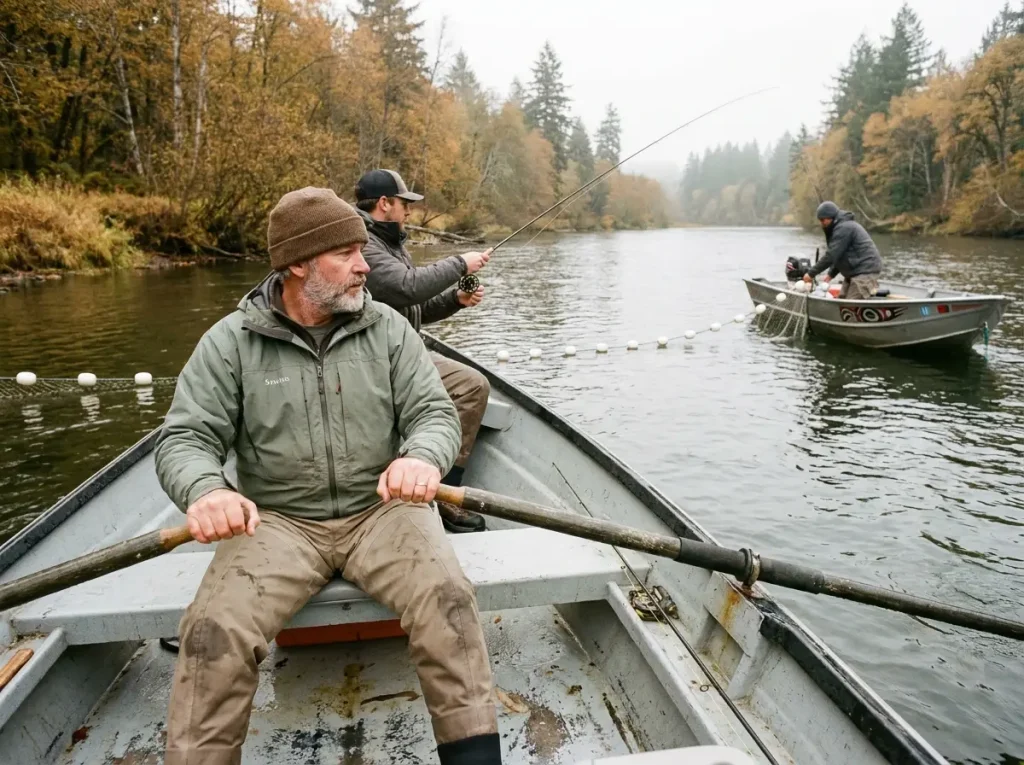
The legal rules are simple. The etiquette is what separates good anglers from the loud ones at the boat ramp.
License Requirements On vs Off Reservation
If you fish on tribal reservation water, you typically need a tribal permit — not a state license. Tribal permits are usually available at the tribal fish & wildlife office, sometimes online. Costs vary by tribe. If you fish in shared off-reservation water (treaty U&A territory under co-management), your standard state license is what you need. The same state regulations apply to you that apply to any non-tribal angler. Mixing this up is the most common rookie mistake — anglers think they need a tribal license to fish a river that flows past a reservation, when they actually only need one to fish on tribal reservation water itself.
Etiquette and Respect
If you see a tribal fisher on the water — running a gillnet, dipnetting from a platform, spearing walleye at night — give them wide berth. They’re exercising a treaty right. Don’t crowd, don’t drift through their net, don’t shine lights at spearfishing boats. Wave, nod, and move along. Tribal commercial fishers often work in low light or weather conditions where rec anglers wouldn’t bother — that’s not a sign they’re poaching, it’s a sign they have decades of family experience reading those conditions.
The Conservation Paradox
The narrative I grew up hearing was that tribal harvest was decimating fisheries. The data tells a different story. Tribal fisheries commissions like CRITFC and GLIFWC have led some of the most aggressive habitat restoration, hatchery improvement, and run-recovery work in North America. The Yakama and Nez Perce hatchery programs have rebuilt Snake River fall chinook from near-extinction. GLIFWC’s walleye monitoring is some of the most rigorous on the continent. Co-management has consistently improved fisheries when both sides bring science and good faith. If you find yourself blaming a tribal fishery for declining fishing, look at habitat loss, dams, water temperature, and ocean conditions first — those are usually the actual culprits.
Pro tip: Tribal fisheries staff are some of the best-trained biologists working on Pacific Northwest and Great Lakes fish today. If you have a real conservation question about a watershed, the tribal fish commission for that area is often your best phone call.
Conclusion
Three takeaways worth carrying with you to the boat ramp. First, tribal fishing rights are reserved rights — they pre-existed the treaties, weren’t granted by states, and operate under federal law. Second, the 50% allocation from Boldt is a ceiling tied to conservation, not a guaranteed harvest of half the river. Third, the etiquette and respect you bring to treaty water matters more than knowing every detail of every court case.
Before your next trip to a Pacific Northwest river, a Great Lakes inland walleye lake, or any water where treaty rights apply, spend ten minutes on the relevant tribal commission’s website. CRITFC, GLIFWC, and the Northwest Indian Fisheries Commission publish run timing, allocation summaries, and current management bulletins. Reading those before you launch tells you what’s happening on the water — and signals to the people who fished there long before you that you actually care.
Q1 What are tribal fishing rights?
Tribal fishing rights are pre-existing rights that Native American tribes reserved when they signed treaties with the U.S. government in the 1800s. They allow tribal members to fish at usual and accustomed places under tribal regulation, often without state licenses, under federal treaty law that supersedes state law in shared waters.
Q2 What is the Boldt Decision?
The Boldt Decision is the 1974 federal court ruling in United States v. Washington that confirmed Pacific Northwest treaty tribes are entitled to up to 50% of harvestable salmon and steelhead in shared waters. The U.S. Supreme Court affirmed it in 1979, establishing the co-management framework still used today.
Q3 Do Native Americans need a fishing license?
Tribal members fishing under treaty rights at usual and accustomed places generally don’t need state fishing licenses. Tribal members fishing outside treaty rights — for example, in another state — follow standard state license rules like any other angler.
Q4 What does usual and accustomed mean in fishing treaties?
Usual and accustomed refers to the historic fishing places a tribe used at the time their treaty was signed. Courts identify these areas through historical and anthropological evidence. Once determined, the tribe can fish there even if it’s outside the current reservation boundary.
Q5 Can non-tribal anglers fish in treaty waters?
Yes. Non-tribal anglers can fish in treaty co-managed waters with a standard state license. On tribal reservation water, non-tribal anglers usually need a tribal permit issued by the tribe’s fish and wildlife office. Etiquette and respect for tribal fishers exercising treaty rights are expected on shared waters.
Risk Disclaimer: Fishing, boating, and all related outdoor activities involve inherent risks that
can lead to injury. The information provided on Master Fishing Mag is for educational and informational purposes
only. While we strive for accuracy, the information, techniques, and advice on gear and safety are not a substitute
for your own best judgment, local knowledge, and adherence to official regulations. Fishing regulations, including
seasons, size limits, and species restrictions, change frequently and vary by location. Always consult the latest
official regulations from your local fish and wildlife agency before heading out. Proper handling of hooks, knives,
and other sharp equipment is essential for safety. Furthermore, be aware of local fish consumption advisories. By
using this website, you agree that you are solely responsible for your own safety and for complying with all
applicable laws. Any reliance you place on our content is strictly at your own risk. Master Fishing Mag and its
authors will not be held liable for any injury, damage, or loss sustained in connection with the use of the
information herein.
Affiliate Disclosure: We are a participant in the Amazon Services LLC Associates Program, an
affiliate advertising program designed to provide a means for us to earn advertising fees by advertising and linking
to Amazon.com. As an Amazon Associate, we earn from qualifying purchases. We also participate in other affiliate
programs and may receive a commission on products purchased through our links, at no extra cost to you. Additional
terms are found in the terms of service.