
In this article
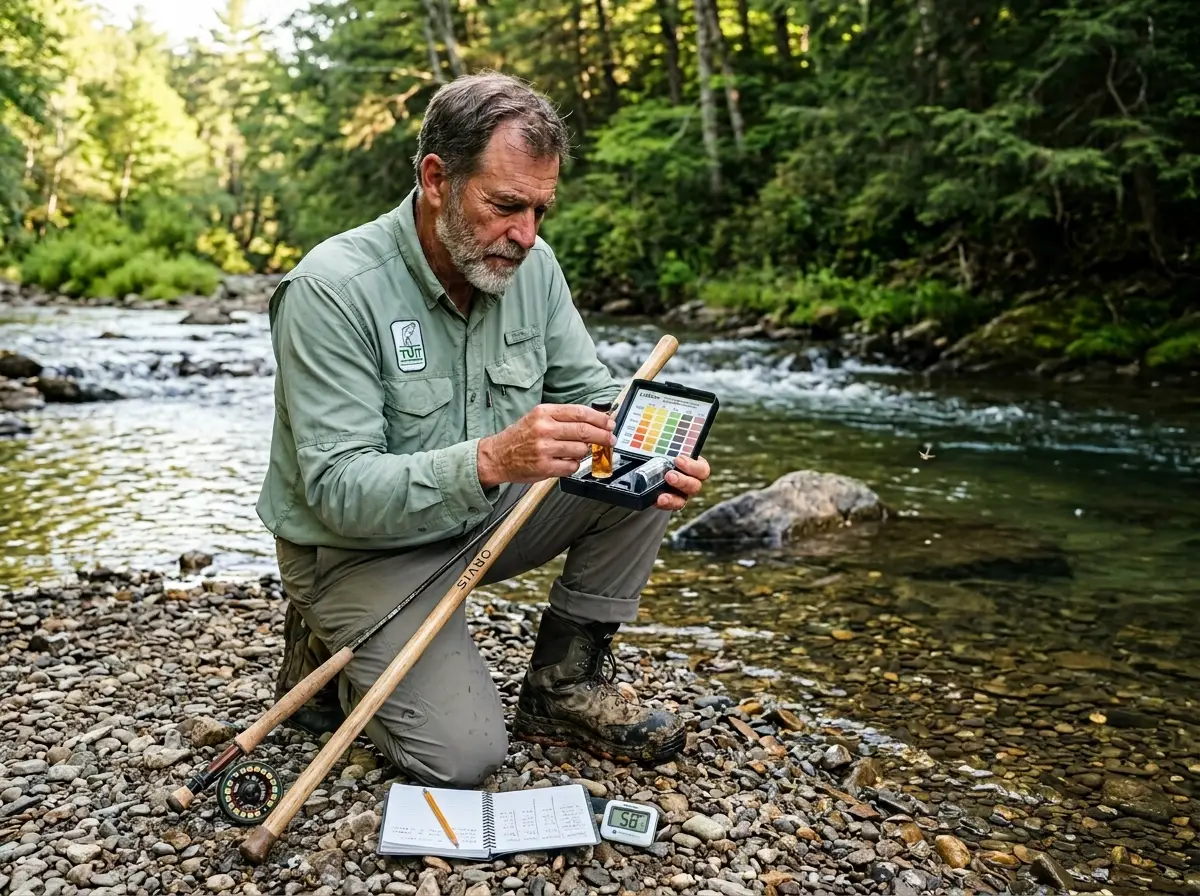
I spent $1,200 on a fish finder and two seasons staring at arches on a screen before a guy at the boat ramp changed how I think about finding fish. He wasn’t looking at electronics. He was dipping a test strip in the water at the launch and writing a number in a notebook. When I asked what he was doing, he said he was checking dissolved oxygen — and that the reading told him the bass had moved to the creek channel that morning. He was right. I caught nothing in the main lake. He limited out by 9 AM.
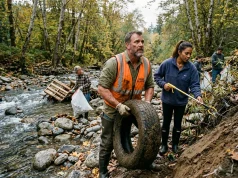
That interaction got me into water quality testing — first as a way to fish smarter, then as a citizen science volunteer feeding real data back to the agencies that manage our fisheries. Here’s what I’ve learned.
Quick Answer: Five water tests that improve your fishing and help your fishery:
- Dissolved oxygen — tells you where fish can breathe and where they can’t
- pH — reveals stress zones and feeding windows
- Temperature — predicts species location, metabolism, and activity level
- Turbidity — shows bait visibility and recent runoff events
- Nitrates/phosphorus — flags nutrient loading before algae blooms hit
Why Water Quality Is the Fishing Variable Nobody Checks
The Information Gap Between Anglers and Biologists
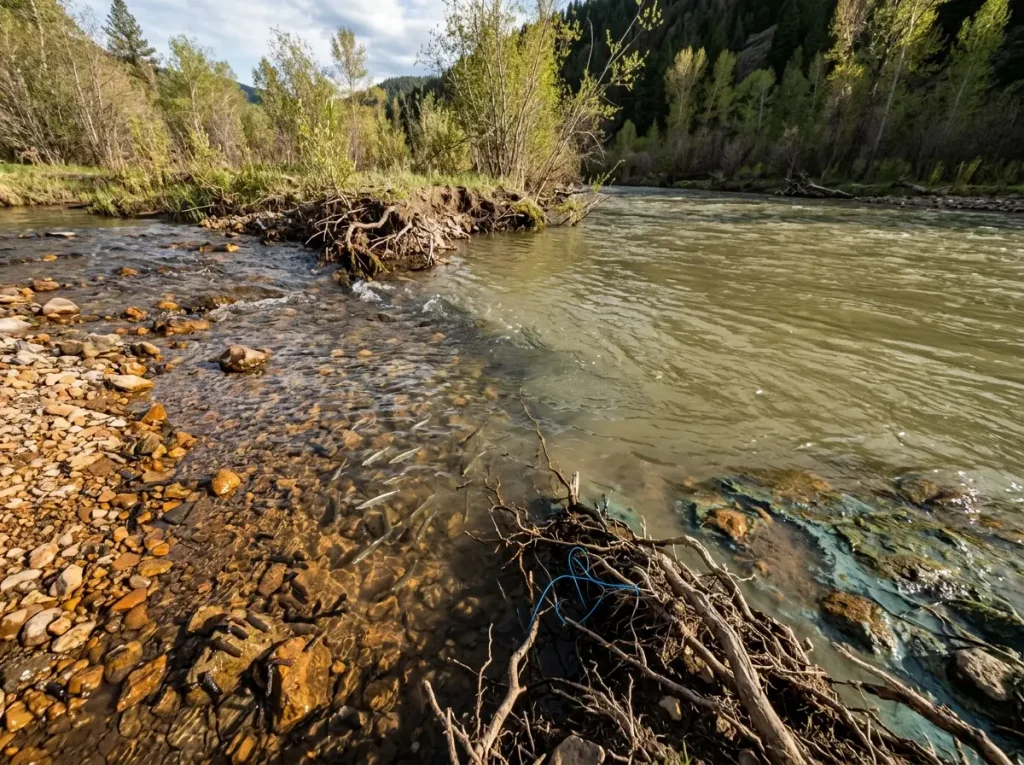
Most anglers pick a spot based on structure, depth, and maybe water temperature if their electronics show it. Fisheries biologists pick the same spots based on dissolved oxygen profiles, nutrient concentrations, and thermal stratification patterns — and they consistently find fish faster because of it. The gap between how anglers read water and how scientists read water is huge, and it’s entirely closable with $30 in test strips.
Why Anglers Are Perfectly Positioned for This
You’re already on the water. You’re already watching it, studying it, noticing when it changes color or smells different or when the bite dies for no visible reason. Understanding basic fish behavior starts with knowing what the fish are responding to — and water chemistry drives more of that behavior than structure or lure choice ever will.
Anglers were the original citizen scientists. The Izaak Walton League formed in 1922 specifically because anglers organized to assess pollution in the Mississippi River. A century later, Trout Unlimited’s community science program still relies on volunteers who fish the same waters they monitor.
What’s in It for You
This isn’t charity. An angler who tests water before fishing has a measurable edge. You’ll know which coves have enough oxygen to hold fish on a hot August afternoon. You’ll notice the early signs of a nutrient spike weeks before a visible algae bloom shuts down your favorite lake. You’ll understand why the bite turns off at 2 PM on a July day and know exactly where to move.
Dissolved Oxygen — The Number That Tells You Where Fish Are
What It Means in Fishing Terms
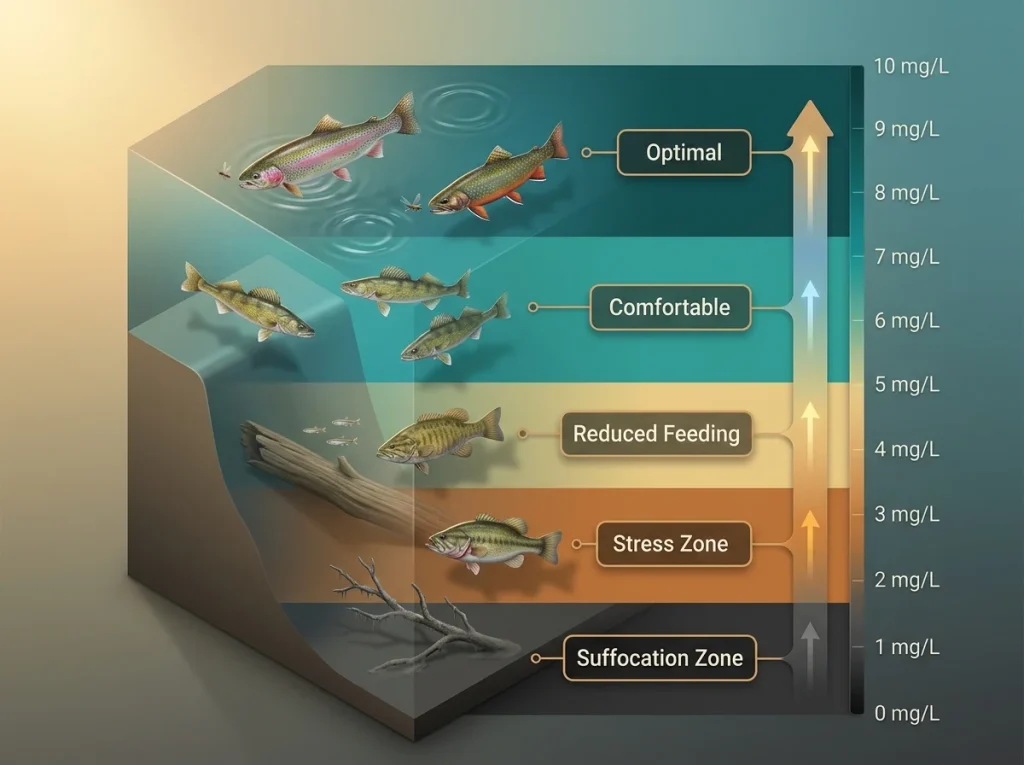
Dissolved oxygen is the amount of breathable oxygen in the water, measured in milligrams per liter (mg/L). Most warm-water species like bass need at least 5 mg/L to function normally. Below 3 mg/L, fish become stressed, stop feeding, and move. Below 1 mg/L, they leave or suffocate.
That matters because DO isn’t uniform across a lake or river. A wind-exposed point at noon might read 8 mg/L while a sheltered back cove with heavy vegetation reads 3 mg/L by the same afternoon. The fish aren’t randomly scattered — they’re stacked where they can breathe.
How to Test It
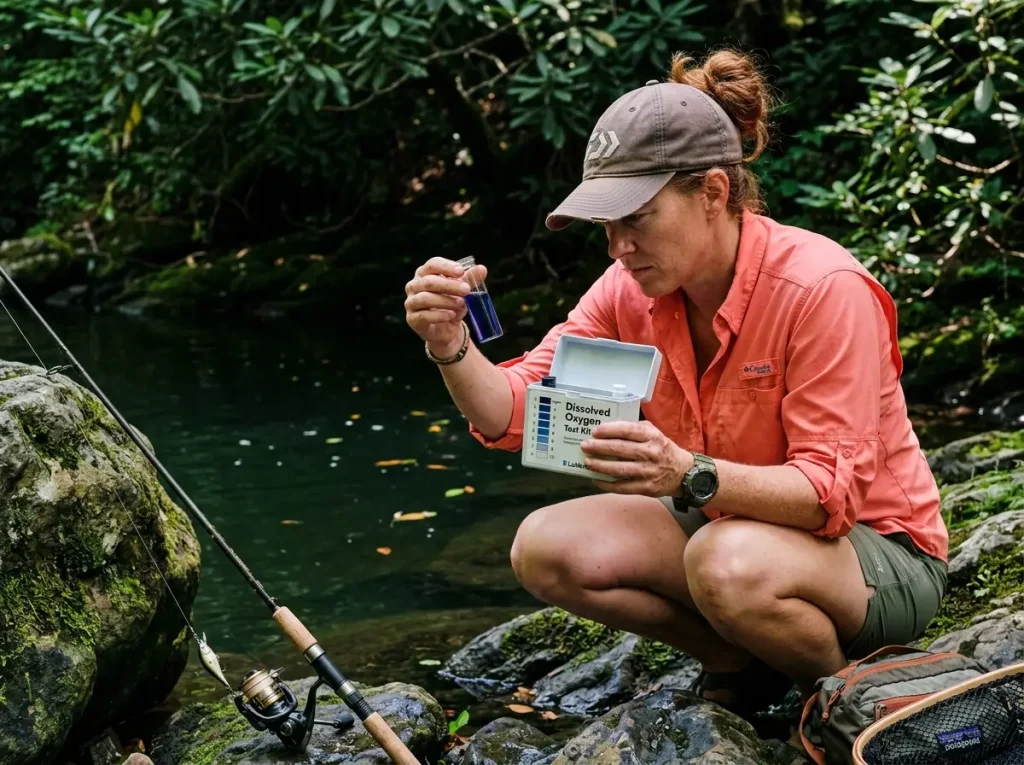
Colorimetric test kits like the ones in a Hach Stream Survey Kit work well for field use. Drop two reagent tablets into a water sample vial, shake for five minutes, and compare the color to a scale. The whole process takes about three minutes and gives you accuracy within 1 mg/L — more than enough to tell the difference between a fishable spot and a dead zone.
Pro tip: Test DO in the morning and again in the afternoon at the same spot. Plants produce oxygen during daylight hours, so afternoon readings in weedy areas can be deceptively high. The morning number is the real floor — that’s when fish are most oxygen-stressed.
pH, Temperature, and Turbidity — The Three You Can Test in Two Minutes
pH: The Stress Indicator
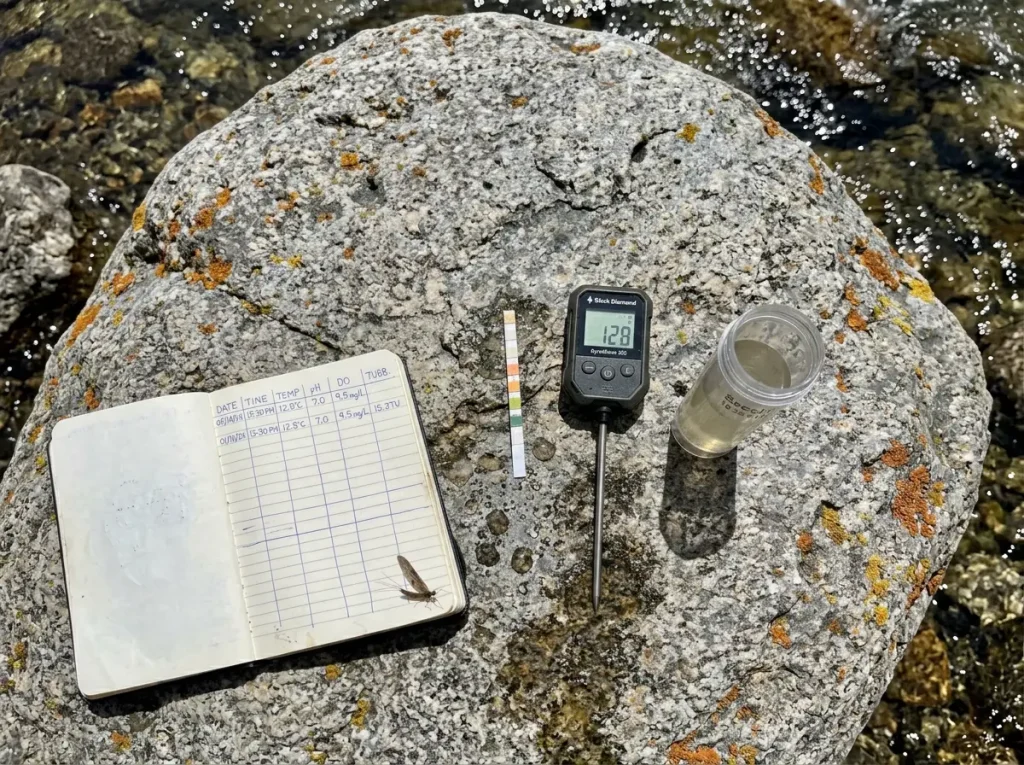
pH measures acidity on a 0–14 scale. Most freshwater fish thrive between 6.5 and 8.5. Sharp pH changes — even within that range — can trigger stress responses that shut down feeding. After heavy rain, runoff from agricultural land can drop pH rapidly in small streams, and you’ll notice the fish go dormant before any visible change in the water.
Multi-parameter test strips give you a pH reading in 60 seconds for about $0.30 per strip. Dip, wait, compare. That’s it.
Temperature: The Metabolism Dial
You probably already know water temperature matters. But testing it consistently — same spot, same time, logged in a notebook — turns a vague awareness into a pattern you can fish by. A two-degree rise at your favorite trout stream between April visits tells you more about insect activity and fish positioning than any hatch chart.
Turbidity: What the Fish Can See
Turbidity measures how much suspended material is in the water — sediment, algae, organic particles. High turbidity means fish can’t see your lure from as far away, which changes your entire lure selection and color strategy. You can measure it with a turbidity tube (a clear graduated tube with a target at the bottom — you fill it until you can’t see the target) or estimate it using a Secchi disk in lakes.
Pro tip: Log turbidity after every rain event at your home water. Over a season, you’ll build a personal database that tells you exactly how many days after a 1-inch rain your river clears enough to fish effectively. That kind of pattern recognition is worth more than any weather app.
Nitrates and Phosphorus — The Early Warning System
Why These Two Numbers Matter
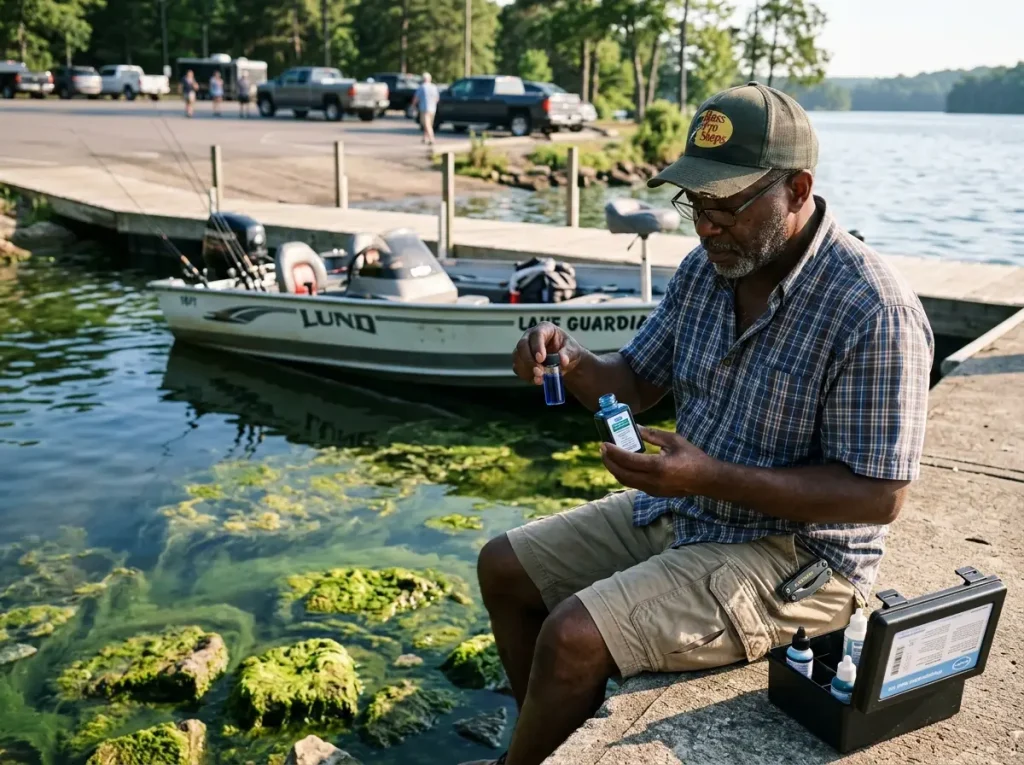
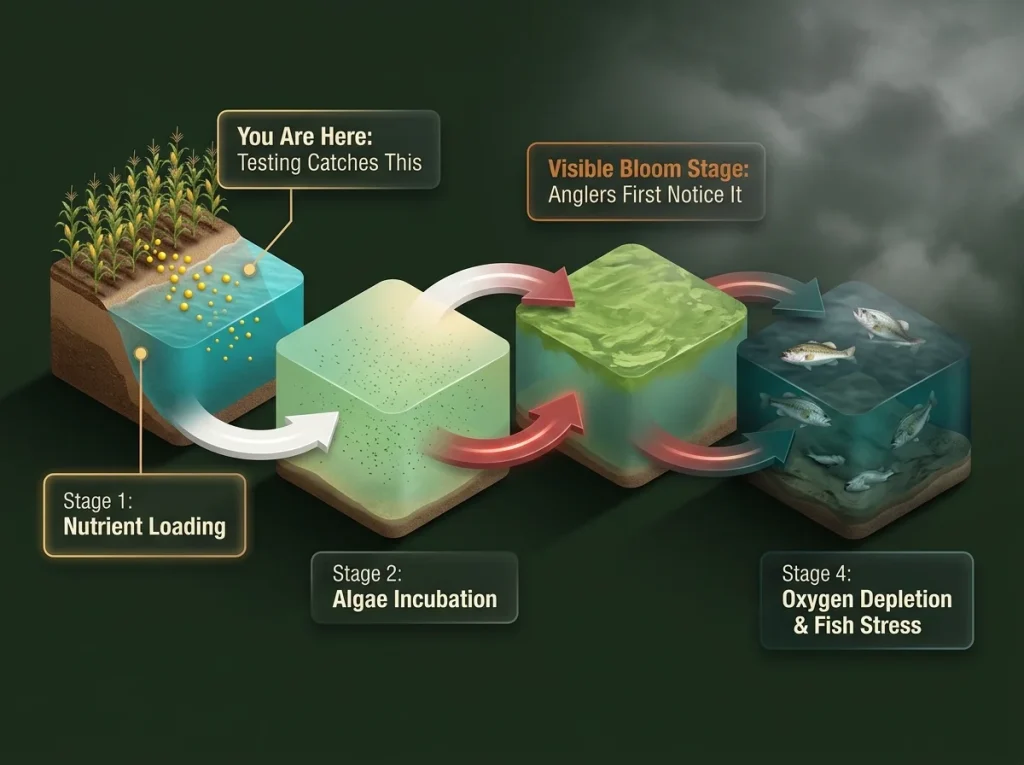
Nitrates and phosphorus are nutrients that fuel plant and algae growth. In small amounts they’re natural. In excess — usually from agricultural runoff, septic leaks, or lawn fertilizer — they trigger algae blooms that deplete oxygen and create conditions where fish can’t survive. A reading of 10 mg/L nitrate-nitrogen or above is the EPA threshold where problems start.
The Advantage of Catching It Early
By the time you see a green algae bloom, the nutrient overload happened weeks ago. If you’re testing nitrates and phosphorus monthly at a few spots on your home water, you’ll see the spike before the bloom forms. That gives you time to alert your local fisheries agency, and it gives you the fishing intelligence to avoid that cove before it goes dead.
Testing Method
The Hach Stream Survey Test Kit includes phosphate tests alongside DO, pH, and temperature — roughly $120 for a kit with 100 tests per parameter. LaMotte sells individual nitrate and phosphate kits for $30 to $50 each. A season of monthly testing at three sites costs less than a single crankbait habit.
The 10-Minute Pre-Fishing Test Routine
What to Test and When
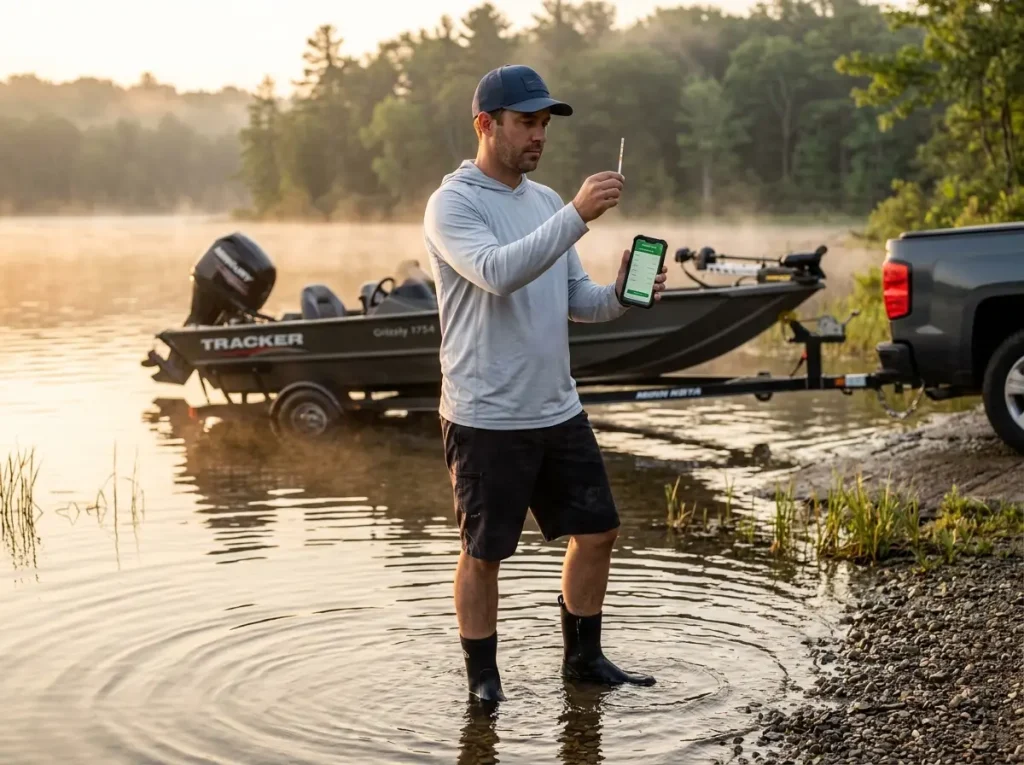
Add this to your launch routine, right between backing the trailer down and tying on your first lure:
- Fill a sample vial at the launch ramp or your first wade-in point
- Dip a multi-parameter test strip — read pH and nitrates after 60 seconds
- Drop your digital thermometer probe and record the number
- If you have a DO kit, run the reagent test while you rig up — it takes five minutes and your rod isn’t doing anything yet
- Log everything in a notebook or the Water Rangers app on your phone
What the Numbers Tell You Right Now
A morning DO reading below 5 mg/L at the main lake launch means the shallow flats are oxygen-starved — fish the creek channels or deep points where dissolved oxygen stratifies higher. Temperature above 80°F in a trout stream means the fish are stacked in thermal refuges near spring seeps — find the cold water pockets. High turbidity after rain means switch to high-contrast lures with strong vibration.
Every number connects to a fishing decision. That’s the point.
Pro tip: Keep a waterproof field notebook dedicated to water quality. After a season, you’ll have a personal database that no app or fish finder can replicate — specific to your water, your conditions, and your fish.
Citizen Science Programs That Want Anglers
National Programs
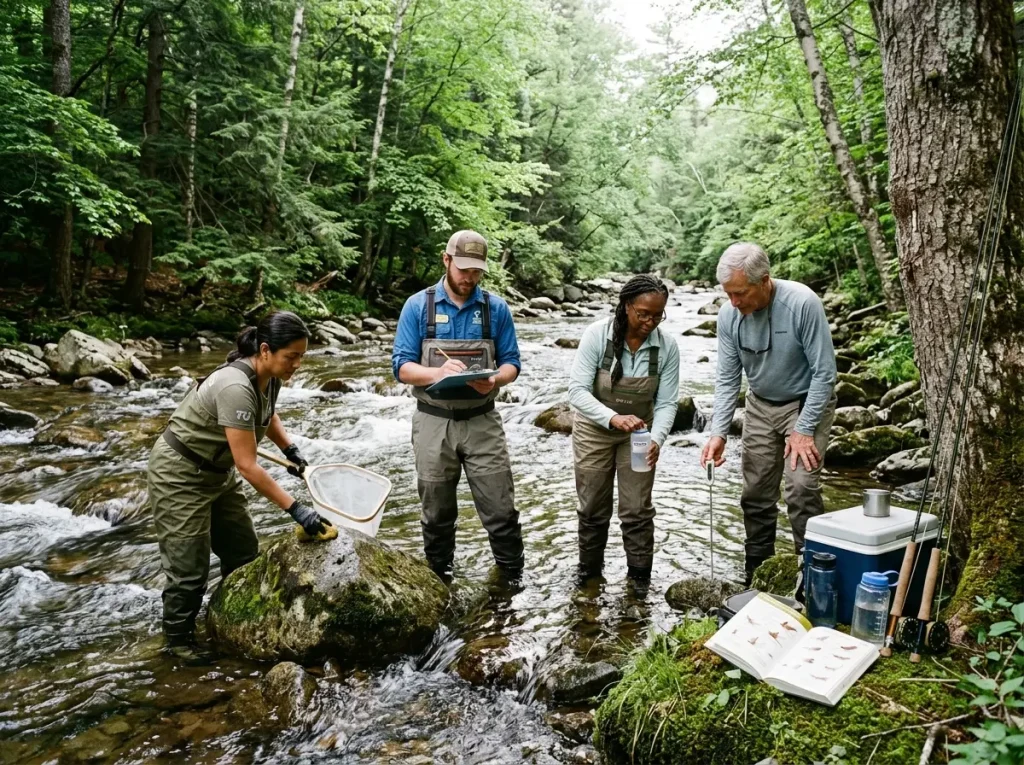
Trout Unlimited runs the largest angler-focused monitoring network. Volunteers work in teams of 2 to 5, spend about one hour per month from May through October, and collect data on temperature, DO, turbidity, flow rate, and macroinvertebrates. You don’t need to be a TU member to volunteer — contact your local TU chapter to find a stream near you.
The EPA’s Volunteer Monitoring Program supports state-level programs across the country. The EPA’s participatory science portal lists active projects by state, and many include training, equipment loans, and established sampling protocols.
Water Rangers offers a free app and affordable test kits designed specifically for community scientists, including anglers. Their platform makes data entry simple from a phone while you’re still streamside.
State and Regional Programs
Texas Stream Team, Missouri Stream Team, Michigan Clean Water Corps, and the Chesapeake Monitoring Cooperative all train volunteers and accept data from anglers. Many state fish and wildlife agencies also run their own monitoring programs — check your USGS stream gauge page as a starting point for finding what’s active in your watershed.
Getting Started Is Simpler Than You Think
Most programs provide free training — usually a half-day workshop on a local stream. Equipment is often loaned or subsidized. And the commitment is typically one sampling session per month during fishing season. If you’re already on the water every weekend, adding a 10-minute data collection stop is practically nothing.
What Happens After You Submit Your Data
The Data Pipeline
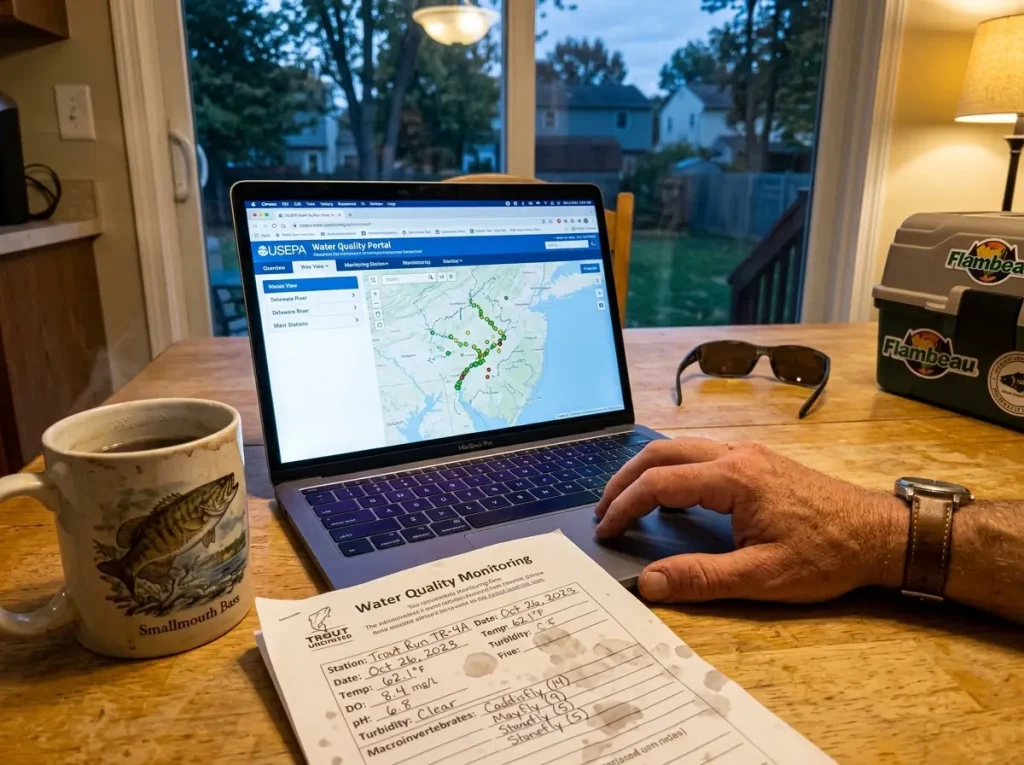
Your test strip result at the boat ramp doesn’t stay in a spreadsheet. Volunteer monitoring data from EPA-supported programs feeds into the Water Quality Exchange (WQX), a national database that state and federal agencies use to assess watershed health. Trout Unlimited data goes into state-level databases and directly informs habitat restoration priorities.
When Your Data Changes Policy
The Izaak Walton League’s Save Our Streams program has directly contributed to Clean Water Act enforcement actions based on volunteer-collected data. State agencies use volunteer monitoring trends to identify impaired waterways, allocate restoration funding, and set fishing regulations — including the seasonal closures and stocking decisions that directly affect where and when you fish.
Closing the Loop
This is the part that keeps volunteers engaged. You test a stream, report elevated nitrates, and two years later see a riparian buffer project funded on that stretch. You monitor DO through a summer drought and your data shows up in a state report recommending updated spawning season protections. The connection between your 10 minutes at the launch ramp and a healthier fishery is real — it just takes time to see it.
Pro tip: Ask your program coordinator for an annual summary of how volunteer data was used. Seeing your numbers in a state report is surprisingly motivating, and it makes the testing habit stick.
Conclusion
Water quality testing makes you a better angler and a better steward of the water you fish. The five tests — dissolved oxygen, pH, temperature, turbidity, and nutrients — each connect directly to fishing decisions you’re already making, and together they paint a picture of your fishery that no electronics can match.
The citizen science programs are there, the equipment costs less than a good crankbait collection, and the commitment fits inside a fishing trip you were going to make anyway. Start with a $30 test strip kit and a notebook. Log three parameters at every launch for a month. You’ll be hooked on the data before the season’s half over.
The water is telling you something. Most anglers aren’t listening. Now you are.
Q1 How can anglers help with water quality monitoring?
Join a program like Trout Unlimited’s community science network or your state’s volunteer monitoring program through the EPA portal. Training is free, equipment is often provided, and sampling takes about one hour per month at a stream or lake location near you.
Q2 What water quality parameters matter most for fishing?
Dissolved oxygen and temperature have the biggest immediate impact on fish location and feeding behavior. A DO reading below 5 mg/L tells you fish are stressed and repositioning. Temperature drives metabolism — every species has a preferred range where they feed most aggressively.
Q3 How much does a water quality test kit cost?
Multi-parameter test strips run $15 to $25 for a pack of 50 or more. A comprehensive Hach Stream Survey Kit with reagents for DO, pH, phosphate, nitrate, and temperature costs about $120 and includes 100 tests per parameter. Monthly testing at three sites runs under $50 for a full season.
Q4 Can citizen science data be used by government agencies?
Yes. Data from EPA-supported volunteer monitoring programs feeds into the Water Quality Exchange national database. State agencies use this data to identify impaired waterways, allocate restoration funding, and inform fishing regulations including stocking and seasonal closures.
Q5 What is dissolved oxygen and why do fish need it?
Dissolved oxygen is gaseous oxygen present in water, measured in mg/L. Fish extract it through their gills the way lungs extract oxygen from air. Most freshwater gamefish need at least 5 mg/L to feed normally. Below 3 mg/L, fish stop eating and seek better water. Below 1 mg/L, most species cannot survive.
Risk Disclaimer: Fishing, boating, and all related outdoor activities involve inherent risks that
can lead to injury. The information provided on Master Fishing Mag is for educational and informational purposes
only. While we strive for accuracy, the information, techniques, and advice on gear and safety are not a substitute
for your own best judgment, local knowledge, and adherence to official regulations. Fishing regulations, including
seasons, size limits, and species restrictions, change frequently and vary by location. Always consult the latest
official regulations from your local fish and wildlife agency before heading out. Proper handling of hooks, knives,
and other sharp equipment is essential for safety. Furthermore, be aware of local fish consumption advisories. By
using this website, you agree that you are solely responsible for your own safety and for complying with all
applicable laws. Any reliance you place on our content is strictly at your own risk. Master Fishing Mag and its
authors will not be held liable for any injury, damage, or loss sustained in connection with the use of the
information herein.
Affiliate Disclosure: We are a participant in the Amazon Services LLC Associates Program, an
affiliate advertising program designed to provide a means for us to earn advertising fees by advertising and linking
to Amazon.com. As an Amazon Associate, we earn from qualifying purchases. We also participate in other affiliate
programs and may receive a commission on products purchased through our links, at no extra cost to you. Additional
terms are found in the terms of service.