
In this article
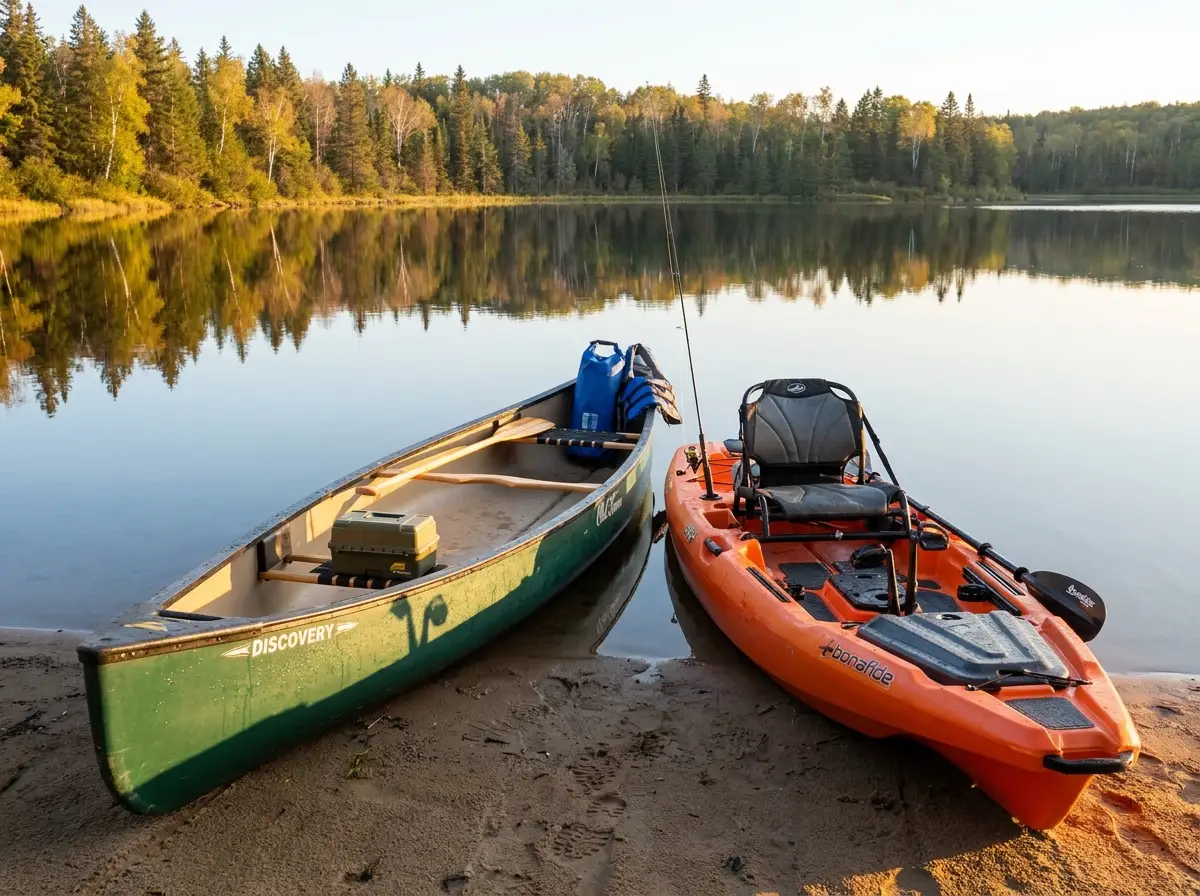
I’ve watched anglers agonize over the canoe-versus-kayak decision for years, and every article online gives the same non-answer: “it depends.” That’s not helpful when you’re standing at the dealer trying to decide where to put your money. I’ve fished from both — canoes on calm lakes and slow rivers, kayaks on everything from Texas flats to Great Lakes shoreline — and the honest answer comes down to how you actually fish, not what looks cooler on Instagram. Here’s the real comparison.
Here’s how they stack up at a glance:
| Canoe vs. Fishing Kayak | ||
|---|---|---|
| Factor | Canoe | Fishing Kayak |
| Gear capacity | ~800 lbs, open hull | ~400 lbs, hatch storage |
| Stability in calm water | Higher (wider beam) | Moderate (lower profile) |
| Wind handling | Poor (acts like a sail) | Strong (low center of gravity) |
| Standing to fish | Possible on calm water | Purpose-built platforms available |
| Solo portability | 55–80 lbs, easy car-top | 65–100+ lbs, may need loader |
| Rigging | DIY blank canvas | Plug-and-play gear tracks |
| Entry price | $300–600 fishes well | $600+ for real fishing features |
| Best for | Tandem, gear-heavy, calm water | Solo, windy water, hands-free |
The Real Difference Between Fishing From a Canoe and a Kayak
How You Sit Changes How You Fish
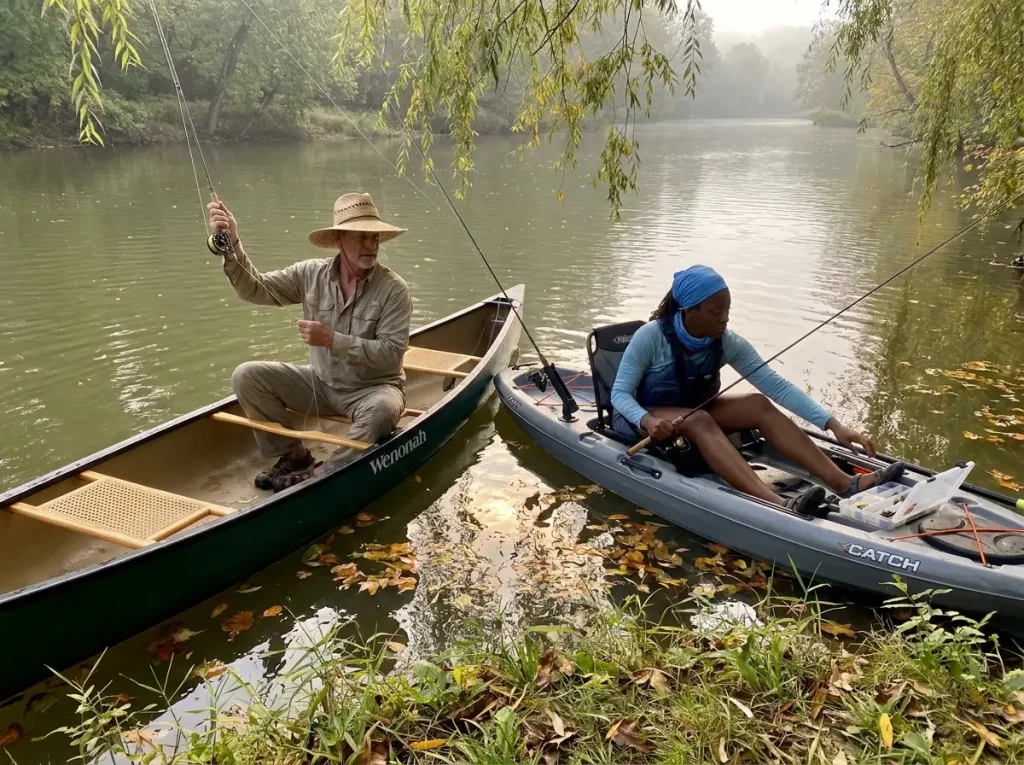
This is the thing that every spec sheet misses. Fishing from a canoe and fishing from a kayak are fundamentally different physical experiences. In a canoe, you sit on a bench seat or kneel — your hips are above the gunwales, your legs are free to shift, and you can turn your whole torso to cast in any direction without thinking about it. It feels like fishing from a low platform. You can reach down into the hull and grab a tackle box, kick your legs out, or lean over the side to land a fish with a net.
In a kayak, you sit low — either inside a cockpit or on top of a molded seat. Your legs extend forward into footwells or stretch out on deck. Your center of gravity is inches from the waterline. Casting requires rotating your torso against the seat back, and reaching anything behind you means twisting or storing everything within arm’s length. It feels like wearing the boat rather than sitting in it.
Neither is better. But they create completely different fishing rhythms, and the one that fits your style matters more than any feature comparison.
What “Stability” Actually Means on the Water
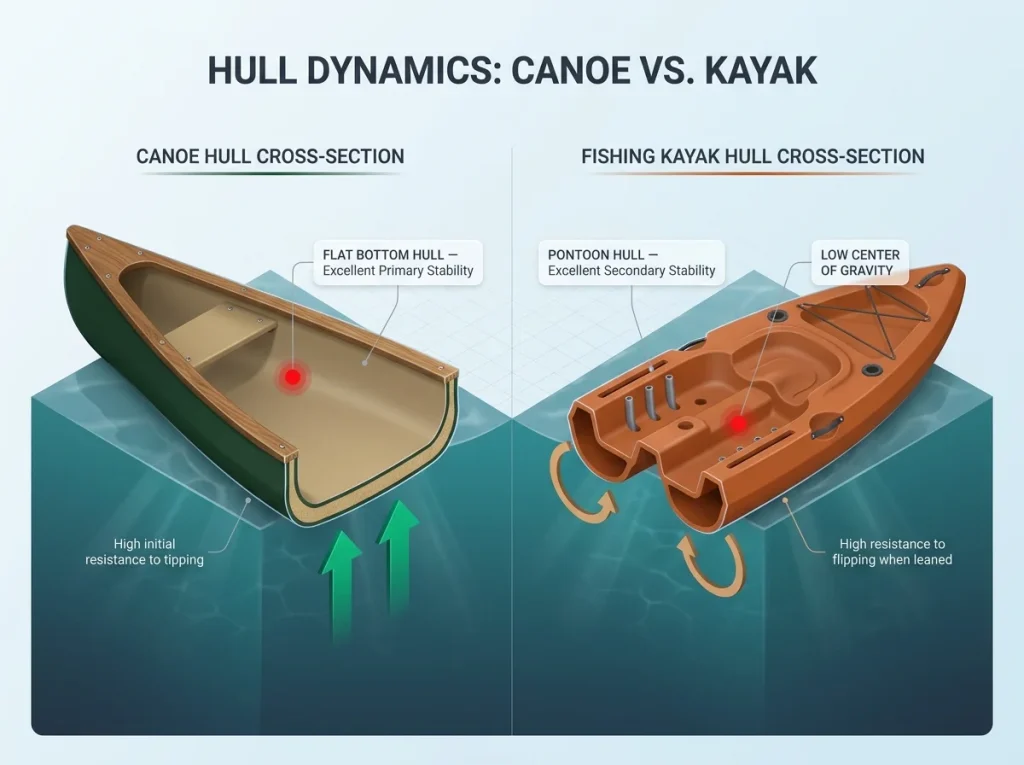
Every comparison article says canoes are “more stable” or kayaks are “more stable” without explaining what that means. There are two types of stability, and each boat wins a different one.
Primary stability is how solid the boat feels when you’re sitting still on flat water. Canoes win here — the wider beam and flatter hull bottom create a platform that feels planted. You can shift your weight, lean to grab something, and the canoe barely moves. Kayaks feel tippier at rest, especially narrower models.
Secondary stability is how the boat recovers when it gets hit by a wave or you lean hard to one side. Kayaks win here — the lower center of gravity means the boat rocks but recovers. A canoe’s higher center of gravity means that once it starts to tip past a certain point, it goes over fast. The forum wisdom puts it well: canoes feel stable until they flip, while kayaks feel tippy but rarely actually go over. For a deeper look at how hull shape drives these tradeoffs, check out our breakdown of kayak hull design. Take Me Fishing’s comparison guide covers the basics from a .org perspective.
Gear Capacity and Storage — Where Canoes Win Big
What Actually Fits in Each Boat
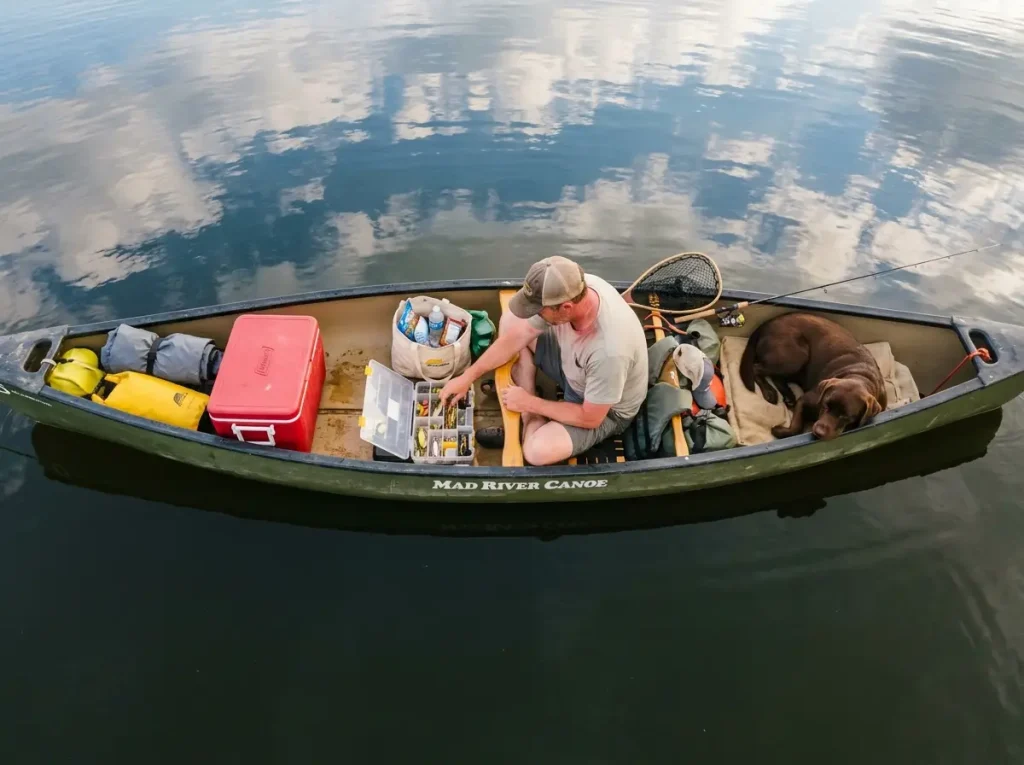
This isn’t close. A standard 16-foot canoe has an open hull with roughly 800 pounds of carrying capacity. That means a full-size cooler, two tackle boxes, a landing net, a dry bag with extra layers, a thermos, snacks, and still enough room to move around. Everything sits inside the hull where you can see it, grab it, and reorganize on the fly. The trade-off is exposure — splash, rain, and the occasional wave can get your gear wet if you don’t pack smart.
A fishing kayak typically maxes out around 400 pounds of capacity, and a significant chunk of that is you. Storage is split between sealed hatches (waterproof but hard to access while fishing), tankwell areas behind the seat (reachable but cramped), and whatever you can strap to the deck. You learn to be strategic about what goes where, and you accept that some gear stays at home.
The “Bring a Friend” Factor
If you fish with a partner, a kid, or a dog, the canoe wins by default. Two anglers in a tandem canoe have room to fish independently, store separate gear, and land fish without getting in each other’s way. Tandem kayaks exist, but they’re a compromise — two people crammed into a narrow boat with limited independent movement. Most experienced kayak anglers fish solo, and that’s by design.
The canoe also wins for the practical reason that nobody talks about: when you catch a big fish in a canoe, you don’t have to put it in your lap.
Maneuverability, Speed, and Handling Wind
Paddling Efficiency and Tracking
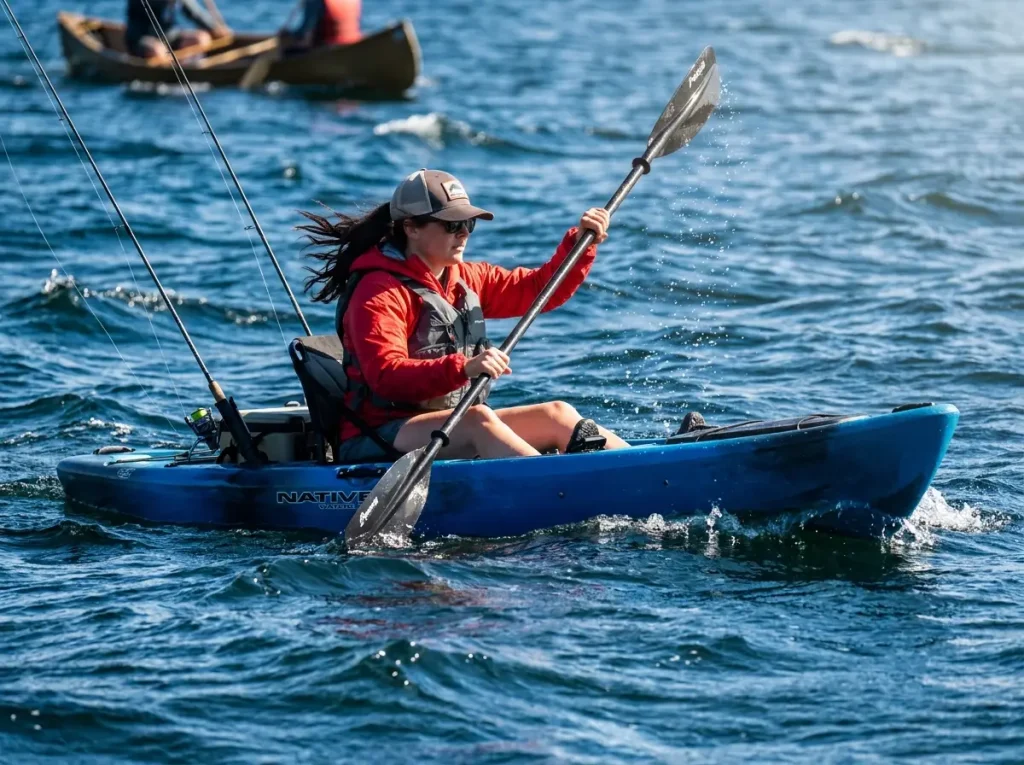
A kayak with a double-blade paddle is more efficient than a canoe with a single blade. Each stroke propels and corrects simultaneously. A canoe requires technique — the J-stroke, draw stroke, and pry — to maintain a straight line. An experienced canoeist can track well, but the learning curve is steeper. A beginner in a kayak goes straight on the first try. A beginner in a canoe zigzags.
Speed is comparable in calm water, but the kayak pulls ahead on longer paddles because the stroke is less fatiguing. The lower windage also means less energy wasted fighting crosswinds.
Why Wind Is the Canoe’s Worst Enemy
If there’s one factor that tips the whole decision, it might be wind. A canoe’s high sides catch wind like a sail. In a 15-mph crosswind on open water, you spend more energy fighting the boat than fishing. You get pushed sideways, your casting is compromised, and your position over the fish changes constantly.
A kayak sits low. Wind passes over the hull rather than catching it. You maintain position with half the effort, and your casts stay accurate because the boat isn’t drifting between strokes. If you fish open water — big lakes, reservoirs, coastal bays — and wind is a regular factor, this single advantage might make the decision for you. Our guide to fishing in wind covers boat control tactics for both platforms.
Pro tip: If you’re committed to canoe fishing on windy water, a small trolling motor and a drift sock change everything. The motor holds you in position, and the sock slows your drift to a fishable speed. It’s not as clean as a kayak’s low profile, but it works.
Standing to Fish — The Factor Nobody Covers Well
The Physics of Standing in Each Craft
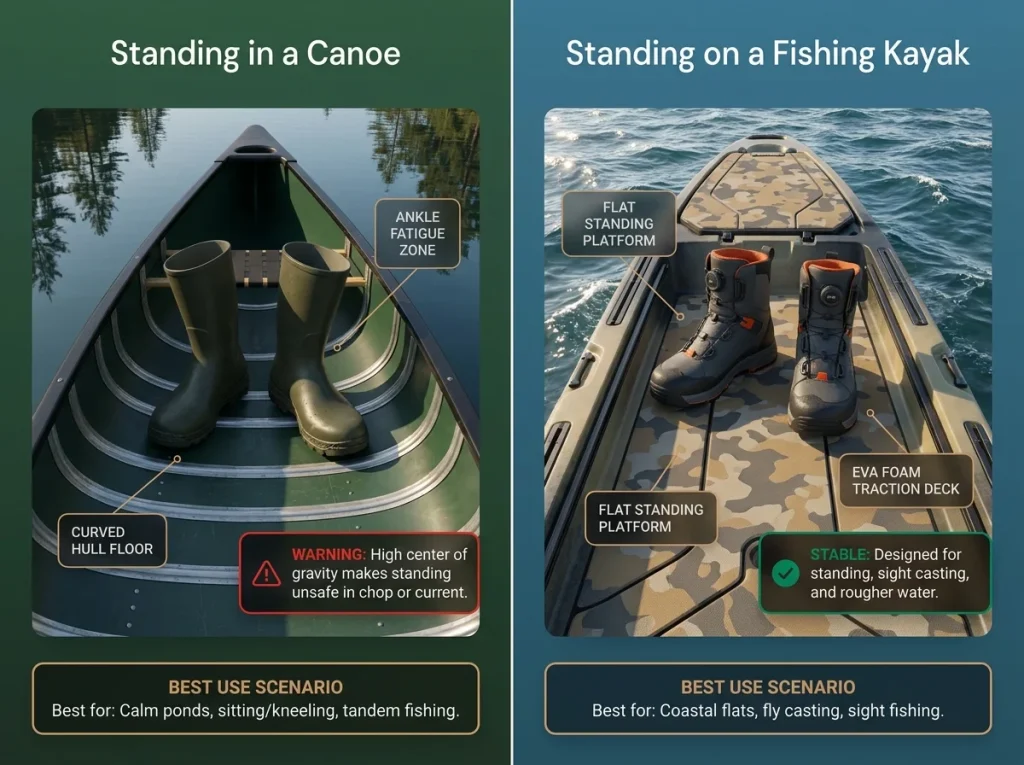
Most comparison articles mention standing in one sentence and move on. But if you sight fish, fly cast, or fight big fish, standing ability matters as much as anything else on this list.
Standing in a canoe is possible on calm water. The wide beam — typically 34-36 inches — gives you a reasonable platform, and many anglers kneel rather than stand to keep their center of gravity low. The problem is that canoes have high centers of gravity to begin with. Add a standing angler and you’re stacking instability. In any chop or current, standing in a canoe is a swim waiting to happen.
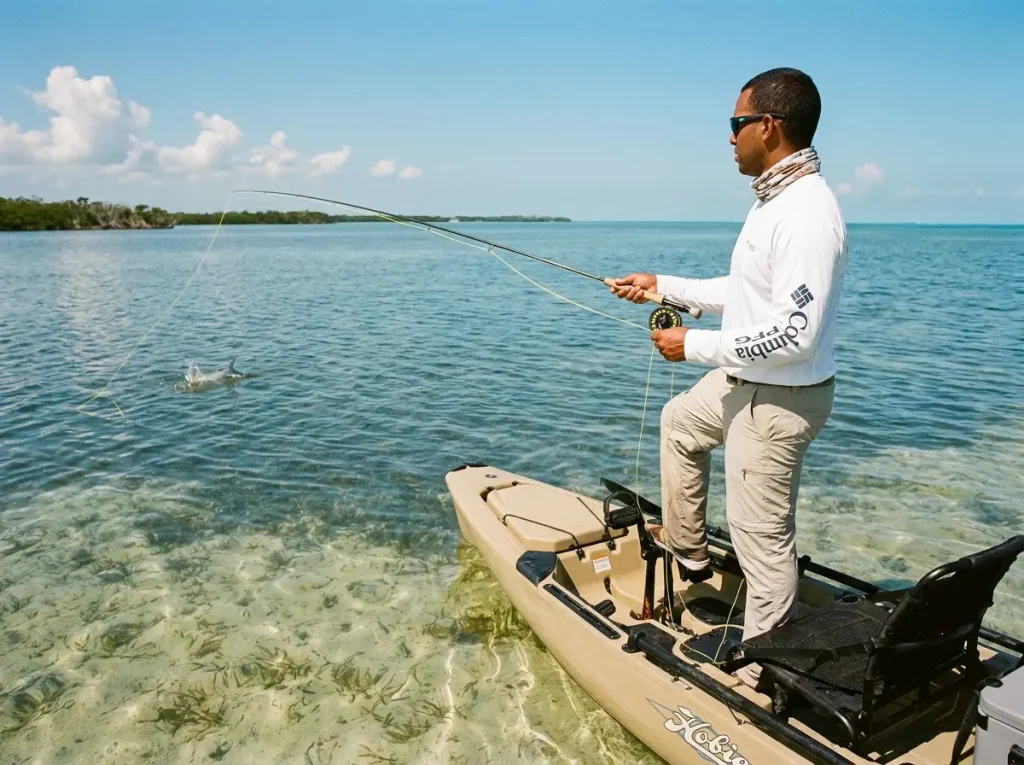
Standing in a fishing kayak depends entirely on the model. A standard recreational sit-in kayak? Forget it. But purpose-built fishing kayaks like the Bonafide SS127 and Hobie Pro Angler are designed with flat, wide standing platforms, textured non-skid surfaces, and standing assist bars. These boats are 34-36 inches wide at the standing area and sit low enough that even with an angler standing, the center of gravity stays manageable.
Which One Lets You Sight Fish and Fly Cast
For sight fishing — spotting tailing redfish, cruising bonefish, or watching bass on beds — elevation matters. A canoe’s higher seating position gives you better sight lines even while sitting, which is an advantage over the kayak’s low riding position. But if you need to stand to see into the water, a fishing kayak with a standing platform is more secure.
For fly casting, the backcast needs clearance behind you. In a canoe, standing gives you that clearance, but stability is the trade-off. In a fishing kayak with a standing platform, you get both clearance and stability — but the boat’s accessories (rod holders, fish finder mount) can snag your fly line. Neither is perfect, but the dedicated fishing kayak is closer to a functional casting platform.
Pro tip: If standing is your priority, look specifically at fishing kayaks with standing platforms rated for your weight. Don’t try to make a $400 recreational kayak work for standing — the hull width and design aren’t built for it. You’ll swim.
Which Water Type Matches Which Boat
Rivers with Current
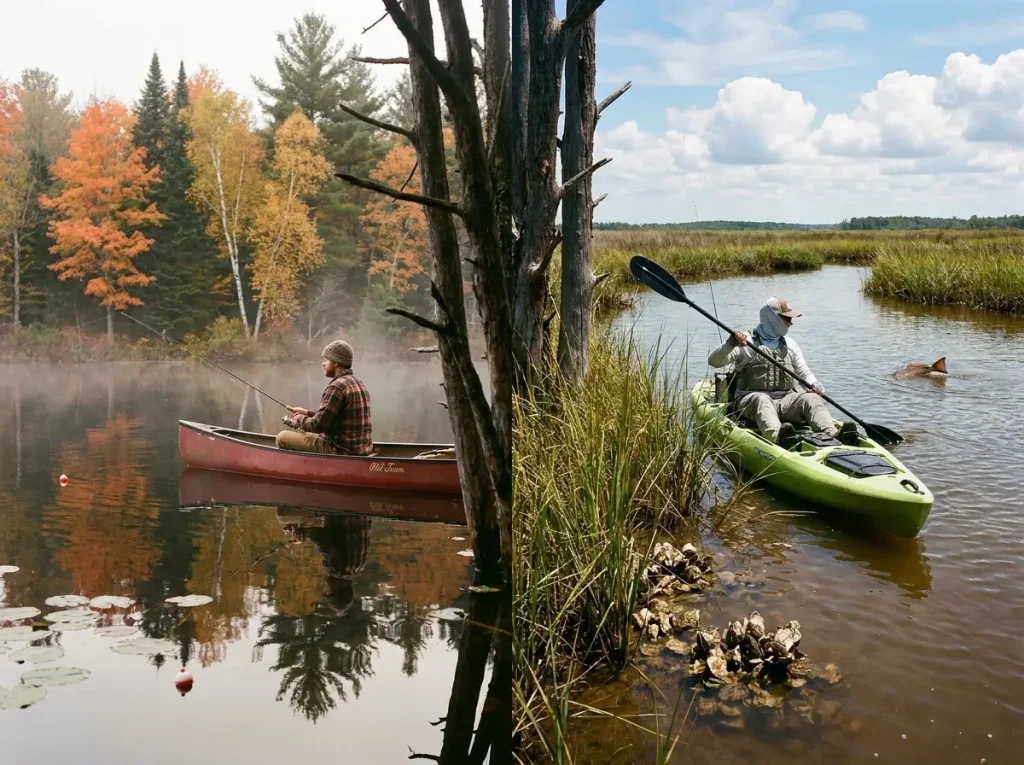
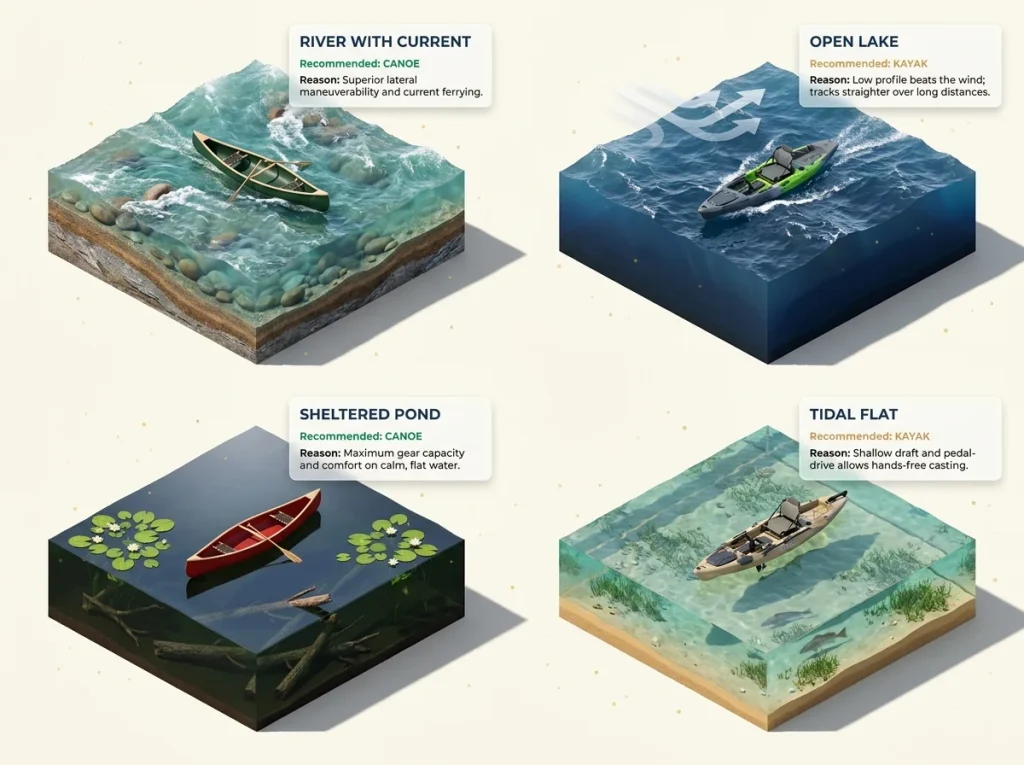
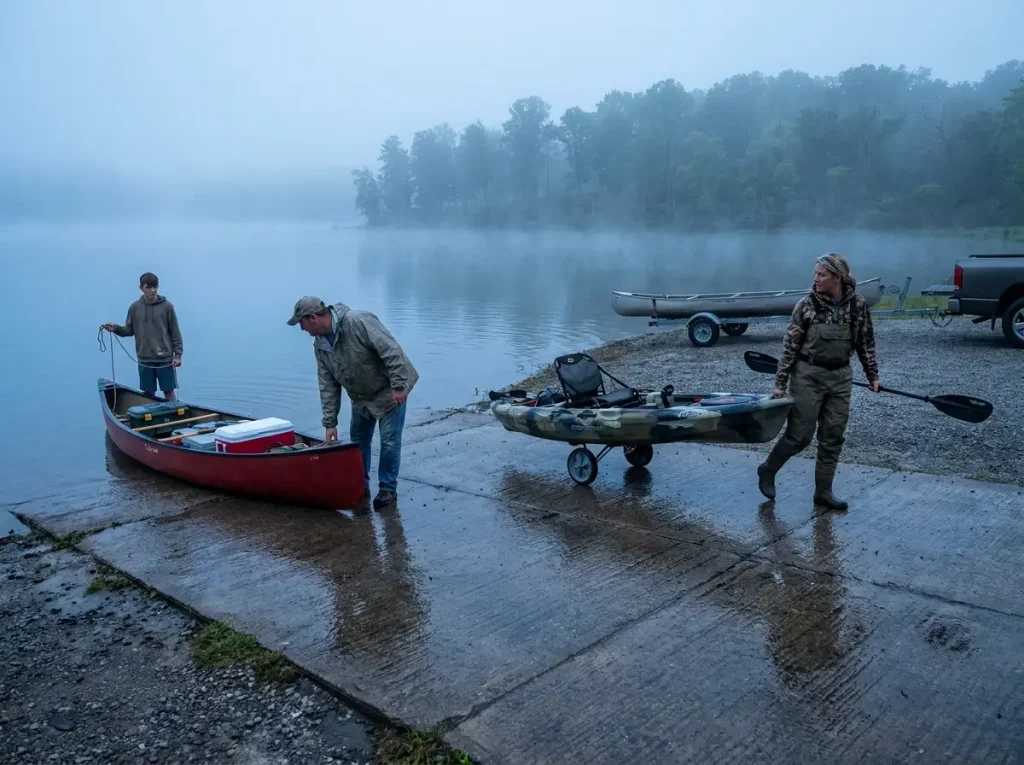
In moving water, canoes handle current naturally. The open design lets you shift weight to ferry across current, and a canoe paddle gives you powerful correction strokes to position in eddies and seams. For river fishing — smallmouth bass, trout, steelhead — canoes have been the standard for a century because they work.
Kayaks track well in current but are harder to position laterally. Peeling out of an eddy or ferrying across a strong current takes more skill in a kayak. Sit-on-top models with rudders handle rivers reasonably well, but the sit-inside touring-style kayak in rapids is a different skill set entirely.
Open Lakes and Reservoirs
This is kayak territory. The wind resistance advantage alone makes kayaks the better choice on big water where you’re paddling significant distances and dealing with afternoon winds. The lower profile handles boat wakes from other traffic, and the tracking efficiency means you cover more water with less effort. If your fishing involves open water, the kayak is the clear pick.
Sheltered Ponds and Backwaters
Canoe country. Small ponds, sheltered bays, flooded timber, and calm backwaters play to every canoe strength — stability, gear capacity, comfort, room to move. Wind isn’t a factor, waves don’t exist, and the canoe’s open hull lets you spread out and fish all day without feeling cramped. A canoe on a calm pond is about as close to fishing from a dock as you can get while floating.
Tidal Flats and Coastal Marshes
Kayak wins again. Sit-on-top fishing kayaks with shallow draft can float in four inches of water, letting you access skinny water that a canoe can’t reach without dragging. Pedal drive kayaks are the real advantage here — hands-free propulsion lets you cast while covering water, which is how you fish flats efficiently. The low profile also hides your approach from spooky fish.
For portage-heavy destinations like the Boundary Waters, the canoe is the only reasonable choice. You can carry a 55-pound canoe on portage trails. An 85-pound fishing kayak on a portage is punishment.
Rigging and Modifications — The Customization Comparison
Kayak Gear Track Ecosystem
Modern fishing kayaks ship ready to fish. Gear tracks (usually YakAttack-style aluminum rails) run along the gunwales, accepting rod holders, fish finder mounts, camera arms, and accessories with a quarter turn. Flush-mount rod holders are standard. Many models come pre-wired for fish finders with battery compartments and transducer scupper mounts. The plug-and-play approach means you can go from box to water in an afternoon.
The downside is that factory gear tracks aren’t always positioned where you want them, and the proprietary mounting systems can be limiting. Our article on what factory kayak tracks get wrong covers the common issues and upgrade paths.
Canoe as Blank Canvas
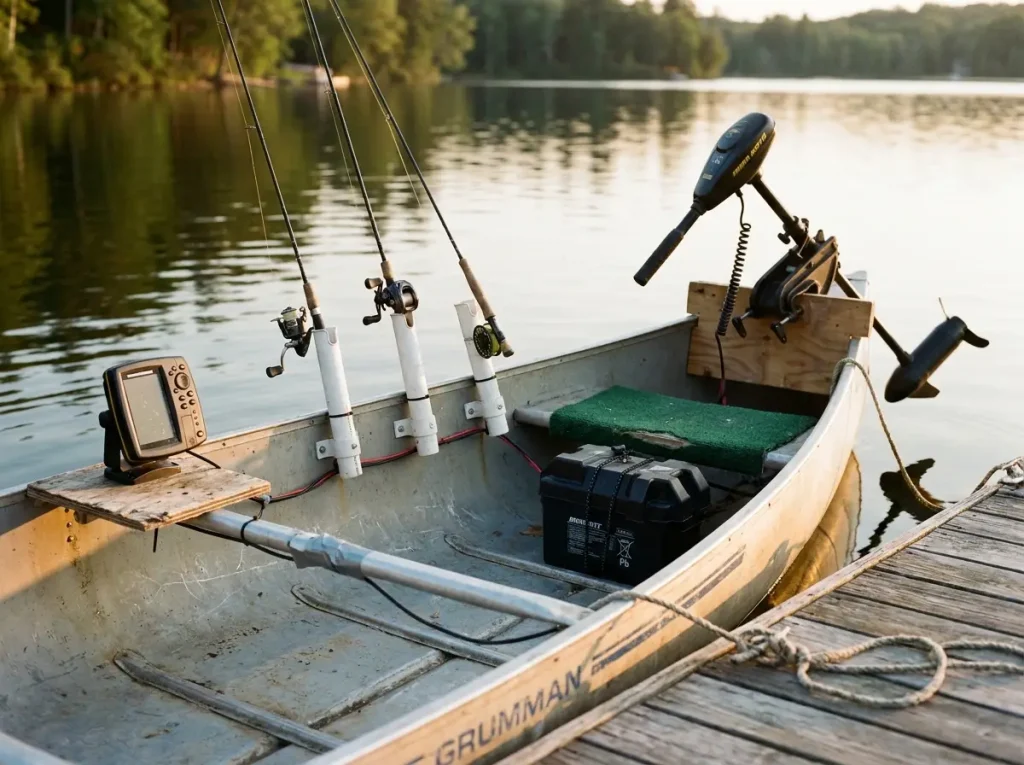
A fishing canoe ships with seats, thwarts, and nothing else. That’s either a limitation or a feature, depending on your mindset. You build exactly the fishing setup you want: PVC rod holders bolted to the gunwales, a plywood platform for a fish finder, a custom trolling motor mount on the stern, a carpet mat for traction, even a raised casting deck if you’re ambitious.
The canoe modification community runs deep. DIY builds with hardware-store materials turn a $400 aluminum canoe into a dedicated fishing platform for under $200 in parts. The trade-off is time and effort — nothing is plug-and-play, and every modification requires measuring, drilling, and figuring out what works on your specific hull.
Trolling Motor and Electronics Setup
Both boats take trolling motors, but the setup is different. A canoe uses either a side mount (clamped to the gunwale) or a transom mount on a square-stern canoe. Thirty to 36 pounds of thrust moves a canoe efficiently. The battery sits on the hull floor in a battery box. It’s simple, effective, and cheap. A canoe with a trolling motor, a fish finder, and a few rod holders is basically a mini bass boat for under $1,000 total.
A kayak trolling motor requires an aftermarket mount — many fishing kayaks have pre-drilled mounting points, but some don’t. Weight distribution is critical because the motor and battery shift the center of gravity. Pedal drive kayaks often can’t accommodate a trolling motor at all because the drive unit occupies the stern. For wiring a trolling motor system correctly on either platform, proper gauge wire and circuit protection matter more than the boat type.
Pro tip: Before you buy a canoe to rig for fishing, look at the NuCanoe Frontier. It’s a hybrid — canoe width and open deck with kayak gear tracks and a standing platform. It’s designed specifically for anglers who want the best of both and don’t want to build from scratch.
Portability, Transportation, and Solo Loading
Weight and Car-Topping
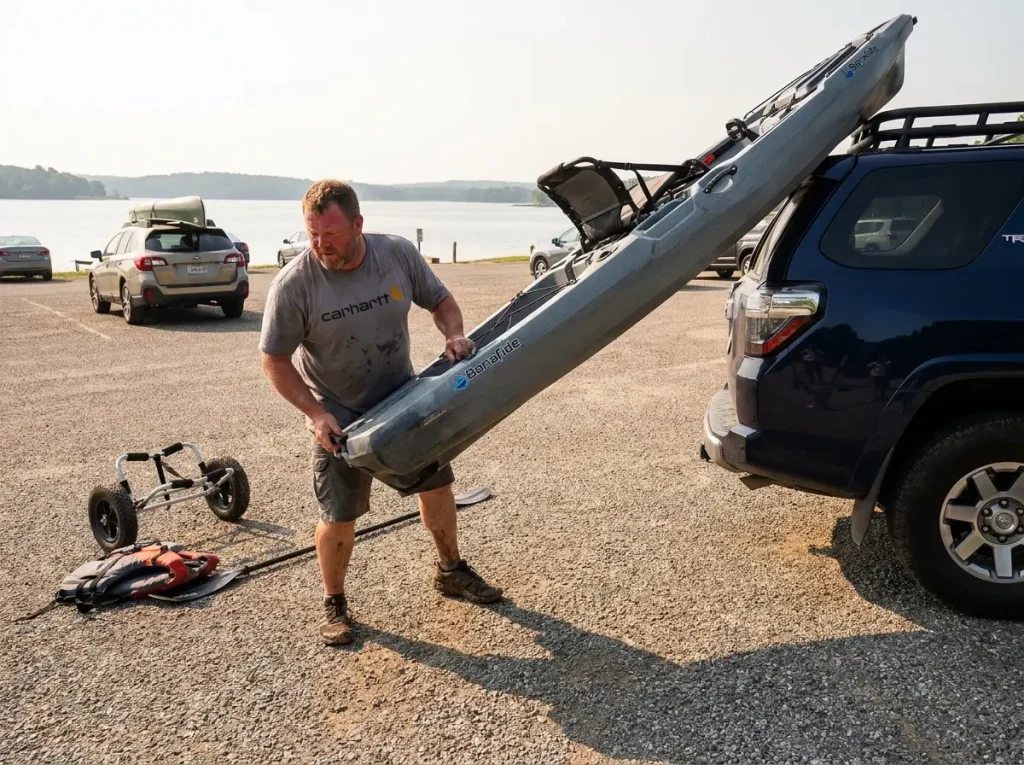
A standard aluminum or polyethylene canoe weighs 55-80 pounds. It’s long (15-17 feet) but manageable for one person to load onto crossbars using the flip-and-overhead technique. You position the stern on the rear bar, walk to the bow, and push it up and forward. Most adults can do this solo.
A fishing kayak weighs 65-100+ pounds and is wider than a canoe. The width makes roof loading awkward even with assist rollers. Many kayak anglers end up with truck beds or small trailers rather than car-topping, which adds $300-500 to the total cost. If you buy a 100-pound pedal drive kayak, plan for how you’ll move it before you buy it.
Launch and Recovery Solo
Canoe launches are straightforward — slide it off the rack, carry it to the water’s edge, set it down, load your gear, and step in. At a boat ramp, you back the canoe to the water and push off. Recovery is the reverse.
Kayak launches are easier from beaches and shorelines — kayak carts let you roll the boat right to the waterline. From boat ramps, sit-on-tops are simple to push in and climb on. But retrieving a heavy fishing kayak from the water and loading it back on the car solo is where reality hits. The kayak that was fun for six hours becomes a workout at the take-out.
Cost Comparison — What Your Budget Actually Gets
Entry-Level Budget ($300–600)
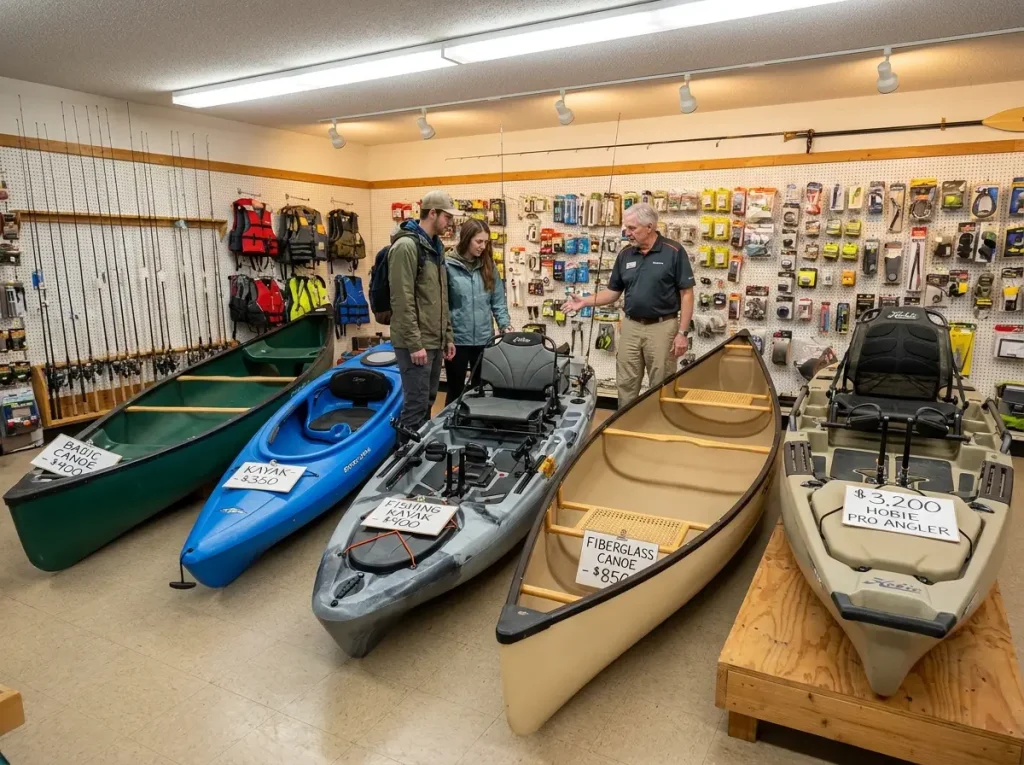
At this price point, the canoe delivers real fishing value. A basic aluminum or polyethylene canoe for $300-500 has enough stability, capacity, and durability to fish lakes and rivers right out of the box. Add a $15 rod holder and a $10 paddle clip and you’re fishing.
A kayak at $300-500 is a recreational boat — narrow, no rod holders, limited storage, minimal stability. It’s fine for paddling but marginal for fishing. You can fish from it, but you’re fighting the platform instead of working with it.
Mid-Range Budget ($600–1,500)
This is where kayaks become competitive. A sit-on-top fishing kayak in the $700-1,200 range — Pelican Catch, Perception Pescador, Lifetime Tamarack — comes with molded rod holders, tankwell storage, and enough beam width for comfortable fishing. These are real fishing platforms, not repurposed recreational boats.
A canoe at this price point — fiberglass or Royalex — gives you better materials, lighter weight, and enough room to bring a fishing partner. Add a trolling motor setup ($150-300 for motor, battery, and mount) and you have a powered fishing platform for under $1,500.
Premium Budget ($1,500+)
Premium fishing kayaks dominate this tier. Pedal drive systems from Hobie, Old Town, and Native Watercraft deliver hands-free fishing that no canoe can match. The hidden costs and quirks of pedal drive kayaks are real, but the fishing advantage — covering water while casting, holding position without anchoring, reversing without turning — is substantial.
Premium canoes exist (Wenonah Fisherman, Esquif Prospecteur) and they’re excellent boats, but they serve a smaller audience — serious canoe anglers who want lightweight materials and refined hull designs.
Pro tip: A used aluminum canoe ($150-250) plus a basic trolling motor ($100-150) plus a marine battery ($80-120) creates a powered fishing boat for under $500. Nothing in the kayak world comes close to that value.
The Decision Matrix — Pick Your Boat by How You Fish
Pick a Canoe If
You fish with a partner, a kid, or a dog. You want maximum gear capacity and room to move. You fish calm water — ponds, small lakes, slow rivers. You want a trolling motor platform without spending $2,000. You enjoy customizing and building your own setup. You portage. You want the best fishing value per dollar spent.
Pick a Kayak If
You fish solo most of the time. You want hands-free pedal propulsion. You fish open water where wind matters. You want to stand and sight fish. You want plug-and-play rigging that works out of the box. You fish tidal flats and shallow coastal water. You value maneuverability over capacity.
The honest answer that most articles won’t give you: most solo anglers on open or windy water are better served by a fishing kayak. Most anglers who fish calm water with a partner or heavy gear load are better served by a canoe. Neither is universally “better.” The question is which one fits how you actually spend your time on the water.
For those just getting started with kayak fishing, safety fundamentals should be your first read before you buy — stability and self-rescue skills matter more than accessories.
Conclusion
The canoe-versus-kayak decision comes down to three things: who you fish with, what water you fish, and whether wind is a regular factor. Canoes win on capacity, comfort, and value. Kayaks win on wind handling, maneuverability, and solo capability. The best boat is the one that matches the water you actually fish, not the one that looks good in someone else’s YouTube video.
If you’re still torn, rent one of each for a weekend. Two trips will tell you more than any article — including this one.
Q1 Is a canoe or kayak better for fishing?
Neither is universally better. Canoes excel for tandem fishing, gear-heavy trips, and calm water. Fishing kayaks win for solo anglers, windy conditions, and sight fishing. Match the boat to your water and fishing style rather than picking based on general advice.
Q2 Can you fish from a canoe as easily as a kayak?
Canoe fishing is comfortable and effective, especially on calm water. The open hull gives you more room to move, access gear, and land fish. Kayaks offer more specialized fishing features like rod holders and gear tracks, but canoes provide a simpler, roomier platform.
Q3 Are kayaks more stable than canoes for fishing?
Kayaks have better secondary stability — they recover from waves and lean better thanks to a lower center of gravity. Canoes have better primary stability — they feel more solid on calm water. For rough or windy conditions, kayaks are more stable overall.
Q4 Can you stand up in a fishing kayak?
In purpose-built fishing kayaks with wide standing platforms — yes. Models like the Bonafide SS127 and Hobie Pro Angler are designed for stand-up fishing with non-skid decks and assist bars. Standard recreational kayaks are not safe to stand in.
Q5 What size canoe is best for fishing?
A 14 to 16-foot canoe is the sweet spot for fishing. Shorter canoes (12-14 ft) are easier to transport but sacrifice stability. Longer canoes (17+ ft) track better but are harder to solo. A 16-foot canoe with a flat bottom offers the best balance of stability, capacity, and maneuverability for most fishing situations.
Risk Disclaimer: Fishing, boating, and all related outdoor activities involve inherent risks that
can lead to injury. The information provided on Master Fishing Mag is for educational and informational purposes
only. While we strive for accuracy, the information, techniques, and advice on gear and safety are not a substitute
for your own best judgment, local knowledge, and adherence to official regulations. Fishing regulations, including
seasons, size limits, and species restrictions, change frequently and vary by location. Always consult the latest
official regulations from your local fish and wildlife agency before heading out. Proper handling of hooks, knives,
and other sharp equipment is essential for safety. Furthermore, be aware of local fish consumption advisories. By
using this website, you agree that you are solely responsible for your own safety and for complying with all
applicable laws. Any reliance you place on our content is strictly at your own risk. Master Fishing Mag and its
authors will not be held liable for any injury, damage, or loss sustained in connection with the use of the
information herein.
Affiliate Disclosure: We are a participant in the Amazon Services LLC Associates Program, an
affiliate advertising program designed to provide a means for us to earn advertising fees by advertising and linking
to Amazon.com. As an Amazon Associate, we earn from qualifying purchases. We also participate in other affiliate
programs and may receive a commission on products purchased through our links, at no extra cost to you. Additional
terms are found in the terms of service.