
In this article
Somewhere in your closet is a long-sleeve shirt you bought specifically so you’d stop burning on the water, and you have almost certainly never read its tag twice. That’s the quiet problem with fishing apparel and sun protection: the number printed inside the collar is treated as a settled fact, when it’s really a starting condition that fit, coverage and your washing machine all get a vote on. Ask around any boat ramp and you’ll hear the same story on repeat, from anglers who bought the shirt, wore the shirt, and still came home with a scalded neck and forearms. What follows is the full head-to-feet system: what each layer actually does, which pieces deserve your money, which are commodity, and the care habits that quietly undo everything else.
What UPF Actually Means on a Fishing Shirt Tag
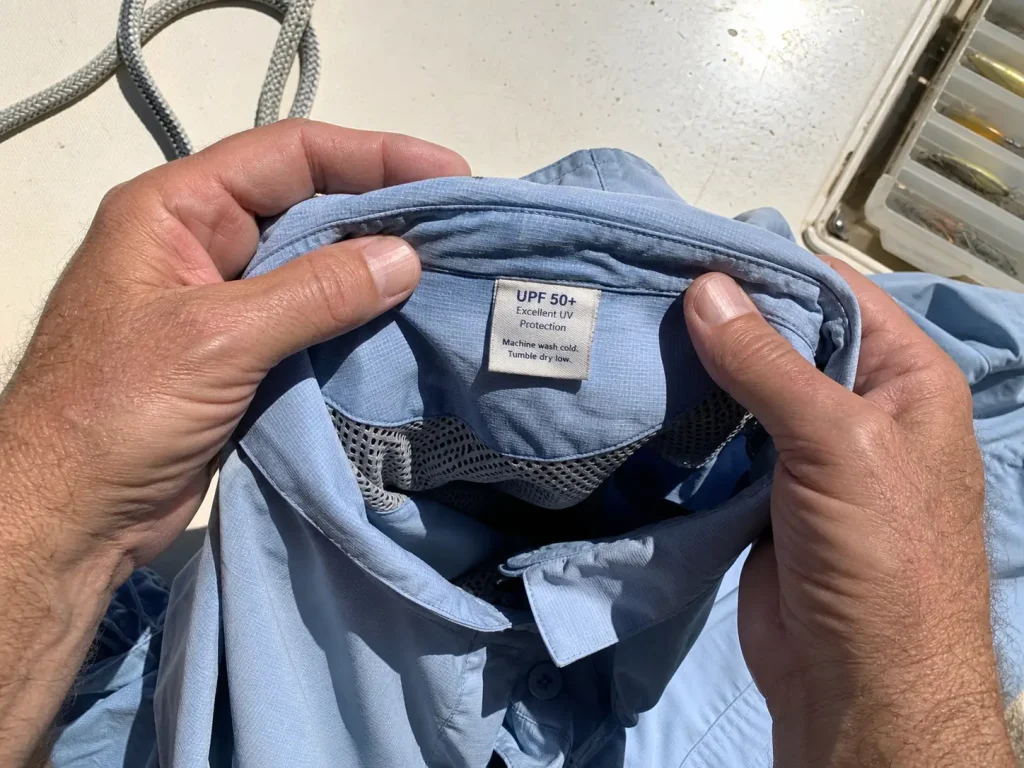
UPF stands for Ultraviolet Protection Factor, and it measures one thing: how much UV a given fabric lets through to the skin underneath. A UPF 50+ garment blocks roughly 98% of it, according to the Skin Cancer Foundation’s sun-protective clothing guidelines, which sets the whole conversation in perspective once you learn that an ordinary untreated cotton t-shirt sits around UPF 5. That gap is why fabric is the foundation of a sun system and everything else is support.
Two labels get confused constantly, so let’s separate them once. SPF rates a sunscreen and describes how long treated skin resists burning, which is a UVB measure. UPF rates a fabric and accounts for both UVA rays and UVB rays passing through the material. UVB is what reddens skin on a hot afternoon; UVA penetrates deeper, drives premature aging, and passes through window glass and thin cloud without announcing itself. Certified sun protective clothing is rated against both, which is precisely why a garment and a bottle aren’t interchangeable tools.
Why this matters more for anglers than for most people is a matter of dose. Over 90% of skin cancers are linked to cumulative UV exposure, melanoma included, and outdoor workers carry roughly 3.5 times the risk of people who work indoors. Skin cancer risk for anglers tracks the same pattern for the same reason: hundreds of hours a year on a reflective surface during peak hours. Nobody gets there in one bad Saturday. Everybody gets there eventually if nothing changes.
The first thing the number doesn’t tell you is coverage. UPF rates the material, not the garment, so a UPF 50+ short-sleeve tee is still leaving your forearms fully exposed for eight hours. Two shirts with identical tags protect wildly different amounts of skin depending on sleeve length, collar height and whether there’s a hood. If you want the fiber-level explanation of why weave density and treatment produce that rating in the first place, how UPF fabric actually stops UV at the fiber level goes deeper than this overview can.
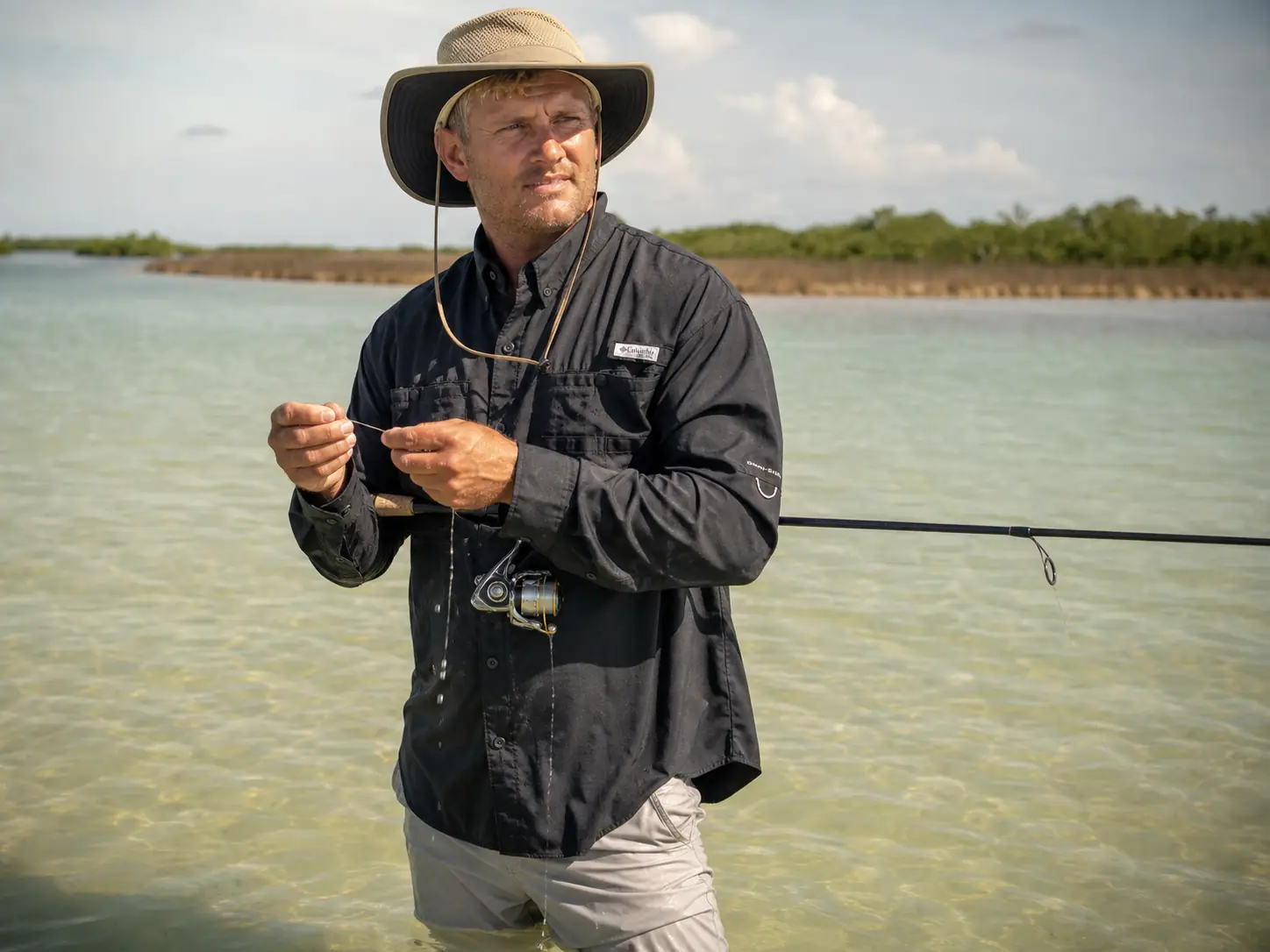
The second thing it doesn’t tell you is that mainstream doesn’t mean maximum. Columbia’s Omni-Shade PFG Tamiami II, one of the most-purchased fishing shirts on Amazon, carries a rating of UPF 40, not UPF 50+. Nobody hides this. It’s printed right there. But most buyers see the PFG logo, assume top-tier protection, and never check.
Then there’s the marketing vocabulary problem. Phrases like cooling technology, sun-friendly and sun-shielding carry no testing behind them whatsoever. If a listing doesn’t state an actual UPF number, the garment was never lab-tested, and a surprising share of budget long-sleeves sold to anglers fall in that bucket. This is one of the most common mistakes in the whole category: treating an unrated cooling shirt as if it were rated protection.
Finally, a free upgrade nobody advertises. At the same nominal rating, looser and darker fabric outperforms tight and pale, because stretching a fabric across your shoulders pulls the fibers apart and opens gaps that UV walks straight through. Sizing up half a step and skipping the pastels costs nothing and buys real protection.
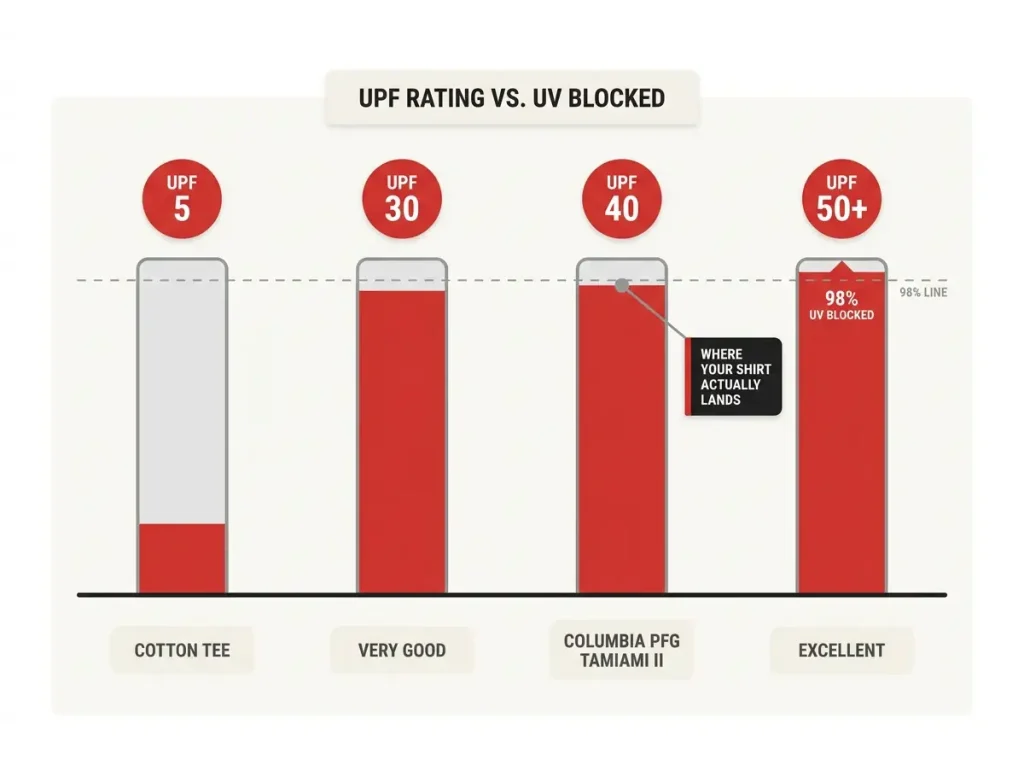
So is UPF 40 disqualifying? No, and it’s worth being blunt about that. UPF 40 still blocks roughly 97.5% of UV, and the practical difference between that and 98% is smaller than the difference between a shirt you wear all day and a shirt that’s too hot to keep on past ten in the morning. Fit, venting and coverage area beat the last half-percent almost every time. The point isn’t that the shirt is bad. The point is that you should know what you bought.
Why the Water Doubles Your Sun Exposure
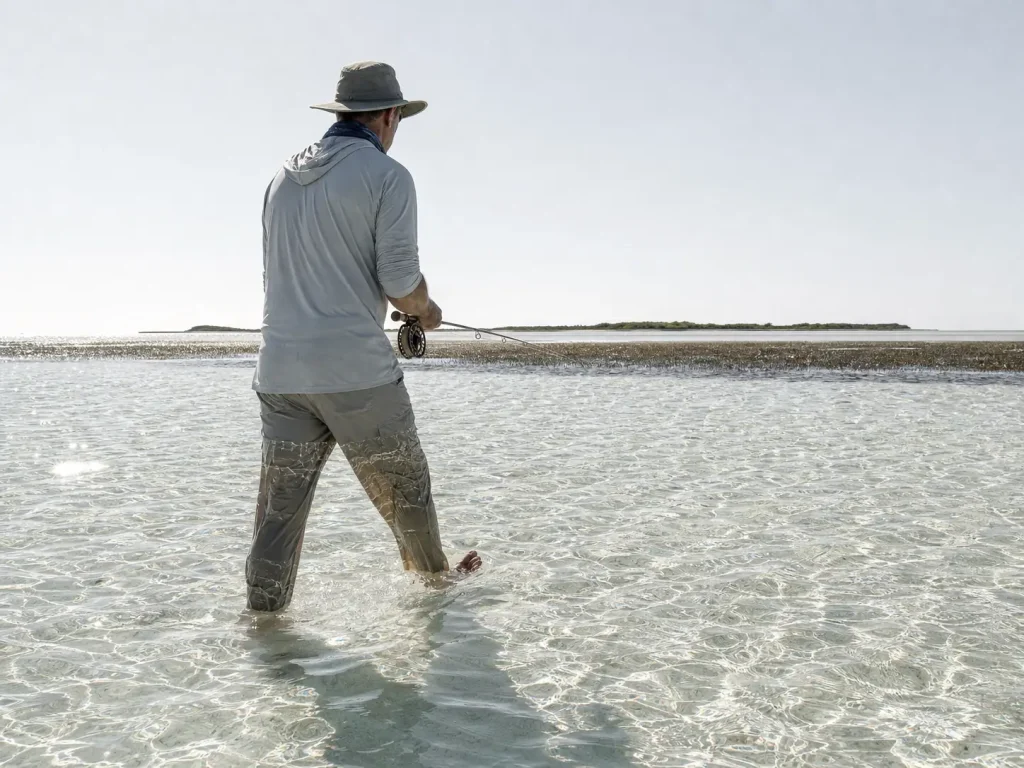
Here’s the part that reframes everything. You are not standing in the sun. You are standing inside it, with a meaningful share of the dose arriving from below.
Water reflection throws UV back up at you, and how much depends almost entirely on what’s under it. Fresh water reflects roughly 5–10%. Open ocean and big lakes run 10–25%. Turtle grass flats sit around 15–20%, dark mud bottoms closer to 8–12%, and white sand bottoms bounce up to about 40% straight back into your face. That’s the same physics that produces the surface glare you fight all day, which is why the same reflected light that produces surface glare is worth understanding as one problem rather than two.
Run the arithmetic and the numbers get uncomfortable. A six-hour session on a bright flat delivers combined direct and reflected UV roughly equivalent to 7.5 to 8.4 hours of straight direct sun. “I was only out a few hours” undersells the actual dose by nearly two bonus hours. Shallow-water anglers can absorb 35–40% more UV than someone working deep water under identical conditions. That’s UV amplification in plain terms: the same sky, doubled by the surface underneath you.
The bounce also lands in the places nothing covers. The underside of the chin. The jawline. The inside of the forearms. The backs of the hands. Anglers describe coming home burned under the chin and being genuinely confused about how, and the answer is always the same: they were shaded from above and cooked from below. That matters more than any single burn, because of the cumulative math from the last section. Every ordinary Tuesday afternoon counts toward the same tally, which is the whole argument for sun safety as a habit rather than a vacation precaution.
Two ways to time around it. Check the UV index before you leave, the same way you check wind, and treat anything at 6 or above as full-kit weather. And know that peak UV hours run 10am to 4pm, which is unhelpfully the exact window most of us fish. You’re not going to skip those hours. You’re going to dress for them.
Build your kit around the worst bottom you fish, not the average one. If white sand flats are on your calendar even three times a year, buy for the sand. The extra coverage costs you a little heat on the mud-bottom lake days and nothing else.
The Long-Sleeve Sun Shirt Does Most of the Work
If you buy one thing off this page, buy this. The shirt covers more skin than every other piece combined, and it’s the layer you’ll have on from the boat ramp until the truck door closes.
What to Look for in a Fishing Sun Shirt
- A stated UPF number on the tag or listing, not adjectives
- Full-length sleeves, with roll-tab cuffs if you want the option
- A collar that stands up on its own to shade the back of the neck
- Mesh ventilation or vented panels across the back and under the arms
- Flatlock seams so a full day under a pack strap doesn’t leave a raw line
- Four-way stretch if you cast a lot, because rigid fabric fights the shoulder
- Thumb holes on a hooded shirt, which pull the sleeve over the wrist bone
- Quick-dry synthetic fabric rather than a cotton blend, with a fast dry time
Two more specs are worth knowing about even though they’re secondary. Antimicrobial fabric, usually a silver ion treatment, buys odor resistance on multi-day trips and does nothing at all for UV. And fabric weight, measured in ounces per square yard, is the quiet trade-off behind everything: heavier fabric generally blocks more and breathes less, which is why the lightest sun hoodie on the rack is rarely the highest rated one.
Fit matters more than most people expect. A slightly loose cut holds its weave and lets air circulate; a shirt stretched drum-tight across your back is measurably worse at its one job. Venting matters for a less obvious reason: a UPF 50+ shirt left in the truck because it’s stifling protects nobody at all. Comfort is a protection spec.
Cost sorts into fairly clean tiers at the category level. Budget rated long-sleeves land around $20–35 and frequently carry a genuine UPF 50+ rating. Mainstream branded shirts run roughly $45–70, and premium technical pieces climb past $75. The jump from budget to mainstream mostly buys you fit, durability and cut, not a higher number on the tag. That’s an uncomfortable thing for the industry to admit and a useful thing for you to know.
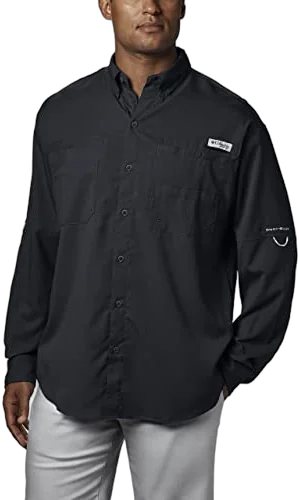
The Columbia PFG Tamiami II (men’s · women’s) earns its spot here on availability and fit rather than on raw rating. Omni-Wick pulls sweat off fast, the mesh back vents in still heat, and Columbia stocks sizes that other brands quietly skip. It’s the shirt to buy if you want something that fits properly the first time. If the higher rating is what you’re after, we broke down shirts that carry a true UPF 50+ rating separately, including which ones don’t live up to the tag.
Sun Hoodies vs Button-Down Fishing Shirts
Size range is its own protection spec, and it’s the one the industry handles worst. Big guy sizing past 2XL and youth sizing for kids in the boat both disappear fast in technical lines, and a shirt that doesn’t fit gets replaced by a cotton tee, which is the actual outcome nobody plans for. Columbia is unusually good here, which is a real part of why it’s the default recommendation.
The community calls a hooded sun shirt a sun hoodie, and it solves two problems in one garment: the hood covers your head and the sides of your neck without a hat doing all the work, and many of them build in a pull-up mesh face panel that anglers just call the mask. If you’d rather not carry a separate gaiter, that combination is the reason.
Button-down fishing shirts win on venting in dead-still heat and on looking normal when you stop for food on the way home. Neither is wrong. The hoodie covers more; the button-down breathes better. One thing does hold for both: a soaked cotton shirt can drop toward single-digit protection, while a quick-dry synthetic holds most of its rating wet.
Worth naming a third option people forget. A rash guard from the surf side of the store is a rated long-sleeve that’s built to be wet all day, and it works fine for wading or kayak days when you expect to be soaked. It’s warmer in still air than a vented fishing shirt, so it’s a situational pick rather than a default one.
Hats and the Zone Where Most Skin Cancers Show Up
The baseball cap is simultaneously the most-worn and least-effective piece of sun gear in fishing. It shades your forehead and abandons your ears, your jaw and the back of your neck, and then the reflected UV from the water comes up under the brim and gets the parts it was theoretically covering anyway.
Brim Width, and Why a Cap Isn’t Enough
A brim starts doing real work at around 3 inches all the way around, and reaches full ear-and-neck coverage closer to 4 inches and up. The difference between a cap and a wide-brim isn’t incremental. A cap protects one flat plane; a 360-degree brim protects a cone. Add a dark under-brim fabric and you also cut the glare bouncing up into your eyes, which is a fishing benefit on top of a skin one. There’s more to it than width alone, and the features that separate a real sun hat from a branded cap covers the details the tag leaves out.
Booney, Wide-Brim and Flap Hats
Booney hats pack flat and behave in wind. Straw and stiff wide-brims give the best shade and the worst manners at 30 mph. Flap hats look faintly ridiculous in the parking lot and then cover your entire neck and ears for the six hours that matter, which is a trade most anglers make once and never reconsider.
One thing is non-negotiable on a boat: a chin strap. The best hat ever made is worth nothing at running speed without one, and losing a hat over the gunwale is such a universal complaint that it’s practically a genre of fishing story.
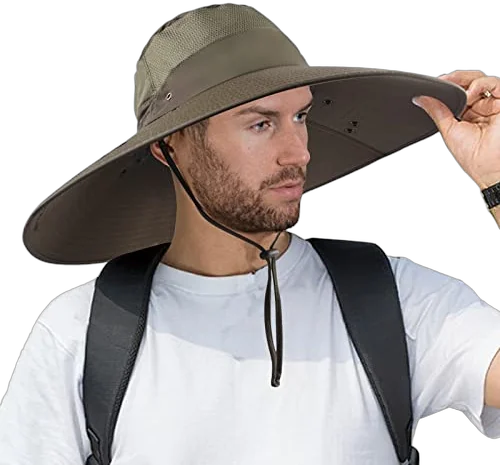
Coverage geometry, it turns out, is cheap. Budget wide-brims run roughly $20–30 and premium technical hats $45–65, and what the extra money buys is materials, ventilation, packability and a brim that keeps its shape after a season in a truck. The shade itself is the same shade.
Neck, Face and Hands, the Gaps Fabric Usually Misses
Two garments have now solved most of the problem. This section is about the part that still burns.
Neck Gaiters and How Anglers Actually Wear Them
The back of the neck sits in direct sun for anyone facing away from it, which is everyone working a shoreline or standing at a bow. A gaiter, or buff as it’s universally called in fishing circles, closes that gap for less than the cost of lunch.
How you wear it matters. Pulling a gaiter up over the nose to go full-coverage crushes the bridge of your nose and fogs your sunglasses within a minute, which is the single most repeated complaint about them. Most experienced anglers run it at the cheekbone or just under the nose and let the hat brim handle the rest. Breathability is the make-or-break spec: one that’s miserable to breathe through ends up bunched around your neck by nine in the morning, protecting nothing.
The KastKing Agies Neck Gaiter gets named directly in forum discussion for exactly that reason, described as easy to breathe through with genuine UPF 50 protection rather than a marketing claim. Buy two so one is always dry. If you want the wider field, we compared gaiters that stay comfortable through a full day across brands and fabric weights.
Sun Gloves and Why the Backs of the Hands Burn First
Your hands are extended in front of you for the entire trip, they’re constantly wet, and sunscreen on them survives roughly one fish. There is no zone where the gap between assumed protection and actual protection is wider.
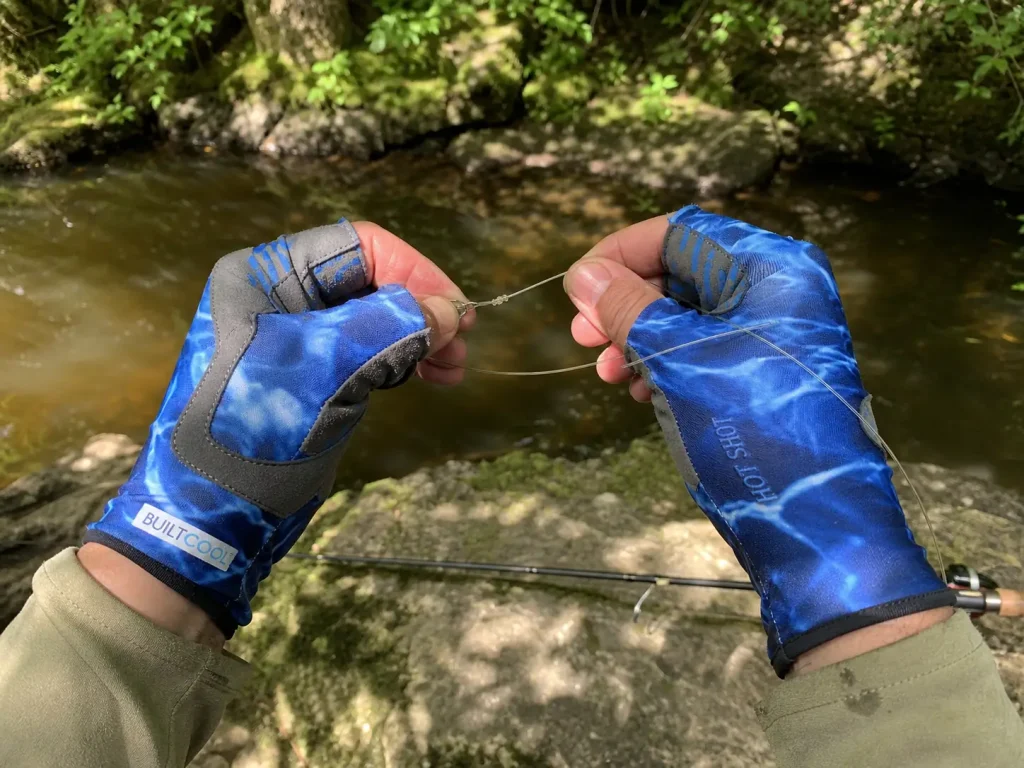
Fingerless gloves built as sun gloves solve it without costing you anything you care about. The back of the hand gets covered, the fingertips stay bare, and you can still tie a clinch knot, thumb a spool and pick a treble out of a net. The HOT SHOT fingerless reinforced fishing gloves are a straightforward example: UPF 50, reinforced palm, nothing clever. Sizing is where these go wrong more often than materials, and getting the sizing right so you can still tie a knot is worth two minutes before you order. For the cold-weather and fish-handling versions of the same question, fishing gloves for sun and cold covers the broader category.
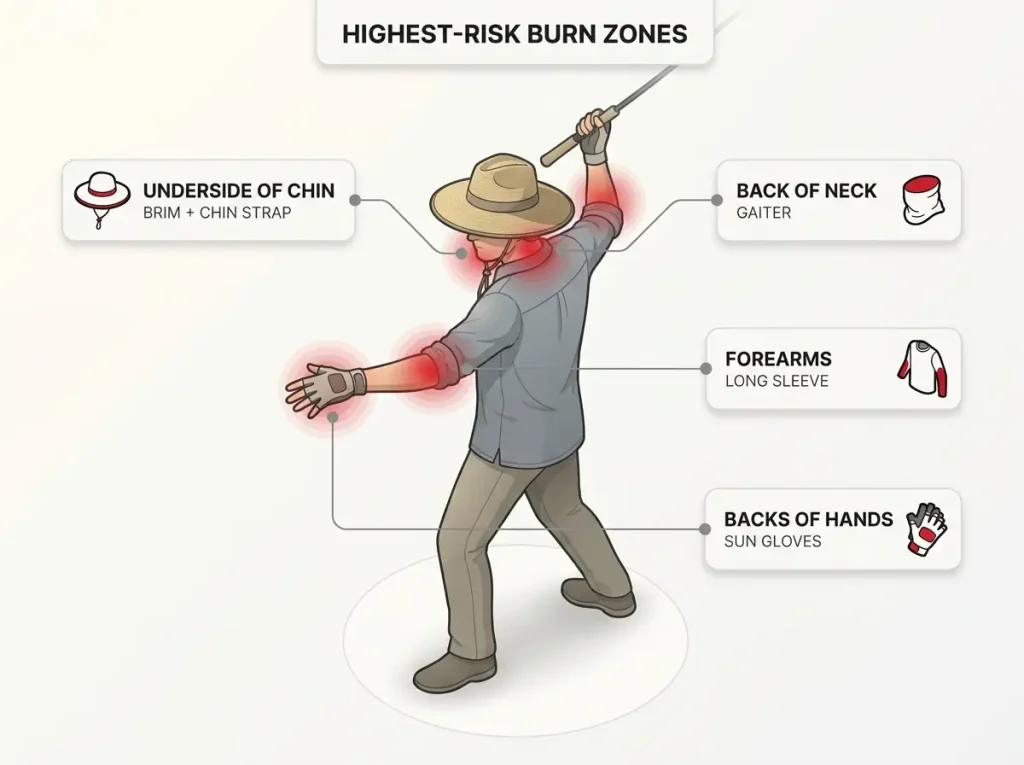
Here’s the honest verdict: a gaiter and a pair of sun gloves are the highest return per dollar on this entire page. Together they cost less than one mainstream shirt and they cover three of the four zones that burn worst. And in the opposite direction, sun gloves are the one apparel category here where premium genuinely doesn’t outperform. The whole market lives in about $15–25, and the expensive pairs are not better at the job. Buy cheap, buy two.
Sunglasses and Sunscreen as the Supplemental Layer
Most anglers treat these two as the whole plan. They’re the last 15%.
What Polarization Does and Doesn’t Do for UV
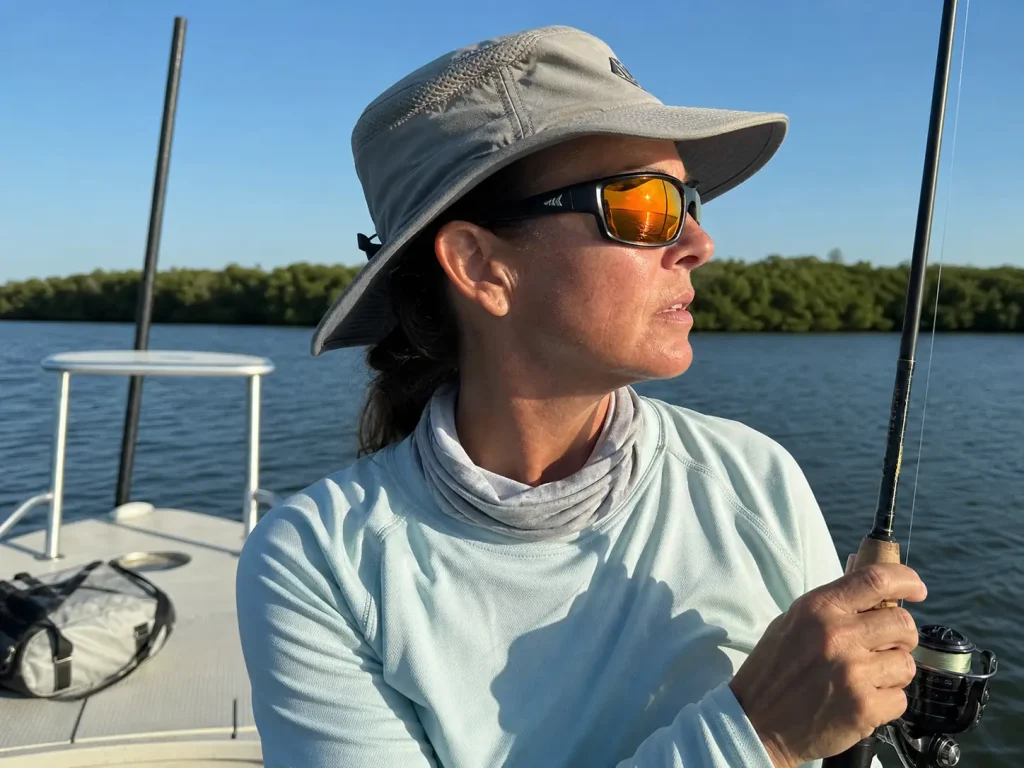
Polarization and UV protection are separate specs, and a lens can carry one without the other. Polarization cuts glare so you can read water and spot fish; UV400 is what blocks the radiation reaching your eyes and eyelids. Check for both, because a cheap dark lens with neither is worse than no sunglasses at all: it opens your pupils without filtering anything.
Eye protection is the part of this article people skip, and it shouldn’t be. Long-term UV exposure is linked to cataracts and to pterygium, the growth of tissue across the surface of the eye that anglers and surfers get often enough that some clinicians call it by an occupational nickname. The eyelids and the skin at the outer corners are also among the thinnest on the whole face, and they take the reflected dose from below at close range.
Frame shape does more on the water than on land. The reflected UV from earlier arrives from below and to the side, which is precisely where a flat-front frame is wide open. Wraparound or side-shielded frames close that gap. The KastKing Skidaway polarized sunglasses are a reasonable illustration of the combination without a premium spend: polarized, UV400, wrapped frame. Which tint you choose is a genuine decision rather than a style one, and choosing a lens color for the water you fish walks through it. For a full field of options, polarized sunglasses built for fishing compares the ones worth the money.
Where Sunscreen Still Earns Its Place
Sunscreen isn’t the enemy here. It’s the filler. It belongs on the strip of skin between glove and cuff, on the lower face under the brim, on the ears, and on the tops of your feet if you’re wet wading in sandals.
For fishing specifically, two things narrow the choice. Buy water-resistant sunscreen rather than the standard formula, since everything else surrenders to the first hand-wash over the gunwale. And prefer a mineral filter, meaning zinc oxide or titanium dioxide, which sit on the skin as a physical barrier rather than absorbing into it. Mineral formulas also hold up better against sweat and handling, and the visible white cast that people complain about doubles as a useful signal: you can see the spots you missed. On SPF, anything above 30 is fine and the jump to 70 buys you a rounding error. Reapplication beats a bigger number every time.
What it can’t do is survive fishing. Wet hands, line handling and fish slime strip it fast, and the two-hour reapplication clock is a theory that almost nobody executes on hour four of a good bite. Fabric doesn’t wash off, doesn’t sweat off and doesn’t get forgotten. As Cleveland Clinic’s dermatology team has confirmed, a rated garment is still blocking UV at hour six exactly as well as it was at hour one. That’s the entire argument for building the system around clothing and letting sunscreen cover the seams.
Put sunscreen on before you leave the house, not at the ramp. Once your hands are wet and smell like bait you will not do it properly, and the spots you skip standing in the driveway are the same spots you skip every single trip.
Bottoms, Socks and the Layers Nobody Photographs
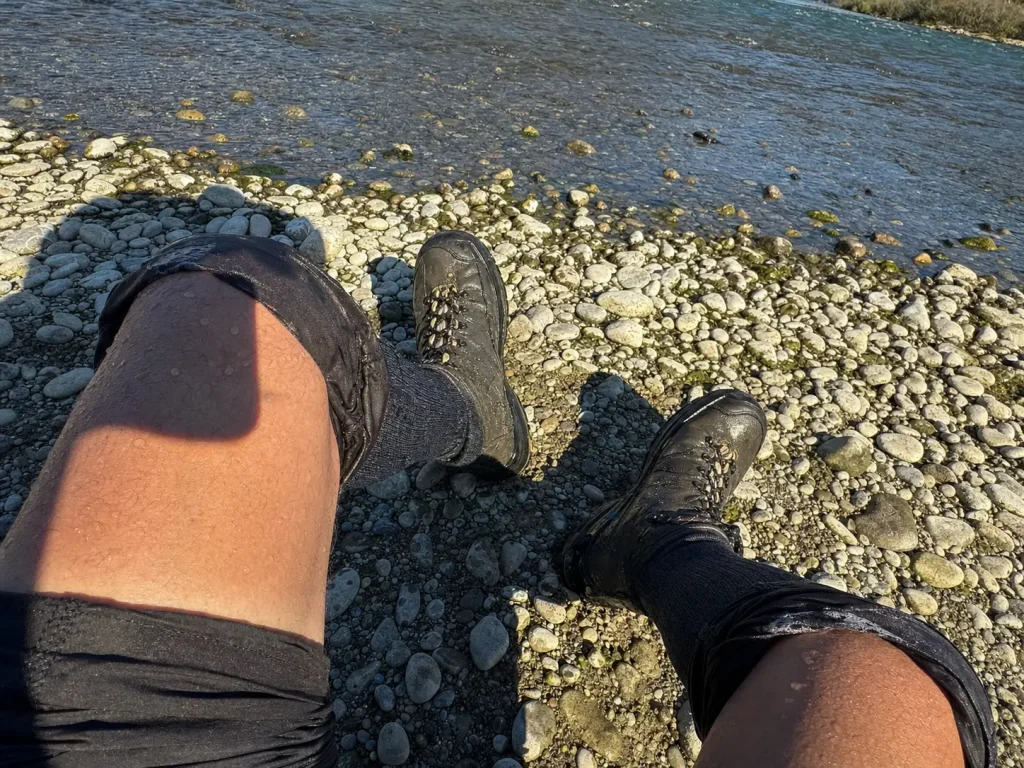
Everyone solves the top half. Almost nobody thinks below the waist until the first wet-wading trip of the summer teaches them.
Pants, Convertibles and Wet-Wading Legs
Sitting in a boat puts the tops of your thighs and knees close to perpendicular to midday sun for hours at a stretch. It’s an exposure geometry a standing angler never faces and a seated one never thinks about. Quick-dry nylon pants beat denim on every axis that matters here: they cover more than shorts, they dry in a fraction of the time, they weigh almost nothing wet, and they transmit far less UV.
Convertibles get mocked and then get worn, because being able to zip the legs back on when the sun swings around is genuinely useful. Wet wading in shorts is fine for a river under canopy and a poor decision on an open flat.
Socks, Feet and the Base Layer Underneath
The tops of the feet burn badly and surprisingly, catching both direct sun and the bounce off the water at the same time. A taller sock or a wading boot with more upper coverage fixes it at no cost. Socks are doing thermal, blister and moisture work simultaneously, and the ones that manage all three through a long day are worth choosing deliberately: socks that manage moisture through a full wading day sorts out what actually holds up. What kind of coverage is even available to you depends on your setup, since stockingfoot and bootfoot waders handle this differently.
Under waders, the layer against your skin is a moisture problem rather than a sun problem, but it’s the same wardrobe decision on the same trip. Wader breathability is the whole reason it matters: a breathable shell can only move sweat outward if the layer underneath hands it off. Synthetic and wool move sweat outward; cotton holds it, chills you, and stops doing anything useful the moment it’s soaked. That’s true in November and it’s true in July. If you’re building for both seasons at once, building a base layer system that works under waders is the counterpart to everything in this article.
How Washing Quietly Destroys Your UPF Rating
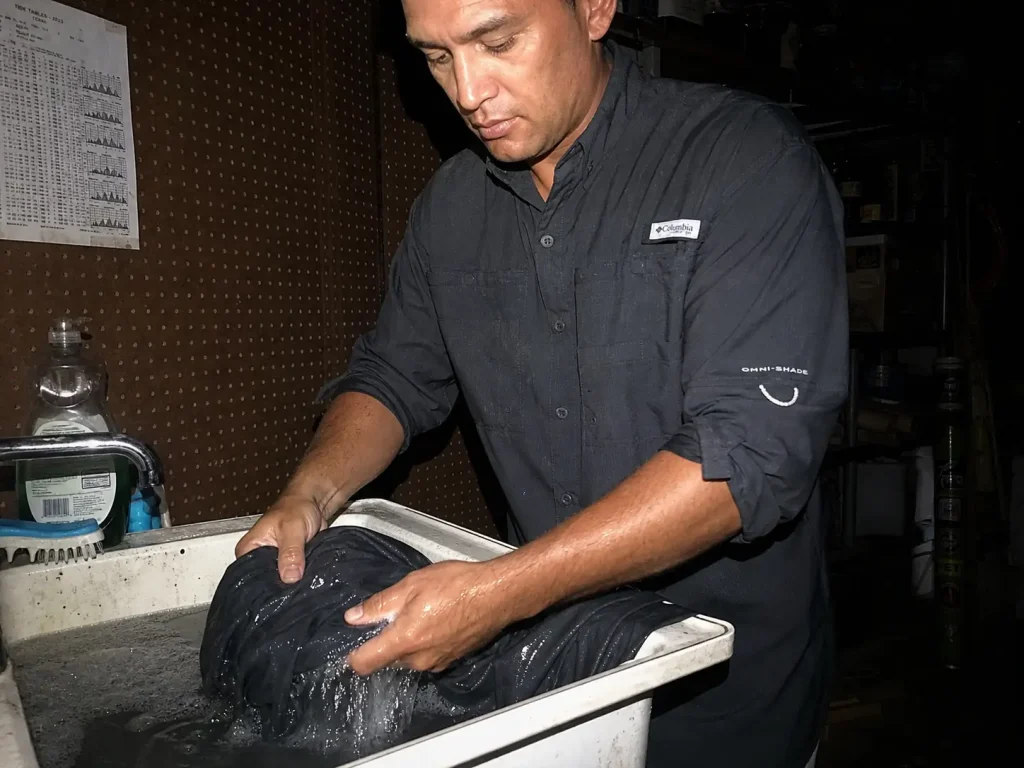
This is the part nobody selling you a shirt has any reason to tell you: the shirt you bought two summers ago is probably not the shirt you think you’re wearing.
What Actually Degrades the Fabric
UPF isn’t a coating sprayed on top of a garment in most cases. It’s a property of the weave, the fiber and the dye, and anything that opens up that weave lowers the number. Four things do it faster than anything else.
Heat is the first. A shirt that starts at UPF 50+ can fall to UPF 40 or below after roughly 20–30 hot-water wash and hot-dry cycles. For a shirt you wear every trip, that’s one to two seasons. The machine dryer compounds it, because tumbling adds mechanical abrasion on top of the heat.
Fabric softener is the second, and it’s the fastest. A single wash with softener can cut UPF effectiveness by 10–15%, because softener works by coating and separating fibers, which is the exact opposite of what a tight protective weave needs.
Salt buildup and dried sunscreen residue are the third, and this one is a completely separate failure mode from washing. Salt crystals left to dry inside the fabric are mechanically abrasive. Every time you flex that fabric with crystals in the weave, you’re sanding the fibers from the inside. The real enemy of a gaiter’s rating isn’t washing it too often, it’s not rinsing it after a salty day.
The fourth is simply time under load, and it’s the one you can’t fix. Stretching, snagging and sun exposure age fabric no matter what you do.
The reason a fading UPF rating slips past everyone is that it’s invisible. A shirt with half its protection gone looks, feels and fits exactly like it did new. There’s no fray, no thin spot, no warning. You find out on the drive home from a long day, with a burn you can’t explain because you wore the shirt the whole time.
The Routine That Keeps a Shirt Rated
- Rinse in fresh water after every saltwater trip, before it dries
- Wash cold, never hot
- Skip fabric softener entirely, on everything technical
- Hang dry rather than machine dry
- Size up slightly so the fabric isn’t under permanent tension
That’s it. Done consistently, a correctly cared-for UPF 50+ shirt holds its full rating past 100 wash cycles, which is several seasons of hard use rather than one and a half.
Keep a cheap plastic tub in the garage. Everything that touched salt goes in it with fresh water the moment you get home, shirt and gaiter included, and gets hung over the line before you deal with anything else. Two minutes, and it’s the difference between a shirt lasting two seasons and five.
The verdict worth committing to: your care routine matters more than the last ten points on the tag. An angler deciding between spending another $40 on a higher-rated shirt and changing how they wash the one already in the closet should change how they wash it. A budget shirt treated properly outprotects a premium shirt run through hot cycles with softener for two seasons, and it isn’t close. The same logic applies to every technical piece you own, which is why the same care logic applies to waterproof breathable fabrics in your wader and rain kit too.
Matching Your Sun Protection to Where You Fish
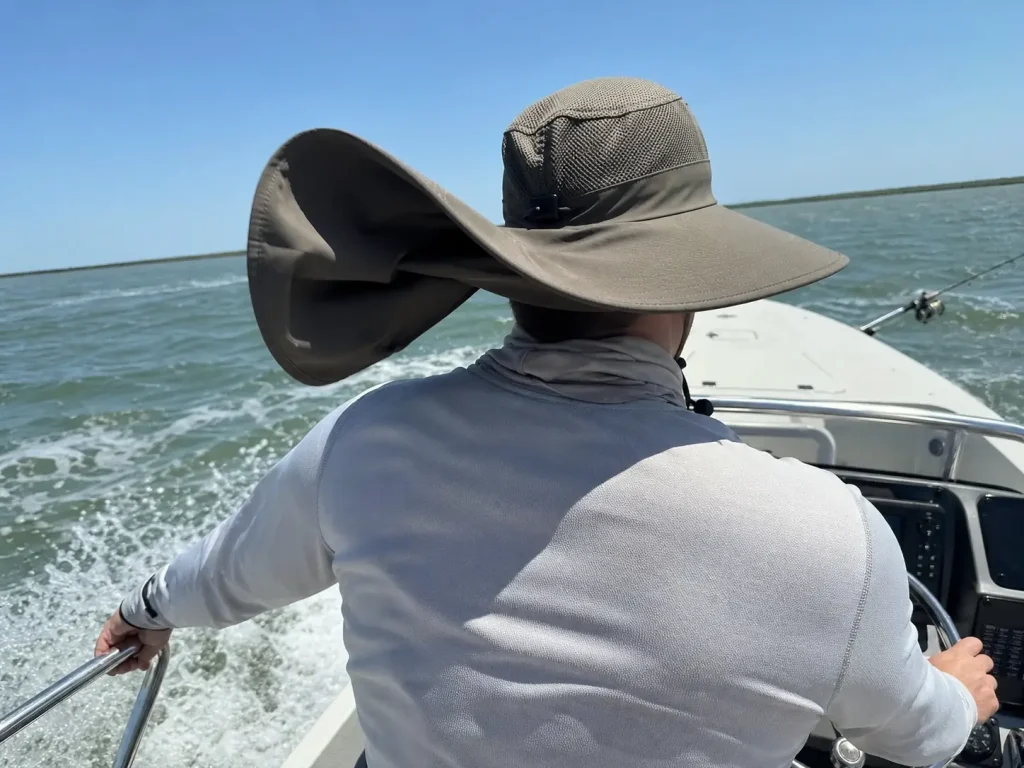
Same parts list, three very different priority orders.
Flats, Open Water and Saltwater
Flats fishing is the worst case in the sport, and it isn’t close. White sand bottoms sending back up to 40%, no shade for miles, wind that dries sunscreen off in minutes, and salt attacking the gear that’s protecting you. Saltwater fishing in general runs hotter than its freshwater equivalent for exactly this reason, and offshore fishing adds a full day of open deck with the sun overhead and the surface glare all around. If you fish the Gulf Coast or anywhere with that combination of latitude, humidity and pale bottom, this is your baseline rather than your extreme.
Run everything here: long sleeves down, widest brim you own with the strap cinched, gaiter, gloves, wraparound polarized lenses. Tournament fishing deserves a specific note, because a schedule you can’t adjust removes the option of ducking the worst hours. This is also where the rinse habit stops being optional.
Rivers, Shade and Cool-Weather Trips
Canopy changes the math, but not as much as it feels like it does. Freshwater fishing under trees still bounces 5–10% back at you, dappled shade moves constantly, and the hours you spend in open runs count fully. Breathability drops down the priority list here and a real layering strategy climbs, because river days start cold and end hot. Merino wool earns its place as the layer against the skin on those trips, since it keeps working damp and doesn’t turn sour after three days in a duffel. The wet-weather kit overlaps heavily with the sun kit, which is worth planning for rather than discovering: rain gear that layers over the same sun system is the same purchase decision viewed from the other season.
Boat vs Bank vs Wading
A boat adds wind and speed, which is what turns a chin strap from preference into requirement, and it seats you with your thighs facing the sky for hours. Kayak fishing is the extreme version of that seated geometry, with your legs extended, no shade structure at all, and water within arm’s reach on both sides. Bank fishing gives you shade you can actually use, if you’re willing to move for it. Wade fishing brings your legs and feet into the calculation and puts the reflected component at close range. Your pack sits on top of all of it, and how you carry gear changes what rubs and what stays covered over a full day, especially where a strap crosses a gaiter or a sleeve seam.
One thing overrides all three: cool weather and overcast do not reduce UV meaningfully. A significant share passes straight through cloud, and the reflection off the water keeps going regardless. The worst burns anglers report are almost always from the days they decided they didn’t need to think about it.
While we’re clearing out bad assumptions, the base tan myth deserves a mention, because it still circulates at every ramp in June. A tan built on purpose before a trip offers almost nothing in measurable protection, and the process of building it is itself the exposure you were trying to avoid. It’s a losing trade in both directions.
If you only build one kit, build the saltwater flats version. It over-protects everywhere else, and over-protection costs you a bit of heat and nothing more. Trying to maintain two separate systems is how people end up with a hat in the wrong truck.
Building the System You’ll Actually Wear
A sun protection system is four garments and one habit, not a shopping spree. Three things to carry away from all of this.
Read the tag, and don’t assume a big name means a big number. A mainstream best-seller can sit at UPF 40 while a generic listing sits at 50+, and both can be the right buy for different reasons.
Spend where the return is highest, not where the marketing is loudest. A gaiter and a pair of sun gloves cost less together than one branded shirt and cover the neck, face and hands, which is most of what actually burns.
Cold wash, hang dry, no softener, rinse after salt. Care is what keeps the rating you already paid for, and it’s free.
Before you buy anything, go read the tags on what’s already hanging in your closet. Most anglers find at least one shirt they’ve been trusting for years that was never rated at all, and one they’ve been washing into the ground since the day they brought it home.
Frequently Asked Questions
01Is UPF 50 clothing better than sunscreen for fishing?
For the skin it covers, yes. Rated fabric blocks about 98% of UV, never washes off wet hands, and never needs reapplying. Sunscreen still matters for the face, ears and any gap the fabric leaves open, but it works best as the filler rather than the foundation.
02Does UPF clothing lose its protection after washing?
Yes, gradually. Repeated hot washes and machine drying can pull a UPF 50+ garment down to UPF 40 or below over roughly 20 to 30 cycles, and one wash with fabric softener cuts effectiveness by 10 to 15%. Cold water, no softener and hang drying hold the rating far longer.
03What should I wear fishing to protect from the sun?
A rated long-sleeve UPF shirt, a wide-brim hat, a neck gaiter and fingerless sun gloves cover the four zones anglers burn most. Add polarized UV400 sunglasses and quick-dry bottoms, then use sunscreen only on the skin still left exposed.
04Do I really need sun gloves for fishing?
The backs of your hands are constantly exposed, constantly wet, and the first place sunscreen fails, so they burn more than almost anywhere else. Fingerless sun gloves cost very little, keep enough dexterity for tying knots, and close the gap outright.
05Can you get sunburned fishing on a cloudy day?
Yes, and it is one of the most common ways anglers get burned. A meaningful share of UV passes through cloud cover, and the reflection off the water continues regardless, so the dose adds up on exactly the days nobody plans for it.
Risk Disclaimer: Fishing, boating, and all related outdoor activities involve inherent risks that
can lead to injury. The information provided on Master Fishing Mag is for educational and informational purposes
only. While we strive for accuracy, the information, techniques, and advice on gear and safety are not a substitute
for your own best judgment, local knowledge, and adherence to official regulations. Fishing regulations, including
seasons, size limits, and species restrictions, change frequently and vary by location. Always consult the latest
official regulations from your local fish and wildlife agency before heading out. Proper handling of hooks, knives,
and other sharp equipment is essential for safety. Furthermore, be aware of local fish consumption advisories. By
using this website, you agree that you are solely responsible for your own safety and for complying with all
applicable laws. Any reliance you place on our content is strictly at your own risk. Master Fishing Mag and its
authors will not be held liable for any injury, damage, or loss sustained in connection with the use of the
information herein.
Affiliate Disclosure: We are a participant in the Amazon Services LLC Associates Program, an
affiliate advertising program designed to provide a means for us to earn advertising fees by advertising and linking
to Amazon.com. As an Amazon Associate, we earn from qualifying purchases. We also participate in other affiliate
programs and may receive a commission on products purchased through our links, at no extra cost to you. Additional
terms are found in the terms of service.