In this article
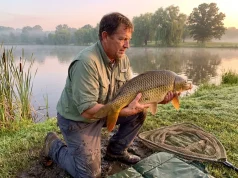
The alarm went off at 2 a.m. I’d been asleep on the bank for maybe three hours when a 28-pound common erupted from the reed bed like a submarine clearing the surface — line ripping a white scar across dark water. I’d spent six hours of daylight studying that wing dike seam, pulling flow data and roughness values, before I ever staked a rod. The other three anglers on that stretch had packed up by midnight, fishing the same exposed gravel flat they always hit. They weren’t reading the water wrong. They were skipping the system that tells you why that flat is wrong.
That’s the gap with carp in North America. Not a shortage of fish — common carp dominate virtually every major watershed. The shortage is in how most anglers approach the problem. Specimen carp fishing is a three-pillar engineering challenge: Hydrography (where fish hold and why), bait chemistry (what triggers feeding at a molecular level), and bolt rig mechanics (why European terminal tackle outperforms traditional North American setups). Most anglers skip all three. This article covers each one, straight.
⚡ Quick Answer: North American carp success rates drop because anglers ignore three things — hydraulic roughness for locating fish, L-amino acid chemoreception for bait selection, and passive hook-setting physics for the bolt rig. Find the high-roughness velocity shelters on your water (weedy pools, back-eddies behind bridge piers), ditch iodized salt from your bait prep, tie a knotless knot Hair Rig, and pin it to a 2–3 oz semi-fixed lead. Trust the rig and stop striking manually.
Where Carp Actually Hold: Applying River Reading to Fish Location

Manning’s Roughness Coefficient as a Fish Locator
Most bank anglers pick a spot by feel. “Looks fishy” is not a system — it’s a habit. The water has structure you can calculate, and carp respond to that structure in predictable ways because they’re slaves to energy efficiency.
The concept starts with Manning’s n — a roughness coefficient that describes how much friction a riverbed imposes on flow. A clean, straight run has an n value around 0.025. A weedy, deep pool runs 0.050 to 0.080. Dense reed margins can push 0.130 or higher. What that means practically: a weedy pool creates two to three times more hydraulic resistance than an open run, which means two to three times less energy cost for a resting carp. The fish don’t choose randomly. They’re parked where the current costs them nothing. According to the Manning’s roughness coefficient guide for natural channels, these values hold across most natural channel types in North America.
River research on Mississippi River carp, both common and silver, shows they select wing dike areas with moderate flow and elevated chlorophyll-a — exactly what you’d predict from high-n zones where food concentrates in the eddy. The weed mat that looks impossible to fish? That composite n value from emergent reeds and silted substrate is often 0.15 or higher. It’s a parking lot for tired, actively feeding fish.
Scout these zones before you cast. Paddle upstream in a kayak or wade during low flow and identify foam lines, back-eddies, and color transitions. Those surface signatures are the visual fingerprint of current seam hydrodynamics — the same hydraulic boundaries that hold multiple species across river systems.
Pro-Tip: Use Google Earth to identify channel bends and pinch points from above before your session. Then confirm on the water. The aerial view shows you the structure; the roughness tells you which part of that structure holds fish.
River vs. Lake Hydrology: Two Different Playing Fields
In rivers, rheotaxis is the force that matters. Carp orient upstream by default, so you want to find the downstream face of obstructions — behind bridge pylons, on the trailing edge of gravel bars — not the face taking the current head-on. That’s where fish sit without fighting the flow. A strong understanding of reading current for fish position separates anglers who consistently find carp from those who random-cast and hope.
Lakes and ponds work differently. Thermal stratification drives position more than flow. Carp hold along the thermocline break in summer, then go shallow as temperatures drop below 12°C (54°F). Their metabolic cost of foraging changes with the season, and so does where they’ll be willing to feed.
The Great Lakes and St. Lawrence River add a layer most anglers underestimate: clarity. High water clarity makes these fish extremely wary of terminal tackle. Carp detect the hydrodynamic drag of line through their lateral line sensitivity — braided mainline pinned to the bottom with backleads becomes non-negotiable in those conditions. The common carp habitat biology factsheet from USGS confirms their preference for turbid, sluggish environments, which explains why clear-water carp in our high-visibility lakes behave like an entirely different animal.
Culvert outlets and drainage channels deserve more attention than they get. Low-velocity refugia concentrate food and reduce fish energy expenditure — the bioenergetics of foraging work in your favor at these spots. Check them.
Watercraft: Reading Nervous Water and Bankside Signatures
Spend time watching before you cast. I mean real time — 30 minutes minimum on a calm morning before you touch a rod.
Nervous water is a subtle surface disturbance, not a boil. It’s the slight riffling of calm water caused by a large fish moving just below the film. Bubbling is different — carp rooting in substrate release gas pockets. Dense random clusters mean active feeding is happening right there. A linear trail of bubbles means a fish is moving; let it settle before you set up.
Bankside vibrations are where most anglers burn their own swims without realizing it. A heavy person walking on clay bank transmits vibrations detectable 15–20 meters into the water through the lateral line. The fish felt you before they saw you. Stop ten rod-lengths from your target, approach low and slow, and stop completely before you do anything else.
At dawn and dusk, surface tail-tips and dorsal fins show you exactly where fish are basking. Cast two rod-lengths beyond and bring the rig back to them. If you cast directly on top of them, they’re gone before the lead hits bottom.
Polarized reading and reading nervous water and fish vision are learnable skills. The “Golden Ghost” — a common carp in high-clarity water that reveals itself as a single pressure wave moving through calm shallows — if you can see it, you’re already too close.
Bait Chemistry: From Corn to L-Amino Acid Engineering
The Chemoreceptor System: How Carp Actually Smell and Taste
Sweet corn is the standard North American carp bait. It works on naive, lightly-pressured fish. Here’s why it fails everywhere else: it delivers sugar signals, not amino acid signals — and carp chemoreception is optimized for amino acids, not sugar.
The research on L-amino acid chemoreception in common carp is specific. L-Cysteine is the highest-stimulant amino acid, with receptors densest at the base of the large barbel — the first contact point during bottom foraging. L-Proline is the secondary attractant. L-Phenylalanine is a documented repellent and should never appear in your bait formulation; avoid any hydrolyzed plant protein that’s phenylalanine-heavy. Model experiments show that contact concentration at the fish’s skin is approximately 57% of the initial solution peak — meaning leakage rate, not total bait volume, controls effectiveness. Carp chemoreception and L-amino acid feeding behavior research backs this directly.
Sugar-based attractants like sucrose operate at thresholds two to four orders of magnitude weaker than cysteine. In pressured or cold water, corn fails not because fish don’t like it — they do — but because it sends the wrong molecular signal to the wrong receptor. I watched a fish mouth a corn kernel six times and spit it. Switched to a fishmeal boilie with a high-cysteine core. Same fish took it in under two minutes.
How scent attractants trigger inactive fish covers the broader olfaction science if you want to understand how this applies across species.
Particle Bait Preparation: The 24–36 Hour Protocol
The prep protocol isn’t optional, and it’s not about personal preference. Get it wrong and you’re either catching fewer fish or harming them.
Seeds — maize, hempseed, chickpeas/garbanzo — need 24–36 hours of soaking before use. This isn’t about softening texture. Seeds expand 20% or more in volume after proper hydration. Uncooked or partially cooked maize can expand inside a carp’s gut and cause serious internal injury. That’s the hard safety rule. After soaking, boil vigorously for 30 minutes minimum. The boil extracts bound natural sugars and amino acids into the cooking liquid. Let the seeds cool in their cook water — they’ll reabsorb the attractants.
Iodine is a documented repellent. Never use iodized table salt. Sea salt or rock salt at two to three tablespoons per five-gallon bucket is your standard. And use filtered or collected rainwater for soaking when possible — chlorine in tap water reacts with amino acid chains and degrades the attractant profile before you ever put it in the water.
The expanded volume also matters for the pharyngeal sorting process — longer time on the baited patch means more opportunity for the hook to work. Dissolved oxygen and bait health during a session covers the related biology of live bait condition if you need it.
Pro-Tip: Cool your seeds in the cooking liquid, not under fresh water. That brown cook water is loaded with leached amino acids. Losing it is losing your attractant.
The Anti-Sell: When Boilies Beat Corn (and When They Don’t)
Boilies win in high-pressure venues and in deep or cold water, where amino acid leakage outperforms passive sugar release every time. A pre-baiting campaign — three to five sessions of introducing boilies with no rods in the water — conditions fish to feed on them without caution. “Bait turnaround time” in most North American environments is three to seven days before wild fish actively seek out a new food source.
Corn wins on naive, lightly-pressured ponds and rivers where fish haven’t associated certain baits with hazard yet. Overcomplicating bait on an unpressured Ohio farm pond is a real and common mistake.
The “fake corn topper” technique belongs in any serious rig box. A buoyant piece of plastic corn added above the hook bait neutralizes the hook’s weight for a critically balanced presentation — the pharyngeal jaw sorting process can’t identify it as non-food. The $2 bag of fake corn outfished my $40 bag of premium boilies on three sessions in a row on a farm pond. Context beats cost.
Check how water temperature changes carp feeding metabolism before you commit to a bait strategy on a cold-morning session. The metabolic threshold matters.
The Pharyngeal Mill: Why Hair Rigs Work (and Hooks in Bait Don’t)
Anatomy of the Pharyngeal Jaw System
Carp have no teeth in their mouths. Full stop. The teeth are located on the fifth branchial arches — the pharyngeal jaws — deep in the throat, grinding food against a cornified keratinous pad on the base of the skull. The pad rotates laterally during mastication (rostroventrad, if you want the anatomical term), with up to 82 taste buds per square centimeter on the pharyngeal roof and mucous cells that allow the fish to rinse and backwash an item before committing to swallowing it.
Suction flow during initial intake exceeds 5 meters per second — items are vacuumed in fast. The decision to swallow or eject happens in the pharynx, not the mouth. Large epaxial muscles transmit crushing forces through the same system; you can hear an actively feeding carp grinding corn or mollusks from a short distance.
Pharyngeal mastication and food transport biomechanics in common carp is the source for the 16-muscle mastication cycle and the lateral pad rotation. The redear sunfish (shellcracker) uses an anatomically similar system — pharyngeal teeth and how they influence hook presentation shows how the same principle drives rig design across species.
Hair Rig Mechanics: The Physics of Bait Separation
The Hair Rig exists because of the pharyngeal sorting process. A hook buried in bait cannot rotate — both get ejected together. A hook on a 1–3 cm hair loop past the bend enters the fish with the bait but without the bait’s mass. When the carp attempts to move the debris back out, the exposed hook is free to rotate and catch in mouth tissue.
The knotless knot is the critical variable, and most North American anglers tie it wrong. The line must exit the hook eye on the inside — facing the point. That geometry creates a lever that pulls the point downward when tension is applied. Tie it the other direction and you reverse the lever. Hook-up rates drop sharply. Hair exit point position matters too: moving the knot lower toward the hook bend shortens the lever arm for faster rotation, which is the primary finesse adjustment for pressured fish.
Don’t strike manually on a bolt rig. The lead has already set the hook. A hard manual strike at that moment often pulls the point before it seats. Terminal tackle systems and hook presentation logic covers the broader rig decision matrix if you’re building a system from scratch.
Hookbait Hardness and the Pharyngeal Rotation Axis
Because the pharyngeal pad rotates laterally during grinding, bait hardness controls ejection speed. Soft baits collapse before the hook completes rotation. Critically balanced hard baits stay intact long enough for the hook to catch.
“Long-soak boilies” — soaked for 24 hours to partly soften the outer layer — are a high-pressure trick. The dissolved outer shell accelerates amino acid leakage; the compressed core maintains structural integrity for the hook hold. The boilie outer skin cross-links during the boiling process, creating a semi-permeable membrane that regulates diffusion rate. That’s the science behind leakage rate control.
Pop-up rigs (buoyant hookbait suspended 2–5 cm above bottom) bypass the thermal layer problem in high-silt areas where bottom debris clouds the chemical signal. Buoyancy physics and neutral presentation covers the Archimedes mechanics if you want to understand why a specific pop-up size needs a specific counter-weight.
Watch Danny Fairbrass walk through IQ hooklinks and rig camouflage in-depth:
Bolt Rig Physics: The Self-Hooking Machine
The Physics of Inertia-Based Hook Setting
The bolt rig removes human reaction time from the equation entirely. When a carp inhales the bait and moves away, the semi-fixed lead (2 oz minimum) can’t be displaced — its mass provides the resistance that drives the hook point. No human can match the speed of that sequence. Carp are faster than your hands.
Two ounces is the threshold for the “bolt effect” to work. Below that weight, a carp can move the lead without triggering sufficient hook-set force. In strong current, go to 3–4 oz to maintain the inertial anchor. The “pop-off” function of a semi-fixed lead clip releases the lead once the hook is set, letting it slide free on the mainline. That eliminates the head-shake leverage fish use to throw hooks — the lead stops being a counterweight the moment it’s no longer attached.
The inline lead variant places the lead directly on the mainline for slightly higher inertia, but with no safety pop-off. Use it only in snag-free environments. In snag-heavy water, always use a lead clip with a safety slide.
Common mistake: using a running lead with no fixed attachment. Without the bolt mechanism, you’re dependent on a manual hook set — and you will lose that race. Hook-setting physics and timing for inertia-based rigs breaks down the force transfer if you want to understand the full sequence.
Shrink Tube, Kickers, and Hook Rotation Geometry
The kicker — a bent piece of shrink tube on the hook shank — creates a lever arm that forces the hook point downward when tension is applied. Without it, a straight shank hook tends to pull linearly instead of rotating into tissue.
Here’s where people go wrong with kickers: they use too much. Danny Fairbrass has documented this with underwater filming. Too much shrink tube inhibits rotation. A nearly straight extension of just 5–10 degrees is superior to an aggressive bend for immediate hook flip and catch hold. Less is almost always more.
Knotless knot friction and loop mechanics goes deeper on how the tension arc of the trailing loop drives hook-point direction.
Hook sharpness is non-negotiable. A carp’s pharyngeal ejection force can exceed 10 N in milliseconds. A dull point won’t penetrate before the ejection cycle reverses. Test each hook with a thumbnail drag — if it skates, sharpen it before it ever sees water.
In high-pressure clear water, use a “long IQ hooklink” — 12 inches or more of fluorocarbon or coated braid. Standard 6-inch rigs are recognized by conditioned fish. Fluorocarbon at a refractive index of 1.42 (closest to water at 1.33 of any line material) is significantly less visible than mono or braid at hooklink distances. That’s physics, not marketing. Fluorocarbon refractive index and underwater visibility covers the optical detail.
Pro-Tip: Use Korda Safe Zone or equivalent substrate-matched leaders on the hooklink in high-clarity water. Silt, weed, and gravel tones all exist for a reason. Match the bottom you’re fishing over, not the brand you prefer.
Gear Reality Check: The Anti-Sell on Carp Tackle
Rods: Test Curve vs. the American Alternative
Test curve (TC) is the weight required to pull a rod tip 90 degrees to the butt. Standard European carp rods run 2.5–3.5 lb TC. At short range — 50 yards or less on farm ponds and canals — an 8–9 ft heavy-action American rod (Catfish King style) is mechanically superior to a 12-foot specialist. Shorter blanks maneuver around brush, deliver leads without overshoot, and cost a fraction of European imports.
For long-range casting to Great Lakes or wide river swims — 80 to 120 yards — a 12-ft 2.75–3 lb TC blank is a functional requirement, not a luxury. Distance demands it. Korda Kaizen Green, Fox Horizon X4, Daiwa Black Widow — all exceptional. None will catch more fish than an $80 rod if your rig mechanics and location reading are wrong. Gear does not fix process errors. If you want to go down the specialist rod road, carp rods benchmarked by blank mechanics and sensitivity is worth your time.
The Baitrunner Reel: The One Non-Negotiable Item
The Baitrunner is Shimano’s branded name for a secondary drag system — it lets line run freely from the spool, without opening the bail, at a pre-set low tension when a carp picks up bait and moves. Disengage it with a turn of the handle and you’re back on primary drag.
This is the one non-negotiable item in the carp setup. A 20-lb carp generating burst force will throw a rod off a pod or drag an unattended setup into the water on a savage take without one. Primary drag should sit at 25–30% of line breaking strength pre-session; Baitrunner drag loose enough for a fish to take one to two meters of line. I’ve seen $600 European rods on standard reels get thrown in the water by a 20-lb common at 3 a.m. The Baitrunner costs $80. It’s the piece of engineering that makes overnight sessions viable.
Okuma Avenger, Shimano Baitrunner OC, and the ST series all do the job. Size 4000–6000 for rivers; 6000–8000 for large-water and long casts. Setting dual-drag systems and primary drag calibration has the setup sequence.
Line and Rig Camouflage in High-Clarity Water
Backleads clip to the mainline 5–10 feet from the terminal rig and sink it to the bottom, eliminating the hydrodynamic drag signature that carp detect through lateral line sensitivity at frequencies below 200 Hz. Mono and fluoro dampen this frequency. Braid transmits it. Use braid for sensitivity on the cast; mono for the final leader approach in line-shy conditions.
Mainline color match: dark green or brown for weedy/muddy substrates; clear or gravel-tone for sand and gravel beds. Study the substrate from above before you target it. “Safe Zone” leaders — coated braid in silt, weed, and gravel tones — reduce visual and hydrodynamic detection in the two-foot strike zone around the bait. That last two feet matters more than any other two feet in your setup.
For the hooklink, fluorocarbon is the technical choice in clear water. Its refractive index of 1.42 is the closest of any line material to water’s 1.33 — significantly less visible than mono or braid at hooklink distances. Fluorocarbon refractive index and underwater visibility is the explainer if you want the physics in full.
Fishing Snags and High-Pressure Situations: The Locked-Up System
The Locked-Up Setup for Snag Fishing
When you’re targeting trophy fish near underwater trees or dense reeds, the fight changes before it starts. “Locked up” means the clutch is set fully tight — zero line given. The goal is to get the fish’s head up immediately and redirect it before it finds the snag.
Drop the rod to a low angle pointing directly at the spot (no stored bend in the rod system that gives the fish leverage). Use snag bars — heavy-duty metal brackets on your pod or bank sticks — to prevent rod loss on savage takes when the clutch is fully locked. Minimum line class: 18–20 lb mono or 30 lb braid. Standard 10–12 lb setups snap on the initial bolt.
This technique demands an angler at the rod at all times. Locked-up fishing is incompatible with unattended overnight setups. It’s active surveillance fishing only. Rod angle and pressure phases when fighting large fish maps out the phase sequence once you’ve got the fish moving.
Pre-Baiting Strategy and the Bait Turnaround Timeline
Wild carp that have never encountered boilies need time. Three to five pre-baiting sessions with no rods in the water — consistent timing, consistent location — and the “bait turnaround time” in most North American environments is three to seven days before fish actively seek the new food source. Carp pattern feeding windows on reliable food sources. You’re building a pattern, not just leaving bait.
Volume per session: 1–2 kg of dry particle or boilies scattered over a 10-meter radius. Consistency of time matters as much as volume. “Spombing” — using a castable rocket-shaped delivery device — puts 200–400 grams of particle per cast to exactly the same GPS-marked spot at 80–100 yard range. Far superior to hand-throwing for precision pile-building.
PVA bags — mesh bags of dry particle or pellets clipped to the hooklink — dissolve within 90 seconds in water and create a micro-baited area directly around the hook. Zero spreading. Ideal for new swims and for pressured fish that won’t commit to feeding an open patch. Three weeks of quiet pre-baiting once turned a completely blank canal stretch into the most productive swim I’d fished in a year. The carp came to me. That’s the only system that works at scale. Carp feeding behavior and population density in North American lakes gives context on how population density affects conditioning windows.
Three Takeaways Before Your Next Session
Stop guessing locations. Pull up a USGS topo map, identify the high-n roughness zones — weed mats, back-eddies behind bridge piers, silted bays — and put your rig where the hydraulics say the fish are. Every hour of pre-session analysis reduces blank risk more than six hours of random casting.
Fix your bait chemistry. If you’re using iodized salt, chlorinated tap water, or L-Phenylalanine-heavy pellets, you’re actively repelling fish. The molecules matter more than the brand on the bag.
Trust the bolt rig. Manual hook sets on a semi-fixed lead lose fish. The rig was designed to do the work. Your job is watercraft, bait placement, and staying quiet on the bank.
Next time you arrive at a new piece of water, spend 20 minutes reading before you cast a single rod. Identify the high-roughness zone, get the bait placed precisely, and walk away from the rods. Check back in the morning. The results will justify the investment in understanding how the system works.
FAQs
What is the best bait for carp fishing in North America?
For lightly-pressured ponds and rivers, sweet corn still works — fish that haven’t been conditioned don’t associate it with hazard. For high-pressure or clear-water venues, fishmeal boilies with high L-Cysteine and L-Proline content outperform corn significantly. These free amino acids match the precise chemoreceptor triggers at the carp’s barbels. The right answer depends on session history, water clarity, and fish pressure — not personal preference.
How do you rig for carp fishing?
Start with a Hair Rig combined with a semi-fixed bolt rig lead of 2–3 oz. Tie a knotless knot with the line exiting the hook eye toward the point, use a 15–25 lb fluorocarbon hooklink of 8–12 inches, and attach the lead using a lead clip with a pop-off safety pin. The rig self-hooks the fish on initial movement — don’t strike manually.
Do you need specialist rods for carp fishing?
At short range in North American farm ponds and canals (under 50 yards), a standard heavy-action 8–9 ft rod handles the job. For large-water casts of 80+ yards to the Great Lakes or wide rivers, a 12-ft 2.75–3 lb test-curve rod is a functional requirement. The Baitrunner-equipped reel’s dual-drag system is genuinely non-negotiable for any unattended fishing, regardless of venue.
Are carp invasive in North America, and should we target them?
Common carp (Cyprinus carpio) were introduced in the 1800s and are naturalized but ecologically disruptive — their benthic rooting damages aquatic vegetation and raises turbidity. Targeting them as sport fish reduces local population pressure and is actively encouraged by fisheries managers. Catch-and-release is a personal and conservation decision. Check local state regulations on corn or grain-based chumming, since rules vary by water body.
How does water temperature affect carp feeding in North American climates?
Carp feeding intensity drops sharply below 10°C (50°F) — the metabolic cost of foraging exceeds the caloric return in cold water. Peak feeding windows in temperate North American fisheries run 15–25°C, typically late spring through early fall. High current also raises metabolic cost; fish hold in velocity shelters and feed on what drifts to them rather than actively hunting. Adjust both bait approach and presentation accordingly.
Risk Disclaimer: Fishing, boating, and all related outdoor activities involve inherent risks that
can lead to injury. The information provided on Master Fishing Mag is for educational and informational purposes
only. While we strive for accuracy, the information, techniques, and advice on gear and safety are not a substitute
for your own best judgment, local knowledge, and adherence to official regulations. Fishing regulations, including
seasons, size limits, and species restrictions, change frequently and vary by location. Always consult the latest
official regulations from your local fish and wildlife agency before heading out. Proper handling of hooks, knives,
and other sharp equipment is essential for safety. Furthermore, be aware of local fish consumption advisories. By
using this website, you agree that you are solely responsible for your own safety and for complying with all
applicable laws. Any reliance you place on our content is strictly at your own risk. Master Fishing Mag and its
authors will not be held liable for any injury, damage, or loss sustained in connection with the use of the
information herein.
Affiliate Disclosure: We are a participant in the Amazon Services LLC Associates Program, an
affiliate advertising program designed to provide a means for us to earn advertising fees by advertising and linking
to Amazon.com. As an Amazon Associate, we earn from qualifying purchases. We also participate in other affiliate
programs and may receive a commission on products purchased through our links, at no extra cost to you. Additional
terms are found in the terms of service.