
In this article
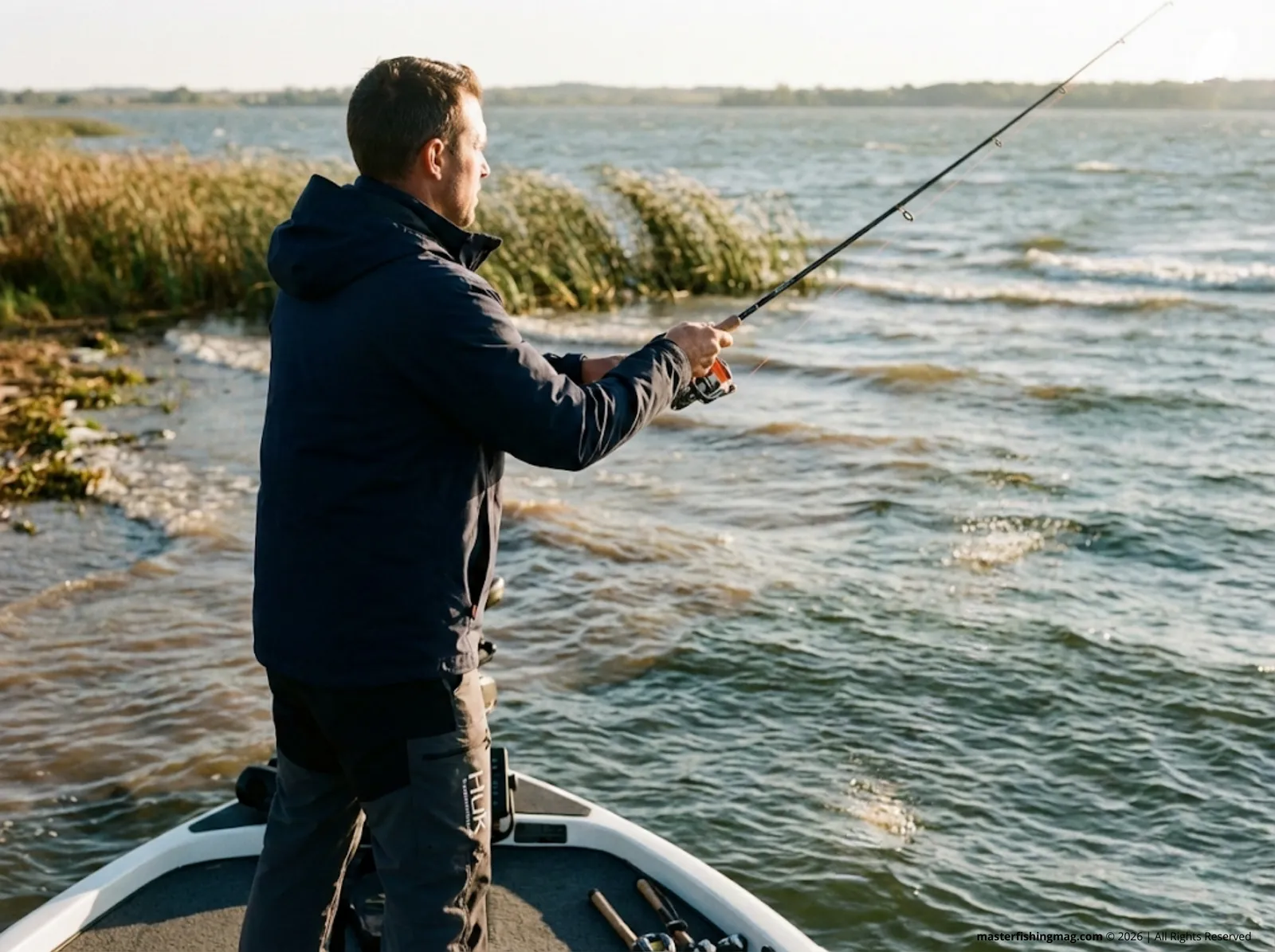
The barometer had been dropping since Tuesday. By Thursday morning, a steady 14 mph south wind was pushing a visible mud line against the windward bank. Three boats idled past without stopping. They were hunting for calm water. Meanwhile, the bass were stacked in the chop, faces into the current, waiting for the conveyor belt to deliver breakfast. The wind was not ruining the day. It was announcing exactly where the fish were.
I have watched this play out hundreds of times across lakes, reservoirs, and coastal flats. Most anglers treat wind as something to fight. The ones who consistently catch fish treat it as a locator. After two decades of guiding in conditions that send fair-weather fishermen running for the ramp, I can tell you this: wind direction and wind speed are the two most valuable pieces of free intelligence the water gives you. Learning to read them changes everything.
This guide breaks down exactly how wind concentrates baitfish, positions gamefish, and hands you a tactical playbook for boat positioning, casting strategy, and lure color selection that turns a rough day into your best one yet.
⚡ Quick Answer: Wind pushes plankton and baitfish toward windward banks, and predators follow. Fish face into the current about 99% of the time, so position your boat with the wind at your back, cast across the wind’s angle, and let your bait drift naturally into the strike zone. The 10-16 mph wind range is your sweet spot for higher hookup rates, better dissolved oxygen, and reduced fish wariness.
The Physics Behind Wind-Driven Fish Location
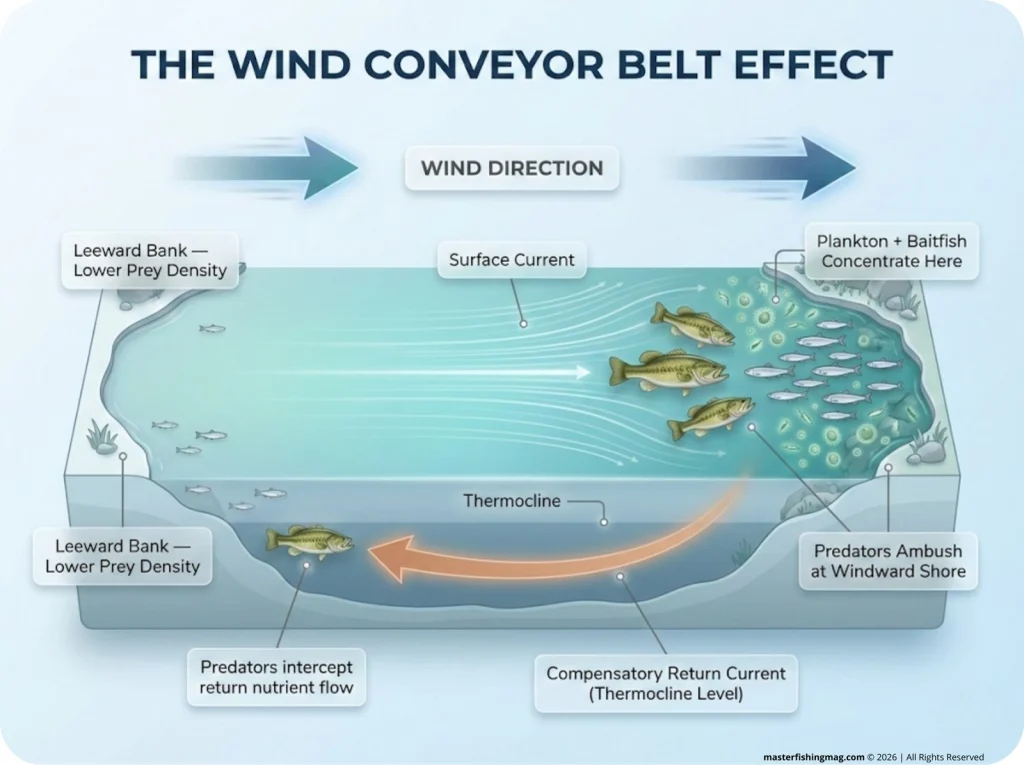
Wind blowing across a lake or bay creates friction on the surface. That friction generates a current running at roughly 1-2% of the sustained wind speed. Sounds like nothing. But across a mile of open fetch, that slow current becomes a conveyor belt that physically drags zooplankton, phytoplankton, and small baitfish toward the windward side of the lake.
Zooplankton are tiny. They cannot swim against even a modest wind-driven current. So they pile up wherever the wind pushes them. Shad, shiners, and alewives follow the food. Bass, pike, and walleye follow the shad. The whole food chain stacks itself against the wind-blown structure, and the angler who recognizes this walks into a loaded buffet line while everyone else fishes dead water. This pattern has been confirmed by peer-reviewed research on wind-driven predator-prey aggregation in lakes, where telemetry data showed predators consistently moving toward wind-exposed shorelines.
Here is the part nobody talks about: the wind needs time. A minimum of 12 to 24 hours of sustained winds is required before the plankton concentration draws in large baitfish schools and their predators. That is why yesterday’s wind pattern still produces fish even after the breeze dies. The bait stacked up overnight does not scatter instantly. On big systems like the Great Lakes, those concentrations hold for days.
Pro tip: Wind stirring tree limbs and submerged timber creates oxygen pockets in stained water. Bass stack on those oxygen-rich spots even when the main lake looks unfishable.
The Conveyor Belt Effect — How Wind Moves the Food Chain
The conveyor belt is strongest when fetch — the unobstructed distance the wind travels over water — is maximized. Large open bays and main lake basins produce the most pronounced baitfish concentration. In reservoirs with irregular shorelines, find the longest uninterrupted stretch of open water on a contour map before you launch. That is your primary target axis.
Phytoplankton and zooplankton travel with surface currents to the downwind end of a basin. Planktivorous baitfish follow the nutrient density. Predators set up camp to ambush them at the windward side, using wave-driven turbidity as concealment. The pattern repeats itself across every major fishery where wind and shallow structure intersect.
In the Northern Hemisphere, moving water gets deflected to the right by the Coriolis force — sometimes up to 45 degrees off the wind vector in deep or open water. In shallower lakes, the shoreline constrains this deflection, but it still shifts where baitfish end up. And there is a compensatory reverse current flowing back along the thermocline in the opposite direction. This explains why predators sometimes show up on the “wrong” side of a point. They are intercepting the return flow of nutrients, not ignoring the wind.
Wave action from sustained wind also aerates the water column, raising dissolved oxygen levels that trigger active feeding. Bass that were locked down in stagnant, oxygen-poor water suddenly come alive — not because of some mystical “feeding mood,” but because the water finally has enough oxygen to support aggressive activity.
The Wind Speed Matrix — From Ripple to Danger Zone
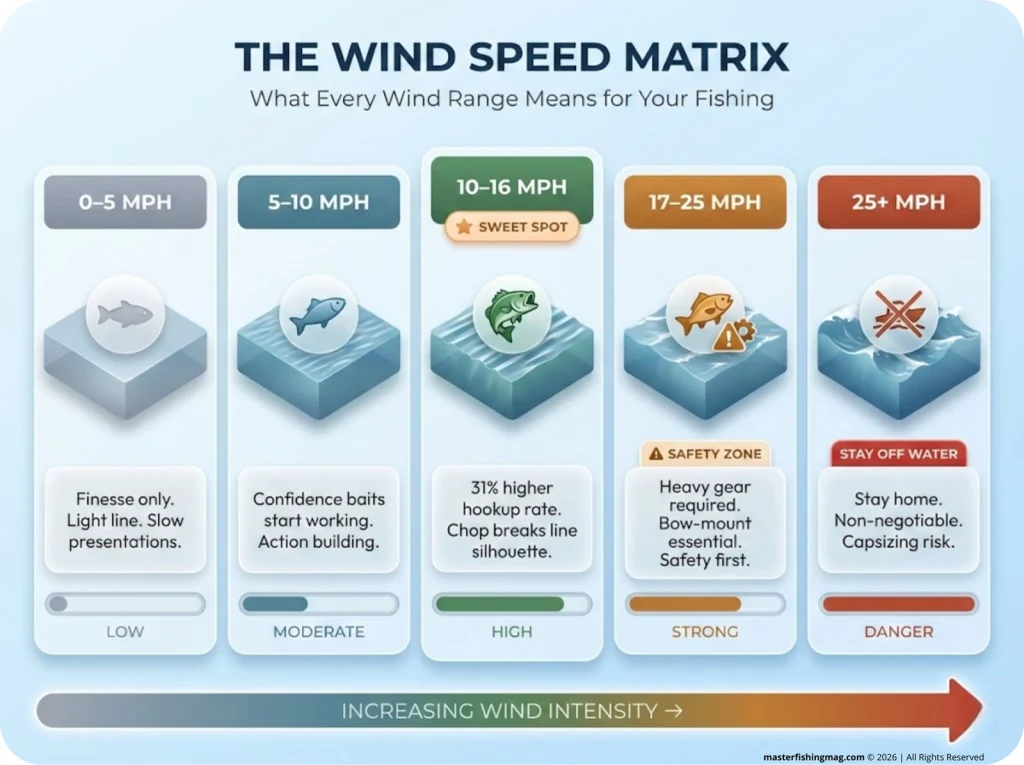
Not all wind is created equal. Here is what each speed range means for your fishing:
At 0-5 mph, you are dealing with calm water. High light penetration, wary fish, and the need for finesse fishing with light line. Expect slow action unless you are throwing subtle presentations.
The 5-10 mph range starts things moving. Surface ripples begin, light oxygenation kicks in, and confidence baits start getting eaten. Most anglers feel comfortable here, but the real action has not started yet.
10-16 mph is the sweet spot. The conveyor belt is established, surface chop breaks light refraction, and fish wariness drops hard. Beyond Braid field tests documented a 31% higher hookup rate in this range compared to calm conditions. The chop breaks your line silhouette, and the current has baitfish pinned right where you want them.
At 17-25 mph, you are in strong wind territory. Turbidity climbs, current deflection gets significant, and you need heavy gear and a bow-mount with serious thrust. Safety becomes the primary conversation before you even think about presentation.
Above 25 mph, stay home. Whitecaps, floating debris, and the risk of capsizing make it a non-negotiable stay-off-the-water day.
Reading Wind Direction Without an App — On-Water Visual Cues
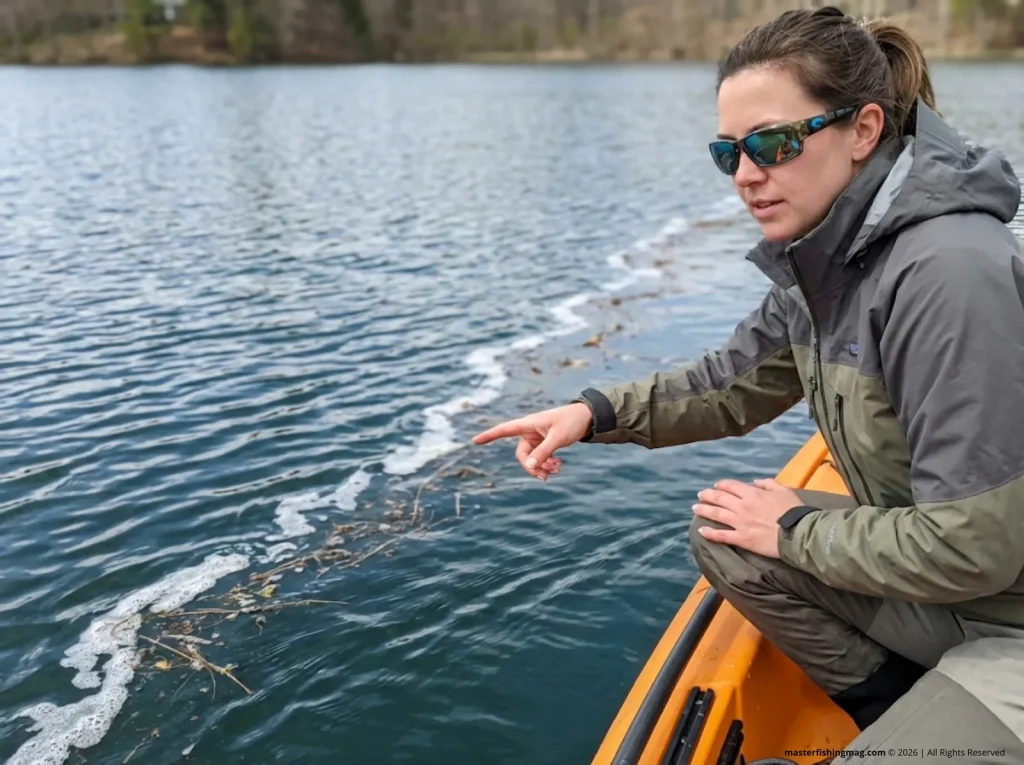
You do not need Windfinder to know where the wind is coming from. Surface ripples form a concave shape with the open side facing the windward direction. That is your instant read. Whitecaps form when wind exceeds 10-15 knots, and foam and debris trails line up with the wind axis, pointing you straight to the surface current path. These visual relationships are well-documented in University of New Hampshire oceanographic data on wind-driven surface currents.
Mud lines form where wave-driven erosion hits the shoreline. These turbidity edges are prime ambush zones. Predators hide in the stained water while prey drifts along the clear edge, oblivious.
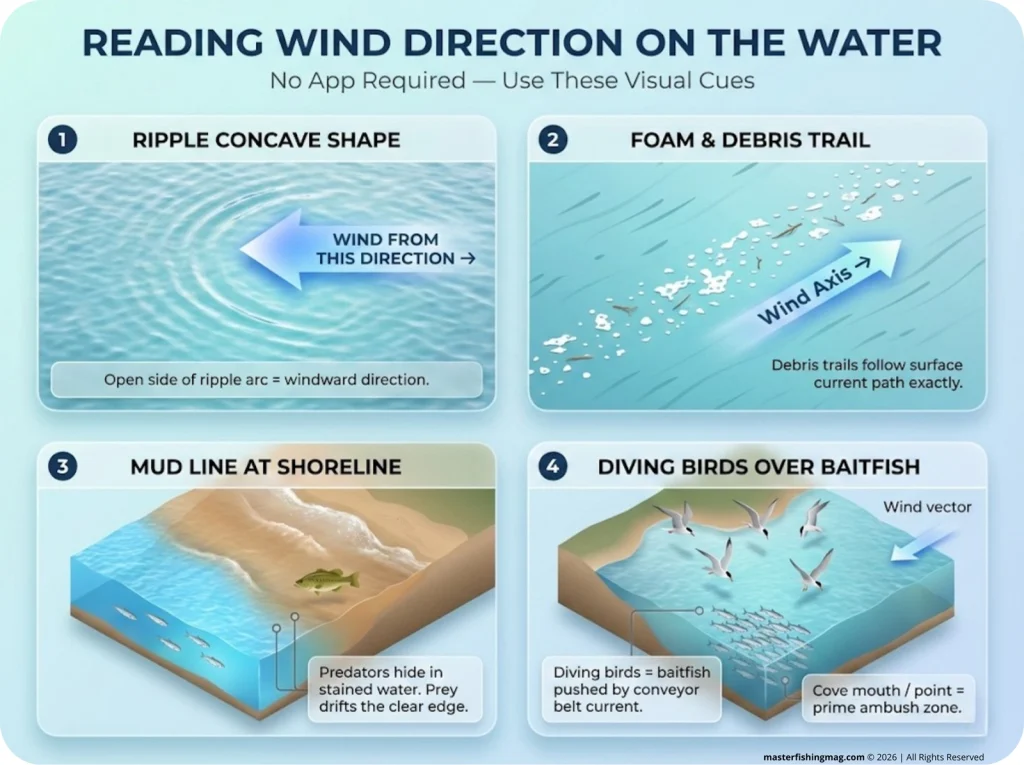
Watch for diving birds. When the conveyor belt pushes shad into a confined area like a point or a cove mouth, birds converge overhead. They are your secondary fish finder, and they work from a hundred feet in the air. Combine bird activity with a visible mud line and reading cloud formations to predict incoming weather shifts, and you are fishing with more data than most tournament anglers carry in their electronics.
The Classic Wind Proverbs — Science Behind the Folklore
Every old-timer at the boat ramp has heard it: “Wind from the West, fish bite the best. Wind from the East, fish bite the least. Wind from the South blows bait in their mouth. Wind from the North, do not go forth.”
Turns out it is not just folklore. Each direction correlates with a specific barometric pressure trend, and that trend predicts fish activity better than almost any other variable.
West and South Winds — The Angler’s Allies
A west wind usually precedes an approaching storm front. Barometric pressure is falling, and fish sense the change coming. They feed aggressively while conditions are still favorable, knowing instinctively that the window is closing. Some of my best bass days have happened under a threatening western sky with a dropping barometer, when every other boat bailed for the ramp.
Pre-frontal south winds bring warming trends in spring and fall, pushing warm surface water and nutrients toward northern shorelines. This concentrates pre-spawn bass and walleye in predictable staging areas. The proverb is literal — the warm surface current physically pushes baitfish closer to shore. In September, south winds extend the warm-water feeding window before cold fronts arrive, creating some of the best topwater action of the year.
The actual pressure level matters less than the direction of the trend. Dropping pressure improves catch rates. Rising pressure kills them. Track the trend, not the number. This relationship between atmospheric forcing and aquatic feeding behavior has been confirmed in NIH research on wind influence on pelagic ecosystem dynamics.
East and North Winds — Adapting When the Bite Shuts Down
East winds following a cold front create the toughest conditions: high pressure, bluebird skies, and fish holding tight to cover with zero interest in chasing anything. This is barometric pressure patterns that trigger lockjaw and feeding binges at their most punishing.
Post-frontal north winds bring cold air and rapidly rising pressure. Fish become lethargic and drop into deeper, more stable parts of the water column. The adaptation strategy is straightforward: slow down dramatically, downsize your lures, and target the deepest structure adjacent to wind-blown banks. Drop shots, finesse jigs, and slow-rolled swimbaits outperform fast-moving reaction baits in these conditions.
The bite can recover 48 to 72 hours after a cold front passes, even if the east wind persists. Fish acclimate to the new pressure level, and feeding gradually resumes.
Pro tip: When the east wind locks the bite down, go smaller and slower than feels comfortable. Half the lure size, half the retrieve speed. That is the post-frontal formula.
Species-Specific Wind Positioning — Where Each Fish Goes
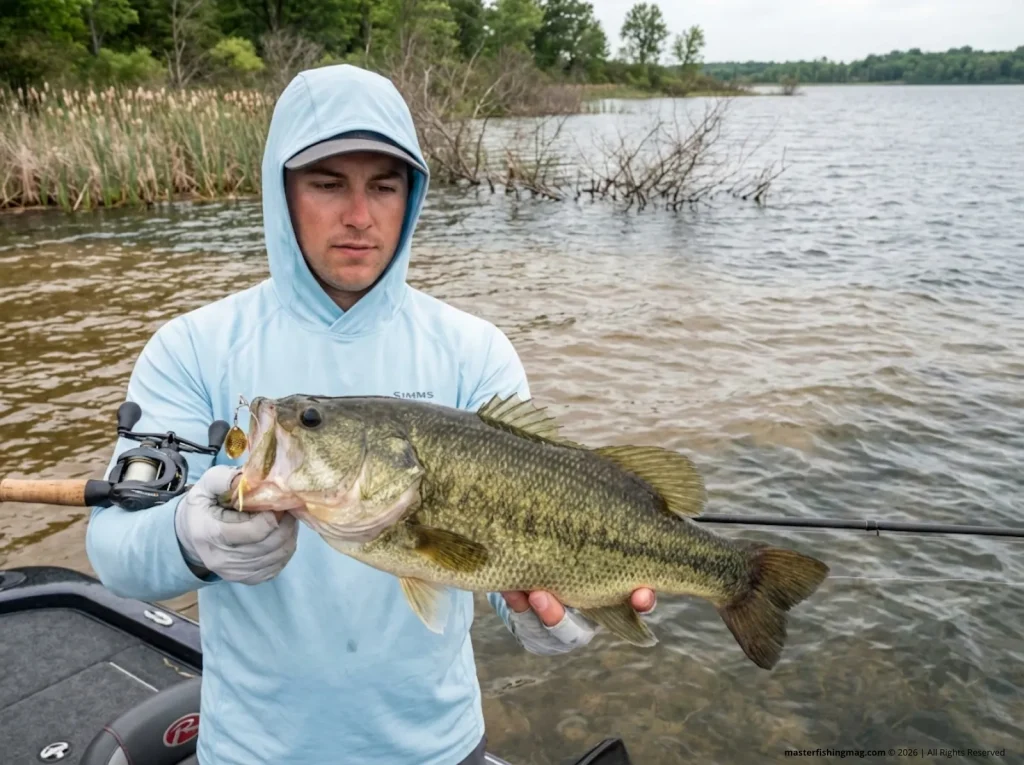
Different species use wind differently, and understanding those patterns lets you target the right water for the right fish.
Largemouth Bass — Faces Into the Wind, Every Time
Largemouth bass face into the current approximately 99% of the time. They are ambush predators exploiting the conveyor belt, and they position on wind-blown banks, points, and humps where the current constricts and accelerates. In clear lakes, bass use the mud line as concealment cover, holding in the stained water and striking at prey that drifts along the turbidity edge.
Increased dissolved oxygen above 5 ppm energizes bass and extends their feeding windows compared to calm, stagnant conditions. Cast parallel to the mud line, not perpendicular. On heavily pressured lakes, bass may hold just outside the turbidity edge rather than in it, where the cleaner water still offers striking visibility.
Northern Pike and Walleye — Wind-Activated Predators
Pike are specialized wind hunters. They move onto reef tops and rocky points during strong wind events — structures that would be vacant during calm periods. On the Great Lakes, pike action on reef tops is directly tied to wind. When it blows, they are up shallow. When it dies, they vanish back to deep structure. Smallmouth bass are highly temperature-sensitive and may vacate wind-blown rocky points entirely if pike move in during these high-wind events.
Walleye thrive in what anglers call “walleye chop” — moderate wind conditions between 10 and 16 mph that reduce light penetration and activate these light-sensitive predators. The ideal walleye presentation in wind is a slow-rolled swimbait or live-bait rig drifted along the wind-blown edge of a main-lake hump.
Inshore Redfish and Saltwater Species — Wind as an Artificial Tide
In inshore fishing, a strong wind can physically push water into or out of a lagoon, creating an artificial tide. A sustained west wind on Florida’s Atlantic coast drives excessively low tides, concentrating redfish into deeper holes and channels. A northeast wind brings cooler, bait-rich water that triggers aggressive feeding among offshore pelagics while muddying inshore flats.
When wind-pushed water floods back onto the flats, redfish follow the advancing waterline, tailing in inches of water — and they are eating everything in sight. Spooky redfish become less cautious in wind-driven stained water because they rely on their lateral lines and olfactory senses rather than sight. This is exactly the scenario where understanding how tidal currents position inshore predators like redfish and striped bass pays off. For targeting reds on windblown grass, see targeting redfish on wind-blown grass flats with the right presentation.
Boat Positioning and Anchor Systems for Wind Control
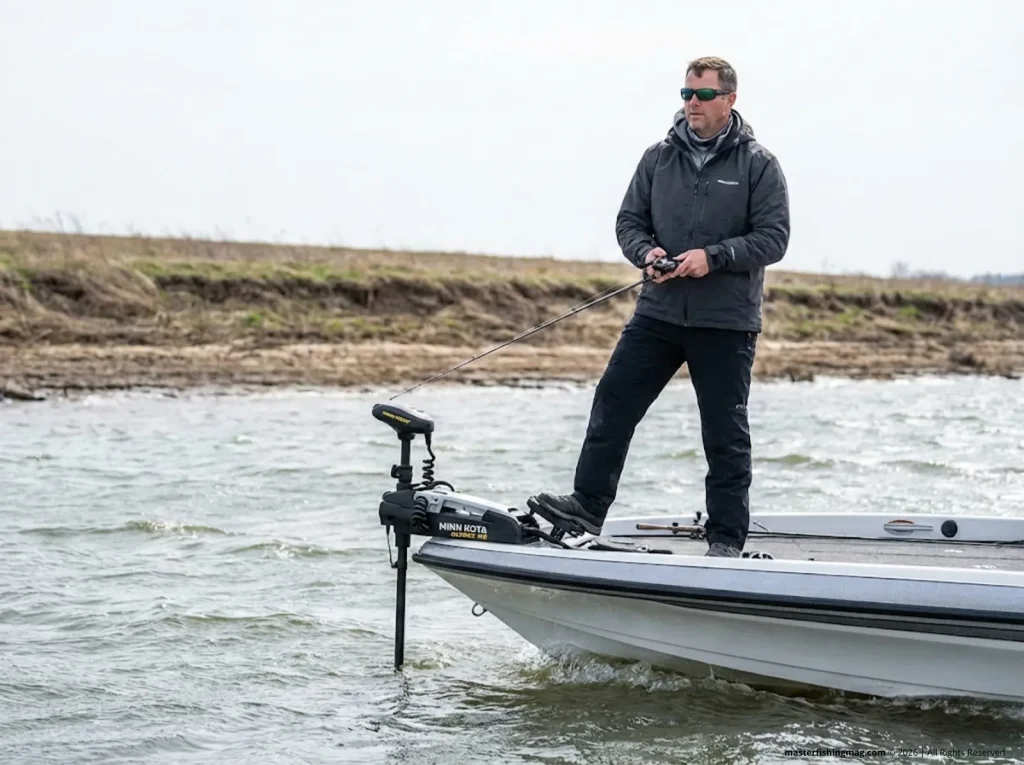
Knowing where the fish are is only half the battle. If your boat control falls apart in the wind, your presentation falls apart with it.
The standard approach is to work a shoreline into the wind. This gives you precise speed control and keeps the bow pointed into the waves, preventing the boat from swapping ends or getting broadsided. When the wind overwhelms your trolling motor, switch to an into-the-wind backward drift. Keep the bow into the waves for stability, but let the wind push you down the bank while you use the motor in reverse to control your speed.
For stationary work, an anchor scope ratio of 5:1 — five feet of line for every foot of water depth — is the standard for stability. Grapnel and fluke anchors grip rocky and sandy bottoms. Mushroom and dumbbell anchors rely on dead weight and only hold in light wind or soft mud. For kayak anglers, an anchor trolley system lets you move the attachment point from bow to stern, keeping the vessel aligned with the wind instead of taking dangerous broadside waves. A quick-release mechanism is non-negotiable in a kayak — if the current pulls you under, you need to dump that anchor instantly. For complete setups, see the 3-point kayak anchor safety rig for windy conditions.
Drift socks are the secret weapon for walleye and smallmouth anglers on main-lake humps. They create underwater drag that slows your drift, keeping lures in the strike zone longer. Deploy one from the bow to slow a forward drift, or from the stern for backward drifts. Two socks from opposite corners can hold you nearly stationary in moderate wind without ever dropping anchor. For more precision boat work, see advanced boat control tactics for heavy wind conditions and low-trajectory casting and GPS anchoring strategies for windy days.
Pro tip: Two anchors, one off the bow and one off the stern, eliminate the swing that a single anchor creates. You stay locked on the exact spot instead of rotating around it. This is the difference between fishing a single brush pile accurately and fishing the general area.
Lure Selection and Casting Tactics in Wind
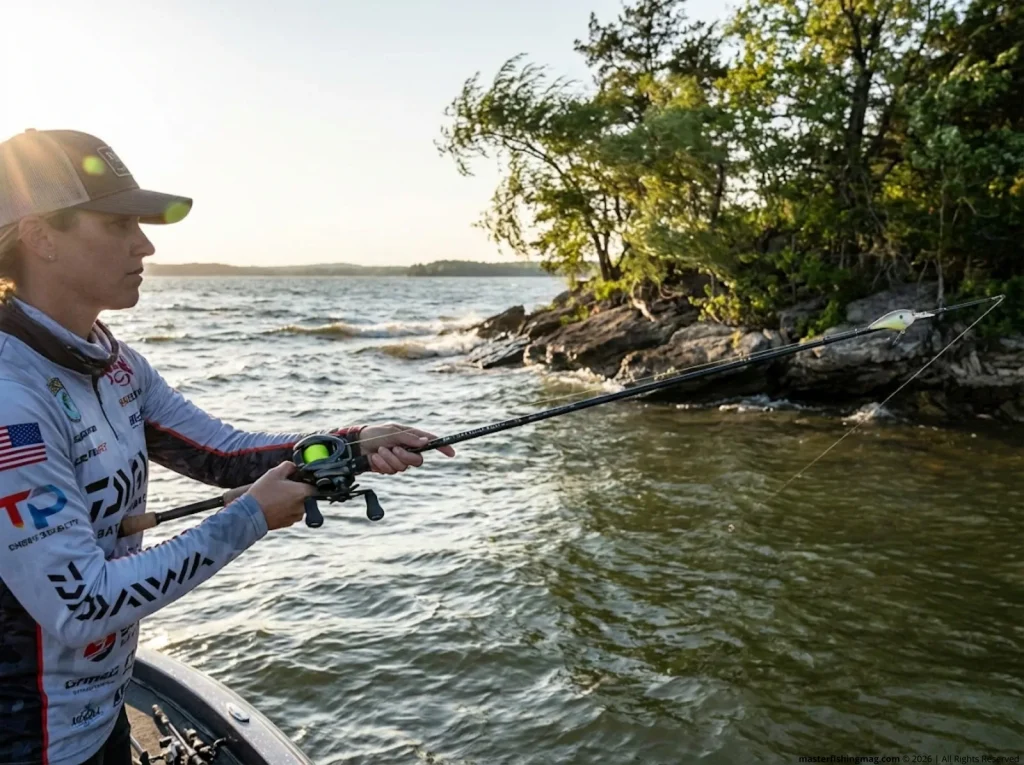
When the wind picks up, your tackle has to change with it. The same finesse presentations that work on a glass-calm lake become nearly useless in 15 mph gusts. Transition to reaction baits — lures aerodynamic enough to cut through wind and heavy enough to maintain depth despite the upward pull of a wind-bowed line.
Spinnerbaits and crankbaits are the workhorses. They cast accurately across or into the wind and provide the flash and vibration that fish need to detect a lure in turbid, churned-up water. Understanding how water turbidity affects lure visibility and color selection is critical here — wind-driven waves change the rules for lure color.
In stained water, go high-contrast: chartreuse, white, and black outperform natural patterns. Willow-leaf spinnerbait blades give maximum flash; Colorado blades produce more vibration for fish relying on their lateral lines when visibility drops to zero. For a breakdown on blade selection, see matching spinnerbait blade type to water clarity and wind conditions.
Swimbaits with paddle-tail designs work well in wind because they mimic struggling, disoriented baitfish — exactly what the real ones look like in turbulent water. When you need to get deep, increase your jig or Carolina rig weight to maintain bottom contact through the line bow.
The Casting Angle — Why Casting Downwind Is a Mistake
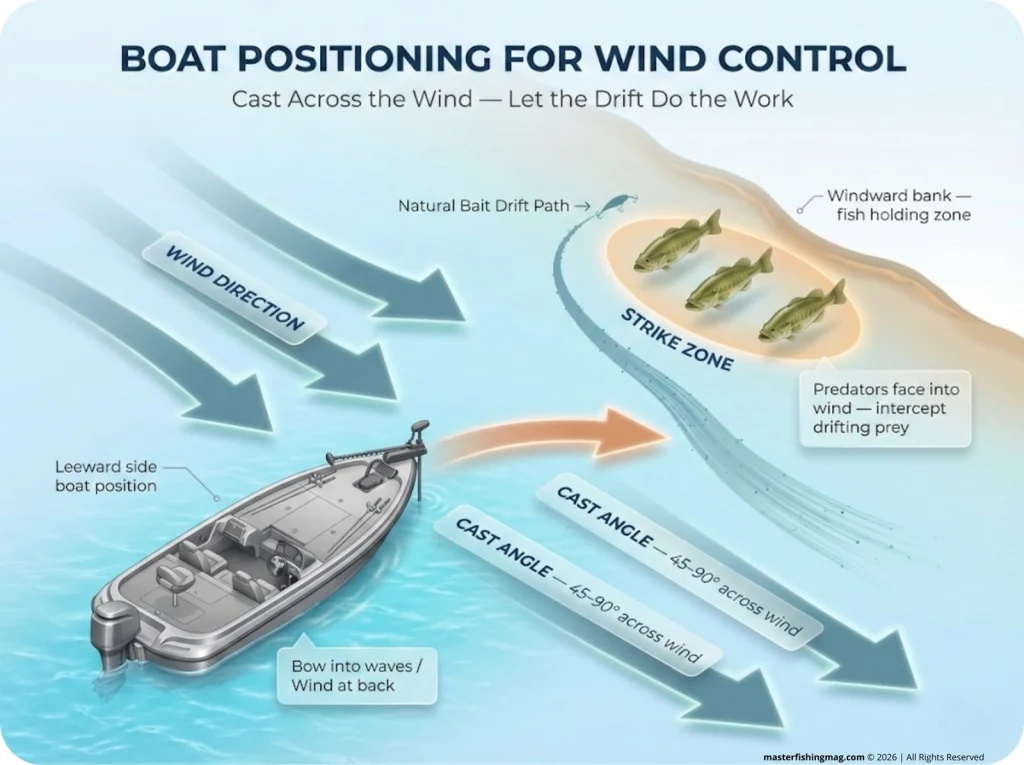
Because fish face into current, they expect prey to arrive from the front. Casting straight downwind delivers your lure from behind the fish, where it may go completely unnoticed. Instead, cast across the wind’s angle so the lure crosses directly in front of the fish’s path. This triggers a reactionary strike instead of a casual look.
Keep your launch angle low. High-arching casts let the wind “kite” your line, and your casting accuracy tanks. A sidearm cast close to the water surface minimizes wind interference and keeps the line from developing a massive bow. In a strong crosswind, aim slightly upwind and let the wind drift the lure into position — that is the wind-compensation casting technique.
Line Selection — Braid vs. Fluorocarbon in Wind
Eight-strand braid cuts through wind better than mono or fluoro because of its thin diameter relative to breaking strength. The lack of stretch transmits strikes directly to the rod tip even through a bowed line. Beyond Braid Optic Orange 8X and similar high-visibility lines let you watch the bow in your line for visual strike detection — field tests show up to a 23% improvement in bite detection at 12-15 mph winds.
Fluorocarbon still has its place. It sinks, which helps crankbaits run deeper. For every 2-pound reduction in test weight, a crankbait can gain about 1.5 feet of depth. The best of both worlds is a 12-15 lb fluorocarbon leader tied to 30 lb braid with an FG knot: wind-cutting performance on the main line, invisibility at the business end. There are also conditions where when to drop down to light line finesse even in windy conditions produces fish that heavier presentations miss entirely, particularly during post-frontal fishing with east winds.
Lure Color and Contrast in Wind-Driven Turbidity
Wind-driven waves reduce water clarity, so your color selection has to adjust. High-contrast colors — chartreuse, white, black — outperform natural patterns in stained water. Fish lateral lines detect vibration frequencies between 1 and 200 Hz, which means lures producing strong low-frequency vibration are most effective when visibility is compromised. Rattling crankbaits, Colorado blades, and paddle-tail swimbaits in white or chartreuse are the most versatile wind-day options.
In clear water with moderate chop, natural colors — shad, perch, crawfish — still work because the surface distortion reduces fish scrutiny without killing visibility entirely. Match the color to the clarity, not to what worked last week on calm water.
Safety, Risk Management, and Sustainable Wind Fishing
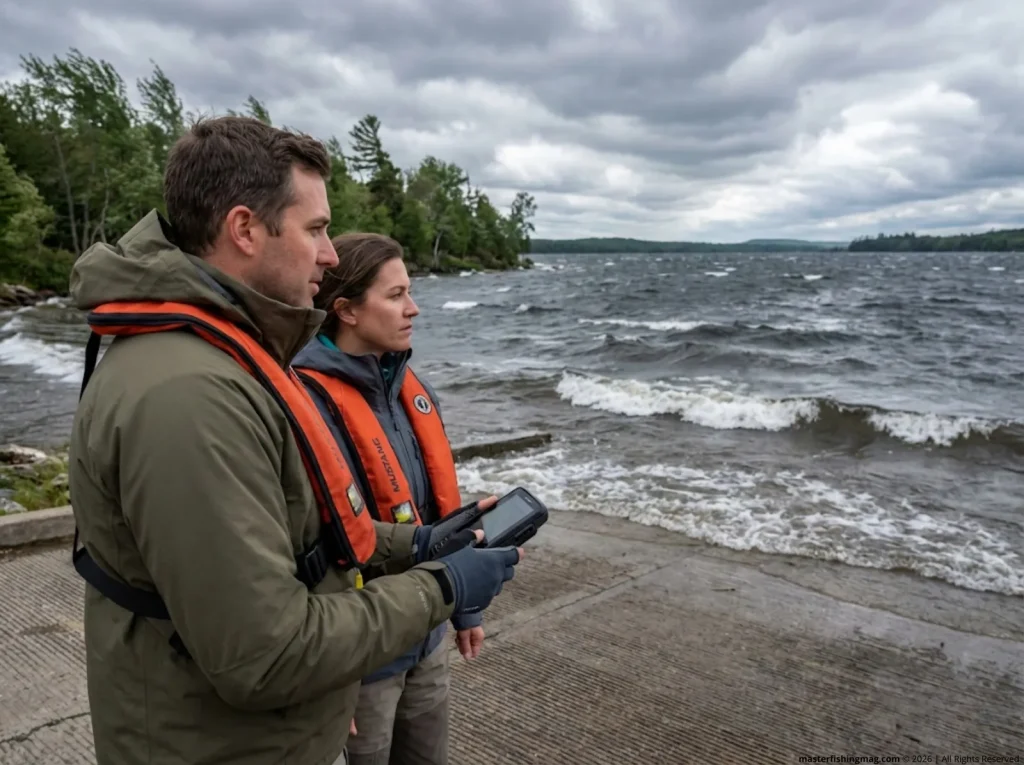
The fish are not going anywhere. You need to come home. That is the starting point for every wind-fishing trip.
Sustained winds over 25 mph are dangerous territory. The risk of capsizing, engine failure, or collision with floating debris is too high for any fishing opportunity to justify. I have a personal rule: if whitecaps are visible from the ramp, I fish protected water only. The fish will be there tomorrow. You might not be. Know when conditions demand a conversation about what to do when wind escalates into a thunderstorm on the water.
All occupants must wear PFDs in rough water, and the operator needs to be physically connected to the kill switch — the U.S. Coast Guard boating safety guidelines for wind and rough water are clear on this point. Trolling into the wind drains batteries fast, so verify full charge before launching because you need enough power to get back against a headwind. And wind dislodges logs and floating debris that can end your day in a hurry at speed. For PFD selection, see choosing the right PFD for rough water and high-wind conditions.
There is a conservation angle here, too. Wind-driven fishing concentrates many anglers in small, high-probability zones. When every boat on the lake is pounding the same windward point, practicing catch-and-release is essential. Overharvesting a localized population during a wind event can impact that spot for an entire season. Use wind-cutting braid and heavy terminal tackle to reduce break-offs, and you leave less lost line and lead in the water.
Pro tip: Before launching, check marine weather forecasts for sustained wind speed AND gust speed. A forecast calling for 12 mph sustained with 22 mph gusts is a very different day than a steady 12 mph. Plan for the gusts, not the average.
Conclusion
Wind is not your enemy. It is a fish finder that runs on air, and it has been giving away fish locations since long before electronics existed.
Three things to carry off this page: First, wind concentrates baitfish on windward structure through a conveyor belt effect that needs 12-24 hours to fully develop. Yesterday’s wind still fishes. Second, fish face into current nearly every time, so position your boat with the wind at your back, cast across the angle, and let the drift do the work. Third, the 10-16 mph range is where everything comes together — reduced wariness, better dissolved oxygen, more active fish, and measurably higher hookup rates.
Next time you pull into the ramp and see whitecaps on the windward bank, do not turn around. Check the wind speed, identify the fetch axis on your map, and motor into position on that bank. Give it 30 minutes. The fish that gave themselves away to the wind are waiting for an angler who knows how to listen.
FAQ
What is the best wind direction for fishing?
West and south winds are generally the most productive. A west wind precedes approaching fronts and triggers aggressive pre-frontal feeding as barometric pressure drops. A south wind pushes warm water and baitfish toward northern shorelines. East and north winds follow cold fronts and bring rising pressure that shuts most bites down.
How long does wind need to blow before fish move to windward banks?
A minimum of 12-24 hours of sustained wind is needed to concentrate plankton and draw in baitfish schools. This is why yesterday’s wind pattern still produces fish even after the breeze dies. In large systems like the Great Lakes, these concentrations can persist for days.
Is fishing better casting with or against the wind?
Neither. Cast across the wind’s angle. Because fish face into current, casting straight downwind delivers your lure from behind them. Casting across the wind puts the lure directly in their path and triggers reactionary strikes. Use a low launch angle and heavier lures for casting accuracy in wind.
Why do fish go to wind-blown shores?
Wind-driven surface currents push zooplankton and small baitfish to the windward side of a basin. Predators position themselves to ambush the concentrated bait, often using the increased turbidity from wave action as concealment. The entire food chain stacks itself against wind-blown structure.
What wind speed is too dangerous for fishing?
Sustained winds over 25 mph are dangerous for most recreational vessels. Whitecaps begin forming at 10-15 knots, which is a useful visual warning. The 10-16 mph range is the productive sweet spot that concentrates fish without creating hazardous conditions. Above 25 mph, stay off the water.
Risk Disclaimer: Fishing, boating, and all related outdoor activities involve inherent risks that
can lead to injury. The information provided on Master Fishing Mag is for educational and informational purposes
only. While we strive for accuracy, the information, techniques, and advice on gear and safety are not a substitute
for your own best judgment, local knowledge, and adherence to official regulations. Fishing regulations, including
seasons, size limits, and species restrictions, change frequently and vary by location. Always consult the latest
official regulations from your local fish and wildlife agency before heading out. Proper handling of hooks, knives,
and other sharp equipment is essential for safety. Furthermore, be aware of local fish consumption advisories. By
using this website, you agree that you are solely responsible for your own safety and for complying with all
applicable laws. Any reliance you place on our content is strictly at your own risk. Master Fishing Mag and its
authors will not be held liable for any injury, damage, or loss sustained in connection with the use of the
information herein.
Affiliate Disclosure: We are a participant in the Amazon Services LLC Associates Program, an
affiliate advertising program designed to provide a means for us to earn advertising fees by advertising and linking
to Amazon.com. As an Amazon Associate, we earn from qualifying purchases. We also participate in other affiliate
programs and may receive a commission on products purchased through our links, at no extra cost to you. Additional
terms are found in the terms of service.