
In this article
The stern of the kayak dipped first—just a few inches—and then the current did the rest. The anchor line snapped taut from the wrong end, the transom went under, and seventy-three pounds of fishing rig became a submarine in about four seconds. Cold water hit at 52°F. The gasp reflex kicked in before the brain could negotiate with it.
I’ve guided on these waters for over two decades. That sequence—anchor from the stern, feel solid, then the hull just goes—plays out every spring. The wide, flat fishing kayak doesn’t lean back into it. It flips. And the water is rarely the forgiving 70°F that anglers imagine when they’re planning a trip from a couch in March.
This guide doesn’t cover “wear your PFD.” You already know that. What it covers is the physics of why kayaks capsize, the physiology of what cold water actually does to your body in the first two seconds, and the communication tools that work when a cell phone is useless. That’s the framework that separates anglers who come home from those who don’t.
⚡ Quick Answer: Kayak fishing claims anglers when three systems fail simultaneously: vessel stability is breached (usually from standing, stern anchoring, or beam waves), cold water immersion triggers the gasp reflex before a PFD can be put on, and no one knows where to look because there was no float plan. Wear a foam Type III PFD at all times, anchor bow-first using an anchor trolley, dress for the water temperature—not the air—and carry a DSC-equipped VHF radio with a registered MMSI. These four decisions resolve the majority of fatal kayak fishing scenarios.
The Physics of Why Kayaks Flip — And When They Stop Righting Themselves
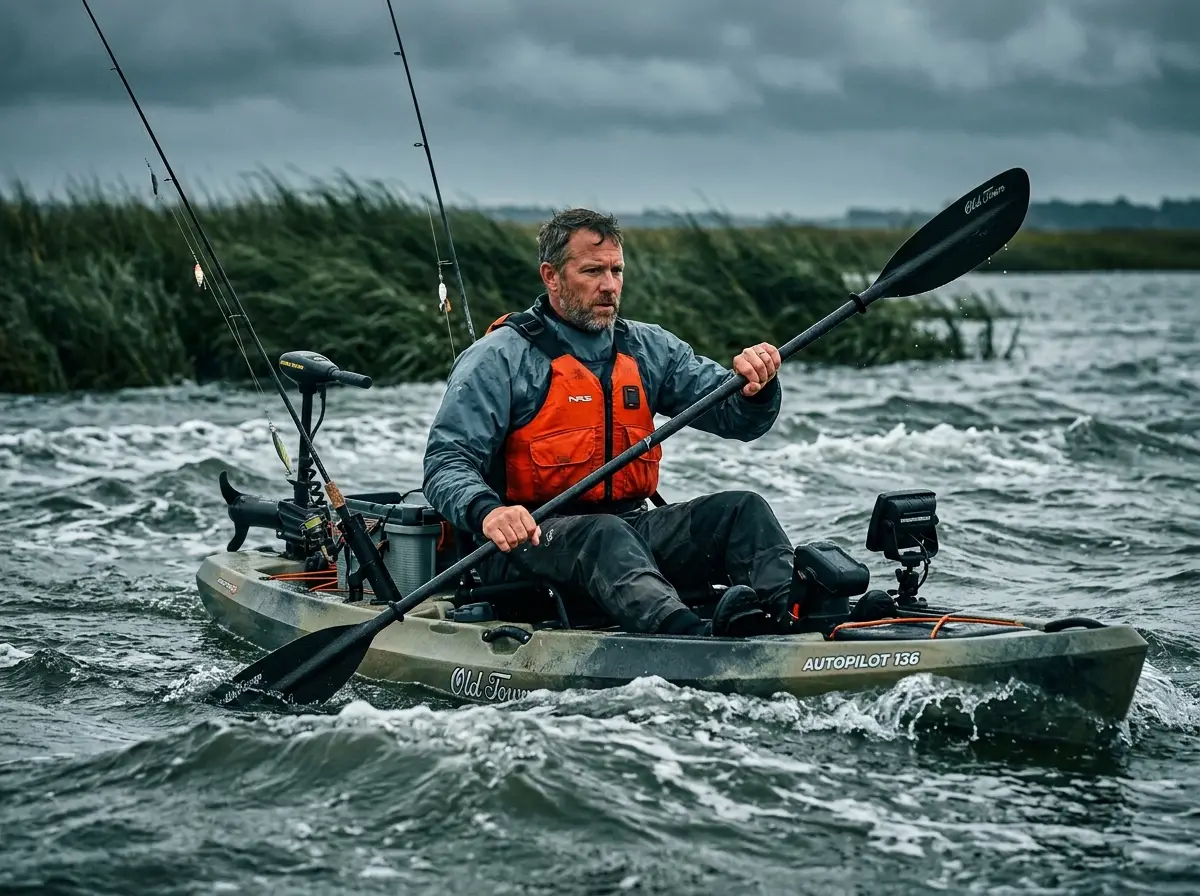
Most beginner anglers learn one thing about their hull: it feels stable. The wide, flat platform of something like an Old Town Sportsman 106—with its 34.5-inch beam and DoubleU hull—barely rocks when you step in. That stability is real. It’s also a trap.
There are two completely different stability systems at work on every kayak. Primary stability is what you feel at rest on flat water: resistance to initial tipping. Wide, flat hulls are built for this. Secondary stability is what saves you when the boat starts to lean—the recovery ability once a heel angle begins. And here’s what beginners don’t understand: wide, flat hulls have almost no secondary stability. They have a hard limit. A point of no return. The hull stays level, stays level, stays level—then goes. Not gradually. All at once.
A rounded or V-hull feels unsteady from the first minute you sit in it. Yet that hull actually has higher secondary stability. As it heels, the center of buoyancy shifts further from the centerline, creating a righting force. The fishing kayak does the opposite. Understanding this paradox—”tippy hull = safer in rough water”—is the single most undersold concept in beginner kayak education. For a deeper look, this peer-reviewed analysis of kayak hull physics and metacentric stability explains the mechanics behind why hull shape determines how far a kayak can heel before recovery becomes impossible. And if you’re choosing between platforms, the primary vs. secondary stability tradeoffs in kayak hull design article maps out which hull types belong in which water conditions.
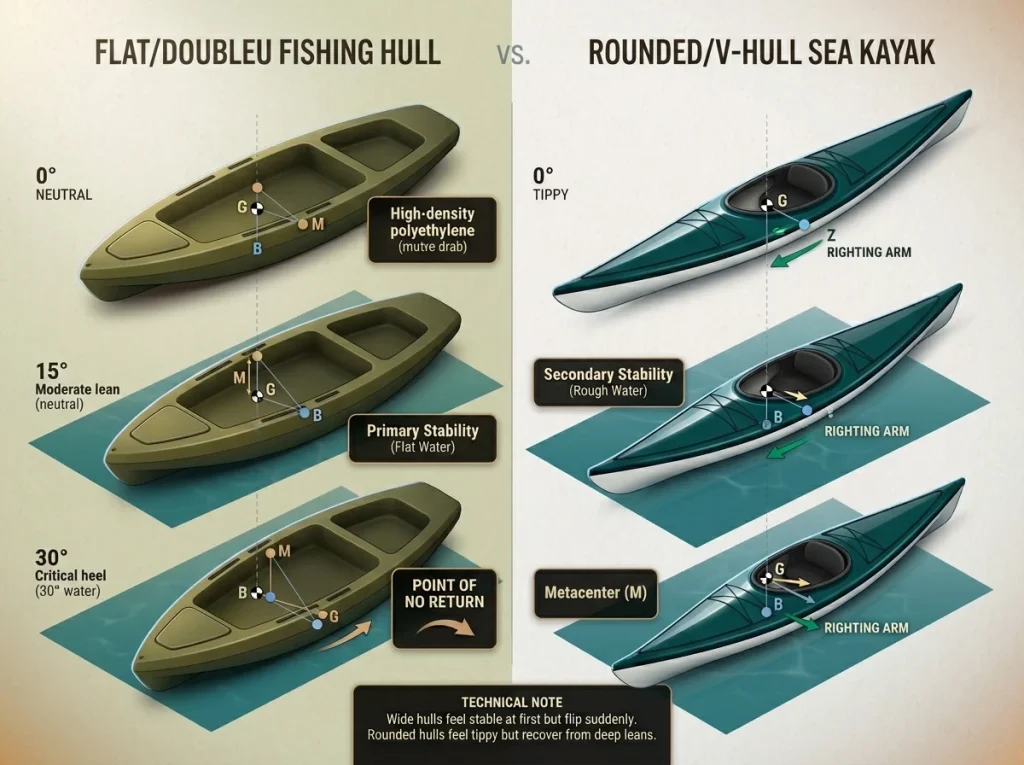
Primary vs. Secondary Stability — The Two Systems Every Beginner Conflates
The Old Town Sportsman 106 at 73 lbs with a 440 lb capacity is built for one thing: calm water stability. Stand-up casting. All-day comfort on a flat lake. It earns every bit of its reputation in those conditions. Move it to a tidal river with a 2-knot current and beam waves from a passing boat, and that same hull becomes the problem.
Buy both hull types before committing to your fishing platform if you can. Put your hand on the gunwale of a rounded sea kayak and feel it resist, recover, resist again. Then do the same in a flat-bottom fishing rig. The difference is tactile. No spec sheet communicates it the same way.
Pro tip: Before you cast from a standing position on a fishing kayak, run this drill: stand up slowly on flat water near shore, then move your weight six inches off centerline. Feel where the hull starts to commit. That’s your true limit. Most beginners don’t find it until they’re fighting a fish twenty yards from the boat ramp.
The Centerline Rule — Where Your Head Must Be Relative to the Keel
The keel is the balance axis. Your head needs to stay roughly above it whenever you’re reaching, landing fish, or grabbing gear. On a 34.5-inch wide kayak, a 200-pound angler leaning 18 inches over the gunwale to grab a flopping bass shifts the center of gravity outside the hull’s buoyancy envelope. That’s not a theory—that’s a geometry problem with one answer: you’re going in.
Centerline management also gets disrupted by the rig itself. A tackle box mounted entirely to starboard. A rod holder on one side with nothing to counterbalance. Over the course of a season, these asymmetric loads become the baseline, and anglers stop noticing. Run a quick balance check on a flat surface before launch each trip. It takes ninety seconds and it tells you where your neutral point actually sits with all your gear loaded.
Hull Load Limits and What “500 lb Capacity” Actually Means
Manufacturer capacity ratings are lab numbers. The Sportsman Autopilot 136—at 95 lbs hull-only—picks up another 50 to 70 lbs when you add the Minn Kota motor and battery. That weight sits astern, lowering stern freeboard exactly where you need it highest when anchoring in current. A 185-pound angler with 30 lbs of gear, 25 lbs of electronics, and a motor system is well within the 500 lb spec. Their deck, however, is sitting much closer to the waterline than the spec sheet suggests. Smaller waves wash over. The margin disappears faster than the rating implies.
Cold Water Is Not Your Enemy — Your Own Body Is
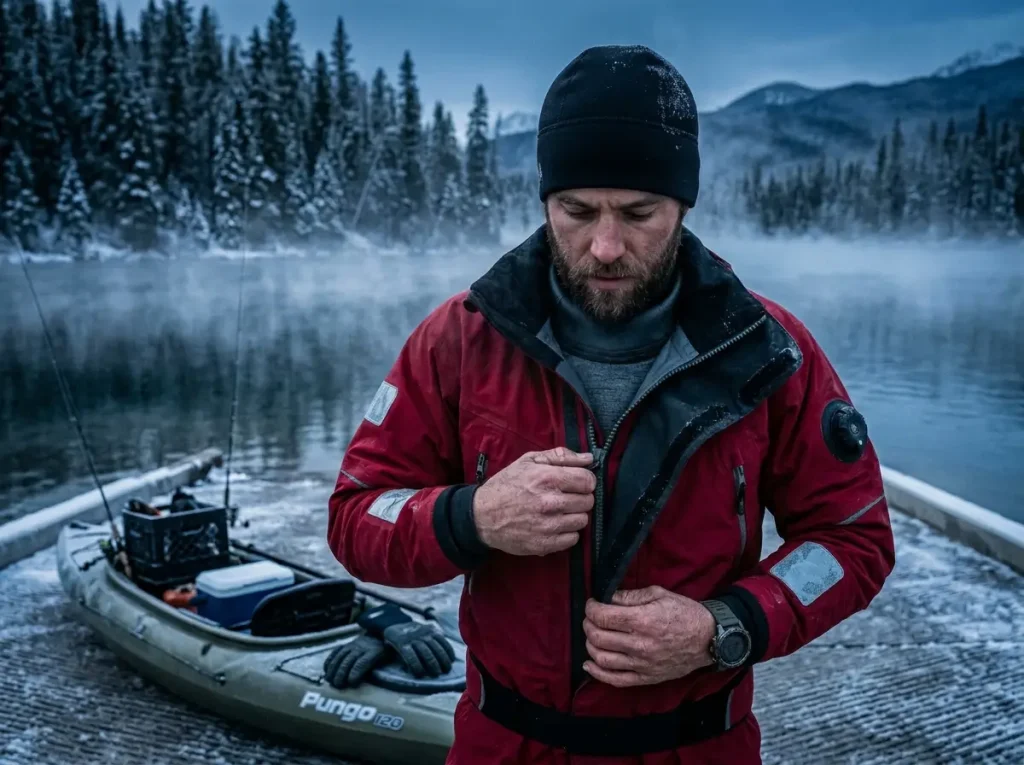
The number people cite is “1-10-1″—one minute to control breathing after immersion, ten minutes of useful movement, one hour until hypothermia sets in. It’s memorable. It’s also wrong. The National Center for Cold Water Safety has documented that this rule directly contradicts its own cited source: Giesbrecht’s 2006 research actually states that incapacitation can begin within two to ten minutes, not ten. More critically, cold water immersion physiology and the 1-10-1 myth debunked shows the gasp reflex can fire within seconds of hitting cold water—not after a full minute.
At 52°F, the cold shock response doesn’t wait for you to plan. Your diaphragm contracts. Your respiratory rate can jump by 600%. That involuntary gasp happens before your brain has issued a single instruction. If your mouth is underwater in that moment, you aspirate water. The sequence from capsize to aspiration can take less time than reading this paragraph aloud.
Then the system compounds. Cold shock triggers the sympathetic nervous system—heart rate can spike to 156 bpm—while facial immersion simultaneously triggers the parasympathetic diving reflex, which wants to slow the heart. The conflict produces cardiac arrhythmias. Arrhythmia rate rises from 2% with free breathing to 82% when the face is submerged and the breath is held. Healthy people. No prior heart conditions. Just cold, wet physics.
When selecting thermal protection for the water, consider choosing the right wader material for your water temperature to understand the insulation options that actually work when wet.
The 1-10-1 Myth — Why the Most Cited Cold Water Rule Is Wrong
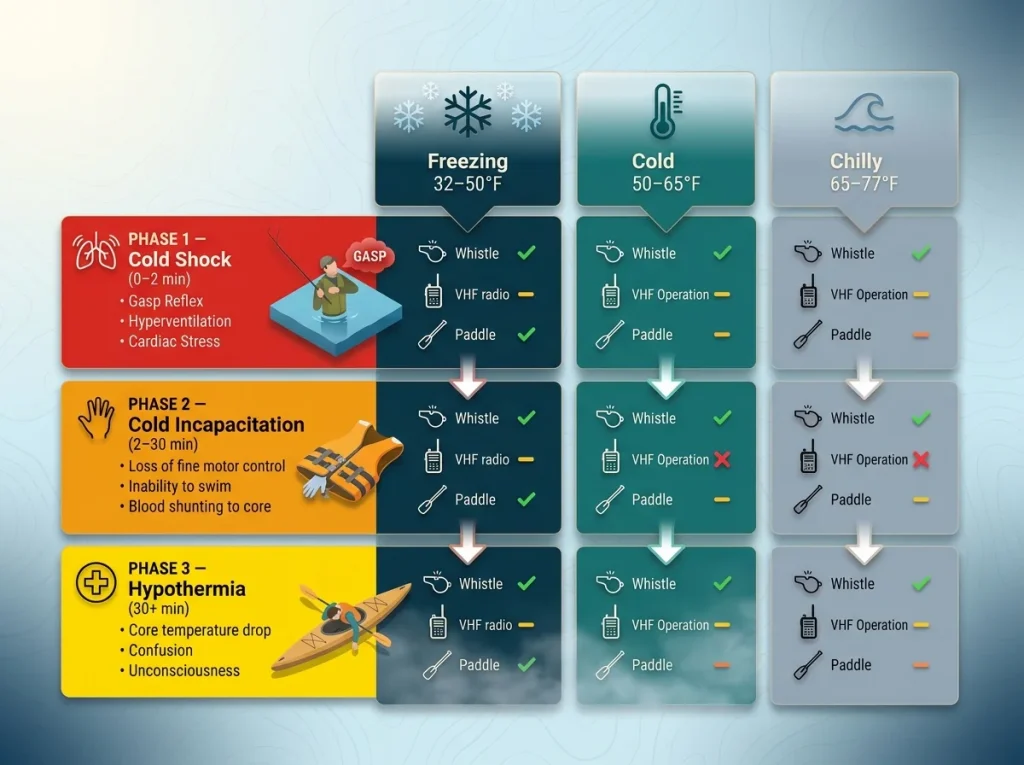
The survival myth persists because it’s comfortable. Ten minutes of competent movement feels like enough time to think, to self-rescue, to signal. The real compressed timeline looks like this: the first two minutes is cold shock—gasp reflex, hyperventilation, arrhythmia risk. From two to thirty minutes is cold incapacitation—blood shunting from extremities to core, loss of manual dexterity, inability to grip, buckle, or paddle effectively. Hypothermia begins after thirty minutes.
The operational problem with the myth is decision-making. An angler who believes they have ten minutes of competent movement may spend those minutes attempting re-entry instead of immediately signaling for help. That’s the failure mode. The window for getting a VHF transmission out, blowing a whistle, or making a call is the first two minutes—while you can still use your hands.
What “Dress for the Water” Actually Means in Practice
Cotton kills. Not as a slogan—as a material fact. Cotton absorbs water, collapses any insulating air pockets, and conducts heat away from your body roughly 25 times faster than dry insulation. It is never a base layer for kayaking, regardless of the air temperature. Wool and synthetics—polyester, polypropylene—maintain some insulation when wet. That distinction matters in early spring and late fall when air temps look manageable but water temps are still in the low 50s.
The decision framework is simple: if water temperature plus air temperature is below 120°F, wear thermal protection. Below 50°F water, you need a dry suit. The 50 to 65°F range calls for a neoprene wetsuit. Neither is overkill. They’re calibrated to the window of time you actually have if you go in.
The wader question comes up constantly, and the common answer is still wrong. Waders don’t pull you under. That’s a myth. The real risk is re-entry: waterlogged waders add significant drag to your body when you’re trying to pull yourself back onto a sit-on-top deck. A wading belt cinched at the waist dramatically slows water ingress and keeps that problem manageable. For more on belt selection, wading belt safety and why that strap matters more than you think covers the pressure mechanics in depth.
Cold Water Survival Matrix — Temperature, Dexterity, and Decision Windows
At 32.5°F, you have less than 15 minutes to exhaustion or unconsciousness. At 40 to 50°F, that window stretches to 30 to 60 minutes. At 60 to 70°F, it’s 2 to 7 hours. Water pulls heat from your body 25 times faster than air at the same temperature. Those numbers are not alarm statistics—they’re the operational time budget you have for self-rescue.
One risk that almost never gets mentioned: post-rescue collapse. When a rescued angler is pulled from cold water, peripheral blood vessels dilate rapidly as the body starts to rewarm. That sends cold blood from the extremities back toward the heart. Sudden cardiac events can occur even after a successful rescue. Responders need to handle cold-water victims horizontally for exactly this reason.
The Safety Gear Stack — What to Wear and Why the Hierarchy Matters
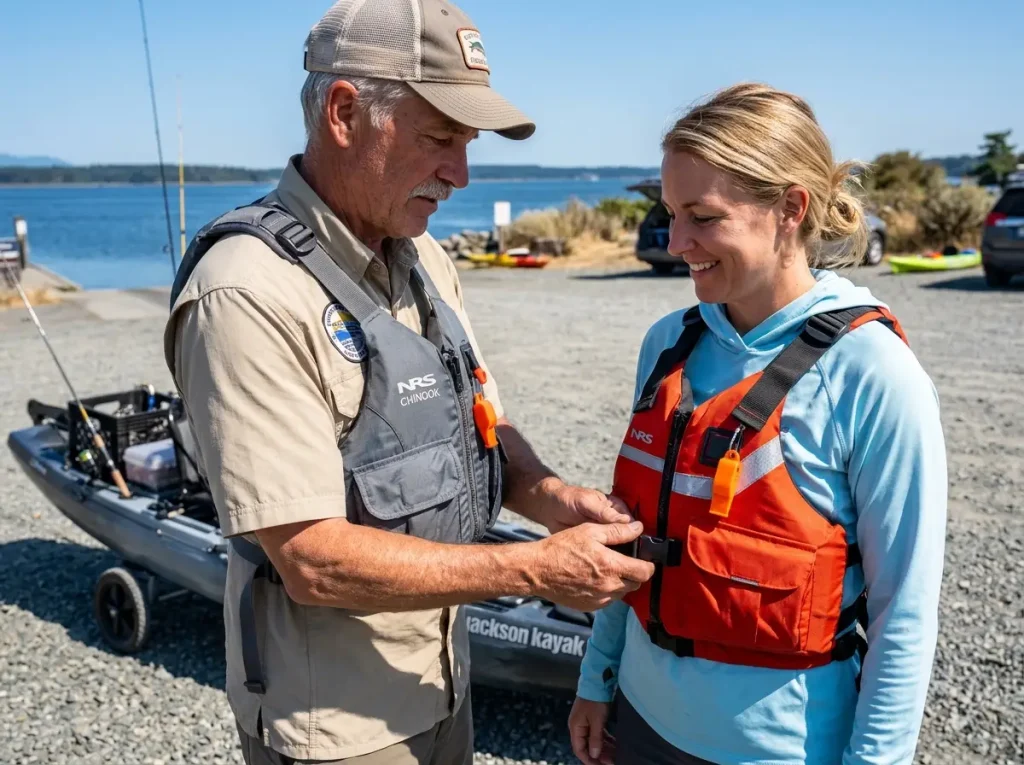
According to USCG recreational boating accident statistics, 87% of kayak fatality victims in 2024 were not wearing their PFD at the time of the incident. Not left it at home. Not lost it overboard. Had it on the boat but not on their body. A personal flotation device in the gear crate is worth nothing during the cold shock window.
Foam PFDs—Level 70, formerly Type III—are the non-negotiable baseline for beginners. No moving parts. No activation required. 15.7 to 16.5 pounds of buoyancy that works the moment you hit the water. The NRS Chinook OS makes a strong case as a purpose-built fishing vest: six front pockets including a dedicated VHF radio pocket, strobe attachment point, and reflective accents. That’s what purpose-built looks like versus a generic foam vest.
For a detailed breakdown of the failure modes involved, see auto-inflate vs. foam PFD for kayak fishing.
Pro tip: Squeeze a PFD that’s been stored in a garage for three years and hold it underwater. If it rises back slowly, the compressed foam has lost buoyancy. It looks fine. It doesn’t perform the same way. Replace it.
PFD Selection — Why “Fishing Style” Inflatables Fail Beginners
Auto-inflate PFDs have three potential failure points: the hydrostatic trigger, the CO₂ cartridge, and the manual pull. Hydrostatic triggers need roughly four inches of submersion to activate—which means they may not fire if you’re floating face-up on the surface. The manual pull requires fine motor control that cold water removes within the first two to three minutes. And many budget inflatables lack USCG approval entirely. Verify the label before you buy, then verify that label again.
The fit matters too: an improperly fitted PFD rides up over the face during immersion, defeating its purpose. The field test for fit is straight-arm upward tension at the shoulder straps. If the jacket rides past your chin, it won’t keep your airway above water.
Building the Deck — The “Rig to Flip” Philosophy
Every experienced kayak angler rigs with one assumption: this trip ends in a capsize. That mindset shows in how they set up the deck. Rods are leashed. Critical tools are tethered. Electronics live in dry bags.
The trap is going too far. Over-leashing creates what experienced paddlers call the “Hog-Tie Risk”: a spider web of tether lines across the deck that can entangle you during a flip, preventing you from surfacing. Leash selectively. Priority order: paddle first, VHF radio second, primary rod third. Pliers and gaffs clip to the PFD, not to the deck. Heavier gear—tackle boxes, crates—stays centered and low to keep the center of gravity as close to the waterline as the hull allows.
The Legal Minimum vs. The Survival Minimum — USCG Requirements
USCG legal requirements for kayaks cover one USCG-approved PFD per person, a visual distress signal (a whistle qualifies), and navigation lights for dusk or dark operation. That’s the floor. The survival minimum adds a communication device, a first aid kit, a float plan, and thermal protection appropriate to the water temperature. The legal requirement gets you compliant. The survival minimum is what keeps you alive if something goes wrong at 7am on a 55°F morning in April.
Anchoring Physics — The “Submarine Effect” and Bow-First Protocol
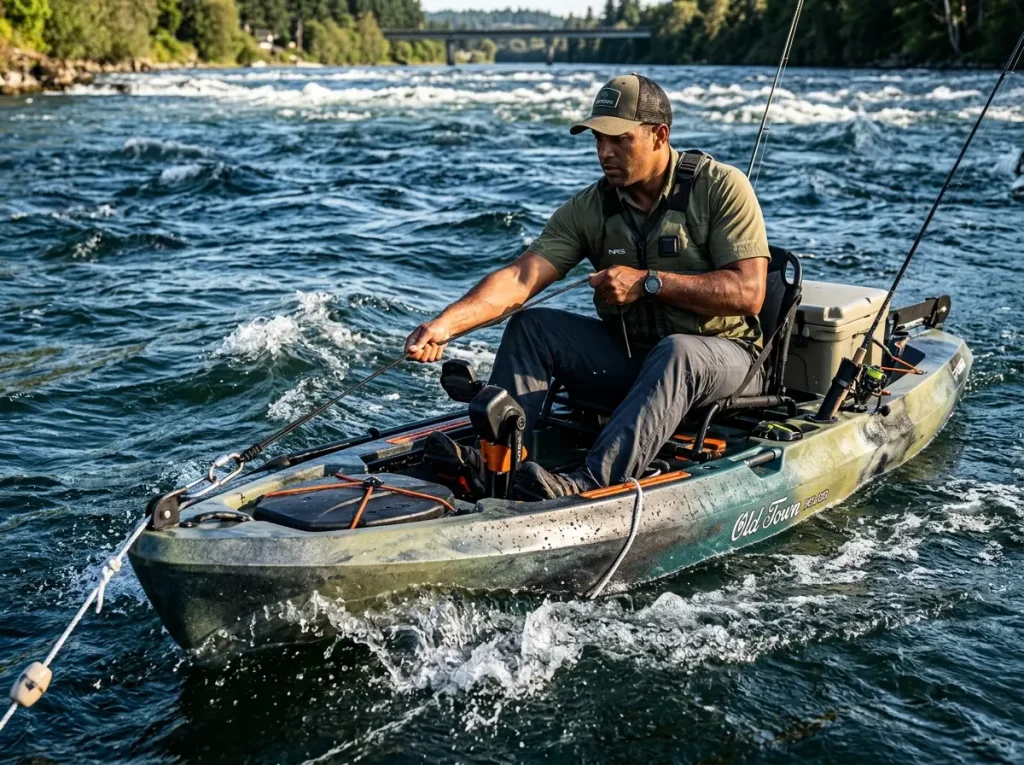
The worst capsize scenario in moving water isn’t a wave or an obstacle. It’s a taut anchor line attached to the wrong end of the boat. When you anchor from the stern in current, the hull gets pushed sideways and then backward as the drag force builds against the broad, flat transom. As current speed doubles, drag force quadruples. The stern of a fishing kayak was designed with low freeboard—deck sitting close to the waterline—for easy gear access. In current, that low freeboard means water washes over the transom before the angler realizes the situation has turned.
Once water clears the transom and enters the cockpit, the center of gravity shifts down and rearward. When the stability margin goes negative at that point, the capsize is irreversible. Paddling harder into it only makes things worse—increased paddling speed raises the effective current velocity over the hull and accelerates the whole sequence.
The fix is an anchor trolley system: a line-and-ring setup that lets you reposition the anchor attachment point anywhere along the kayak’s rail while seated. Move it to the bow, and the kayak naturally weathervanes to face into the current. The bow is designed to deflect water upward and over, not to hold it. For the full setup process, how to set up a 3-point anchor trolley system for kayak fishing covers the rigging from scratch.
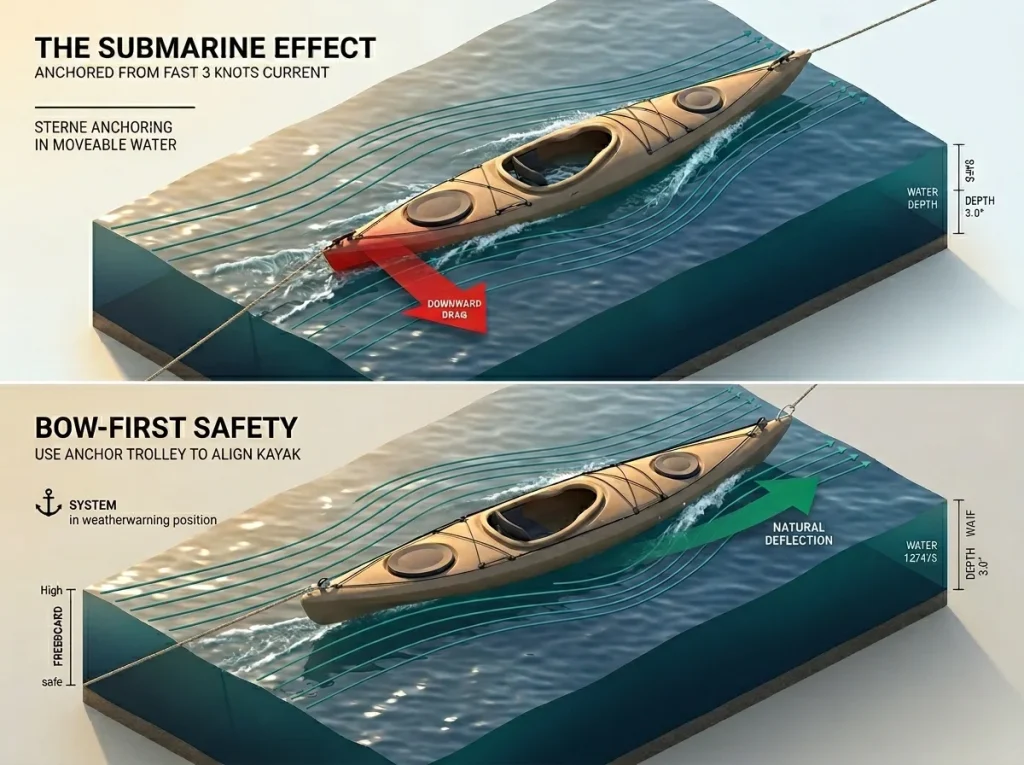
Why the Bow Must Face the Current — The Geometry of Safe Anchoring
The bow entry point is elevated specifically to lift over oncoming water and shed it to the sides. When the anchor is set from the bow using a trolley, the kayak aligns naturally with the current, and drag force pushes the hull forward—against the anchor rode—rather than sideways and down. Scope ratio matters: minimum 7:1 (anchor line length to water depth) for holding power in moving water. Less scope means a steeper angle on the line, which translates into more downward force on the attachment point.
Never cleat an anchor off hard from the bow in strong current without a quick-release mechanism. A quick-release cleat, a float-line system, or a simple weak-link allows you to ditch the anchor instantly if things go sideways. An anchor cleated tight to a capsized kayak becomes a hazard.
Current, Wind, and the “Return to Shore” Trap
Downstream paddling feels effortless. Paddling with a tailwind feels like progress. Both are lying to you about the return trip. A loaded fishing kayak on flat water moves at roughly 2 to 3 mph. A 15-knot headwind generates 17 mph of resistance. You don’t make it back—you burn reserves trying.
Station-keeping in current burns energy at near-racing intensity without the feedback of motion. Holding position in moving water is physically exhausting in ways that don’t register until the reserves are gone. Use your GPS speed-over-ground reading, not your effort sense, to determine if you’re actually making homeward progress.
Pro tip: Plan your route so the hardest segment—into wind or current—is first, not last. Tired anglers make bad decisions. Paddling with the wind home at the end of a long day is how you want to finish, not how you start.
Pedal Drive Capsizes — The Entanglement Risk Nobody Discusses
Old Town PDL and Hobie MirageDrive systems deploy below the hull during use. During a capsize, that deployed drive creates an underwater obstruction that can snag on logs, weed mats, or debris—locking the kayak inverted. Even without snagging, a deployed pedal drive prevents standard wet re-entry: you can’t flip the kayak upright without first retracting or removing the drive unit.
Pre-launch protocol: retract the pedal drive before entering water with submerged structure, heavy weed growth, or woody debris. It takes ten seconds to retract. A capsize with the drive deployed can cost you an hour. For a full breakdown of the hidden costs of pedal systems, what nobody mentions about pedal drive kayak fishing covers drive failures and entanglement scenarios in detail.
Communication and Emergency Signaling — The Technical Layer of Rescue
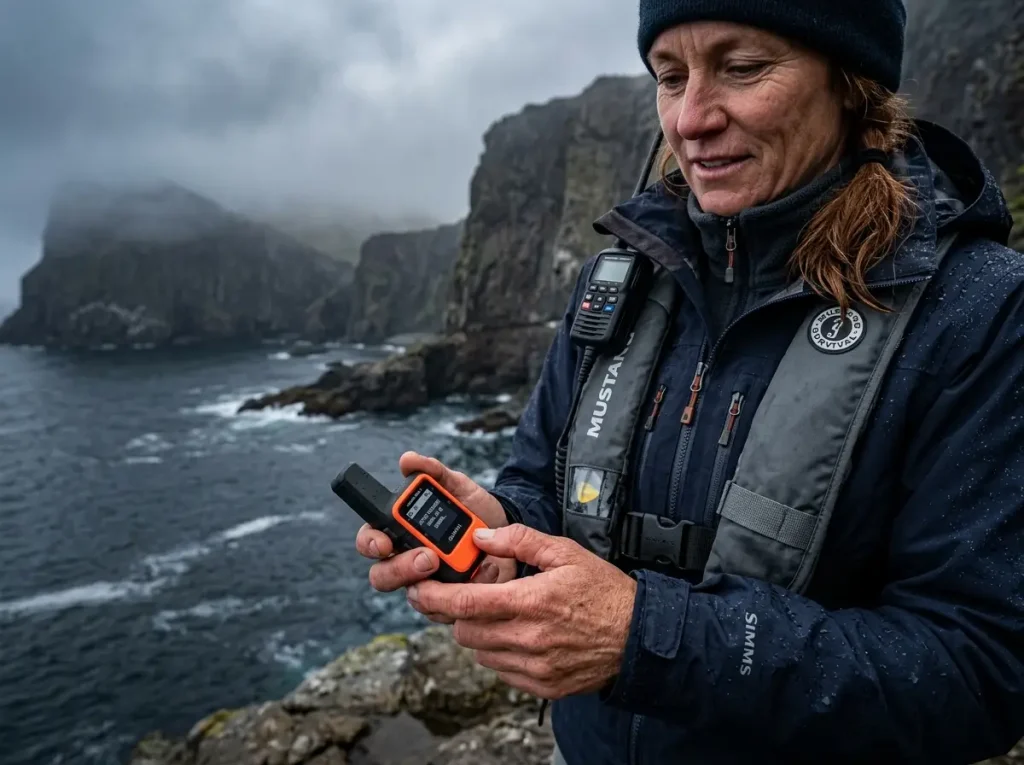
Your cell phone talks to a tower using line-of-sight radio propagation. On the water, surrounded by terrain, bluffs, or even elevation changes from shoreline vegetation, that line of sight disappears. Coverage maps show theoretical signal; they don’t account for what happens in a tidal creek with thirty-foot clay banks on both sides.
VHF Channel 16 is the USCG and commercial vessel monitoring frequency. A single Mayday broadcast from a VHF marine radio reaches every vessel in range simultaneously. That’s the one-to-many capability a cell phone 911 call cannot replicate. Cell 911 routes to a dispatch center, which must then contact the Coast Guard. In cold water, those minutes matter.
DSC (Digital Selective Calling) turns your distress call into a data packet. Press the red button on a DSC-equipped VHF and your unique 9-digit MMSI and GPS coordinates transmit immediately to the Coast Guard and all DSC-equipped vessels in range. Register your MMSI through BoatUS at no cost. Select “Portable Handheld VHF” as the radio type, and in the vessel description, list the specific kayaks you use the radio on. That way rescuers know they’re looking for a plastic 12-footer, not a motorboat. The FCC Maritime Mobile Service MMSI registration requirements page covers the formal requirements.
For the broader safety protocol framework including float plan filing, see float plan filing and boat-safe communication protocols.
VHF Radio vs. Cell Phone — Why One-to-Many Matters in an Emergency
A handheld VHF with IPX7 or IPX8 waterproofing reaches 3 to 5 miles vessel-to-vessel and up to 20 miles to a USCG tower with an elevated antenna. That range covers most inland fishing scenarios and all coastal ones. The waterproofing matters as much as the range: a dropped radio must survive long enough to make the call.
Cell 911 adds dispatch latency. In 45°F water, the time that latency costs you is real. The USCG monitoring Channel 16 means response can come from any direction—not just from dispatch routing the call to the nearest station.
PLB vs. Satellite Messenger — Which One a Beginner Should Buy
A personal locator beacon on 406 MHz connects directly to the COSPAS-SARSAT satellite system, which routes to government Search and Rescue agencies. No subscription. No cell infrastructure. Five-year battery shelf life. A 121 MHz homing signal guides rescuers to your exact location once the initial alert is received. It’s one-way—you can’t receive communication—but it’s purpose-built for the specific scenario: life-threatening emergency, no other comms available.
A satellite messenger like the Garmin inReach uses the Iridium network and allows two-way texting with a subscription. Lower transmit power than a PLB, more versatile for non-emergency communication. For a beginner on a fixed budget, the PLB wins: no ongoing cost, government-grade signal strength.
Carry both if you can. Use the messenger for float plan check-ins. Save the PLB for the moment nothing else is working.
The Float Plan — The One Tool That Costs Nothing and Saves Lives
A float plan is a written document—physical or digital—that you leave with a non-paddling contact before every trip. It includes your launch location, intended route, expected return time, vessel description, MMSI number, and clear instructions: if I’m not back by this time plus two hours, call the Coast Guard.
The USCG FLOAT PLAN app standardizes the format and makes it shareable. There is no equivalent free tool that gives rescuers a starting search area when you don’t come home. A float plan doesn’t prevent capsizes. It ensures someone knows which stretch of water to work when it matters.
Hook Injuries and On-Water First Aid — The Gear You’ll Actually Use
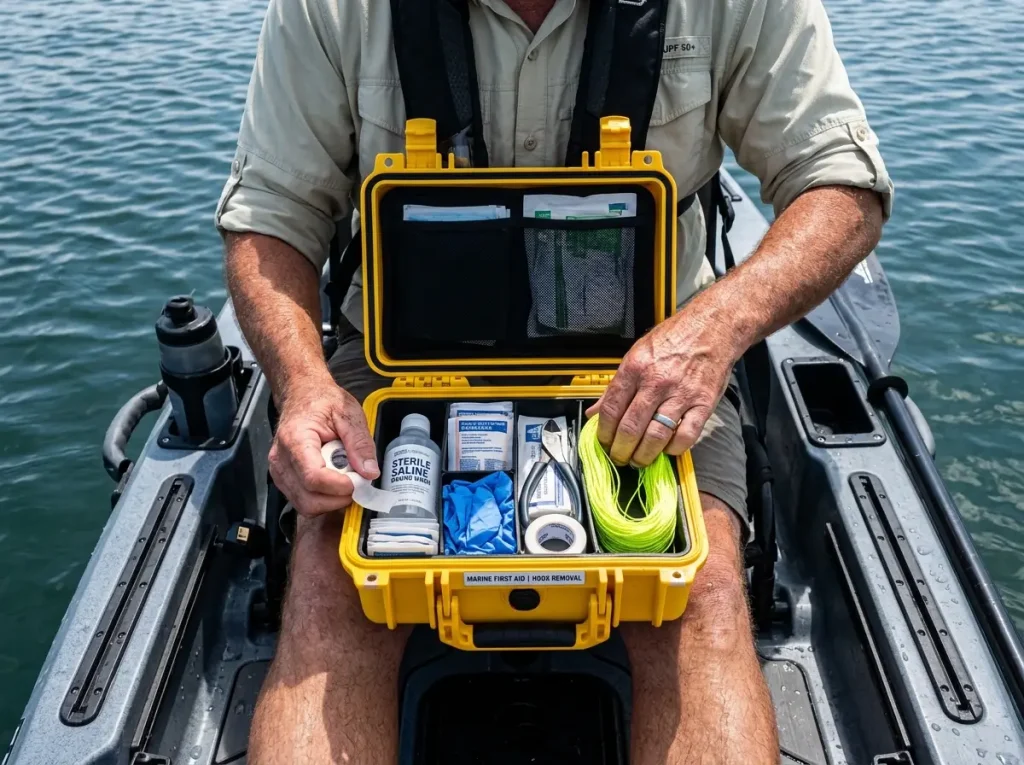
You will not capsize every trip. You will almost certainly put a hook into yourself or a fishing partner at some point. The math is simple: multiple hook points, confined cockpit, fish fighting at close range. Near-misses are weekly for active kayak anglers. Actual embedding is a matter of time.
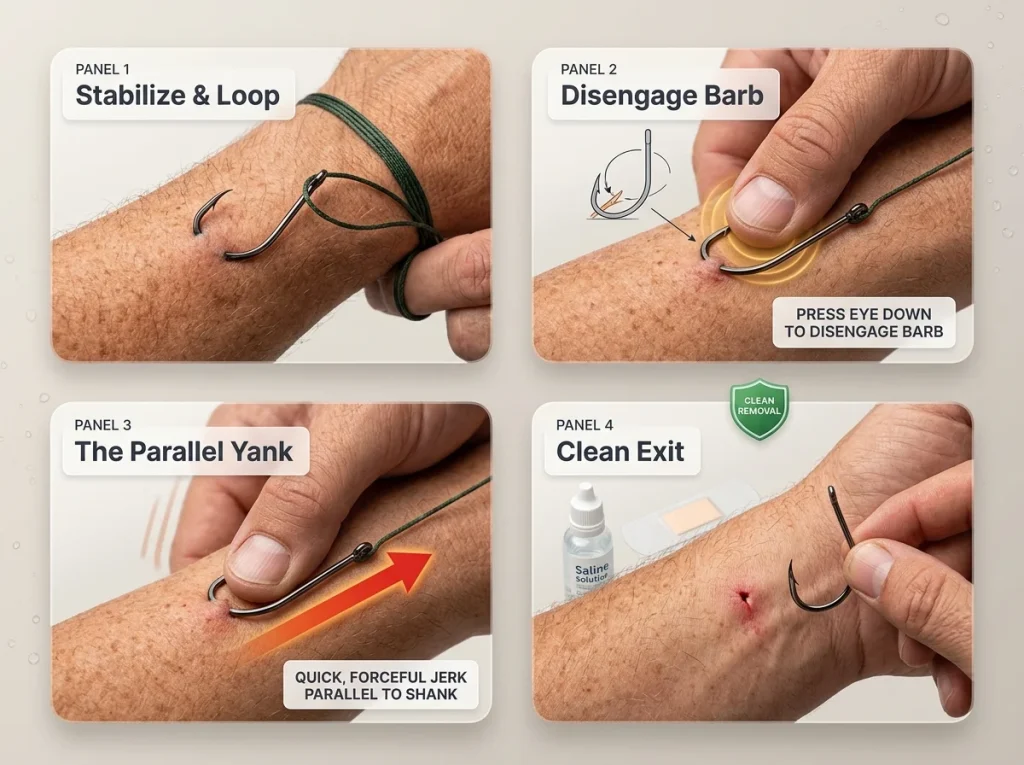
The field method that works is the string-yank technique, also called the retrograde or stream method. String-yank fishhook removal technique clinical evidence from NIH PubMed Central documents why this approach causes less tissue trauma than standard advance-and-cut or other field techniques. It requires no anesthesia, no cutting tools, and no medical supplies beyond what you already have on your line.
For the full breakdown of all three field techniques with visual detail, complete fishhook removal guide with all three field techniques covers every removal scenario. And if you haven’t built a proper on-water first aid kit yet, how to build a waterproof first aid kit for anglers covers the exact components you need in an IP67-rated case.
The String-Yank Technique — Step-by-Step Field Protocol
Here’s where most people fail: they skip step three.
- Stabilize the injured body part on a firm, flat surface. If the hook is in an earlobe, fingertip under load, or near a joint under tension, this technique is contraindicated—stabilize and get to a clinic.
- Loop 30 lb or heavier braided line around the midpoint of the hook’s bend. Wrap the ends around your hand or a tool for a solid grip.
- Press the hook eye DOWN toward the skin with your non-dominant thumb. This pivots the barb away from tissue, disengaging it from the flesh. Skip this step and you’re tearing through tissue instead of exiting cleanly through the entry wound.
- While maintaining downward pressure on the eye, apply a quick, forceful jerk parallel to the hook shank. The hook should pop out through the original entry wound.
- Irrigate immediately with saline. Do not squeeze or probe the wound.
Hooks that come from open water—saltwater or freshwater—carry aquatic bacteria including Vibrio species and Aeromonas. Hook wounds have a higher infection risk than equivalent land injuries for exactly this reason. Watch for redness spreading from the wound, fever, or streaking over the next 24 to 48 hours.
Pro tip: Pinch the barbs on all but one point of every treble hook before fishing from a kayak. You lose almost nothing on the hookset. You convert a triple-point entanglement emergency into a single-hook situation you can handle in the boat.
Heat Exhaustion and Dehydration — The Silent Mid-Trip Hazard
UV exposure on open water is double what it is on land because the surface reflects it back up. Thirst is a lagging indicator—by the time you’re thirsty, cognitive function is already slipping. By the time you’re nauseous, decision-making is compromised in ways you won’t notice until the paddle feels heavy and the shade looks close.
Drink 20 oz of water per hour in warm conditions. More if you’re moving hard or the temperature is above 85°F. To understand the full progression and how to respond when recognizing and treating heat exhaustion on the water escalates, that guide covers the treatment protocol.
For a practical on-water trick that costs nothing: freeze a two-liter bottle of water the night before. It’s an ice pack for your fish box in the morning, cold drinking water by noon, and emergency wound irrigation if your saline runs out.
Conclusion
Three things most kayak fishing guides won’t say directly:
The wide-hull fishing kayak that feels rock-solid in the parking lot has a hard mechanical limit. Centerline management, bow-first anchoring, and understanding your hull’s secondary stability ceiling are the mechanical foundations of not capsizing. None of them are instinctive. All of them have to be learned before the trip, not during it.
Cold water takes you before you know you’re in trouble. The gasp reflex fires in the first two seconds of immersion. A foam PFD worn correctly—every second on the water—is the only countermeasure that works with no reaction time required. Thermal protection matched to water temperature, not air temperature, extends the window you have if everything else goes wrong.
Rescue depends on your preparation, not your cell signal. A registered DSC-equipped VHF radio, a float plan on file with a specific return time, and a PLB as backup put you inside the communication envelope that actually reaches rescuers fast enough to matter in cold water.
Before your next trip, run this drill: put your PFD on and clip your leashes in the parking lot before launch. Time yourself. If it takes more than 90 seconds to be rig-to-flip ready, you’re rushing it at the ramp and skipping it on nice-water days. Nice-water days are when beginners end up in the water.
FAQ
Is it safe to fish from a kayak?
Manageable with competence—not inherently safe. Kayak-specific fatalities numbered 89 in 2024, a disproportionate share of recreational boating deaths relative to vessel size and complexity. The risk mitigation framework is physics-based operation (bow anchoring, centerline management), proper thermal protection, redundant communication, and a worn foam PFD. That combination controls the real risks. Luck doesn’t.
Do I need a life jacket in a kayak?
Legally, you need one aboard. Physiologically, you need it on your body at all times. The involuntary gasp reflex from cold shock response occurs within seconds of cold water immersion—there is no functional window to put on a PFD after capsizing. 87% of kayak fatality victims in 2024 were not wearing theirs when they went in.
What should I do if my kayak flips while fishing?
Stay with the boat. A sit-on-top fishing kayak remains buoyant when swamped—it’s a far larger visual target for rescuers than a human head in moving water. Don’t try to swim for shore unless the boat is actively sinking. Signal immediately using your whistle or VHF, control your breathing through pursed lips to slow the gasp response, and attempt kayak re-entry only if water temperature and your physical condition actually permit it. Practice wet re-entry in a pool or calm water before you need it in the field. The kayak self-rescue or deep-water re-entry guide walks through the scramble recovery method step by step.
Can you wear waders in a kayak?
Yes, but only with a wading belt cinched tight at the waist. The waders pull you down story is false—waders don’t act as an anchor. The real problem is re-entry drag: waterlogged waders significantly increase the effort required to pull your body back onto the deck, and that effort can exhaust you before you succeed. A belt slows water ingress and reduces that risk substantially.
What is a float plan and do I actually need one?
A float plan is a written record left with a non-paddling contact before every trip: launch site, intended route, expected return time, vessel description, and MMSI number. You need one every single time you go out. It’s the only tool that ensures someone knows where to look when you don’t return on schedule. The USCG provides a free standardized form through their mobile app.
Risk Disclaimer: Fishing, boating, and all related outdoor activities involve inherent risks that
can lead to injury. The information provided on Master Fishing Mag is for educational and informational purposes
only. While we strive for accuracy, the information, techniques, and advice on gear and safety are not a substitute
for your own best judgment, local knowledge, and adherence to official regulations. Fishing regulations, including
seasons, size limits, and species restrictions, change frequently and vary by location. Always consult the latest
official regulations from your local fish and wildlife agency before heading out. Proper handling of hooks, knives,
and other sharp equipment is essential for safety. Furthermore, be aware of local fish consumption advisories. By
using this website, you agree that you are solely responsible for your own safety and for complying with all
applicable laws. Any reliance you place on our content is strictly at your own risk. Master Fishing Mag and its
authors will not be held liable for any injury, damage, or loss sustained in connection with the use of the
information herein.
Affiliate Disclosure: We are a participant in the Amazon Services LLC Associates Program, an
affiliate advertising program designed to provide a means for us to earn advertising fees by advertising and linking
to Amazon.com. As an Amazon Associate, we earn from qualifying purchases. We also participate in other affiliate
programs and may receive a commission on products purchased through our links, at no extra cost to you. Additional
terms are found in the terms of service.