

In this article
You are standing in front of a wall of rods, and half of them say “Medium Fast” on the blank without explaining what that buys you. Here is the part nobody says out loud: most of the money wasted on a first rod is not wasted on the wrong price tier. It gets wasted on a rod that never matched how the buyer actually fishes, which is why so many anglers own a perfectly good rod they never reach for. Learning how to choose a fishing rod is really about answering three questions before you look at a single spec. Answer them, and the wall of rods collapses down to one or two obvious choices.
How to Choose a Fishing Rod in the Right Order
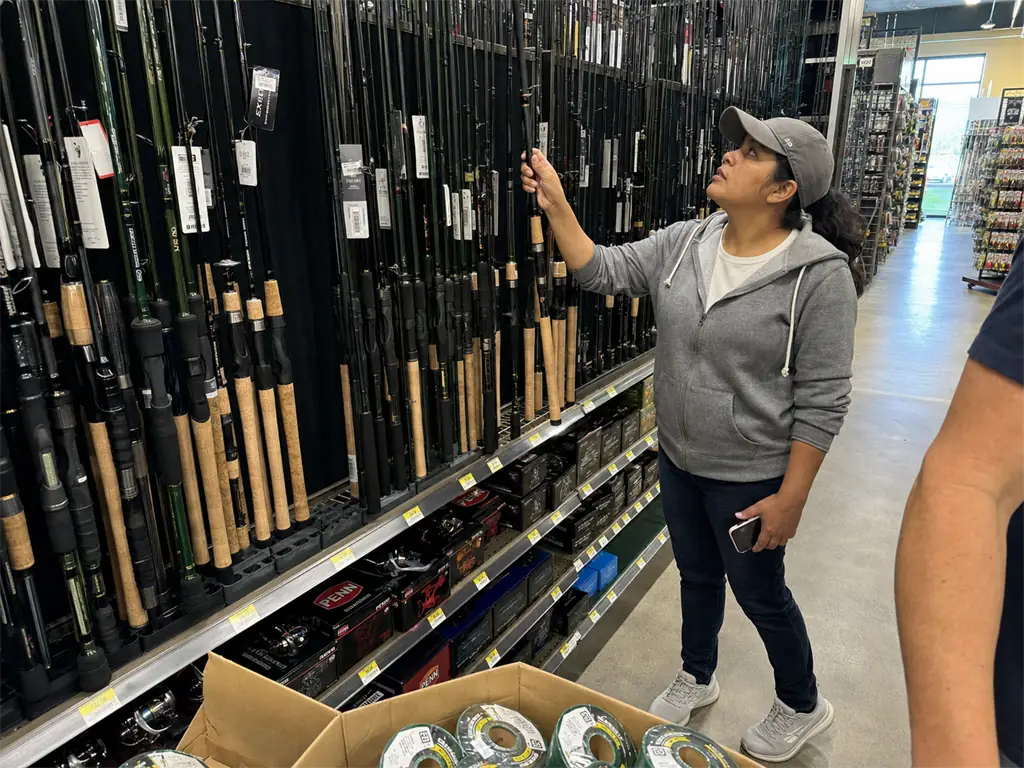
Every guide hands you a spec glossary and walks away. What an experienced angler actually does at the boat ramp is ask three questions, then point at two rods on the rack. That sequence is the whole trick, and almost nobody writes it down.
What Are You Actually Fishing For?
Species and technique come first because everything downstream depends on them. Panfish off a dock, largemouth bass in weed edges, and northern pike in open water ask for three different rods, and no single answer serves all three well.
If your honest answer is “a bit of everything from shore,” that is a real answer, not a cop-out. A single medium power rod covers the widest range of everyday baits and situations, roughly the quarter-ounce to three-quarter-ounce lure window, which is exactly why it is the standard recommendation for a one-rod angler.
How Do You Want to Cast?
This decides the rod type, which eliminates more wrong rods faster than any other choice. Push-button simplicity, open-bail versatility, or thumb-controlled accuracy: those are the three lanes, and each one has a rod built for it.
What Are You Willing to Spend?
Budget goes last, not first, because it narrows a shortlist instead of building one. Decide the first two answers, then let your budget pick between the two or three rods that already fit.
If you want the wider overview before you start narrowing, our complete guide to fishing rods covers the whole category in one place.
Rod Type: Spincast, Spinning, or Baitcasting
This is the fork in the road where beginners get pushed toward a baitcaster by someone showing off, then spend a summer picking out backlashes instead of catching fish. The honest answer is boring and freeing: start easy, graduate when you feel like it.
Spincast: The Zero Learning Curve Start
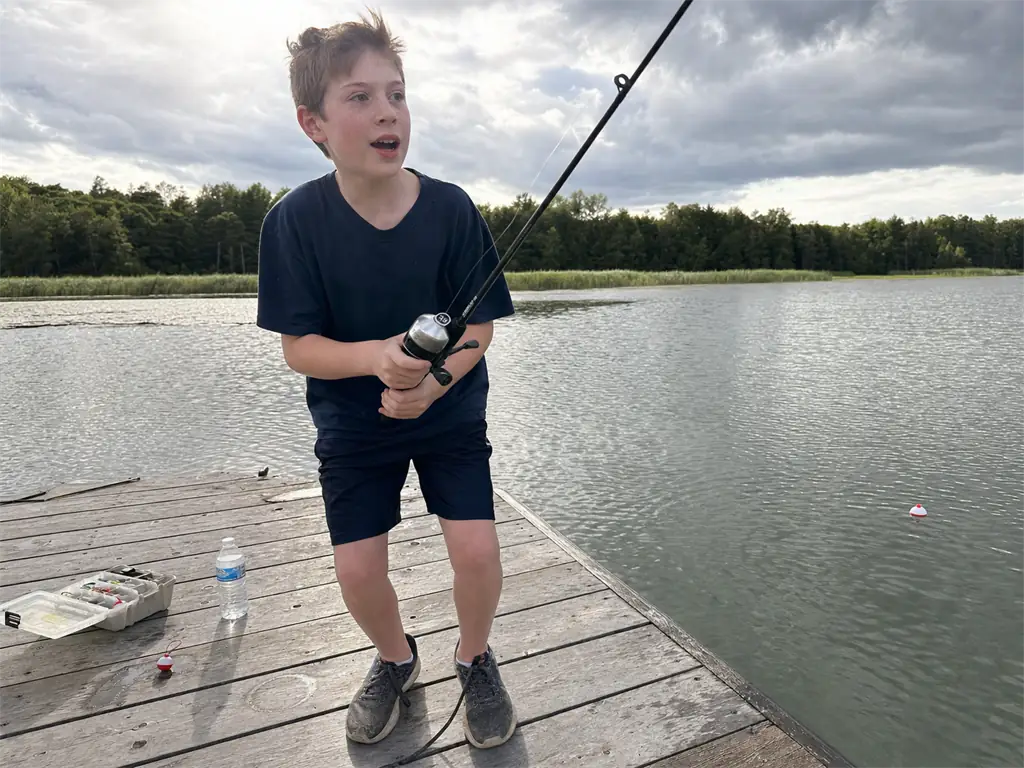
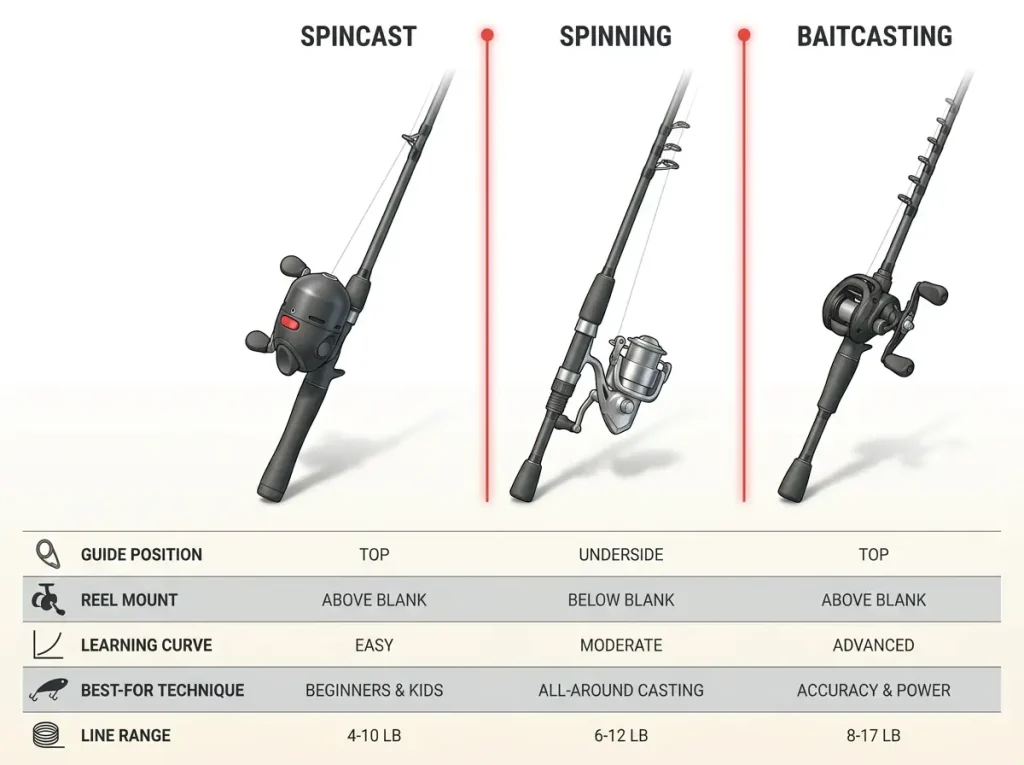
A spincasting rod pairs with a closed-face, push-button reel. Guides sit on top, the line stays enclosed, and casting is a single button press. There is no bail to flip, no spool to thumb, and almost nothing to go wrong.
This is the true first-timer and kid option, and there is nothing embarrassing about it. The U.S. Fish and Wildlife Service’s own guide for first-time anglers recommends exactly this, or an open-bail spinning setup, on a rod that sits comfortably in one hand. The Zebco 33 Spincast Combo is the classic version of that setup, and plenty of anglers caught their first hundred fish on one.
Spinning: The Default First Real Rod
A spinning rod carries its guides underneath the blank and pairs with an open-bail reel that hangs below. It handles light lures better than anything else at this price, it fights tangles less than a baitcaster, and it covers most freshwater fishing without complaint. If you are buying one serious rod, buy this one.
Baitcasting: Worth It, But Not Yet
A casting rod puts the guides on top with the reel sitting above the blank, and it buys real accuracy and control under heavier line and lures. It also comes with a learning curve made of thumb pressure and backlashes. It is a step up, not a starting point, and rod type is not just a preference. Guides-up means the blank loads with the guides on the compression side, so you cannot simply bolt a spinning reel onto a casting rod and call it done.
Once you have the rod type sorted, picking your first reel type is the other half of the same decision.
Rod Power: Matching the Rod to the Fish
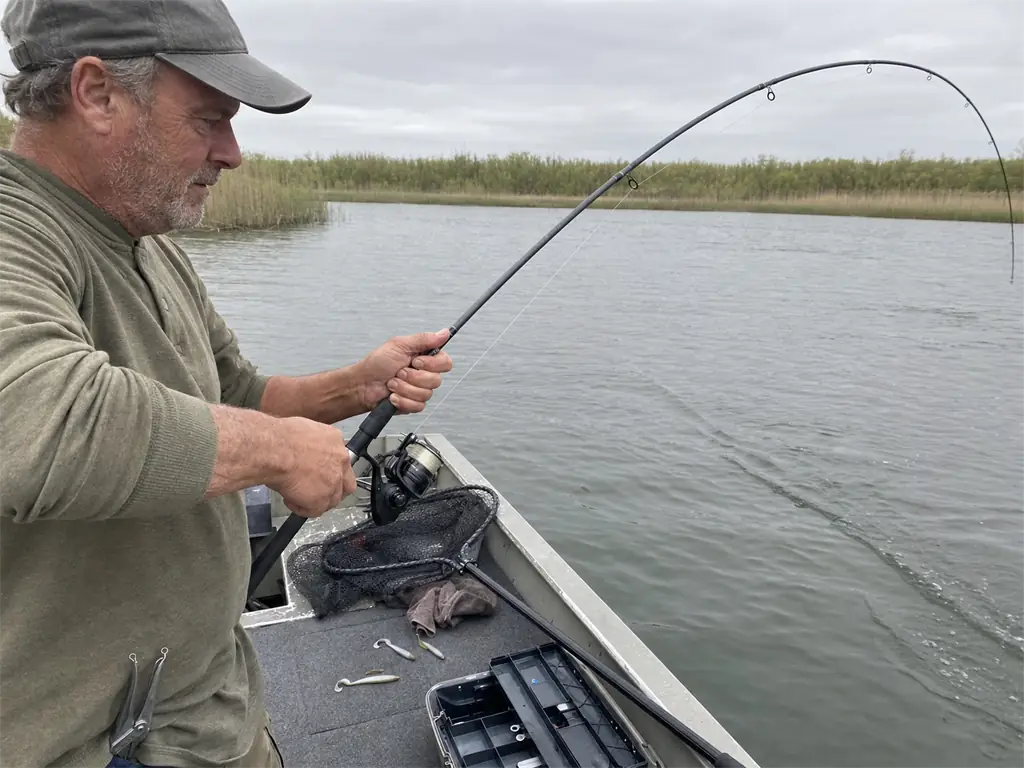
Rod power measures how much force it takes to bend the blank. The scale runs from ultra light power, built for tiny lures and two to six pound line, up through medium, medium heavy power, and heavy power, and out to ultra heavy power, which is musky and tarpon territory.
What the Power Scale Actually Measures
Power is about resistance to bending, not about how the rod bends. That distinction matters because power and action get mixed up constantly, and they control completely different things. Power decides whether the rod can move the fish. Action decides where the blank gives while it does.
Why Medium Is the Honest Default
Medium power, roughly the quarter-ounce to three-quarter-ounce lure range, is the most recommended all-around rating for a first do-it-all rod. It throws most common baits, covers bass, walleye, and stocked trout without complaint, and does not punish you for fishing outside its comfort zone by much. Step up toward medium heavy when salmon or heavy cover enter the picture.
Overpowering and Underpowering Both Cost You Fish
Community slang is diagnostic here. A noodle rod has too little backbone and too much whip for the target species, so you never build the hook-setting power to drive a hook home or turn a decent fish. A broomstick has too much stiffness for the technique, so light bites vanish and hooks tear free on the hookset.
Both descriptions belong to money spent on the wrong rod, not on a cheap one. A heavy-power blank over a panfish pond is a broomstick with a price tag, and it will make good fishing feel dull.
If you are stuck between two power ratings, pick the lighter one. An underpowered rod still lands most fish, it just takes longer and it is more fun doing it. An overpowered rod turns every average fish into a dull, quick chore and hides the light bites you never knew you missed.
Power and action get confused so often that it is worth reading why rod power and rod action are not the same thing before you commit to either.
Rod Action: Where the Blank Bends
Rod action describes where along the blank the rod bends under load, which is really a question of rod taper: how the wall thickness changes from butt to rod tip. It is the spec that most changes how a rod feels in the hand, and the one people understand only after fishing two rods back to back.
Fast Action: Sensitivity and Instant Hooksets
A fast action rod bends in the top third and keeps the rest stiff. You feel more through the blank, and the hookset happens the instant you move your wrist. That suits jig fishing, worm fishing, and other single-hook presentations where the hook has to drive home fast.
Moderate Action: The Forgiving Middle
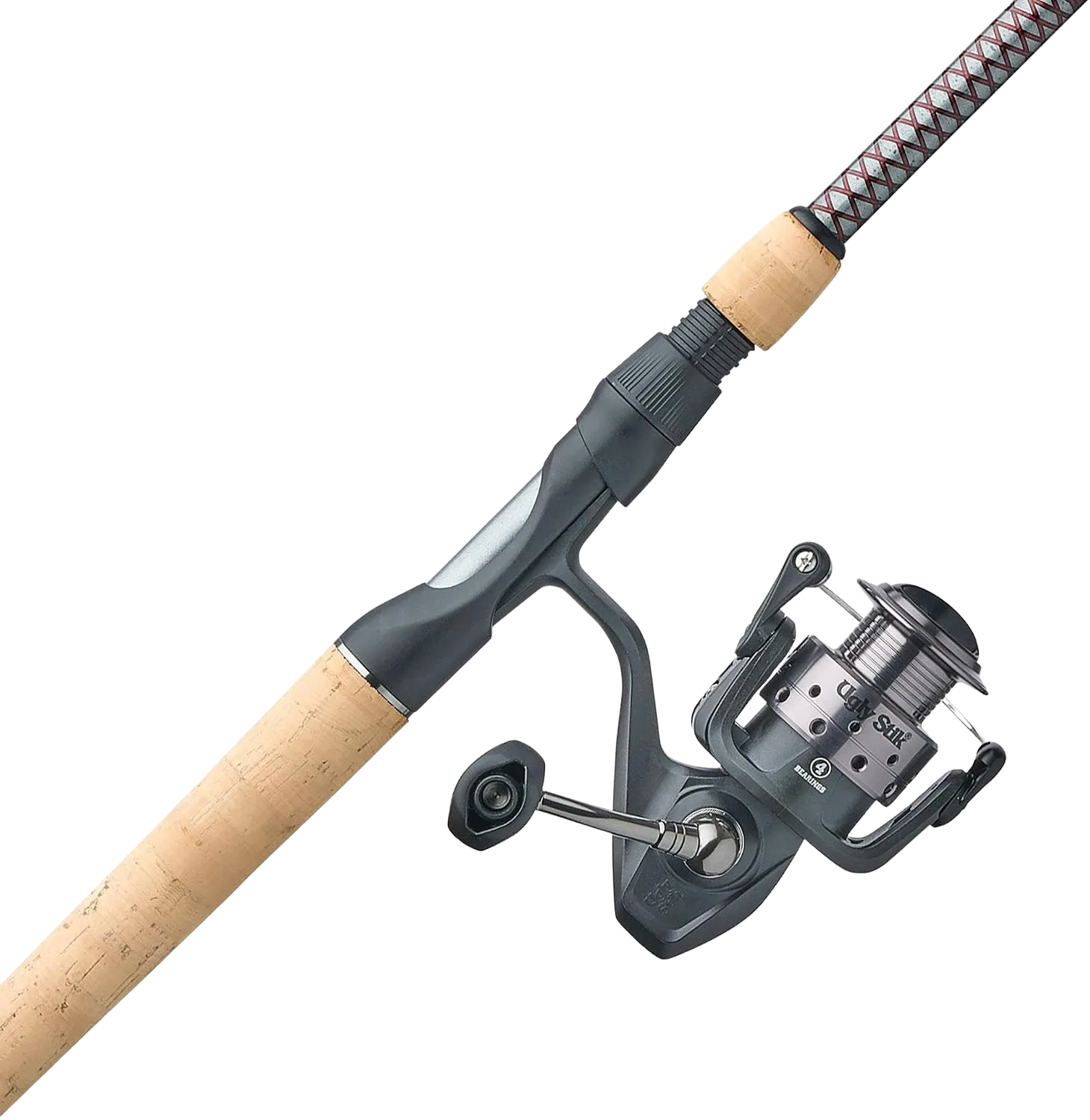
A moderate action rod, sometimes labeled medium action, bends closer to the middle, which makes it slower to set a hook but far more forgiving of timing. That trade is worth it in cranking and spinnerbait fishing, where treble hooks meet a hard, fast hookset and rip out of a fish’s mouth instead of burying.
The Ugly Stik Elite Spinning Combo sits at medium fast, right where most anglers land once they have fished a season. It is the honest middle: quick enough for a jig, soft enough that a mistimed hookset does not cost you the fish.
Slow Action: Distance and Shock Absorption
A slow action, sometimes called parabolic action, bends through nearly the whole blank. That buys maximum shock absorption and long casts with light line, at the cost of hookset speed. It is a specialist choice rather than a first rod, though the difference in rod flex is the reason two rods with identical power ratings can cast completely differently.
Beginners generally do better one notch slower than the tournament crowd recommends. A more forgiving action quietly covers for hookset timing that is not dialed in yet, and that is exactly what a first season looks like. If you want a wider shortlist than one combo, our honest picks for a first spinning rod go through six of them.
Rod Length: What You Gain and What You Give Up
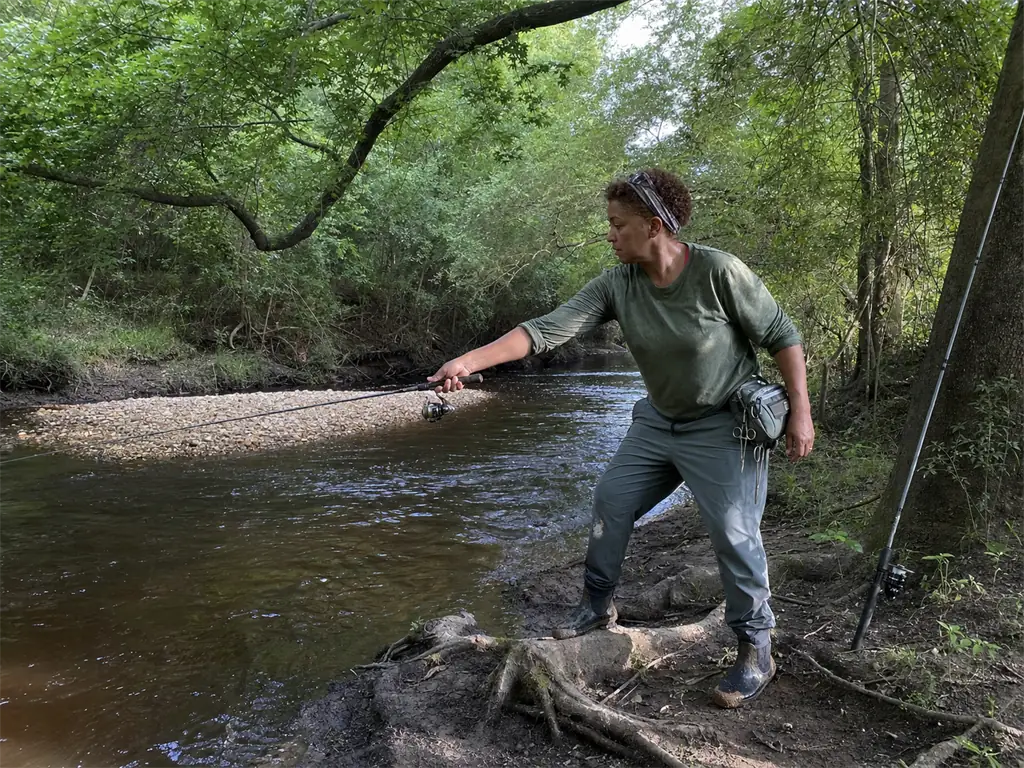
Rod length is the spec people pick by accident, whatever happened to be hanging on the peg, and then quietly fight for years. Where you stand when you fish should decide it.
What Length Buys You
Longer rods buy casting distance and leverage. Shorter rods buy casting accuracy and control in tight quarters. The everyday freshwater range runs roughly six to eight feet, with about seven feet as the common all-around starting point.
Length also has a cost nobody prints on the packaging: a longer rod fatigues your arm faster over a full day of casting. That matters more than most spec sheets admit, especially if you fish from shore.
Matching Length to Where You Stand
Overgrown creek banks, boat fishing from a small hull, and kayak fishing all favor something shorter, because a long rod hits branches and gunwales on every backcast. Open shorelines, piers, wading a wide river, and surf fishing all favor longer, because distance is the whole point. That is the entire logic, and matching rod length to your fishing situation walks through the specific numbers.
One Piece or Two?
A one-piece rod transmits vibration slightly better and has no ferrule to loosen. A two-piece rod fits in a sedan trunk. For most people that second point wins, and the sensitivity difference is smaller than the internet suggests. The full breakdown of the one-piece versus two-piece trade-off covers where each one genuinely matters.
Rod Material: Graphite, Fiberglass, or Both
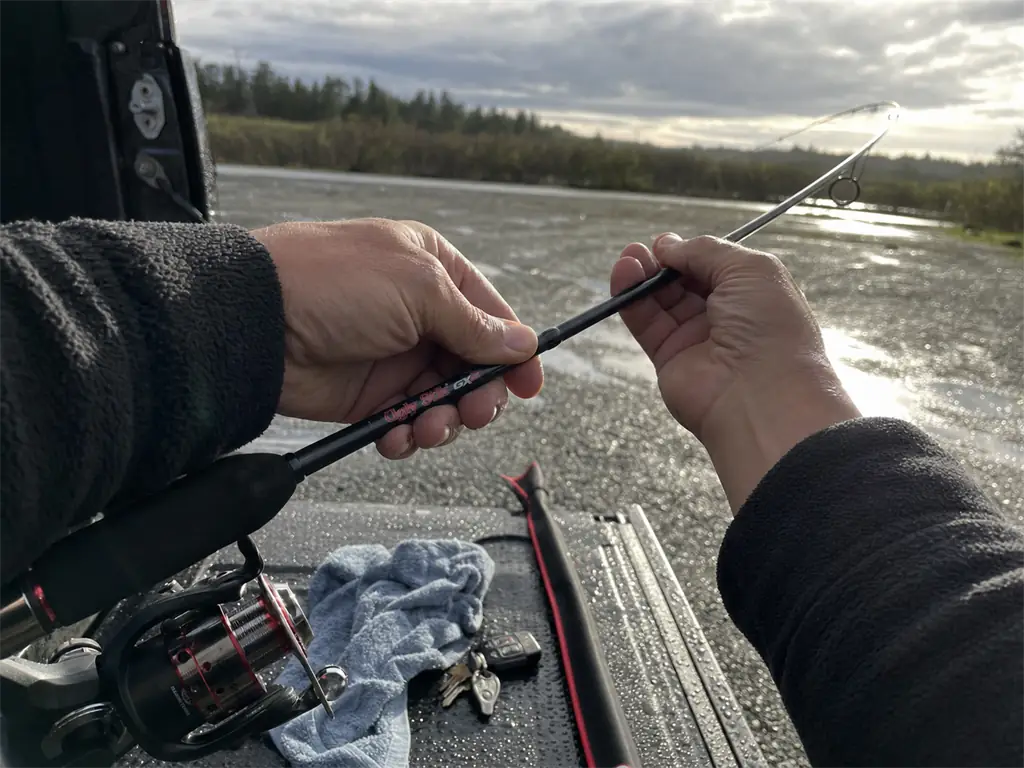
This is where marketing gets loudest and the real difference gets smallest for a first rod.
Graphite: Sensitivity at a Price
A graphite rod is lighter, stiffer, and more sensitive. You feel more of what is happening at the lure, which matters enormously for bottom-contact techniques. It is also less forgiving of abuse, and a car door closing on a graphite blank usually ends the conversation.
Fiberglass: Tough, Slow, and Underrated
A fiberglass rod is heavier, slower, tougher, and cheaper. It absorbs shock, survives mistakes, and keeps treble hooks pinned during a head-shaking fight. Serious crankbait anglers still choose glass on purpose, which should tell you something.
Composite: The Honest First Rod Answer
A composite rod blends both materials and splits the difference. That blend is the sweet spot for a first rod, and the Ugly Stik GX2 Spinning Combo is the version most anglers have handled at some point. Its composite blank has a reputation for surviving things that should have ended it, and that forgiveness quietly covers for hookset timing a first-season angler has not developed yet.
One caveat on the numbers. Graphite modulus ratings like IM6, IM7, and IM8 are not a standardized industry grade, and a blank advertised as high modulus graphite is making a marketing claim rather than quoting a measured tensile strength. A higher modulus can also mean a more brittle blank, and the label alone tells you nothing about how the rod was actually built. If you want the material science behind that, the real difference between graphite and glass and what rod modulus numbers actually mean both go deeper than a spec sticker ever will.
Reading the Numbers Printed on the Blank
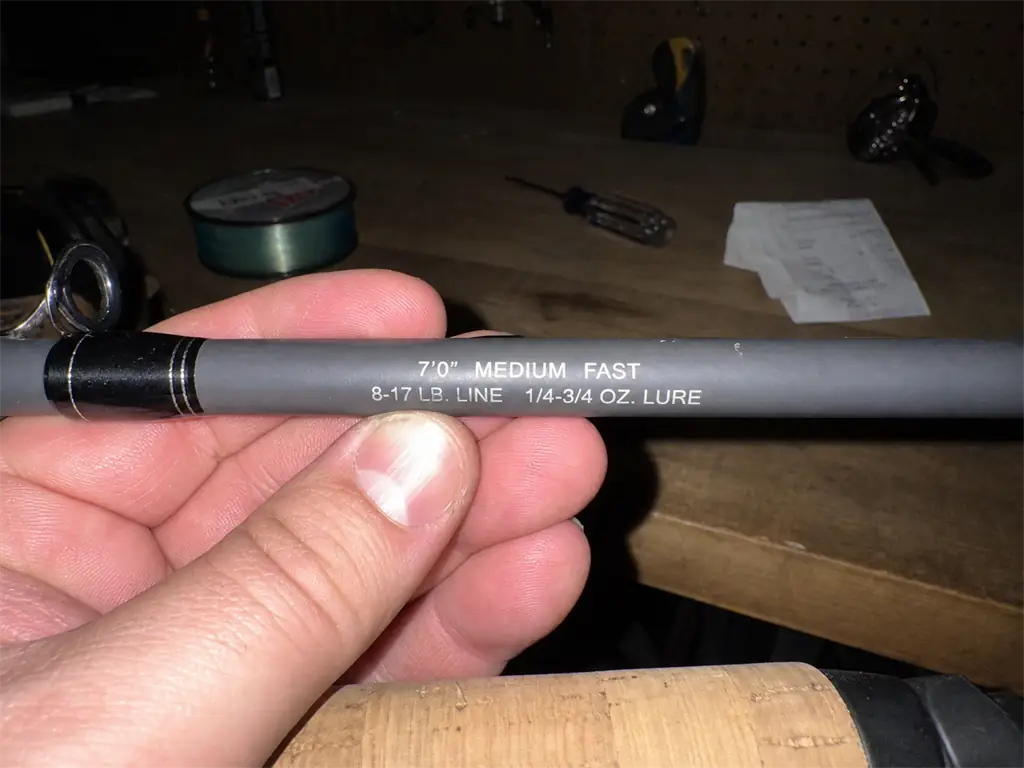
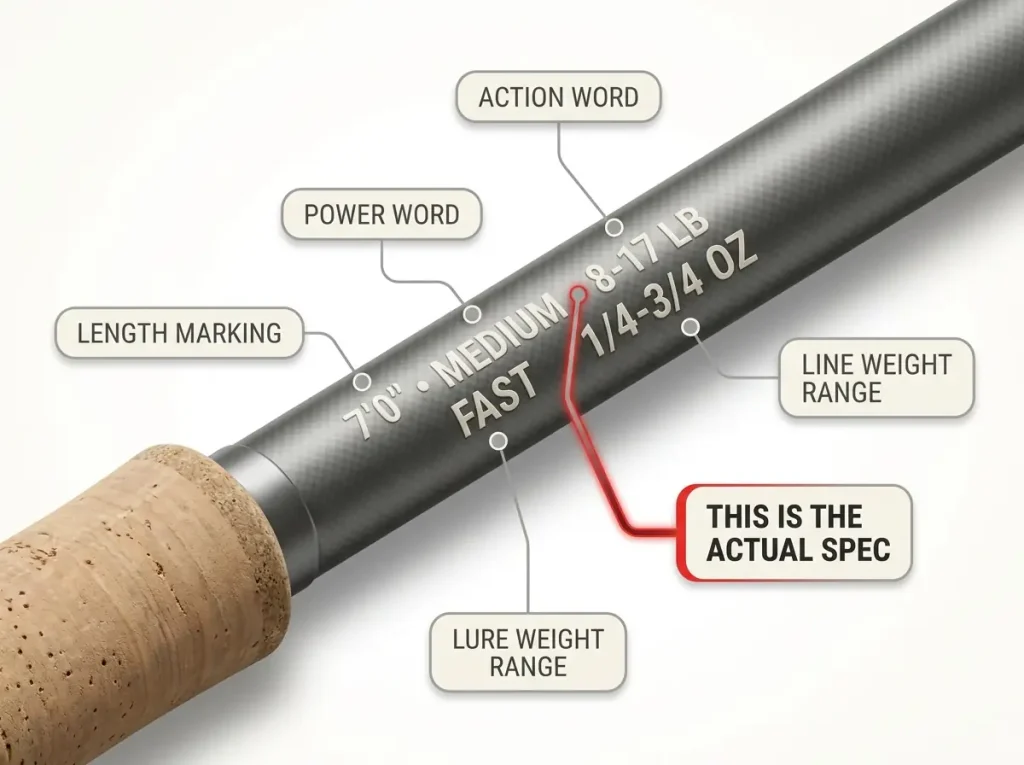
This is the highest-value twenty seconds in the entire buying process, and almost nobody spends it. The word “Medium” is marketing. The two number ranges printed next to it are the actual specification.
Line Rating and Lure Rating
Just above the handle, every blank prints a line weight rating (something like 8 to 17 lb) and a lure weight rating (something like 1/4 to 3/4 oz). Those two ranges are the real spec, and they tell you more in one glance than the power and action words combined. Everything else on that label is worth understanding too, and how to read everything printed on a rod label decodes the rest.
Why the Power Word Cannot Be Trusted Across Brands
Here is the part that catches experienced anglers off guard: there is no universal industry standard for power and action labels. Manufacturers each use their own descriptive scales, and those scales do not line up one to one. A Medium from one brand can flex noticeably differently than a Medium from another, even at identical lengths.
That is not a conspiracy, it is just an industry that never agreed on a benchmark. The practical consequence is simple. Compare the printed numbers between two rods, never the words, and treat “Medium Fast” as a hint rather than a measurement.
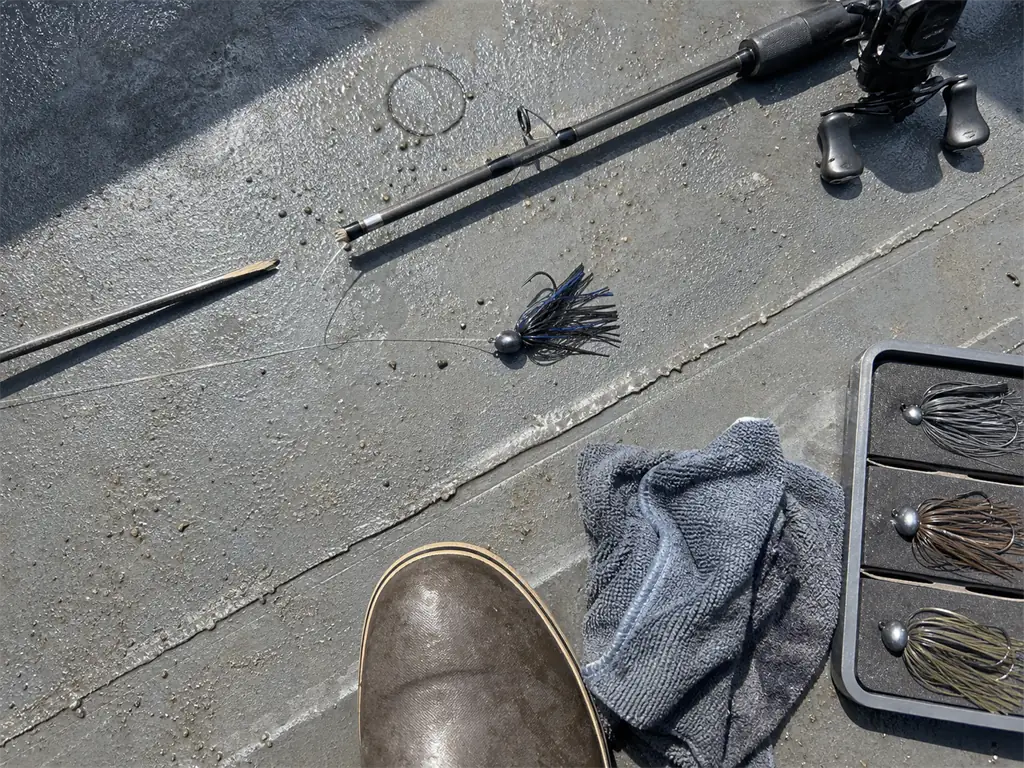
Ignoring those numbers has a specific failure mode that most guides skip entirely. Casting a lure heavier than the rated maximum can snap the blank, and it usually happens on the cast rather than during the fight. The rod loads on the backswing and again on the forward stroke with more mass than it was engineered to accelerate, and the tip is where it gives. That is why so many “my rod just broke” stories end with no fish in the story at all.
Line mismatch cuts both ways, which is why anglers still ask forums to untangle it. Line lighter than the rated range snaps before the blank has absorbed anything. Line heavier than the rating shifts the entire load onto the blank instead of onto the line and the drag, so the rod becomes the weakest link by default.
Line type matters alongside the number. Monofilament line stretches, which quietly forgives a stiff rod and a hard hookset, while braided line has almost no stretch and sends every bit of that force straight into the blank and the guides. A rod rated to 17 pounds with braid on it is under a very different kind of load than the same rod with mono.
Photograph the spec band on your rod with your phone the day you buy it. Six months later, when you are standing in an aisle wondering whether that half-ounce spinnerbait is too heavy, the answer is already in your camera roll instead of on a rod sitting in your garage.
Matching the Reel to the Rod
The reel completes the system, and matching rod and reel is the step most buyers skip entirely. The reel’s size class and line capacity have to land inside the same window the rod prints, otherwise you have spent money on two components that fight each other. A spinning reel belongs under a spinning rod and a low-profile reel belongs on top of a baitcasting rod, and swapping them is not an option no matter how the specs read.
Weight distribution matters too, and balancing the rod and reel together is what separates a setup that feels alive from one that feels like a stick.
Guides and Handles: The Quality Signals
Two rods can print identical length, power, and action and still cost triple the difference. The gap is almost always in the guides and the grip, which are the two parts you touch and the two parts manufacturers cut first.
Guide Inserts and Frames

Rod guides carry an insert ring and a frame, and both matter. Inserts range from basic aluminum oxide ceramic guides up through Alconite guides and SiC guides, short for silicon carbide guides, and the harder, smoother materials run cooler under braid and shed less line friction on long casts. Premium builds often specify Fuji guides by name, which is a shorthand buyers have learned to read as a quality signal. Frames matter just as much: stainless versus titanium guides, single-foot versus double-foot, and how neatly the thread wraps are finished.
The Dobyns Fury casting rod above is a clean example of where that money goes. Nothing about its length, power, or action reads differently on paper than a combo-kit rod. The difference lives entirely in the hardware. If you want the full comparison, how SiC, Alconite, and titanium guides really compare breaks down what each material actually does.
Guide Count and Spacing
Guide spacing determines how evenly the blank loads under pressure. Too few guides and the line pulls the blank into flat spots instead of a smooth curve, which costs casting distance and puts uneven stress on the rod. Count the guides on two rods of the same length and the cheaper one usually has fewer.
Cork, EVA, and Where Your Hand Actually Goes
A cork handle is lighter, warmer in cold weather, and transmits vibration well. An EVA foam handle is tougher, cheaper, and shrugs off water and grime without a thought. A carbon fiber handle shows up on higher-end blanks and buys sensitivity at the cost of cold-hand comfort. Neither cork nor foam is objectively better and both outlast the blank if treated decently, so cork versus EVA foam handles comes down to preference and climate.
Grip layout is not styling either. A split grip handle drops the middle section to save weight, a full grip gives you more to brace against on a long fight, and casting rods add a trigger stick handle or a stubby pistol grip handle under the reel seat for thumb control. Where that seat sits against your forearm changes how a rod feels after four hours, and that is a thing you only notice on a long day.
The Mistakes That Actually Waste Money
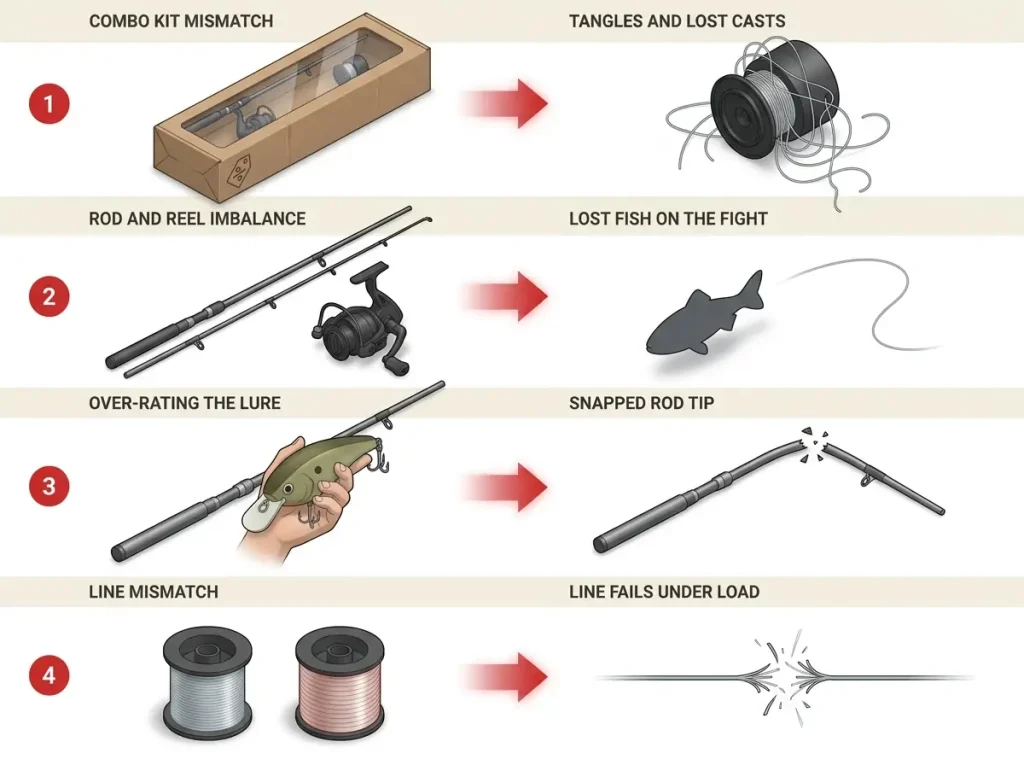
None of these mistakes involve buying a cheap rod. Every one of them involves buying the wrong rod, which is a different and more expensive problem.
The Combo Kit Trap
A rod combo in one box at one price is genuinely convenient, and that convenience is what does the damage. Almost every rod-and-reel combo on the rack was assembled to a number, not to a technique. The rod and reel inside were paired by a marketing department to hit a price point, not matched to the technique you plan to fish. Plenty of kits put a fast-action rod with a reel spooled for something else entirely.
Combos are not the enemy. An unexamined combo is. Check that the reel’s line capacity lands inside the rod’s printed line rating before the box leaves the store, and the trap disappears.
Mismatched Rod, Reel, and Line
Pairing a premium rod with a throwaway reel wastes the exact thing you paid for. The sensitivity gets eaten by a reel that grinds under load, and the drag is what actually loses fish anyway. If your budget is fixed, splitting it evenly beats spending it all on the blank.
The other half of this mistake is line. Going too light snaps before the rod absorbs anything, and going too heavy dumps every pound of stress onto the blank. Overshooting the printed lure rating belongs in the same family, and it is also one of the classic ways to end up outside your coverage, which is worth knowing before you find out the hard way what actually voids a rod warranty.
Blaming the Rod for a Technique Problem
Horsing a fish, meaning reeling and pulling far too hard and too fast, snaps line and pulls hooks free instead of tiring the fish out. Anglers then blame the rod, replace it, and repeat the same fight with better equipment and the same result.
That one is technique, not gear, and it has cost people rods they never needed to replace. If a rod feels like it is failing you, work out whether the rod is actually the variable before you spend money on the next one.
Before you replace a rod you are unhappy with, fish one trip with someone else’s setup in the same conditions. Half the time the rod was fine and the line, the knot, or the hookset timing was the real problem. That single borrowed trip has saved more anglers a purchase than any spec chart ever has.
What Actually Changes at Each Price Tier
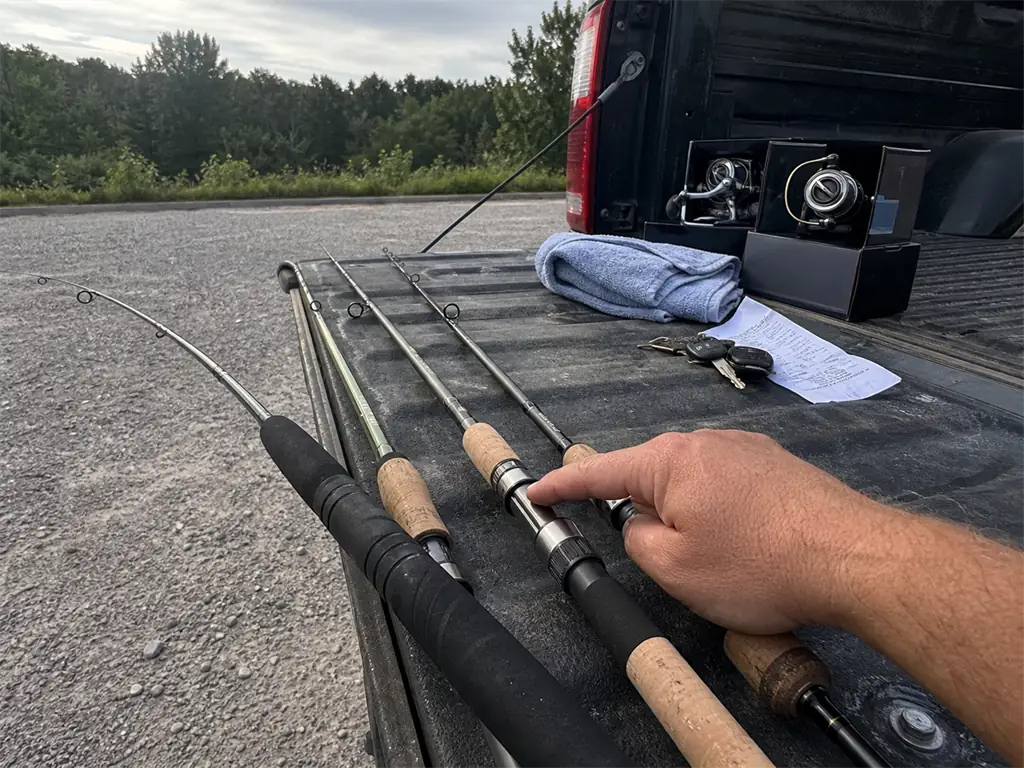
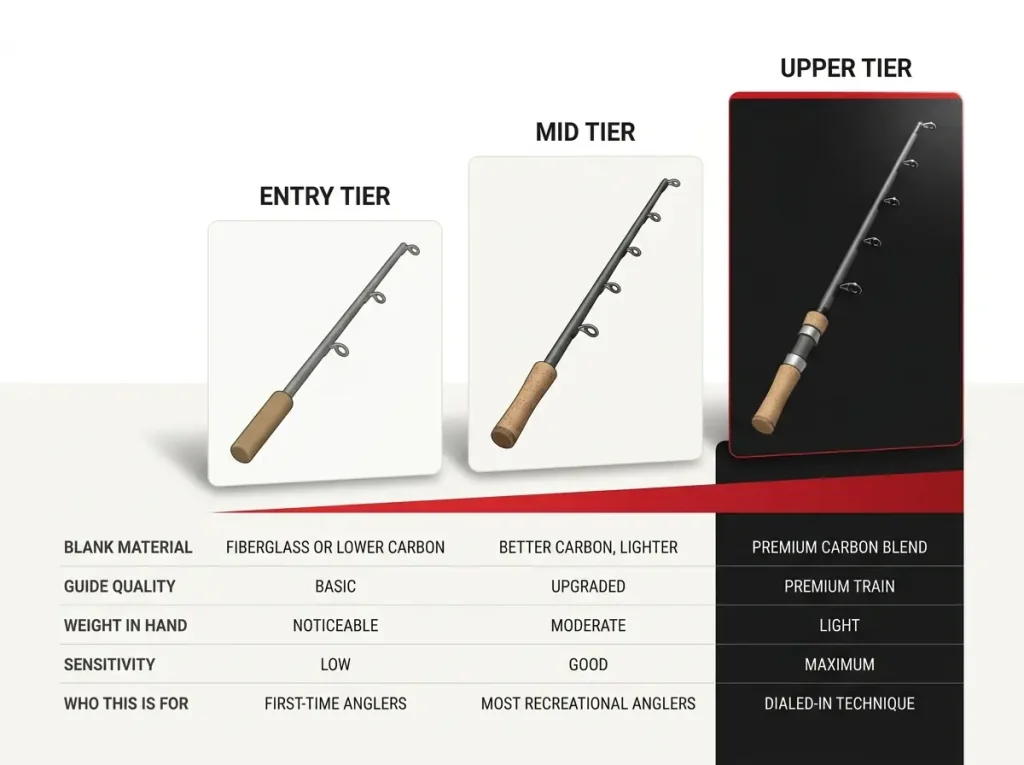
“You get what you pay for” is the laziest sentence in gear writing. Here is what actually improves as the number climbs, and where it stops mattering for how most people fish.
The Entry Tier: Enough Rod to Catch Fish
Roughly $20 to $50 buys an entry-level rod with a fiberglass or lower-grade carbon blank, basic guides, and noticeable weight in the hand. A budget rod at this tier is completely capable of catching fish, and a beginner rod here is where a first-timer should start without a shred of guilt. What you give up is sensitivity and comfort over long days, not capability. If you want the full picture of that trade, where budget fishing gear wins and where it fails covers it honestly.
The Mid Tier: Where Most Anglers Land
Roughly $50 to $150 buys better carbon, a lighter blank, noticeably more sensitivity, and upgraded guides and reel seats. This is where the average recreational angler lands and then stays for years, because the jump from entry to mid is the biggest single improvement in the whole range.
The Upper Tier: Refinement, Not Capability
Roughly $150 to $300 and above buys maximum sensitivity, technique-specific tapers, better strength-to-weight, and premium guide trains. Those are real improvements, but they are improvements you only feel once your technique can use them. Past the mid tier, added cost buys refinement rather than capability, and a mid-tier rod fished well outfishes an upper-tier rod fished badly every single time.
Before spending anything, check whether a local library, state wildlife agency, hatchery, or national wildlife refuge runs a tackle loaner program. The Fish and Wildlife Service’s Learn to Fish program is a good starting point for finding one, and borrowing a setup for a weekend is the cheapest way to find out whether fishing sticks.
The 60-Second Check Before You Pay
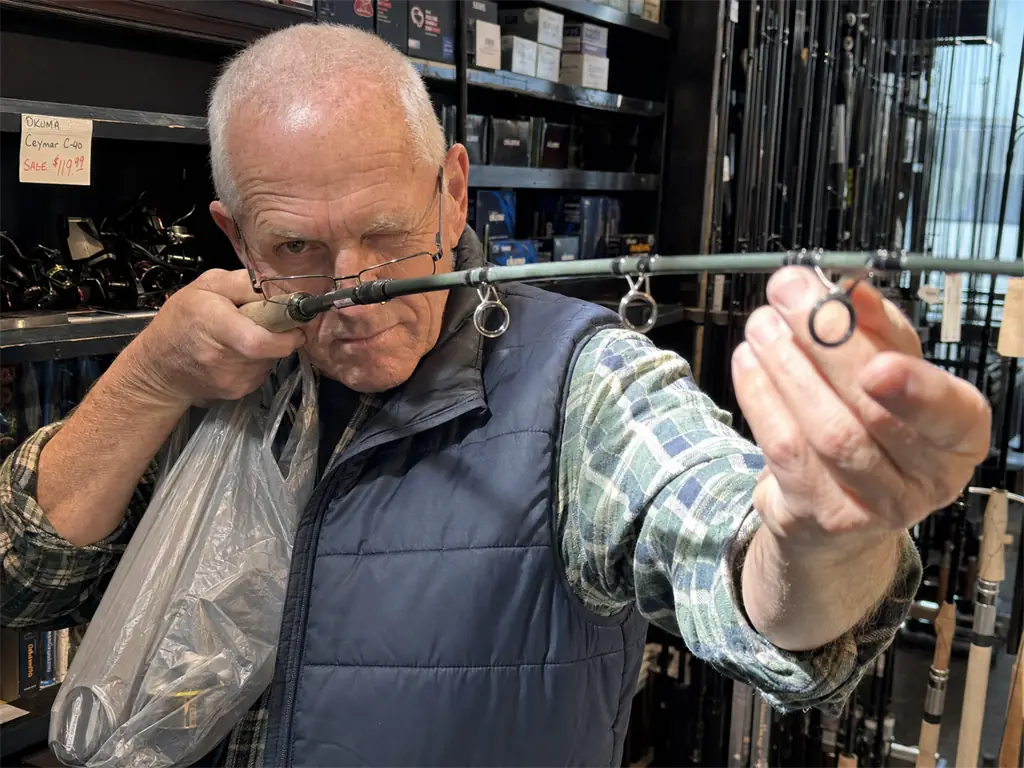
This is the part nobody writes about, and it is the reason experienced anglers look faintly odd in tackle shops. All four checks take under a minute, and each one catches a real problem.
Flex It, Sight It, Feel It
Start with the flex test. Bend the rod gently and evenly from the tip toward the butt and feel where it loads, which also confirms the blank has not taken a set from months hanging on a rack. Flex it straight, though. An off-plane flex manufactures a false curve, and then you end up rejecting a perfectly good rod because of your own grip.
Next, sight down through the guides while the rod is under that slight, even flex. Aligned guide feet read as one clean line. Misaligned ones show up as a visible zigzag, and that misalignment costs you casting distance and wears line unevenly for as long as you own the rod.
Then run a finger slowly from butt to tip and back along the rod blank. You are feeling for bumps, ridges, or soft and rough patches, any of which signals a repair, a crack, or a manufacturing flaw. It takes ten seconds and it matters most on a display rod that fifty people have already handled. The same tactile skill applies to a rod you already own, which is why spotting a cracked rod blank before it breaks is worth reading once. If you want the next level of the flex check, finding a rod’s spine explains the mechanics underneath it.
Bring Your Own Reel
Carry your reel, or the exact model you intend to buy, into the store and mount it on every candidate rod. You are checking two things: whether the reel seat holds the reel foot securely without shimming, and where the balance point actually sits with real weight attached.
Yes, this means walking into a tackle shop with a reel in a plastic grocery bag and mounting it on three different rods before deciding. It looks strange for about four seconds, and then it is simply what you do. It also catches reel-seat fit problems that no amount of online spec reading will.
What to Do When You Are Buying Online
Buying online means giving up all four checks, so the warranty terms become your substitute. Read them before you order rather than after something breaks: what is covered, what voids it, whether there is a replacement-section program, and what the return window looks like once the rod has been fished.
Run the flex, sight, and finger checks the moment the box arrives, before the rod ever sees water. A manufacturing flaw found on day one is a return. The same flaw found in month three is an argument.
Putting It All Together
Answer the three questions first. Target species, rod type, budget. Do that and the wall of specs stops being intimidating, because you are no longer comparing every rod in the store against every other rod.
Read the two number ranges printed on the blank, every time. The power word is a hint that varies by brand. The line and lure ratings are the actual specification, and they are the difference between a rod that lasts a decade and one that snaps on a cast.
Run the 60-second check before you pay. Flex it, sight down the guides, run a finger along the blank, and mount your own reel on it.
Next time you are near a tackle shop, walk in with your three answers and hold two rods that fit them. Do not buy anything. Just feel the difference between them in your hands, because once you know what you are feeling for, the right rod usually picks itself.
Frequently Asked Questions
01What size fishing rod is best for beginners?
A 6’6″ to 7′ rod in medium power covers the widest range of everyday fishing and is the most common beginner recommendation. Go shorter for tight cover and kayaks, longer for open shorelines and casting distance.
02Should I get a 6’6″ or 7′ foot rod?
Choose 7 feet if you fish open water and want casting distance, and 6’6″ if you fish tight banks, small boats, or want more casting accuracy. The difference is real but small enough that where you stand matters more than the half foot.
03What is the 80/20 rule in fishing?
It is the idea that about 80 percent of the fish get caught by roughly 20 percent of the anglers, because most fish hold in a small fraction of any water. It is a lesson about reading water and time on it, not about spending more on a rod.
04What does 3000 or 4000 mean on a fishing reel?
Those numbers are the reel size class, covering spool capacity and frame size, where bigger numbers hold more and heavier line. A 2500 or 3000 pairs with most medium power spinning rods, and a 4000 steps up for heavier line and bigger fish.
05What happens if you use a lure heavier than your rod’s rating?
You risk snapping the blank, and it usually happens on the cast rather than while fighting a fish. The rod loads with more mass than it was built to accelerate, and the tip is where it gives. The printed maximum is a limit, not a suggestion.
Risk Disclaimer: Fishing, boating, and all related outdoor activities involve inherent risks that
can lead to injury. The information provided on Master Fishing Mag is for educational and informational purposes
only. While we strive for accuracy, the information, techniques, and advice on gear and safety are not a substitute
for your own best judgment, local knowledge, and adherence to official regulations. Fishing regulations, including
seasons, size limits, and species restrictions, change frequently and vary by location. Always consult the latest
official regulations from your local fish and wildlife agency before heading out. Proper handling of hooks, knives,
and other sharp equipment is essential for safety. Furthermore, be aware of local fish consumption advisories. By
using this website, you agree that you are solely responsible for your own safety and for complying with all
applicable laws. Any reliance you place on our content is strictly at your own risk. Master Fishing Mag and its
authors will not be held liable for any injury, damage, or loss sustained in connection with the use of the
information herein.
Affiliate Disclosure: We are a participant in the Amazon Services LLC Associates Program, an
affiliate advertising program designed to provide a means for us to earn advertising fees by advertising and linking
to Amazon.com. As an Amazon Associate, we earn from qualifying purchases. We also participate in other affiliate
programs and may receive a commission on products purchased through our links, at no extra cost to you. Additional
terms are found in the terms of service.